Comparison of PSA Software vs Project Management Software
- What is PSA Software?
- What is Project Management Software?
- What Are the Key Differences Between PSA Software vs. Project Management Software?
- How Are PSA Software and Project Management Software Similar?
- Key Features of PSA Software and Project Management Software
- How to Choose Between the Right PSA vs. Project Management Software?
- Use Cases of PSA and Project Management Software
- Enhance Your Workflows With a Perfect Balance of PSA and Project Management
- FAQs about PSA Software Vs. Project Management Software
Key Highlights:
- PSA software vs. project management software differs mainly in operational scope, where PSA connects directly to profitability and billing.
- PSA software manages the full project lifecycle, such as resource utilisation and invoicing, while project management tools are never built to handle.
- Choose the right tool that fits your business model based on financial reporting, billing, contract and workflow scope management.
Many service businesses hit a growth ceiling despite having proper teams and a full project pipeline. It is all about using a project management tool when the business actually needs professional services automation software. The misalignment quietly affects your profit margin every single month.
Service firms that are using PSA platforms increase 24% higher project margins and 28% higher EBITDA than firms that are depending on standard project tools. PSA software vs project management software is not a feature comparison. Instead, it is the difference between a tool that manages task execution and one that connects engagement to profitability in one centralised system.
Explore the key PSA software vs project management software covering resource management, billing integration, financial reporting and analytics as well as operational scope. Also, know exactly which tool fits your business model and where it belongs in your workflow.
What is PSA Software?
Professional Services Automation (PSA) software is designed to manage the complete operational lifecycle of service-based firms. It combines project tracking, resource management, time logging, billing and client management in one workspace to eliminate scattered tools.
Why Use PSA Software?
Most service firms lose revenue due to poor visibility into utilisation rate and billing gaps. PSA software, in comparison to project management software, gives a real-time view of billable hours and if the business is actually capturing the right value.
The growth ceiling of firms is set when their processes can’t scale with their headcount. PSA software removes it by automating the load that quietly eats into team productivity as well as profitability.
Key objectives:
- Resource utilisation optimisation: make sure the right people are assigned to the right projects.
- Accurate time and expense tracking: record every billable unit without depending on timesheets.
- Streamlined project billing: transform tracked time and milestones into client invoices.
- End-to-end project visibility: gives managers a single source of truth across all active projects.
What is Project Management Software?
Project management software is a digital tool designed to plan, execute and monitor tasks across organizations working toward a defined deliverable. It streamlines task ownership, deadlines, dependencies and progress tracking so that nothing is missed through the cracks.
Why Use Project Management Software?
Teams that are working without a structured solution tend to rely on email threads. Project management software, in comparison between PSA software, provides a shared operational space where accountability is built into the workflow in real time instead of guesswork.
Growing teams struggle with coordination gaps that reduce project delivery. A dedicated project management tool stakeholder clarity on planning and deliverables.
Key objectives:
- Task planning and scheduling: Breaks down complex projects into time-bound tasks with clear ownership.
- Deadline and milestone tracking: Keeps your entire team aligned on progress checkpoints.
- Team communication and collaboration: Creates a unified space where updates, file sharing, and feedback are stored together for easy access.
- Progress reporting and visibility: Gives managers a real-time view of the project’s status at any moment.
What Are the Key Differences Between PSA Software vs. Project Management Software?
Explore the key differences between a PSA and project management software that set these two essential tools apart based on business objectives:
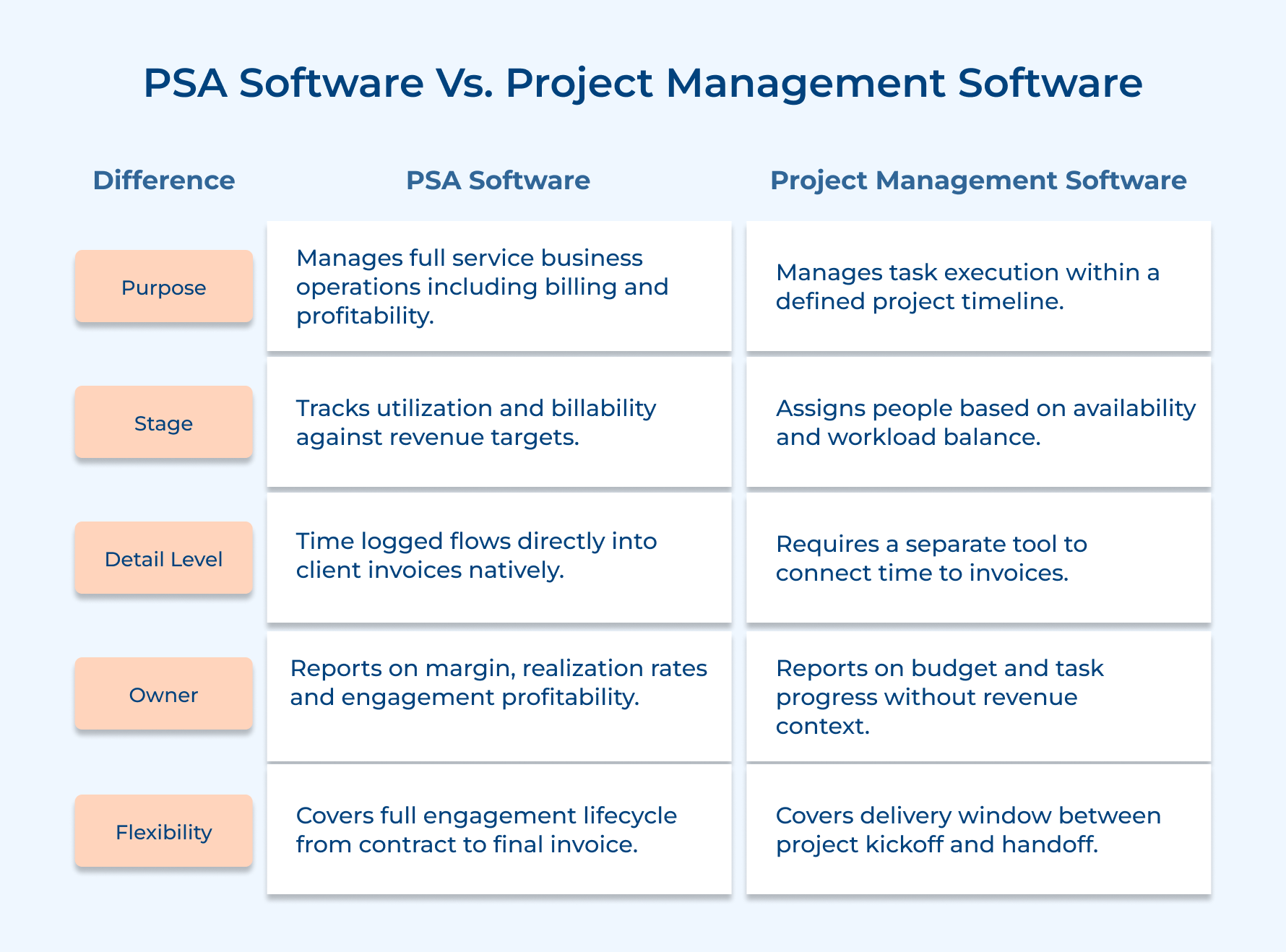
1. Core Purpose and Business Focus
PSA software is ideal for service-based firms that need to connect project delivery directly to revenue outcomes. It offers features such as resource planning and invoicing to protect margins and improve billable efficiency.
For example, a consulting firm uses a PSA solution instead of a PM software to instantly see if a project is over budget and has inaccurate billing before the client even notices.
Consider asking yourself before choosing:
- Do businesses need to track billable hours vs project profitability?
- What is the direct link between project delivery and invoicing within current workflows?
- Will your team benefit from tracking utilisation rates?
The key comparison of PSA vs. project management software is the structured task execution. A project management solution helps in delivering projects on time with the right resources. It is not responsible for connecting work to financial outcomes or client billing.
2. Resource Management Depth
PSA software manages resources at the financial as well as operational level by tracking utilisation rates and skill-based allocation across multiple client engagements.
So what does a PSA vs PM software include:
- Skill-based resource allocation across all client projects
- Defined utilisation rate benchmarks in comparison to revenue targets
- Forecast future capacity and resource data based on pipeline data
Project management software handles resource allocation only at the task level to match people based on availability. It keeps teams from overallocation and stops short of measuring if that assignment is financially valid or not.
Key Takeaways:
- PSA resource management connects people allocation to profitability and utilization benchmarks.
- PM resource management focuses on workload availability without a financial context.
3. Time Tracking and Billing Integration
Time tracking in PSA, in comparison to project management software, is not a standalone feature; instead, it is the financial backbone for both team and clients. Every tracked hour is directly entered into invoicing for project costing and profitability reporting without any manual handoff.
So what does this mean in practice:
- Times are automatically mapped to the correct client contract and billing rate
- Fixed-fee and materials billing are handled within the same workflow
- Approved timesheets trigger an invoice without the need for manual data transfer
A project management solution typically needs a time tracking solution to measure effort and progress, instead of generating revenue. It is useful for planning future projects and rarely connects to an invoicing workflow.
4. Project Financials and Profitability Tracking
PSA software helps in tracking project health in financial terms, such as budget consumption, cost-to-complete and revenue recognition. It provides a real-time view of the project progress to deliver.
The differences of PSA vs. project management software is its finance management approaches from a cost and budget perspective. It helps teams to understand the status of a resource, whether it is underallocated or overallocated, leading to an understanding of the overall profitability for the business.
So, which one to choose between PSA vs. project management software?
- PSA financial tracking operates at the engagement level to access profit margin, revenue and cost across delivery.
- PM financial tracking is typically limited to budget vs. actual spend with no connection to revenue or any client billing.
5. Client and Contract Management
Businesses using PSA software think of client relationships as an operational entity. It stores contract terms, billing rates, engagement history and renewal timelines in one place where the work is executed.
A strong PSA contract management system includes:
- Different billing rates for multiple consultants with the same client account
- Automatic alerts notification when the project is approaching the contracted budget ceiling
The key difference between Project management software (PM) vs. professional service automation (PSA) is that it treats the client as an external stakeholder who receives reviews and deliverables. There is no such native mechanism to govern how work connects on a commercially agreed-upon basis.
Key Takeaways:
- PSA contract management includes connecting commercial terms into the delivery workflow to stay accurate across the engagement.
- PM client management handles communication and visibility, but does not govern the financial relations.
6. Reporting and Business Intelligence
PSA software generates reports that include utilization rates, realization rates, revenue per consultant and margin based on service line. They are the operational signals that define a business’s health and profit margin.
These metrics are present in both PSA and project management software to measure billable time logged, actually invoiced as well as collected.
Below are the reports PSA software delivers that project management tools:
- Profitability at the consultant level across all active as well as closed engagements
- Pipeline-to-capacity forecasting based on upcoming project starts
- Service line margin comparison across multiple client segments
Project management software creates reports based on delivery performance such as task completion rates, milestone adherence and workload distribution. They are generally useful for project leads for managing day-to-day execution.
7. Workflow Scope and Operational Coverage
PSA software is used to fulfil the operational arc of a services business from the moment a deal is won in CRM up to the final invoice. It is more like an operational backbone that connects all components such as sales, delivery, finance and HR data in one centralised place.
So what’s the operational handoffs PSA is built to manage:
- Converts sales opportunities into a scoped project with predefined billing rates
- Resource planning starts before the project kicks off, based on probability
- Project closure triggers final invoicing back into profitability benchmarking
Project management software, in comparison to PSA software, is a purpose-built solution for the delivery phase. It excels between kickoff meeting and final deliverable handoff.
Why this differentiation matters for growing businesses: As a services firm scales, the handoff points between sales, delivery, and finance become the biggest source of operations. PM tools are never designed to manage these handoffs efficiently.
Key Takeaways:
- PSA covers the entire client engagement lifecycle, such as pre-sales resourcing and post-delivery financial close.
- PM is more optimised for execution windows which are highly effective within each phase.
How Are PSA Software and Project Management Software Similar?
PSA and project management software share more common points than most buyers realize in spite of serving different operational needs. It helps avoid duplication and makes smarter tooling decisions.
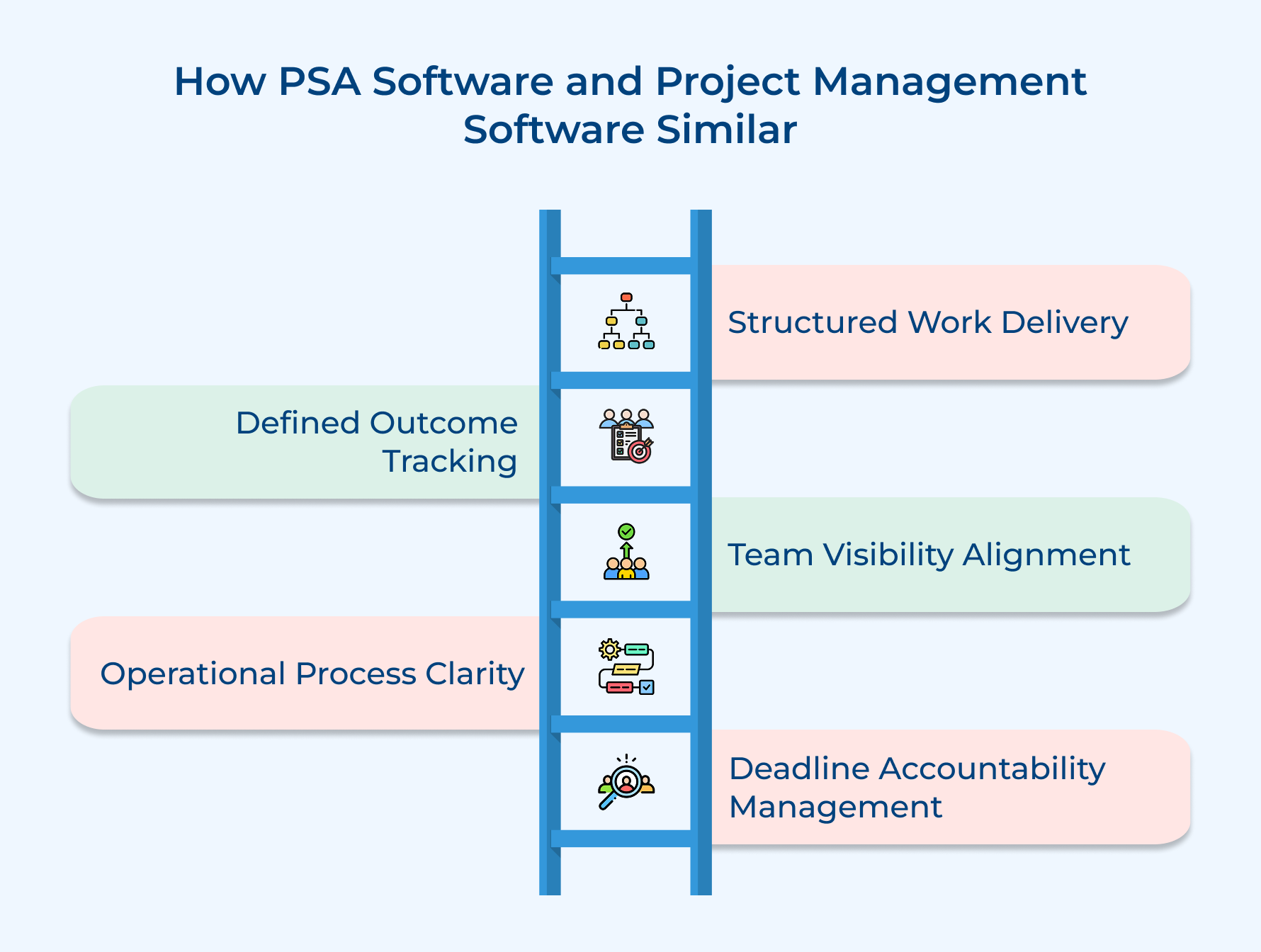
1. Built Around Structured Work Delivery
Both Professional Service Automation (PSA) and project management (PM) software platforms combine to simplify complex deliverables that involve multiple people, deadlines and shifting priorities. It drives both tools is the same work that costs businesses time as well as money.
2. Serve Teams That Deliver Work to a Defined Outcome
Tasks such as consulting engagements or product launches, both tools are designed for managing teams that are accountable within a defined timeframe. The pressure of delivery deadlines and stakeholder expectations is easily handled by both platforms.
3. Combines to Address the Problem of Visibility in Growing Teams
As teams scale, managing tasks becomes harder without a dedicated system. Both PSA and PM software combine to solve the visibility problem. It gives team members a shared understanding of what is happening across the business.
4. Reflect the Operational Maturity of the Business Using Them
A business that uses any of the tools well is similar to a business that has done the harder work of defining its processes. The combination of software does not just create operational clarity but also identifies and scales the clarity that exists within the organization.
Key Features of PSA Software and Project Management Software
Follow these key features of both PSA vs PM that are genuinely separating one from the other in a real operational context.
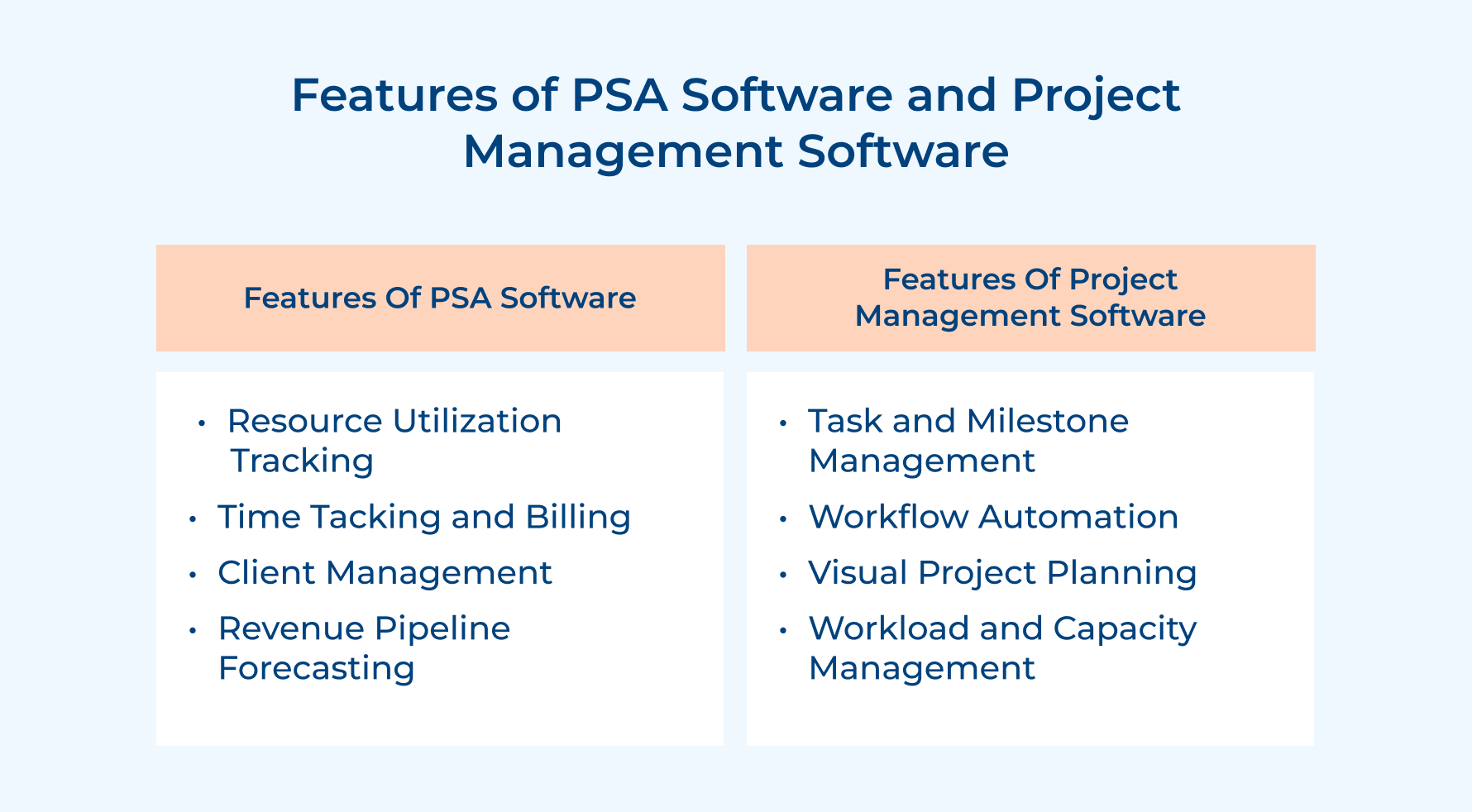
Features of PSA Software
1. Resource Utilization Tracking
PSA software tracks available resources deployed on billable work to flag underutilization before it turns into a revenue problem and not after the project delivery.
2. Time Tacking and Billing
Time entries are mapped to client contracts with billing rates to eliminate manual handoff between timesheets and invoices. Fixed-fee and time-and-materials are handled within the same workflow without any external tools.
3. Client Management
PSA software, in comparison to project management software, keeps billing rates, scope limits and history tied directly to the active project from contract initiation to renewal. Nothing falls through the gap between commercially agreed terms and what is actually delivered.
4. Revenue Pipeline Forecasting
Track project’s future revenue based on active contracts, project stages and resource deployment plans. It gives finance and leadership a reliable revenue outlook that is grounded in delivery data.
Features of Project Management Software
1. Task and Milestone Management
PM software breaks structured tasks with defined deadlines and dependencies into broader project milestones. It provides teams with a clear view of what needs to happen and within what sequence.
2. Workflow Automation
Most PSA and PM software offer recurring task assignments, along with status changes, with proper approval flows management based on predefined triggers. It reduces the administrative workload that builds up when teams handle repetitive processes.
3. Visual Project Planning
Graphic representations such as Gantt charts, Kanban boards and timeline views help teams map work sequencing while also catching scheduling conflicts early. It makes delivery bottlenecks visible before they turn into missed deadlines.
4. Workload and Capacity Management
Managers get a real-time view of workload distribution across the team to make sure accurate task loading. It helps in separating genuine resource shortages from poor task distribution.
How to Choose Between the Right PSA vs. Project Management Software?
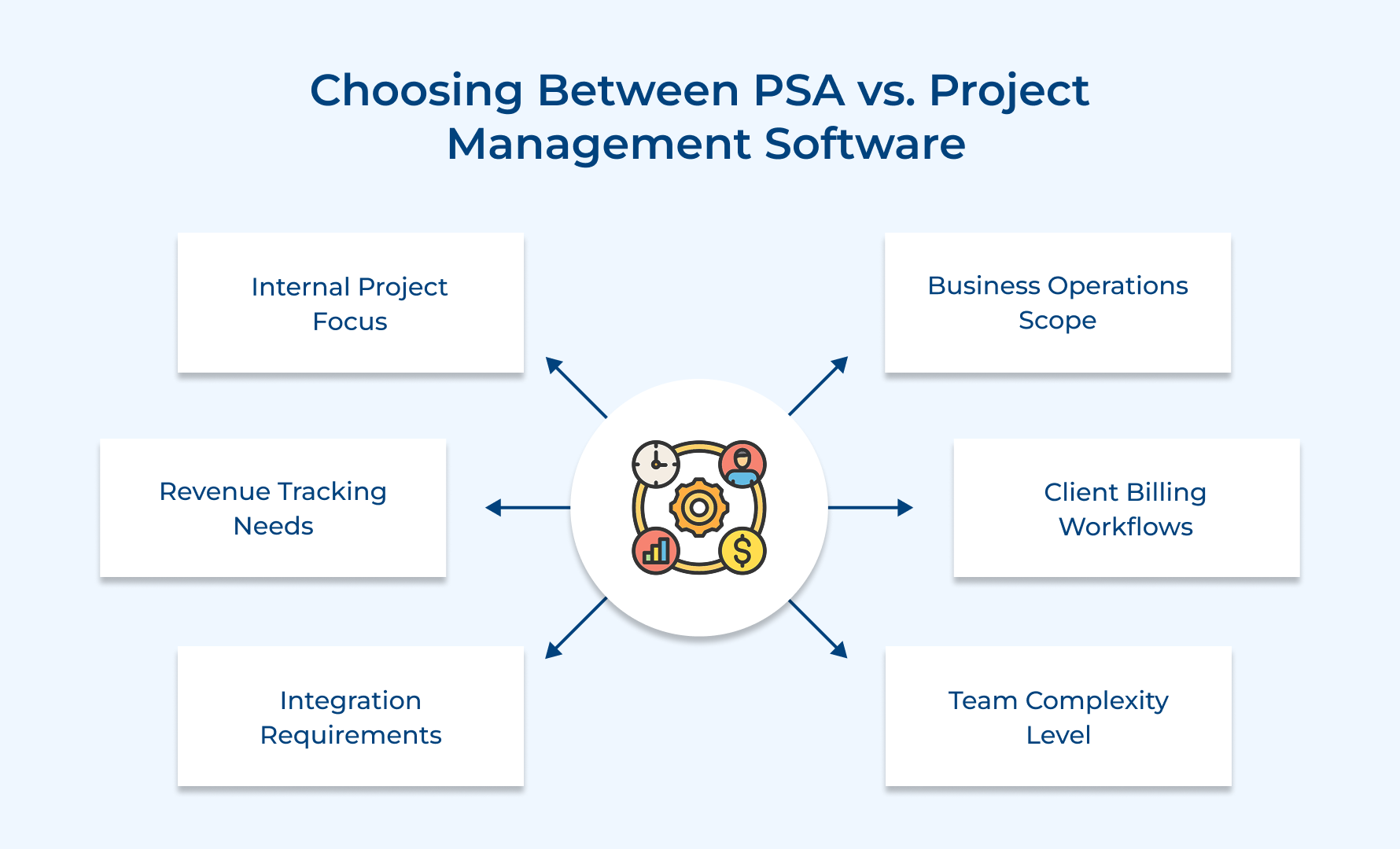
The choice between PSA and project management software is not a feature comparison exercise; instead, it is a strategic business decision of operational pain.
1. Assess the Scope of Your Business Operations
Businesses that are managing client engagements with billing and resource planning need more than project management tools. The scope of operations defines which platform will hold up under workload pressure.
- PSA is ideal when a business depends on billable client engagements that need project execution, invoicing and revenue tracking.
- PM software is ideal when the primary need is to manage internal projects with defined timelines without financial workflows.
2. Evaluate the Size and Complexity of Your Team
- PSA is ideal when an organisation manages multiple client projects and needs real-time visibility in delivery as well as finances.
- PM software is ideal when the team needs to manage simple tasks and workload management without enterprise-level complexity.
3. Consider Your Integration Requirements
- PSA is ideal when the business needs deep integration functionality, such as with CRM, billing and resource planning, to reduce manual data handoffs.
- PM software is ideal when the team needs simple integrations for task management without financial or client data systems.
4. Match the Tool to Your Primary Business Model
- PSA is ideal when revenue is directly bound with billable hours and profitability needs to be measured at the engagement level.
- PM software is ideal when the focus is on delivering internal projects in a fixed budget without billing complexity.
Use Cases of PSA and Project Management Software
Both PSA vs. project management software solve real operational problems across different industries to make more grounded software decisions.
Use Cases of PSA Software
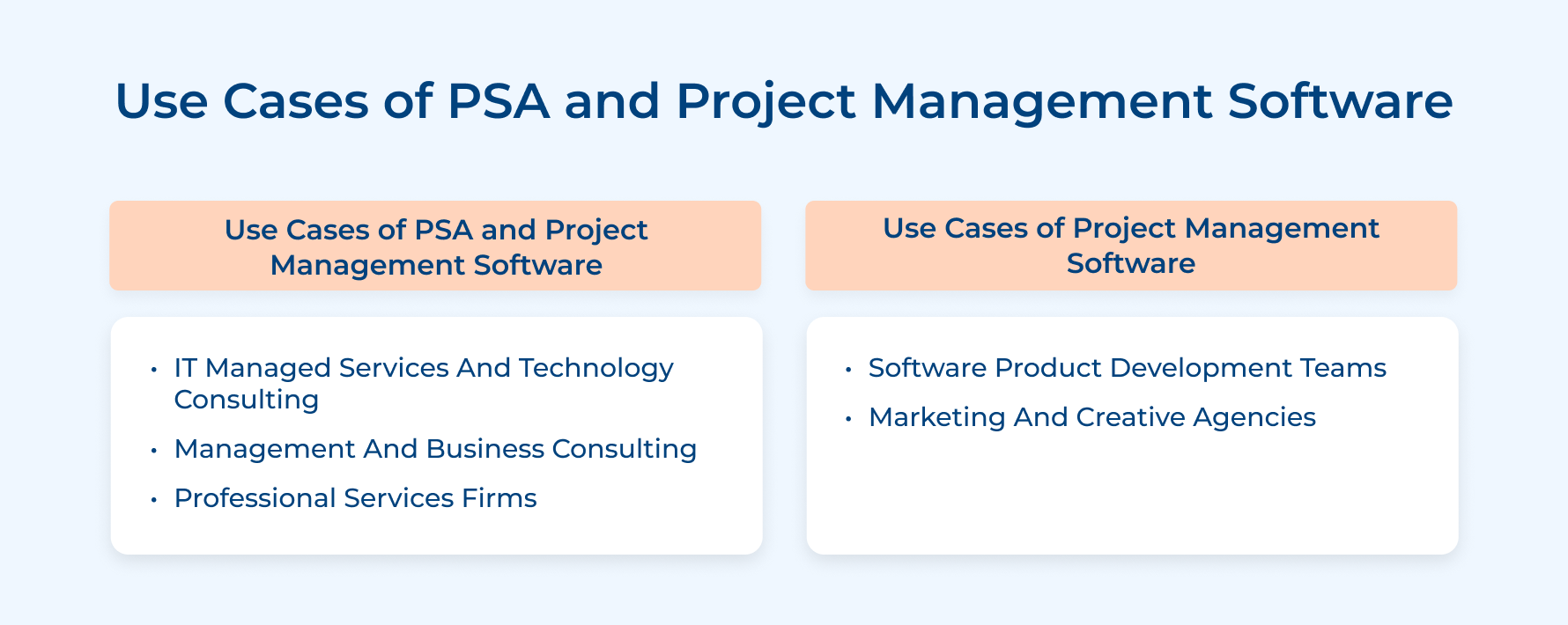
1. IT Managed Services and Technology Consulting
IT service firms tracking billable hours across client accounts need more than basic project tools and using PSA software to prevent revenue leakage when delivery operations are evaluated in disconnected systems.
2. Management and Business Consulting
Consulting firms need utilisation rates and margin per engagement that standard project tools were never built to track. PSA provides real-time visibility into billable and engagement profitability.
3. Professional Services Firms
Law firms operate on billable hour models where time capture accuracy directly determines revenue. PSA makes sure every hour ties to the correct client matter and billing rate.
Use Cases of Project Management Software
1. Software Product Development Teams
Development teams handling release cycles need a tool built around delivery instead of client billing. PM software offers the task structure and dependency mapping that teams need to drive consistently.
2. Marketing and Creative Agencies
Creative teams moving back and forth, overlapping campaign deadlines that need structured workflows to keep approvals as well as asset delivery on track. PM software helps in preventing coordination from breaking down mid-campaign.
Enhance Your Workflows With a Perfect Balance of PSA and Project Management
PSA software vs project management software is a question of which one matches the operational reality of how business actually delivers value. Using both tools to do the job of both is where most service firms lose efficiency and financial visibility at scale.
- PSA software combines resource management, billable time tracking and invoicing into one system, protecting profitability.
- Project management software excels at task execution and collaboration but stops short of connecting work to financial outcomes.
- Growing service firms that align the right tool consistently outperform those with financial workflows.
Book a demo today to see how professional services automation software vs project management software performs in a specific service environment. The smartest service organisations do not choose between software. Instead, they match each tool to its operational purpose, which aligns with delivery performance and profitability.
Limit time — not creativity
Everything you need for customer support, marketing & sales.

Neeti Singh is a passionate content writer at Kooper, where he transforms complex concepts into clear, engaging and actionable content. With a keen eye for detail and a love for technology, Tushar Joshi crafts blog posts, guides and articles that help readers navigate the fast-evolving world of software solutions.