What Is a Project Charter & How to Create One Effectively.
- What Is a Project Charter in Project Management?
- Essential Elements and Components of a Project Charter
- Key Benefits of a Project Charter in Agile Project Management
- What’s the Difference Between a Project Charter Vs Project Plan?
- How to Create a Project Charter in 7 Effective Steps?
- Examples of a Project Management Charter
- Tips and Best Practices to Develop a Project Charter in Project Management
- Bring Clarity in Project Management with a Project Charter.
- Frequently Asked Questions about Project Charter
Key Highlights:
- A project charter is a formal document that authorizes a project and its objectives to give the project manager authority to allocate resources.
- A project charter works best by establishing scope boundaries, roles and success criteria before project planning or initiation starts.
- An unsigned project charter leads to risk, scope creep, misaligned stakeholders and unclear accountability across each phase.
Most projects don’t just fail during execution, but also because no one agreed on the foundations before starting. According to the latest PMI’s Pulse of the Profession, businesses lose around $97 million for every $1 billion due to poor project performance and misalignment with the charter template.
A project charter is a document that authorizes a project, defines its objectives and gives the authority to streamline resource allocation. It is considered the most common and single most important document created before a project moves into the planning stage.
Explore what a project charter includes, how to write one and best practices that separate successful project delivery from costly mid-execution corrections.
What Is a Project Charter in Project Management?
A project charter is a formal document that authorizes a project and gives the manager the right to allocate resources as well as lead the work. Think of it as an agreement between the project team and the organization, as it defines the project’s existence as well as expected deliverables.
So what is the purpose of a project charter? It goes beyond documentation to set the boundaries of scope, key stakeholders and a shared understanding of success. It is the fastest way to invite miscommunication and scope creep into your project.
Small internal initiative or a large-scale delivery, a good project charter template gives legitimacy and a clear direction of deliverables.
Who uses a project management charter?
- A project manager is used to lead a team with defined authority and clear boundaries.
- The project sponsor signs off on it to authorize projects and commit resources.
- Stakeholders use it for understanding project objectives, risks and level of involvement.
- Project team members help to understand roles and the overall direction of work.
Essential Elements and Components of a Project Charter
The strongest charter always shares a core set of components that keep the project grounded and aligned from start.
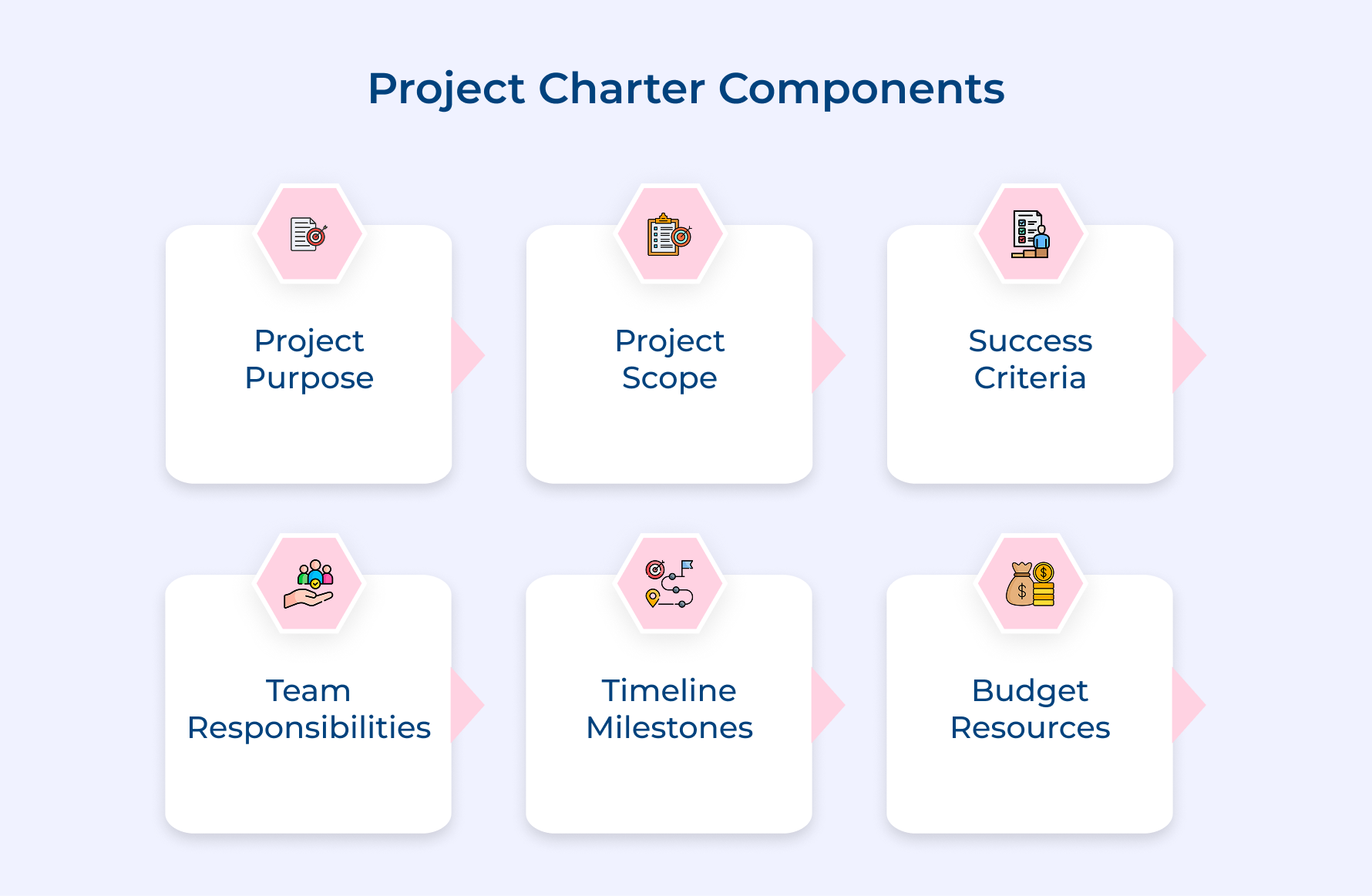
1. Project Purpose and Objectives
The project’s purpose is the most fundamental question of why this charter exists. A well-defined purpose helps the most talented teams to end up working accurately.
The objectives need to be specific and measurable so that, from the sponsor to the newest team member, everyone should understand what winning is all about.
2. Scope
The scope outlines. It defines what the project will deliver and not. So why is scope needed so much in a project charter? Every uncontrolled addition to the project chips away based on your timeline and budget.
Document the scope early to make the strongest defense against scope creep.
- List all scope deliverables
- Remove whatever components are out of scope
- Get sign-off from stakeholders
3. Success Criteria
Success criteria are all about how your stakeholders agree on a successful project delivered. It is not only about guesswork but also involves pre-agreed and measurable benchmarks for successful outcome.
4. Roles and Responsibilities
Every project charter must define the exact ownership. Project sponsors, stakeholders or individual team members all have a proper role in a project. Is there still a cause of conflict and missed accountability in projects? Ambiguity in assigning roles.
5. High-Level Timeline and Milestones
The meaning of timeline management in a project charter is about having a high-level view of key milestones as well as target dates. Think of it like the project’s heartbeat that has the rhythm of delivery without losing the task planning.
Why keep it high-level at each stage? Because detailed planning is not done here. Stakeholders need to see if the overall delivery window is realistic, based on the resources and scope defined.
6. Budget and Resources
The budget gives proper financial boundaries to make sure that resource planning starts from a standard baseline. A charter without an estimate looks similar to a roadmap without direction and is practically incomplete.
Budget planning in a charter template involves the following elements that will shape how the project is executed:
- Estimated total cost
- key resource requirements
- Any known financial constraints.
Key Benefits of a Project Charter in Agile Project Management
Projects without a charter template are the same as the ones that struggle with unclear goals and misaligned teams. Explore how a well-written charter actually helps.
1. Gives the Project Manager Formal Authority
A good project charter helps make real-time decisions and direct resources. Skip this documented authority and you will constantly find yourself negotiating for resources that were already committed.
2. Aligns Stakeholders From Day One
A charter forces all key stakeholders to align on the same page before project initiation starts. The simple alignment helps in preventing mid-project disagreements that delay timelines as well as increase budgets.
3. Defines Project Boundaries and Prevents Scope Creep
A good project charter is your strongest template for protecting scope against uncontrolled changes from clients. During a situation when a new request is received, it needs a formal change request before moving forward.
4. Creates a Clear Link Between Project Goals and Business Objectives
A structured charter does not just define the working of the project. It explains what is the reason behind the organization’s investment. This connection between objectives and business goals bridges the gap while keeping clients engaged throughout delivery.
What’s the Difference Between a Project Charter Vs Project Plan?
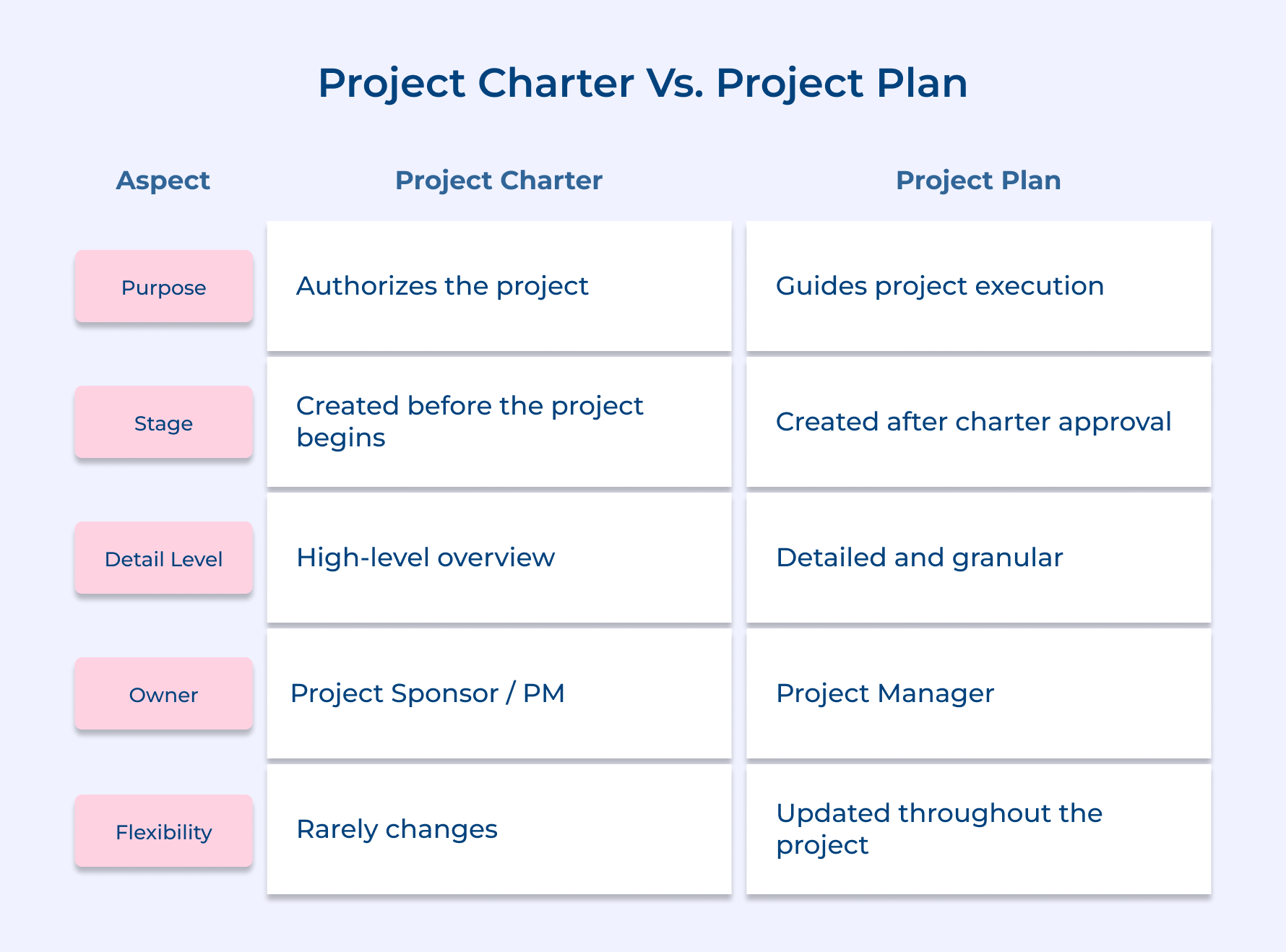
Project charter and project plan both documents sound similar, but serve different purposes at each stage of the project. It explains the ends and starts of each within the project cycle.
1. Purpose
A project charter formally authorizes the project and gives power to mobilize resources. It answers questions about the reason behind the building project and confirms the organization is committed.
A project plan, in comparison to a charter template, is designed to guide the team through actual execution. It answers by breaking down every deliverable into tasks and assigning responsibilities.
2. Stage of Creation
The charter is the first document created. It appears before initial planning starts. Consider it as a green light signal for starting the project and being ready to move forward.
The project plan appears just after the charter is approved, when the project is initiated. The team is assembled and detailed planning can realistically start by this stage.
3. Level of Detail
A charter stays at a high level to cover project scope, objectives and milestones without deep diving into task-level. The broader view is what stakeholders and sponsors need during the authorization stage for clear visualization.
A project plan, in comparison to a charter, goes several layers deeper in an agile project for covering work breakdown structures and detailed schedules. It is considered the living document for tracking daily activities across the entire project lifecycle.
4. Flexibility and Change
A project charter is a stable document that, once approved, does not change automatically unless there is a fundamental shift in project direction vs the business case. Stability is actually one of its strongest strengths with respect to a reference point.
A project plan is a dynamic document that scales as new information is found during execution. Regular updates do not mean signing off on poor planning. They are a sign of good project management.
How to Create a Project Charter in 7 Effective Steps?
Explore the seven effective steps to write a project charter in agile project management that paves the way for a successful journey.
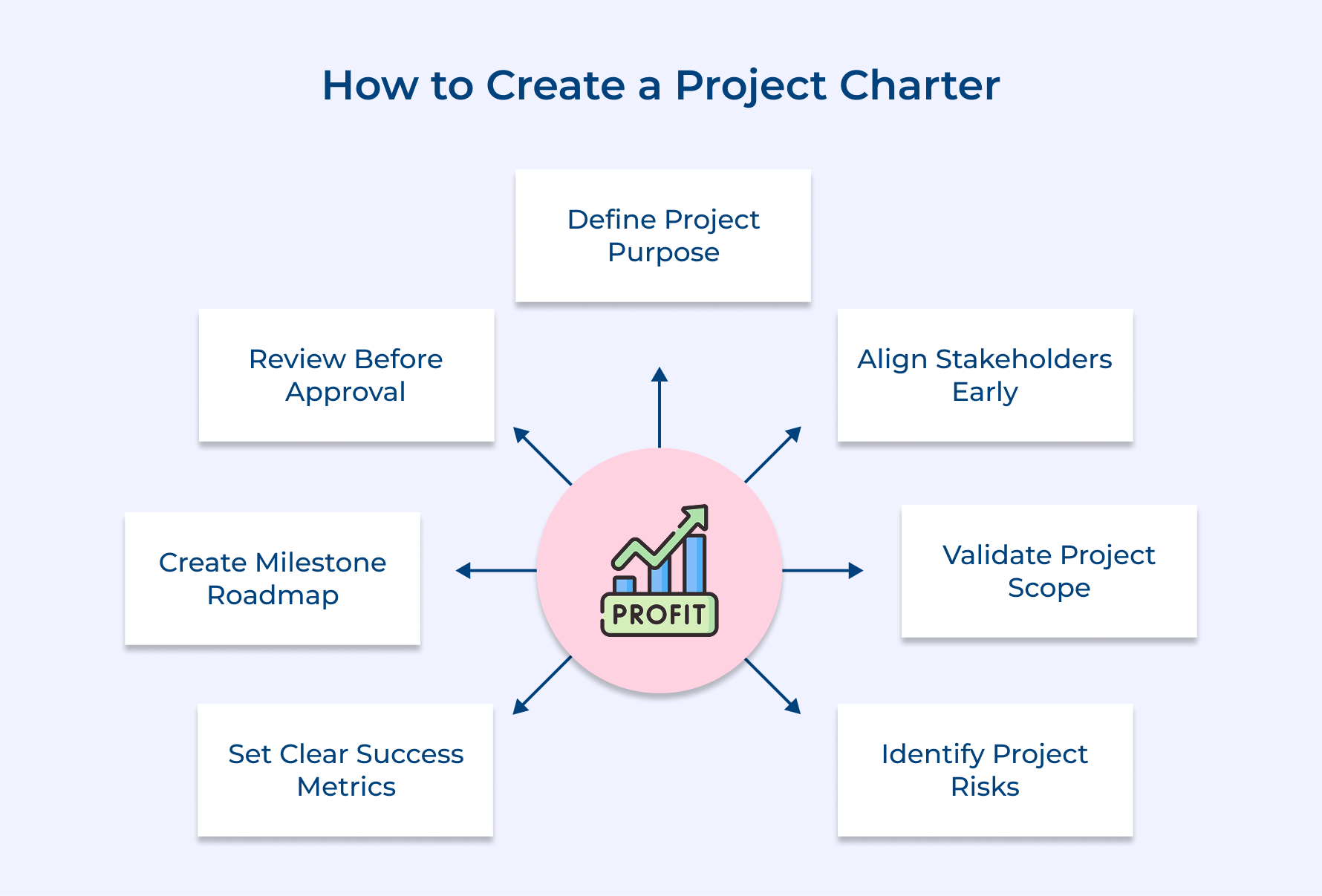
1. Start With the “Why” Before Anything Else
Every strong charter begins with a clearly validated business issue instead of just assumptions. Follow these effective ways to anchor your charter around the right purpose:
- Interview the sponsor directly: the most reliable foundation for a project charter is to capture intent in one’s own words. It surfaces priorities that no document or brief will ever capture.
- Document the problem this project solves: A charter without a stated problem is only a list of activities without a real anchor. The specific pain point gives every client a shared and unambiguous starting point.
- Validate urgency and organizational priority: Make sure the initiative has committed leadership before locking the project charter template. Resource commitments will not hold under pressure without a validated priority.
Consider an example of a situation when a retail company scales into a new market and discovers that its real problem was supply chain readiness. It redirected the entire project scope and prevented months of miseffort.
2. Pull the Right People Into the Room Early
A proper system built without the right contributors will always face blockage during the review process. The people excluded from the project charter become the loudest critics after the document is distributed.
Consider this checklist before finalizing who to involve in the documentation process:
- Who is authorized to approve key project decisions?
- Which person holds critical information to define the scope?
- Who will be genuinely impacted by project outcomes?
- Are there stakeholders whose input could be needed within the project boundaries?
The checklist makes sure what and who is included in the project charter to reflect a complete picture during formal review. So why does early involvement change the quality? The right people contribute and assumptions get challenged before they are locked-in commitments. Also, if you know that constraints and expectations can be identified at each stage.
Pro Tips:
- Instead of non-open-ended meetings, schedule focused charter sessions for contributors to arrive with actionable input.
- Document all input within the project charter in project management with the contributor’s name, so accountability is maintained from the beginning.
3. Pressure-Test Your Scope Before Locking It
A scope defined without stress-testing in a charter will face blockers mid-project execution. Every assumption about deliverables needs to be questioned before it is formally signed off.
Challenge Every Assumption About What Will Be Delivered
Every deliverable within the charter tools survives a round of direct questioning before project initiation. It is all about making a decision on if each item is a genuine requirement or a nice-to-have that entered the list.
Run Your Scope Past the Stakeholders Most Likely to Push Back
The most disruptive situation is when scope disagreements are discovered after the charter than those caught during drafting. Taking the draft scope to the most skeptical stakeholders turns pushback into valuable input.
Draw Hard Lines Around What Will Not Be Delivered
The out-of-scope section of a project charter document includes much more information than the in-scope section. Explicitly documenting leads to no deliverables for most projects, along with defense against scope boundary expansion.
4. Surface Risks While Stakes Are Still Low
Risk identification during charter does not affect, but ignoring it can affect everything. The earlier you can identify the risk faced in a charter, the cheaper and easier it will be to address.
So, when should risk brainstorming be used during project charter development? Just after the scope setup, the risks attached to it become visible. It is not just about predicting problems but also about eliminating element surprise before commitment.
Create an early risk brainstorming structure:
- Unify the core team for a focused risk identification session based on project charter scope.
- Record and prioritize each low-probability risk at this stage
- Flag risks that need deeper analysis at the time of formal planning phase
Rank risks based on impact to transform raw brainstorming into a guide for the team. A simple matrix placed at the right risk helps in getting attention early.
So, how to develop a project charter by identifying Risk? Document mitigation at a high level to let your team know about successful project planning. One mitigation sentence with a named owner is more than enough.
5. Set Success Criteria That Leave No Room for Debate
Undefined success criteria are causes of project disputes at the closure stage. Define what “done” looks like to separate a strong charter from a weak one.
So, how do specific success criteria look in a charter? Clear enough for two people reading it independently and comes up with a similar conclusion.
- What is included in a strong project charter?
- A measurable target that is an actual number instead of just a direction
- A clear deadline tied to no timeframe is a wish, not a criterion
- A named stakeholder with accountability and ownership for each metric
Set up a written agreement on the success criteria before execution to make sure every stakeholder has a different memory of what was agreed. Consider these questions before finalizing criteria:
- Will the criteria be measured without any interpretation?
- Does the key stakeholder agree that this metric reflects real success?
- Do you have clear ownership of the perfect outcome?
6. Build a Milestone Map and Not a Task List
The charter timeline is not a project schedule. It is unrealistic expectations at the authorization stage. So what stakeholders need to see is the flow of delivery and not the internal execution.
A milestone map shows what most matters to leadership, such as major delivery points, expected timelines and decision gates. Sync the milestones with the business decision to make the charter more meaningful.
What does a strong milestone in a project charter map include?
- Key milestones should directly link to business outcomes
- Go or no-go points where leadership review is needed
- A proper Buffer in timelines that account for realistic delays without overpromising
The most common mistake when building the charter timeline is copying task-level detail from the work breakdown structure. It keeps the milestone map high-level with a very undisciplined choice.
7. Run a Charter Review Before Seeking Sign-Off
Once you build a project charter, if you sign off without an internal review leads to the risk of the project failure that no project manager takes. Maintain a proper review to identify gaps and conflicts before it reaches clients.
The best way is a proper stress test with someone who was not involved in it. A fresh set of eyes immediately spots inconsistencies that the original author is too close to see.
Below are the things to resolve before final approval:
- Remove conflicts between the scope and objectives so that they tell the same story
- Rectify missing stakeholder perspectives to confirm every key voice represented
Secure the sponsor’s formal signature within the project charter document, not a formality. It is the moment that becomes an organizationally binding document and gives the authority to move forward with full confidence.
Examples of a Project Management Charter
A project charter looks different based on industry or objective, but its core elements always hold. The examples below show what a well-structured charter looks like.
1. Social Media Campaign Project Charter for a Marketing Agency
A digital marketing agency closed a deal with a D2C skincare brand with zero structured social media presence. Before initiating the work, the agency drafted a PMI project charter template with key elements and components to align both sides on a single success outcome.
Project Purpose:
Build a conversion-focused social media presence for Glow & Co. across priority platforms within the next five-months.
Project Objectives:
- Build an engaging follower base across Instagram and TikTok
- Achieve a defined engagement rate within the next three months
- Produce and publish 60 pieces of original content across the campaign
Scope:
- Profile optimization for both Instagram and TikTok
- Weekly content creation, including static posts and short-form video
- Frequent performance reporting with actionable recommendations
Budget: $35,000 | Timeline: February 1 – June 30, 2025
Known Risks:
- Delayed client content approvals are impacting the schedule
- Mid-campaign algorithm reduces organic reach
2. Product Launch Event Project Charter for a Marketing Agency
A full-service agency briefed to plan the physical launch of a B2B SaaS platform for mid-market finance teams. The client had a tight budget, so getting the charter right was non-negotiable.
Project Title: FinTrack Pro — Market Launch Event
Project Purpose:
Initiate a high-credibility launch event that positions the product as the go-to solution for finance operations post-event demo requests.
Project Objectives:
- Deliver a polished event for qualified B2B attendees
- Secure live coverage from at most finance and SaaS-based media channels
Scope:
- Seamless coordination with client executives and external industry personnel
- Event branding, signage, along with all printed and digital collateral
Budget: $75,000 | Timeline: Kickoff April 1 – Event May 28, 2025
Success Metrics:
- A minimum number of pieces of earned media coverage within the first week of the post-event
- Capture more than 40 demo sign-ups from the first day
Tips and Best Practices to Develop a Project Charter in Project Management
Follow the six best practices that separate normal charters from an agile project charter that drive project management success and client satisfaction.
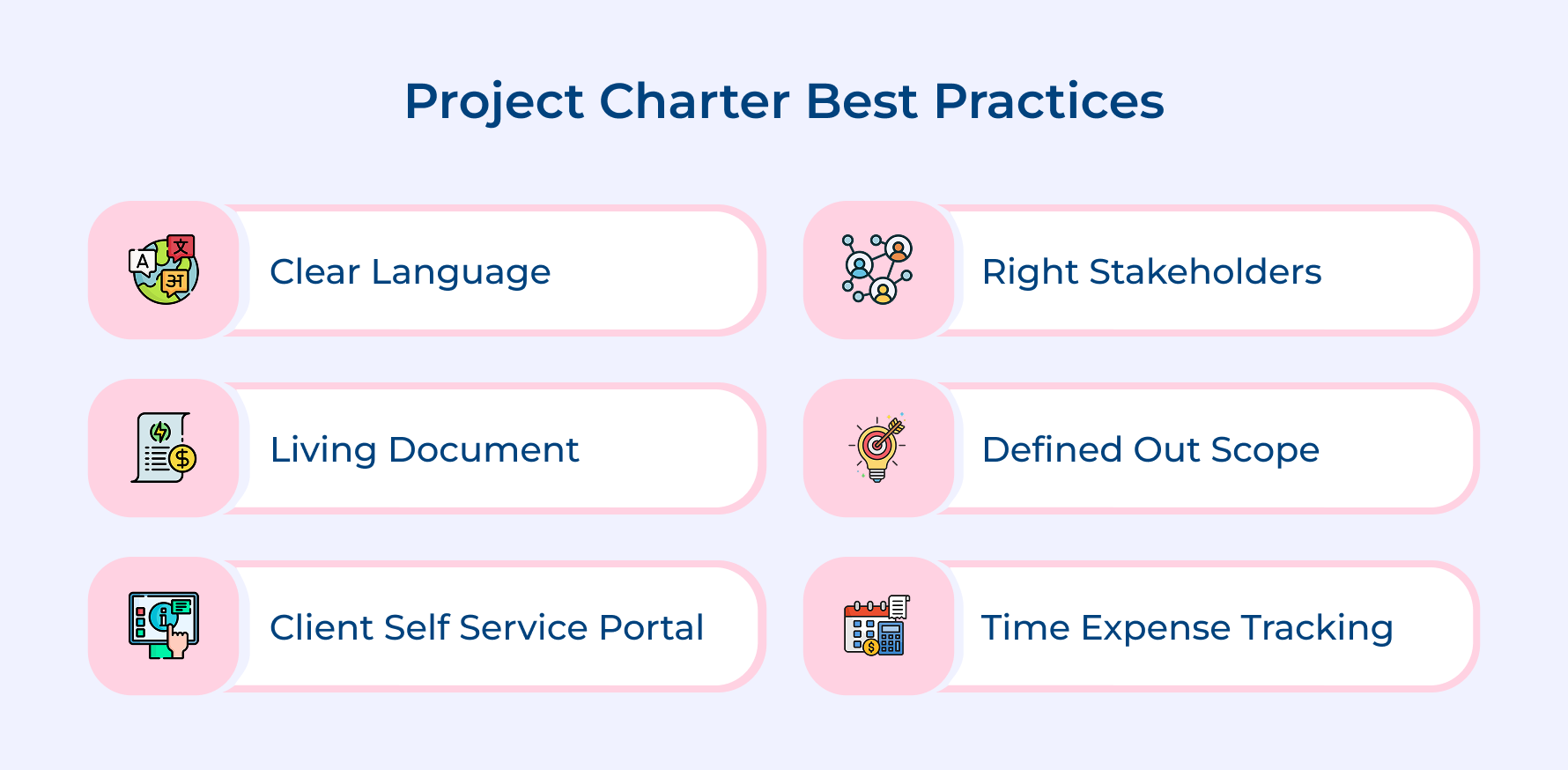
Keep The Language Unambiguous
A project charter document that needs interpretation has failed its primary job, so maintain clarity so that any client reaches the same conclusion.
Involve The Right Stakeholders Before The First Draft
do not wait till the charter is written to avoid sequencing mistakes and unnecessary rework. Bringing key decision makers before drafting to make sure the charter reflects reality.
Never Treat The Charter As A One-Time Document
After sign-off if you never return to it, become updated by the passage of time. Update the project charter whenever there is a change in scope or direction.
Be Specific About What Is Out Of Scope
Name the charter exactly what the project will deliver is just a critical documentation process for its success.
Align The Charter To A Real Business Objective
Connect every goal in the charter directly to something the organization has committed to the client for achieving.
Get A Formal Sign-Off Not Just Verbal Agreement
A verbal approval is a conversation that will not be remembered. Maintain a formal sponsor signature to give the charter real organizational weight and for the project manager to act on it.
Bring Clarity in Project Management with a Project Charter.
A project charter is a foundation project needs before a resource commitment or setting a deadline. Even the most capable teams end up working without a shared direction and clear accountability.
- A good project charter includes scope, objectives and stakeholder roles before the start of project execution.
- Identify project risks and maintain accountability during charter creation so risk management starts before escalation.
- Revisit it across the entire project lifecycle to keep delivery aligned with business intent
Ready to put this into practice? Download a free project charter template to build your next project on a foundation that actually works best. A project that is able to deliver on time while staying within scope always starts with a charter that leaves no room for ambiguity.
Limit time — not creativity
Everything you need for customer support, marketing & sales.

Neeti Singh is a passionate content writer at Kooper, where he transforms complex concepts into clear, engaging and actionable content. With a keen eye for detail and a love for technology, Tushar Joshi crafts blog posts, guides and articles that help readers navigate the fast-evolving world of software solutions.