How to Calculate and Track Project Budget Variance
- What is Budget Variance in Project Management?
- Why is Project Budget Variance Important in Project Management?
- 5 Types of Budget Variance in Project Management
- What Are the Common Causes of Budget Variance in Projects?
- How to Calculate Project Budget Variance?
- Common Examples of Project Budget Variance
- Tips & Best Practices for Budget Variance in Project Management
- Keep your Projects on Track with Real-Time Budget Insights.
- FAQs about Budget Variance in Project Management

Key Highlights:
- Budget variance is the measurable gap between planned budget and actual spend — giving managers early warning before costs overruns.
- More than 27% of projects exceed planned budget, making consistent variance analysis a critical financial discipline in delivery.
- Favorable, unfavorable, cost and revenue signal different financial risk that demands immediate response from the project team.
Why do well-planned projects still lose their budgets? The cost gap was already present, it was just unnoticed until too late. More than 27% of projects exceed the planned budget, which damages more than money, hitting client trust and delivery credibility.
Budget variance differentiates the planned budget and the actual amount spent in a project. It tells project managers whether the spending is on track and produces measurable outcomes or not.
Explore the complete definition, calculation formula and best practices for budget variance in project management. It gives a clear framework to monitor and act on variances before transforming to costly overruns.
What is Budget Variance in Project Management?
Budget variance in project management is the measurable distinction between your planned budget and actual amount spent during execution. This gap analysis separates projects that stay on track from those that are in a chaotic financial loop.
The analysis of budget variance identifies the cost gap that occurred and what it means to the financial health of your project. It also helps to course-correct before small deviations turn into budget overruns. The moment you stop analyzing, you lose the ability to make informed decisions.
Key Considerations:
- Scope clarity: An undefined change in project scope is the biggest driver of budget variance.
- Baseline accuracy: The variance is only as reliable as the budget benchmark defined at the start of execution.
- Variance threshold: Not every variance needs escalation, so better to define acceptable tolerance levels early.
- Stakeholder visibility: Share budget variance regularly with stakeholders to maintain trust and faster decisions.
Why is Project Budget Variance Important in Project Management?
The importance of budget variance is about financial decision management that impacts your project’s outcome. Let’s see why it deserves serious attention:
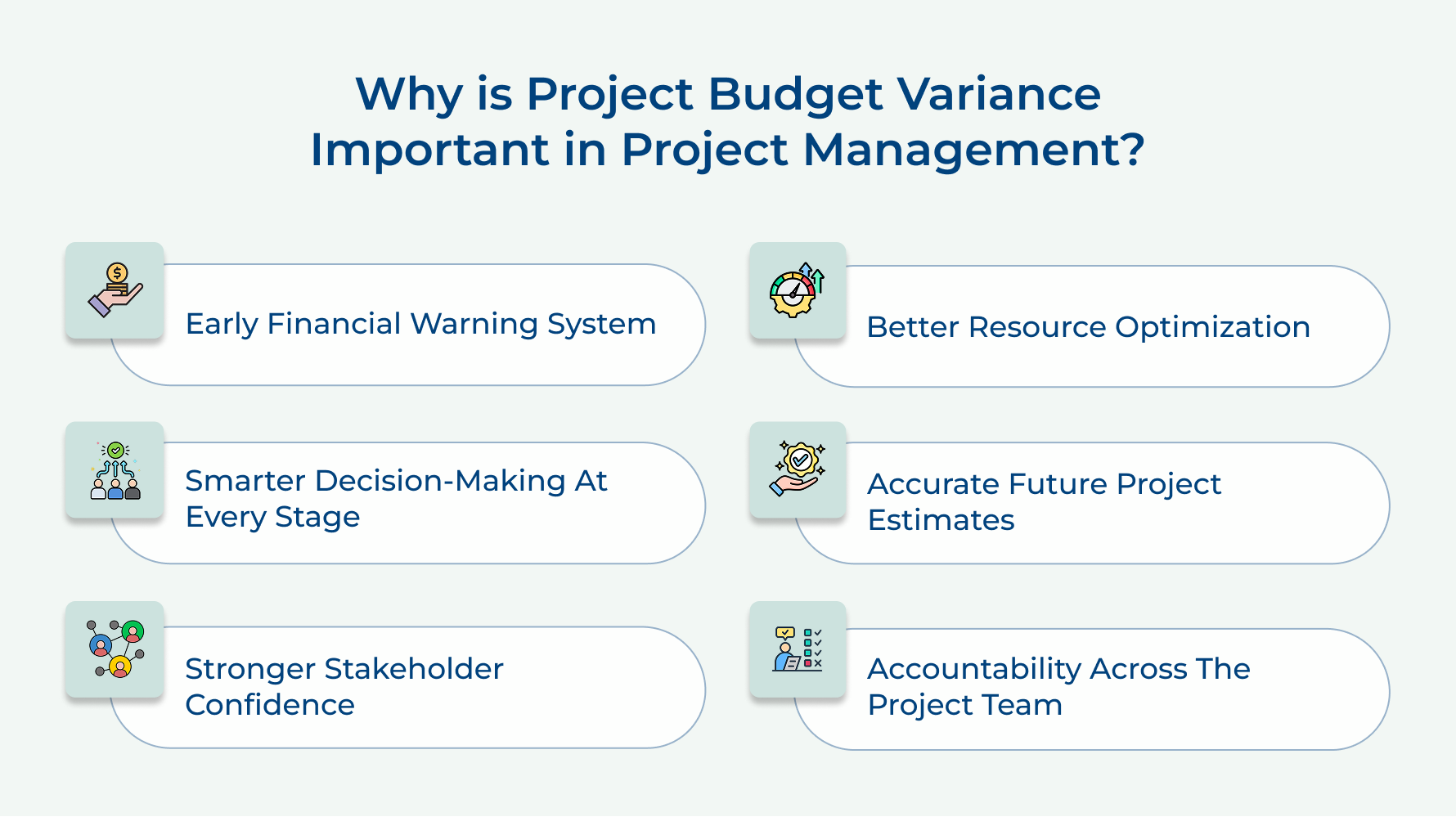
1. Early Financial Warning System
Project budget variance is the first line of defense against cost overruns. An early identification of negative variance provides time to adjust resource allocation before damaging the delivery.
2. Smarter Decision-Making at Every Stage
Constant variance analysis tracks in project management help in making every decision backed by real financial data. It eliminates guesswork while helping project leaders prioritize spending that actually matters.
3. Stronger Stakeholder Confidence
Most stakeholders look for a service firm that offers financial transparency and proof that their investment is managed responsibly. Regular variance reporting helps in building that trust faster than any status meeting could.
4. Accurate Future Project Estimates
Every documented variance today becomes your manager’s future reference point for estimating future projects precisely. This historical data eliminates the gap between planned vs actual costs significantly.
5 Types of Budget Variance in Project Management
Not all types of budget variances are the same. Each helps your project managers take the right action at the right time:
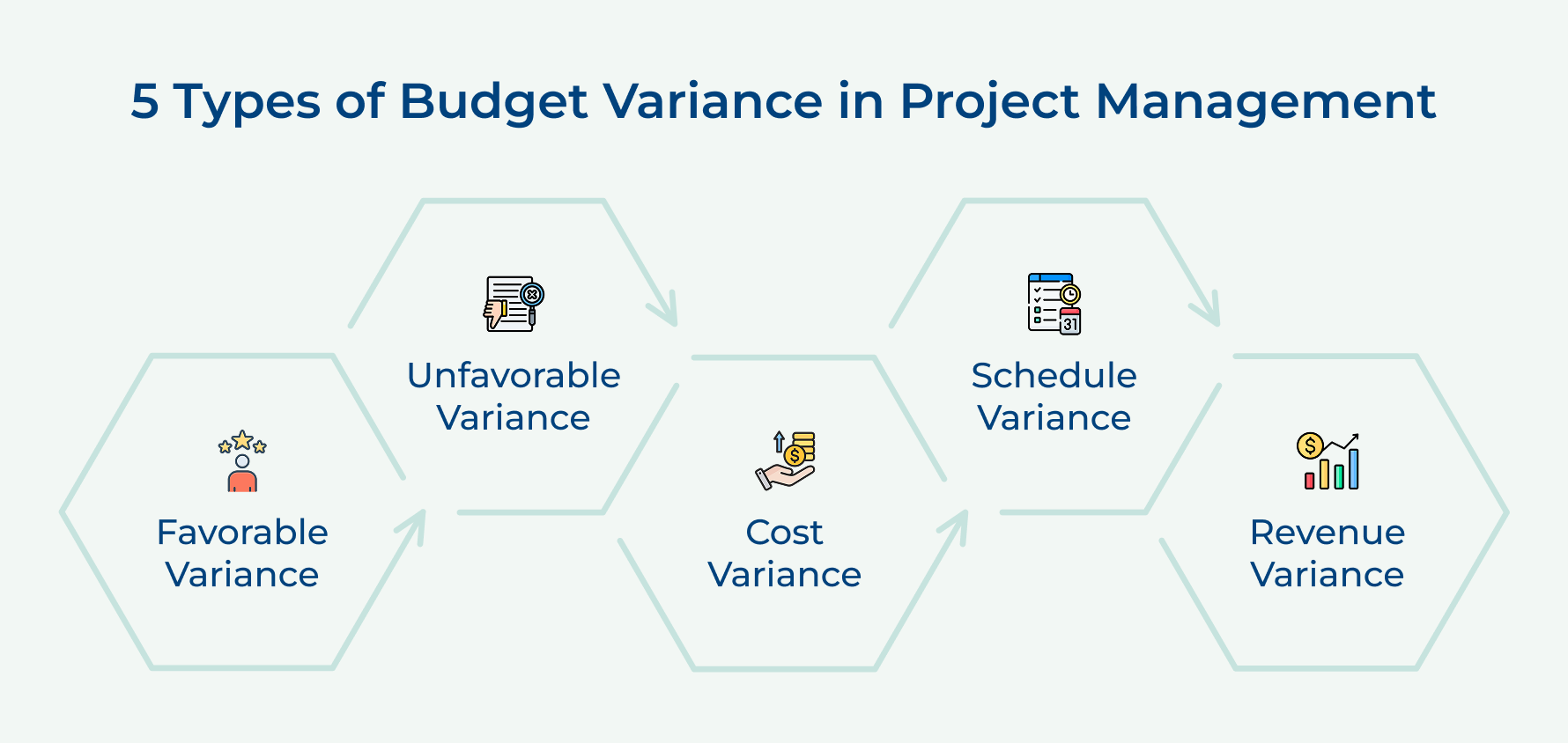
1. Favorable Variance
A favorable variance is considered when actual project spending comes in lower than planned budget, but what most miss is that it is not always a win worth celebrating.
So, why should you be cautious about it? In some cases, deliverables were skipped, or the original budget estimate was simply too padded, so before labeling it a success, perform a proper investigation.
2. Unfavorable Variance
This variance is also called a negative budget variance, which means “the project has spent more than planned”. It demands immediate attention from the budget review process.
The real danger of this variance appears when it becomes a pattern after multiple reporting periods and the recovering financial health becomes harder once it scales.
3. Cost Variance
Point-in-time to Cost variance defines the earned value of a task completed and the actual cost spent. It practically answers one question: “Are you getting the output you paid for?”
This connects real-time financial data directly to project cost performance index, making it the most used budget variance. Keep these points in mind while reviewing variance:
- Always combine cost and schedule variance for a complete project health picture.
- An inconsistent cost variance analysis leads to poor task-level estimation.
- Make the tracking more structured by using the earned value management (EVM) system.
4. Schedule Variance
Schedule variance measures a project’s standing across the planned timeline. Projects that are within the timeline directly impact your budget, while others lead to tasks slipping and costs quietly creeping up.
Follow these common schedule variance triggers:
- Dependency bottlenecks that delays your entire work streams unnecessarily.
- Resource unavailability types were not considered in the original project plan.
- Scope additions mid-project that were not backed by timeline estimates.
Now, a question that comes to mind is how often managers treat schedule delays as a timeline problem? Every week of delay is equivalent to real unplanned costs that show up as variance in the report.
5. Revenue Variance
Revenue variance is ideally applicable to projects where expected returns are part of the project plan. It measures the gap between projected revenue and actual revenue earned during a given period.
So what does this project budget variance mean in the revenue context? project might be delivered on time, but not generating the expected financial value. Proper analysis keeps your delivery teams as well as finance stakeholders aligned on true business impact.
What Are the Common Causes of Budget Variance in Projects?
The root causes of most budget variances are predictable and preventable. Let’s explore what every project manager must watch for:
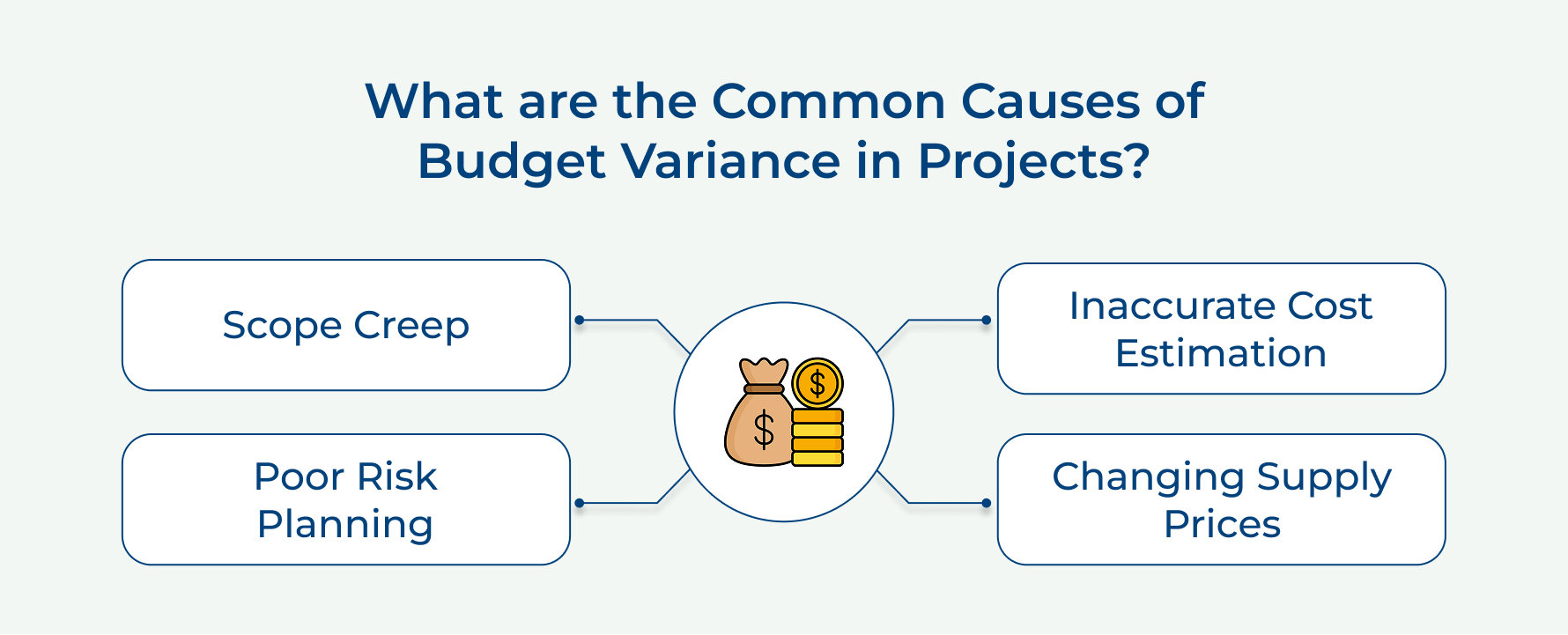
1. Inaccurate Cost Estimation
Baseline budgets that are built on guesswork instead of real-time data make every phase of the project financially shaky. Estimation errors happen due to rushed decisions under stakeholder pressure or without historical project data.
2. Changing Supply Prices
Material and vendor prices are not static, which makes planned projects vulnerable to mid-project fluctuations. Smart managers overcome it by building price escalation clauses into vendor contracts to maintain a contingency reserve for market-driven changes.
3. Scope Creep
Client’s new requirement is the cause of scope creep without an adjustment to the budget. Each unplanned change feels small, but cumulatively it consumes your entire reserve before managers realize the entire financial damage.
4. Poor Risk Planning
Project risks that are not identified upfront show up as unplanned costs that trigger budget variance in project management. Prevent it by creating a structured risk register with assigned cost impacts to prevent financially damaging surprises mid-project.
How to Calculate Project Budget Variance?
The formula for calculating budget in projects is only half but evaluating the numbers makes the difference. Follow this breakdown of how to calculate project budget variance the positive way.
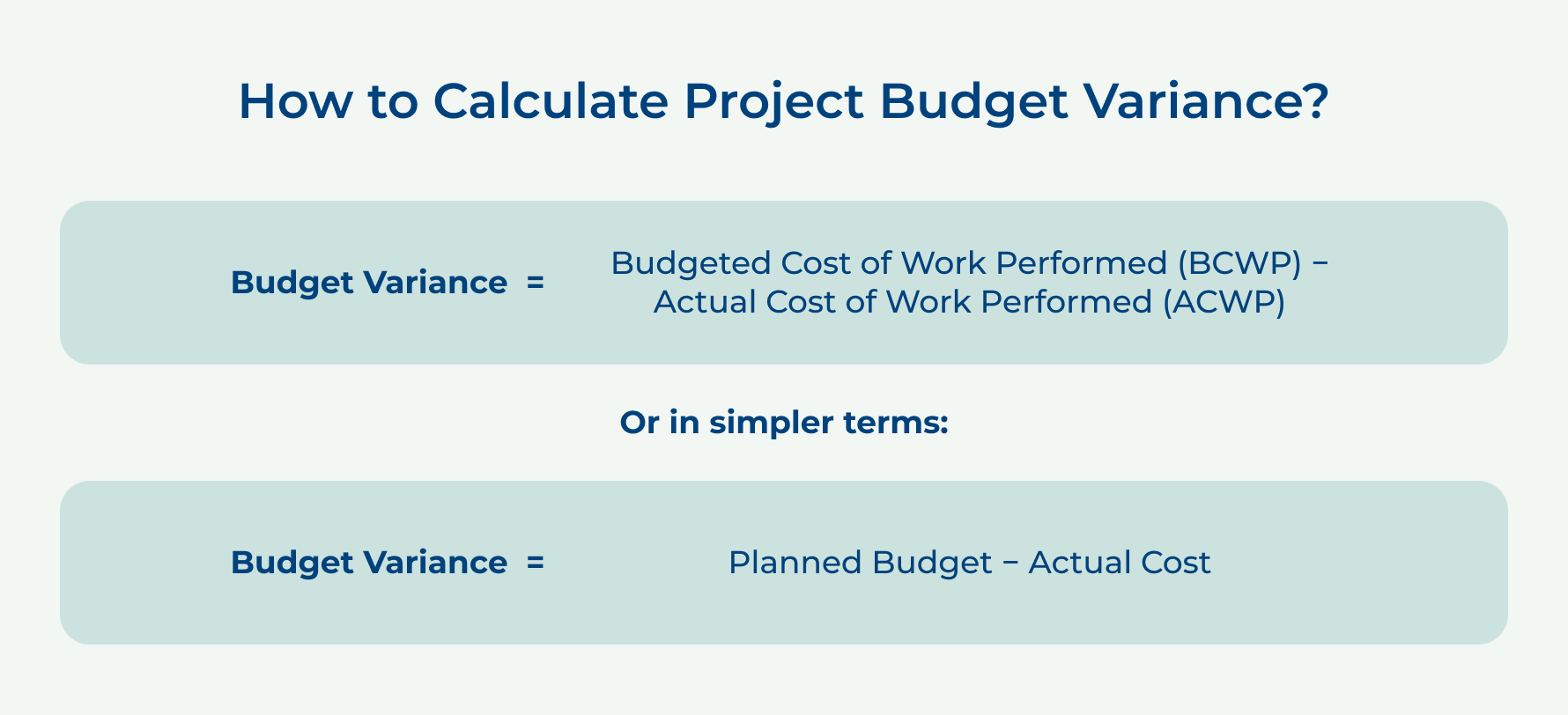
Formula
Budget Variance = Budgeted Cost of Work Performed (BCWP) − Actual Cost of Work Performed (ACWP)
Or in simpler terms:
Budget Variance = Planned Budget − Actual Cost
Consider these key components in practice before applying the budget variance formula:
- Budgeted Cost of Work Performed (BCWP): Total planned cost assigned to tasks that have actually been completed..
- Actual Cost of Work Performed (ACWP): The real amount invested to complete the same portion of the task.
So, What is the Standard Benchmark for Budget Variance?
Variance of 10% is considered as Industry standard, which is manageable, but any variance beyond the range on the negative side triggers budget analysis along with a proper action plan.
Steps to Calculate Project Budget Variance
These essential steps help you measure and manage variance for financially healthy project outcomes.
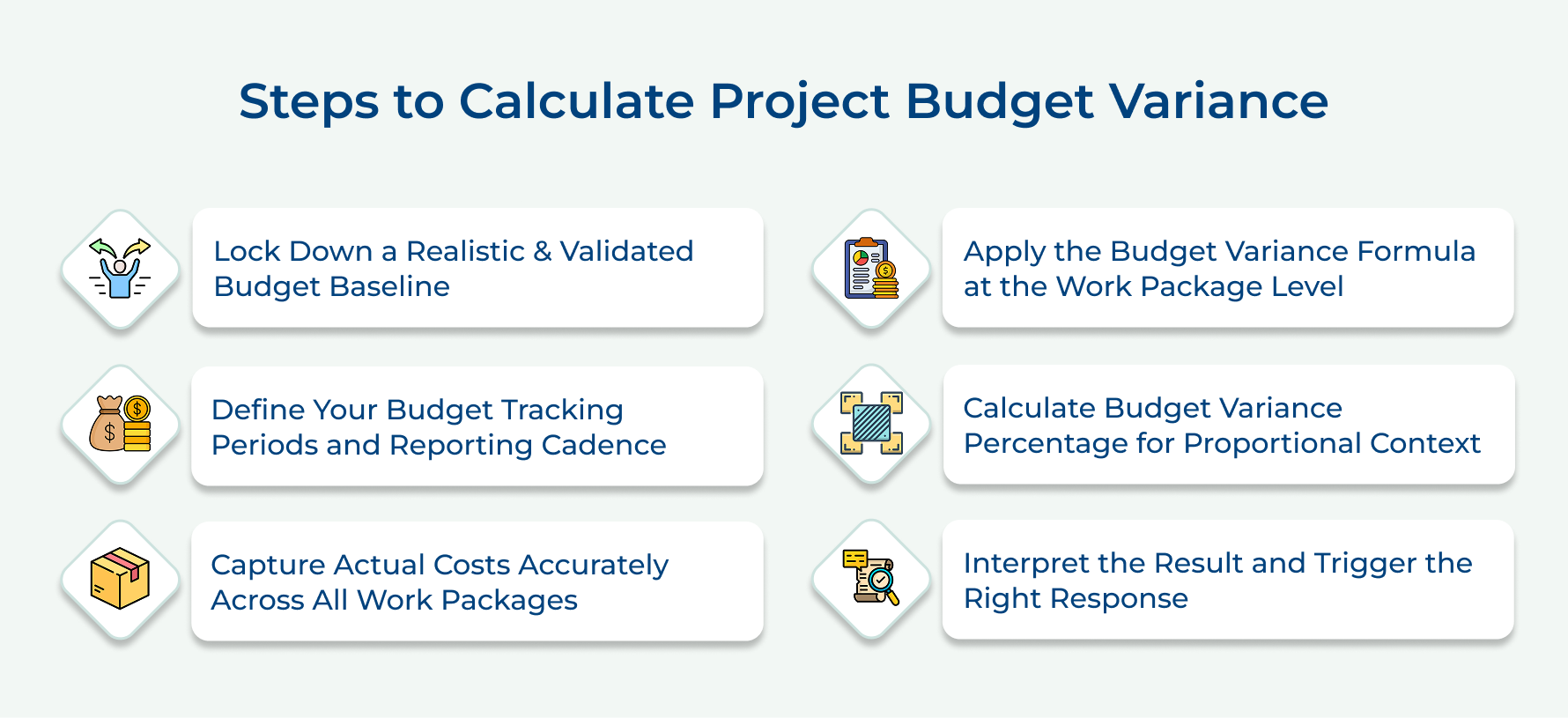
1. Lock Down a Realistic and Validated Budget Baseline
A budget baseline is useful when it reflects actual scope, realistic resource costs and market-aligned estimates.
Now, how to build a baseline that holds up? Start with a bottom-up approach where each work is cost independently before evaluating the total project budget. This minor-level estimation makes your project budget variance meaningful.
A strong budget baseline must include:
- Labor costs: Roles and estimated hours per task instead of using a single blended rate.
- Material and vendor costs: Always validate based on current market rates instead of old data.
- Contingency reserve: instead of just a percentage of total volume, define it based on identified project risks.
Pro tip: A baseline built under stakeholder pressure to hit a number always misleads variance data, so better to have a realistic frame upfront, as every budget calculation depends on it.
2. Define Your Budget Tracking Periods and Reporting Cadence
Budget variance is not a one-time calculation process. Measured it at regular intervals across the project lifecycle to identify damage early.
Projects that are running for more than three months, a monthly variance review cycle is best to spot trends without creating reporting fatigue for the team. Consider these factors when defining your tracking cadence:
- Longer projects need more frequent budget tracking checkpoints
- Stakeholder reporting combined with governance expectations
The budget tracking period also determines the granularity of your variance analysis across projects. Weekly tracking can catch micro-variances before they pile up into financial risk.
3. Capture Actual Costs Accurately Across All Work Packages
A question to ask that exposes a major gap in projects is: “Are the actual costs captured at the work package level or at the project level?” Work level tracking gives project budget variance its real diagnostic value.
Actual cost data across most projects include every dollar spent on
- Direct labor hours
- Vendor invoices
- Software licenses
- Travel expenses
Variance calculation becomes unreliable when cost data is incomplete or delayed, so watch out for these common mistakes when capturing:
- Hour logging: Team members who don’t log hours accurately create invisible gaps in actual cost data.
- Invoice booking: Vendor invoices created in the wrong phase affect variance results for the reporting cycle.
- Indirect costs: The actual cost without including indirect costs gives a falsely optimistic picture of spending.
A reliable actual cost capture system is ideal for overcoming this, as it includes a centralized cost tracking tool that integrates with your project management solution. It helps in defining a cost submission deadline and a finance review point before costs are defined for calculation.
4. Apply the Budget Variance Formula at the Work Package Level
Most project managers apply the budget variance formula only at the total project level, but at the work package level, it reveals the exact point of financial pressure.
Budget Variance = Planned Budget − Actual Cost
Start by subtracting the actual cost from the planned budget allocation. A negative result is a sign of further investigation before it escalates into a project-level overrun.
So, why does work package level calculation matter:
- Isolate the problem area instead of making it in aggregate numbers
- Helps in identifying if the variance is cost-driven or schedule-driven
- Enables targeted action instead of broad budget adjustments
Consider a project showing only 5% overall variance but might be hiding a 30% overrun in one critical work offset by an underspend in others. Regardless of the healthy number, this imbalance needs attention.
5. Calculate Budget Variance Percentage for Proportional Context
Raw variance numbers mislead without proportional context. For example, a $50,000 overrun is something different on a $200,000 project in comparison to a $5 million project, which is exactly where the budget variance percentage formula becomes essential.
Budget Variance Percentage = (Budget Variance ÷ Planned Budget) × 100
The flexible budget variance formula helps in adjusting the planned budget with respect to actual activity levels, making the calculation even more accurate for dynamic projects.
Consider these questions when interpreting the result:
- Does the percentage fall within the predefined threshold?
- Is the trend upward across consecutive reporting periods?
- Are there any work packages driving the percentage beyond limits?
6. Interpret the Result and Trigger the Right Response
Budget variance calculation is not the endpoint. What you do with the result will actually protect the project. A proper budget variance analysis includes a clear interpretation followed by an action plan.
So, what does project budget variance mean in negative results? It is a sign of overspending information planned. The response needs to be proportionate to the trend of that variance. A strong variance optimization process includes:
- Root cause documentation: Identify and record the specific variance driver that breaches the tolerance threshold.
- Re-baseline decision: Evaluate the current budget baseline to check the realistic status or formal revision with approval.
- Lessons captured: Feed every finding into the organization’s project estimation and risk planning process.
Common Examples of Project Budget Variance
Variance shows up differently across project types. Here are four common examples of budget varies across different projects worth understanding closely:
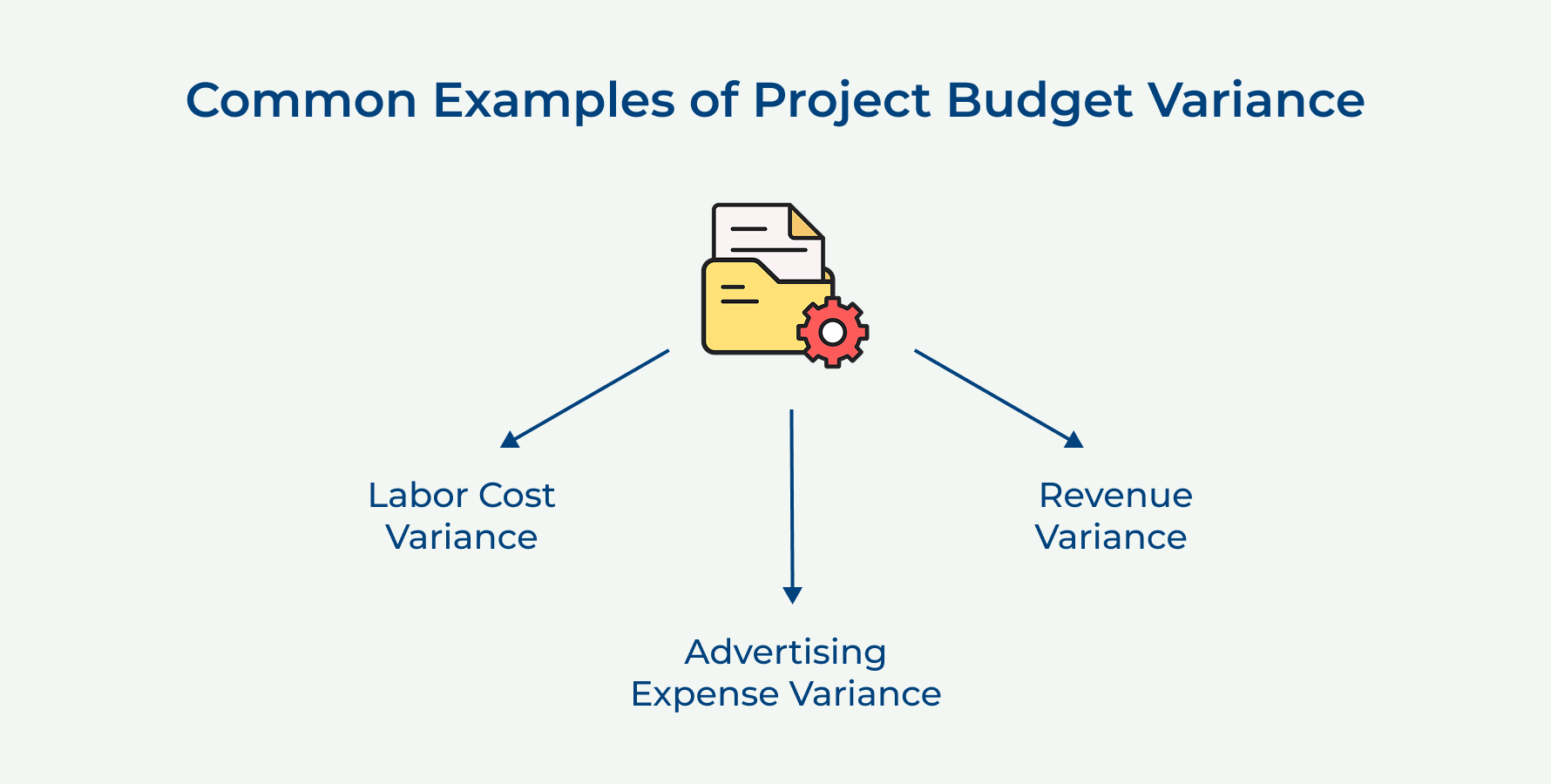
1. Advertising Expense Variance
A digital marketing project budgets $20,000 for paid ad campaigns but later invests $27,000 due to rising cost-per-click rates. This is a classic example of an unfavorable budget variance driven by external market forces instead of poor planning.
The overspend was caused by not building a price escalation buffer into the advertising budget. Teams are conducting a weekly analysis against the planned budget to catch variance early and reallocate underperforming campaigns before a budget overrun.
2. Revenue Variance
A software development project had $150,000 in billable milestones for Q2, but invoiced $110,000 due to a delay. It is a direct example of an unfavorable project budget variance based on the identified gap between projected and actual revenue.
This means the project delivered work but was not able to generate the planned revenue that impacts the broader business. So what’s the most effective way to overcome it? Try billing milestones to specific verified deliverables instead of calendar dates.
3. Labor Cost Variance
A product development project estimates 500 hours of time at $80 per hour, but the actual hours logged are 680 hours due to task complexity. It creates budget variance that directly impacts the project’s bottom line.
Teams that use historical data from similar past projects can consistently produce tighter labor estimates and experience very few cost changes mid-delivery.
Tips & Best Practices for Budget Variance in Project Management
Project budget variance management is about building financial discipline. Below are key strategies that actually make a difference:
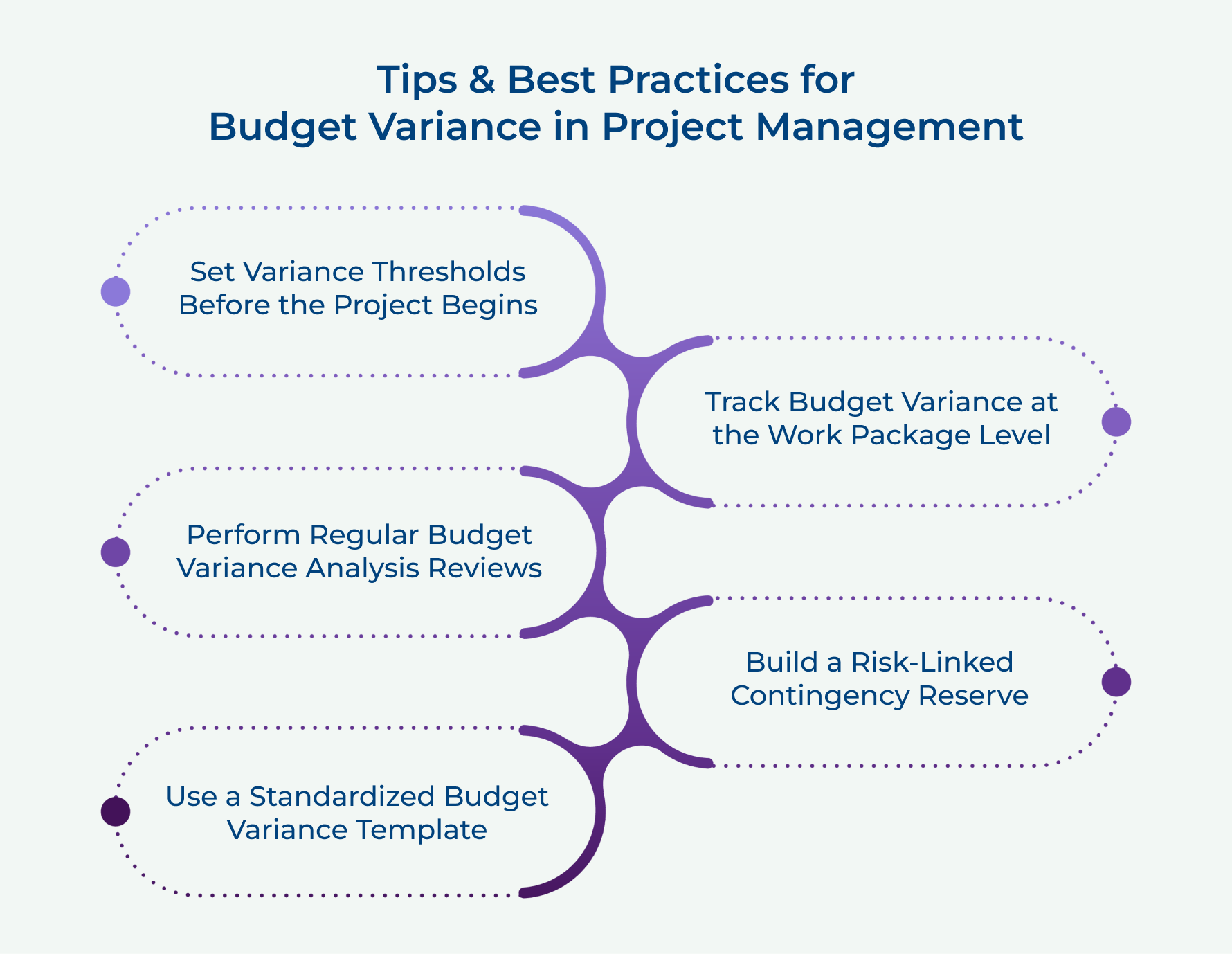
1. Set Variance Thresholds Before the Project Begins
Start by defining acceptable variance limits to give your team clear financial boundaries. Budgets without predefined thresholds trigger variance that either panics or gets ignored and neither serves the project well.
The best thresholds are set at both the work package level and the overall project level, which helps managers respond proportionately. Consider these questions when defining a threshold limit:
- What is the most acceptable variance percentage for a given project’s risk profile?
- Is the threshold limit formally approved by sponsors before locking the baseline?
- Are thresholds reviewed when a formal scope change is approved?
2. Track Budget Variance at the Work Package Level
Project managers who check variance once a month lose their budget fast, while those performing work specific tracking catch problems before they escalate into serious overruns.
A work package consistently running at 15% over budget signals for estimating the approach for that type of work with a fundamental review. Also consider the warning signs:
- Consistent overrun: The same work package will exceed the budget if a proper reason is not documented.
- Silent underspend: A work level with a defined incomplete deliverable shows favorable variance.
3. Build a Risk-Linked Contingency Reserve
A properly structured contingency reserve is based on specific risks identified in your register. Each risk carries an estimated cost impact along with a probability rating, while the contingency reflects the weighted sum of those exposures.
Consider these contingency planning practices:
- Risk-weighted sizing: Calculate contingency based on probability multiplied by impact for each identified risk.
- Separate allocation: Maintain a separate budget line for contingency and never mix it into work package budgets.
- Release protocol: Prepare a formal approval process before releasing the contingency.
4. Perform Regular Budget Variance Analysis Reviews
Project budget variance analysis should be built into the project governance calendar instead of being a quarterly activity. It directly determines how quickly your team intervenes when variances show a negative value.
A proper review involves comparing trends against previous periods to create a clear action plan. So below are all the non-negotiables for variance review:
- Current period variance compared with previous reporting for trend visibility
- Documentation of root cause for every variance that breached the threshold
5. Use a Standardized Budget Variance Template
Inconsistent reporting is a silent killer of good budget variance management across projects. When managers present data differently, leadership can’t find the difference across the portfolio.
Maintain a standardized template to make sure every project reports the same data in the same structure. It is making portfolio-level project budget variance analysis more effective while less time-consuming.
Keep your Projects on Track with Real-Time Budget Insights.
Budget variance Management is an ongoing financial discipline that separates good projects from those that constantly fight overruns. When tracked consistently and analyzed with a proper intent, it becomes a powerful indicator of project health.
- Establish a budget baseline to define variance thresholds before it kicks off
- Track and analyze budget variance at both work package level as well as project level
- Maintain proper document for each variance to build estimation intelligence over time
Ready to take control of your project finances? Explore how project management tools help you monitor project budget variance in real time. Consider this as a strategic decision-making tool to consistently deliver projects within a timeline.
Limit time — not creativity
Everything you need for customer support, marketing & sales.

Neeti Singh is a passionate content writer at Kooper, where he transforms complex concepts into clear, engaging and actionable content. With a keen eye for detail and a love for technology, Tushar Joshi crafts blog posts, guides and articles that help readers navigate the fast-evolving world of software solutions.