How to Implement Client Relationship Management in Your Firm
- What is Client Relationship Management (CRM)?
- What Are the Benefits of Managing Client Relationships?
- How To Implement Client Relationship Management: 7 Steps?
- Common Customer Relationship Management Challenges to Overcome
- What Are the Best Practices for Client Relationship Management?
- What Are the Best Tools for Client Relationship Management?
- How Do You Measure ROI in Client Relationship Management?
- What Are Examples of Client Relationship Management in Action?
- Elevate connections with Client Relationship Management
- FAQs about Client Relationship Management

Key Highlights:
- Client relationship management is the practice of building and maintaining relationships through consistent communication and personalization.
- A 5% increase in client retention boosts revenue by 95%, making it one of the highest-impact priorities any service business can invest in.
- Turn client relationship management into a measurable growth engine by assessing CRM needs and defining metrics for phased rollout and team training.
Most service firms invest in CRM tools but still lose clients because of an unplanned relationship strategy. Even the best relationship becomes an expensive contact list without a structured approach.
Client relationship management is the practice of building and maintaining business relationships through consistent communication and customer engagement. An increase in client retention by 5% can boost revenue up to 95%. It is the highest-impact operational priority any business can focus on.
Explore everything from core definitions and implementation steps, best practices and client relationship management examples strictly based on a strategic standpoint.
What is Client Relationship Management (CRM)?
Client relationship management is the process of building meaningful connections between a business and its customers. It starts with interaction from the first sales call to long-term account management and turns one-time buyers into loyal partners.
Why Is Managing Client Relationships Important for Companies?
The importance of client relationship management is not only about keeping clients happy but also about directly impacting revenue retention and business growth. Companies that invest in a structured framework outperform those that treat customer interactions as transactional.
Businesses face higher churn rates, damaged brand reputation and shrinking revenue pipelines when client relationships are poorly managed. A single unresolved issue can trigger a chain reaction that costs far more than the proactive management effort.
Key objectives:
- Build trust: Build consistent and transparent communication that makes clients feel valued by your service.
- Improve retention: Identify dissatisfaction early and resolve issues before they escalate to churn.
- Drive revenue growth: Leverage strong client relationships for upselling and cross-selling opportunities.
- Enhance client experience: Personalize every touchpoint for clients to feel understood instead of just served.
What Are the Benefits of Managing Client Relationships?
Client relationship management through CRM goes beyond surface-level satisfaction to directly influence project outcomes.
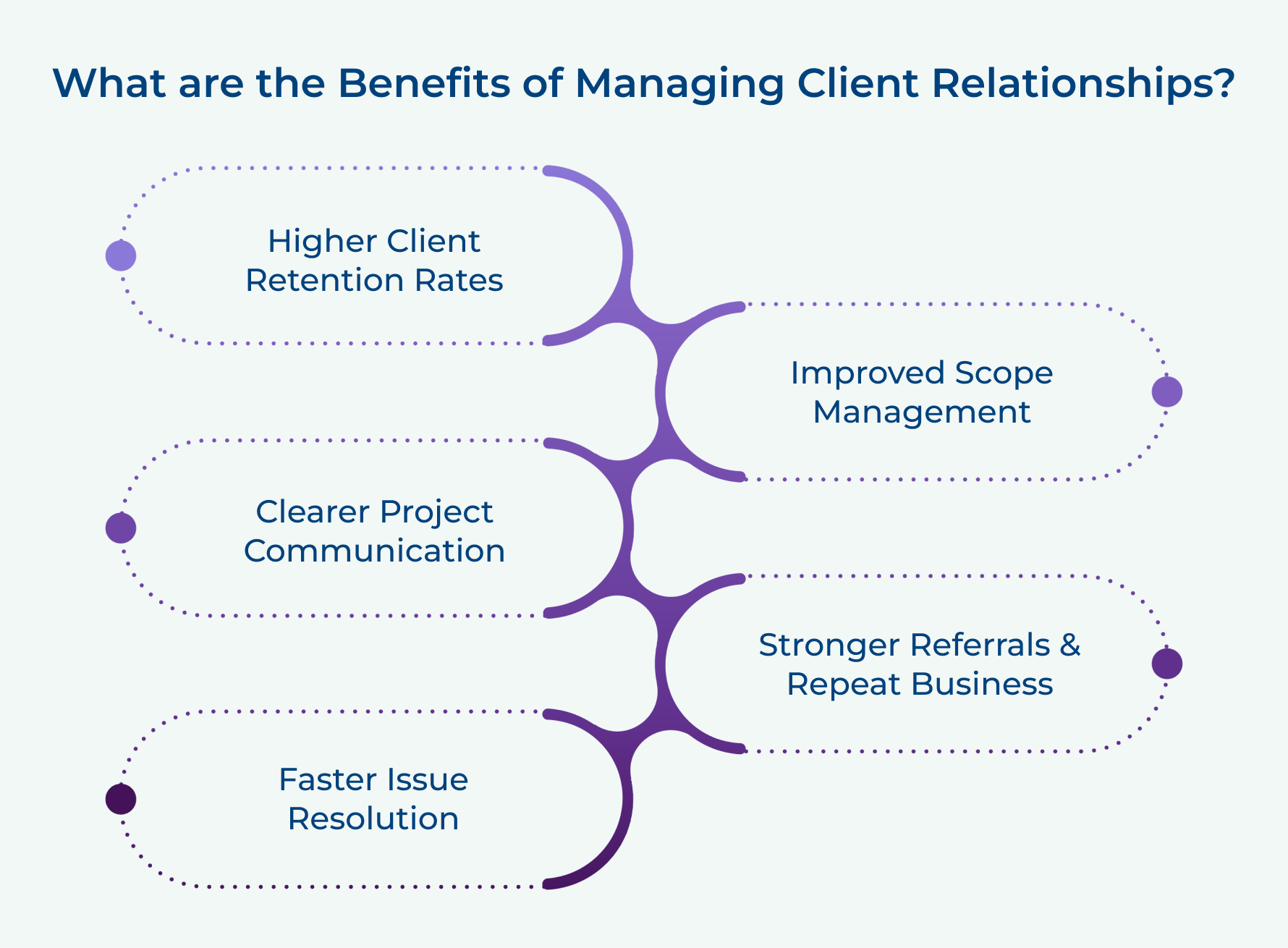
1. Higher Client Retention Rates
Clients trust your process when they feel consistently informed. They don’t even look to other competitors knocking with better pricing. Client Retention in project management is built during the delivery phase.
2. Clearer Project Communication
Strong client relationships create an environment for feedback to flow openly and scope change discussion early. The clarity in communication alone can save a project from costly derailment.
3. Faster Issue Resolution
A solid relationship helps clients to flag concerns immediately instead of building frustration silently behind the scenes. The early warning system gives project managers the real window needed to course-correct in time.
4. Improved Scope Management
Trust building with clients helps project managers be more collaborative when discussing scope boundaries and timelines. The mutual respect reduces scope creep while keeping project budgets intact.
5. Stronger Referrals and Repeat Business
A good client relationship becomes the foundation for future contracts and warm referrals. Opportunities in project management are almost always sitting inside your current client base for better management.
How To Implement Client Relationship Management: 7 Steps?
Implementing CRM successfully requires more than software selection, follow these seven structured, proven steps.
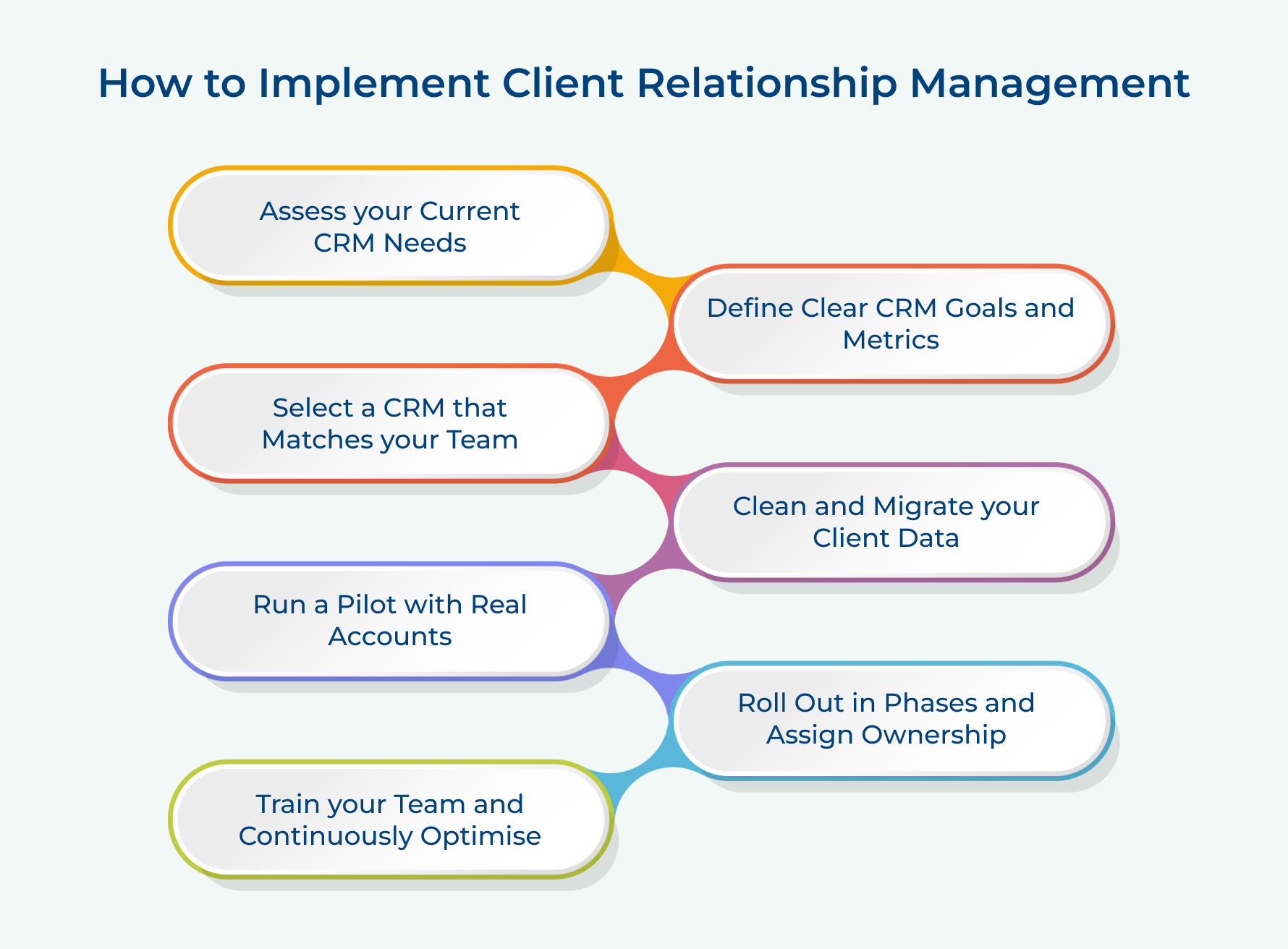
1. Assess Your Current CRM Needs
Before starting with the implementation process, you need to understand the current status of client relationship management. What happens if you skip this? You will end up digitizing existing problems instead of solving them.
Before Assessing Your CRM needs, answer these Questions:
- In which touchpoint do communication gaps most frequently occur?
- Are your teams working from a single source for client communication?
- How are client issues currently tracked and resolved?
The answer to this question gives a ground-level view of your client relationship management (CRM) technique.
How does auditing actually help you implement better? It stops the guesswork and starts building a strategy around real gaps. It makes the implementation process faster and more effective from the start.
Pro Tips:
- Document before you digitize: Note down your current client workflow before evaluating any tool.
- Involve frontline teams: Account managers have the most accurate picture of the gap in the current client relationship workflow.
2. Define Clear CRM Goals and Metrics
A proper client relationship management strategy without defined goals is similar to tracking activity, but with no real outcome. Measurable goals transform your CRM from an administrative tool into a growth engine.
So, how to define CRM goals that enhance your client relationship management? Tie every goal directly to a business outcome that leadership depends on and for connected numbers, adoption becomes far less of a battle.
Key metrics to consider tracking:
- Client retention rate: Measures the success of your relationship management efforts in keeping clients long-term.
- Average response time: Tracks your team’s engagement rate with client queries across all touchpoints.
- Client satisfaction score (CSAT): Direct customer feedback about your relationship management quality.
- Pipeline conversion rate: Shows how effectively strong client relationships translate into expanded contracts.
Establish these metrics before rollout to set a benchmark to measure the real impact of your client relationship management strategy, as without it, progress measurement is nothing.
3. Select a CRM That Matches Your Team
The right CRM is all about finding the client relationship management software tool that your team will use consistently. A CRM that fits your team’s existing workflow will always outperform a complex system that demands new habits overnight.
Consider these key Factors When Choosing the Right CRM:
- Ease of adoption: The best CRM tool should be easy to use from day one without heavy training sessions.
- Workflow compatibility: It should mirror how your team already manages client interactions.
- Scalability: the tools should scale with your client base without the need for migration every few years.
- Integration capability: the best tools should integrate with your existing system.
So what happens when you select a system without matching the team’s workflow? It ends up with low adoption and inconsistent data, making it a system nobody trusts. The definition of a client relationship done right starts with a tool that removes friction.
Below are the real-world CRM Use Cases for Client Relationship Management:
- Account tracking: Help teams to monitor every client interaction so no follow-ups are missed.
- Pipeline management: provide a clear view to track where each client sits in the relationship lifecycle.
- Automated follow-ups: Trigger timely check-ins based on client activity to keep your team proactive.
- Client health scoring: Flag risk accounts early by scoring engagement across all touchpoints.
4. Clean and Migrate Your Client Data
Data migration in CRM is what most teams underestimate, leading to the failure of client relationship management to fall apart. Messy or duplicated data within your system makes every decision of your team built on an unreliable foundation.
Audit and Remove Duplicate Client Records Before Migration
Duplicate records in the CRM migration process are the most damaging issues. For example, when two members work from different versions of the same client profile, it creates miscommunication that directly damages the relationship management experience from the start.
Standardise Data Fields Across All Client Touchpoints
Before starting with the migration of a single record, follow a consistent format for each field, such as:
- Names
- contact details
- account status
Inconsistency makes it impossible to run reliable reports or track client relationship patterns accurately.
Ensure Full Data Integrity Across Every Pipeline Stage
Data integrity maintains every client record accurate, complete and traceable from first contact to active management. Run a full integrity check before starting the migration to protect your client relationship management techniques from being undermined.
5. Run a Pilot With Real Accounts
Once done with the migration, start a pilot run to put your strategy into reality. It helps your team to discover any workflow gaps and adoption challenges that no other planning session can predict.
So, which account is best for the CRM pilot run? Consider 3-5 high-value accounts that represent the full complexity of client relationships. On a simple account, it gives you false confidence before starting the full rollout.
Key Areas to Track During the Pilot Run:
- Data accuracy: Check if client records are entered consistently across all team members.
- Team adoption: Monitor your team’s activity in logging interactions without constant reminders from managers.
- Response time: The measure of clients’ query turnaround has visibly improved since the launch.
- Workflow gaps: Identify the steps that feel forced or are quietly being skipped by the team.
- Client feedback: Assess if clients are noticing any real improvement in communication quality or its constant.
Document every friction point found during the pilot run, as these are direct inputs for refining your strategy. Before closing the pilot run:
- Gather proper feedback from both team members and clients.
- Analyze pre-pilot and post-pilot response times with respect to the benchmark defined.
6. Roll Out in Phases and Assign Ownership
Client relationship management software rollout across every department at once always leads to chaos. It is recommended to release in phases so that experienced managers can protect the implementation from failure. So, how to structure your phased CRM rollout:
Phase 1: Start with high client exposure teams: Begin rolling out across sales and account management since they are most involved in direct client interactions. It creates a working model for every department that follows it.
Phase 2: Bring in cross-functional teams: Once core teams are running live, it’s time to integrate with operations and project delivery teams. This is where client relationship management starts functioning as a company-wide system.
Phase 3: Execute full organisational rollout: Before starting this phase, you will already have real data, refined workflows and internal champions in hand to support new users. Adoption rates at this stage are higher as the system has already been within the last two phases.
Pro Tips:
- Create internal CRM champions: Identify an early adopter per team who becomes the support person.
- Set hard adoption deadlines: Open-ended rollouts drag on in the long term, so schedule a live date per department.
7. Train Your Team and Continuously Optimise
Team Training is not a one-time event. It is an ongoing flow that determines the success of your client relationship management investment in long-term value. Key sign that signals your team needs immediate retraining:
- Client records are incomplete or being updated irregularly across all departments
- Advanced relationship tracking features are sitting completely unused by most team members.
- Clients are reporting communication gaps that the team should have been tracking across the CRM.
Start the session with role-specific training that always outperforms generic walkthroughs. It is because each team member needs to get a demo on how the current system solves daily challenges.
Pro tip: A project manager needs separate guidance from a client-facing account executive as they handle the complete operations.
Most CRM implementations fail not during setup but at the six-month mark, when active performance across client relationship management stops. Maintain a structured optimisation loop that helps to grow with your business.
Common Customer Relationship Management Challenges to Overcome
Do you know that even well-structured client relationship management techniques run into obstacles that derail your implementation? Explore these challenges in detail.
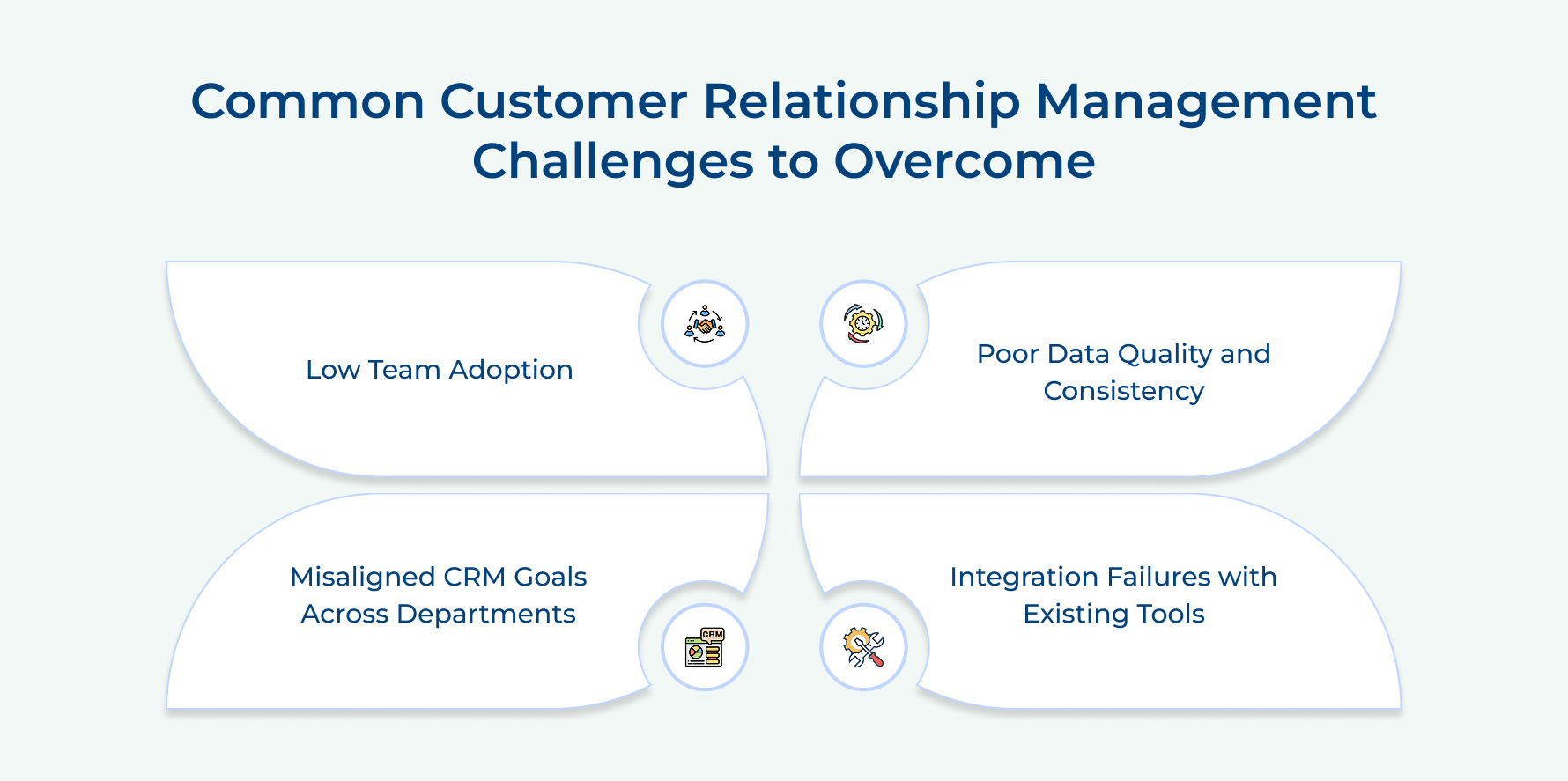
1. Low Team Adoption
CRM implementations struggle because teams resist changing from the legacy system they have always been working. A new client relationship management (CRM) tool feels like extra work to them in terms of adoption before considering it as a solution.
2. Poor Data Quality and Consistency
Situations when multiple team members enter client data differently, CRM becomes an unreliable source for decision-making due to inconsistency. It directly undermines and considers it as a waste system you built.
3. Misaligned CRM Goals Across Departments
The priorities of each team rarely align naturally, like the sales team wants pipeline visibility while project teams want delivery tracking. Business without a unified system leads each department to end up using CRM for a different purpose.
4. Integration Failures With Existing Tools
A Customer relationship management software that cannot connect with your existing tools creates data silos. Teams switch between disconnected systems and client relationships break down at exact touchpoints that matter most.
Consider the strategies to overcome the challenges:
- Drive adoption early: include your team in the CRM tool selection process so ownership is built before rollout.
- Standardise data rules: Define mandatory data entry standards before your client relationship management software goes live.
- Align goals cross-functionally: Collaborate across all departments to agree on unified goals before rollout starts.
- Audit before you select: Review your existing tech stack before choosing any software to eliminate friction across integration and adoption.
What Are the Best Practices for Client Relationship Management?
Below are the right client relationship management best practices that separate teams retaining clients long-term from those constantly chasing.
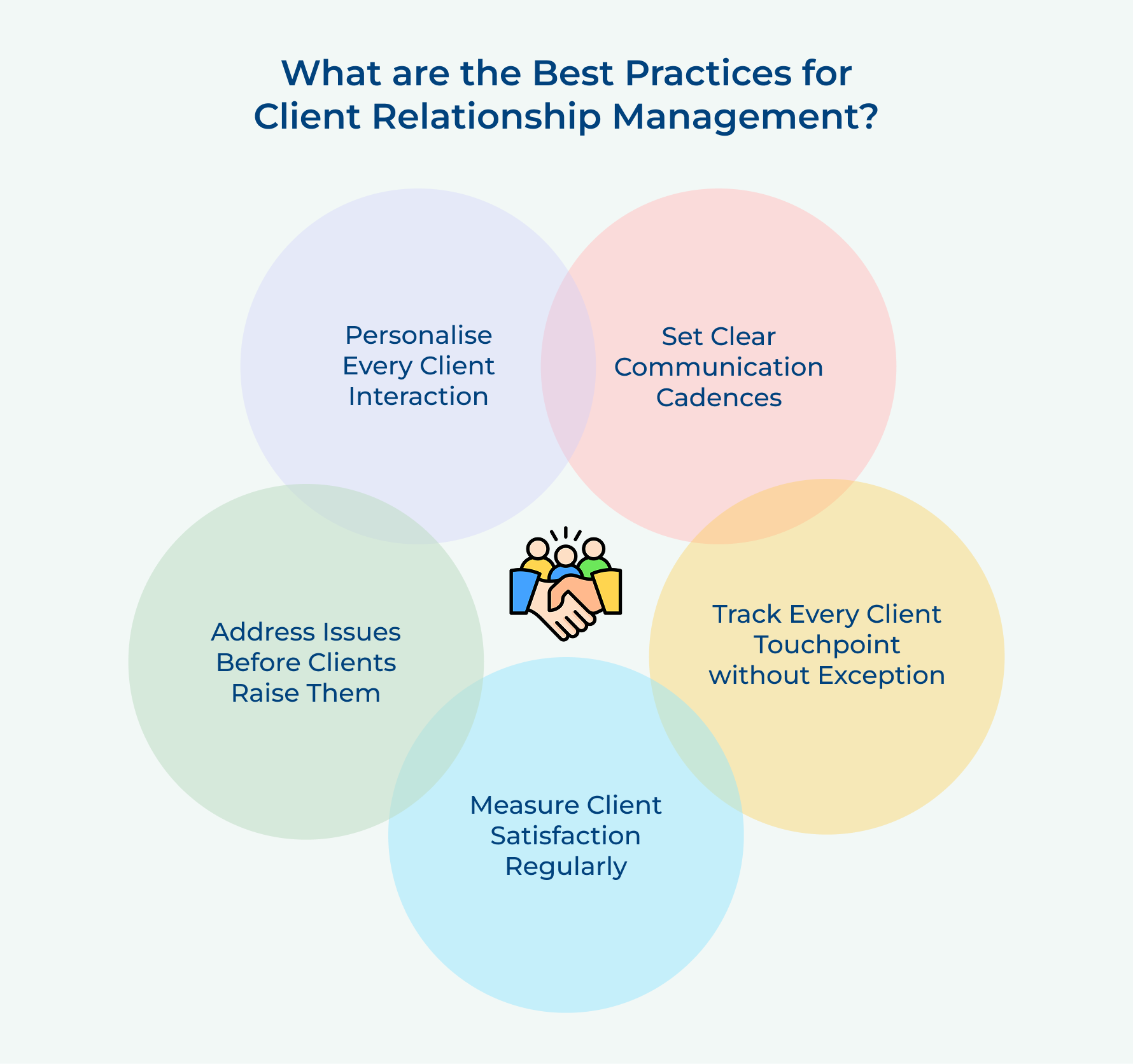
- Set clear communication cadences: Finalize all channels through which you will update each client. Consistent communication is an effective relationship management technique for building long-lasting client trust.
- Personalise every client interaction: Treat each client with respect for their specific goals rather than a one-size-fits-all approach. Personalisation further strengthens the client relationship apart from a purely transactional exchange.
- Track every client touchpoint without exception: Keep a record of every call, email and meeting within your client relationship management software so nothing is missed. It gives your team the entire context needed to deliver consistent experiences.
- Address issues before clients raise them: Proactive problem-solving is the most underused client relationship management skill among all project teams. Clients, when they notice you address issues before they arise, their confidence grows significantly.
- Measure client satisfaction regularly: Run CSAT or NPS checks on a quarterly basis. Regular measurement keeps you ahead of dissatisfaction, transforming to a bigger problem.
What Are the Best Tools for Client Relationship Management?
The right client relationship management tools directly determine the effectiveness of your team relationship-building at scale. Below are tool categories widely trusted across project environments.
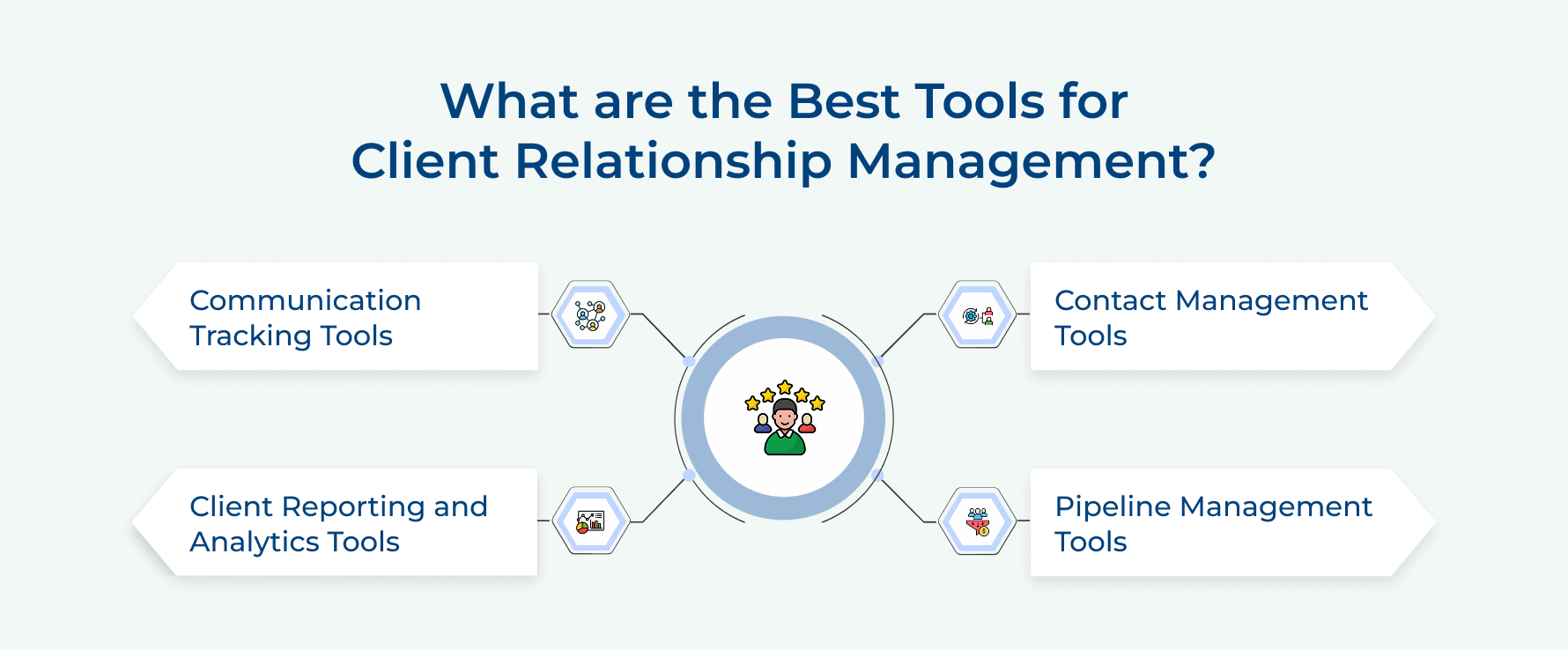
1. Contact Management Tools
Contact management tools are the foundation of any client relationship management system as they centralize all client information in one place. They eliminate the use of scattered spreadsheets and give your team a reliable source for client data as well as interaction history.
2. Pipeline Management Tools
Pipeline tools give real-time visibility of every client standing across the relationship lifecycle. It makes follow-ups and tracking deal progress significantly easier, making sure that no client opportunity goes unattended.
3. Communication Tracking Tools
Communication tools automatically sync emails, calls and meetings against the right client record within your CRM. The complete communication history makes sure your team always engages clients with full context instead of starting from scratch.
4. Client Reporting and Analytics Tools
Reporting tools convert raw client data into actionable insights to help you measure the relationship health. They highlight accounts that are at risk and track satisfaction trends to give clear visibility to make informed decisions.
How Do You Measure ROI in Client Relationship Management?
Below are the key metrics that give you a clear picture of CRM strategy in delivering real value and business outcomes.
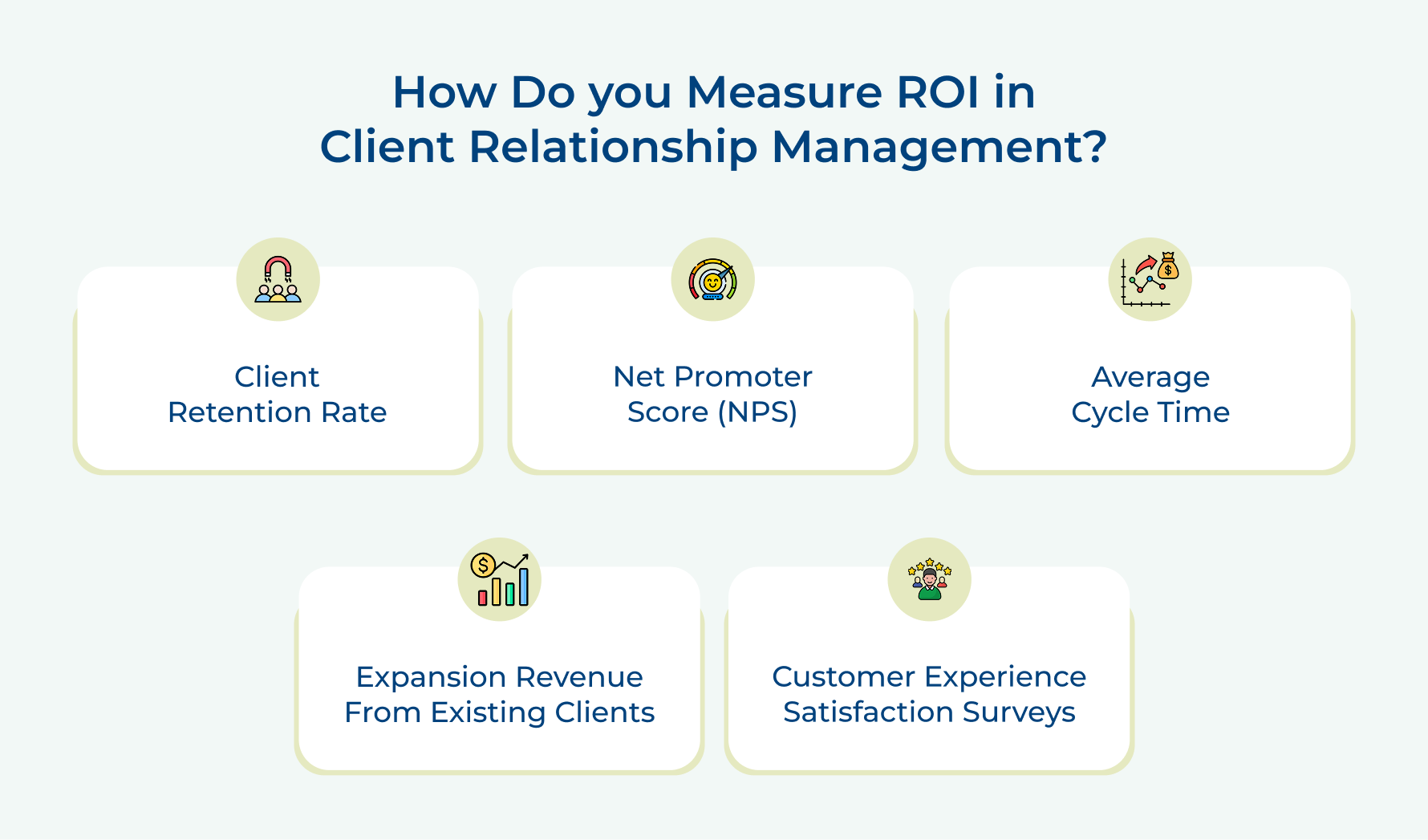
Client Retention Rate
The most direct indicator for tracking the success of a relationship management strategy across multiple clients. A long-term client stays longer, drops the cost of revenue generation and lifetime value grows consistently.
Expansion Revenue From Existing Clients
Expansion revenue measures the revenue you are generating from clients you already manage. Strong relationships naturally create higher upselling and cross-selling opportunities, which new acquisitions simply cannot match in efficiency.
Average Cycle Time
Tracking how long it takes to move a client from onboarding to full engagement reveals inefficiencies in your relationship management process. Shorter cycle times directly reflect a smoother and more structured client relationship management strategy in action.
Net Promoter Score (NPS)
NPS measures how likely your clients are to recommend your business to others based on the quality and experience. A high score is the strongest signal of client relationship management best practices that are genuinely working.
Customer Experience Satisfaction Surveys
Regular satisfaction surveys capture clients’ feelings across every touchpoint with your team. This qualitative data adds the human context that numbers cannot provide in any other assessment.
What Are Examples of Client Relationship Management in Action?
Real scenarios of client relationship management examples explain how it plays out across different business situations better than any definition ever could.
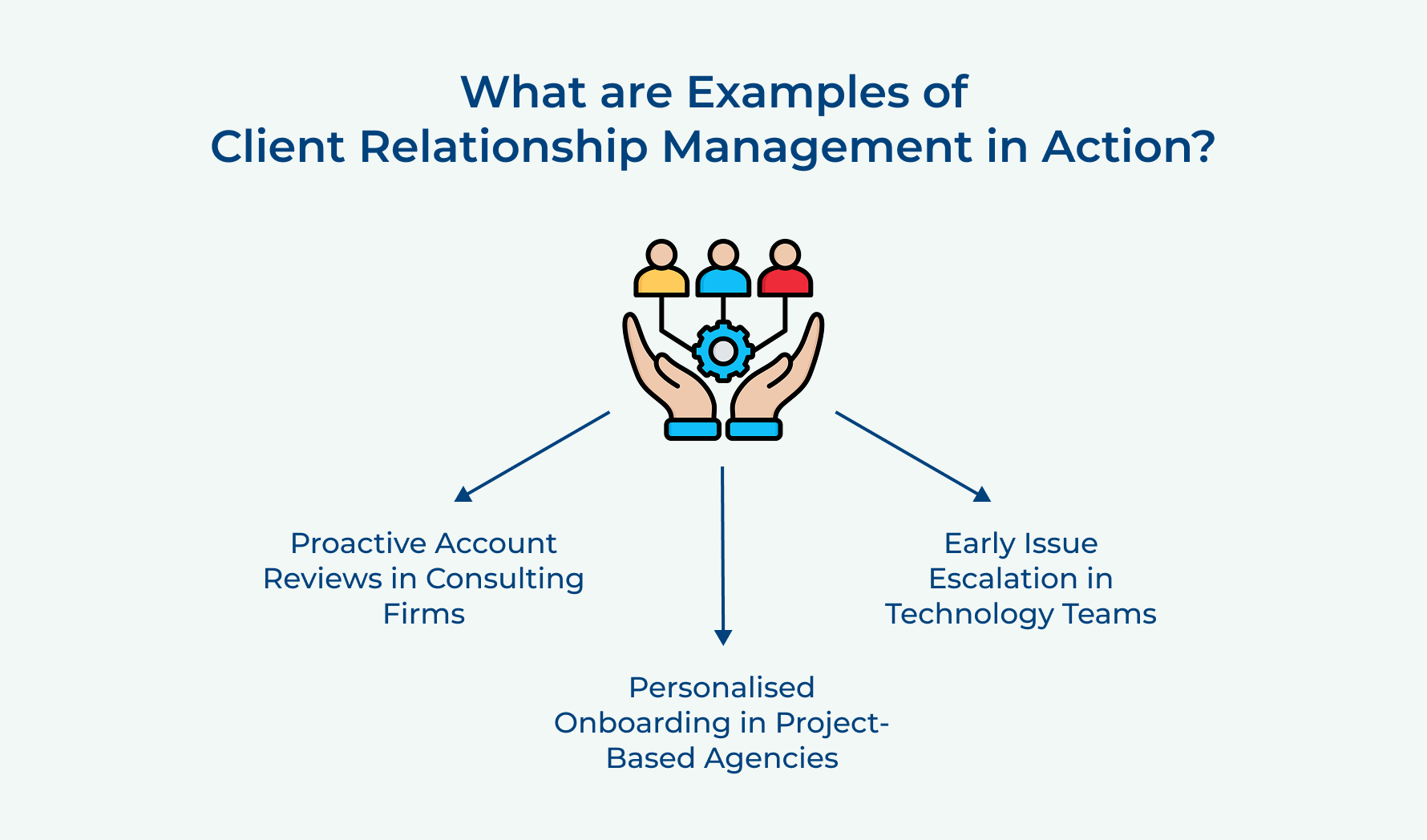
1. Proactive Account Reviews in Consulting Firms
A consulting firm schedules business reviews with every active client to assess progress on goals. Instead of waiting for clients to raise concerns, the team proactively arrives with data and recommendations.
A strong quarterly review typically covers:
- Performance metrics from the last quarter against agreed deliverables.
- Upcoming project risks that need early input or decision-making.
- New opportunities identified based on client’s business priorities.
2. Personalised Onboarding in Project-Based Agencies
A project agency builds a personalized onboarding journey for each new client instead of following the same generic process. It sets the tone for a relationship built on genuine understanding in real time.
An effective personalised onboarding process includes:
- A dedicated kickoff session to map the client’s specific goals and success metrics.
- A communication plan to define preferred channels and update frequency.
3. Early Issue Escalation in Technology Teams
A technology delivery team uses its client relationship management (CRM) software to identify accounts showing signs of dissatisfaction before the client complains. Early warning signals allow the team to resolve issues while maintaining a good relationship.
An early escalation in the technology team looks like:
- Client response times and engagement tracking across all touchpoints.
- Schedule an unplanned check-in call when satisfaction scores drop below the threshold.
- Document resolution steps with CRM for your entire team aligned on recovery actions.
Elevate connections with Client Relationship Management
Good relationship management determines whether your clients stay, grow and advocate for your business long-term. It becomes one of the highest ROI a project-driven business makes when combined with the right strategy and tools.
- Strong client relations reduce churn and drive expansion revenue.
- Successful CRM depends on team adoption that clearly defines cross-departmental goals.
- Retention rate, NPS and satisfaction surveys keep your strategy grounded in real-time.
Ready to strengthen your client relationships? Start by auditing your current touchpoints and gaps your team identifies immediately. Businesses that consider client relationship management as an operational priority consistently outperform those that treat it as an afterthought.
Limit time — not creativity
Everything you need for customer support, marketing & sales.

Neeti Singh is a passionate content writer at Kooper, where he transforms complex concepts into clear, engaging and actionable content. With a keen eye for detail and a love for technology, Tushar Joshi crafts blog posts, guides and articles that help readers navigate the fast-evolving world of software solutions.