Benefits of Professional Service Automation to Consider
- What is PSA Software?
- Benefits of Professional Services Automation (PSA)
- Who Can Benefit From Using PSA Software?
- Components of PSA for Professional Services
- How to Choose the Right PSA Software for Your Professional Services Business?
- Boost Productivity With Automated Professional Solutions
- FAQs about Professional Services Automation Benefits

Key Highlights:
- Key benefits of professional services automation include real-time visibility into resource utilization, project margins and billing accuracy across each phase.
- Connects project delivery, financial management and enterprise resource planning into one unified system to eliminate profit margin loss.
- Firms that adopted PSA software achieve stronger project profit margin, invoicing cycles and a delivery team that scales without headcount growth.
Think of a situation where you are having the best team and planning for project delivery, but losing revenue as well as having inconsistent profit margins. It is the disconnected processes that compound quietly into real financial damage every single project delivery.
Service firms that integrated PSA platforms into their existing workflow have increase billable utilization rate by 15% than spreadsheets and manual handling. Professional services automation benefits are the measurable operational gains, such as resource planning, billing accuracy and client satisfaction.
Explore the nine core benefits of PSA software. It includes maximizing resource utilization and project margins without additional headcount. Also, get a clear visibility on how the right solution transforms performance across consulting firms, agencies and service businesses.
What is PSA Software?
Professional Services Automation (PSA) software helps service-based businesses manage projects, resources, time tracking and billing operations. It brings all operational features under one roof to eliminate complexity.
So, what is the benefit of PSA software? It acts as an operational backbone for teams handling client-facing work by connecting project delivery, financial tracking and team capacity in a way that simple spreadsheets cannot.
Think of PSA software as a solution that keeps all teams and managers aligned without constant back-and-forth communication. It gives every single source of truth to work from any phase of the project lifecycle.
Key objectives:
- Project management: PSA streamlines the planning, execution and tracking of a client from initiation to delivery.
- Resource optimization: The right people are assigned based on skills and availability.
- Time and expense tracking: Track billable hours and project costs to protect revenue as well as margins.
- Financial visibility: Real-time analytics and reporting include KPIs such as project profitability, budgets as well as forecasted revenue.
Benefits of Professional Services Automation (PSA)
Explore the benefits that PSA can bring in professional services, consulting firms, and organizations with automation to transform the way you operate for success.
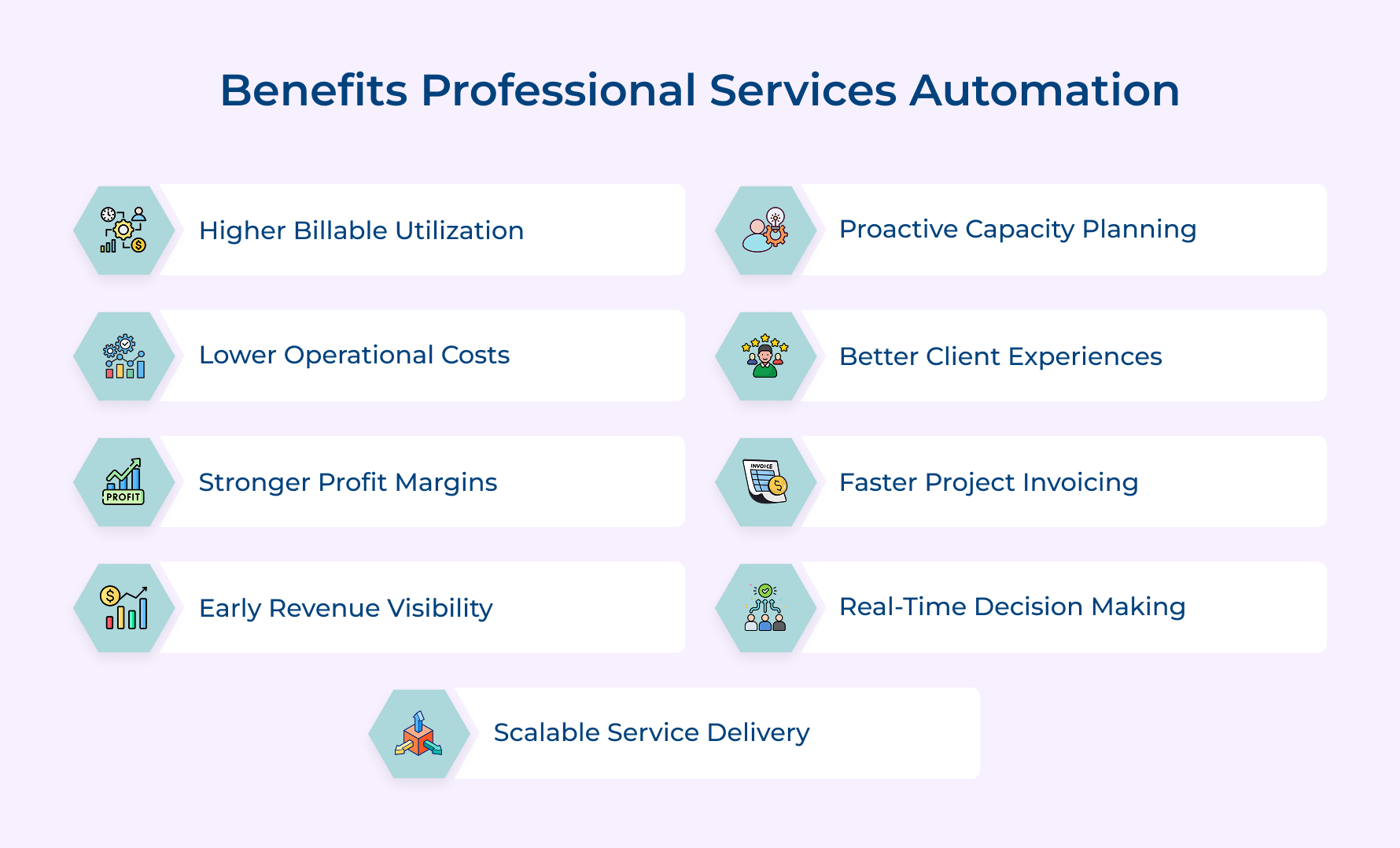
1. Maximize Billable Resource Utilization Rates
Most businesses lose revenue due to poor tracking of billable hours. It is not because of bad projects. A professional service automation (PSA) provides the benefits of closing the gap by capturing every billable minute with accuracy.
A healthy utilization rate of around 75–80% need deliberate scheduling with real data. Implementing a PSA in your business to achieve the benefit of aligning resource allocation based on real-time project demand.
Follow these key signs that show your resource utilization tracking attention:
- Billable hours are estimated but not logged daily
- Bench time does not come with a defined threshold that triggers reallocation
- Utilization reports are generated monthly instead of being reviewed weekly
So, what is the perfect way to achieve the benefit of PSA? Automating the resource reassigning process at the right moment requires. Utilization gaps quietly escalate into revenue loss that becomes difficult to recover.
2. Slash Operational Costs Without Cutting Corners
There are many services where operational costs increase quietly due to the use of redundant tools, manual processes and rework. A professional service automation (PSA) provides the benefit of consolidating scattered workflows into one system. It eliminates unnecessary costs across project delivery and finance.
Below are the hidden costs any PSA solution can address:
- Duplicate data entry: Disconnected does not allow teams to sync the same data across platforms, which PSA resolves.
- Manual timesheet workflows: The manual process of timesheet approval eats up hours that should be billable.
- Rework from misalignment: PSA offers the benefit of maintaining real-time data for project information, triggering one-time delivery.
Consider a situation when project managers stop chasing timesheets with the benefit of PSA that redirects toward actual billable work. A unified system enables finance and delivery teams to work from the same data, eliminating miscommunication over time.
3. Drive Stronger Project Profit Margins
Project profitability is all about identifying margin leaks at every stage of the delivery. Implementing professional service automation provides the benefit of financial granularity at each task level.
So, why do most projects finish on time but miss margin targets? Untracked scope creep and unbilled hours are the answers that quietly increase the budget. PSA software tracks these early for project managers to correct course before any financial damage.
The solution also includes planned vs actual margin for early visibility, which separates profitable firms from those depending on volume.
Key indicators of margin erosion need to be monitored:
- Hours variance: Actual hours increase by 10% in early phases, signaling budget risk.
- Unbilled adjustments: Frequent invoicing is the sign of systemic gaps in billable work.
- Revision cycles: change request for unplanned client demands not raised, which silently consume budgeted hours.
So, how does professional service automation help? Implementing the best PSA provides the benefit of real-time margin data at the task level across the business. Based on it, project leaders make corrections instead of waiting for financial reviews.
4. Spot and Capture Revenue Opportunities Early
A positive client relation in the most overlooked revenue in a services business. The right solution identifies patterns in project data. It reveals timely conversation expansion and is relevant.
Track these revenue KPIs in your PSA system:
- Repeated scope requests: Same client asking for work signals for structured communication.
- Project closure gaps: Engagement completion with no extra demand from the client that might be a revenue opportunity.
- Dormant high-satisfaction accounts: Strong satisfaction scores from the client, but no new engagement available.
Real-time data sync is the benefit of professional service automation, which helps account managers open conversations backed by delivery data instead of guesswork.
Revenue conversations started based on project data have a significantly higher conversion rate. It also shortens the sales cycle because client context is already synced inside the PSA.
5. Plan Capacity Before Bottlenecks Hit Delivery
Reactive capacity planning is the most expensive habit of a professional services firm that uses automation and real-time analytics of PSA that offers the benefit of real-time visualization in resource availability.
Follow this capacity planning checklist to use every week:
- Are there enough resources allocated in projects fully resourced for the next few weeks?
- Are any roles approaching 90% of resource utilization?
- Are new proposals tested against the current available resources?
One of the important benefits of PSA is that it shifts capacity planning to a forward-looking strategic discipline for consulting firms. Project managers have access to see weeks ahead for making e-sourcing decisions.
Consider the following scenarios for capacity planning:
- Unplanned acceleration: Early approval from clients can compress timelines and overload resources without warning.
- Sudden attrition: a key resource is exhausted mid-project without a backup plan, leading to delivery at risk.
So, what about the situation where no capacity plan anticipates? A good professional service automation provides the benefit of Structured visibility to leaders, enough time to make controlled adjustments.
6. Deliver Consistently Exceptional Client Experiences
A PSA provides structured touchpoints to keep clients informed in real time without depending on individual team members.
So, what are the client experience benefits a professional association offers:
- Automated milestone updates: Status updates with real milestones go out consistently without project managers remembering.
- Live client dashboards: Give clients shared visibility into deliverables throughout the project lifecycle.
- Change request workflows: Change processes protect both parties from scope ambiguity as well as billing and invoicing disputes.
Clients with clear visibility into project progress feel in control even during mid-engagement changes. This transparency converts a difficult moment into a trust-building opportunity.
7. Accelerate Accurate and Timely Project Invoicing
One of the most viable problems is late invoicing in most businesses. The solution links billable hours directly to invoicing without manual intervention.
So, what is the need for invoicing accuracy over invoicing speed? Consider a situation when an invoice is sent quickly, but errors trigger a dispute process, leading to delays in payment. A PSA provides benefits to professional firms by making sure that every line item has an approved timesheet and deliverables before billing.
Before passing a bill to a client, consider this checklist:
- Are all timesheets for the billing approved by the project leader?
- Are expenses categorized into both billable and non-billable?
- Is there a pending scope change included or deferred to the next billing cycle?
- Did the client approve the invoicing format and the delivery channel followed?
Invoices within two days of milestone completion lead to stronger working capital than monthly cycles. It is achievable for your business to have integrated time tracking, approvals, and billing software.
Follow these benefits PSA offers to eliminate invoicing delays:
- Timesheet gaps: PSA helps in maintaining unapproved timesheets with automation to streamline the entire invoicing cycle.
- Milestone ambiguity: Clear milestone management leads to accurate client billing and maintains relationships.
- Approval bottlenecks: Automate multi-step manual approval chains to fast forward the invoice billing when the underlying data is already accurate.
So when you focus on reducing the invoicing cycle to days, it compounds to the annual cash flow.
8. Make Faster Decisions With Real-Time Data
Due to missing data, most project-driven businesses delay decisions by two days, leading to measurable financial cost. PSA changes weekly status meetings with a live operational dashboard available to leaders.
The risk is not only slow decisions but also confidently wrong decisions made on outdated project information.
Consider these high-value decisions that real-time data supports:
- New project acceptance: Real-time capacity data tells leaders that taking on a new engagement is viable.
- At-risk project escalation: Real-time signals to manage risks before they become visible to the client.
- Service line profitability: Margin data helps leadership double down on what works and fix what does not.
The firm’s decision-making culture shifts from reactive to proactive when leadership pulls a profitability process in real time. This shift is one of the most underrated benefits of implementing PSA system.
9. Scale Delivery Without Scaling Your Headcount
A growth firm does not need to hire proportionally for every new project. Instead, PSA creates operational leverage to take on more work with existing teams. Below are the operational functionalities inside PSA that drive delivery:
- Standardized project templates: Reusable structures cut capacity planning time on every new engagement.
- Automated admin workflows: Timesheet approval routing eliminates manual follow-up, consuming bandwidth.
- Historical budget frameworks: Cost and hours data feed into more accurate estimates for future work.
So what does scaling actually look like for a mid-size firm? It is similar to winning 30% more projects while keeping the team the same size. PSA converts one-time delivery into repeatable operational steps.
Who Can Benefit From Using PSA Software?
PSA software is built for businesses where client billing, budget planning and managing multiple engagements are the key operations.

Consulting Firms
Consulting firms get the most benefit from professional service automation software by removing the need to juggle multiple engagements for every billable hour, leading to improved profitability. Even high-performing consultants miss revenue without weekly tracking.
Untracked time across projects creates margin leaks that are difficult to identify. PSA software gives consulting firms the benefit of getting financial visibility to protect margins across every active engagement.
Marketing Agencies
Marketing agencies run several campaigns simultaneously, leading to resource conflicts that damage client relationships as well as retention rates. The right solution gives teams the structure to deliver consistently without employee burnout.
Legal Firms
Legal firms operate in an environment where client billing is the optimal need. Every billing unit that goes unrecorded is permanently lost.
A professional service automation software tracks every billable unit accurately, protecting revenue as well as client trust. It also creates a clear audit trail that supports transparent client billing.
Engineering Companies
Engineering companies manage long-cycle projects where budget overruns are the most common issue compounding across multiple delivery phases. PSA provides real-time financial visibility to keep complex deliverables within budget and schedule.
Resource misalignment also creates downstream delivery risks, which a PSA uses automation to allocate the right people at the right project phase without conflicts.
Components of PSA for Professional Services
PSA software provides the most benefits with the ecosystem of interconnected components that collectively drive project delivery, financial accuracy and operational efficiency.
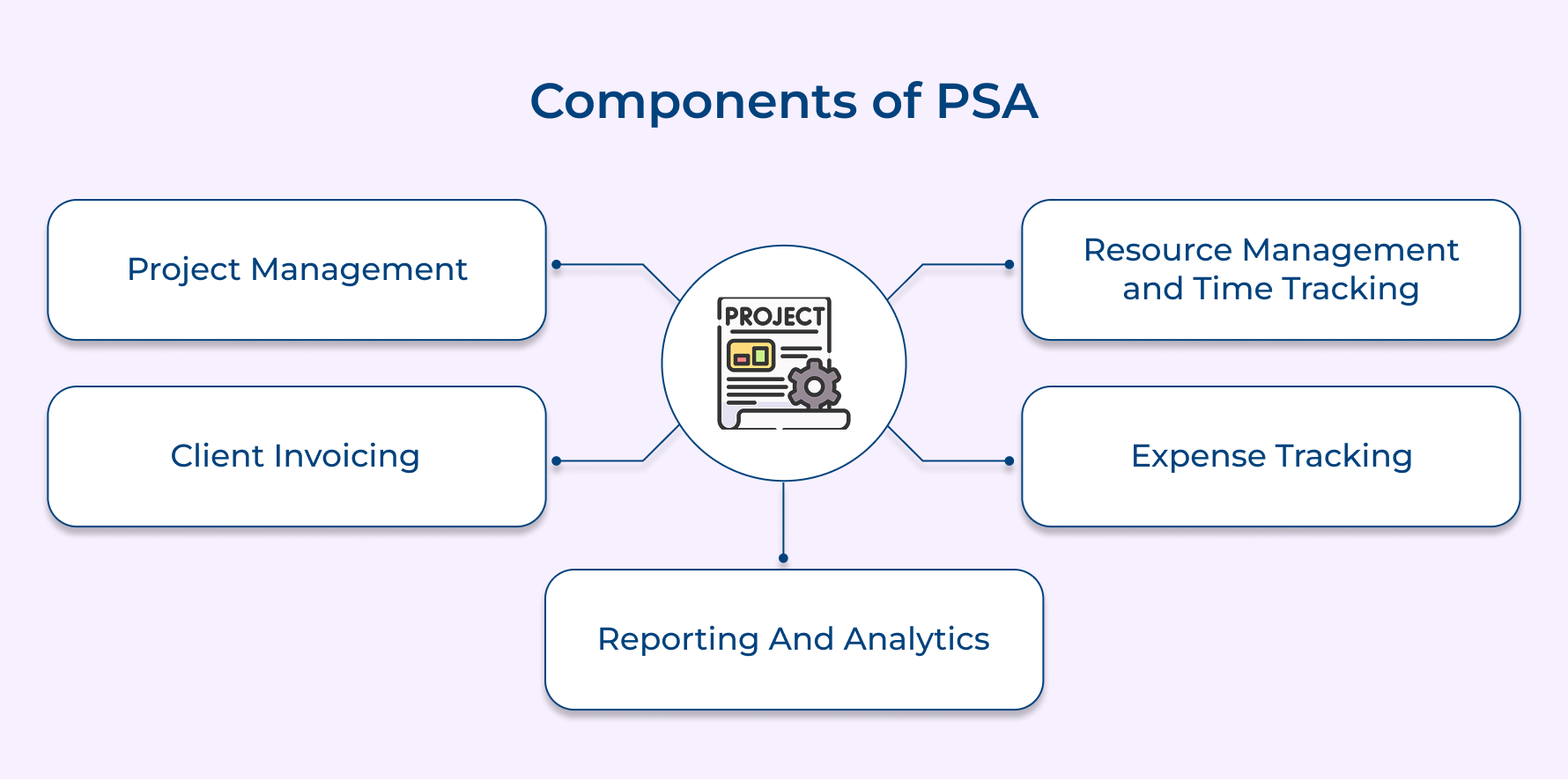
Project Management
Project management gives teams a structured framework to plan, execute and monitor every client task from initiation to closure. It replaces spreadsheets with a single unified tool that keeps milestones and task ownership visible.
Resource Management and Time Tracking
Resource management within a PSA software offers the benefit of allocating the right projects based on skills, availability, and targets. Integrated time tracking helps in capturing every billable and non-billable hour in real time.
Client Invoicing
PSA offers client invoicing functionality that directly links to approved timesheets and project milestones. It reduces manual steps from the billing cycle. The direct connection shortens invoice timing while making sure that every client receives accurate billing based on the delivery data.
Expense Tracking
The component gives real-time visibility of project costs to make sure budgets reflect the true cost of delivery. So what happens when every expense logged against a project feeds? It directly reflects its profit margin and gives an accurate picture of margin performance.
Reporting and Analytics
PSA software’s reporting and analytics convert raw data into actionable intelligence for leaders to act on immediately. It gives decision-makers the visibility to identify risks, spot opportunities, and make informed operational decisions across the project lifecycle.
How to Choose the Right PSA Software for Your Professional Services Business?
The right PSA software is all about finding a system that helps businesses actually deliver work. It becomes the operational backbone your teams rely on.
- Evaluate workflow fit first: Blends with your existing delivery processes without affecting the structural changes on your team.
- Assess integration capability: PSA must connect with your existing finance and CRM tools to create a real-time data sync as well as management.
- Prioritize scalability over current needs: The right solution supports the business to build toward success and not just for the sake of operations.
- Validate reporting depth: Leadership needs granular profitability and utilization data to make accurate operational decisions.
- Examine implementation and support quality: Implement a good PSA software that offers vendor onboarding support that benefits in long-term success.
- Test user adoption potential: A PSA your delivery team resists using will never return its intended value, regardless of its functionalities delivered.
Boost Productivity With Automated Professional Solutions
Professional services automation benefits go far beyond time management. It builds a delivery infrastructure that connects with every project delivered. Firms that implemented it are consistently reporting stronger margins and faster invoicing cycles.
- Improves resource utilization with real-time visibility into capacity, availability and allocation gaps.
- Built-in billing and financial management helps in reducing invoicing delays to increase protected revenue.
- Real-time analytics help consulting firms to identify margin risks early and make faster decisions across each engagement.
Start your free trial of Kooper today and measure the operational impact after the first project delivery. Service firms that leverage professional services automation benefits build a scalable delivery engine that grows stronger with every project delivery.
Limit time — not creativity
Everything you need for customer support, marketing & sales.

Neeti Singh is a passionate content writer at Kooper, where he transforms complex concepts into clear, engaging and actionable content. With a keen eye for detail and a love for technology, Tushar Joshi crafts blog posts, guides and articles that help readers navigate the fast-evolving world of software solutions.