How to Reduce Time to Fill Faster in Hiring

Key Highlights:
- Reducing time to fill ensures project continuity, revenue growth, and client satisfaction.
- Optimized sourcing channels strengthen your talent pipeline, improving candidate quality while cutting down unnecessary screening and communication delays.
- Applicant Tracking Systems boost candidate engagement and coordination, ensuring faster feedback loops with smoother end-to-end hiring execution.
Your best candidate just accepted another offer while your hiring team was still scheduling the third interview round. Extended recruitment timelines cost you top talent and leave critical positions unfilled for months while your existing team struggles with increased workloads.
The good news is that slow hiring isn’t inevitable or something you just have to accept as normal. Strategic improvements to your recruitment process can cut your time to hire significantly without sacrificing the quality of people you bring onboard.
This guide on how to reduce time to fill walks you through eleven proven strategies that organizations use to accelerate their hiring while maintaining standards. You’ll discover practical steps you can implement immediately to stop losing candidates to faster-moving competitors and fill your resource needs efficiently.
What is Time to Fill?
Time to fill measures how many days pass between posting a job opening and a candidate accepting your offer. This metric tracks the complete hiring timeline for a specific resource position. Organizations use it to understand how quickly they can bring new talent into their workforce and fill critical resource gaps.
When time to fill stretches too long, your work faces delays and existing team members shoulder extra workload. A lengthy hiring process can mean losing top candidates to competitors who move faster. Efficient time to fill helps maintain project momentum and prevents resource shortages that derail strategic initiatives.
Key objectives:
- Benchmark hiring efficiency: Compare your resource acquisition speed against industry standards to identify where your process lags or excels.
- Predict resource availability: Forecast when new team members will be available so you can plan project timelines and resource allocation with confidence.
- Identify process bottlenecks: Spot which stages in your hiring workflow slow down resource acquisition and need streamlining.
- Optimize recruitment costs: Reduce expenses associated with prolonged vacancies and extended search periods for critical resources.
- Improve candidate experience: Create a faster and more responsive hiring journey that respects candidates’ time as well as increases offer acceptance rates.
Important Factors that Affect Time to Fill
Several variables influence how quickly client-based businesses can secure the right resources for their projects. Understanding these factors helps you anticipate delays and adjust your recruitment strategy accordingly.
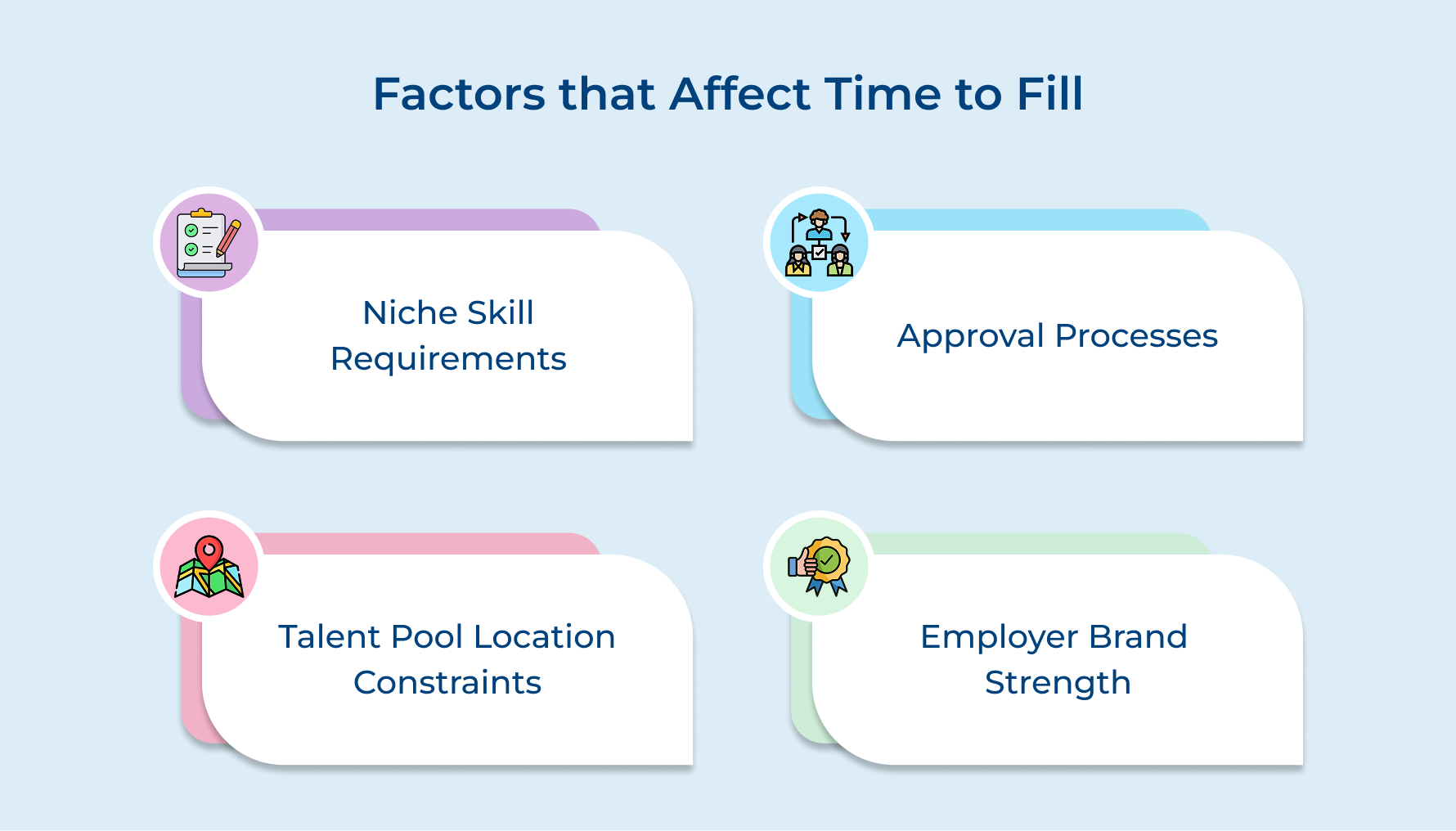
1. Niche Skill Requirements
Projects needing rare technical expertise naturally take longer to staff since qualified professionals are scarce. Using recruitment software helps streamline searches and identify hard-to-find specialists faster, cutting down manual effort while expanding your reach.
2. Approval Processes
Client sign-offs often delay hiring, especially in project-based environments. Automated scheduling reduces coordination time by syncing interviews, reminders and feedback loops – keeping hiring decisions on track.
3. Talent Pool Location Constraints
Roles that require onsite work or specific time zones narrow the available talent pool. Targeted candidate sourcing helps reach qualified professionals in restricted regions and minimizes time spent chasing unsuitable applicants.
4. Employer Brand Strength
A strong reputation attracts talent more easily. Tracking recruitment metrics helps measure brand impact and optimize outreach, especially when engaging passive candidates who aren’t actively job hunting.
How to Reduce Time to Fill in 8 Effective Ways?
In this article, we delve into eight effective strategies to help you minimize the time-to-hire, ensuring that you secure the best talent for your team in a timely manner.
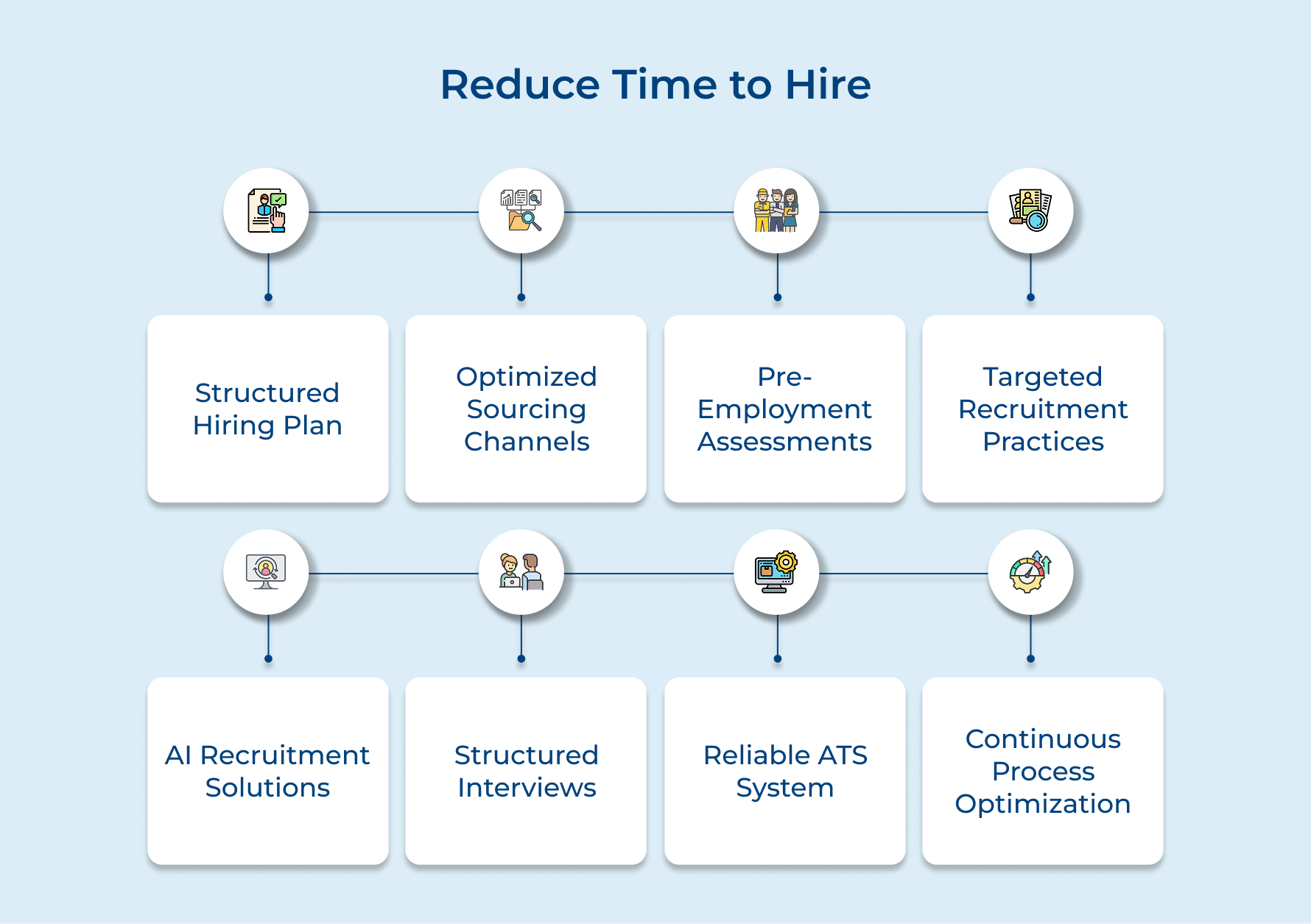
1. Outline a Structured Hiring Plan
A structured hiring plan gives HR teams a clear roadmap, reducing confusion and keeping the recruitment process consistent. Without it, hiring stalls and candidates lose interest.
Define recruitment objectives to clarify success metrics and set realistic targets. Build a strong value proposition that helps attract top talent faster. Choose the right recruitment management system to centralize communication and track progress in real time. Allocate budgets wisely across job ads, tools and assessments to prevent funding hiccups.
If you’re wondering how to reduce time to fill, the key is documentation and alignment. For instance, one marketing agency cut hiring time from 45 to 28 days simply by mapping every step, accounting for client approvals and setting clear timelines that kept everyone accountable.
2. Optimize Your Sourcing Channels
Channel optimization means directing recruitment toward platforms that bring in quality candidates instead of chasing quantity. This focused approach strengthens your talent pipeline and saves time.
Here’s how to make it work:
- Identify effective sources: Track where your best hires originated—LinkedIn, GitHub, or niche job boards.
- Evaluate past performance: Compare candidate quality, offer acceptance rates and time spent on each channel.
- Prioritize high-return platforms: Double down on those that consistently bring strong candidates quickly.
- Eliminate low-performing sources: Cut channels that generate volume without conversions.
Measure the average hiring speed per source over six months to learn how to reduce time to fill. Use this data to focus efforts on channels that deliver faster, higher-quality hires and streamline your recruitment strategy.
3. Add Pre-Employment Assessments
Pre-employment assessments help you evaluate candidates’ real skills and work styles early, saving time while improving hiring accuracy. Instead of relying solely on resumes or interviews, they provide data-driven insights that strengthen candidate engagement and hiring confidence.
Here’s how they help and how to use them effectively:
- Accelerate hiring: Filter out unqualified candidates early to shorten interviews and reduce decision delays – a key step in how to reduce time to fill.
- Enable objective decisions: Assessments provide measurable results, minimizing internal debate among hiring managers.
- Enhance preparedness: Candidates gain realistic job previews, improving retention and reducing early exits.
- Integrate with tech: Use an Applicant Tracking System to automate test delivery as candidates progress through pipeline stages.
- Set clear benchmarks: Define success criteria based on top performers to ensure consistent evaluation standards.
4. Prioritize Targeted Recruitment Based on Resource Need
Targeted recruitment means directing your hiring energy toward positions that create the most urgent impact on your business operations and client commitments. When you treat every open role as equally important you end up with critical resource gaps that stall revenue-generating projects while less essential positions consume disproportionate attention.
Think of your open positions like a triage system where you assess which vacancies threaten immediate project delivery versus those you can fill more gradually. A client-facing consultant role that starts in three weeks demands faster action than a back-office support position with flexible timing.
Pro tips:
- Create a priority matrix that scores each opening based on project deadlines and revenue impact so everyone knows which searches deserve premium sourcing efforts.
- Communicate your prioritization decisions transparently with hiring managers so they understand why certain roles receive faster movement and can adjust their project planning accordingly.
5. Embrace AI Recruitment Solutions
AI recruitment solutions use machine learning algorithms to automate repetitive hiring tasks and analyze candidate data faster than human reviewers possibly could. Client-based businesses handling multiple project staffing needs find AI essential because it processes hundreds of applications instantly while your team focuses on qualified candidates.
Here’s how AI technology transforms resource hiring speed in practical ways:
- Resume screening automation: AI systems scan incoming applications against your job requirements within seconds and rank candidates by match quality so your recruiters review only top prospects instead of every submission.
- Intelligent chatbot engagement: AI-powered chatbots answer candidate questions at any hour as well as schedule screening calls automatically which eliminates back-and-forth email delays that add days to your timeline.
- Predictive matching analytics: Advanced AI analyzes historical hiring data to identify which candidate characteristics predict successful project performance so you make faster decisions backed by pattern recognition.
Consider a consulting firm that previously spent three weeks screening 200 applications for each project manager opening. After implementing AI screening they reduced initial review to two days because the system instantly filtered candidates meeting required certifications and experience.
6. Conduct Structured Interviews
Structured interviews use standardized questions and scoring to ensure every candidate is evaluated fairly as well as consistently. This approach removes bias, speeds up comparison and shortens hiring timelines.
Here’s how to streamline your process:
- Prepare question sets: Focus on job-relevant skills and daily responsibilities.
- Standardize feedback: Use a shared scoring rubric so hiring managers receive comparable data.
- Define timelines: Communicate interview dates upfront to keep candidates and teams aligned.
- Balance structure with flexibility: Allow brief open discussions so candidates can showcase unique strengths.
For resource-based roles, ask targeted questions like:
- How do you manage tight deadlines across multiple projects?
- What’s your approach to learning new technical skills?
- How do you communicate progress with teams and clients?
7. Invest in Application Tracking Systems
An application tracking system centralizes all candidate information and automates communication workflows that otherwise require manual coordination across multiple stakeholders. Lack of this technology forces your hiring team to drown in email chains while candidates wait days for responses that damage your brand.
Evaluate these factors when selecting an ATS that accelerates resource acquisition:
- Integration capabilities: Ensure the system connects with your job boards and calendar tools so data flows automatically without manual entry.
- Customizable workflows: Look for platforms that let you design approval chains matching your specific decision-making structure for different resources.
- Reporting functionality: Choose systems that track time to hire metrics by role so you identify bottlenecks and improve performance.
- User experience quality: Prioritize intuitive interfaces that your team and candidates navigate easily without extensive training or frustration.
The right ATS eliminates administrative friction that adds days at each stage. Automated reminders keep interviewers on schedule and instant notifications alert managers when candidates complete assessments so resources move through your pipeline without waiting.
How Can Slow Time to Hire Affect Your Organization?
A prolonged hiring process creates ripple effects that extend far beyond empty chairs and delayed start dates. These consequences impact your team morale, client relationships and bottom line in ways that compound over time.
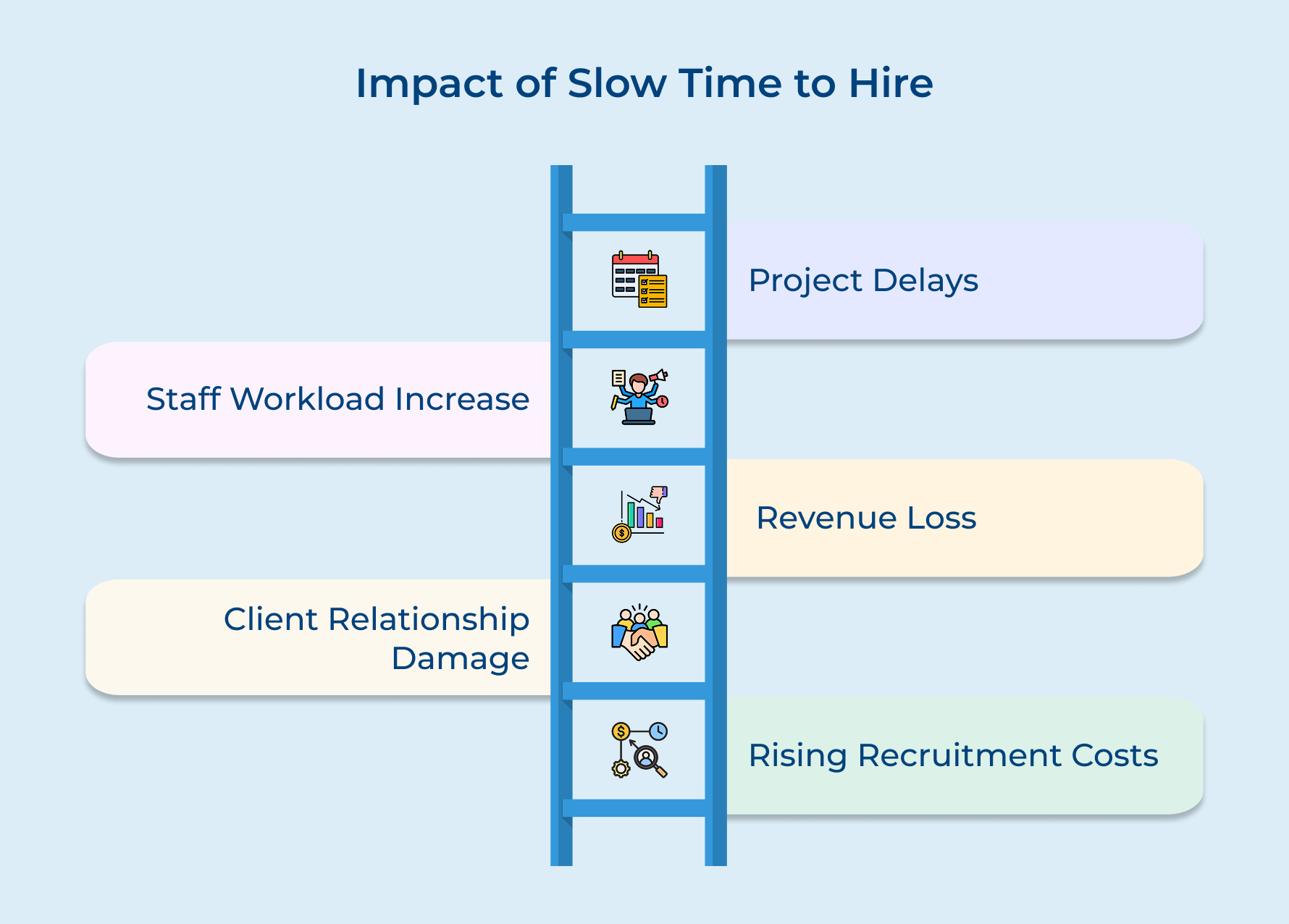
- Project delays and missed deadlines: Without adequate resources onboard your existing projects fall behind schedule and deliverables slip past agreed timelines. Clients grow frustrated when promised milestones aren’t met.
- Increased workload on current staff: Your existing team members absorb the responsibilities meant for unfilled positions which leads to burnout and decreased productivity. Overworked employees make more mistakes while delivering lower quality.
- Lost revenue opportunities: You turn away profitable client work because you lack the resources to staff new projects adequately. Revenue growth stalls while competitors with faster hiring capture market share.
- Damage to client relationships: Clients lose confidence when you cannot scale your team quickly enough to meet their evolving needs and urgent requests. Weak resource capacity signals unreliability as well as threatens contract renewals.
- Higher recruitment costs: Extended searches consume more recruiter hours, additional job board postings and repeated interview cycles that inflate your cost per hire. Financial resources drain away without producing results.
Discover Efficiency in Resource Hiring by Reducing Time to Fill
Focusing on how to reduce time to fill transforms your business, acquires talent and maintains competitive advantage. Implementing structured plans and leveraging technology helps you secure quality resources faster while reducing costs associated with prolonged vacancies.
The strategies outlined above work together to create a hiring system that respects candidate time and meets your organizational needs efficiently. Start by addressing your biggest bottleneck and gradually refine each stage until your entire recruitment process operates smoothly while delivering results consistently.
Limit time — not creativity
Everything you need for customer support, marketing & sales.

Shivank Kasera is part of the marketing team at Kooper, where he focuses on building content that helps agencies and service providers grow. With a keen interest in SaaS, operations, and scalability, he translates practical insights into actionable resources for business leaders.