9 Project Management Tips for Consultants That Actually Work
- What Is Consulting Project Management?
- What Are The Common Challenges in Managing Consulting Projects?
- 9 Practical Project Management Tips and Strategies for Consultants
- Why Is Project Management Important for Consultants?
- Elevate Your Consulting Game With Expert Project Management Strategies
- FAQs Project Management Tips for Consultants

Key Highlights:
- Effective project management for consultants includes scope management before any other client work.
- Keep complex consulting engagements consistent with structured check-ins, milestone tracking and risk reviews.
- Project management tips for consultants help in preventing silent project delivery failures with effective resource planning.
Have you thought about why most of the well-planned consulting projects fall apart during the execution phase? It does not fail due to bad planning.
The gap between great strategy and delivery is where consulting reputations are either made or broken.
A recent report shows that consulting firms wasted around $97 million due to poor project performance. Even the strongest consulting teams spend more time firefighting instead of actually delivering but fail without discipline.
Explore the guide to understand the best project management tips for consultants who want to deliver consistently. It will also help to protect client relationships and build a scalable standard across every engagement.
What Is Consulting Project Management?
Project management for consultants is a process of planning, executing and delivering client engagements within a defined scope as well as budgets. It makes sure that every project moves with clear accountability and measurable outcomes.
How Project Management Works for Consultants?
Businesses handle multiple client projects, making disciplined project management non-negotiable for quality as well as client trust. Consider an example of a strategy consulting firm where a consultant is managing a project for a client. They have to research, conduct interviews and final recommendations within a fixed timeline.
The most talented consultants will also lose control over deliverables if proper agile project management strategy and tips are not followed. It keeps every workstream aligned to the client’s objectives and increases profitability.
Key factors:
- Scope definition: Clearly establishing goals to prevent scope creep from derailing budgets.
- Stakeholder alignment: Keeping both internal teams as well as clients on the same page for faster decision-making.
- Resource planning: Assigning the right consultants with the right skill sets for each phase of project management directly impacts final deliverables.
- Risk management: Recognise potential bottlenecks and dependencies for teams to respond proactively.
What Are The Common Challenges in Managing Consulting Projects?
Managing consulting projects comes with distinct pressures that go beyond the standard. Without proper addressing, it can derail a well-planned engagement.
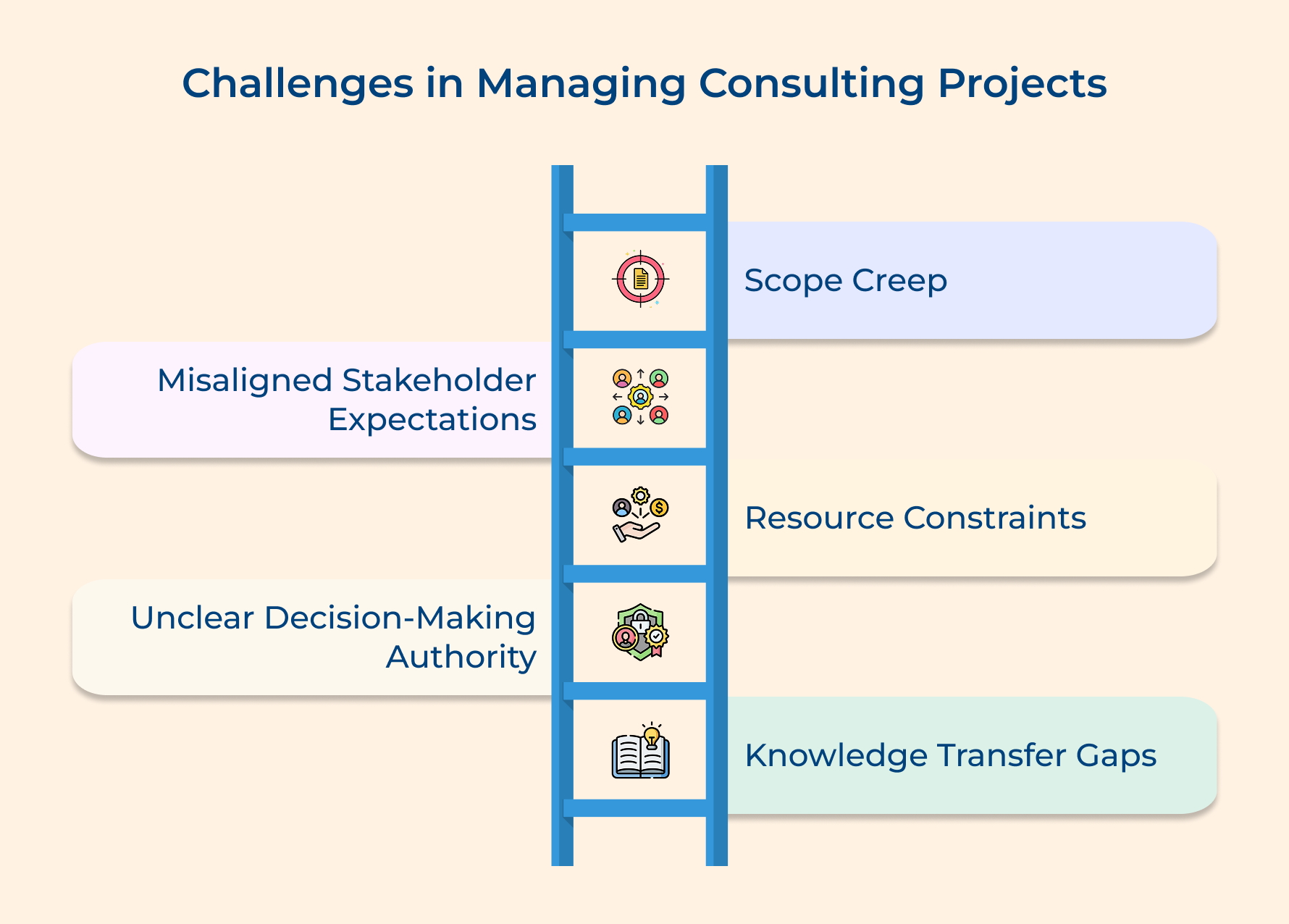
1. Scope Creep
Sometimes, client requests expand mid-deliverable. They see consulting as an open resource instead of a fixed-scope service. An informal scope setup process from the start separates firms that deliver on time from those that are constantly firefighting.
2. Misaligned Stakeholder Expectations
When multiple stakeholders are involved in the decision-making process on the client side with different definitions that gap surfaces fast during review cycles. It escalates to a trust issue by week eight if you don’t run a session in week one.
3. Resource Constraints
One of the fastest ways to compromise project delivery is allocating consultants across multiple management processes without clear planning. The real risk isn’t about under-allocation, it’s about not knowing you’re under-resourced until a deadline.
4. Unclear Decision-Making Authority
Chasing approvals through the wrong channels on the client side is another unavoidable delay in firms. Overcome it by mapping decision-making authority during project kickoff. Most teams skip this process.
5. Knowledge Transfer Gaps
A consulting engagement ends when the client team can independently execute on the recommendations and with proper follow-up on this. Consultants who use the knowledge transfer tips during project management can clearly see the changes.
9 Practical Project Management Tips and Strategies for Consultants
Managing consulting projects requires balancing timelines, client expectations and team coordination. These practical project management tips help consultants improve delivery, communication and overall project success.
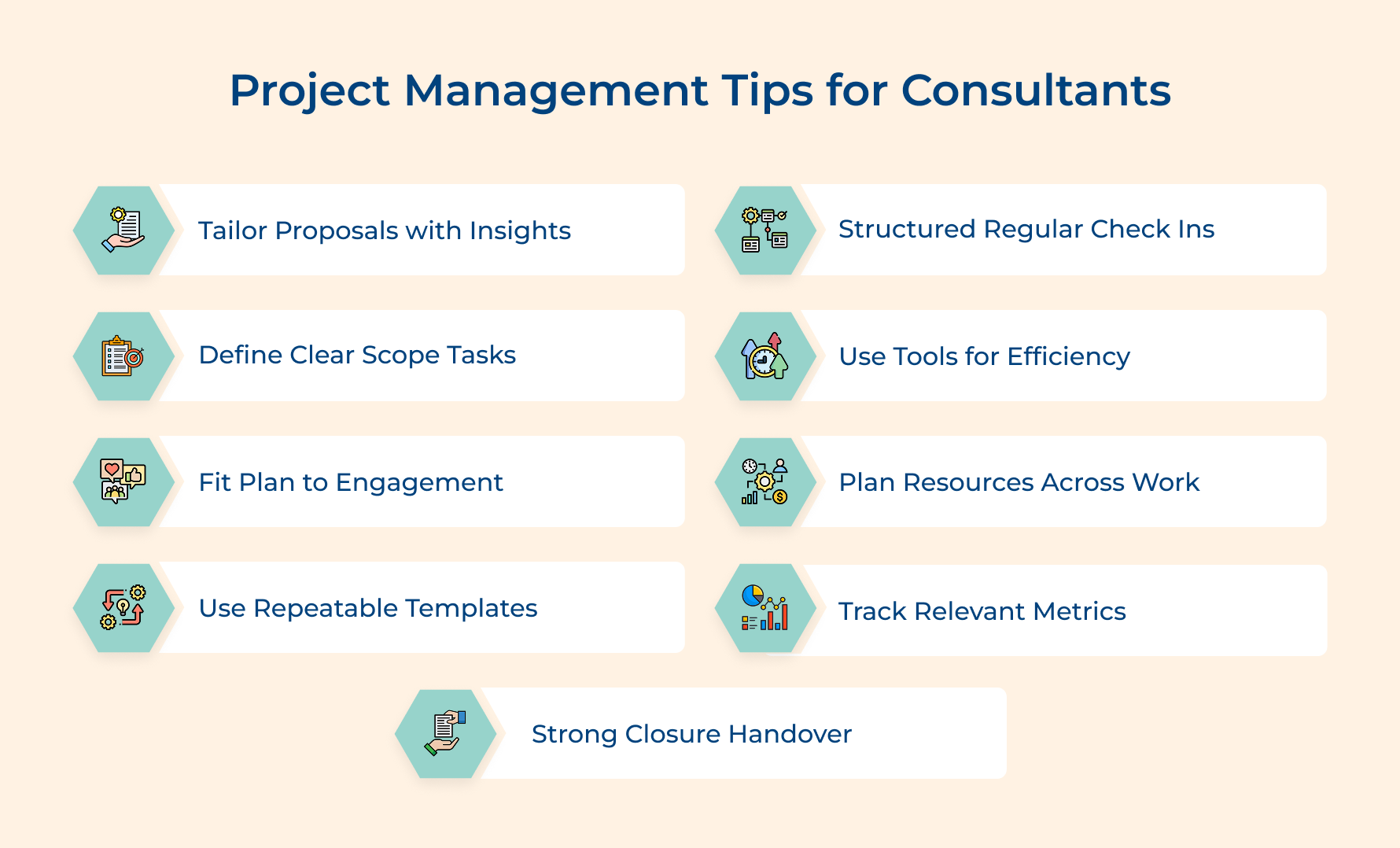
1. Tailor Your Proposals With Project Management Insights
A proposal is the first signal to your client that explains the method of delivery. Consultants embedding project management into their proposals positively win more engagements and face fewer delivery surprises.
So, how exactly does a proposal reflect project management thinking? Treat the proposal as a delivery blueprint that maps actions, ownership and what success looks like before signing the contract.
Make sure to include the following 4 things in the proposal:
- Defined scope boundaries: Clearly state what is included and excluded outside the documentation to prevent misalignment.
- Milestone-based timeline: Break it into management project phases with clear checkpoints instead of presenting in a single format.
- Resource allocation overview: Indicate roles that need to be involved in each phase so that the client understands the real value of your business.
Pro tip: Consultants use this project management tip for building smoother project kickoffs. The groundwork for delivery accountability is already established.
2. Nail Down Project Scope Into Manageable Tasks Lists
One of the most important tips for consultants in a project management setting is that the scope almost always starts with the setup stage. What happens when a consultant implements it effectively? You will protect your teams from endless rework and clients from unexpected cost overruns.
Define Boundaries Before Any Work Begins
Waiting till mid-engagement to clarify your project scope drains team energy as well as client trust. The most effective way is to document every scope with proper review and signed off by the client before it starts.
Document Every Agreed Deliverable With Full Clarity
Specify deliverable descriptions such as “strategic recommendations” or “market analysis”. It provides an identification for both sides. It should have a proper format, depth, audience and expected outcome to minimise zero ambiguity.
Build a Formal Change Management Process From Day One
Generally speaking, scope creep happens mainly due to a non structured evaluation process and not irresponsible clients. A simple change request, along with timeline and budget provides a transparent way to handle needs.
3. Build a Project Plan That Fits the Engagement
The fastest way to lose control of delivery is a “generic project plan”. Each client engagement has different dynamics, so you have to adjust the plan to reflect realities instead of the standard internal template.
So what are the key considerations before building the plan? Lock the project scope before finalising the plan and identifying key stakeholders, as well as resource availability.
Follow the tips for building a new project management plan that fits engagement:
- Map milestones with client decision points: Design the project plan around milestones and not just internal completion dates.
- Assign clear ownership to every workstream: Every task on the plan needs to have a proper ownership as it helps in maintaining credibility.
- Build buffer around stakeholder review cycles: Client feedback loops take more time to complete, so it is recommended to plan.
Now, what happens during real execution challenges? Most of the time, the project plan becomes outdated within a few weeks of execution. It means the plan needs to be updated in real-time along with a designated owner.
4. Templatize Wherever Possible
Templatization isn’t about cutting corners. It’s about redirecting the team toward high-value thinking instead of repetitive formatting. Before building a project management template for a consultant, consider these checklist tips:
- Is the task performed across multiple engagements?
- Will the output follow a predictable structure regardless of who the client is?
- Can the template be built once and updated over time with minimal rework?
This question helps in identifying the right candidate for templatization, and the time invested in building the template will pay back quickly.
Now here comes the real question: when should the template be updated automatically and when does it need to be done manually? When output is highly strategic or needs original thinking, manual work is the right choice. Automation works best for process-driven tasks where consistency needs prioritization.
Pro tips:
- Update project templates after every delivery based on lessons learned and keep them relevant.
- Create a centralised library to store all templates for access by team members.
5. Establish Consistent and Structured Check-ins
A structured check-in rhythm is another necessary project management strategy or tip for consultants to keep the team aligned. It also prevents risks in real time and reassures that client engagement is managed effectively.
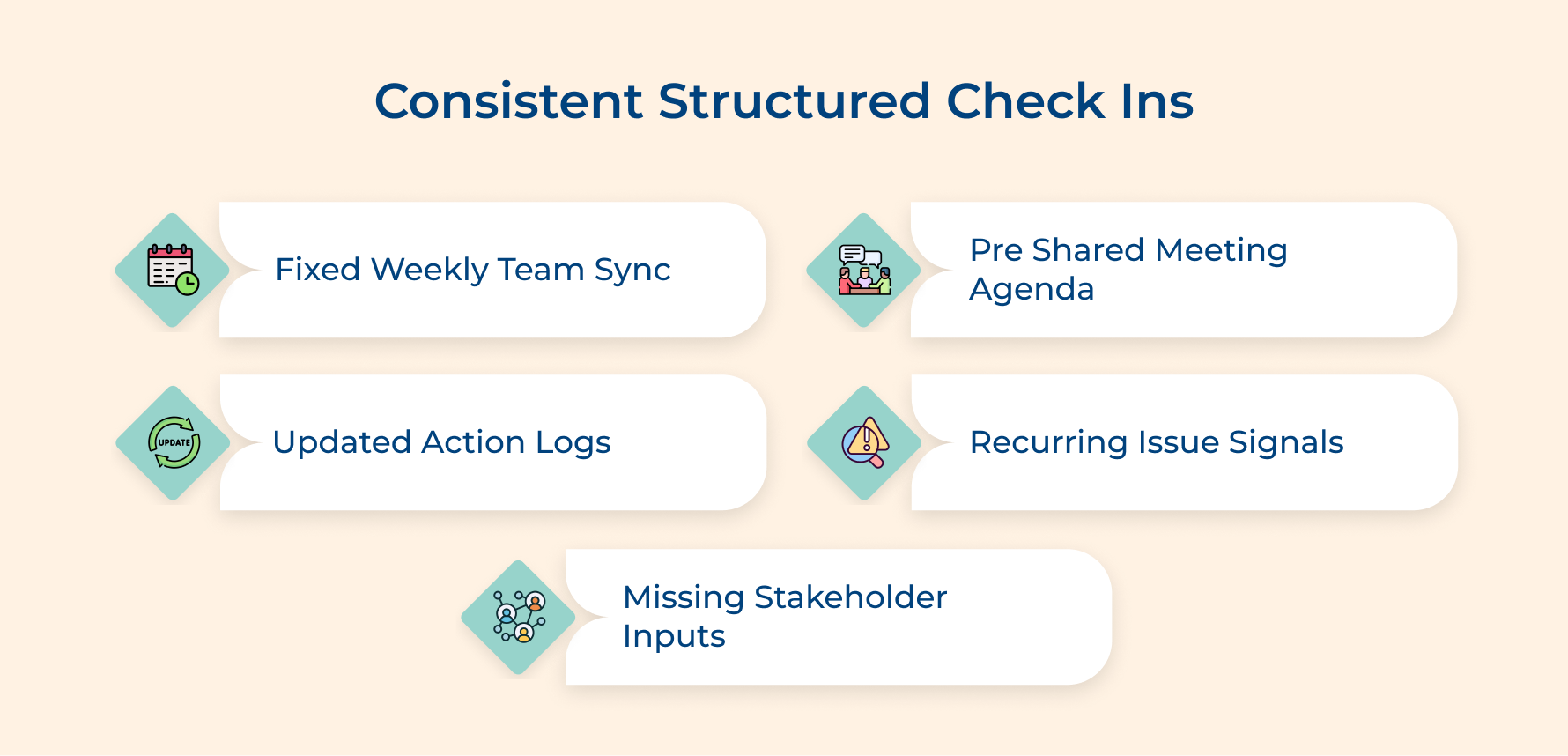
Follow the key elements of an effective consulting check-in structure:
- Does your calendar have a fixed weekly internal team sync?
- What is the pre-distributed agenda every client-facing check-in has?
- Are all the action logs updated after every session?
Your frequent check-ins serve as an early warning system. The format will also shift as the project moves through phases. Below are key signals that your check-in structure needs adjustment:
- After each meetings Issues are raised consistently
- Stakeholders arrive frequently without the inputs
- All Action items from the last sessions are not tracked or followed up on
6. Leverage Technology for Execution Efficiency
Consulting firms that are operating without a technology stack lose critical visibility into project health. The right tools give the team the clarity needed for decision making.
Below are the key factors to consider for choosing the right technology stack:
- Ease of adoption: choose a software that your consulting team can easily adjust.
- Cross-functional visibility: technology that will give your teams and clients real-time project visualisation.
- Integration capability: It should seamlessly connect with existing workflows that eliminate duplicate data entry and keep project information accurate.
- Scalability across engagements: The platform should scale with the growing project volumes without a bottleneck.
Every technology decision must be made before kickoff with clear guidelines and with a proper team adoption process. Below are the key software used in project management for consultants:
- Project tracking and task management: You can use it to centralise ownership and deadlines so that execution never relies on separate email threads.
- Collaborative documentation platforms: Allow consultants to create controlled co-creation of project documents across teams and the client record in real time.
- Communication and workflow tools: Eliminate general communication by organising project conversations in a workstream.
7. Master Resource Planning Across Engagements
Let’s start with the question of what happens when resource planning across projects in consulting is not managed. It silently erodes team performance and client confidence at the same time.
An effective resource planning in project management works in a multi-engagement for consultants. It starts with full allocation across every project before committing any client work.
Implement these project management tips for consultants include:
- A real-time capacity mapping: generate a live allocation view across all deliverables to make sure that there is no over-commitment, which is flagged before it escalates to a crisis.
- Skill-to-engagement matching: route and assign the right consultants to the right client tasks based on project-specific skill demands.
- Forward-looking availability planning: Scanning resource needs in advance to maintain allowed gaps before deadline pressure.
Consider an example of a senior consultant that acts as the subject matter expert across three projects for effective management, but without a capacity plan. It will compromise deliverables over time. A structured resource management plays a crucial role in preventing conflict at the planning stage.
8. Define and Track the Right Project Metrics
Another important tip for consultants in project management is that tracking activity-based metrics gives a real-time visualisation of project health, which goes undetected. Track metrics that directly signal deliverable status.
Consider an example of a consulting team tracking milestone completion rate, which drops to 30 per cent in week four. It signals that the project phase needs an immediate review. It prevents a minor workstream gap from escalating into a delivery failure.
Below are key core metrics every consulting engagement should track:
- Milestone completion rate: Measures scheduled milestones to directly reflect the health of the delivery plan.
- Scope change frequency: Tracks the number of times change requests arise and whether the original scope needs updates.
- Stakeholder engagement score: Monitors client participation quality in review sessions, as it is always an early warning of deeper misalignment.
- Budget utilization rate: Track actual budget spend against the plan so that financial overruns are addressed before escalating.
9. Build a Strong Closure and Handover Process
A structured handover process helps in converting a one-time client into a long-term advocate for your business. Project closure is the part where most firms lose the relationship they have worked on the entire engagement.
Document Lessons Learned After Every Engagement Ends
Capture what worked in your delivery project and what didn’t. It will immediately help in building a smarter and faster delivery capability over time.
Ensure the Client Team Can Execute Independently
A strong final report is not enough for seamless handover if the client lacks confidence to act on it without support. Create a detailed knowledge transfer session to build into the closure phase. It helps the client leave the engagement fully equipped to execute.
Close Every Project With a Formal Sign-Off Process
Start a formal sign-off with a documented boundary that protects the firm and the client from post-engagement disputes. Includes writing such as “all agreed outputs have been reviewed, and handed over” to maintain accountability against the original scope.
Why Is Project Management Important for Consultants?
Strong project management helps consulting firms to consistently deliver promises on time. Without it, even good strategic thinking fails to produce outcomes.
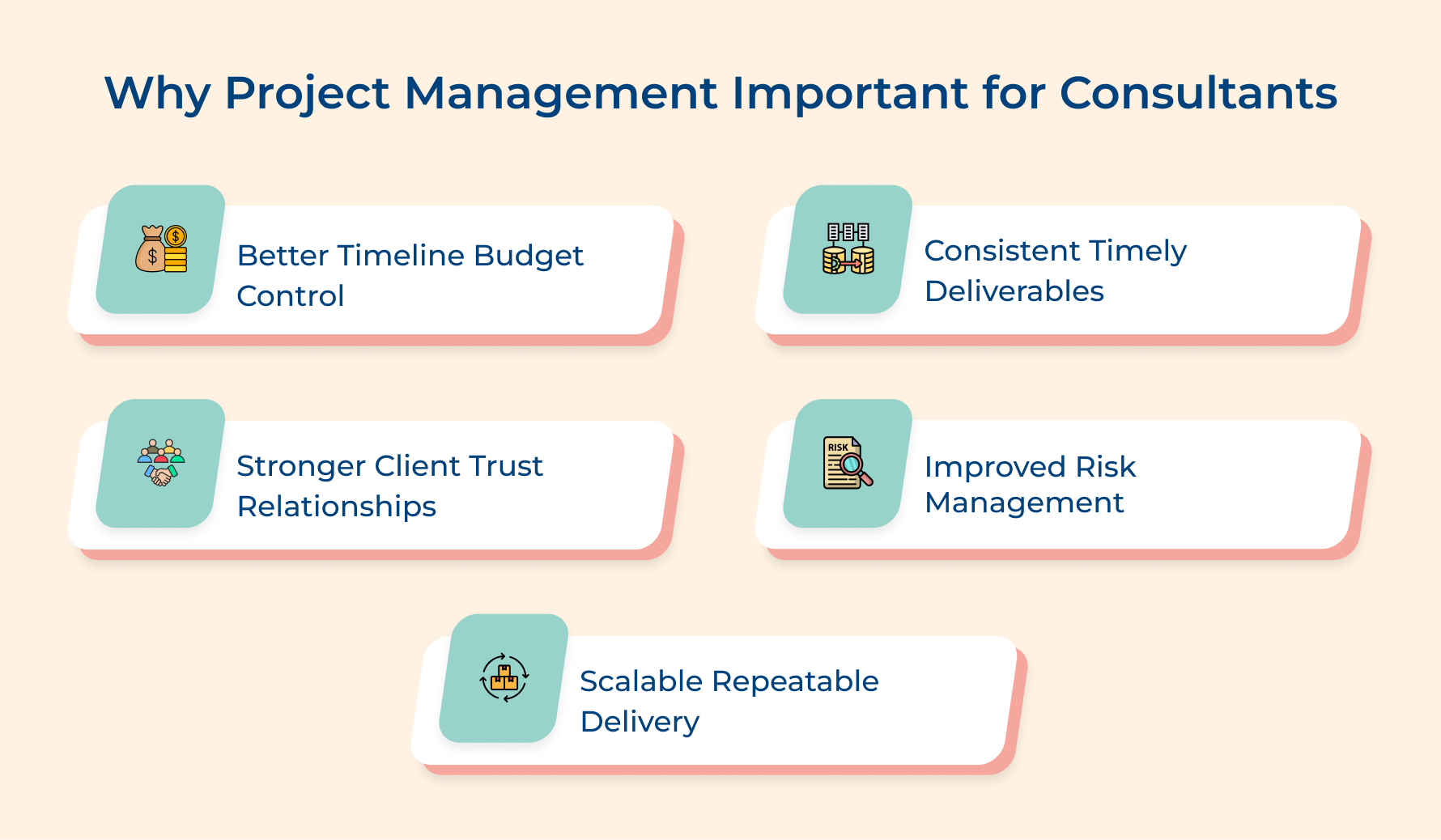
1. Improving Timeline and Budget Management
Most consultants overrun budgets because no one is actively managing the baseline plan during project management. Budget and timeline tracking at every phase helps in keeping the engagement financially healthy.
2. Ensuring Consistent and Timely Deliverables
Client satisfaction hits its peak when project deliverables either arrive as promised or don’t. Internal reviews into the project rhythm for consistency, a repeatable outcome rather than a happy accident.
3. Strengthening Client Trust and Relationships
Client trust increases through every milestone, and risk is flagged early or when every meeting is run with a clear agenda. Consultants that are bringing structured project management signals to clients that delivery is in the right hands.
4. Enabling Better Risk Management Across Engagements
Risks are the early signals that are never tracked and lead to derail consulting projects. Following consistent risk reviews every week helps in maintaining the project rhythm and separating firms’ profiles.
5. Driving Scalable and Repeatable Delivery
Think of a firm that depends on its best people, which helps in saving every engagement that cannot scale without that model. A structured project management approach creates a framework that maintains execution quality for consultants across every client.
Elevate Your Consulting Game With Expert Project Management Strategies
A good consulting delivery demands more than just a strategy and requires disciplined execution along with structured timelines. Build long-lasting client trust across every high engagement with seamless communication and delivery management.
- Protect project deadlines and relationships by mastering scope control, milestone tracking as well as alignment.
- Delivery discipline separates firms’ clients from those that simply move on.
- Transforms your approach to clients to affect resource allocation across their project deliverables.
Implement these project management tips for consultants and watch how quickly delivery quality improves. With the passage of time, the execution will become your firm’s core competency.
What does it mean? Consulting firms that are winning repeat business are the most disciplined in execution.
Limit time — not creativity
Everything you need for customer support, marketing & sales.

Neeti Singh is a passionate content writer at Kooper, where he transforms complex concepts into clear, engaging and actionable content. With a keen eye for detail and a love for technology, Tushar Joshi crafts blog posts, guides and articles that help readers navigate the fast-evolving world of software solutions.