What Are the Core Elements of Project Management?

Key Highlights:
- The core elements and components of project management turn scattered effort into a structured deliverable process.
- Scope creep starts with informal approvals and expands your budget, timeline, as well as risk beyond the defined deadline.
- Making sure no risk catches your project off guard by effective risk management to eliminate threats.
Have you ever wondered how or why a project falls apart? It is not that your planning and execution of the idea was wrong; instead, no one agreed on what “done” meant.
Businesses waste around $97 million for every $1 billion invested in poor project performance based on the report generated by the project management institute. The gap is due to the fact that core components of project management were ignored and poorly executed.
The guide helps you to explore the essential elements of project management, starting from scope to risk and communication. You can build projects based on the elements to make it deliverable on time and within budget.
What is Project Management?
Project management is the process of planning and organizing a project from start to finish. It makes sure that all key elements of project management combine every task, resource and milestone to deliver the right outcome within the agreed time as well as budget.
The first step is to break down the project scope into elements so that nothing is missed. A defined project management approach helps in building a proper structure. The complete effort has been made but without expectation is met.
The real control comes in project management from the components that help in tracking progress at every stage for informed decisions. Service firms play an important role as they bring structured frameworks that teams lack. It directly improves overall delivery quality and reduces the risk of overruns.
Key Objectives:
- Define and maintain the basic elements of project management included.
- Make sure that every phase of the project is completed within the specified deadline.
- Maintain financial stability without losing quality.
- Deliver exceptional project outcomes that meet the standards expected.
Key Elements & Components of Project Management
Let’s explore the main elements and components of project management that enable you to transform chaos into order. Prepare to boost your project management prowess and drive to success.
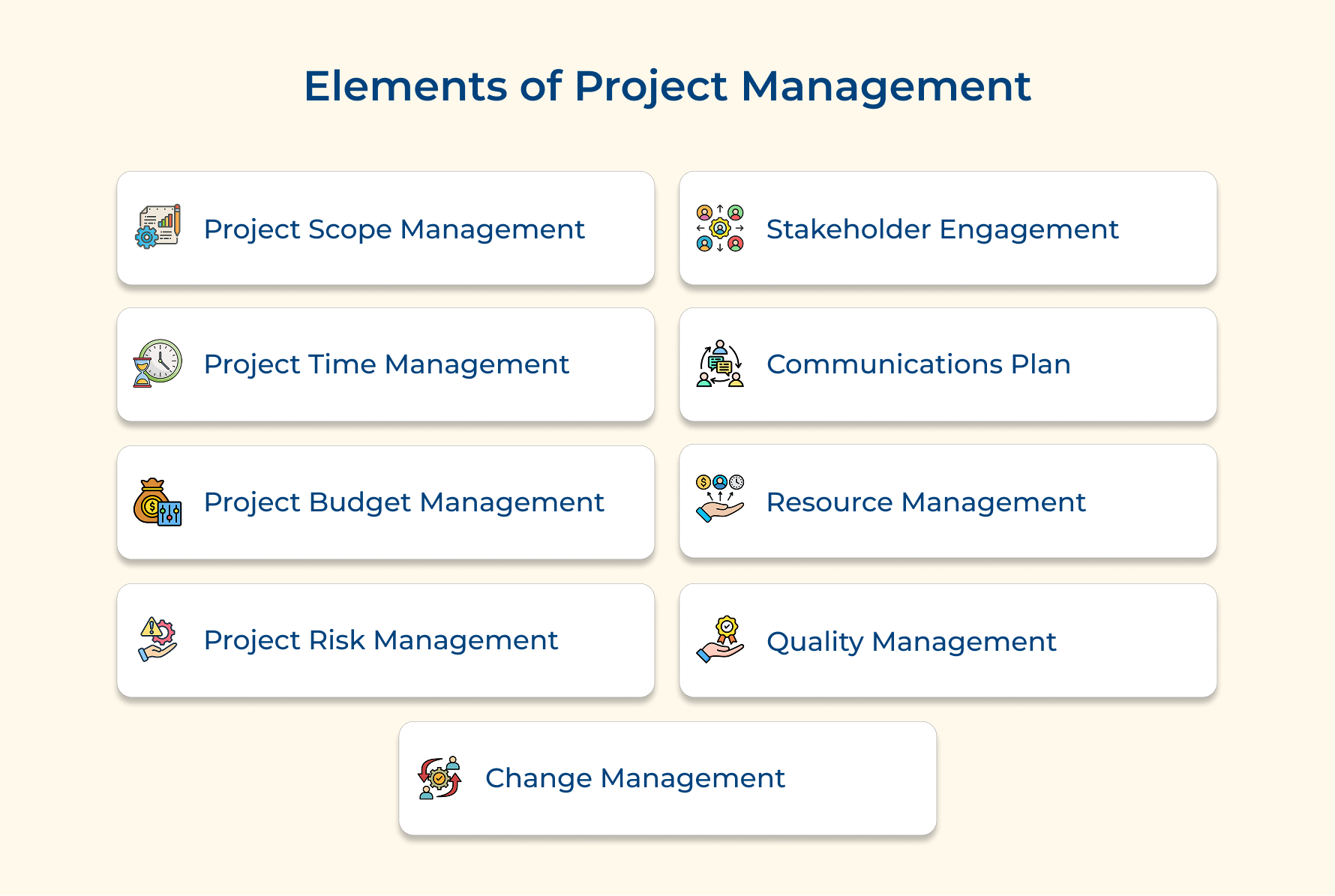
1. Project Scope Management
Project scope management is all about maintaining the process of the exact boundaries of what a project will deliver based on its elements. Think of a project without a locked scope, teams end up chasing volatile targets and access the lifecycle.
What happens when one is unable to manage the scope efficiently? Project budget and risk expand beyond the defined line. It is recommended to treat the scope as a contract between team and clients. Agreed that all changes should follow an official review and approval process.
Explore some of the key Scope Management Checklist:
- Before execution approve a written approach from stakeholders
- Use a systematics Work Breakdown Structure (WBS) to map every task
- Set up a control process to manage scope additions
After setting the scope, why do projects still fail? It is all about scope creep, which always starts from informal approvals and agreements. Avoid this by documenting every addition to manage the impact of time as well as cost.
Implementation of scope management in a project starts with a formal document that is reviewed and signed by all key stakeholders before any execution of elements begins.
2. Project Time Management
One of the main components of the project management process is time management, which is not just about deadlines but also about sequencing tasks. In the right order with the right buffers, missed dependency in the schedule can delay the entire delivery.
How do project managers protect this element? Build realistic planning based on actual team capacity instead of just assumptions.
Tracks schedule variances weekly and fixes issues before delays convert into major setbacks. Time lost is always harder to recover in the final stretch, so it’s better to resolve it earlier.
Best Practices:
- Visualize the full project timeline and dependencies with Gantt charts
- Define a baseline schedule at first to maintain an accuracy
- Perform weekly analysis to prevent the timeline from escalating
The critical path is the key concept of this element in project management, as it tells exactly which process in tasks cannot afford any delay. It ensures that the overall timeline is not missed.
3. Project Budget Management
Budget management is the planning of every basic and even key financial element of a project before the first amount is spent. It gives a clear financial baseline to measure cost estimation against the mentioned.
What is the biggest budgeting mistake? Underestimating the hidden costs. It includes rework, resource gaps and tool upgrades that only appear during the execution of the project.
For example, a project manager must review these components of project management at regular intervals with the end of each phase. It will separate projects that finish on budget from those that are out of control.
Below are core budget components that must be actively controlled for effective project management:
- Labor costs: The largest cost driver that must be tracked to prevent unnoticed overruns across the team.
- Contingency reserve: A financial buffer before execution to absorb unplanned cost events without affecting the baseline.
- Vendor and tool costs: locked in through formal contracts early to avoid cost surprises during execution.
A contingency reserve is a sign of experienced planning. Setting it up before the execution gives the project manager financial control. It goes one level deeper than the budgeting components of the project management, as it is all about planning and controlling costs at the task level.
Why do so many projects exceed their cost targets despite having an approved budget? Because cost is tracked at the phase level instead of being monitored at the individual work package level.
Value Indicators that Must Be Monitored:
- Cost performance index (CPI): Below 1.0 signals means the project is overcosting with respect to the progress
- Schedule performance index (SPI): Score 1.0 indicates project is lacking its planned schedule
This analysis together gives stakeholders a real-time financial health check of the project. Maintain a weekly review for course correction before small variances turn into overruns.
4. Project Risk Management
The component is all about the practice of identifying what could go wrong in a project and preparing a management process. The main objective is not to eliminate risk but to make sure that no risk catches the project off guard.
Implementing these components in the system for project management starts with a defined risk identification during the planning phase, with the presence of all members. All identified risks are documented and are assigned an owner.
Pro tips:
- Set up a review session for this element on a weekly basis with the core team for effective project management.
- visually prioritize risks based on severity with the use of a heat map
- Assign a named risk owner who will be managing all high-priority risks
Assess all risks based on two dimensions to help the team prioritize which risks deserve the most attention.
- Probability of occurring
- The impact it would have on the project
A risk that is recognized but never resolved is just the same as one that is never identified. Risk management plans is an ongoing activity for these components from the start of the project initiation.
5. Stakeholder Engagement
The right people are informed, involved, and aligned throughout the entire project journey. Still, why do stakeholder relationships break down mid-project? It is because engagement is treated as a one-time activity instead of a continuous loop.
Understanding each level of interest helps decide how much time and effort to invest in each relationship. It is said that “every stakeholder does need the same depth of communication, but everyone needs the correct approach.
Below is the structured stakeholder engagement framework:
- Identify: Map all stakeholders based on their level of interest in the project
- Analyze: Stakeholder analysis helps to understand their expectations and preferred communication style
Stakeholder engagement starts with a communication planning exercise for effective management and identifying every element over the project. Regular as well as structured engagement reduces last-minute surprises while keeping the project timeline intact.
6. Communications Plan
A communications plan is the key element that tells about who needs what information and at what point during the project lifecycle management. Think of a project that does not have any critical updates, and get lost, which ends up making decisions based on only incomplete information.
What is the overlooked part of this component? Underestimating the amount of time spent on poor communication costs in rework and misalignment. The format and frequency of communication should match your organizational strategy to maximize project profitability
Let’s explore the Core Components of a Communications Plan in project management:
- Audience definition: Access and segment those who need information based on a level of detail
- Communication frequency: Stick to a defined schedule and set regular touchpoints.
- Channel selection: Choose the right communication channel based on your audience.
Start implementing elements of the communications plan by documenting every touchpoint before the project management begins. Once the touchpoints are identified and set up, it should be reviewed on a regular basis to make sure they are still meeting needs.
7. Resource Management
Resource management is one of the main project management components that make sure the right people are available at the right time during your project execution. It is recommended to not to over-allocate resources. It leads to burnout as well as delivery gaps.
What do resources actually mean? It is not just people, but a combination of tools, equipment, budget and time. Managing all of these resource management elements together allows to maintain consistent project delivery throughout the process.
Use this resource management to directly protect project delivery:
- Role-to-phase mapping: Before the start of the phase execution, assign specific skills and roles to each project so every task has a qualified owner.
- Utilization tracking: Perform weekly workload monitoring of resource workload on a weekly basis to identify over-allocation before it starts impacting timelines.
- Contingency planning: Set a backup plan for every key role so that sudden unavailability does not create a gap in your project schedule.
One of the key causes of project schedule delay is resource bottlenecks; avoid them by proactive tracking, giving enough time for this element to manage.
8. Quality Management
Every deliverable produced during the project should meet the basic standards that were agreed upon at the start.
What does quality management look like in practice? It means setting up your measurable criteria for every deliverable and validating each against them before it is signed off.
Think about the element as building a foundation that has to be built into the process from the very beginning of the project management planning. For example, if a project manager waits until the final phase, it is already too late to fix most issues.
Pro tips:
- Before the start of the work, define measurable standards for every deliverable
- Conduct structured quality checks at the end of your project to get a clear visualization intro project.
9. Change Management
Change management is considered as the formal process of evaluating, approving and implementing key elements of the project scope, but in a controlled manner.
Why is it considered important in complex projects? Uncontrolled changes accumulate over time, combining impact on timeline and cost, which is more than any single change.
Key essentials for Change Management to consider:
- Change Control Board (CCB): A structured group that is mainly responsible for approving all change requests across the final deliverables
- Impact assessment: Perform frequent evaluation of every change for its effect on scope and timeline.
Every change request must go through an impact assessment before it is approved. It protects the project and makes sure that the final decisions are made with full awareness of the project management principles.
Why are the Core Components of Project Management Important?
The right Project management elements determine whether a project succeeds or fails. Let’s explore it benefits in details
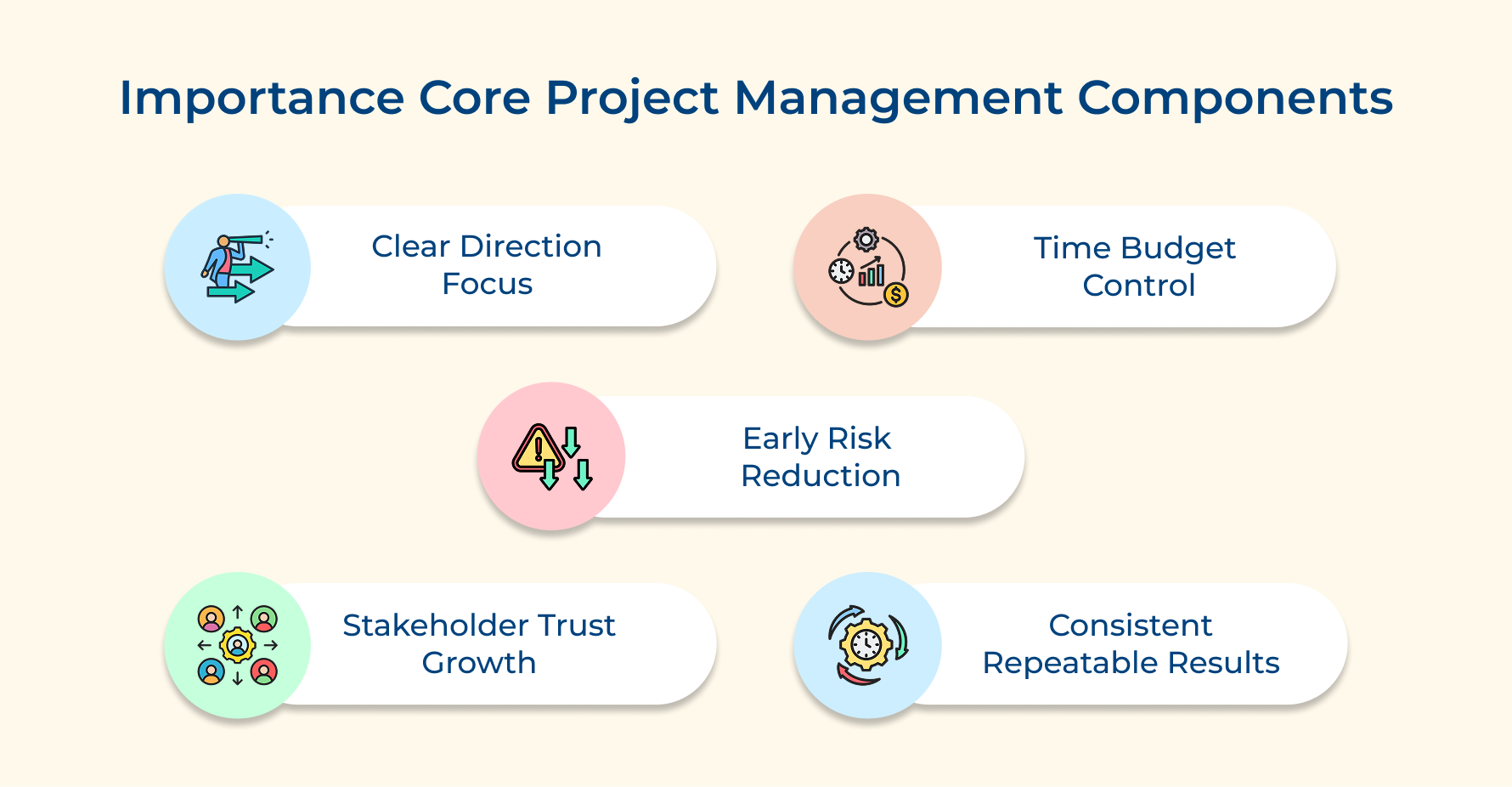
1. Delivers Clear Direction and Focus
Every team member has a defined goal to work toward and this eliminates confusion from unclear priorities. Even skilled teams waste time on tasks and are not able to move the project forward without the right strategy.
2. Keeps Time and Budget Under Control
A structured approach makes sure both the timelines and budget elements are tracked consistently. It is not just reviewed when something goes wrong, as it prevents small variances into costly overruns.
3. Reduces Risk Before It Becomes a Problem
Project management elements are used in such a way that potential threats are identified and addressed before they affect delivery. Managing risk formally is far less likely to face surprises that derail projects in the middle.
4. Improves Stakeholder Confidence and Trust
A clear project delivery approach with regular updates and transparent reporting increases stakeholders’ confidence in the project team. It makes the process frictionless, which might slow projects down.
5. Drives Consistent and Repeatable Results
Documented processes and lessons learned that can be applied to the future with effective project management elements. Managing projects in a proper organizational structure delivers better results than those that rely on improvisation.
Master the Art of Successful Projects with Elements of Project Management
A project that delivers on time and within budget defines foundational elements that are adjusted throughout the project life cycle. The best teams also lose direction before they reach the deliverables without a proper structure.
- Scope, budget and risk are core components of project management that must be managed together.
- Clear roles and responsibilities help in removing confusion before it becomes a conflict on your team
- The basic elements work best when they’re treated as ongoing weekly practices instead of a one-time setup.
Understanding and applying the elements of project management efficiently helps in delivering accurate results. It becomes the standard that every manager of your team works.
What does this mean for you? Projects don’t fail during the deadline, it does in the planning stage when essential components and elements are skipped or poorly defined.
Limit time — not creativity
Everything you need for customer support, marketing & sales.

Neeti Singh is a passionate content writer at Kooper, where he transforms complex concepts into clear, engaging and actionable content. With a keen eye for detail and a love for technology, Tushar Joshi crafts blog posts, guides and articles that help readers navigate the fast-evolving world of software solutions.