Resource Management Skills Every Manager Must Master
- What is Resource Management?
- Resource Manager Responsibilities and Functions
- How is a Resource Manager Different from a Project Manager?
- 7 Essential Skills Resource Managers Need to Thrive
- Steps to Develop Resource Management Skills
- How To Improve Your Resource Management Skills: 5 Best Practices
- Practical Examples of Resource Management Skills
- Master the Art of Resource Management With Right Skills for Project Execution
- FAQs about Resource Management Skills

Key Highlights:
- The right resource management skills close the gap between team capacity and project commitments.
- Forecasting demand before a project starts is what keeps delivery timelines from falling apart.
- Strong pipeline visibility separates reactive managers from those who plan weeks ahead with confidence.
Most project failures do not happen because of poor planning on paper, they happen because the right people were never placed in the right roles. This is not a process problem but a resource management skills problem.
The deeper issue is that many managers carry the resource manager title without ever developing the decision-making depth the role truly demands. Poor allocation, burnout and missed deadlines are almost always symptoms of skill gaps hiding in plain sight.
This guide breaks down every critical resource management skill you need, right from forecasting and capacity planning to conflict resolution. If you are serious about leading projects with consistency and confidence this is where that journey starts.
What is Resource Management?
Resource management is the process of planning, allocating, as well as overseeing resources (people, budget, tools, and time) to deliver projects successfully. It ensures that every resource is used purposefully and nothing valuable is left either idle or overburdened during a project lifecycle.
A project can have a perfect timeline on paper but still collapse if the people behind it lack the capability or direction to execute.
This is exactly where resource management skills become the backbone of successful project delivery. Strong skills in this area allow project leaders to forecast demand, handle competing priorities and keep team performance consistently high without pushing people to burnout.
Primary objectives:
- Optimal allocation: Assign the right people with the right skills to the right tasks.
- Cost efficiency: Maximize output while keeping resource-related costs within budget.
- Capacity planning: Understand team bandwidth before committing to project timelines.
- Performance visibility: Track how resources are utilized to make smarter decisions in real time.
Resource Manager Responsibilities and Functions
A resource manager sits at the intersection of people, projects, and priorities – making sure nothing falls through the cracks. Here are the core responsibilities that define this role in project management.
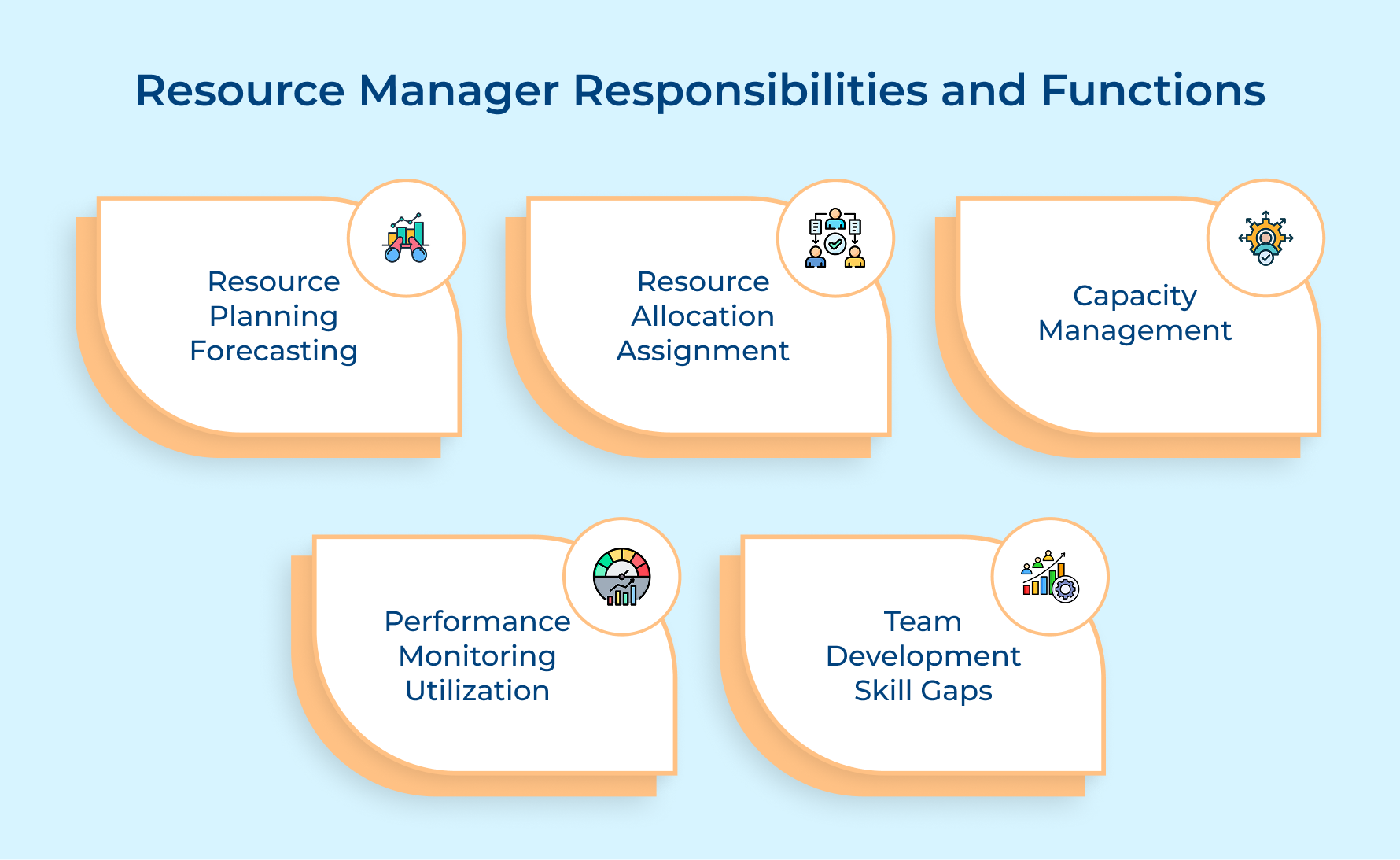
1. Resource Planning and Forecasting
Effective resource planning means looking ahead and identifying what skills as well as capacities a project will demand before it even kicks off. A resource manager who plans reactively will always be a step behind the project’s actual needs.
2. Resource Allocation and Assignment
Allocating resources is all about placing the right expertise where it creates the most impact. Poor allocation is one of the most common reasons projects run over budget and over time.
3. Capacity Management
Understanding how much bandwidth your team truly has is a skill that separates average managers from exceptional ones. Overloading a capable team is just as damaging as underutilizing them.
4. Performance Monitoring and Utilization Tracking
Keeping a close eye on how resources are being utilized helps managers spot bottlenecks before they become blockers. Consistent tracking also reveals patterns that inform smarter allocation decisions on future projects.
5. Team Development and Skill Gap Management
Identifying skill gaps within the team and addressing them proactively is a responsibility that directly impacts project quality. A forward-thinking resource manager treats team development as a strategic investment.
How is a Resource Manager Different from a Project Manager?
Both roles are critical to project success but they operate with fundamentally different focuses and responsibilities. Understanding this distinction helps organizations structure their teams more effectively.
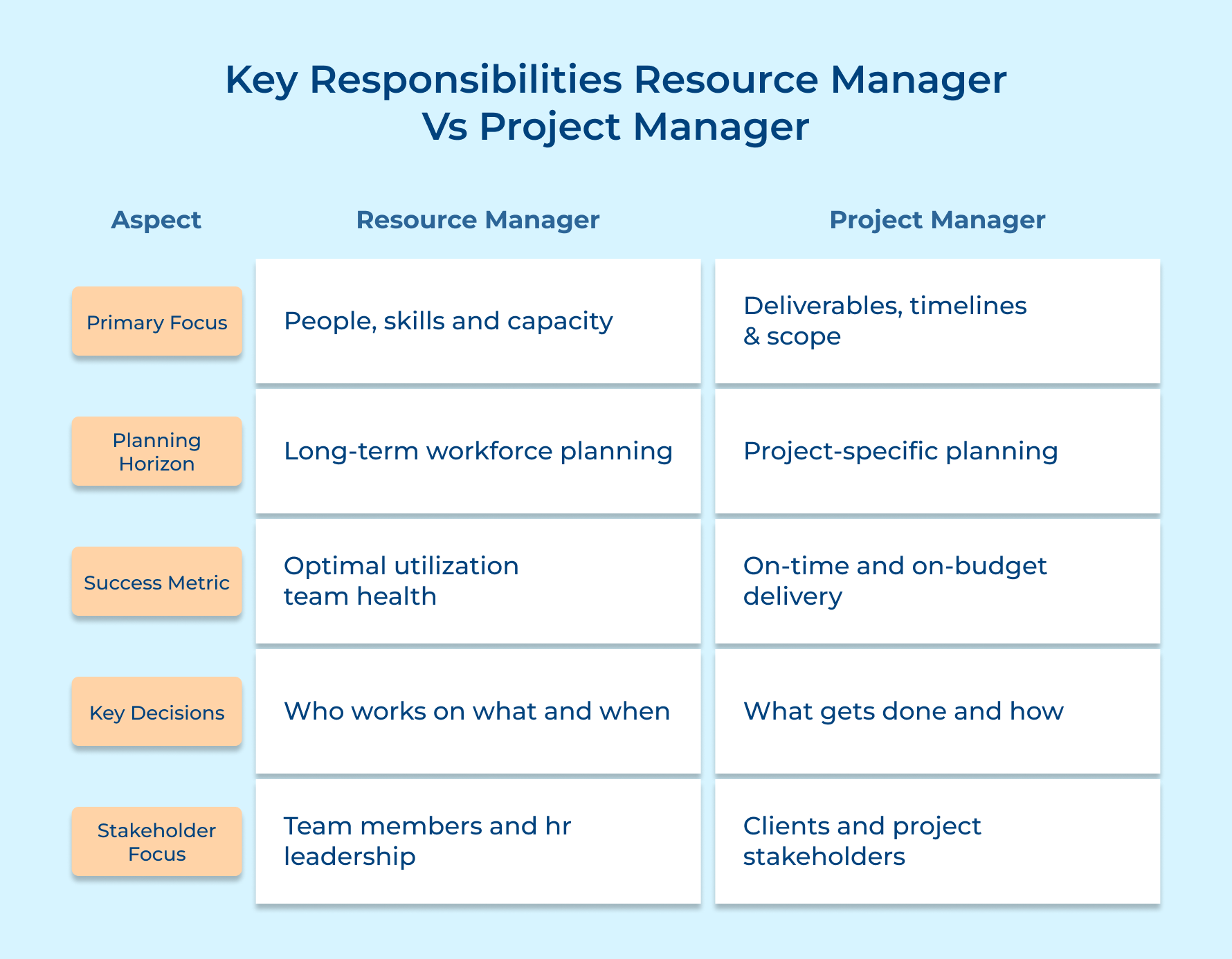
1. Core Job Focus
A resource manager’s core job is to ensure the right people with the right skills are always available. Their lens is always on workforce capability and capacity across the organization.
A project manager stays laser-focused on delivering a specific outcome within defined constraints. Their world revolves around scope, timeline and budget.
2. Planning Time Horizon
Resource managers think beyond individual projects, they plan for long-term talent availability and skill development. Their decisions today directly shape the organization’s delivery capability months ahead.
Project managers plan within the boundaries of a single project lifecycle. Once the project closes, their planning responsibility for that engagement ends.
3. Measuring Success Differently
A resource manager measures success through healthy utilization rates and a well-balanced team workload. Keeping people neither overburdened nor underutilized is their definition of a win.
A project manager defines success as delivering the right output on time and within budget. Client satisfaction as well as milestone achievement are their primary benchmarks.
4. Decisions They Own
Resource managers make decisions around who gets assigned to which project and when. These decisions directly impact team morale, productivity along with overall delivery quality.
Project managers decide how the work gets structured, sequenced and executed within a project. Their decisions shape the day-to-day rhythm of the project team.
5. Who They Engage
A resource manager’s primary stakeholders are the team members and HR or leadership teams. They advocate for people, ensuring workloads are fair and skills are growing.
A project manager engages primarily with clients, sponsors and delivery teams. Their stakeholder focus is on managing expectations and communicating project progress clearly.
7 Essential Skills Resource Managers Need to Thrive
Resource management demands a very specific and layered skill set. These are the seven skills that truly define a high-performing resource manager in project management.
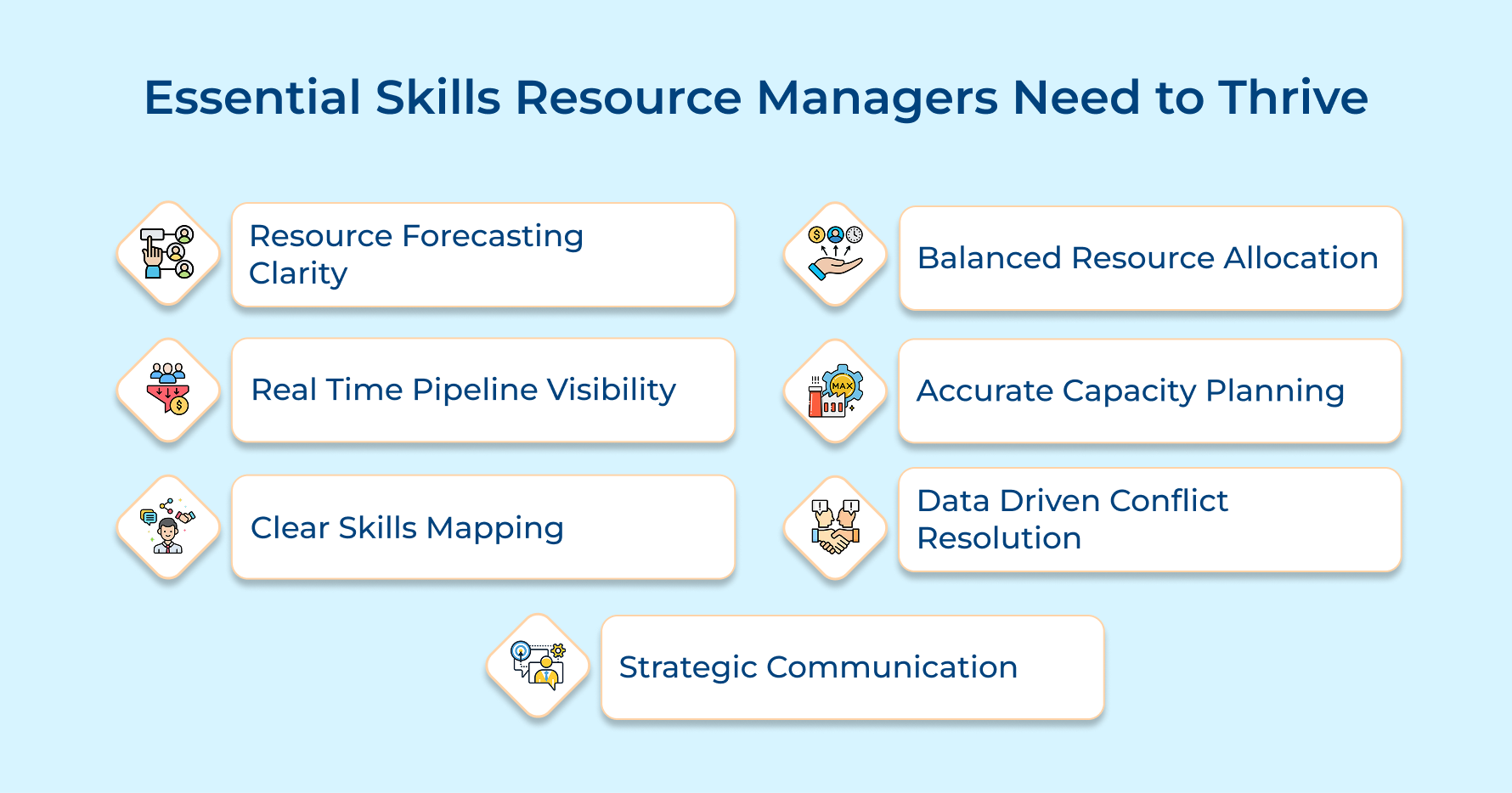
1. Resource Forecasting Capabilities
Think of resource forecasting as your early warning system. It’s your ability to predict what talent, skills, and capacity a project will need – before the work even kicks off. Managers who skip this step are always reacting instead of planning, and that’s where delivery timelines start slipping.
Strong forecasting isn’t guesswork. It means digging into past project data, understanding your pipeline, and translating business goals into real workforce needs. Using the right project management software with forecasting dashboards makes this significantly easier and more accurate.
Before starting any project, ask yourself:
- Skill readiness: Do I know what skills each phase will demand?
- Buffer planning: Have I accounted for leaves, ramp-up time, and skill gaps?
- Pipeline alignment: Does my forecast reflect the full pipeline, not just this one project?
The managers who rarely get caught off guard are the ones who build buffers into forecasts and revisit them regularly.
2. Resource Optimization Skills
Resource optimization sounds simple in theory, get the best output from every person on your team without burning them out. But anyone who’s managed resources across multiple projects knows it takes real experience to get right.
The problem most managers face isn’t a shortage of people – it’s misalignment. Your best performers are stretched thin while others sit underutilized. That imbalance quietly kills morale and delivery quality. Applying the right resource management techniques helps you spot and fix these gaps before they escalate.
Watch out for these warning signs:
- Overload pattern: Star performers are always maxed out.
- Skill mismatch: Delays caused by wrong people on wrong tasks.
- Burnout signal: Fatigue is showing up as a recurring delivery pattern.
To sharpen your optimization instincts:
- Track individual utilization weekly, not just at project milestones.
- Have an honest one-on-one to understand each person’s actual workload.
- Build alternate allocation scenarios before locking in your final plan.
3. Pipeline Management Capabilities
Here’s the thing about pipeline management; if you don’t have a real-time view of what’s coming, you’re essentially making resource decisions with a blindfold on. Every project you commit to today affects your capacity for tomorrow’s work, and that ripple effect adds up fast.
Strong pipeline management means you’re not just reacting to confirmed projects. You’re tracking probabilities, monitoring start dates, and flagging conflicts before they land on your active team. The project management office plays a key role here, helping centralize this visibility across teams and projects.
Key elements to focus on:
- Live visibility: Always know what’s starting, when, and what it needs
- Conflict flagging: Catch capacity clashes early — before they disrupt delivery
- Leadership collaboration: Stay connected with sales and leadership on pipeline shifts and project probabilities
The managers who do this well treat their pipeline view as a living document, not a quarterly snapshot. Update it regularly and your allocation decisions will be sharper every time.
4. Capacity Planning
Do you actually have enough of the right people to deliver on what’s been committed? Capacity planning is how you find out before it becomes a crisis.
The mistake many managers make is treating availability as the same thing as capacity. Someone might be technically “available,” but if they’re already stretched across three projects, their productive resource capacity is nowhere near 100%. That distinction matters enormously.
Before confirming any new project commitment, validate:
- Utilization check: What are current load levels across active projects?
- Availability audit: Factor in upcoming leaves, training blocks, and bench strength
- Skill fitment: Can your existing team deliver this, or do you need to hire?
Some managers still rely on an excel spreadsheet to track this, which works at a small scale but quickly becomes unmanageable. Build a proper capacity baseline, update it every sprint or month, and align regularly with project leads on what’s realistic.
5. Workforce Skills Mapping
How well do you really know what your team can do? Not what their job titles say, but their actual, current capabilities? For most resource managers, the honest answer is “not as well as I should.” Skills mapping fixes that.
Workforce skills mapping means maintaining a clear, updated picture of every team member’s expertise, experience levels, and growth areas. When this visibility exists, allocation decisions are based on facts, not assumptions. Well-defined resource groups built around skill sets make it easier to match the right people to the right work quickly.
A solid skills map should capture:
- Core expertise: Technical and functional skills with defined proficiency levels.
- Domain exposure: Certifications, industry background, and project history.
- Growth skills: Capabilities your team members are actively building right now.
To build and maintain yours:
- Run periodic skill assessments with clear proficiency frameworks.
- Collect direct feedback from project leads on observed performance.
- Keep a centralized, regularly updated skills repository for your whole team.
6. Resource-Centric Conflict Resolution
In any multi-project environment, conflicts are unavoidable. Two projects need the same person at the same time and someone has to decide who gets them. How you make that call defines your credibility as a resource manager.
The most common mistake? Giving in to whoever pushes hardest. That’s just responding to pressure! A better approach is resource leveling, where you balance workloads based on project priority, client impact, and actual team capacity, not noise levels in the room.
Build your conflict resolution capability with these habits:
- Priority frameworks: Use project prioritization matrices to make defensible reallocation decisions.
- Data-backed reasoning: Always bring utilization data and capacity numbers into the conversation.
- Post-conflict reviews: Look back at past conflicts to find patterns and prevent repeat situations.
The goal is to build a process that handles the next one faster and fairer. That consistency is what earns trust from both project teams and leadership.
7. Strategic Communication and Stakeholder Management
A resource manager’s decisions touch everyone including individual contributors, project leads, and senior leadership. That’s exactly why communication isn’t a soft skill here, it’s a core one. If you can’t translate resource data into language that lands with different audiences, even your best decisions won’t get the support they need.
Think about what this looks like in a leadership meeting. You’re not just reporting a capacity shortfall, you’re presenting it as a business risk with a clear solution already framed. That’s the difference between being seen as a coordinator and being seen as a strategic partner.
Strong stakeholder communication includes:
- Expectation setting: Give project managers early, clear visibility into resource availability.
- Risk escalation: Surface resource risks while leadership still has time to act.
To sharpen your communication skills:
- Practice converting complex utilization data into simple visual summaries.
- Seek regular feedback from project managers and leaders on how clearly your messages land.
- Treat every stakeholder interaction as an opportunity to reinforce your credibility with data.
Steps to Develop Resource Management Skills
Effective resource management skills aren’t built overnight- they’re developed through consistent practice, real-world exposure and sharper decision-making habits. These steps help you move from reactive allocation to proactive, strategic resource planning.
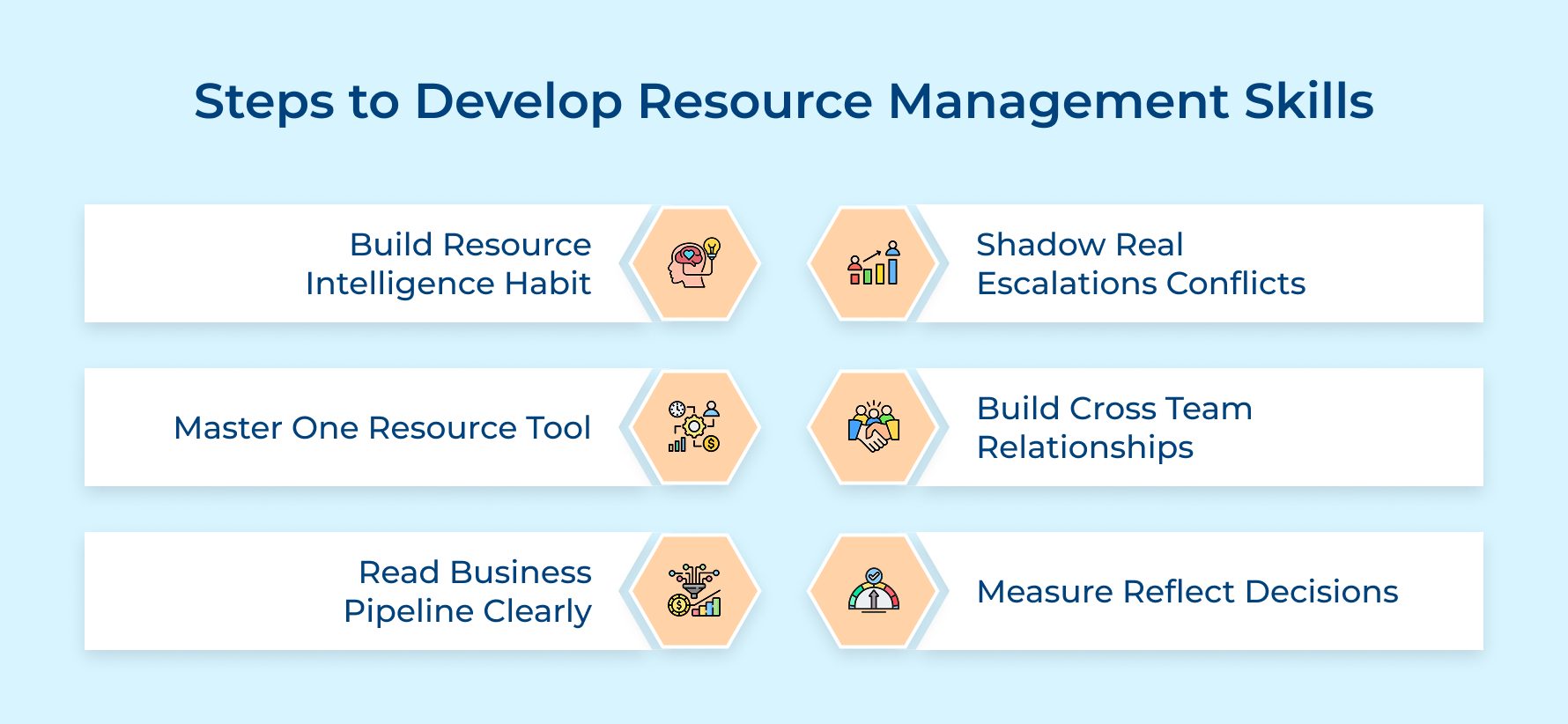
1. Build a Resource Intelligence Habit
Resource intelligence is what separates managers who prevent problems from those who constantly put out fires. It’s a weekly discipline you build over time. And the earlier you start, the sharper your instincts get.
The resource management process improves dramatically when intelligence-gathering becomes a consistent habit rather than a reactive exercise. Here’s how to build it from the ground up:
- Weekly skill audits: Block time every week to review your team’s current skills and available bandwidth.
- Decision documentation: Record every allocation decision with clear reasoning — patterns become visible faster than you’d expect.
- Forecast reviews: After every project closes, compare your original forecast against what actually happened.
That last one is underrated. Most managers move on after a project wraps. The ones who pause and measure their forecast accuracy are the ones who consistently make smarter decisions on the next one.
2. Shadow Real Resource Escalations and Conflicts
No training program teaches conflict resolution like watching a seasoned manager handle a real one under pressure. Shadowing live escalations compresses years of learning into a few high-stakes experiences and that’s genuinely hard to replicate any other way.
Even the Resource Management Institute emphasizes experiential learning as a cornerstone of building strong resource judgment. Here’s what to actively watch for during these sessions:
- Decision triggers: What specific data point finally drives the reallocation call?
- Stakeholder dynamics: How are competing project demands balanced without damaging relationships?
- Communication style: How are tough decisions framed and delivered to senior leadership?
- Escalation thresholds: When does a conflict get escalated versus resolved at the manager level?
Pro tips to get the most out of shadowing:
- Document your observations and the exact decision logic you witnessed after each session.
- Handle smaller conflicts independently first, then debrief your approach with a senior manager.
3. Master at Least One Resource Management Tool Deeply
Knowing a tool well enough to schedule tasks is not the same as knowing it well enough to make strategic decisions. Surface-level tool knowledge limits you. Deep mastery turns your planning platform into a genuine competitive advantage.
A human resource manager working across multiple projects needs more than a scheduling board. They need forecasting power, utilization visibility, and scenario planning capability, all in one place.
Here’s where to focus your effort:
- Forecasting modules: This is where the tool’s real value lives. Most managers never explore these features fully, but they surface capacity conflicts weeks before they become delivery problems.
- Reporting dashboards: Don’t just look at the numbers — bring business context to them. Utilization trends reveal who’s overloaded and where hidden capacity quietly exists.
- Scenario simulation: Test multiple allocation options before committing to one plan. Walking into stakeholder meetings with two or three data-backed options immediately elevates your credibility.
Depth beats breadth here. Own one tool completely before branching out.
4. Build Relationships Across Project and Delivery Teams
Here’s something no dashboard will ever tell you, what’s actually happening inside a delivery team on the ground. That kind of intelligence only comes from real relationships built over time, and it’s worth more than most managers realize.
When project managers trust you enough to share ground realities early, every allocation decision you make becomes faster and smarter. Strong relationships are a core part of any effective resource management process.
Three ways to build these connections deliberately:
- Regular syncs: Schedule consistent check-ins with project managers to stay ahead of emerging resource needs before they escalate.
- Delivery immersion: Spend time understanding the workflow pressures delivery teams actually face – your decisions will reflect reality much better.
- Feedback culture: Invite honest fitment feedback from project leads after every assignment so future placements keep getting sharper.
The payoff? When two projects compete for the same person, you already know which deadline is harder and you resolve it in minutes.
5. Learn to Read Business Pipeline Like a Leader
Most resource managers wait for a project to land before they start thinking about staffing it. The best ones are already three steps ahead, mapping upcoming demand against current capacity before a deal is even confirmed.
Pipeline visibility is what makes that possible and it’s one of the clearest signals that a manager is thinking like a leader, not just an operator. Even the Resource Management Institute recognizes pipeline fluency as a distinguishing trait of high-performing resource professionals.
Here’s a practical checklist to make pipeline reading a real habit:
- Pipeline access: Get consistent visibility into sales and pre-sales data, not just confirmed projects.
- Demand mapping: Regularly map probable and confirmed projects against your current team’s capacity.
- Skill anticipation: Identify skill requirements for upcoming work before it officially lands on your desk.
- Capacity flagging: Flag potential shortfalls to leadership before client commitments are locked in.
Attending even one pipeline review monthly and treating it as a resource planning session, immediately sharpens your workforce decisions.
How To Improve Your Resource Management Skills: 5 Best Practices
Strong resource management skills are not built overnight, they are sharpened through deliberate practice and consistent application. Here are 6 best practices for you to focus on:
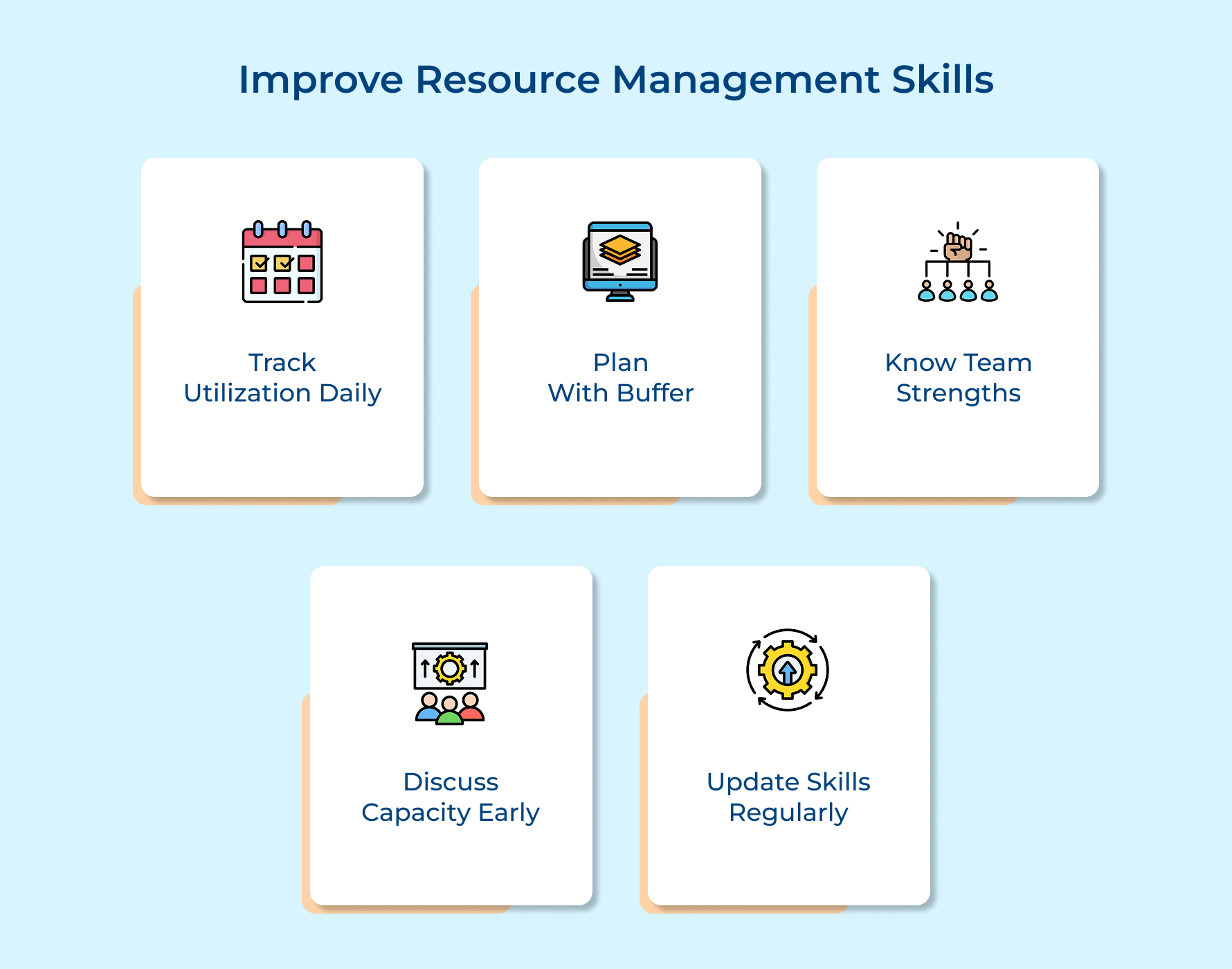
- Treat utilization data as a daily decision-making tool: Utilization data stops being useful when you only look at it during weekly reports or monthly reviews. By the time you catch a problem in a monthly review, it has already affected delivery. Checking utilization daily builds a natural awareness of who is overloaded and who has capacity right now.
- Always plan resource allocation with a contingency buffer: Every experienced resource manager knows that projects almost never go exactly as planned on paper. Scope changes, sudden leaves, and client requests have a way of disrupting even the most carefully built plans. Building a contingency buffer into every allocation plan gives you room to absorb those unexpected changes without derailing delivery.
- Invest in knowing your team beyond their job titles: A job title tells you what someone was hired to do — not what they are capable of doing right now. People grow, pick up new skills, and often have strengths that never show up in their official role. Taking time to know your team at a deeper level helps you spot hidden capacity you would otherwise miss.
- Make capacity conversations a leadership agenda item: Resource managers who only discuss capacity within their own function gradually lose influence over how delivery gets planned at the top. Leadership makes commitments without full visibility into what the team can realistically handle. Bringing clear capacity data into leadership conversations changes that dynamic.
- Continuously refresh your skills inventory across the team: A skills inventory that was accurate six months ago is already out of date in a fast-moving project environment. People complete training, gain project experience, and develop new capabilities all the time. If your inventory does not reflect that growth, your allocation decisions are built on stale assumptions.
Practical Examples of Resource Management Skills
Here are four real-world examples that show how experienced managers put these skills into practice across different business contexts.
1. Resource Management Skills in Professional Services
In professional services, a resource manager must constantly balance billable utilization targets while ensuring the right expertise lands on the right client engagement. Misallocating even one senior consultant to a low-complexity project directly impacts both client satisfaction and revenue realization.
2. Resource Management Skills in a Marketing Agency
A marketing agency runs multiple campaigns simultaneously with tight deadlines and creatives who carry very specialized skills. A resource manager here must map each campaign’s creative and strategic demands against available talent without burning out the core delivery team.
3. Resource Management Skills in Consultancies
In a consultancy, resource managers deal with the constant pressure of matching highly specialized consultant profiles to specific client requirements and engagement scopes. The real skill lies in maintaining bench strength while keeping billability high across a fluid and fast-moving project pipeline.
Master the Art of Resource Management With Right Skills for Project Execution
Building strong resource management skills is a career-defining investment that directly shapes how confidently you handle allocation decisions and capacity risks. The managers who develop these skills deliberately are always the ones leading projects from the front.
The resource managers who consistently deliver flawless execution are not the lucky ones, they are the ones who sharpened the right skills. Apply them with discipline and every project becomes an opportunity to demonstrate what truly effective resource leadership looks like in practice.
Limit time — not creativity
Everything you need for customer support, marketing & sales.

Neeti Singh is a passionate content writer at Kooper, where he transforms complex concepts into clear, engaging and actionable content. With a keen eye for detail and a love for technology, Tushar Joshi crafts blog posts, guides and articles that help readers navigate the fast-evolving world of software solutions.