Top 10 Benefits of Project Portfolio Management for Firms
- What is Project Portfolio Management?
- Why Service Firms Need Project Portfolio Management?
- Top 10 Benefits of Project Portfolio Management Explained
- Challenges and Limitations of Project Portfolio Management
- Align Your Projects with Success Through Smart Portfolio Planning
- FAQs about Benefits of Project Portfolio Management
Key Highlights:
- The benefits of project portfolio management (PPM) start at the selection stage, not during execution.
- Organizations that align projects to business goals consistently outperform those that prioritize based on opinions.
- Real-time project data removes dangerous guesswork and helps leaders make faster, more confident portfolio decisions daily.
Most organizations are running more projects than they can realistically handle. Teams are stretched thin, priorities keep shifting and leadership is making critical decisions without a clear picture of the portfolio.
The result is predictable. Budgets overrun, deadlines slip and high-potential initiatives stall because the right resources never showed up at the right time to support delivery.
This is exactly where the benefits of project portfolio management make all the difference. This blog breaks down ten concrete benefits of an effective PPM strategy and what each one means for your business.
What is Project Portfolio Management?
Project portfolio management (PPM) is the centralized process of selecting, prioritizing and overseeing a group of projects that align with an organization’s strategic goals. It gives leadership a structured way to decide which initiatives deserve resources and which ones should wait. Simply put, it’s how smart organizations make sure the right projects get done at the right time.
Without this visibility, teams end up competing for the same budget and talent. Projects get approved based on who argues loudest in the boardroom rather than what actually moves the business forward. PPM fixes that by introducing a structured framework for evaluating what deserves attention and what doesn’t.
Primary objectives:
- Strategic alignment: Every project in the portfolio must directly support a defined business goal rather than exist as a standalone effort.
- Resource optimization: PPM ensures people, budgets and tools are distributed where they create the most measurable impact across projects.
- Risk balancing: It identifies overlapping risks across multiple projects so leadership can act before small issues snowball into costly failures.
- Performance visibility: Stakeholders get a real-time picture of which projects are on track and which ones are quietly bleeding resources.
Why Service Firms Need Project Portfolio Management?
Service firms juggle multiple client engagements simultaneously and one mismanaged project can damage relationships built over years. Here is why PPM is not optional for them.
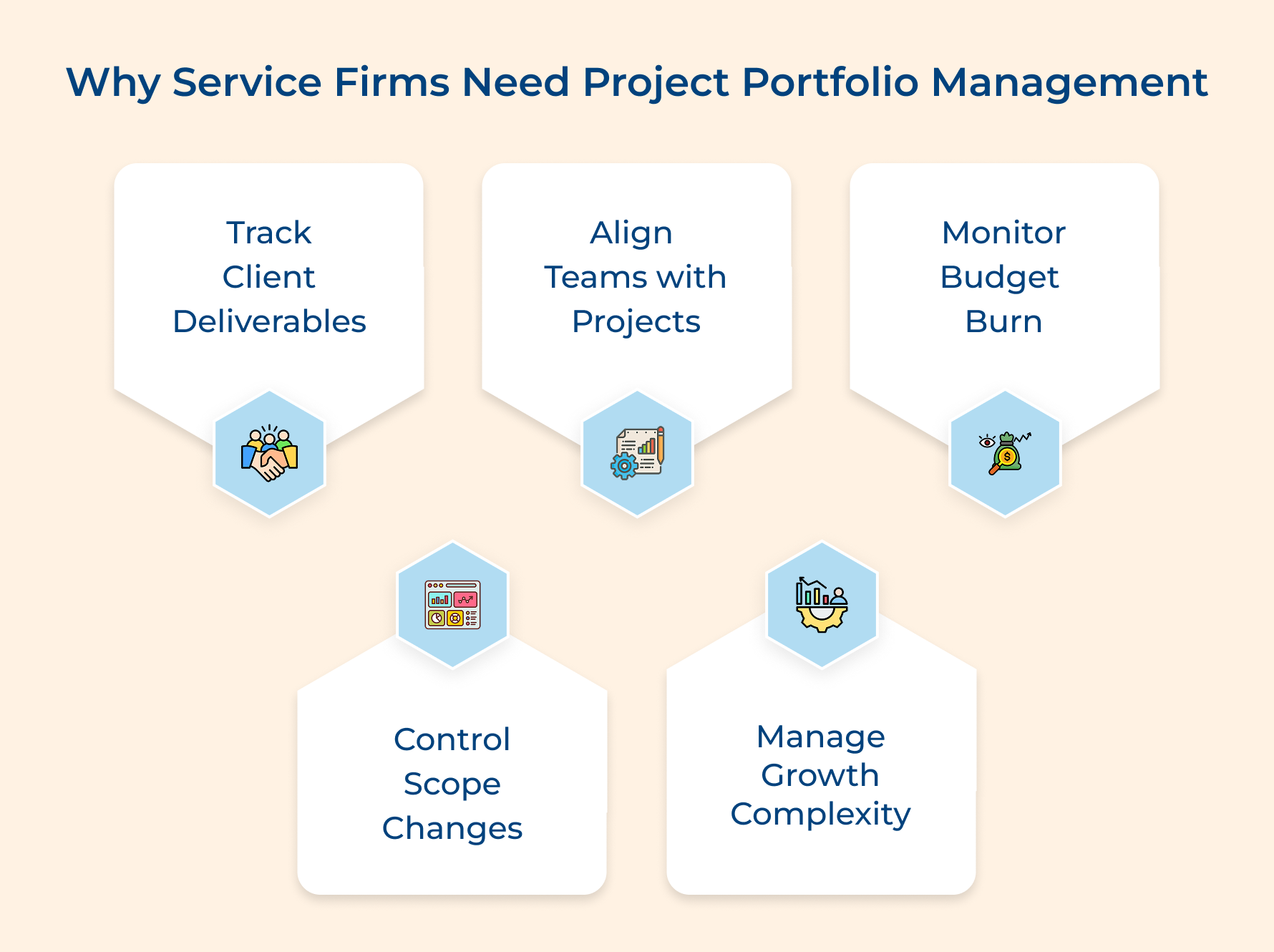
- Client commitments run on tight deadlines: Service firms can’t afford missed deadlines. PPM tracks every client deliverable, keeps project documentation intact and ensures nothing slips through the cracks when timelines get tight.
- Billable resources are always stretched thin: Pulling the wrong consultant into the wrong project hurts everyone. PPM aligns your team with the right engagements while keeping project health visible so utilization never quietly tanks.
- Revenue depends on project outcomes: Service firms get paid for results, not effort. PPM monitors project metrics like budget burn and delivery pace, flagging risks before a stalled project starts eating into your margins.
- Scope creep is a silent profit killer: Client requests expand without warning. PPM establishes a clear project scope baseline so firms can spot changes early, protect profitability and have honest conversations before timelines completely fall apart.
- Growth means managing more complexity: More clients means more moving parts. PPM gives growing service firms the structure to scale confidently while keeping every engagement tied to broader business objectives without losing control of anything.
Top 10 Benefits of Project Portfolio Management Explained
Most organizations don’t fail because of bad execution, but because they said yes to the wrong projects at the wrong time. Here is what a solid PPM strategy actually delivers for your business.
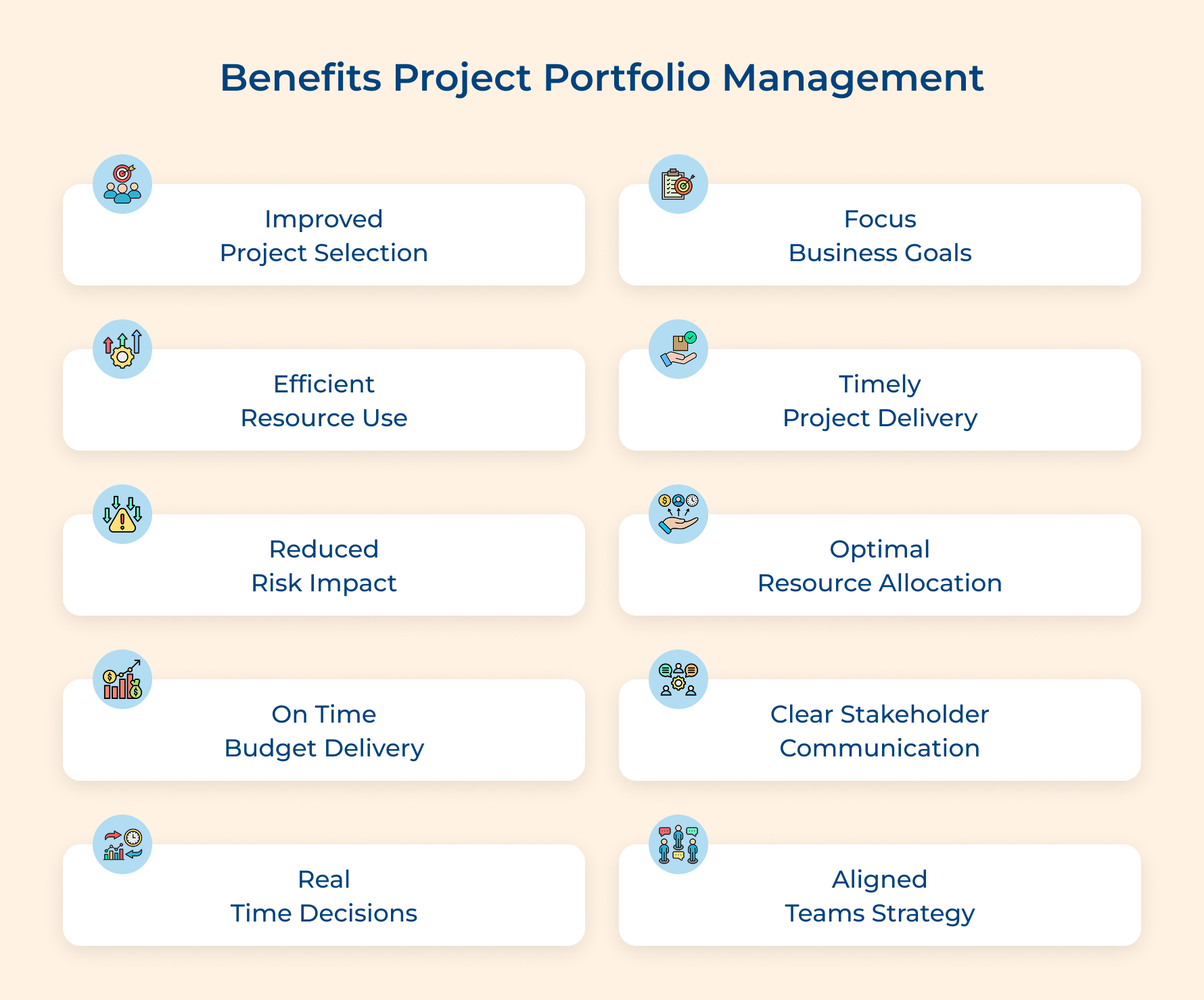
1. Improved Project Selection Process
Most projects fail before they even begin. Poor selection is the real culprit and it quietly drains budgets, burns teams as well as delivers little meaningful value to the business.
PPM replaces gut-feel decisions with a structured evaluation process. Think of it as a decision tree analysis that scores every project against strategic value, available resources and expected ROI before a single dollar gets committed.
Before greenlighting any project, ask:
- Does this project directly support a business goal we have committed to this year?
- Do we have the budget and people to deliver it without stretching critical teams?
- What happens if we skip this project entirely this quarter?
This filter alone saves hundreds of hours spent chasing initiatives that were never worth pursuing. The benefits of project portfolio management start right here at the selection stage, long before any team kicks off work or timelines get locked in.
2. Focus on Objective Business Goals
Every leader thinks their project matters most. Opinions get loud, priorities clash and resources end up spread across initiatives that quietly drift away from what the business actually needs to achieve.
PPM cuts through that noise. Every project ties back to a measurable business objective across the entire project lifecycle, from initiation through delivery and closure. If it cannot be linked to a real goal, it does not belong in the portfolio.
Here is how PPM keeps teams anchored to what truly matters:
- Quarterly goal mapping: Each project connects to a specific business objective before kickoff so teams always understand why their work matters.
- Milestone-based reviews: At every major milestone, teams revisit whether the original goal still justifies continued investment.
- Dynamic reprioritization: When business priorities shift, PPM gives leaders a clear framework to pause or redirect projects without creating chaos across dependent teams.
This stops teams from spending months building something the business has already quietly moved on from.
3. More Efficient Use of Resources
Poor resource visibility burns teams out, stalls projects and drains budgets without anyone catching it early enough to course correct before damage is done.
This is where Demand Management becomes critical. PPM maps incoming project demand directly against actual team capacity so resource conflicts get spotted weeks in advance, not the day a deadline is missed.
PPM solves resource visibility through three core levers:
- Live allocation tracking: Leaders see in real time who is working on what and which teams are approaching their limits before delivery starts suffering.
- Demand vs capacity planning: Incoming project demand is mapped against available capacity so no team gets quietly overloaded.
- Reallocation triggers: When a low-priority project holds resources it no longer needs, PPM flags it so that capacity moves where it creates more immediate value.
Consider a consulting firm running twelve active client projects. Without PPM, senior consultants end up double-booked every quarter and client delivery suffers directly because of invisible conflicts nobody tracked.
4. Increased Timely Project Deliveries
Late delivery rarely happens because of one big failure. It happens through poor sequencing, hidden dependency conflicts and resource gaps nobody identified early enough to fix before the deadline passed.
Agile project management paired with PPM gives teams visibility into cross-project dependencies before they become active blockers. If Project B needs a critical output from Project A, that connection gets flagged upfront so delays do not cascade into full portfolio disruption.
Use this delivery readiness checklist before launching any new project:
- Cross-project dependencies have been identified and documented with clear owners assigned
- Resource availability has been confirmed against actual capacity and not just assumed
- Timelines have been built using historical delivery data rather than optimistic assumptions
- Contingency buffers have been added for the three most likely delay scenarios
Consistent on-time delivery builds client trust and internal credibility that no marketing effort can replicate. This is one of the most visible benefits of project portfolio management in client-facing organizations.
5. Minimize Risks, Maximize Business Impact
Every project carries risk. The dangerous assumption is that those risks stay neatly contained inside individual project boundaries. In a portfolio, risks compound across initiatives and most organizations never see it coming until it is too late.
The Project Management Institute consistently emphasizes treating risk as a portfolio-level conversation, not a per-project checkbox done once at kickoff. When three projects share the same vendor, technology, or key employee, that is a portfolio risk hiding in plain sight.
Build a stronger risk posture with these three practices:
- Quarterly dependency audits: Review shared resources, vendors and technology dependencies across all active projects without treating it as routine box-ticking.
- Impact-based risk categorization: Classify risks by likelihood and actual business impact rather than just by project phase.
- Pre-built contingency plans: For your top five portfolio-level risks, have a documented response plan with an assigned owner ready before those risks trigger.
Organizations that respond fastest to disruption are the ones who mapped their risks clearly before the storm arrived.
6. Optimal Resource Utilization Across Projects
When skilled people sit on low-value work while critical client projects starve for the right talent, the business ends up paying twice. Once in wasted capacity and again in missed delivery quality.
Good project management software gives leaders real-time utilization visibility across every active project without relying on weekly status emails that are already outdated by the time they arrive in anyone’s inbox.
Ask yourself these three questions honestly:
- Are your highest-skilled team members allocated to your highest-value engagements or buried in low-impact internal work?
- Do you have real-time visibility into utilization rates across all active projects right now?
- When a project gets delayed, do you have a clear process for redeploying freed-up resources immediately?
For a client-facing firm managing fifteen concurrent engagements, PPM-driven utilization tracking reduced bench time by thirty percent in a single quarter. That translated directly into more billable hours without hiring a single additional resource to meet growing demand.
7. Deliver Projects Within Time and Budget
Budget overruns happen gradually. Small scope additions, untracked hours and decisions made without real financial visibility quietly push projects over budget before anyone realizes how far off course things have gone.
A dedicated Project Management Office using PPM creates a financial control layer across every active project without adding bureaucratic overhead to already stretched delivery teams. Budget consumption is tracked in real time and any project trending toward overrun triggers an early warning before it becomes a full crisis.
Your PPM financial dashboard should consistently track:
- Planned vs actual spend: Monitor budget consumption at both project and portfolio level so financial surprises get caught early.
- Forecast to completion: Project remaining budget needs based on current burn rate so leaders see the financial impact before committing to stakeholders.
- Cost variance trends: Track how budget variance moves across project phases to catch scope or estimation problems before they become unrecoverable.
Consistent budget delivery means clients renew and leadership can forecast revenue with real confidence every quarter.
8. Better Stakeholder Communication and Transparency
Stakeholders do not lose confidence because projects are hard. They lose confidence because nobody tells them what is happening until something has already gone seriously wrong and the damage is already done on the ground.
PPM creates structured reporting rhythms that give every stakeholder the right information at the right time. Think of it as a living project documentation system that keeps everyone aligned without drowning delivery teams in unnecessary reporting overhead.
Strengthen stakeholder communication with these three approaches:
- Tiered dashboards: Build views tailored to each stakeholder’s actual decision-making needs rather than giving everyone the same raw overwhelming project data.
- Fixed review cadences: Schedule portfolio reviews that happen regardless of whether the news is good or bad so stakeholders always know when their next update arrives.
- Paired problem reporting: When flagging an issue, always include two potential solutions so the conversation moves forward rather than stalling on blame.
Trust is built in the consistent, boring moments of communication. PPM makes those moments happen automatically across every active project.
9. Smarter Decision-Making With Real-Time Data
Experienced leaders still make poor project decisions. Not because they lack judgment but because the data they are working from is already outdated by the time it reaches their desk for review.
PPM centralizes project metrics so decision-makers always work from current information. This is one of the core benefits of project portfolio management that compounds in value as portfolios grow larger and more complex over time.
What decisions become dramatically clearer with real-time data?
- Whether to continue, accelerate, or formally kill an underperforming project before it consumes more budget than it will ever return
- How to reallocate budget and talent quickly when a high-priority initiative hits an unexpected blocker
- Which new incoming project request to approve without destabilizing the balance of the existing portfolio
Better data does not guarantee perfect decisions. But it removes the dangerous guesswork that consistently turns small fixable problems into expensive organizational disasters that nobody saw coming until it was far too late.
10. Stronger Alignment Between Teams and Business Strategy
The biggest gap in most organizations is not between strategy and execution as a concept. It is between leaders setting strategy in quarterly offsites and teams executing daily without truly understanding why their specific work actually matters to the business.
PPM closes that gap with three deliberate practices:
- Clear priority communication: Share portfolio priorities across all project teams at the start of every quarter so nobody works in the dark about what the business is trying to achieve.
- Visible contribution mapping: Show individual teams explicitly how their project contributes to a larger business outcome rather than leaving them to assume their work matters.
- Strategy ownership: Assign a strategy owner to each portfolio project who is responsible for maintaining the link between daily execution and the original business objective throughout delivery.
When people understand why their work matters, they make better decisions and raise the right concerns faster without waiting for a formal escalation. That is a measurable competitive advantage that shows up directly in delivery quality and client satisfaction.
Recognizing the benefits of project portfolio management at this level separates high-performing organizations from those that are always busy but rarely moving forward.
Challenges and Limitations of Project Portfolio Management
Implementing PPM is not a plug-and-play process. Even well-resourced organizations hit real friction points that slow adoption while limiting the value they expected from day one.
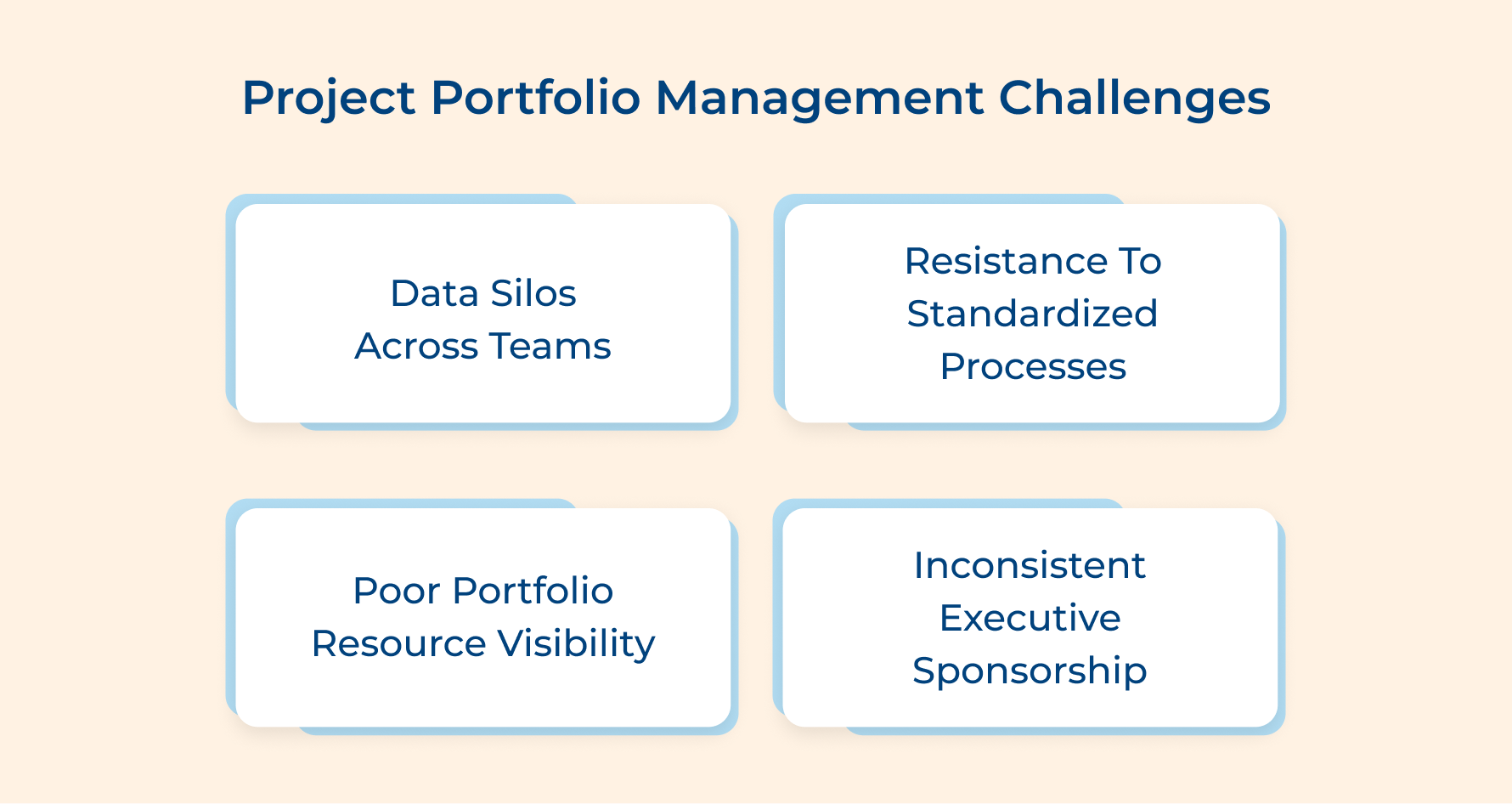
1. Data Silos Across Teams and Tools
Most organizations run projects across multiple disconnected tools and getting a unified portfolio view becomes nearly impossible when every team guards their own spreadsheet. The portfolio picture you are working from is always incomplete and dangerously outdated before any real decision gets made.
2. Resistance to Standardized Processes
Project managers who have run things their own way for years don’t embrace PPM frameworks overnight regardless of how logical the new process looks on paper. The resistance is almost always about loss of autonomy and fear of increased scrutiny over work that previously had very little leadership visibility.
3. Poor Resource Visibility at Portfolio Level
Most organizations know who is busy but very few know whether their busiest people are working on the right things at the right priority level. Portfolio managers end up making allocation decisions based on availability rather than strategic fit and that gap quietly erodes delivery quality over time.
4. Inconsistent Executive Sponsorship
PPM initiatives that launch with strong leadership support often stall within six months when executives shift focus to the next operational fire. Without consistent sponsorship, portfolio governance meetings get skipped, prioritization frameworks get ignored and the entire PPM structure collapses back into informal decision-making it was designed to replace.
These challenges are real but not permanent. With the right approach, each one has a practical and proven solution that organizations have successfully implemented across industries.
- Integrate a centralized PPM platform that pulls live project data from all existing tools into one consistent dashboard so leadership always works from a single source of truth.
- Run structured PPM onboarding workshops for project managers that focus on how standardization reduces their workload.
- Build a real-time resource capacity model that maps every team member’s allocation against active project demands.
- Formally assign an executive portfolio owner with a standing monthly review commitment so PPM governance stays visible and protected.
Align Your Projects with Success Through Smart Portfolio Planning
The benefits of project portfolio management show up clearly in organizations that consistently deliver on time, within budget and aligned to strategy. They treat their portfolio as a managed asset rather than a growing backlog of competing priorities.
Smart portfolio planning means making deliberate choices about what to start, what to stop and what to accelerate based on real data. That discipline separates businesses that grow with control from those that stay permanently busy but rarely move forward with real purpose.
Limit time — not creativity
Everything you need for customer support, marketing & sales.

Neeti Singh is a passionate content writer at Kooper, where he transforms complex concepts into clear, engaging and actionable content. With a keen eye for detail and a love for technology, Tushar Joshi crafts blog posts, guides and articles that help readers navigate the fast-evolving world of software solutions.