How to Build a Project Intake Process for Improved Planning
- What is a Project Intake Process?
- Why is an Intake Process Important For Project Management?
- Features of an Effective Project Intake Process in Project Management
- Impacts of a Good Project Intake Process in Professional Services
- How To Create A Project Intake Process in 7 Actionable Steps?
- Common Challenges in Managing the Project Intake Process
- Practical Examples of Project Intake Process
- Streamline Your Firm’s Success With the Right Project Intake Process
- FAQs about Project Intake Process

Key Highlights:
- A project intake process ensures your team evaluates the right work before committing any resources.
- Skipping structured intake is where timelines collapse, budgets overrun and teams quietly burn out.
- Prioritization stops being political when your team scores every request against real business impact data.
Most teams jump straight into project execution without ever asking one critical question – is this the right work to be doing right now? That single oversight is where timelines collapse and resources get wasted.
The root cause is almost always a broken or missing intake process. If you lack a clear process to review and approve requests, important work gets overlooked while unnecessary work piles up.
A well-designed project intake process fixes that at the source. This guide walks you through what it is, why it matters and exactly how to build one that actually holds up in a real professional service environment.
What is a Project Intake Process?
A project intake process is a structured system that organizations use to capture, evaluate and prioritize incoming project requests before any actual work begins. Every request (in case it comes from a client, a department head, or an internal team) goes through this process before it gets a green light.
Teams end up chasing unclear goals and wasting resources on work that was never properly vetted without a defined intake process. It brings order to the chaos of “we have an idea, now what?”
4 Phases of the Project Intake Process:
- Request submission: A stakeholder or team formally submits a project request with details like objectives, expected outcomes and rough timelines. This creates a paper trail and sets clear expectations from day one.
- Project review: The submitted request here gets examined by the right people. The review team checks feasibility and strategic alignment before the request moves any further in the pipeline.
- Approval: It is the decision-making phase where leadership or a steering committee gives the final go-ahead. This is a deliberate call based on business priority and capacity.
- Prioritization & assignment: This is the phase where a project officially gets an owner (a project manager or a lead) and moves from “approved on paper” to “ready to execute.”
Why is an Intake Process Important For Project Management?
Skipping the intake process might feel like saving time upfront but in reality it is where most project chaos originates. Here is what a proper intake process actually protects you from.
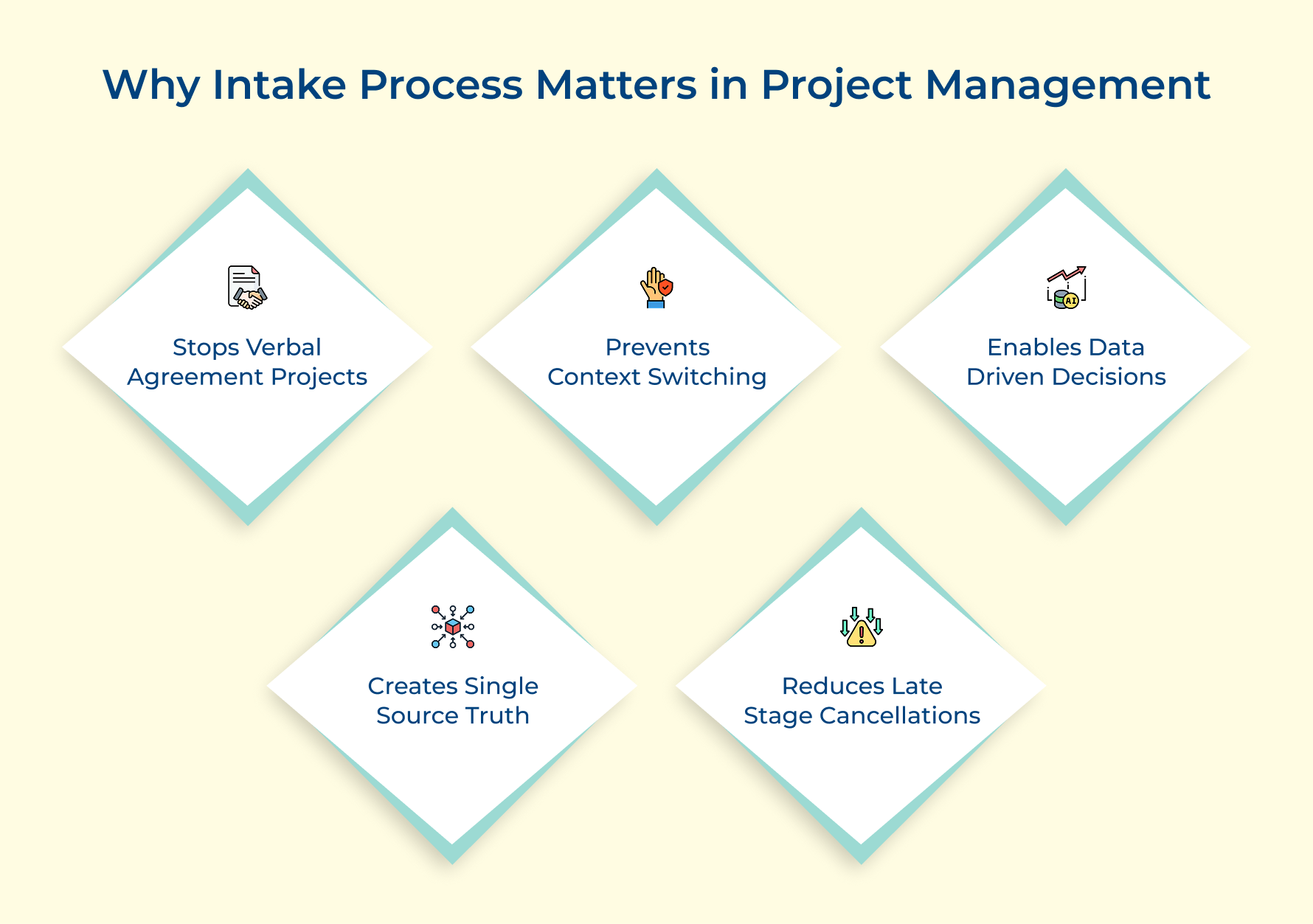
Stops “Verbal Agreement” Projects From Slipping Through
One of the most common problems I see is projects that kick off based on a hallway conversation or a quick email thread. Without a formal intake process those requests never get properly scoped and teams end up building something nobody officially approved.
Protects Your Team From Constant Context Switching
In my experience the biggest productivity killer is not workload, it is unplanned work landing on a team mid-sprint. The intake process creates a buffer so new requests go through evaluation first instead of directly disrupting active projects.
Gives Leadership Actual Data to Make Decisions
Project approval becomes a political game where the loudest stakeholder wins especially without intake. A structured process gives decision-makers real data on resource availability and strategic fit before they say yes.
Creates a Single Source of Truth for All Incoming Work
When requests come in through emails, Slack messages and meetings simultaneously nothing gets tracked properly. The intake process centralizes everything so no request falls through the cracks and every task is visible to the right people.
Reduces the Cost of Late-Stage Project Cancellations
Killing a project after two months of work is far more expensive than rejecting it at the intake stage. A proper review during intake catches misaligned or under-resourced projects before your team has invested significant time and budget into them.
Features of an Effective Project Intake Process in Project Management
An effective intake process is about building a system that helps your team make smarter decisions faster. These four features separate a well-run intake process from one that creates more confusion than clarity.
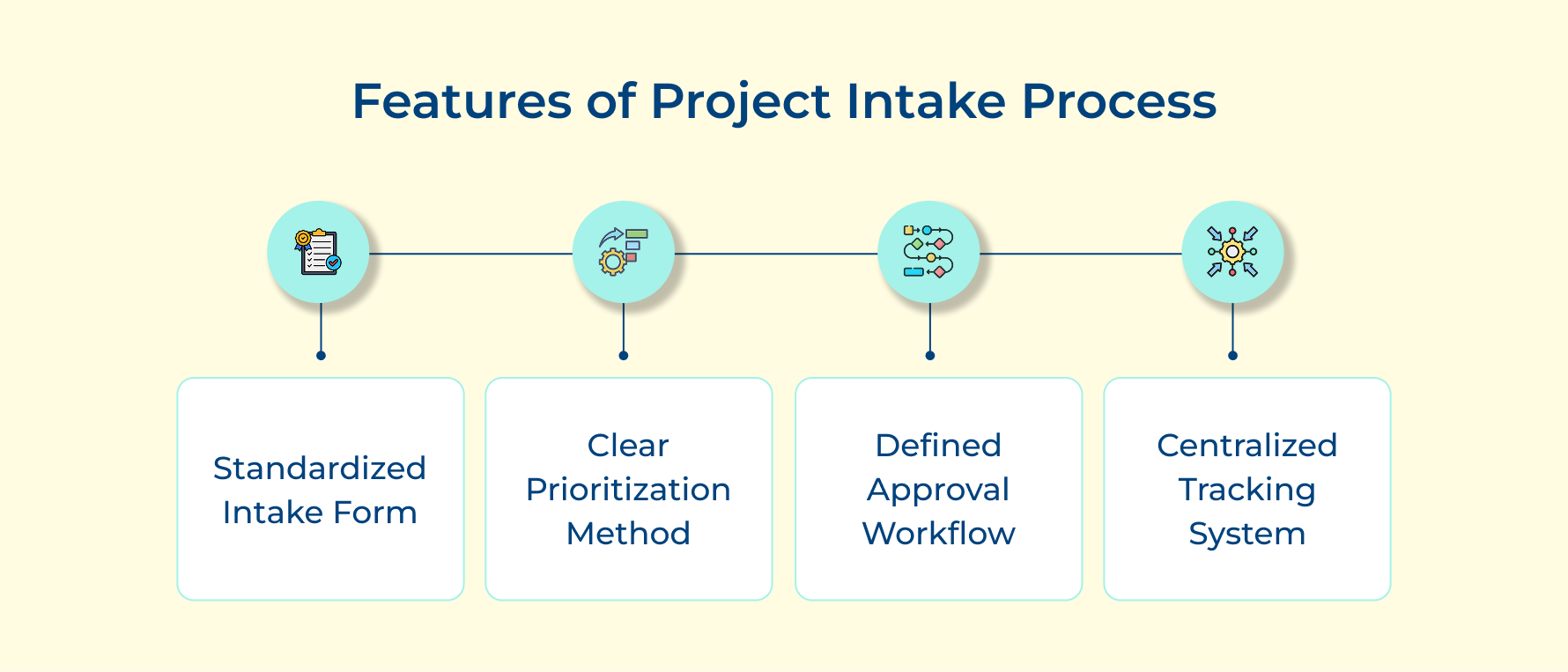
1. Standardized Project Intake Form
A project intake form is the foundation of your entire intake process. If not, requests come in half-baked and your team spends more time chasing information than actually evaluating the work.
What 5 elements should be included in your project intake form?
- Project objective: What problem is this request solving and for whom?
- Business justification: Why does this project matter to the organization right now?
- Estimated timeline: What is the expected start date and delivery deadline?
- Resource requirements: What team members, tools, or budget will this need?
- Success metrics: How will you measure if this project actually delivered value?
2. Clear Prioritization Method
Collecting requests without a way to rank them just creates a backlog nobody knows how to act on. A prioritization method gives your team an objective framework to decide what gets worked on first and what gets pushed or rejected.
What should your prioritization method evaluate?
- Strategic alignment: Does this project directly support a current business goal?
- Resource availability: Does the team have actual capacity to take this on right now?
- Risk vs. impact ratio: Is the potential outcome worth the effort and risk involved?
3. Defined Review and Approval Workflow
A request sitting in someone’s inbox with no clear owner is a request that will never move forward. A defined review workflow assigns the right stakeholders to evaluate each request at the right stage, so nothing stalls and no decision gets made arbitrarily
4. Centralized Intake Tracking System
One of the most overlooked features is having a single place where every request (submitted, under review, approved, or rejected) lives and is visible to the right people. Project managers end up handling requests through scattered emails, making it impossible to spot priorities.
What should your intake tracking system give you visibility into?
- Request status in real time: Exactly where each request stand in the pipeline
- Intake volume over time: No. requests are coming in and from which departments
- Approval turnaround time: How long is it taking to move requests
Impacts of a Good Project Intake Process in Professional Services
In professional services, the difference between a profitable engagement and a chaotic one is often decided before the project even starts. Let’s explore how a good project intake impacts the process.
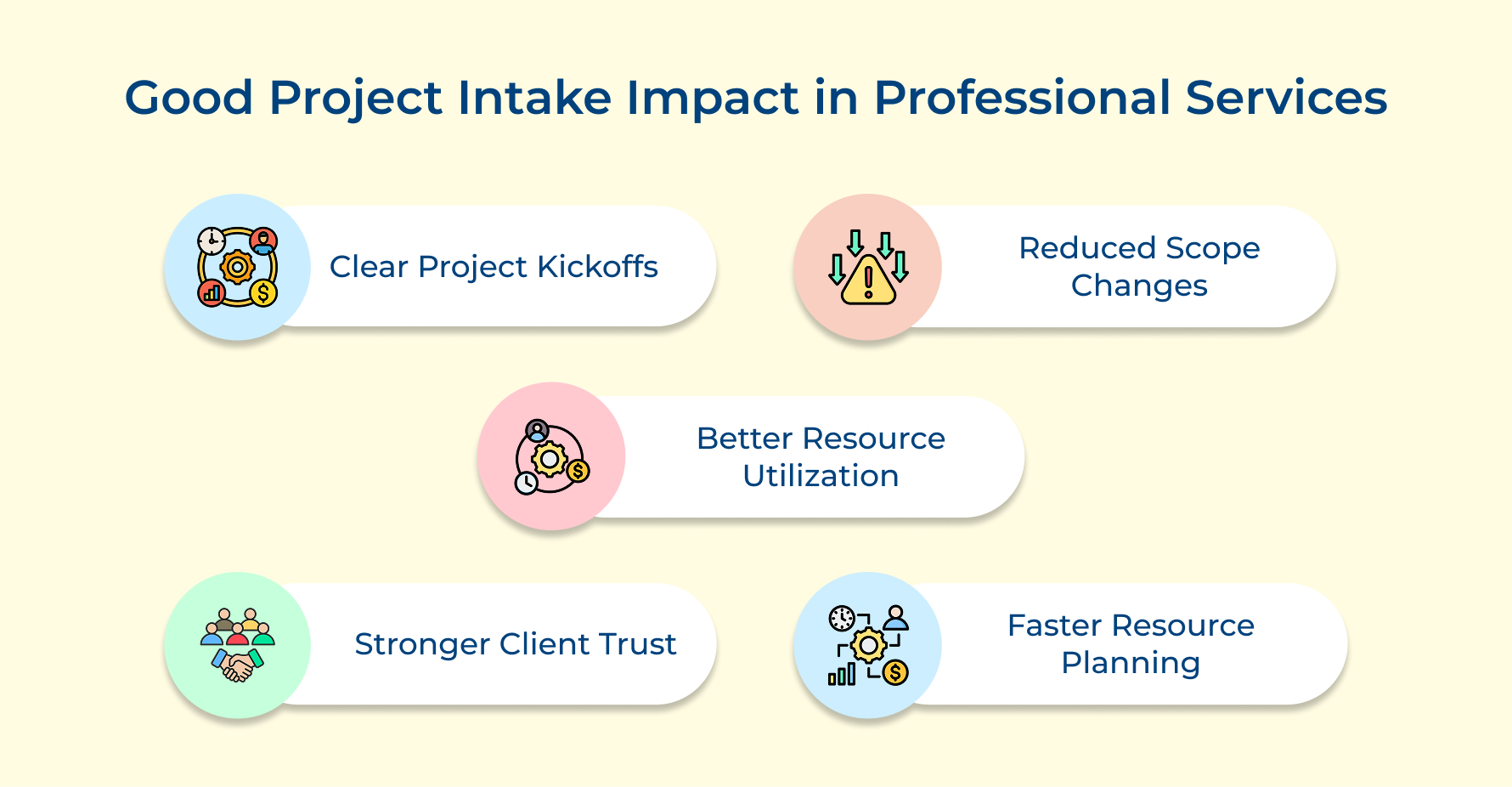
- Cleaner project kickoffs: When intake captures scope, ownership and expectations upfront, kickoff meetings stop being discovery sessions while becoming alignment sessions.
- Fewer mid-project scope changes: In professional services, scope creep rarely happens during execution – it happens because intake never forces the client to define boundaries clearly.
- Better utilization of billable resources: An inadequate intake makes senior consultants get pulled into firefighting mode. A structured process ensures billable hours go toward planned delivery and not reactive damage control.
- Stronger client relationships from day one: Clients who go through a structured intake feel heard and taken seriously. That early experience directly shapes how much they trust you throughout the engagement.
- Faster and more confident resource planning: When project details are captured at intake, resource managers can plan assignments proactively. They stop making capacity decisions based on incomplete or secondhand information.
How To Create A Project Intake Process in 7 Actionable Steps?
Let’s guide you through a simple 7-step approach to create a robust project intake process that will transform how your team handles new projects.
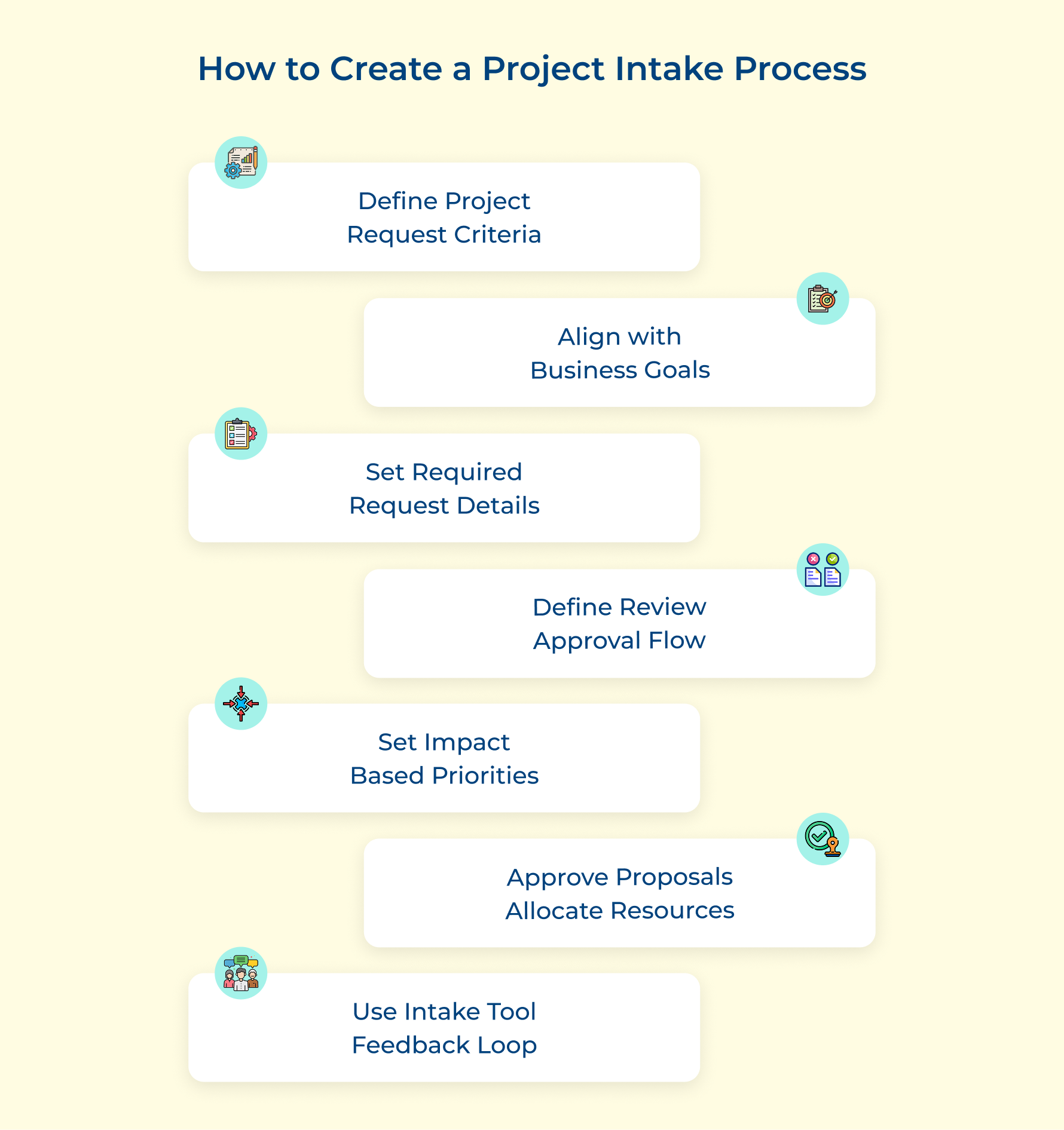
1. Identify and Define What Qualifies as a Project Request
Not every incoming ask deserves a spot in your project pipeline. The first step is drawing a clear line between a task and a real project request so your team stops wasting review time on work that should never have entered the intake process.
A task is something one person resolves within their normal workflow. A project requires cross-functional effort, a defined project plan and tracked delivery. That distinction needs to be documented and shared before anything enters your pipeline.
Before any request moves forward, ask:
- Does this require resources from more than one team or department?
- Does it have a defined start, end point and measurable outcome?
- Will it impact existing project timelines or current resource allocation?
Here is how to put this into practice:
- Document your qualification criteria in a single reference sheet and share it with every team lead.
- Set a scope threshold, any work requiring more than one team and two or more weeks qualifies.
- Add a resource trigger, if dedicated headcount or budget is needed, formal intake is required.
This gives every team lead a self-screening tool before a request even reaches your review pipeline.
2. Align the Intake Process With Business Goals and Strategy
An intake process disconnected from business strategy is just an administrative exercise that keeps people busy without moving the business forward. Every request entering your pipeline needs to be measured against where the organization is actually headed right now.
The Project Management Office plays a critical role here. Before approving any review criteria, sit down with leadership and document the top three to five business priorities for the current quarter. Every incoming request gets filtered through that list first.
Effective ways to keep your intake process aligned to strategy:
- Strategic filter at submission: Build alignment questions directly into your intake form so requestors self-assess strategic fit before the request reaches any reviewer.
- Leadership-defined priority tiers: Pre-classify business goals into tiers so reviewers know which initiatives take automatic precedence during evaluation.
- Quarterly recalibration: Update your intake criteria every quarter based on any shifts in business direction or market conditions.
Schedule a sixty-minute session with leadership before your intake process goes live. That session output becomes the alignment filter every reviewer uses from day one.
3. Determine Required Information for Your Project Request Form
Your intake form is only as useful as the information it actually captures. The real challenge is not knowing what fields exist but deciding which ones are right for your specific intake context without over-engineering the process into something nobody wants to fill out.
Choosing the wrong fields creates two problems. Either you collect irrelevant data that slows reviewers down or you miss critical details that make sound decision-making nearly impossible from the start.
Key fields every project request form should include:
- Business case field: Forces the requestor to articulate why this project matters right now and if it has real strategic grounding behind it
- Resource and effort estimate: Captures what the project will demand so reviewers can assess feasibility before committing to full evaluation
- Success criteria: Defines what done actually looks like without it projects get approved with no clear delivery measure
- Dependency and risk field: Flags in case this request connects to an active project or carries risks that affect the broader pipeline
Test your form with three to four frequent requestors first. Cut any field that does not directly influence a review decision and keep what remains lean.
4. Define How Requests Are Reviewed and Who Approves Them
Without a defined review workflow, project requests do not just get delayed. They get decided by whoever follows up the loudest. Teams end up approving work based on persistence rather than priority and that is where resource misallocation quietly begins causing real damage.
The absence of clear approval ownership also creates a trust problem. When requestors stop hearing back or receive inconsistent responses, they abandon the intake process entirely and go back to informal channels that bypass structure completely.
Review and approval workflow checklist:
- Is there a named reviewer assigned to every stage of the intake review?
- Is there a documented criteria sheet guiding how each request gets assessed?
- Is there a clear escalation path when reviewers cannot reach a decision?
Here is how a clean two-stage review workflow looks in practice:
- Stage 1 — Feasibility Review: A project initiator or project manager evaluates the request against scope, effort and resource availability
- Stage 2 — Final Approval: A department head or governance lead makes the final go or no-go call
- Review window: Each stage gets a defined time limit of five business days
- Escalation trigger: Anything unresolved beyond ten days automatically escalates to a senior decision-maker
Map every review stage and assign a named owner before your intake process goes live.
5. Establish a Prioritization Framework Based on Business Impact
Approved requests pile up fast. Teams then default to working on whatever feels most urgent rather than what actually moves the business forward.
A structured scoring model removes that guesswork and gives every decision a defensible rationale that leadership can stand behind.
Before prioritizing any project request, ask:
- Does this request directly support a current business goal or revenue target?
- What happens to the business if this project is delayed by one quarter?
- Do we have the right resources available without disrupting active projects?
How to apply a prioritization framework without adding bureaucratic overhead:
- Score each request across three criteria – business impact, resource availability and strategic alignment
- Assign a weight to each criterion and let the total score determine where the request sits in the queue
- Tie scores to real business metrics because vague labels like “high impact” mean nothing without a defined benchmark behind them
- Revisit your priority queue every two weeks because business conditions shift and last month’s low priority can become this month’s critical initiative
This turns prioritization from a gut-feel exercise into a structured process grounded in actual business consequence.
6. Approve Project Proposals and Allocate Resources
Approval without resource allocation is just a promise nobody can keep. The moment a project gets approved without confirmed capacity, delivery timelines become fiction and client expectations get set up to fail before the first task is even assigned.
In professional services, this is where most intake processes quietly break down. Projects get green-lit in meetings but nobody confirms if the right people are actually available to deliver them on time.
Effective methods for approving proposals and allocating resources:
- Capacity-first approval: Run a resource availability check against your current project load before issuing any approval and only commit when capacity is genuinely confirmed.
- Staged resource commitment: Allocate resources in phases tied to project milestones rather than committing full bandwidth upfront to protect active projects from disruption.
- Ownership assignment at approval: Every approved business case gets a named project owner before it leaves the approval stage with no exceptions.
How to stop resource allocation from bottlenecking your intake process:
Build a simple capacity dashboard showing current team utilization before every approval meeting. When decision-makers see real availability data in the room, allocation conversations take minutes instead of days and projects move forward with genuine resource backing.
7. Leverage a Project Intake Management Tool
Most intake processes break down not because of poor planning but because they are being run manually across emails and spreadsheets. A dedicated intake tool brings everything into one place and turns your process from something that depends on people remembering things into something that runs on actual structure.
Can a spreadsheet handle intake? At a small scale, yes. But the moment intake volume grows or multiple reviewers get involved, visibility breaks down fast. A proper tool gives you automated workflows, real-time status tracking and audit trails that no spreadsheet can replicate reliably.
Key factors for choosing the right intake management tool:
- Workflow automation: The tool should move requests through review stages automatically without requiring manual follow-up at every handoff.
- Custom form builder: Modify your intake form without needing developer support every time a field needs updating.
- Role-based access control: Reviewers, approvers and requestors should each see only what is relevant to their specific stage.
- Pipeline visibility: Real-time view of where every request stands and how long each stage is actually taking.
What a good intake tool does in practice:
- All incoming requests live in one place so nothing gets lost and every status is visible without chasing anyone down.
- The tool automatically pings the right reviewer the moment a request reaches their stage eliminating manual handoffs that cause most delays.
- Project managers pull data on submission volume, approval rates and average turnaround time to spot exactly where the process consistently slows down.
Common Challenges in Managing the Project Intake Process
Even with a well-designed intake process, managing incoming project requests consistently is harder than it looks. These are the four challenges that surface most frequently in real project environments.
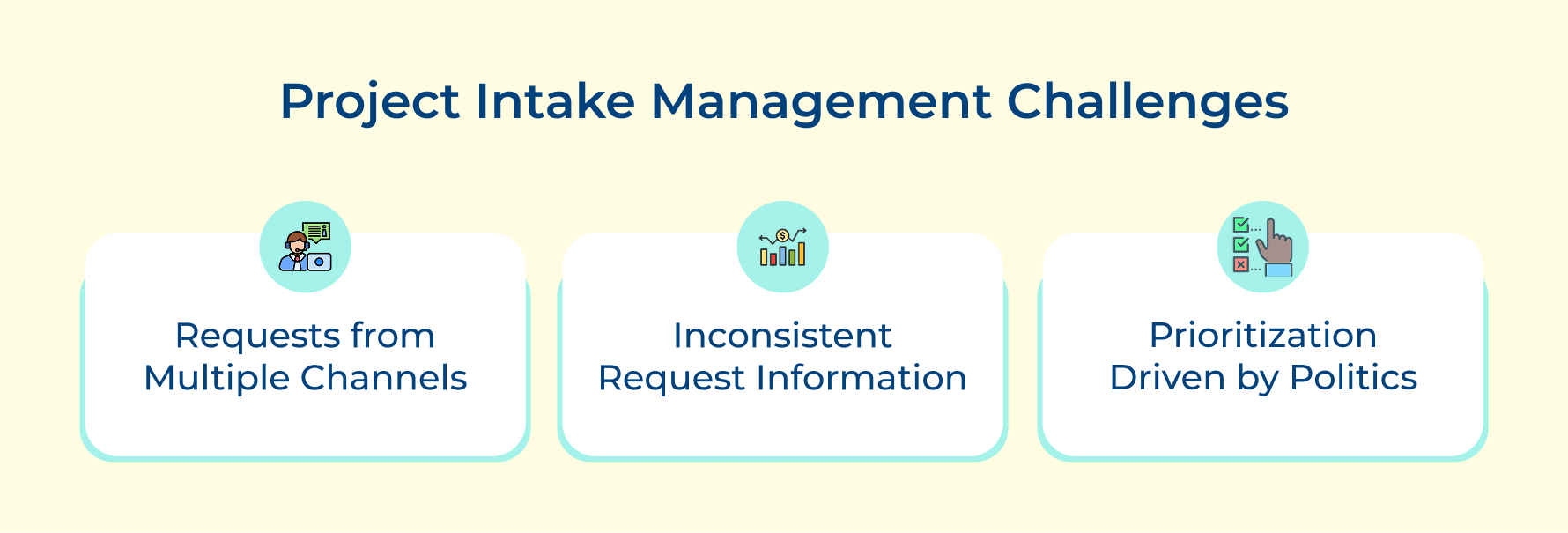
Requests Coming in Through Multiple Informal Channels
When there is no single submission point, requests arrive through Slack messages, emails and hallway conversations simultaneously. The intake pipeline fragments and high-priority work gets missed simply because it came in through the wrong channel.
Inconsistent Information Across Submitted Requests
Not every requestor fills out the intake form with the same level of detail. Reviewers end up spending more time chasing missing information than actually evaluating whether the request deserves approval.
Prioritization Becomes Political Instead of Data-Driven
In most organizations the loudest stakeholder wins, not the most strategically aligned request. Without a scoring model in place, prioritization decisions get influenced by seniority and pressure rather than actual business impact.
These challenges are fixable but only when addressed at the process level, not just through better communication. Here is what actually works in practice.
- Build a mandatory intake form with non-negotiable fields that cannot be skipped before submission.
- Designate a single submission point and make it the only officially recognized channel for project requests.
- Implement a weighted scoring model that every reviewer uses consistently across all incoming requests.
- Assign a permanent intake process owner who is responsible for adoption, compliance and quarterly refinement.
Practical Examples of Project Intake Process
The intake process does not look the same across every business — the stages stay consistent but what gets evaluated at each stage depends entirely on the nature of the work. Here is how it plays out across four different professional service environments.
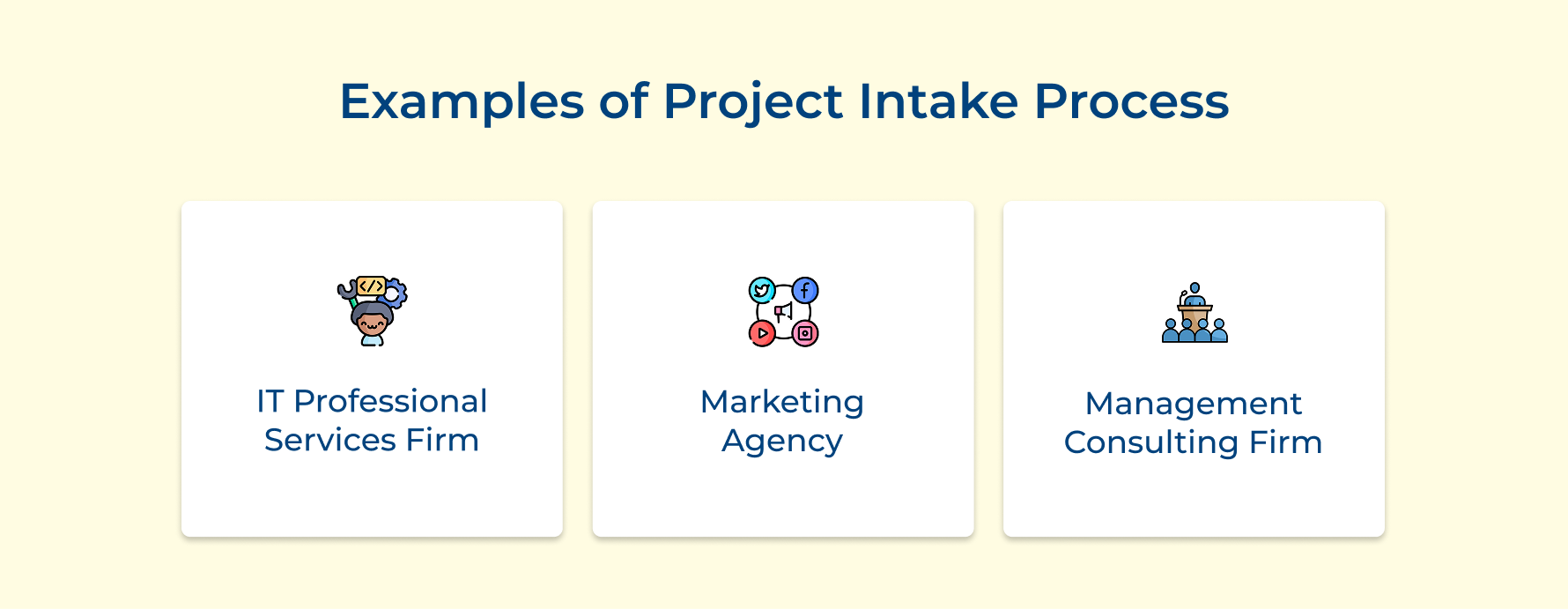
1. IT Professional Services Firm
A client requests a new system integration and before any scoping call is scheduled the firm runs it through intake first, because committing to a discovery session without checking internal capacity is where over-promising begins.
- Request submission: Client-facing team logs the request with affected systems, integration scope and the client’s go-live expectation.
- Technical feasibility review: The technical lead checks if the right skillset exists internally or a subcontractor dependency would be created.
- Capacity check: Delivery team availability is confirmed against active engagements, no approval moves forward if it means pulling someone mid-project.
- Approval and ownership: The delivery head issues formal approval with a named project manager and locked start date.
2. Marketing Agency
In a marketing agency, the biggest intake risk is creative team burnout from accepting every campaign that comes in. A structured intake process forces the agency to evaluate capacity and fit before the client relationship creates an obligation.
- Request submission: Account manager logs the campaign brief with deliverables, budget range and client-expected timeline.
- Creative capacity review: The creative director checks current workload, accepting a campaign without this step is how deadlines get missed.
- Margin review: Finance confirms the proposed budget meets agency margin thresholds before any commitment is made to the client.
- Account lead assignment: A dedicated lead is assigned and the client is informed before any kickoff conversation begins.
3. Management Consulting Firm
Consulting firms face a unique intake challenge, not every engagement that looks profitable is actually the right fit. Intake here is as much about protecting the firm’s reputation as it is about managing capacity.
- Request submission: Business development logs the engagement request with client context, restructuring scope and expected outcomes.
- Conflict of interest check: Compliance verifies no existing client relationships create a conflict, skipping this step has ended consulting relationships permanently.
- Expertise and availability review: The practice lead confirms the right domain expertise is available within the proposed engagement window.
- Engagement prioritization: The request is ranked against active projects to ensure delivery quality on existing clients is not compromised.
Streamline Your Firm’s Success With the Right Project Intake Process
A project intake process is not paperwork. It is how your firm decides what work deserves attention and what does not. Firms that get this right protect their teams, their margins and their client relationships before a single project kicks off.
Getting it right takes deliberate effort upfront but the returns compound across every project that follows. Start with the fundamentals in this guide and build from there. A process that consistently filters the right work in and the wrong work out is one of the smartest investments a professional service firm can make.
Limit time — not creativity
Everything you need for customer support, marketing & sales.

Neeti Singh is a passionate content writer at Kooper, where he transforms complex concepts into clear, engaging and actionable content. With a keen eye for detail and a love for technology, Tushar Joshi crafts blog posts, guides and articles that help readers navigate the fast-evolving world of software solutions.