The Ultimate Guide to Project Governance for Service Firms
- What is Project Governance?
- Why is Project Governance Important for Service Firms?
- Project Governance vs. Project Management: What’s The Difference?
- Key Components of Project Management Governance
- How to Establish a Project Governance Framework in 6 Steps
- Key Pillars of Project Governance Structure to Consider
- Project Management Governance Models Used In Service Business
- Real-World Examples of Project Governance
- Streamline Your Project Management Journey with Project Governance
- FAQs about Project Management Governance Framework

Key Highlights:
- The right model manages decision-making authority and accountability across each phase of delivery.
- Project Management Governance structure is a living structure that scales based on the project across service firms.
- The foundation of a successful project governance framework includes clear roles, reporting and defined escalation paths.
Most projects in service firms fail not only due to poor execution but also without any defined ownership for decision making, change control or boundary management. The issue is all about project governance failure.
According to a recent report, only 35% of projects meet all goals and timelines, while others fail due to a governance gap. Businesses that are closing this gap are governing their projects with clear authority and structured control.
Explore the guide to cover what project governance is, its importance and how to build a framework to manage deliverables. It not only covers general management methodology, but also focuses on the specific governance layer. The framework sits above execution to ensure that projects deliver real value.
What is Project Governance?
Project management governance is considered the backbone of any project that defines who holds authority and how delivery stays aligned to outcomes. The setup is not a one-time; instead, think of it as a living structure that guides every phase.
The project fails across professional service firms, agencies and consultancies when the right decision is not made at the right moment. The project quietly drifts off course. A strong project governance model eliminates that gap by aligning the right authority at each important checkpoint.
The process also protects client relationships in unique ways, such that others cannot. Project governance means a scope change hits or a deadline shifts. The structure separates a constantly struggling team from a high-performing group.
Key purposes:
- Accountability: allocate ownership at every level so that no important updates get lost in ambiguity.
- Decision-Making: A clear approval hierarchy keeps the projects moving across stages without delays.
- Transparency: Defined reporting and review cadences for delivering a consistent visibility.
- Strategic Alignment: Make sure every decision actively supports the business goal for which it has been made.
Why is Project Governance Important for Service Firms?
Strong project governance structure not only keeps projects on track but also drives better outcomes across every phase. Let’s explore the benefits in detail:
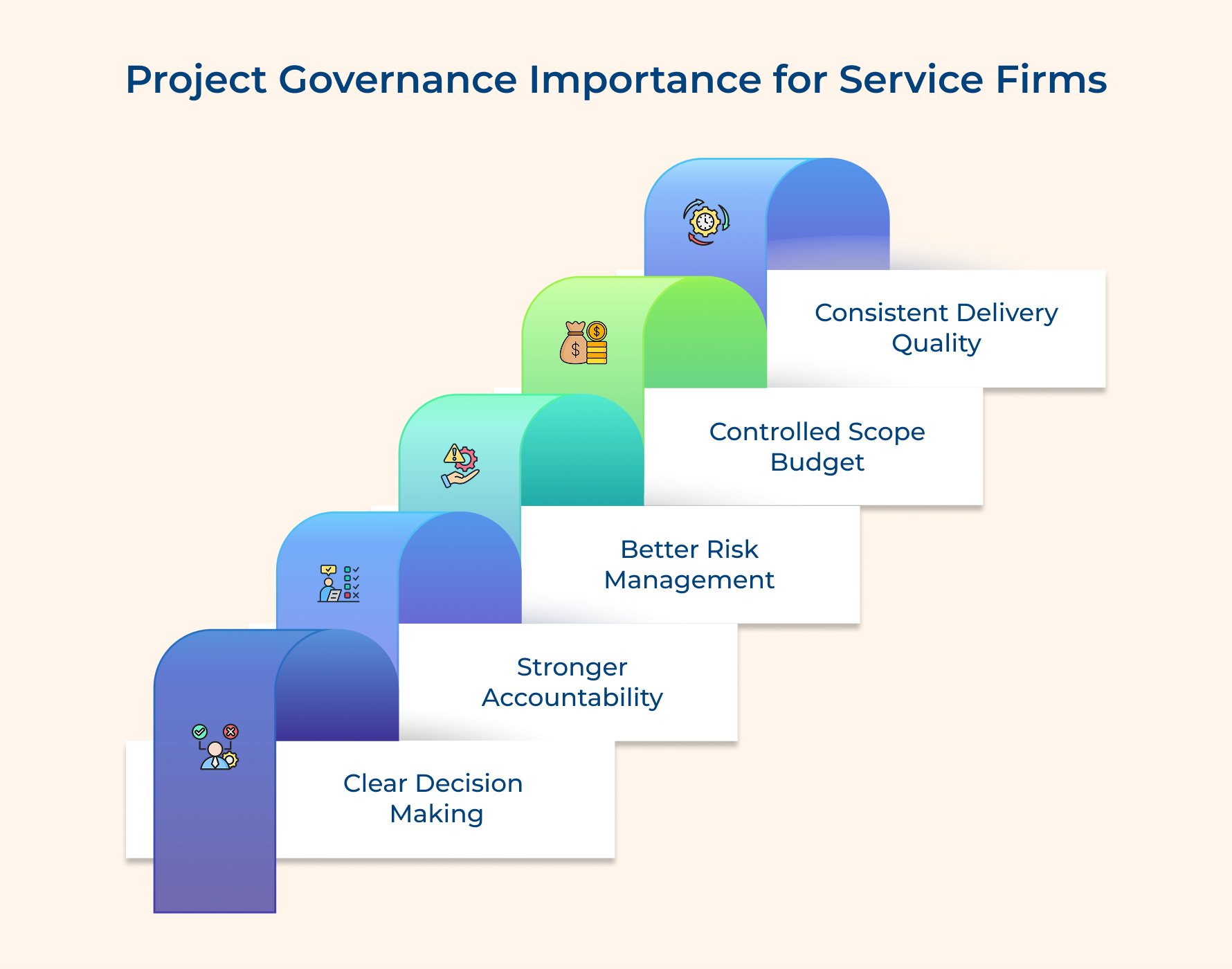
1. Clearer Decision-Making
Delayed decisions in any project can cost time and budget faster. A governance framework puts the right authority in the right phase so that important calls are made without escalation, leading to improved overall project deliverables.
2. Stronger Accountability
The quality of work changes noticeably when everyone knows their own roles and responsibilities. Agile governance helps in removing ambiguity and allows project tasks to be routed to the appropriate member. It ensures that every task has a specific owner responsible for the outcome.
3. Better Risk and Issue Management
Risks rarely occur during early signs to make sure you actually act upon them. Structured checkpoints force teams to surface risks instead of just absorbing them silently till they become threatening issues.
4. Controlled Scope and Budget
Scope creep is a common reason projects overrun. A good project governance template is the primary defence, as it changes control processes and also makes sure every addition to the scope is approved.
5. Consistent Delivery Quality
The framework creates a delivery standard that does not rely on individual or tribal knowledge. For example, in professional service firms and consultancies, project governance builds long-term client trust as well as overall operational scalability.
Project Governance vs. Project Management: What’s The Difference?
Project governance as well as management are often used interchangeably and not being able to differentiate them is one of the most common mistakes made across delivery organisations.
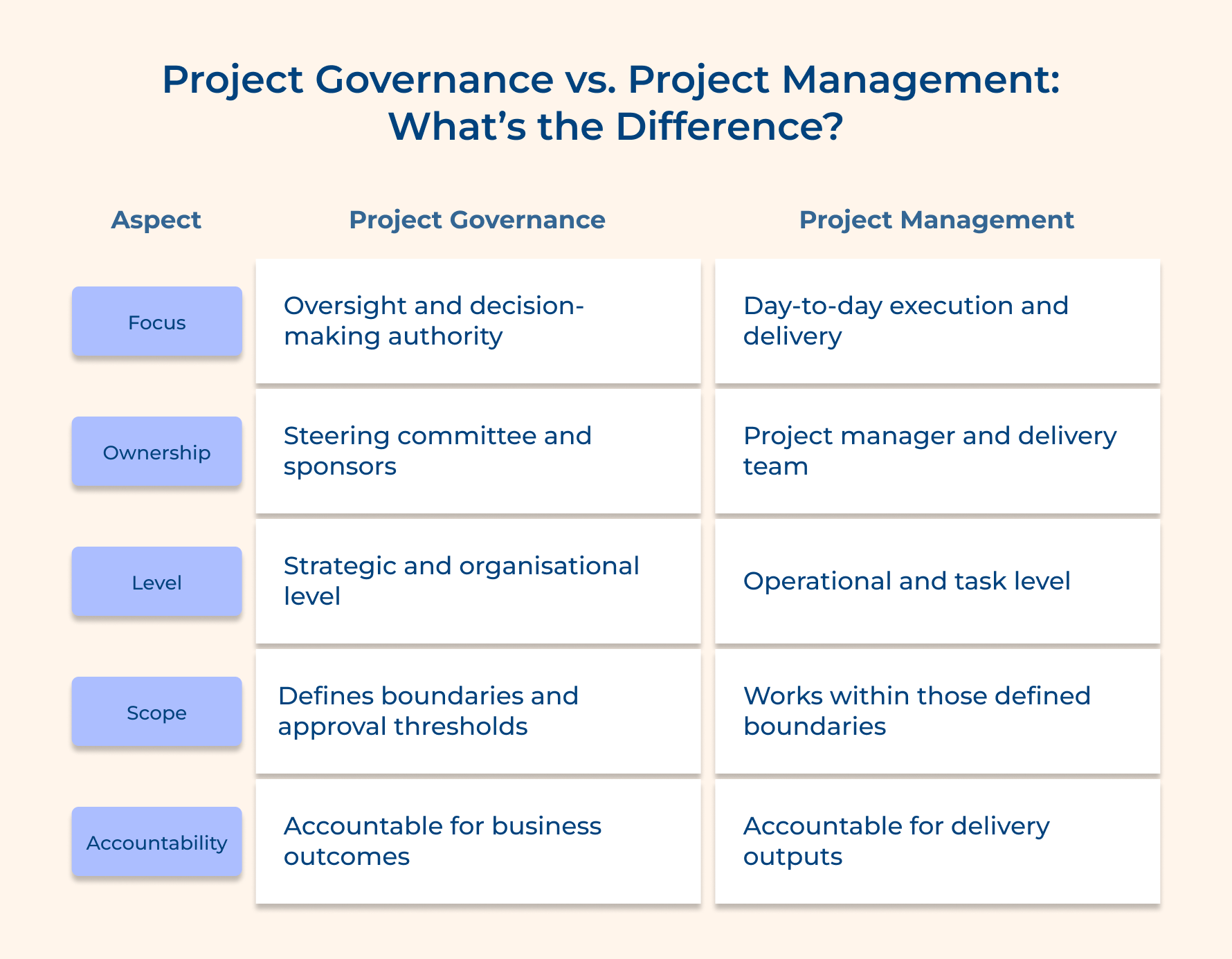
1. Focus
Project governance maintains oversight to make sure the right decisions meet the right authority level. It never gets into daily execution and that is not deliberately its role.
Project management occurs inside the execution layer where the team outputs forward every single day to translate strategic direction into delivered work on the ground.
2. Ownership
The governance system is a steering committee that carries the authority to approve major decisions in your project. Its involvement is structured as a checkpoint, rather than a continuous process.
Project management combines with the project manager to coordinate the delivery team through every phase.
3. Level
The model operates at a fixed level that sets the rules to shape how every project should run. It connects project activity directly to organisational priorities as well as with the business strategy.
Project management is different in comparison to governance. It works at an operational level to apply rules to real tasks and deadlines. It helps in converting high-level direction into executable delivery plans.
4. Accountability
Governance holds accountability for the project, which delivers measurable business value and as well as outcomes. It sits at the leadership level without the process of exception.
Project management is different from governance as it is accountable for delivering projects with the best quality and within budget. It helps in answering governance for how well the execution is tracked against the approved plan.
Key Components of Project Management Governance
Project management governance is not only a strong framework but also holds all components together for structured delivery.
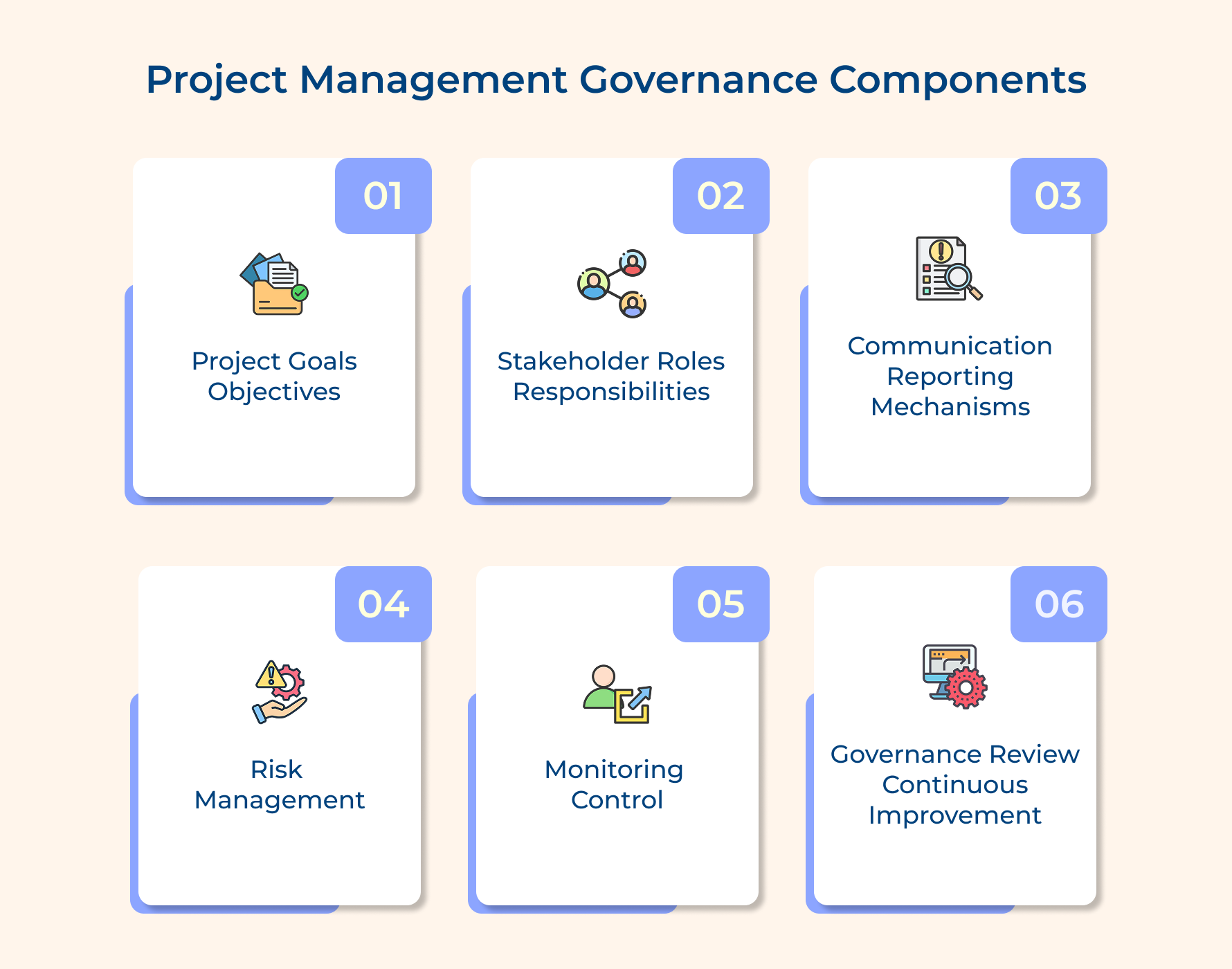
1. Project Goals and Objectives
Project governance structure begins with goals that are specific and directly tied to a business outcome. A defined goal and objectives act as a reliable reference to validate every decision.
What happens when goals shift mid-project? Governance is the model that controls the changes to approve the project deliverables. Let’s suppose that when a project runs without clear objectives, then it is recommended to move fast in the most accurate direction.
Setting up the project objectives starts with these questions:
- Are these goals aligned with the strategy and not just a brief?
- Did all the stakeholder groups formally sign off on the process?
- What is the change process when these objectives need to shift?
Governed objectives create the baseline against the project performance, which need to be measured at every stage.
2. Roles and Responsibilities of Project Stakeholders
What is the fastest way to regain control of your project when you lose it? Situations in which two people make the same decision. A good governance structure helps here by taking the key responsibility to define the roles of each member so that accountability is unambiguous at each level of the project.
The framework is more than just a simple RACI chart. Project governance meaning defined decision thresholds and boundaries of each role.
Now it is all about who has the authority to sign off on changes in scope, budget and timeline? It needs clear documentation before the project moves, not just during the crisis. Well-defined roles streamline the responsibilities of project deliverables.
Below is the roles and responsibilities checklist that needs to be considered:
- You should review RACI at every major project phase
- Each risk and issue category is assigned based on escalation ownership.
- Define stakeholder interest levels based on the formal approvals
3. Communication and Reporting Mechanisms
Without a structured communication project, governance feels like having a control room with no instruments. The framework is there, but leadership cannot actually access it. The core responsibility is what gets reported and at what frequency in the project cycle.
A clear project governance framework should explain:
- The weekly status report and who is responsible for generating it.
- Identified risks and issues that require immediate escalation.
- A Structured Committee update for real decisions instead of passive reviews
Let’s consider an example where a communication in a governance framework is properly defined and stakeholders stop chasing project updates. The shift helps you to keep focused on decisions instead of just gathering information.
4. Risk Management
Every project comes with its own risk, but if the risks exist, or the team creates it and is unable to resolve them. It is where a risk process governs work well to identify risks, their ownership and offers a clear escalation path when the severity increases.
The projects in which risk is handled well are the ones where your risk review has a fixed agenda at each checkpoint. It is not just a conversation but a strategic process for efficient project management across the risk governance.
Best practices to follow:
- Manage a live Governance document with named owners, along with specific mitigation plans
- Client-facing risks are communicated transparently instead of just to internal management
5. Monitoring and Control
A monitoring project without a governance structure, meaning only simple management, with no advanced strategies. It is only useful when there is a predefined process for an action.
Governance builds the foundational control that converts performance tracking data into informed decisions. An effective management project governance framework should include:
- KPIs and metrics that are tracked across the entire project lifecycle
- Corrective action logs that are tracked and reviewed during the governance meetings
- A detailed audit trail for tracking all key decisions for post-project accountability
Monitoring and control also help you create the audit trail that protects both the team and the client during project decision-making questionnaires. A well-governed project stores a clear record of escalation and action that has been taken in important touchpoints
6. Governance Review and Continuous Improvement
Teams treat governance as something that has been set up at the start and revisit it when breaks that is why the frameworks lose effectiveness in between complex or long-running projects.
Track the governance review checklist:
- Set up formal governance reviews at major project phase transitions
- Track if the current reporting cadences are still meeting the needs of the client
- A clear documentation of lessons learned from governance performance to use in future projects
Governance itself needs to be reviewed, so it is recommended to do so at regular intervals to confirm it is still helping in evolving your project. Let’s consider an example of a global professional services firm that designed a governance framework during the project initiation phase. It needs adjustment during the execution stage. The changes occur due to the team structures, client dynamics, or delivery risks.
How to Establish a Project Governance Framework in 6 Steps
Build a project governance framework to get a clear decision-making structure and control needed for delivering outcomes. Let’s explore the steps to build it that work best for service firms.
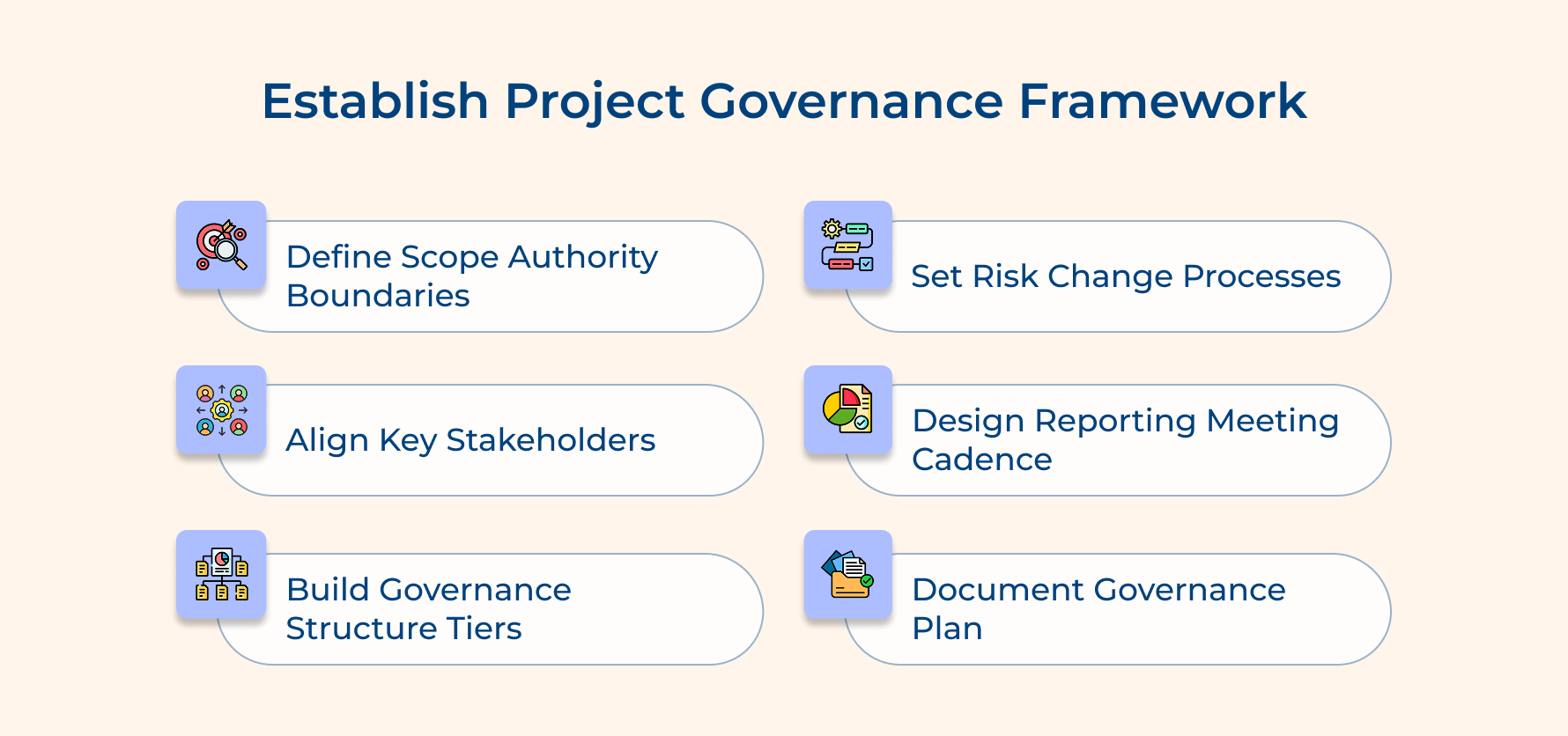
1. Define Scope and Authority Boundaries
The first step in the project management governance framework is defining scope and authority boundaries. The decision-making power of governance is no work without a clear scope. Projects become vulnerable due to the authority conflicts.
This step helps you to define how cleanly every governance decision will be made throughout the deliverables
At which stage do most frameworks break down? Boundaries. When the decision conflicts there is no documented authority to resolve it.
Explore the examples of ideal scope and authority boundaries:
- The project manager keeps control of budget authority up to a specific threshold without involvement
- Delivery time affected by more than five days require formal sponsor sign-off
- Real time Decisions that are affecting business objectives outside the project boundary should fall under managers authority
Governance moves from a theoretical structure to an operational tool when the project management boundaries and thresholds are documented frequently. Roles and decisions have a clear home. It is the foundation upon which everything from planning to execution is built.
2. Identify and Align Key Stakeholders
Stakeholder identification and involvement in the governance process helps in allocating right people at key moments for informed decision-making in projects. What happens if stakeholder identification is done wrong? Builds authority gaps and misalignment that grow across the entire lifecycle.
Questions to consider profile key stakeholders:
- Who has the final authority to approve major project decisions?
- Who carries influence to derail project delivery if not engaged?
- Where does the escalation of ownership occur when an issue exceeds the authority?
These questions force the team to confront where authority lives ahead of the delivery pressure. Once identified, align stakeholders with defined roles to secure explicit commitment and prevent the future escalation of risk.
Practical tips:
- Formal role confirmation: offer sign off to stakeholders on their responsibilities before the project execution phase.
- Escalation path agreement: Prevent any surprise during project execution by providing a clear escalation chain.
3. Build the Governance Structure and Tiers
Do you know what the effect is on project management when it runs without a governance tier? Senior leaders called into operational work, which caused the delivery teams to wait for approvals. A tiered governance eliminates this issue.
Follow the effective methods to set a project governance design and tiers:
- Define committee composition and mandate: Include sponsor authority, business representation and delivery leadership within the steering committee. It limits their involvement strictly to decisions instead of operational delivery.
- Set clear escalation paths between tiers: Define a trigger for upward escalation either in a budget threshold or in a timeline that exceeds agreed tolerances.
Consider an example of a global infrastructure project running without a tiered governance framework. Every issue lands on the director’s desk, which causes chaos. A proper tiering resolves operational decisions and only escalates issues that genuinely require attention.
4. Establish Risk and Change Control Processes
Risk and change control are considered as protection mechanisms that stop events from disrupting a well-governed project. What role does a governance framework play here? Every risk becomes a potential crisis and a source of conflict.
Checklist to implement a risk and change control:
- A live risk register with an assigned owner for every risk that has been identified
- Risk should have a mitigation plan along with a defined escalation threshold
- Activate a formal change request before any unplanned work.
When these controls are followed, leaders stop being surprised and start making decisions based on reliable information.
How does it work in a live project? Consider a scenario when a client requests an additional scope. The change control process within governance immediately triggers an assessment and it reaches the right authority of the project to maintain the timeline.
Best practices:
- Approvals are confirmed at the manager level, while scope or budget escalates directly to stakeholders.
- The risk register review should be a standing agenda item at every meeting and reporting instead of waiting for the time when issues arise.
5. Design Reporting and Meeting Cadence
A meeting and reporting cadence converts project governance from a static structure into an active decision-making system. It helps streamline the visualisation gaps so that leadership does not lose the decision-making ability. What could be an ideal cadence that needs to be built into your framework?
- Weekly delivery standups: In this stage, the project team reviews progress, flags blockers and maintains momentum without escalating to senior governance.
- Bi-weekly risk and issue reviews: The project manager reviews the registered risks to make sure emerging threats are found before reaching the steering level.
- Monthly steering meetings: Senior stakeholders review progress to approve escalated decisions so that core objectives remain intact.
What does the status report solve on a project? It removes inconsistent reporting to make sure everyone receives reliable delivery visibility every week across the entire project.
6. Document the Governance Plan
A successfully established governance model stores every decision, role and boundary of a project in one formal document. When no documentation is done, it only exists in memories, which diverge fast under pressure.
The document also becomes the critical reference point when new stakeholders join mid-delivery, which might need immediate clarity.
Best practices:
- Each new update will be logged and redistributed with stakeholder acknowledgement for a clean audit trail.
- Stakeholders must formally approve the plan before project delivery starts without shortcuts.
Key Pillars of Project Governance Structure to Consider
Every agile governance model includes three foundational pillars that make sure projects are delivered successfully. Let’s explore these models in detail:
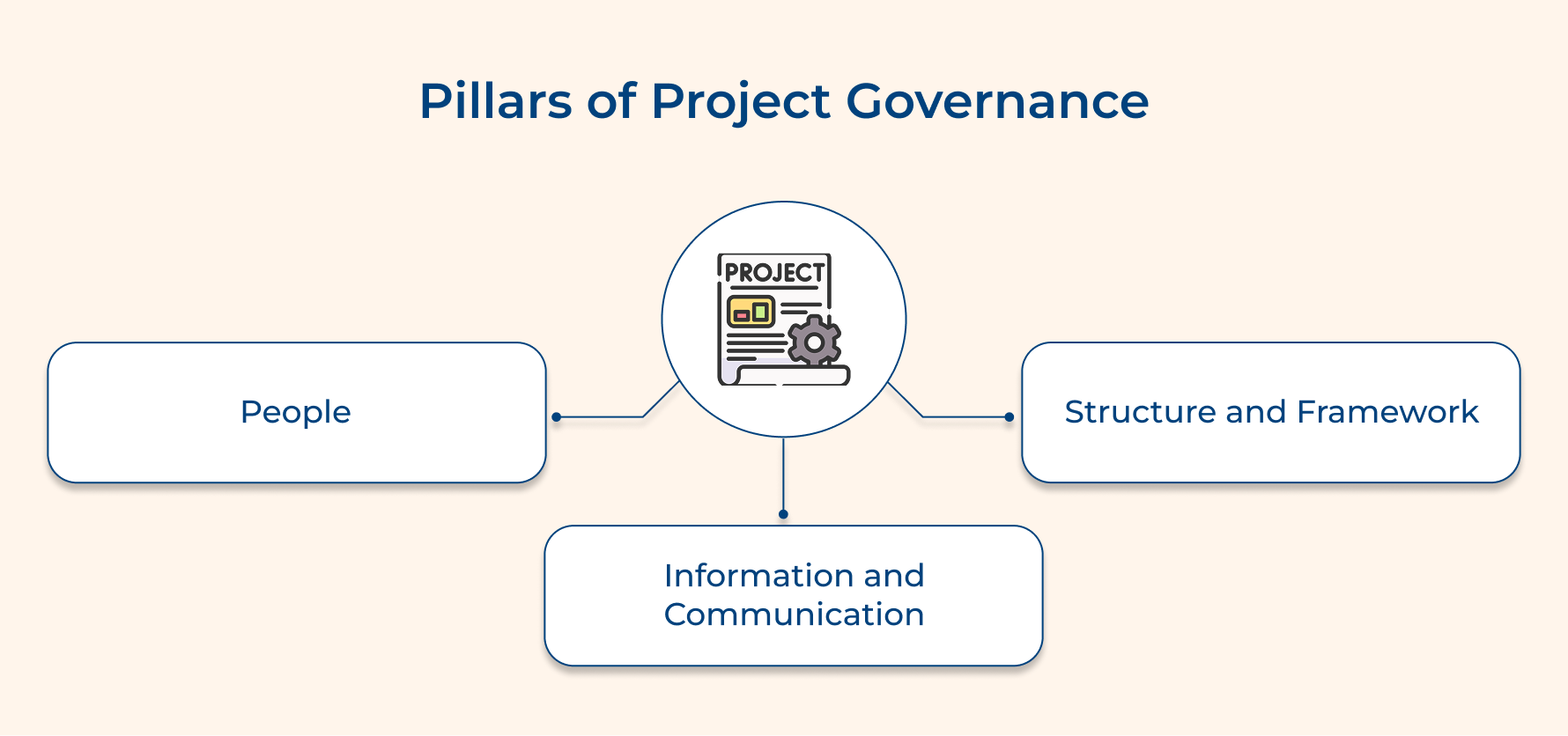
1. People
Governance starts with the right authority, skills and accountability in the hands of people who can actually act on them when needed.
Think of a real project where governance breakdowns can be traced back to a people problem or teams operating without a decision-maker. The right people layer makes every other framework element functional for deliverables.
- Defined roles and responsibilities: Projects need a clear, documented ownership so that no decision waits for someone to claim.
- Steering committee and sponsorship: A committed team of people of a project with real authority should be present to streamline blocked escalation within hours.
2. Structure and Framework
Structure is the pillar that transforms good intentions into repeatable as well as auditable project behaviour. Now, the question comes: what happens if someone skips this pillar? Experienced teams make informal decisions that create inconsistency and serious risk over time.
- Tiers and escalation paths: Clear levels of authority are established to make decisions without unnecessary delays or bypassing.
- Change control mechanism: Every key element, such as budget, scope, etc., of the project must pass through a structured approval process.
3. Information and Communication
A Project Governance without reliable documentation is just like a structure management on paper. It needs accurate data to function properly and the quality of decisions depends on the information within the document.
Poor communication is a leading cause of governance failure in agencies and delivery teams. Even after the structure of it is perfect.
- Consistent reporting across projects gives a reliable view of delivery health at any stage.
- Document all project data, such as risks, budgets and changes in one unified place for stakeholders to work consistently.
Project Management Governance Models Used In Service Business
Choosing the right model is a strategic decision that shapes your project delivery. Explore the models in detail for a better understanding:
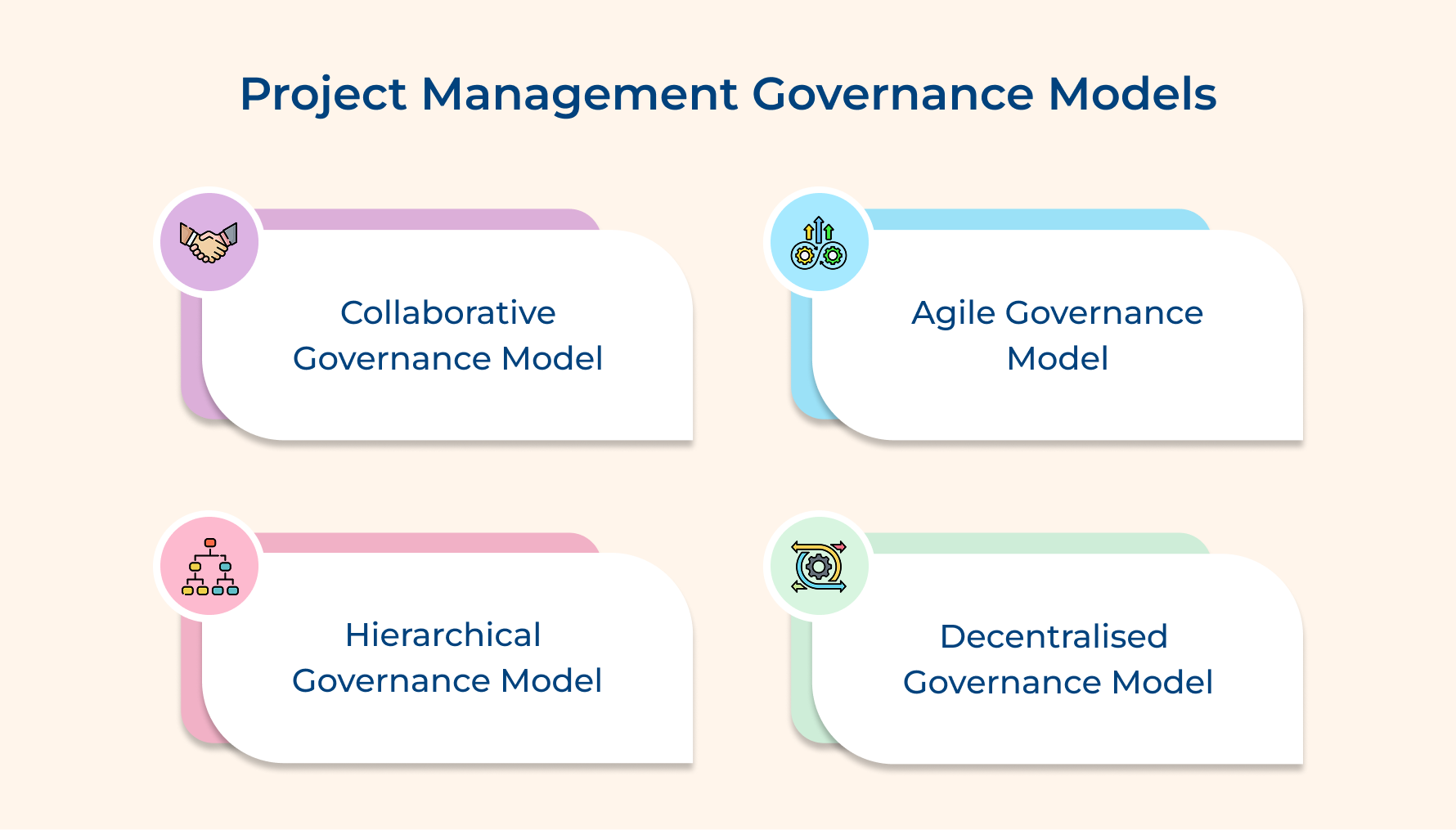
1. Collaborative Project Governance Model
The collaborative model helps in collaborating with multiple stakeholders into a unified decision-making structure so that no single party holds control. It works best during situations such as complex engagements where diverse expertise is represented at the governance level.
What is the correct scenario when this model delivers more value? During multi-party programmes in consultancies and professional service firms. It makes sure accountability is shared instead of stakeholders’ involvement.
2. Agile Governance Model
The model is built for environments where needs and the ability to respond quickly outweigh a rigid plan. It uses lightweight checkpoints to keep governance active without slowing the Global project delivery team.
3. Hierarchical Governance Model
The hierarchical governance model operates on a defined structure, from the project team up to the steering committee. In this, every decision follows a proper escalation path and nothing moves without appropriate approval.
4. Decentralised Governance Model
Decentralised models distribute decision-making authority across teams or workstreams rather than assigning ownership to a single stakeholder. Each unit operates within its own governance boundaries and remains aligned to broader programme objectives.
This governance model is best suited for global organisations running multiple projects across different regions. It maintains strategic alignment without micromanaging and keeps the balance that drives both speed as well as coherence.
Real-World Examples of Project Governance
Explore the examples to understand how exactly a structured project management governance framework delivers outcomes across industries.
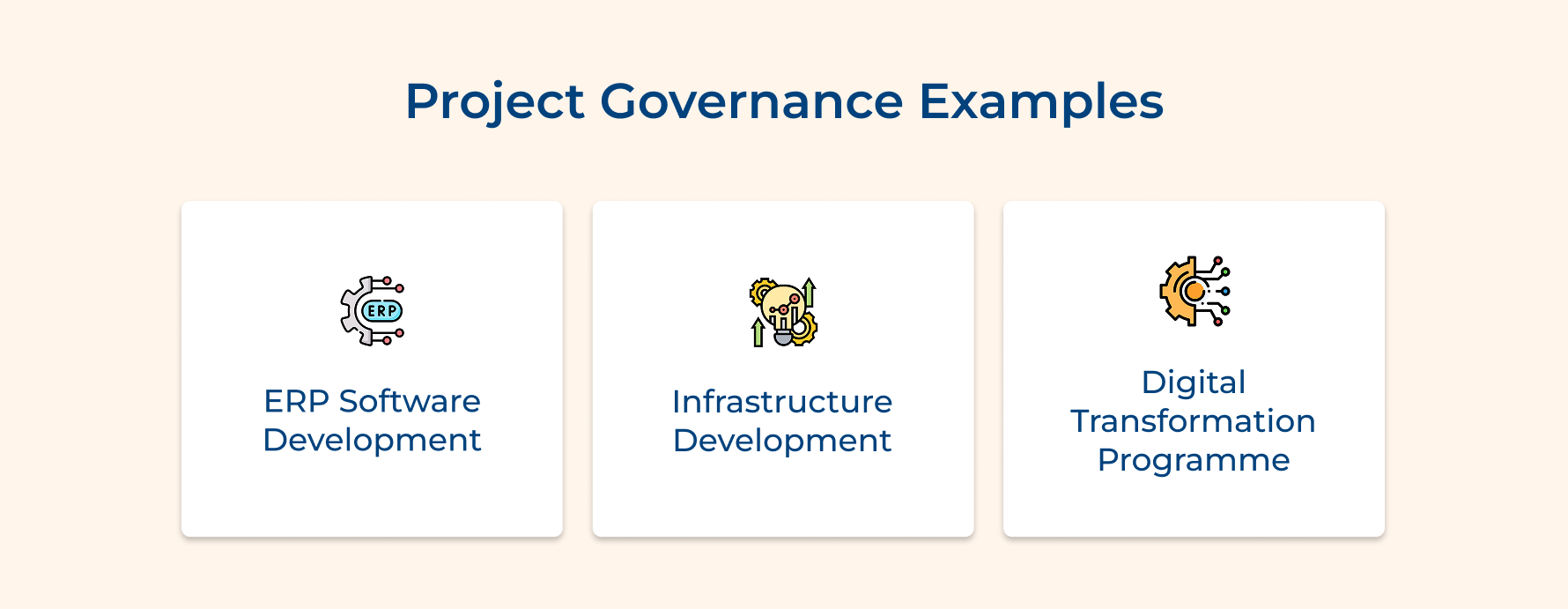
1. Software Development for Enterprise Resource Planning (ERP)
Governance is the only framework that prevents conflicting priorities from derailing the programme in an ERP, which touches every business function at once. Without a defined change control, scopes are added silently until the project becomes commercial.
2. Infrastructure Development Project
Large infrastructure projects operate across multiple contractors, where a single decision can cause heavy financial consequences. A good model helps to define approval authority to make sure checkpoints are met across project delivery.
3. Digital Transformation Programme
Most digital transformation programmes fail due to management gaps instead of technology. It is because business and technology must align on joint decisions. A strong governance framework aligns business units into one decision-making structure for maintaining project delivery.
Streamline Your Project Management Journey with Project Governance
Project governance is the process of structural decision-making that helps in determining a project’s success. It eliminates the ambiguity that leads to project failure before execution. Also, stakeholders get a defined role so that every decision is made clearly.
- Choosing the right governance model depends on the project’s complexity and structure.
- Governance needs to be reviewed and evolve continuously, as it is a living framework.
Ready for the next action? Use the project governance framework template to start building the structure of your project that it actually needs.
Project governance is the difference between a project that delivers business value and one that consumes resources without an outcome. Teams with a proper framework finish the right project at the right time with detailed deliverables.
Limit time — not creativity
Everything you need for customer support, marketing & sales.

Neeti Singh is a passionate content writer at Kooper, where he transforms complex concepts into clear, engaging and actionable content. With a keen eye for detail and a love for technology, Tushar Joshi crafts blog posts, guides and articles that help readers navigate the fast-evolving world of software solutions.