How to Calculate Project Margin for Agency Profitability
- What is Project Margin?
- Key Factors Affecting Project Profit Margins
- How to Calculate Project Margin Percentage?
- Example of How to Calculate Project Margin
- Critical Steps to Stop Project Margin from Reducing
- 6 Practical Strategies to Increase Project Margins
- 4 Essential Types of Project Margin To Consider
- Transform your Project Margin with the Right Strategies
- Frequently Asked Questions about Project Profit Margin

Key Highlights:
- Project margin is the clearest financial signal that tracks project profitability.
- Most professional service firms have a profit margin between 20% to 40%.
- Prevents margin damage before it escalates by tracking labour hours, vendor invoices and budget burn rate on a weekly basis.
Every thought of what separates a successful project from a profitable one? You delivered great work, but your profit margins still tell a different story.
A recent report shows that due to poor cost tracking and scope management, project-based firms lose an average of 11% in margin. Teams always stay focused on delivering on time by not noticing the financial damage happening underneath.
After going through this guide, you will understand what project margin is and how to calculate it effectively. Want your projects to be as profitable and successful? This is exactly where you should be.
What is Project Margin?
Project margin is the gap between a project’s revenue generated and the total cost to deliver it. It is one of the most clear financial indicators for your project’s profitability. Also, use it to track if your project is silently draining your resources.
Importance of Project Margin?
Project margin helps you to understand if your project is running at a profit or just using your team without financial returns. Track this number to make smarter decisions on choosing the right projects for better outcomes.
The moment at which this margin starts shrinking is a clear signal that something in your delivery process is not working. It is recommended to track project margin very frequently to fix problems before it starts affecting your bottom line.
Primary objectives:
- Profitability measurement: Determines the actual profit margin a project generates after covering all types of costs to maintain cash flow.
- Cost control: Identifies the exact moment of your budget overruns to take measures before they escalate.
- Resource optimization: It makes sure your resources are invested in the projects that deliver financial value.
- Business forecasting: Predict future revenue and plan capacity with the reliable data it provides.
Key Factors Affecting Project Profit Margins
Below are the following five factors that consistently make or break the profitability of your project across industries.
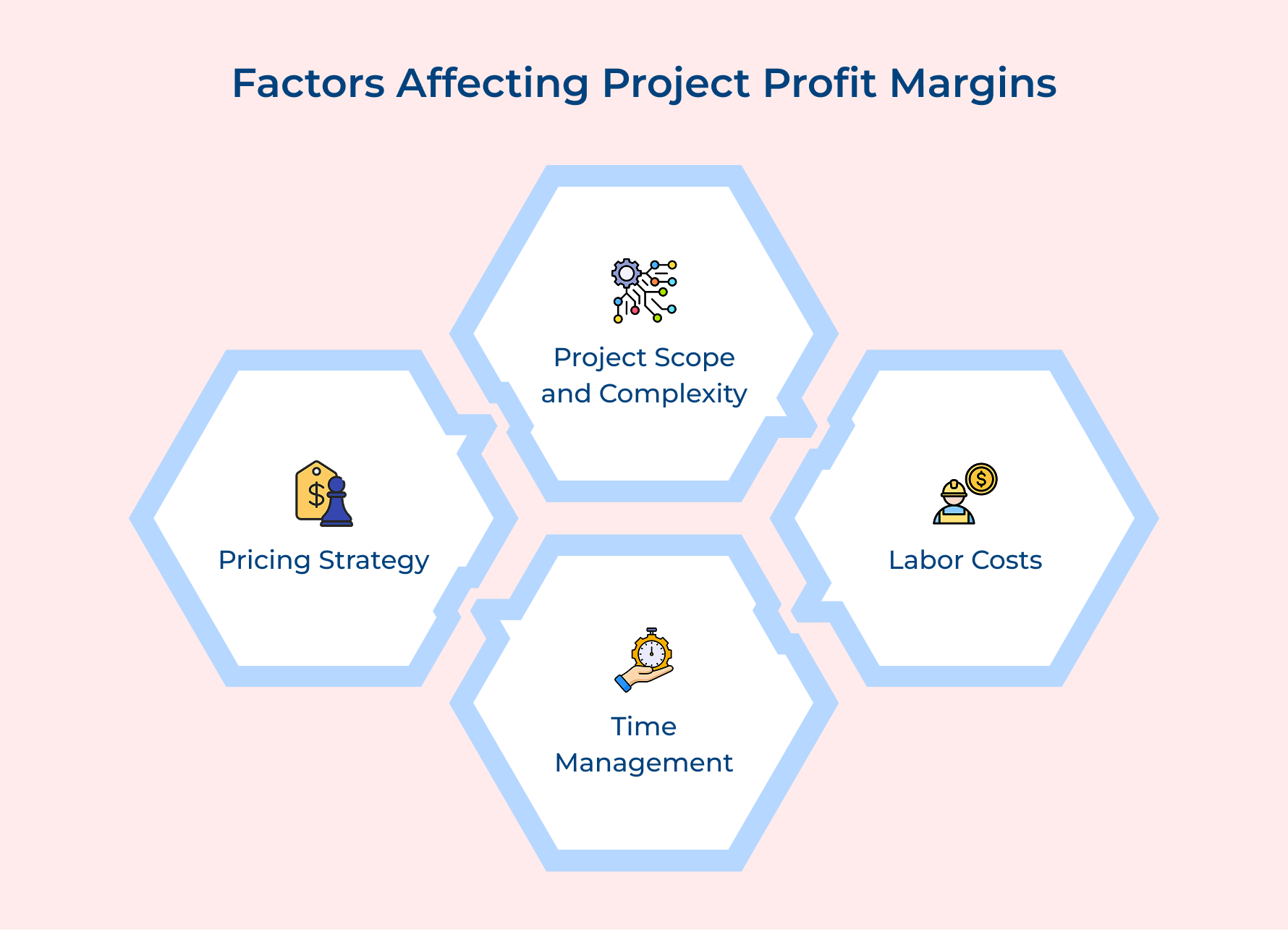
Project Scope and Complexity
Scope is the most silent margin killer that managers do not realise until the budget starts bleeding. Think of a marketing project where your client is adding new demand every few weeks and without a price adjustment, your margin also takes a peak.
A rock-solid scope definition upfront is essential to absorb unlimited project costs within a fixed margin, which leads to better outcomes.
Labor Costs
Labour is a factor in any project where even a small misalignment can wipe out your margin. For example, assigning senior resources to tasks that junior members can easily handle is a costly delivery mistake.
Over time, last-minute hiring can also create cost leakages and it is hard to recover in mid-project. So what can be done? Manage your resource allocation from day one and separate profitable projects from the broken ones.
Time Management
Every day a project runs beyond the delivery timeline, it means fixed costs keep running without any revenue. Deliverables do not just affect profits but directly compress your margin in ways that are hard to reverse.
Pricing Strategy
Pricing projects based on the competitor is the fastest way to an unprofitable engagement. It must be defined on a clear understanding of your actual cost and the value you are delivering.
How to Calculate Project Margin Percentage?
Calculating your margin is all about how profitable your business is for the project. A proper process is essential for making the right pricing and resourcing decisions.
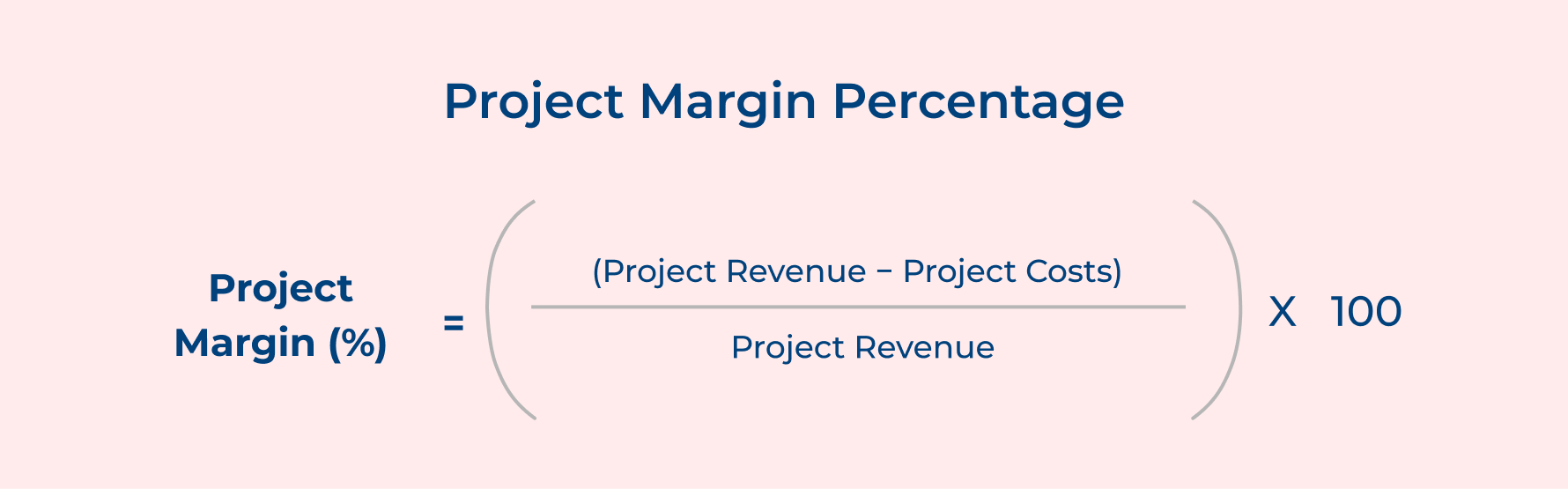
Explore what each component of the project profit margin formula is all about:
- Project revenue: Total amount billed to the client for delivering the project.
- Project costs: All types of costs incurred to complete the project, such as labour, tools and vendor fees.
- Gross project profit margin: The gap between your project revenue and total project costs.
- Margin percentage: A revenue percentage that translates into actual profit.
What’s a Healthy Project Margin?
A healthy project profit margin falls between 20% to 40% for professional service firms and agencies. It also depends on service complexity as well as market positioning. Below 15% indicates that your pricing and cost control need immediate attention.
These steps will help to calculate the margin of your project accurately:
- Capture total revenue: Create clear documentation of the full contract value or all billable amounts with the client.
- List all project costs: Include every cost tied to the project, such as labour, software or overhead allocation.
- Calculate gross profit: Subtract your total costs from the project revenue to get your gross profit margin.
- Apply the formula: once you get the gross profit, divide it by total revenue and multiply by 100 to get it in the form of a percentage.
Example of How to Calculate Project Margin
|
Component |
Amount |
| Project Revenue | $50,000 |
| Labor Costs | $20,000 |
| Vendor/Subcontractor Costs | $8,000 |
| Total Project Costs | $35,000 |
| Gross Profit | $15,000 |
Project Margin (%) = (($50,000 − $35,000) / $50,000) × 100
Project Margin = 30%
The result indicates that the business is retaining $0.30 as profit for every $1 of revenue earned.
Critical Steps to Stop Project Margin from Reducing
Want to get a fixed project margin? Follow these steps to identify the cracks early and seal them before draining. These steps are your defence system.
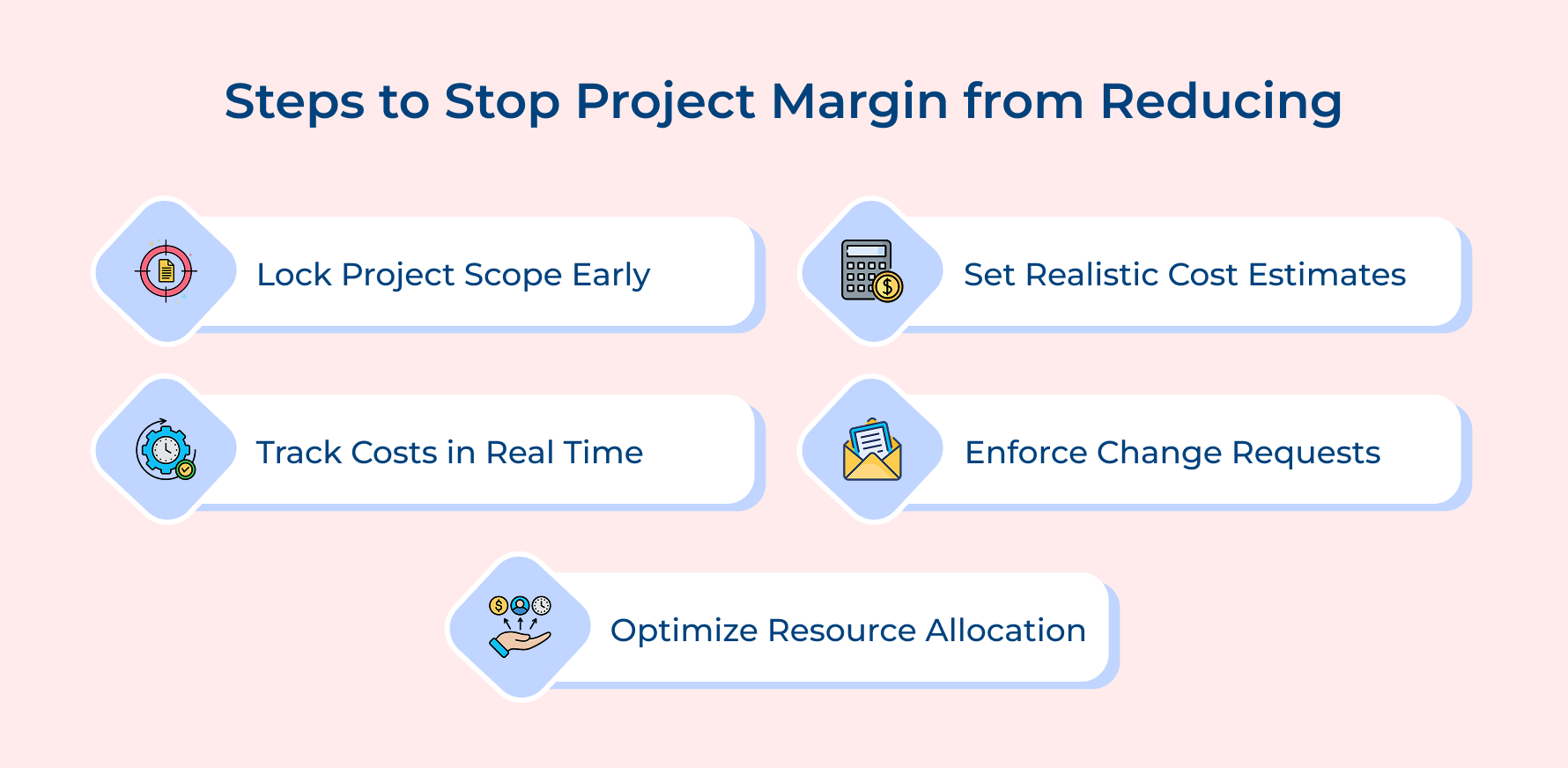
1. Lock Down Your Project Scope Before Work Begins
Scope creep is the key reason for project margins to shrink. It always starts with a verbal agreement that nobody documents. Also, it directly eats into your margin as well as cash flow without a proper record of client requests.
So, what does a scope lock look like in practice? Nothing but a detailed statement of resources and tools needed for the project.
Before starting with the implementation, run through this checklist:
- Proper statement signed and approved by the client
- Extra items which out of scope are explicitly listed in the contract
- Proper review of the scope before project work begins with the delivery team.
- Client delivery expectations are aligned with acceptance criteria
2. Build a Realistic Cost Estimate From Day One
What happens when you ignore the valuation of project costs? At the proposal phase your profit margin shrinks slowly. You are setting yourself a guaranteed loss when you build a cost estimate based on optimism instead of data.
Are you estimating costs based on the timeline for delivery? The estimation stands alone as the difference between a 20% margin while 5% is for the same project.
Consider asking yourself these questions to test your cost estimate:
- Have you analysed actual hour logs from the last few similar projects to validate the estimate?
- Will your estimate separate fixed and variable costs?
- Have you set a percentage of cost for each high-risk workstream in the project?
Pro tip: The most reliable estimates are built based on actual hour logs of the same projects — instead of templates. Skipping this can underprice your effort and make you wonder why it is shrinking despite a full pipeline.
3. Monitor Project Costs Margin in Real Time
Waiting for the project review until it is complete is the biggest mistake. Think of you are running a car and suddenly it stopped due to a low fuel gauge. The margin damage is already done by the time you see the full picture.
Track the following things throughout the project lifecycle for real-time cost margin changes:
- tracking labour hours
- vendor invoices
- Resource utilization every week.
All the metrics together in a dashboard give you the visibility to catch overruns early to adjust your delivery process. The best practice is to monitor these Key performance indicators on a weekly basis.
Apart from this metrics set up your real-time monitoring strategy:
- Weekly labour hours review: Analyse actual hours logged for each team member as well as their roles.
- Budget burn rate: Monitor budget consumption rate in comparison to the percentage of the task completed.
4. Enforce a Strict Change Request Process
The reality of delivering complex work for clients involves multiple change requests. So the real question that comes: Are those changes being aligned with your existing budget and billed as additional work?
Even though most teams struggle with change requests, they are the ones that inject in their process and adjust it. Consider an example, when a client has signed a document that outlines all changes shifts the conversation from an uncomfortable to a professional tone.
A functional change request includes the following elements:
- A change request form that documents all the newly added changes.
- A revised cost and timeline estimate is attached to each request
- A clear log of all approved requests is tracked based on the original value
Situations when the client pushes back on a change request, you walk them through the original document and show that the request falls outside boundaries..
5. Optimize Resource Allocation to Match Project Needs
Allocating the wrong resource to the wrong task consistently kills profit margin and delays project delivery.
The most margin-efficient teams always maintain a clear task complexity matrix for mapping deliverables to the appropriate level before starting. This single practice can recover 4-5 per cent of margin on complex multi-resource projects.
Consider these questions when allocating resources to any project:
- Is the skill level genuinely matched to the complexity of the task?
- Are there low-cost members who can handle entire workstreams with proper guidance?
- Is any other resource currently underutilised on projects?
Consider a scenario where a resource gap appears mid-project, the instinct is to allocate senior people.
A smarter process is to diagnose the type of issue, such as a skill gap or a process gap. Segmenting is important as two problems require very different solutions.
Look out for these allocation patterns that are killing your project margin:
- Invisible idle time: Team members generating little actual billable output by appearing occupied in meetings.
- Late-stage reshuffling: Replace key resources mid-project forces permanent damage to delivery momentum
6 Practical Strategies to Increase Project Margins
The six strategies below give you a clear roadmap to systematically improve project profit margin. It helps to drive profitability higher across the entire project portfolio management:
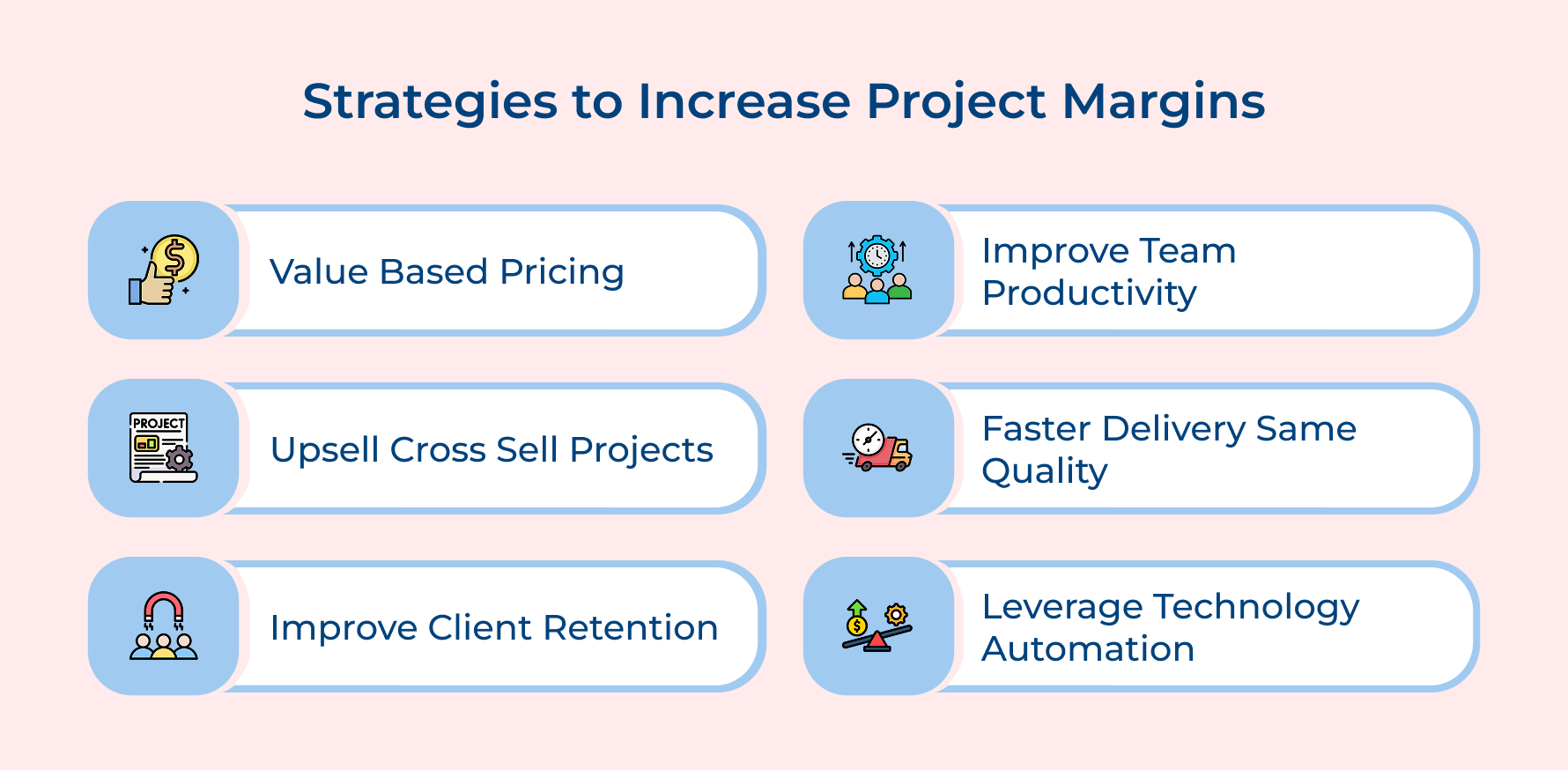
1. Switch to Value-Based Pricing
The common pricing pattern is based on hours worked, while the profitable ones charge based on the value delivered to clients. Consider asking these questions to identify the position of your value-based pricing in your portfolio:
- Which projects deliver measurable impact that exceeds the current billing rate?
- Is your pricing strategy similar for complex as well as straightforward projects?
- Have you ever compared pricing with the quantified business outcome your project delivered?
Shift two or three projects to value-based pricing per business strategy to get a gradual 10 to 20% profit margin. What does it mean? Quantifying client outcomes before pricing and using that data to convert every proposal conversation.
How to do a proper transition of pricing model toward value-based:
- Build a value quantification framework for your top project types that helps to calculate client ROI.
- Train your project leads to initiate pricing conversations with the client before presenting any cost figures.
2. Improve Team Productivity and Output Quality
A more productive team can deliver the project scope in fewer hours. It means a reduction in labour costs, but project revenue stays the same. That gap is pure margin that compounds across every project you deliver.
Below are the things that high-productivity teams do:
- They run a focused daily review to remove blockers within 24 hours instead of taking weeks
- They maintain clear task ownership, so no need to wait for someone to claim responsibility
Low output quality also affects the margin, as rework hours are rarely billed to the client. Every rework is pure cost with zero revenue attached to it.
3. Upsell and Cross-Sell Within Existing Projects
Your existing client relationship is the highest-margin growth opportunity compared to your new business pipeline. A client who has already trusted your delivery needs less effort and is easier to sell.
Look for these upsell and cross-sell signals during project delivery:
- Client stakeholders are expressing frustration about a related problem during the current project scope
- When project outcomes lead to a logical next phase of work that the client had not considered pursuing
Most of the time, effective upsells happen during project delivery when you have already become a trusted partner. Align upselling opportunities into your delivery process as a standard practice.
- Document every client’s pain point head during delivery and review them in monthly meetings.
- Create a simple proposal template that project leads can use to present upselling scope without formal sales support.
4. Reduce Delivery Time Without Reducing Quality
When you can deliver before the timeline, you can move to the next billable project that directly increases revenue capacity. The goal is to eliminate non-billable time that affects cash flow in businesses.
Audit these common time drain areas where delivery time is being lost:
- Approval bottlenecks: Creating structured approval windows would eliminate deliverables sitting idle waiting for sign-off.
- Unclear handoffs: Tasks move between team members because responsibilities were never clearly defined upfront.
Reducing average delivery time by 10 to 15% helps your team take on additional projects and additional revenue flows entirely into margin changes. As the fixed team cost remains constant and billable output grows.
Best Practices:
- Map your last few projects and highlight every stage where resources are unutilized for more than 48 hours.
- Define clear response deadlines to eliminate waiting time from your project timelines.
5. Improve Client Retention to Reduce Acquisition Costs
The overall profit margin is affected when you try to add a new client, which includes acquisition costs. When you put efforts into client retention, it eliminates that cost and deliver projects that are faster to start with more profitability
Consider these questions to assess the success of your retention strategy:
- Do you have a structured client success process to resolve concerns before becoming serious churn risks?
- Are retained clients being offered renewal projects before they start evaluating their next engagement?
Pro Tips: Build a structured 30-60-90 day check-in after project delivery to position your team for the next engagement.
6. Leverage Technology and Automation
Technology helps in improving project profit margins by changing the delivery objective of your team within the same cost structure. The right solution eliminates entire categories of low-value work and redirects toward higher-margin activity.
Capture these technology-driven gains by targeting high-impact areas:
- Automated project financial tracking: Replace manual budget tracking with real-time dashboards for instant margin visibility without human involvement.
- Integrated resource management tools: Automatically flag resource utilization gaps before it creates last-minute reshuffling that destroys margin.
In the service business, the compounding effect of technology adoption across a full project is the most underutilised margin lever. So, build a technology adoption roadmap that directly targets margin:
- Evaluate your current tool stack to identify manual processes your team performs that a purpose-built tool can automate.
- Assign a technology specialist who controls the adoption process and tracks margin impact metrics for every tool implementation across your projects.
4 Essential Types of Project Margin To Consider
Each margin type gives you a different lens to evaluate your project’s health and maintain business profitability.
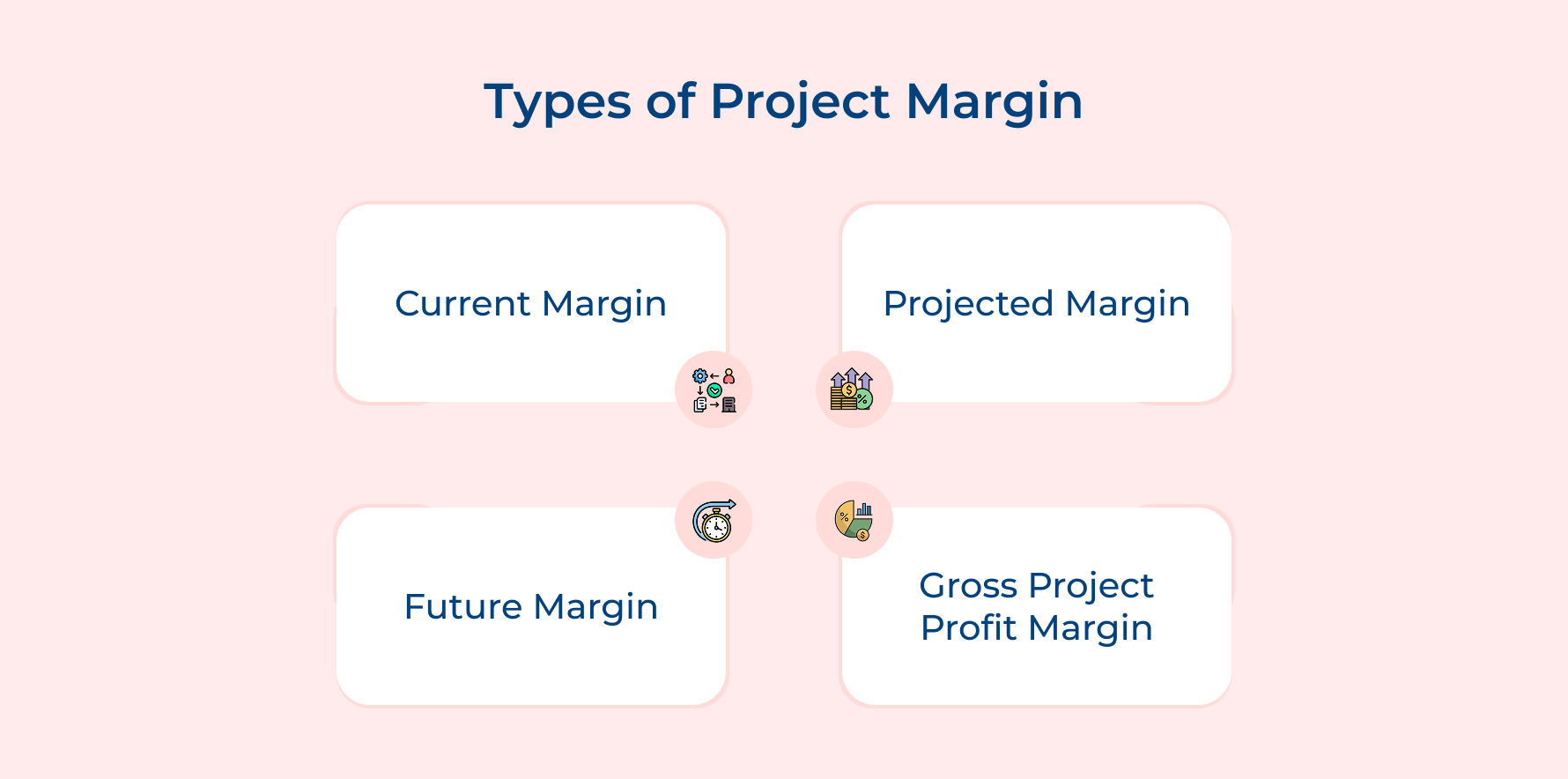
1. Current Margin
Current margin is like your project’s financial heartbeat. It reflects profitability based on costs and revenue recognised. It helps to manage margin mid-project, so that you have time to correct before the damage starts.
Current margin gives visibility into these areas:
- Budget tracking: Track exactly how much of the budget is consumed with respect to the work completed.
- Cost leakage detection: Identify unexpected cost spikes so you can overcome them before they compound.
2. Projected Margin
Projected margin is your early warning system that forecasts the expected final margin when the project is fully delivered. So how does type work? It analyzes remaining work to anticipate costs and scope changes to prevent getting caught off guard at delivery.
3. Future Margin
The model helps smart leaders use project data to make better business decisions. It estimates profitability potential of similar future projects to understand which to chase and reprice before signing.
4. Gross Project Profit Margin
Gross margin cuts show you the exact revenue generated after direct costs are removed. It is the most honest way on how to efficiently measure the project margin to deliver value related to clients’ payments.
Transform your Project Margin with the Right Strategies
Project margin is the direct result of deliberate decisions made at every delivery phase. Teams that define margin in structured habits outperform those reacting only during profitability threats.
- Fix margin leaks profit quickly before layering in any broader improvement across your delivery workflow.
- Treat margin management as a proactive operational discipline to mitigate financial pressure.
- Defined scope control, resource planning and milestone tracking help in protecting margins accurately.
Start implementing these margin management strategies on your project to measure impact within the delivery cycle. Teams that use a proactive method build a culture that compounds revenue forecasts over time.
Limit time — not creativity
Everything you need for customer support, marketing & sales.

Neeti Singh is a passionate content writer at Kooper, where he transforms complex concepts into clear, engaging and actionable content. With a keen eye for detail and a love for technology, Tushar Joshi crafts blog posts, guides and articles that help readers navigate the fast-evolving world of software solutions.