Client Project Management Guide for Agencies in 2026
- What is Client Project Management?
- 5 Stages That Define Effective Client Project Management
- 8 Strategies for Improving Your Client Project Management
- Additional Tips for Client Project Management Across Agencies
- Tools for Client Project Management
- Streamline Success from Start to Finish with Effective Client Project Management
- FAQs about Client Project Management

Key Highlights:
- Client project management aligns expectations, resources, and timelines for consistent client satisfaction.
- Effective strategies include discovery protocols, expectation management, flexible resources, strategic delivery and continuous improvement cycles.
- Client project management balances client expectations with deliverables, using structured stages, communication and tools to ensure high-quality outcomes.
Many agencies face the same frustrating pattern (missed deadlines, disorganized workflows, and unhappy clients) even when they’ve got talented teams as well as great ideas. These issues don’t just cause stress; they hit where it hurts most: profits, team morale, and client retention.
When projects spiral out of control, it’s not just about fixing the current mess at hand. It can hurt your reputation and cost you future business from referrals.
An effective client project management can turn things around. With clear stages, smart strategies, and the right tools, agencies can bring order to the chaos, deliver work more consistently while creating standout client experiences.
What is Client Project Management?
Client project management is the art of balancing client expectations with project deliverables while ensuring smooth communication between agency teams and clients. It involves coordinating resources, managing timelines, and delivering high-quality work that exceeds client expectations – all while maintaining positive relationships throughout the process.
Client project management begins with clear scope definition followed by detailed planning of resources and timelines. Regular check-ins with clients ensure alignment while internal team coordination keeps work moving forward. Throughout the project lifecycle the project manager adjusts plans as needed and communicates changes proactively to prevent surprises.
Key areas to consider:
- Expectation setting that establishes realistic goals while still inspiring confidence in your agency’s capabilities.
- Scope management that prevents feature creep without making clients feel their requests are being dismissed.
- Timeline communication that accounts for inevitable delays while maintaining client trust.
- Budget conversations that balance profitability with client value perception.
- Feedback facilitation that transforms critical client input into actionable improvements without defensiveness.
5 Stages That Define Effective Client Project Management
Each stage builds upon the previous one, forming a comprehensive framework that guides projects from conception to completion.
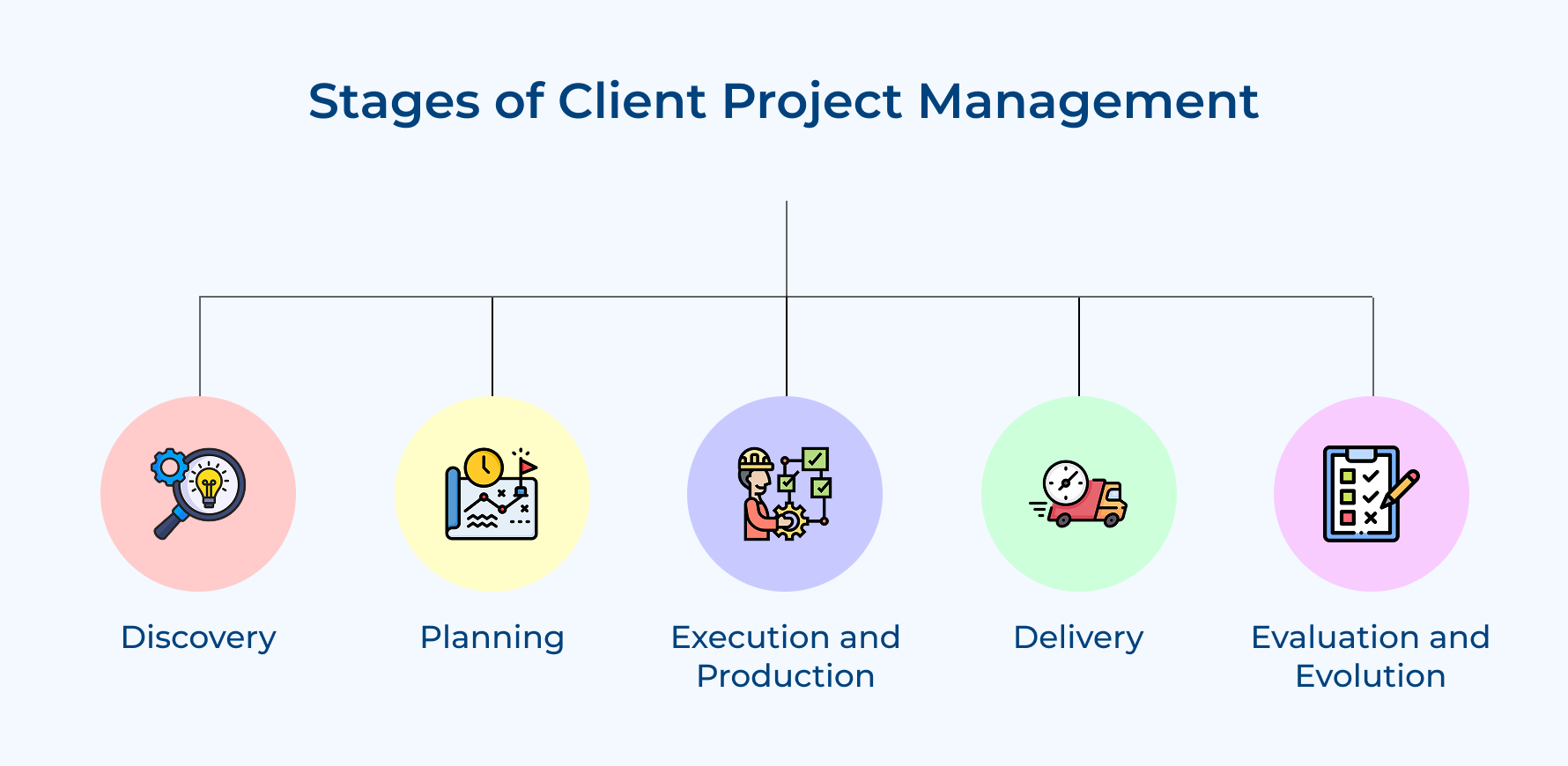
Stage 1: Discovery
The discovery phase is the backbone of effective project plans. It’s where you go beyond basic requirements to understand what really matters to the client.
Through detailed interviews, you uncover:
- Core business goals
- Success metrics for different stakeholders
- Known risks or roadblocks
- Unspoken expectations that could derail progress
Most projects go off track not during execution, but due to gaps in this early stage. That’s where the planning phase steps in, turning insights into structure. You create:
- A clear project charter
- Defined communication protocols
- Preliminary but realistic timelines
Using client project management software at this point keeps everything organized and accessible, helping your team stay aligned as well as your projects move forward with fewer surprises.
Stage 2: Planning
The planning phase turns your project definition into a practical roadmap. It’s where you map out key milestones, assign resources, and build in buffer time for the unexpected. What is the goal, you ask? A schedule that pushes your team but doesn’t break them.
This is also where strategy kicks in. You align your plan with what your agency does best and what the client expects. That means choosing the right methodology, setting up clear governance, and building in honest feedback loops.
A solid strategy doesn’t just outline how to get work done, it also sets the tone for communication, accountability and long-term project success.
Stage 3: Execution and Production
Execution is where all your planning starts to pay off, the stage where things finally move from concept to reality. As a service provider, this is your chance to keep teams aligned, ensure creative ideas are technically feasible, and deliver real progress that leads to customer satisfaction.
During execution, it’s smart to pause regularly and ask:
- Are we staying flexible without losing momentum?
- Are there gaps in communication with the client?
- Should we escalate a concern or handle it quietly?
- How can we keep morale high with small wins?
In the production phase, your focus shifts to quality assurance. You want consistency, documented decisions, and systems that catch issues early so nothing derails progress or puts client trust at risk.
Stage 4: Delivery
The delivery phase is more than just handing over final work, it’s your chance to leave a lasting impression. As a service provider, think of this as a milestone where your deliverables shift from internal assets to client-ready tools. The best delivery moments are:
- Clear and confident, showing how the work ties back to original business goals
- Collaborative, highlighting shared wins and teamwork
- Practical, with documentation and training to ease adoption
Support doesn’t end here. From performance checks to answering client questions, your ongoing involvement shows you care about long-term customer satisfaction—not just project closure.
Stage 5: Evaluation and Evolution
Evaluation is your team’s opportunity to pause and ask, “How did we really do?” It’s where you review timelines, team performance, as well as client feedback to uncover valuable insights.
- Did we meet our original goals and timeline?
- What changes helped or hurt us along the way?
- How can we communicate better next time?
The real magic happens in the evolution part. You take those lessons and improve how your agency works, from refining project plans to building stronger client relationships. It’s how one successful project leads to many more.
8 Strategies for Improving Your Client Project Management
Here are eight proven strategies to enhance your project management skills, ensuring that you not only meet client expectations but exceed them.
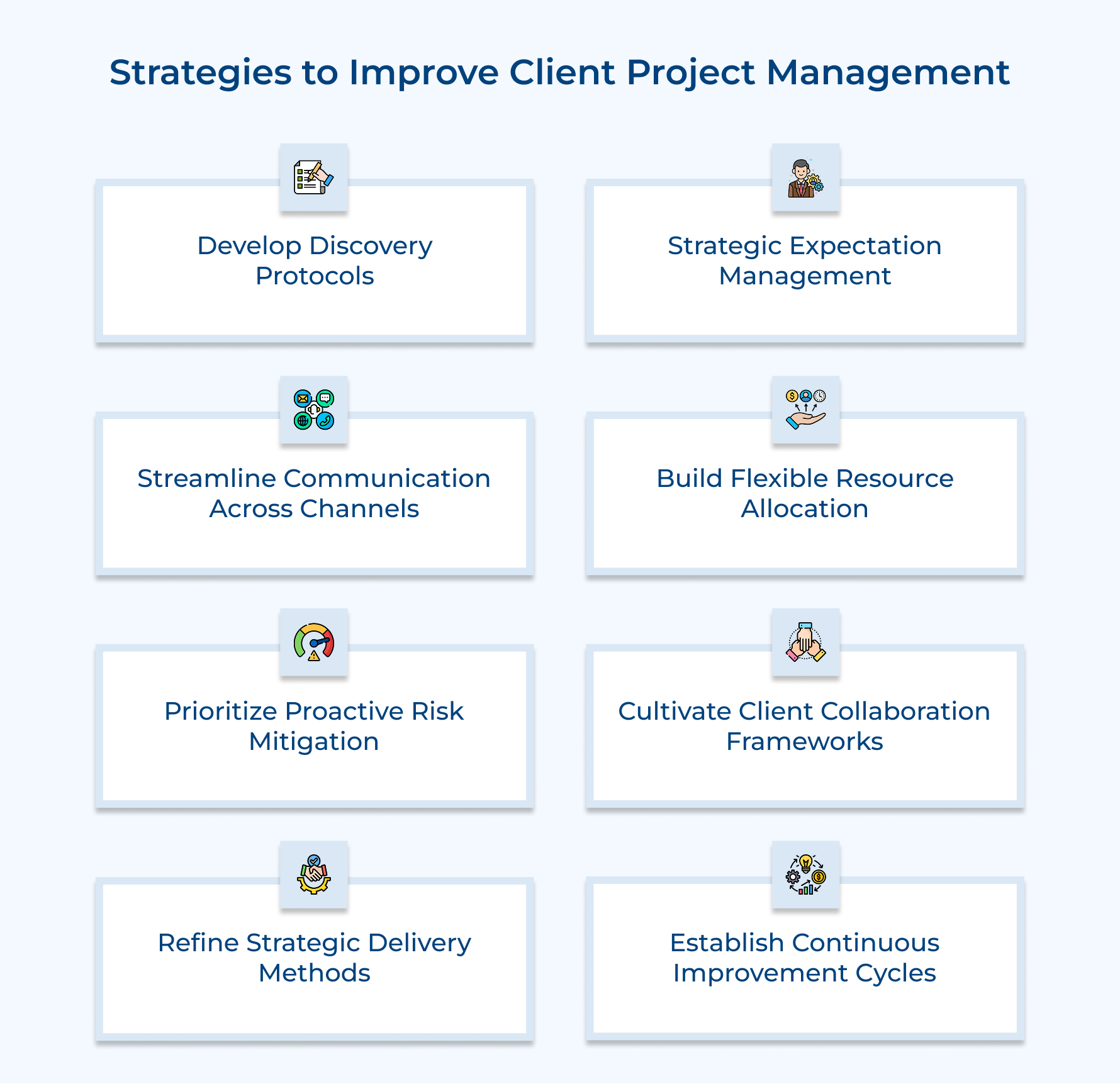
1. Develop Robust Discovery Protocols
Strong discovery protocols help you avoid costly surprises by giving structure to early project conversations.
Instead of jumping in blind, you use tools like standardized questionnaires to guide thoughtful discussions. These help clients articulate needs they may not have fully considered yet—and surface concerns early.
Try asking things like, “What would make this a success for you?” or “What frustrated you in past projects?” These questions often reveal hidden expectations.
Also, don’t skip stakeholder mapping. A visual map of who holds influence helps you avoid getting approvals from the wrong people. It ensures the real decision-makers are aligned from the start.
2. Master Strategic Expectation Management
Managing client expectations is about creating clarity from the start. The best way to avoid confusion later? Get specific early. Document any assumptions (like who’s supplying content and when), so there’s a shared understanding if things shift.
Visual timelines also help. When clients see how their input affects deadlines, they’re more likely to stay on track. And when changes do come up (because they always do), having a clear change request process avoids tough conversations.
Instead of finger-pointing, it becomes, “Here’s the process—let’s figure it out together.” That’s how you turn potential conflict into collaboration.
3. Streamline Communication Across Channels
Clear communication keeps projects on track. Instead of endless messages and missed updates, create structure. Here’s how to streamline:
- Use email for formal approvals only, anything tied to money or contracts stays documented and searchable.
- Stick to project management tools for all task-related chats. Keep conversations connected to deadlines and deliverables.
- Reserve chat for quick, urgent clarifications but define what counts as urgent to avoid constant pings.
- Save video calls for complex discussions, follow the “could this be an email?” rule.
Also, keep a decision log. It prevents déjà vu debates as well as keeps your team aligned on what was decided and why.
4. Build Flexible Resource Allocation
Flexible resource allocation helps you stay agile when project needs shift. But how do you stay adaptable without compromising client trust? Start by building smart systems:
- Create capability matrices so you know who can step in when someone’s unavailable.
- Use progressive onboarding. Loop in backup team members early so clients are already familiar with them.
- Design modular project structures that allow easy handoffs with minimal ramp-up.
Ask upfront:
- Who can cover whom?
- Where are likely bottlenecks?
- What’s the bare minimum team needed to keep things moving?
Done right, flexible staffing keeps momentum going while still delivering a consistent, high-quality client experience.
5. Prioritize Proactive Risk Mitigation
Proactive risk mitigation means staying ahead of problems instead of scrambling to fix them later. Here’s how to make that shift:
- Use scenario planning to map out common challenges and responses. Think of it as a playbook with not just fixes but also client-ready messaging.
- Set up early warning systems like milestone check-ins and anonymous feedback channels, so small issues don’t become big surprises.
- Build contingency reserves where risk is highest. Explain to clients why buffer time exists so it’s seen as smart planning, not padding.
When you plan for risks early, you protect timelines, budgets and client trust.
6. Cultivate Client Collaboration Frameworks
Client collaboration frameworks help turn clients from passive reviewers into active partners, bringing their insights into the process early and often. Here’s how to do it right:
- Create collaboration touch points throughout the project, not just during reviews. This ensures alignment before too much time is spent in the wrong direction.
- Host co-creation workshops instead of formal approval meetings. Let clients brainstorm and solve challenges with your team. This builds trust as well as ownership.
- Build client-specific playbooks outlining their communication style, preferred tools, decision patterns, and key terminology.
When clients feel involved, projects run smoother, results improve, and satisfaction soars.
7. Refine Strategic Delivery Methods
Strategic delivery is more than just handing off final files, it’s about making sure your client can confidently use what you’ve built. Here’s how to do it right:
- Break implementation into phases: Design a step-by-step rollout plan with clear goals for each stage. This avoids overwhelm and builds client confidence.
- Tailor education for different users: Executives need a big-picture view, while daily users need hands-on training. Create role-based learning paths.
- Provide support post-delivery: Schedule follow-ups, offer guided walkthroughs, and stay available for key adoption milestones.
Asking questions about internal processes, users, and knowledge gaps helps shape delivery methods that lead to real-world success.
8. Establish Continuous Improvement Cycles
Continuous improvement is all about learning what went right, too. Instead of treating project wrap-ups as endpoints, use them to sharpen your future work. Here’s how:
1. Track the right metrics:
- Estimation accuracy
- Frequency of scope changes
- Client satisfaction trends
- Team consistency and velocity
2. Build a knowledge system: Capture lessons learned, decision rationales, and post-mortem insights in a searchable format. Organize templates and checklists by project type so teams don’t reinvent the wheel.
When improvement is baked into your process, every project becomes smoother, smarter, and more strategic.
Additional Tips for Client Project Management Across Agencies
Here’s how agencies can step up their client project management game, not just by fixing issues but by proactively strengthening systems, communication and team resilience:
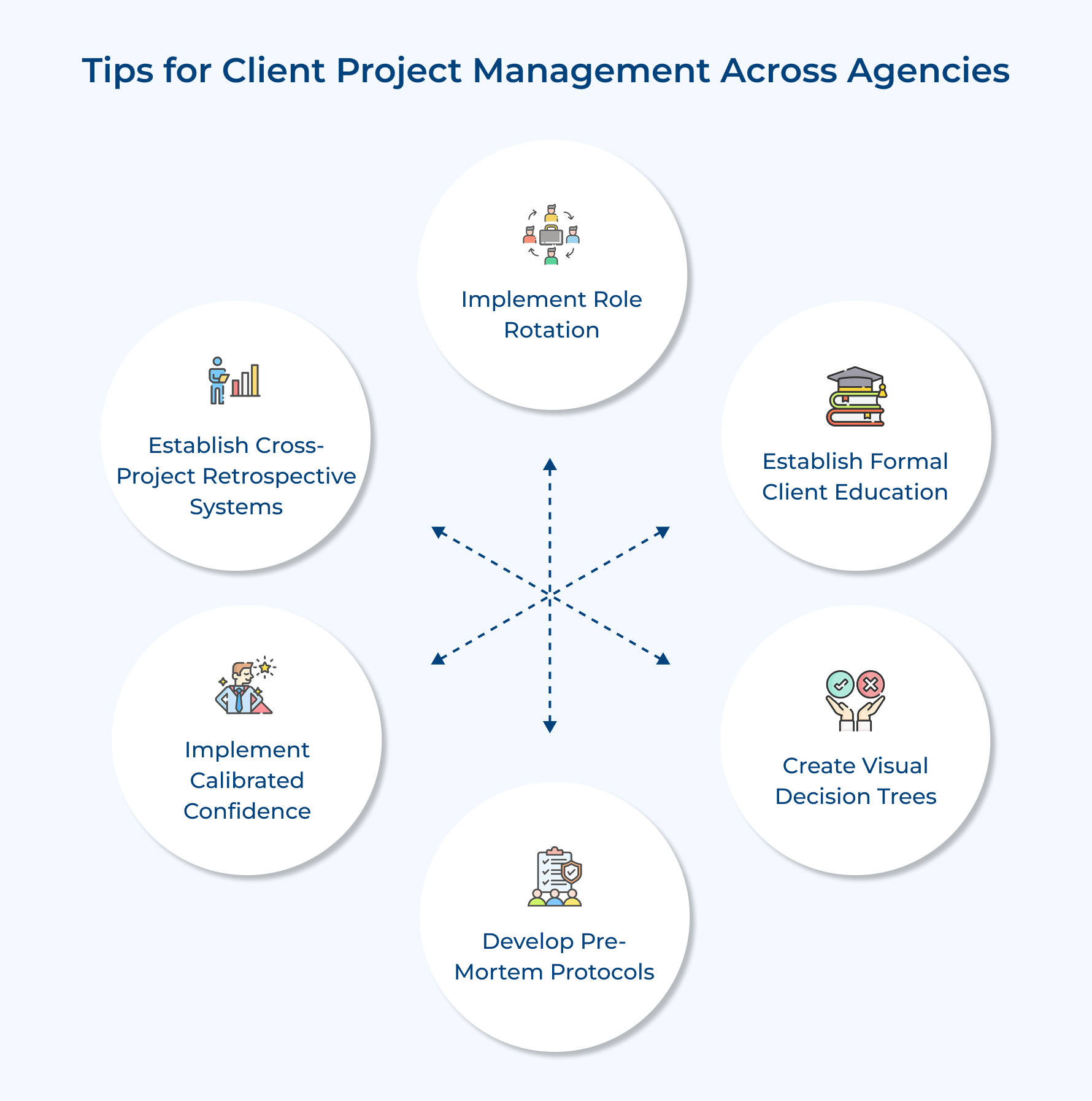
1. Implement role rotation within project teams
Let team members temporarily swap responsibilities when possible. This builds empathy across roles and avoids knowledge silos that cause chaos when someone’s suddenly unavailable.
2. Establish formal client education programs
Develop onboarding materials that walk clients through your process. It saves time in the long run, no more repeatedly explaining your workflow or resetting expectations mid-project.
3. Create visual decision trees for common project inflection points
Visual maps help clients see the ripple effects of each option, especially for moments where big decisions need to be made. This avoids abstract back-and-forth and builds confidence in their choices.
4. Develop pre-mortem protocols for high-risk projects
Instead of waiting for things to go wrong, gather your team early and ask, “How might this fail?” It’s a simple but powerful way to surface risks before they derail your timeline.
5. Implement calibrated confidence indicators for project estimates
Be honest about how certain you are. Use indicators (like low/medium/high confidence) when sharing estimates to avoid overpromising and disappointing later.
6. Establish cross-project retrospective systems
Hold regular retrospectives that evaluate trends across multiple projects. You’ll spot agency-wide issues like repeated bottlenecks or common scope creep patterns that individual project reviews can miss.
Tools for Client Project Management
Join us as we explore the most effective tools available that can transform how you manage client projects, ensuring successful outcomes every time.
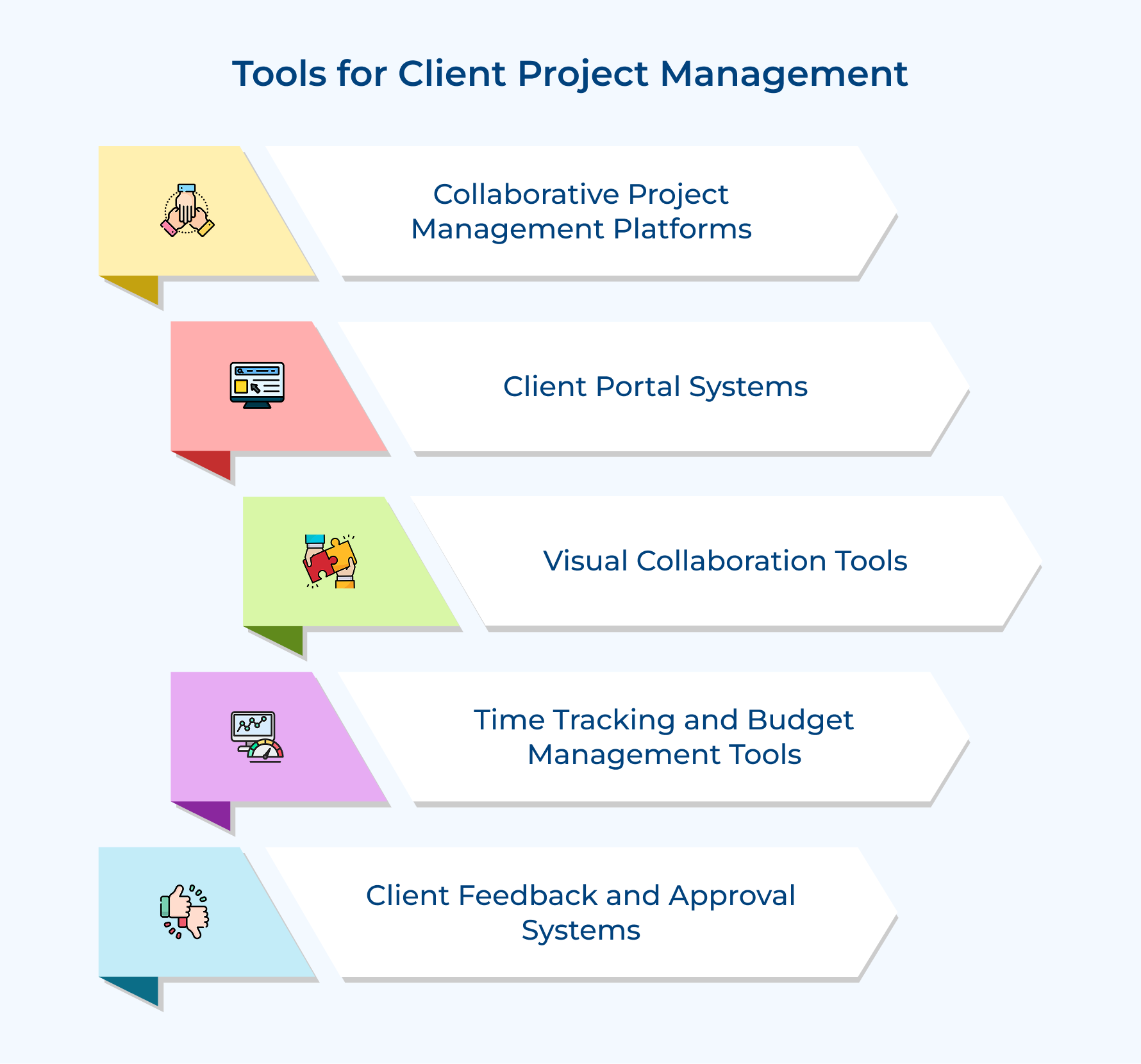
1. Collaborative Project Management Platforms
Comprehensive platforms like Kooper or Veemo Projects create centralized workspaces where teams and clients track progress as well as visualize timelines. These systems replace scattered email threads with structured workflows that maintain context between discussions and deliverables.
2. Client Portal Systems
Dedicated client portals create branded environments where clients access all project materials in one organized location. These portals transform fragmented communication into cohesive experiences by housing documents, feedback threads, approval histories, and important project milestones.
3. Visual Collaboration Tools
Digital whiteboarding tools enable real-time visual collaboration that transcends geographical limitations. These platforms transform abstract discussions into concrete visual artifacts through collaborative diagrams, wireframes, and user journey maps that help clients understand design decisions.
4. Time Tracking and Budget Management Tools
Comprehensive platforms like Kooper or Veemo Projects offer Specialized financial tools that provide detailed visibility into how project hours and resources are being utilized. These systems transform vague budget concerns into specific data points by connecting time entries with project tasks and creating transparency that prevents end-of-project budget surprises.
5. Client Feedback and Approval Systems
Dedicated review platforms streamline the feedback process by enabling precise, contextual comments directly on deliverables. These tools transform ambiguous feedback into actionable direction by organizing client input, tracking revision histories, and documenting approval decisions throughout the project lifecycle.
Streamline Success from Start to Finish with Effective Client Project Management
Effective client project management isn’t just a process improvement—it’s a business survival skill for agencies navigating increasingly complex client expectations. When projects derail, agencies face not only immediate financial impacts but also long-term relationship damage and reputation risks that affect future growth opportunities.
Implementing structured methodologies that balance flexibility with consistency help agencies transform project delivery from unpredictable to reliable. This operational maturity creates a powerful competitive advantage where increased profitability naturally emerges from streamlined processes, reduced rework, and the premium clients willingly pay for exceptional experiences that consistently deliver tangible business value.
Limit time — not creativity
Everything you need for customer support, marketing & sales.

Shivank Kasera is part of the marketing team at Kooper, where he focuses on building content that helps agencies and service providers grow. With a keen interest in SaaS, operations, and scalability, he translates practical insights into actionable resources for business leaders.