How to Measure and Improve Capacity Utilization Rate
- What is Capacity Utilization?
- Why Measuring Capacity Utilization Rate Matters?
- What is the Optimal Capacity Utilization Rate?
- How to Measure Capacity Utilization Rate Effectively?
- Strategies for Improving Capacity Utilization
- Examples of Capacity Utilization
- Empowering Your Business Through Capacity Utilization
- FAQs about Capacity Utilization
Key Highlights:
- Learn how tracking the capacity utilization rate improves planning accuracy and profitability.
- Proven strategies optimize your utilization rate and boost overall team performance.
- Practical examples show capacity utilization applications across various business functions.
Your team works hard, yet profits stay flat and deadlines keep slipping. Sound familiar? Many companies in the industrial sector face this issue – where talented employees give their best, but productivity doesn’t match their true potential.
The real culprit? Not knowing your capacity utilization rates. Without this insight, it’s like running manufacturing industries on guesswork. Some teams end up overworked and exhausted, while others sit underutilized. Projects miss deadlines and resources get stretched thin because no one truly knows how much capacity is available.
This guide breaks down how to measure and optimize manufacturing capacity utilization effectively. You’ll find practical calculation methods, real-world examples and proven strategies that help manufacturing industries turn resource management into a smart, data-driven advantage.
What is Capacity Utilization?
Capacity utilization measures how effectively available resources are being used compared to their maximum potential. It reveals whether resources are sitting idle or being stretched too thin across different activities.
This concept is also known as resource utilization. The capacity utilization rate calculates the ratio between actual resource usage and total available capacity. When you have team members working 30 hours per week out of their available 40 hours, you’re looking at a 75% utilization rate.
Core objectives:
- Maximize resource efficiency: Ensure every available hour and skill set contributes meaningfully to project outcomes.
- Identify bottlenecks early: Spot where resources are overloaded before delays cascade through the entire timeline.
- Balance workload distribution: Prevent some team members from burning out while others remain underutilized.
- Improve cost management: Align resource allocation with budget constraints and project profitability targets.
- Enable accurate planning: Use historical utilization data to make realistic estimates for future project timelines and resource needs.
Why Measuring Capacity Utilization Rate Matters?
Understanding your capacity utilization rate isn’t just about numbers, it’s about making informed decisions. These directly impact your team’s success and your organization’s bottom line.
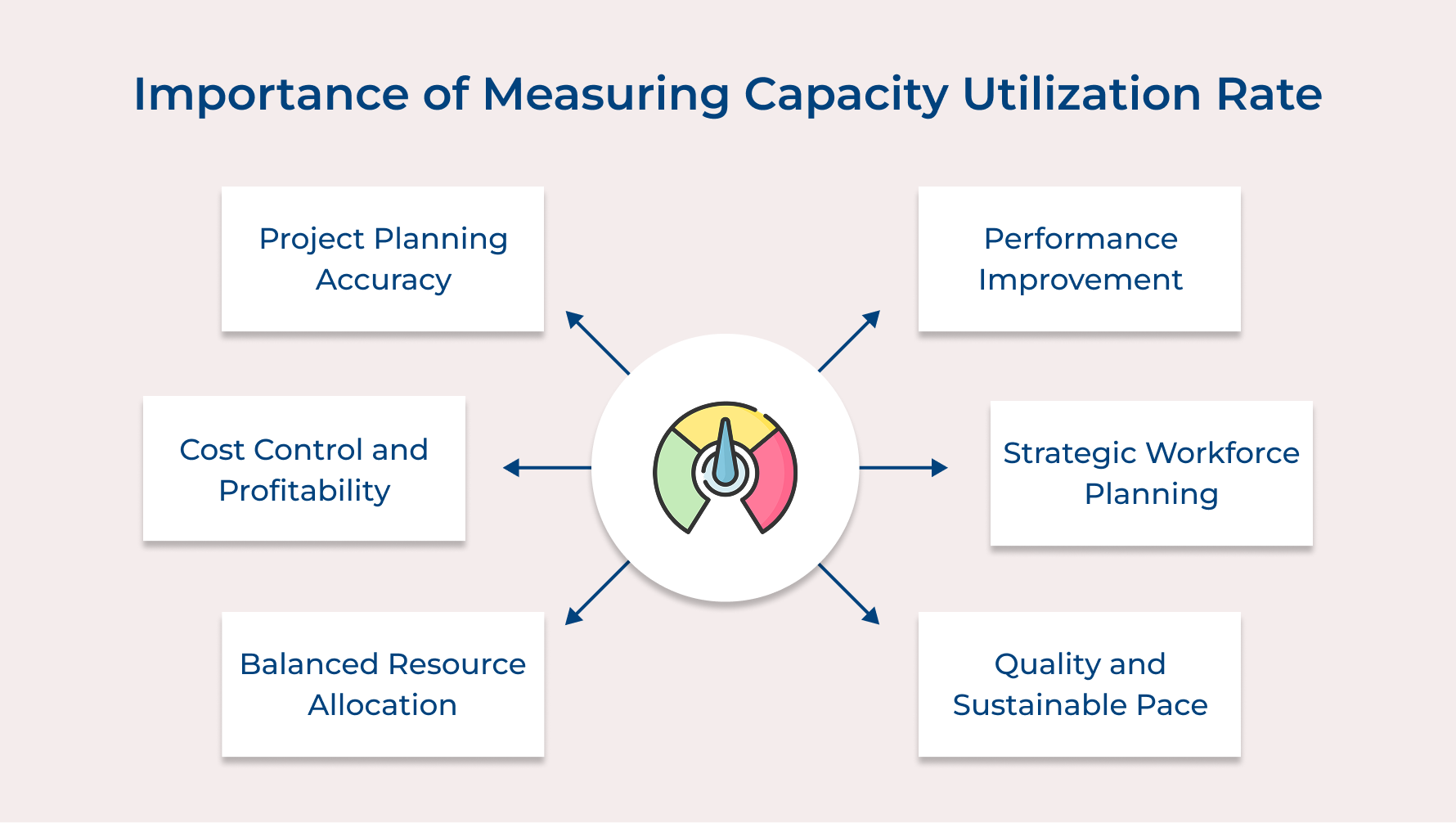
Project Planning and Timeline Accuracy
Measure utilization rates to give you realistic data for future project estimates. When you know your team typically operates at 80% capacity, you can build accurate timelines instead of promising unrealistic deadlines that set everyone up for failure.
Cost Management and Profitability
Tracking how efficiently resources are used directly impacts your project’s financial health. Higher utilization rates mean you’re getting maximum value from salary investments while avoiding the costs of rushed hiring or expensive contractor rates.
Resource Allocation and Load Balancing
Utilization data reveals who’s overwhelmed and who has bandwidth for additional work. This prevents talented team members from burning out while ensuring no one sits idle when critical tasks need attention as well as support.
Performance Benchmarking and Improvement
Regular measurement establishes baseline performance metrics that help identify improvement opportunities. You can spot patterns in productivity dips and address systemic issues before they become major problems affecting multiple projects.
Strategic Workforce Planning
Understand capacity trends to help you make smarter decisions about team expansion or restructuring. Instead of reactive hiring during crunch times, you can proactively plan for growth based on actual utilization patterns and business forecasts.
Quality Control and Sustainable Pace
Monitor utilization to prevent the dangerous extremes of both underutilization and overwork. Teams operating at sustainable capacity levels consistently deliver higher quality work while maintaining the energy needed for creative problem-solving throughout long projects.
What is the Optimal Capacity Utilization Rate?
Determining the perfect capacity utilization rate isn’t straightforward because it varies significantly across different work environments. Project-based teams might thrive at different levels compared to ongoing consultant work where client demands fluctuate unpredictably throughout various seasonal periods.
Yet despite the variability across different contexts, project managers should typically aim for a utilization rate of 80 percent. This target provides the sweet spot between maximizing productive output while preserving essential buffer time for unexpected challenges and professional development activities.
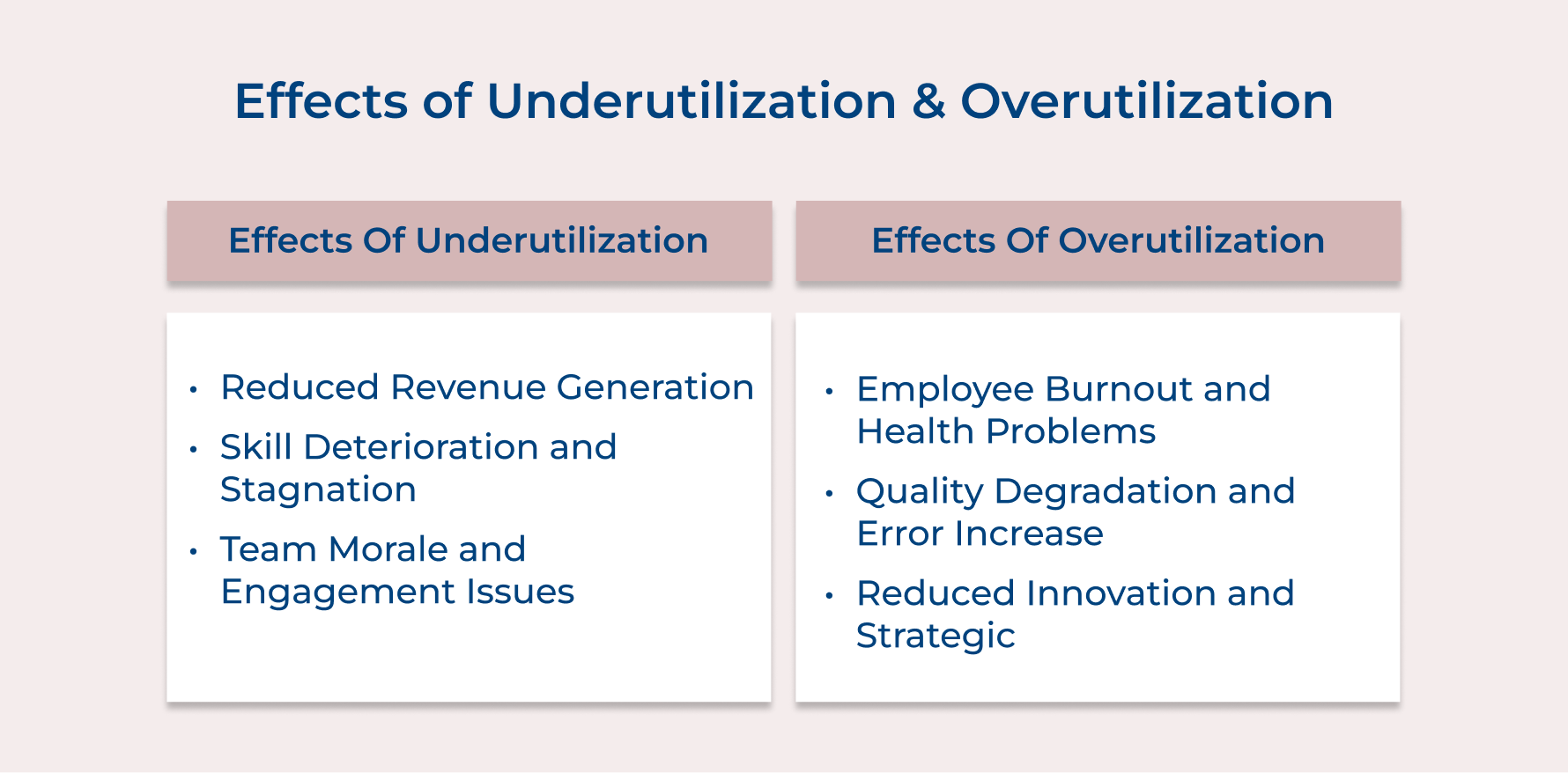
Effects of Underutilization
- Reduced revenue generation: When teams work below their full capacity, production processes slow down. Fewer billable hours mean lower income and missed chances to take on profitable projects. This directly affects your output index and overall financial growth.
- Skill deterioration and stagnation: When employees don’t get enough challenging work, their skills fade. Over time, they lose confidence and struggle to manage complex tasks. This limits your team’s production capabilities in the long run.
- Team morale and engagement issues: A lack of meaningful work makes employees feel undervalued. Their motivation drops and this disengagement spreads through the team, leading to lower retention as well as weaker production efficiency overall.
Effects of Overutilization
- Employee burnout and health problems: Constantly high workloads reduce production efficiency. Long hours and stress cause burnout, which affects both wellbeing as well as work quality.
- Quality degradation and error increase: Overworked employees rush tasks, causing mistakes that reduce the output. Rework and poor attention to detail slow down production processes further.
- Reduced innovation and strategic thinking: When every moment is packed with immediate tasks, there’s no time for creative thinking or planning. This limits future production capabilities and innovation potential.
How to Measure Capacity Utilization Rate Effectively?
Let’s guide you through a 7-step process to calculate your capacity utilization rate and interpret the results effectively. Thus, empowering you to drive your business toward operational excellence.
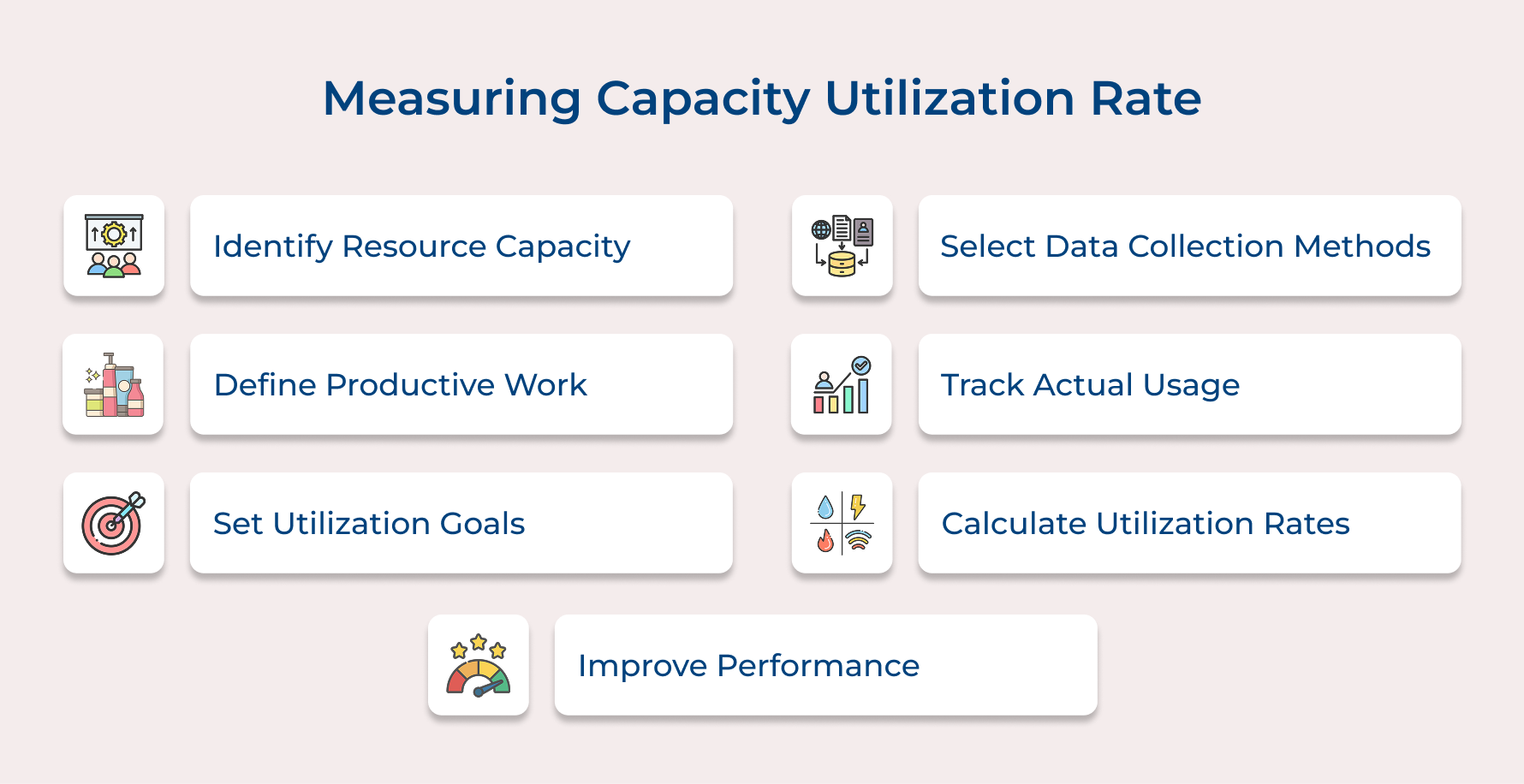
1. Define Your Available Resource Capacity
The foundational step establishes the baseline against which all utilization measurements will be compared. Without accurately defining available capacity, your calculations become meaningless and lead to poor resource allocation decisions.
Understanding your available resource capacity requires gathering three essential data points that form the foundation of accurate utilization measurement:
- Total working hours: Calculate the maximum hours each employee is contracted to work during your measurement period including regular schedules and any agreed overtime provisions.
- Planned time off: Account for all scheduled vacations, holidays, sick days and personal time that reduces the actual hours available for productive work activities.
- Realistic work expectations: Establish what percentage of available time can realistically be spent on productive tasks considering breaks, meetings and necessary downtime for optimal performance.
For example, if Sarah works 40 hours weekly but takes two vacation days monthly, her true available capacity becomes 32 hours that week rather than the full 40-hour assumption.
2. Define What Counts as Productive Work
This step creates clear boundaries between value-generating activities and necessary overhead tasks that don’t directly contribute to organizational goals. These four fundamental questions help establish clear criteria for categorizing work activities:
- Does this activity directly generate revenue or advance client deliverables?
- Does this task contribute measurable value to organizational objectives and strategic goals?
- Would clients be willing to pay for this specific activity or output?
- Does this work advance project milestones or improve operational efficiency?
Answering these questions systematically helps teams develop consistent categorization standards that improve measurement accuracy. Clear definitions prevent confusion during time tracking and ensure everyone applies the same criteria when recording their daily activities.
Common productive and non-productive work examples include:
Productive Work:
- Client meetings
- Project development
- Strategic planning
- Business development
Non-productive Work
- Administrative paperwork
- Internal reporting
- System maintenance
- General overhead
Beyond these classification questions, consider creating detailed activity codes that capture the nuances of your specific work environment. This granular approach helps identify patterns in how time gets allocated and reveals opportunities for streamlining processes that currently consume valuable productive capacity.
3. Set Capacity Utilization Goals
Setting clear targets turns measurement into action. It helps teams make smarter daily choices and plan long-term with purpose. When goals are in place, utilization data starts working for you instead of just sitting in a report.
Targets act like guideposts. They show when performance is strong and when adjustments are needed to balance workloads. Managers can quickly see if current utilization levels support steady growth, protect quality standards and keep employees motivated across every department.
Pro tips:
- Set different utilization targets for various roles since senior managers naturally spend more time on non-billable strategic work than junior team members.
- Build buffer capacity into your targets to handle unexpected projects and prevent burnout from consistently operating at maximum utilization levels.
4. Choose Your Data Collection Methods
You’ll determine how to systematically capture time allocation data across your organization. The method you select directly impacts the accuracy and reliability of your utilization measurements which form the foundation for all future resource optimization decisions.
Here are five proven data collection methods that businesses commonly implement:
- Time tracking software: Digital platforms that automatically log hours spent on different projects and categorize activities in real-time for comprehensive reporting.
- Manual timesheets: Traditional paper or spreadsheet-based recording where employees document their daily activities and hours worked on specific tasks or projects.
- Project management tools: Integrated platforms that combine task management with time tracking allowing teams to log hours directly against project deliverables and milestones.
- Automated activity monitoring: Software that tracks computer usage and application activity to provide objective data about how time gets allocated throughout the workday.
- Hybrid reporting systems: Combination approaches that blend automated tracking with manual input to capture both digital work patterns and offline activities comprehensively.
After selecting your preferred data collection method, ensure you establish clear protocols for consistent implementation across all teams. Training becomes essential because inconsistent data entry undermines the entire measurement process and leads to unreliable utilization calculations that misguide resource allocation decisions.
5. Gather Actual Usage Data Systematically
The next step is to regularly track how your team spends their time over meaningful periods. Consistent data collection builds a clear picture of actual work patterns and gives you the reliable insights needed for process optimization. When you have this information, your utilization calculations become more accurate and decision-making more confident.
These insights act as the foundation for calculating utilization rates and spotting trends. Over time, you’ll see where resources are being used well and where adjustments are needed. This steady flow of data helps forecast future capacity, improve efficiency and guide teams toward achieving sustainable maximum output across all projects as well as departments.
Pro tips:
- Collect data for at least 30 days to account for natural variations in workload and ensure your utilization calculations reflect typical operating conditions.
- Implement daily data entry requirements rather than weekly summaries because people forget details quickly and retrospective time tracking becomes increasingly inaccurate.
6. Calculate Utilization Rates Using Formulas
Turn your raw time data into clear percentages that show how efficiently resources are being used. These numbers help you understand real performance levels. If you skip this step, you’ll only have scattered data with no real insights to guide decisions or improve team efficiency.
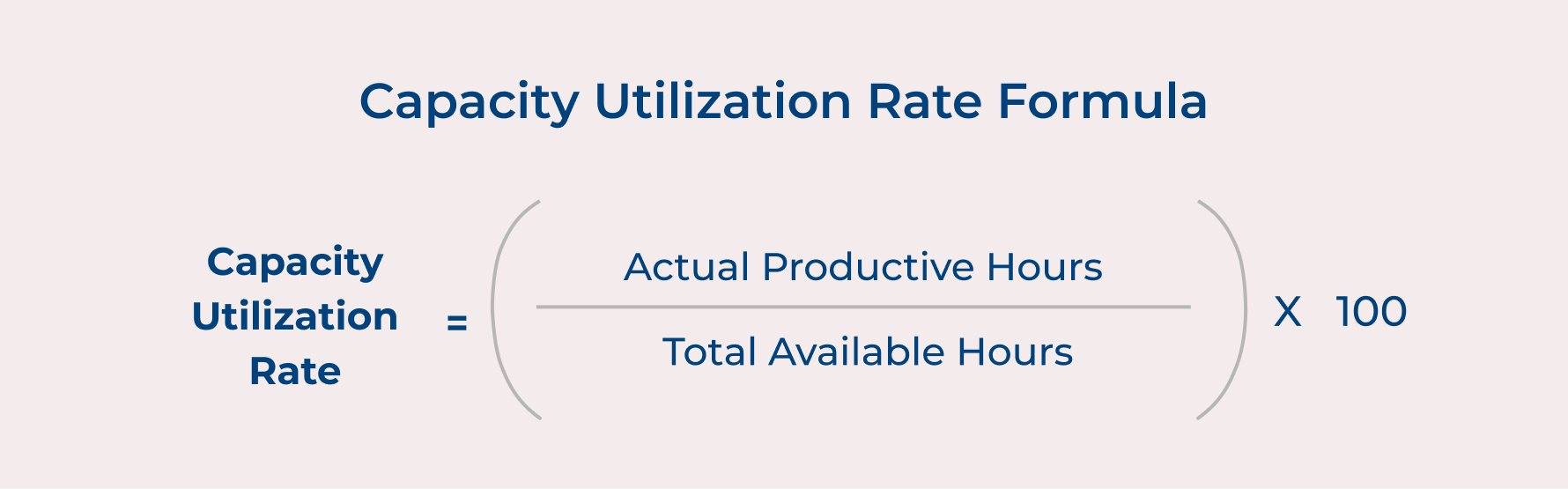
Understanding each component of this formula ensures accurate calculations and meaningful interpretations of your team’s performance:
- Actual productive hours: It represents the total time spent on revenue-generating activities and value-adding tasks that directly contribute to organizational objectives. Include only the work categories you defined as productive in Step 2 to maintain consistency across all calculations.
- Total available hours: These hours encompass the maximum time available for work after accounting for planned time off and realistic work expectations. Use the baseline capacity figures you established in Step 1 rather than theoretical maximum hours to ensure realistic utilization targets.
Example Calculation:
Let’s calculate the utilization rate for Jennifer, a project manager:
Total Available Hours: 160 hours (40 hours/week × 4 weeks)
Planned Time Off: 8 hours (1 vacation day)
Adjusted Available Hours: 152 hours
Actual Productive Hours: 114 hours (client meetings, project work, deliverables)
Capacity Utilization Rate = (114 ÷ 152) × 100 = 75%
This means Jennifer operated at 75% capacity during the measurement period, which falls within the optimal range for sustainable performance while maintaining quality standards.
7. Analyze Results and Implement Improvements
The final step is where data turns into action. Here, you use your utilization insights to fine-tune production resources and boost overall team performance. Even the most accurate numbers won’t help if they’re not analyzed and applied properly. Real improvement comes from turning data into smart decisions that solve capacity and efficiency challenges.
There are three simple ways to make your analysis count:
- Trend analysis: Track utilization over time to spot patterns or shifts in productivity. Sudden drops could point to supply chain disruptions or workflow bottlenecks that need quick fixes.
- Comparative analysis: Compare utilization across teams, departments, or project types. This helps identify what drives top performance and where production resources can be better allocated.
- Threshold analysis: Set upper and lower utilization limits. When teams consistently exceed or fall below these levels, take action to rebalance workloads while maintaining steady performance.
Once you understand the patterns, build action plans that improve efficiency and strengthen operations – without compromising quality or sustainability.
Strategies for Improving Capacity Utilization
Optimizing capacity utilization requires strategic thinking and systematic implementation to maximize resource potential while maintaining sustainable work environments.
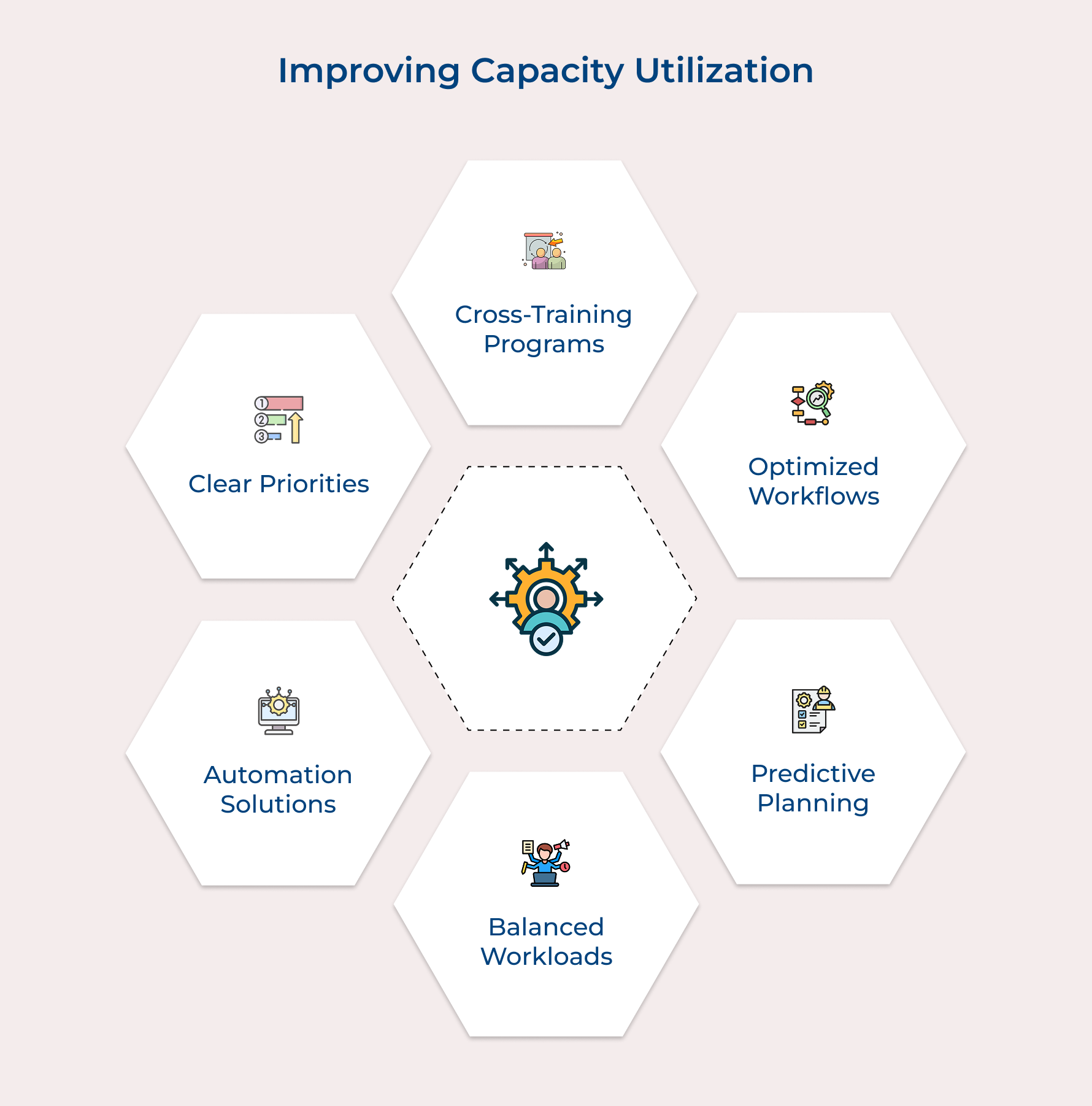
Implement Cross-Training and Skill Development Programs
Cross-training team members in multiple competencies creates flexibility when workloads shift across projects. When employees handle various tasks, you redistribute work effectively during busy periods and prevent bottlenecks that overwhelm some while others remain underutilized.
Optimize Workflow Processes and Eliminate Bottlenecks
Streamline operational processes to remove unnecessary steps that consume valuable time without adding meaningful value. By eliminating workflow bottlenecks, you free up capacity trapped in inefficient procedures and allow teams to focus on high-impact activities.
Use Predictive Planning and Demand Forecasting
Analyze historical data patterns to anticipate future workload demands while adjusting resource allocation proactively. Predictive planning allows strategic resource preparation for busy seasons and avoids last-minute scrambling to meet unexpected project requirements.
Balance Workloads Through Strategic Resource Reallocation
Monitor individual utilization rates that reveals when team members operate above or below optimal capacity. Strategic reallocation moves tasks from overloaded employees to those with bandwidth, creating balanced distribution that maximizes productivity while preventing burnout.
Invest in Automation and Technology Solutions
Automating routine administrative tasks frees human capacity for complex work requiring creativity and critical thinking. Technology handles repetitive processes like data entry and report generation, allowing teams to focus on strategic growth activities.
Establish Clear Priorities and Project Selection Criteria
Not all projects deserve equal resources, so clear prioritization criteria ensures teams focus on high-value activities. When everyone understands project precedence, decision-making becomes faster and capacity directs toward initiatives delivering greatest investment returns.
Examples of Capacity Utilization
These applications demonstrate how capacity utilization principles translate into practical business decisions across different organizational functions and strategic initiatives.
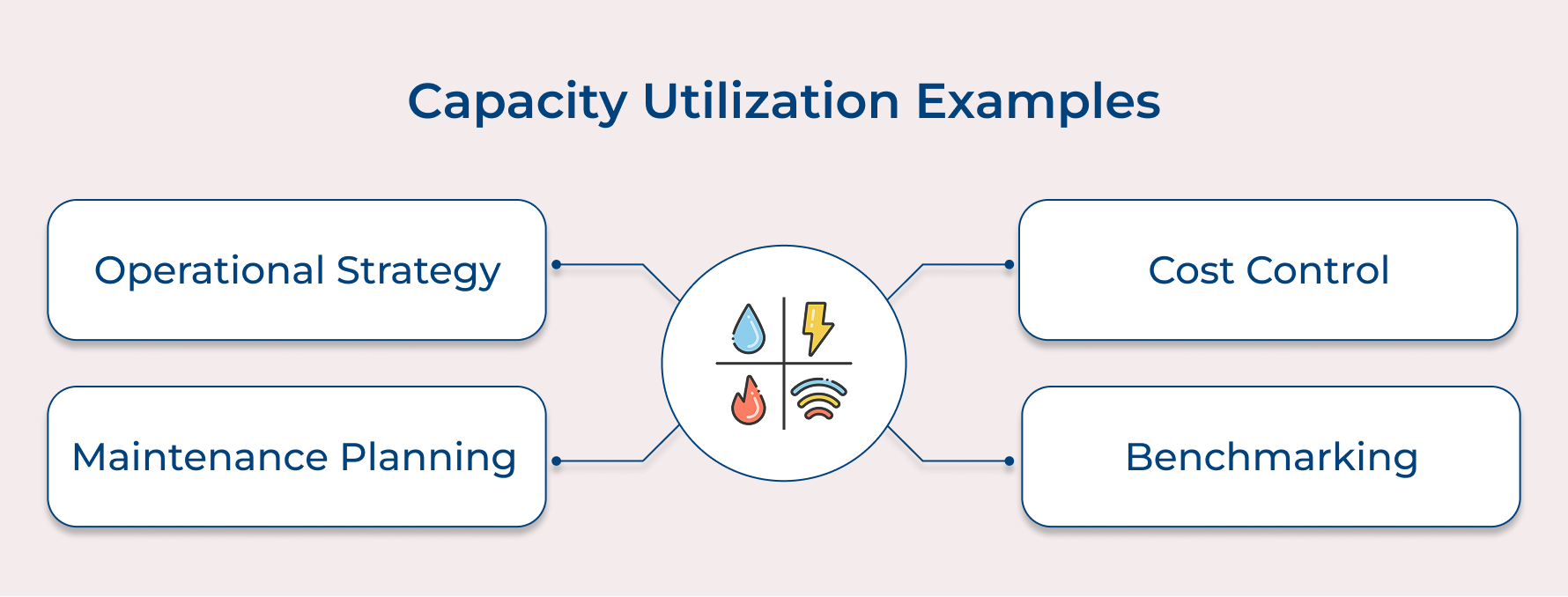
Operational Strategy Development
When senior staff are working at high capacity, it may be time to hire more people to prevent bottlenecks. Consistently low utilization could mean market demand was overestimated, signaling a need to adjust strategy. Reassigning projects and investing in skill development can help balance workloads as well as keep teams performing efficiently.
Maintenance Planning and Resource Scheduling
High utilization in maintenance teams can highlight the need for more preventive scheduling to avoid equipment breakdowns. Low utilization could reveal chances to consolidate resources or expand services. Structuring routine maintenance during slower periods can make operations smoother and more efficient.
Cost Control and Budget Optimization
High utilization might signal that expanding capacity could unlock new revenue opportunities. Persistent low utilization, meanwhile, may indicate overinvestment, prompting a reallocation of resources. Decisions about headcount, project focus, or business development initiatives can help align costs with actual needs.
Benchmarking Performance Against Industry Standards
Comparing utilization to industry benchmarks provides valuable insights. Strong performance may open doors for premium pricing strategies, while below-average rates often point to process inefficiencies that need fixing. Benchmarking helps identify strengths and uncover opportunities for growth and service expansion.
Empowering Your Business Through Capacity Utilization
Mastering capacity utilization transforms how businesses operate by providing clear visibility into resource allocation and productivity patterns. This strategic approach enables data-driven decisions that optimize team performance while maintaining sustainable workloads.
Effective capacity management creates competitive advantages through improved profitability, enhanced client satisfaction and better employee retention rates. Organizations that consistently measure and optimize their utilization rates build resilient operations capable of scaling growth while preserving quality standards.
Limit time — not creativity
Everything you need for customer support, marketing & sales.

Shivank Kasera is part of the marketing team at Kooper, where he focuses on building content that helps agencies and service providers grow. With a keen interest in SaaS, operations, and scalability, he translates practical insights into actionable resources for business leaders.