What Is Capability Building? 8 Ways To Build One Effectively
- What is Capability Building?
- Key Benefits of Effective Capability Building
- 8 Proven Capability Building Strategies for Success
- How to Develop a Capability Building Model?
- 6 Efficient Ways on How to Build Capability in a Team
- Challenges in Capability Building You Should Know
- Practical Examples of Capability Building
- Cultivate Business Success Through Capability Enhancement
- FAQs about Capability Building
Key Highlights:
- Capability building helps teams close skill gaps and stay competitive in fast-changing markets.
- Capability building drives innovation by encouraging experimentation and stronger problem-solving abilities.
- A growth-focused culture ensures continuous improvement, agility and sustained organizational resilience.
Organizations often struggle to keep up with rapid market changes when their teams don’t have the right skills to handle new challenges. As technology evolves faster than traditional training methods, talent gaps continue to grow, making it harder for businesses to stay competitive.
The impact shows up quickly, especially when companies don’t invest in structured capability building. Employees start looking elsewhere for growth and overall performance declines. Relying on constant external hiring becomes expensive and valuable internal knowledge gradually disappears.
A strategic approach to capability building can turn these challenges into real competitive advantages. This guide walks through practical frameworks and proven strategies to help you build capabilities that truly support sustained growth.
What is Capability Building?
Capability building means developing the skills, knowledge, systems and resources that help individuals or organizations perform better. It’s about creating lasting improvements in how people work and solve problems. This process strengthens core competencies and builds confidence to tackle future challenges independently.
Think of it as teaching someone to fish rather than giving them a fish. Capability building focuses on sustainable growth by embedding new abilities into the daily fabric of work. It transforms potential into practical performance through structured learning and hands-on experience.
Key objectives:
- Skills development: Equipping people with technical and soft skills they need to excel in their roles.
- Knowledge transfer: Sharing expertise and insights so teams can make informed decisions without constant guidance.
- Process improvement: Streamlining workflows and systems to boost efficiency while reducing waste.
- Confidence building: Empowering individuals to take initiative and trust their judgment when facing new situations.
- Adaptability enhancement: Preparing people to navigate change and respond effectively to evolving demands.
Key Benefits of Effective Capability Building
When done right, capability building creates ripple effects across entire organizations. It transforms how teams operate and delivers measurable results that last.
1. Improved Performance And Productivity
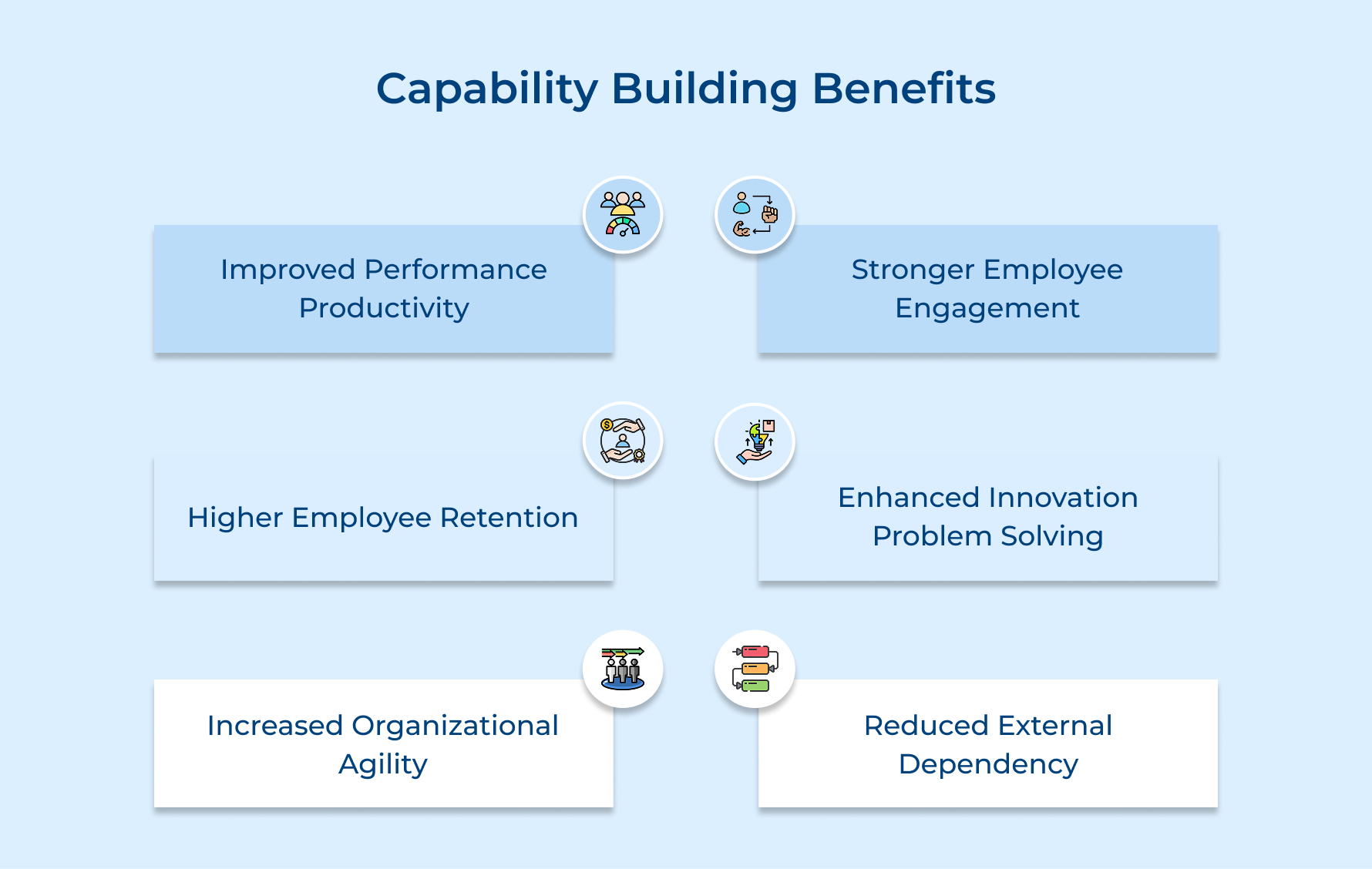
People naturally work smarter and faster when they have the right technical skills as well as clear learning paths to follow. Thoughtful capability building removes everyday bottlenecks and helps teams achieve more with the resources they already have. As a result, performance metrics improve, quality stays consistent and productivity grows in a sustainable way instead of relying on constant pressure.
2. Greater Employee Engagement And Retention
When organizations invest in growth, employees notice. Structured learning paths signal that the company values long-term development, not just short-term output. This sense of progress strengthens engagement, improves performance metrics and reduces turnover because people can see a future where their technical skills continue to evolve.
3. Enhanced Innovation And Problem-Solving
Teams with strong technical skills approach challenges with curiosity rather than hesitation. Continuous learning paths encourage experimentation, helping people uncover opportunities others overlook. Over time, stronger performance metrics reflect this shift as creative thinking turns into practical solutions that move the organization forward.
4. Increased Organizational Agility
Change becomes easier to manage when employees are equipped with adaptable technical skills and flexible learning paths. Teams respond quickly to shifting priorities and performance metrics remain stable even during transitions. This agility allows organizations to pivot without losing momentum or focus.
5. Better Quality And Consistency
Shared learning paths create a common understanding of best practices across teams. With the right technical skills in place, work becomes more predictable and reliable. Consistent performance metrics then reinforce trust among stakeholders and reduce the likelihood of costly errors or rework.
6. Reduced Dependency On External Resources
Capability building strengthens internal expertise, allowing teams to solve problems without constantly turning to outside consultants. As technical skills deepen and learning paths mature, performance metrics improve while costs decline. Most importantly, valuable knowledge stays within the organization, supporting long-term growth and resilience.
8 Proven Capability Building Strategies for Success
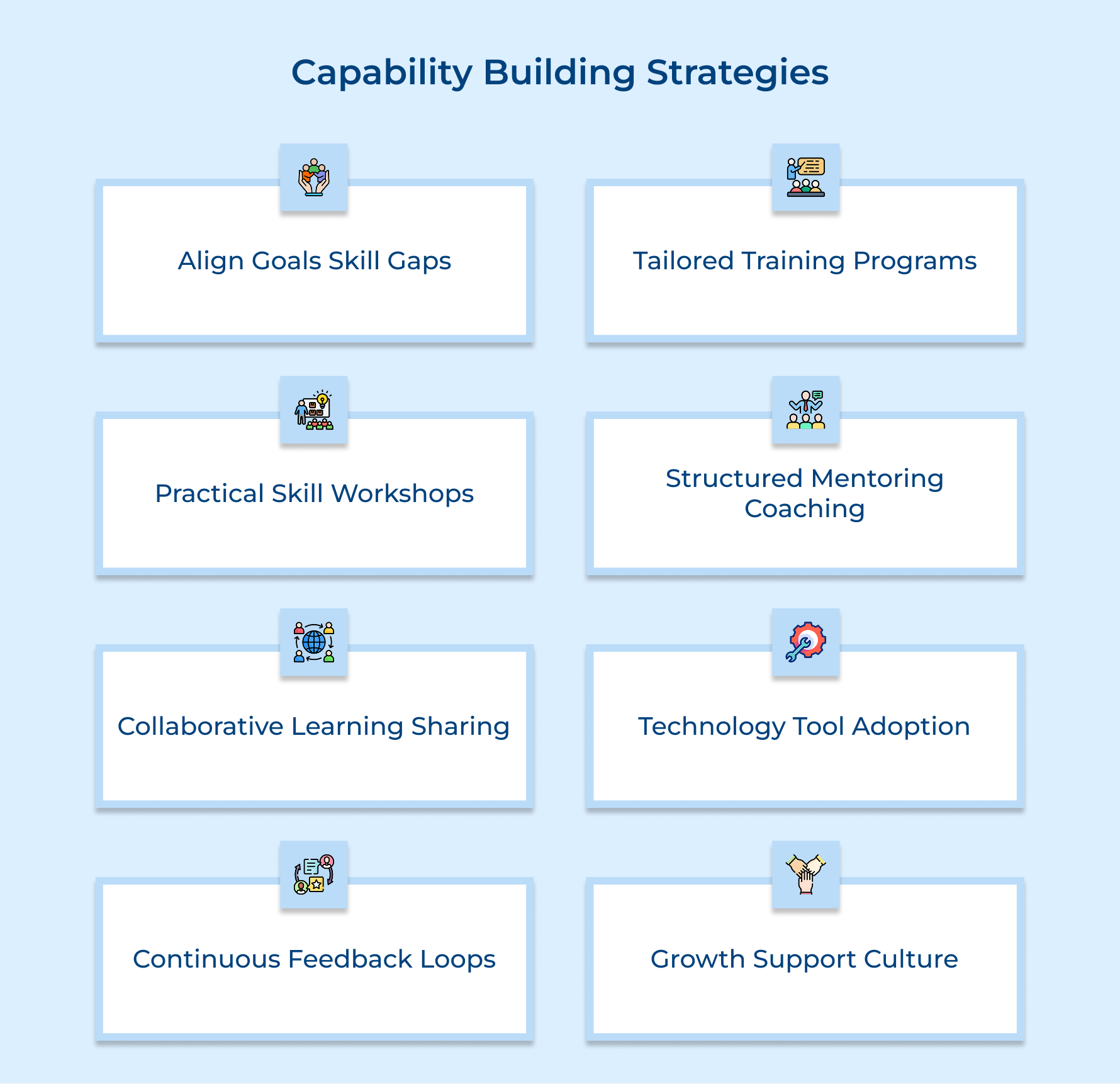
Let’s now delve into eight proven strategies that have demonstrated success in shaping high-performing teams and driving sustainable organizational growth.
1. Identify Organizational Goals and Skill Gaps
Understanding where your organization stands versus where it needs to be forms the foundation of capability building. Start by conducting skills assessments through surveys and performance reviews to understand current capabilities. Compare these findings against your strategic goals to identify critical gaps that need immediate attention.
Once you’ve identified the gaps, here’s how to align and build capability:
- Prioritize high-impact gaps: Focus on skills that directly affect business outcomes and strategic objectives first.
- Create development roadmaps: Design clear pathways showing how individuals progress from current to required skill levels.
- Assign ownership and timelines: Designate leaders responsible for closing specific gaps with measurable deadlines.
- Integrate into performance goals: Make capability development part of regular performance discussions and annual objectives.
But how do you know if you’re assessing the right things? Start by asking your top performers what skills helped them succeed. This real-world insight beats generic competency frameworks every time.
2. Design Tailored Training and Development Programs
Generic one-size-fits-all training rarely sticks because people have different roles and learning needs. Tailored programs address specific challenges and resonate with participants because the content directly applies to their work.
Create Role-specific Learning Pathways for Targeted Skill Development
Each role requires unique capabilities to succeed. Learning journeys should match role needs and career growth, helping people build practical skills they use daily while supporting meaningful individuals as well as organizational progress.
Blend Online and In-person Formats for Flexibility
Combine live workshops for hands-on collaboration with digital modules for core concepts. A hybrid approach helps people practice complex skills together while learning foundational knowledge at their own pace.
Update Content Based on Feedback for Relevance
Collect participant feedback regularly and use their suggestions to improve future programs. Updated content that reflects current challenges keeps learners engaged and ensures your learning investment continues to deliver real value.
3. Encourage Skill Application Through Workshops
Workshops turn theoretical knowledge into practical ability by giving people safe spaces to experiment. Here’s the thing about hands-on practice sessions. Why prioritize hands-on practice when building capabilities? Because people forget lectures within days but remember skills they’ve actually performed.
- Breakout exercises: Divide participants into small groups to solve problems collaboratively and present solutions.
- Role-playing activities: Have team members practice difficult conversations in controlled settings.
- Live demonstrations: Let learners attempt new techniques immediately after watching experts perform them.
Workshops become more valuable when you simulate realistic challenges. Real-world scenarios bridge the gap between classroom theory and actual job demands. Creating situations that mirror daily challenges helps people develop judgment under pressure.
- Customer complaint resolution: Practice handling frustrated clients with specific objections and tight resolution timelines.
- Budget constraint projects: Challenge teams to deliver results with limited resources and competing priorities.
- Crisis management drills: Simulate emergencies requiring quick thinking and coordinated responses under stress.
For workshops to truly build capability, participants need immediate coaching during practice sessions. Real-time feedback prevents bad habits from forming and reinforces correct techniques while the experience is fresh.
4. Implement Structured Mentoring and Coaching
Mentoring creates a more personal way to learn, where experienced professionals guide others through real challenges using practical insight. Progress happens faster because mentees understand not only what to do, but also why it works, straight from people who have already succeeded.
Here are a few ways to make mentoring truly effective:
- Formal pairing programs: Match mentors and mentees based on complementary skills while setting clear expectations from the start. Structure builds accountability and encourages regular, meaningful interaction.
- Reverse mentoring initiatives: Pair junior employees with senior leaders to exchange fresh ideas and current perspectives. Leaders stay updated, while younger team members gain visibility and confidence.
- Group coaching circles: Bring together small groups facing similar challenges under one experienced coach. Shared discussions strengthen community and expose participants to different problem-solving approaches.
Imagine a marketing team where a senior strategist mentors three junior members on campaign planning. Each mentee presents real campaign ideas, receives feedback and learns from the mentor’s past experiences. By the end of the program, all three feel confident leading campaigns on their own.
Once mentoring becomes part of everyday work culture, capability building starts happening naturally through regular conversations instead of being limited to occasional training sessions.
5. Build Collaborative Learning and Knowledge Sharing
Collaborative learning leverages the collective intelligence of your team where people learn from each other’s experiences and insights. When organizations ignore this strategy, knowledge stays siloed in individual heads and teams repeatedly solve problems others have already conquered.
Encourage collaboration by creating cross-functional projects where diverse expertise combines and establishing communities where people share challenges openly. Host regular peer-led sessions where team members teach skills they’ve mastered to colleagues.
Pro tips:
- Rotate facilitators in learning sessions so everyone develops teaching skills while sharing their expertise.
- Document insights from collaborative sessions in accessible formats so learning benefits future team members too.
6. Leverage Technology and Digital Tools
Technology scales capability building by making learning accessible anytime and tracking progress systematically across entire organizations. Digital tools transform training from expensive one-time events into continuous development journeys that adapt to individual needs.
When selecting technology and tools, consider these factors:
- User experience and accessibility: Choose platforms that people actually enjoy using and can access from any device.
- Integration with existing systems: Ensure new tools connect with your current HR and performance management platforms.
- Analytics and reporting capabilities: Select solutions that track engagement and measure skill improvement with meaningful data.
- Scalability and customization options: Pick tools that grow with your organization and adapt to changing needs.
The right technology creates learning ecosystems rather than just delivering content to passive audiences. Tools should encourage interaction and provide personalized pathways based on individual progress as well as performance gaps.
Here are essential tools that support capability building:
- Learning management systems: Centralize training content and track completion while providing certificates as well as credentials automatically.
- Video conferencing platforms: Enable live virtual workshops and coaching sessions that connect geographically dispersed teams effectively.
- Collaboration software: Facilitate knowledge sharing through discussion forums and shared workspaces where teams co-create solutions.
- Performance analytics dashboards: Monitor skill development trends and identify who needs additional support through real-time data.
Technology shouldn’t replace human interaction but should enhance it by removing logistical barriers. The best digital strategies blend automated learning with personal guidance to create efficient yet meaningful development experiences.
7. Build Continuous Feedback and Evaluation Loops
Continuous feedback ensures capability building efforts actually work by measuring impact and course-correcting when programs miss the mark. Without evaluation loops, organizations waste resources on training that sounds good but delivers no measurable improvement.
Key metrics for building continuous feedback:
- Skill proficiency scores pre and post-training
- On-the-job application rates of learned skills
- Performance improvement in targeted competency areas
- Participant satisfaction and engagement levels
These metrics reveal whether training translates into better performance or just checks compliance boxes. Tracking application rates shows if people use new skills while proficiency scores indicate actual capability gains over time.
Beyond metrics, gather qualitative insights through targeted questions: Questions to build continuous feedback:
- What obstacles prevent you from applying learned skills daily?
- Which training elements had the most impact on your work?
- What additional support would help you master these capabilities?
- How has this learning changed your approach to challenges?
Based on evaluation results, adjust your approach by eliminating ineffective programs and doubling down on what works. Redirect resources toward high-impact initiatives and modify delivery formats when engagement drops to ensure continuous improvement.
8. Create A Culture Supporting Growth
A growth culture makes capability building part of daily work rather than an occasional corporate initiative everyone tolerates. Without cultural support, even excellent programs fail because people lack time or permission to develop themselves.
Build this culture by recognizing skill development publicly and allocating protected time for learning without guilt. Leaders must participate visibly in their own growth to signal that development matters at every level.
Best practice:
- Celebrate learning milestones in team meetings to normalize continuous development as career advancement.
- Include capability building contributions in performance reviews so mentoring and knowledge sharing count toward success.
How to Develop a Capability Building Model?
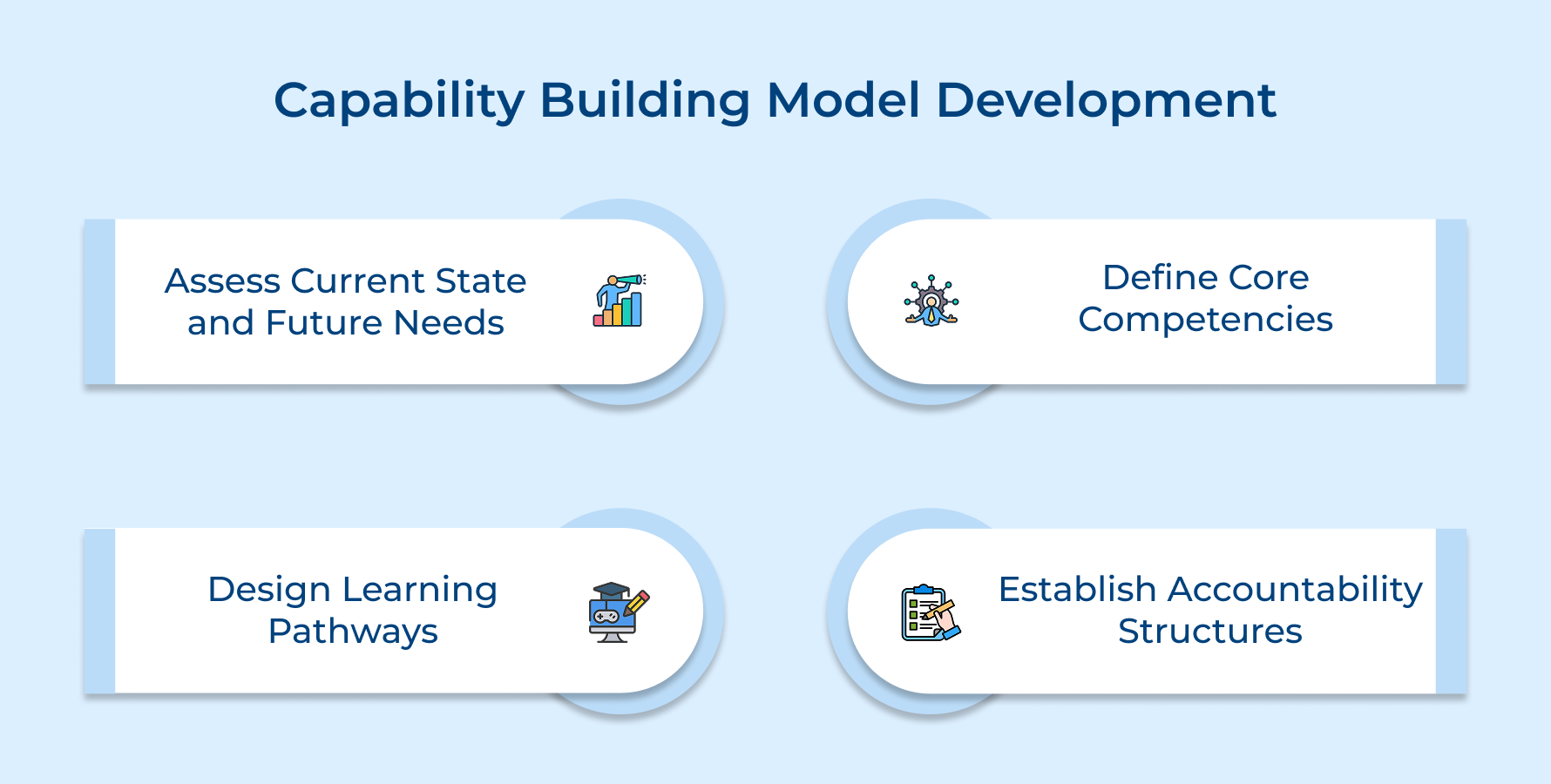
Creating a capability building model gives your organization a structured framework for consistent development. It transforms scattered training efforts into a strategic system that aligns with business goals.
Assess Current State And Future Needs
Begin by evaluating existing skills across your organization through assessments and performance data analysis. Compare current capabilities against future requirements based on strategic plans to identify critical gaps requiring immediate attention.
Define Core Competencies And Success Criteria
Identify the essential skills and behaviors that drive success in each role within your organization. Establish clear performance standards as well as measurable outcomes so everyone understands what good looks like and how progress gets evaluated.
Design Integrated Development Pathways
Create comprehensive learning journeys that combine formal training with on-the-job experiences and mentoring opportunities. Build progression frameworks showing how individuals advance from novice to expert while acquiring complementary skills along the way.
Establish Governance And Accountability Structures
Assign clear ownership for capability building initiatives with leaders responsible for specific competency areas and outcomes. Create review mechanisms that track progress and ensure development efforts receive necessary resources as well as attention consistently.
6 Efficient Ways on How to Build Capability in a Team
Building team capability requires intentional strategies that develop collective skills and strengthen collaboration. These six approaches transform individual talents into cohesive team performance that drives results.
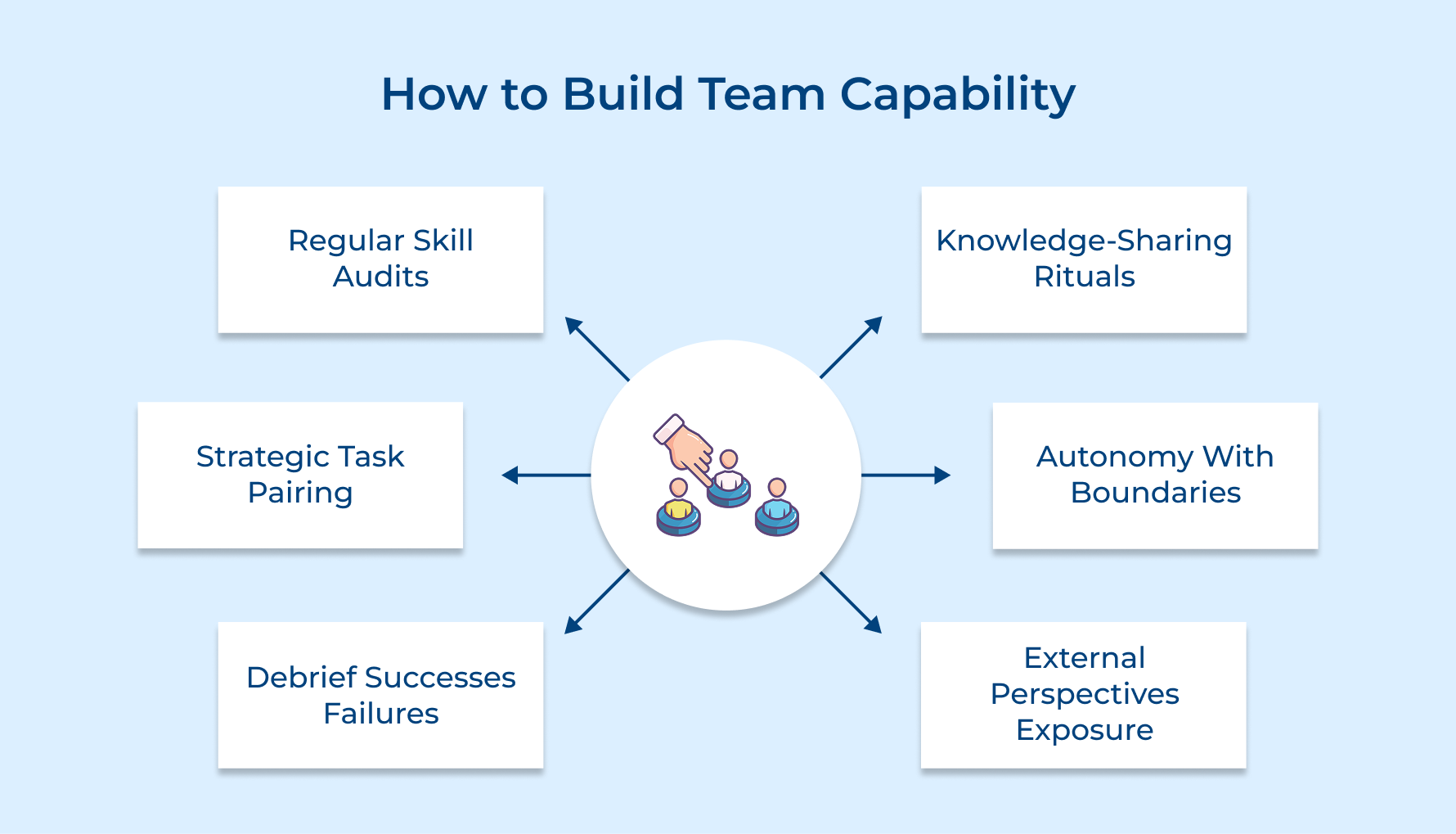
1. Conduct Regular Team Skill Audits
Map out every team member’s current strengths and development areas through honest conversations along with performance observations. Create a visual skills matrix showing who excels at what and where gaps exist across the team.
Here’s what a comprehensive team skill audit reveals:
- Capability overlap: Identify which critical skills only one person possesses creating bottleneck risks.
- Hidden strengths: Discover underutilized talents team members haven’t had chances to showcase.
- Collective gaps: Spot skills nobody on the team currently has but projects require.
These audits show the complete capability landscape so you can make smart decisions about development priorities. Understanding your team’s collective skill profile helps you assign work strategically while identifying urgent areas needing attention.
2. Create Knowledge-Sharing Rituals And Routines
Establish weekly or biweekly sessions where team members present solutions to problems they recently solved successfully. Make these sessions interactive so others can ask questions and discuss how to apply similar approaches.
Effective knowledge-sharing practices that build team capability:
- Lightning talks: Five-minute presentations where someone shares one useful technique or insight quickly.
- Problem-solving showcases: Team members walk through their approach to challenging situations step-by-step.
- Lessons learned reviews: After completing projects, discuss what worked and what didn’t collectively.
These rituals transform individual learning into team knowledge that everyone can access and apply going forward. When one person discovers a better way to handle client requests, the whole team benefits immediately.
3. Pair Team Members Strategically On Tasks
Intentionally match people with complementary skills on projects so they naturally learn from each other through collaboration. Rotate pairings regularly to expose everyone to different working styles and expertise across the team.
4. Give Autonomy With Safety Boundaries
Allow team members to make decisions and solve problems independently within defined guidelines rather than micromanaging every step. Trust people to figure out solutions while making yourself available if they genuinely need help.
Balance autonomy and support for optimal growth:
- Define what decisions team members can make alone versus requiring approval.
- Identify low-risk areas where trying new approaches won’t cause major problems.
- Make it easy to ask for guidance without judgment or penalties.
Autonomy forces team members to develop judgment and problem-solving skills they won’t build if you always provide answers. When teams handle client projects independently, they develop confidence and capability to manage complex requirements efficiently without constant supervision or hand-holding.
5. Debrief Failures And Successes Equally
After any significant outcome, gather the team to analyze what contributed to the result objectively and openly. Extract specific lessons about what actions led to success or failure so everyone learns from real experience.
Make debriefs psychologically safe and focused on learning:
- Blameless retrospectives: Focus on understanding what happened rather than pointing fingers at individuals
- Pattern identification: Look for recurring themes across multiple projects to spot systemic issues.
- Action commitments: End each debrief with concrete changes the team will implement going forward.
6. Expose The Team To External Perspectives
Bring in guest speakers, send team members to conferences or arrange visits with other teams doing similar work. External exposure introduces new ideas and approaches that your team might never discover working in isolation.
External perspectives challenge assumptions and spark innovation by showing different ways to solve familiar problems successfully. This outside input prevents stagnation and keeps your team’s capabilities evolving rather than plateauing at current skill levels.
Challenges in Capability Building You Should Know
Even well-intentioned capability building efforts face obstacles that can derail progress and waste resources. Understanding these common challenges helps organizations prepare effective responses before problems escalate.
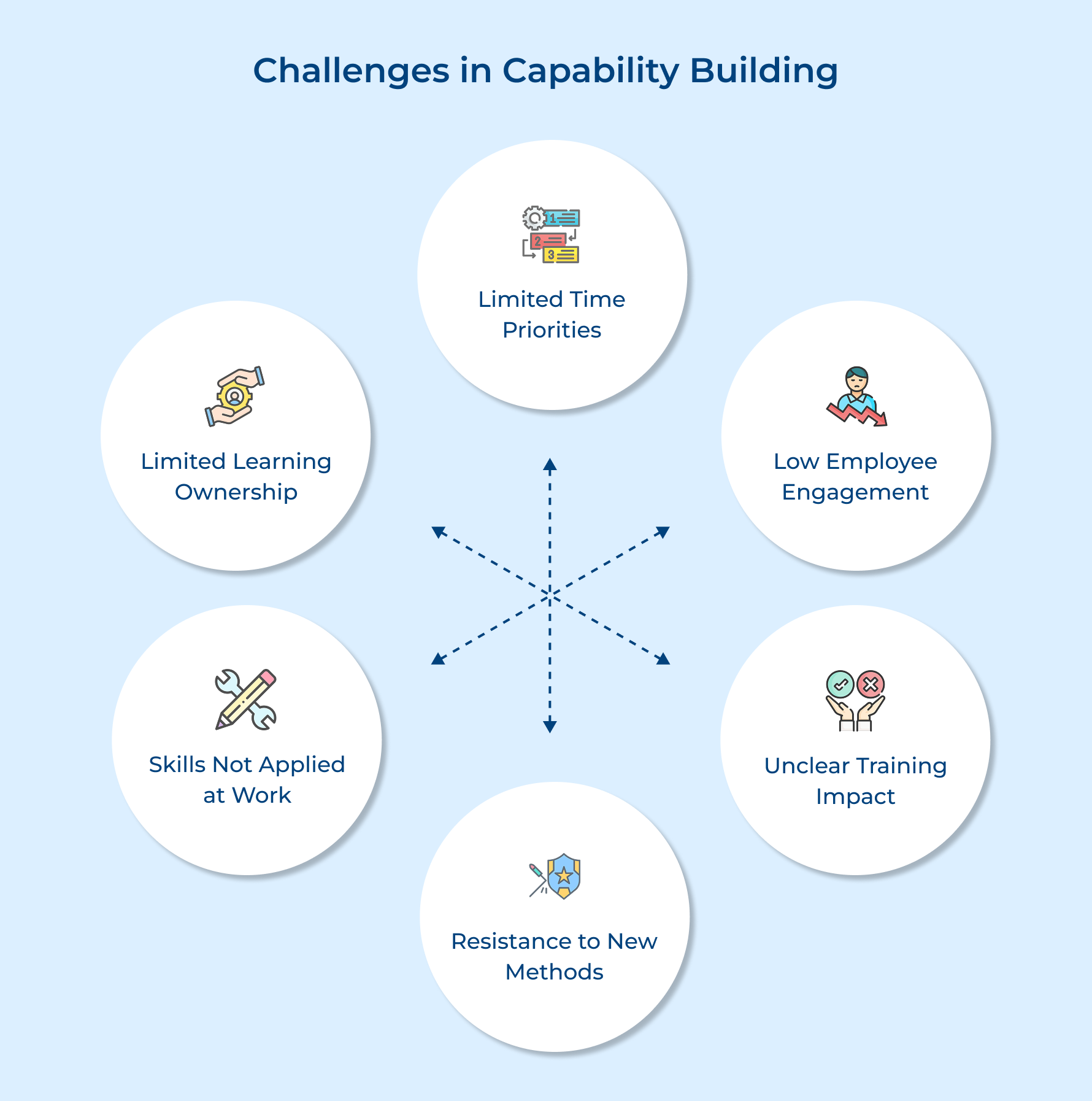
Limited Time And Competing Priorities
Teams struggle to prioritize learning when daily operational demands consume all available time and energy. Development gets postponed repeatedly when urgent tasks always take precedence over important growth.
Lack Of Engagement And Motivation
Employees resist capability building when they don’t see personal relevance or value in the training offered. Disengaged participants go through motions without absorbing skills or applying them afterward.
Difficulty Measuring Impact And ROI
Organizations cannot determine if capability building works when they lack clear metrics linking training to performance. Without measurable outcomes, justifying continued investment becomes challenging for leadership.
Resistance To Change And New Methods
People cling to familiar approaches even when new skills would improve results significantly. Comfort with existing processes creates barriers that prevent adopting better techniques learned through training.
These obstacles are common but not insurmountable with thoughtful approaches. Here are practical solutions that address each challenge directly:
- Embed skill development into regular work activities rather than treating it as separate from daily tasks.
- Show clear pathways between capability building and advancement opportunities employees actually want.
- Measure specific outcomes before and after training to demonstrate tangible improvements as well as business value.
- Let people choose what skills to develop and how to learn them for greater ownership along with commitment.
Practical Examples of Capability Building
Capability building looks different at individual and organizational levels but both aim to strengthen performance as well as readiness. Here are practical examples showing how development happens across both dimensions.
Individual Capability Building Examples
- Goal setting & performance growth: Employees set quarterly skill objectives aligned with career aspirations and track progress through self-assessments. This focused development helps individuals master capabilities needed to deliver complex client projects with increasing independence.
- Targeted training: Team members attend specialized courses addressing specific skill gaps in their current roles. Acquiring technical expertise enables them to handle sophisticated client requirements efficiently without constantly seeking external support.
- Peer-to-peer learning: Colleagues share expertise through informal mentoring where experienced members guide others through challenging tasks. This knowledge transfer builds collective capability that improves collaboration and efficiency on client engagements.
- Risk management: Individuals develop skills to identify project risks early and create mitigation strategies proactively. Strong risk management capabilities help teams anticipate client project challenges and address issues before they impact deliverables.
Organizational Capability Building Examples
- Strategic hiring: Organizations recruit talent with skills that fill critical capability gaps or bring innovative expertise internally. New hires strengthen the organization’s ability to pursue ambitious client projects that previous teams couldn’t handle.
- Enterprise-wide upskilling: Companies launch comprehensive training programs that elevate capabilities across entire departments simultaneously. Broad upskilling ensures consistent service quality and enables organizations to scale client project delivery without compromising standards.
- Talent acquisition: Building robust recruitment pipelines ensures continuous access to skilled professionals as organizational needs evolve. Strong talent acquisition capabilities help organizations staff complex client projects quickly with people possessing the right expertise.
- Leadership development programs: Organizations cultivate future leaders through structured programs teaching strategic thinking and people management skills. Capable leaders guide teams effectively through challenging client projects while developing their direct reports simultaneously.
Cultivate Business Success Through Capability Enhancement
Capability building transforms organizations from reactive to proactive by equipping people with skills to navigate complexity and drive results. It creates lasting value that compounds over time rather than delivering temporary fixes that fade quickly.
Investing in organizational capacity development positions your business for tomorrow’s challenges while strengthening current performance simultaneously. Organizations that prioritize building internal expertise create resilient teams ready to seize opportunities and deliver exceptional outcomes consistently.
Limit time — not creativity
Everything you need for customer support, marketing & sales.

Neeti Singh is a passionate content writer at Kooper, where he transforms complex concepts into clear, engaging and actionable content. With a keen eye for detail and a love for technology, Tushar Joshi crafts blog posts, guides and articles that help readers navigate the fast-evolving world of software solutions.