Billable vs Non-Billable Work Differences & How to Track Them
- What is Billable Work?
- What is Non-Billable Work?
- Importance of Tracking Billable and Non-Billable Work
- What is the Difference Between Billable and Non-Billable Work?
- How to Track Billable vs Non-Billable Work?
- Examples of Billable and Non-Billable Work
- Master Efficiency with Billable vs. Non-Billable Work Tracking
- FAQs about Billable vs Non-Billable Work

Key Highlights:
- Confusing billable and non-billable work quietly drains margins and hurts profitability.
- Tracking billable vs non-billable work improves invoicing accuracy and client trust.
- Understanding differences between billable and non-billable work prevents pricing guesswork.
Ever wondered why some projects seem profitable on paper but leave your budget bleeding dry every month? The confusion between billable and non-billable work silently erodes margins while teams scramble to understand where time actually goes.
This misclassification leads to inaccurate invoicing, frustrated clients and the teams are stretched beyond their actual capacity limits. Lack of clarity turns pricing into guesswork and makes profitability hard to achieve.
Understanding the clear distinction between billable vs non-billable work transforms your project management approach entirely. Let’s explore what separates the two and why it matters for your success.
What is Billable Work?
Billable work refers to any task or activity performed for a client that can be directly charged to them based on your agreed-upon rate or contract terms. This includes time spent on deliverables and services the client has specifically requested as well as approved for payment.
When you track billable hours properly, you create a clear record of value delivered to your client. This tracking becomes the foundation for accurate invoicing and healthy cash flow. It also helps you understand which projects actually make money for your business.
Key objectives:
- Revenue generation: Billable work is the primary source of income that keeps your project financially viable and your team compensated.
- Resource allocation: Understanding billable tasks helps managers assign the right people to work that directly generates client payments.
- Project profitability: Tracking these hours reveals whether a project earns enough to cover costs and produce meaningful margins.
- Client transparency: Clear billable records give clients confidence they’re paying only for work that benefits their goals.
What is Non-Billable Work?
Non-billable work includes all the behind-the-scenes tasks that keep your business running but can’t be charged to a specific client or project. Internal meetings, admin work, training sessions and business development all fall into this category.
Even without direct revenue, this work plays a big role in project success. Training sharpens team skills that benefit future clients, while better internal processes shorten timelines and improve overall quality across engagements.
- Operational efficiency: Non-billable activities like system upgrades and process documentation create smoother workflows for all future billable projects.
- Team development: Training and mentorship hours build capabilities that make your team more valuable to clients over time.
- Business sustainability: Sales calls and proposal writing secure the future projects that keep your organization financially healthy.
- Budget planning: Tracking non-billable time helps you set realistic overhead costs and price your billable services appropriately.
Importance of Tracking Billable and Non-Billable Work
Understanding where your team’s time actually goes is essential for running profitable projects. Tracking both types of work gives you the complete picture needed for smart business decisions.
Importance of Tracking Billable Work
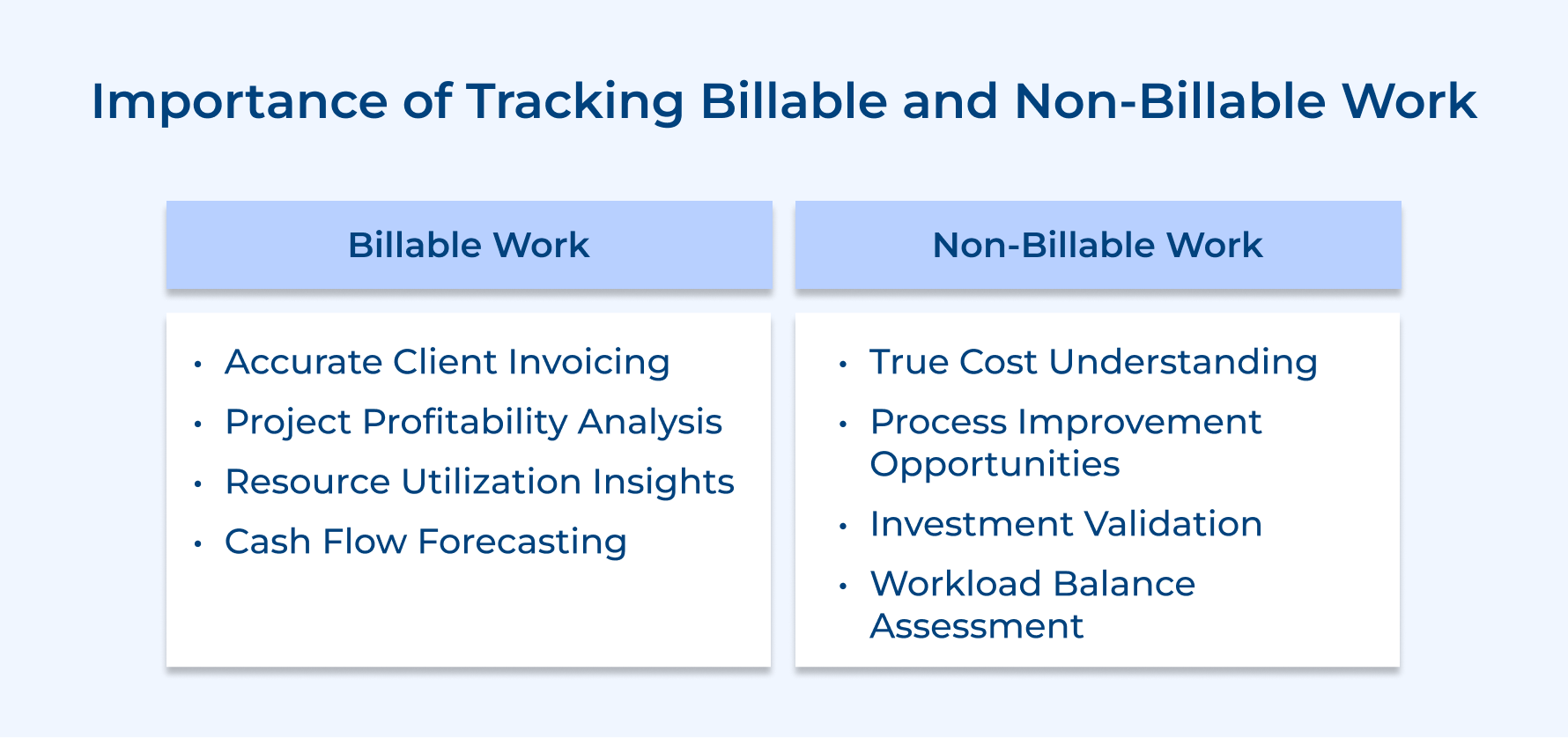
- Accurate client invoicing: Careful tracking ensures invoices reflect the real effort behind client consultations and project delivery. This prevents lost revenue from undercharging and avoids trust issues caused by incorrect billing.
- Project profitability analysis: Clear visibility into billable time shows which projects generate strong margins and which quietly drain resources. These insights help teams prioritize work that truly supports the bottom line.
- Resource utilization insights: Modern time tracking systems reveal how much of your team’s weekly capacity turns into revenue. Low billable percentages highlight scoping gaps, allocation issues, or inefficiencies that need attention.
- Cash flow forecasting: Reliable data strengthens billing practices and makes revenue predictions more accurate. Better forecasting helps you prepare for slow periods and prevent unexpected cash flow pressure.
Importance of Tracking Non-Billable Work
- True cost understanding: Tracking non-billable time reveals the real overhead required to keep your business running smoothly. This clarity helps you set rates that cover expenses while still protecting healthy profit margins.
- Process improvement opportunities: Visibility into where non-billable hours pile up highlights inefficient steps that can be streamlined or automated. Cutting unnecessary admin work frees more time for meaningful client engagement.
- Investment validation: Monitoring hours spent on training and development shows if those efforts actually improve team performance. Real data makes it easier to justify continued investment or shift resources elsewhere.
- Workload balance assessment: Clear insight into non-billable demands helps spot overload early and prevents burnout. Better awareness supports a healthier, more sustainable balance between internal work and project responsibilities.
What is the Difference Between Billable and Non-Billable Work?
Understanding the distinction between these two categories of work helps you manage projects more effectively. Let’s explore seven key differences that every project manager should know.
1. Revenue Impact
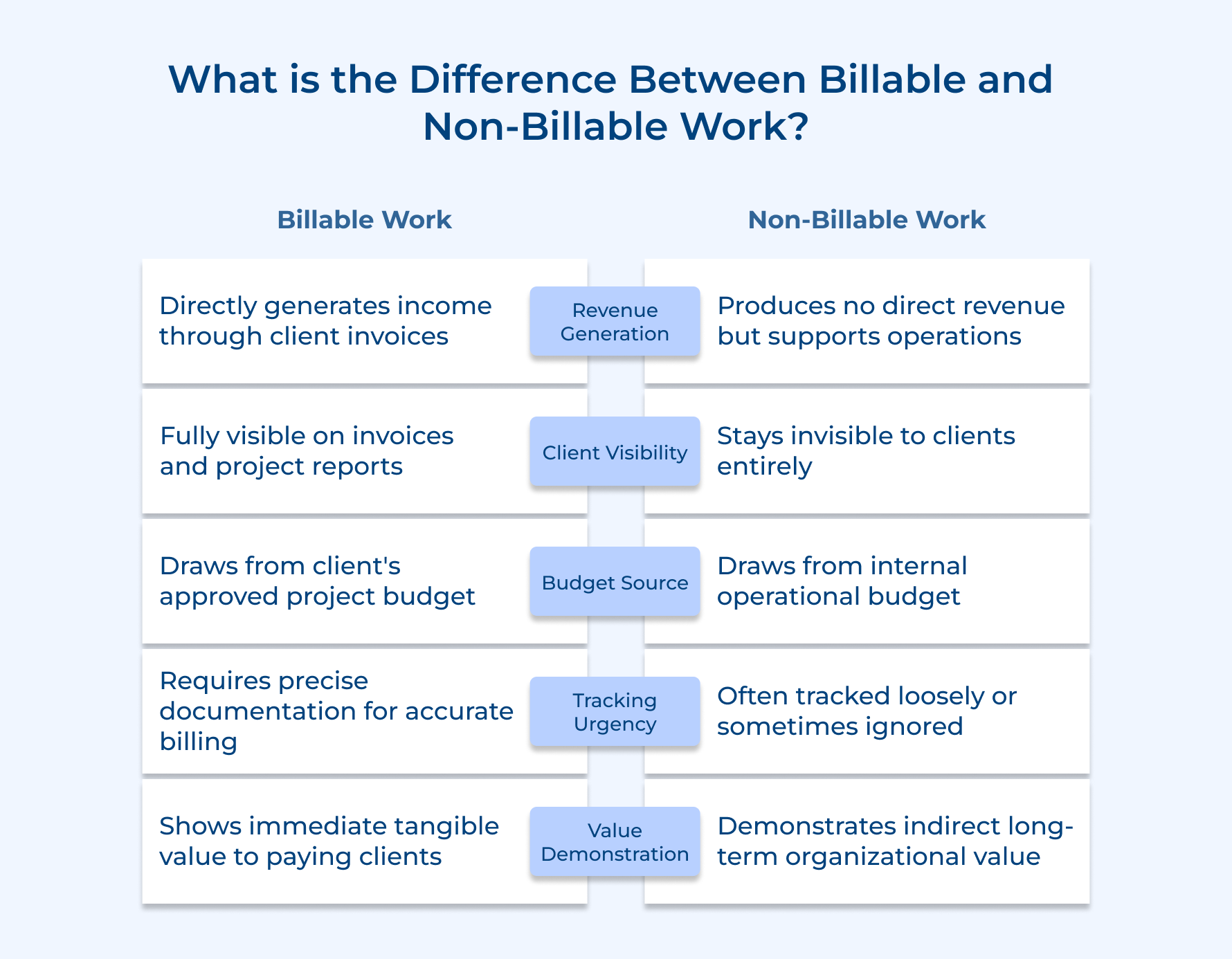
Billable work creates direct income because clients pay specifically for those tasks and outcomes. Every hour spent on revenue-generating activities contributes measurable value to the business and strengthens your realization rate, making billable work the financial backbone of any service organization.
Key characteristics of billable revenue impact:
- Appears clearly on client invoices with defined monetary value
- Connects directly to specific services, tasks, or outcomes delivered
- Follows pre-agreed pricing such as hourly rates, retainers, or contracts
Non-billable work, in contrast, produces no immediate revenue even though it consumes time and resources. These activities support operations behind the scenes and must be managed carefully to maintain overall profitability.
2. Client Visibility
Billable work remains highly visible to clients because they receive detailed breakdowns showing exactly what they’re paying for. Clients can see task descriptions along with time spent and associated costs on their invoices. This transparency creates accountability and helps build trust in the working relationship.
Consider these aspects of client visibility for billable work:
- Clients can question specific line items and request clarification on charges
- Detailed records protect both parties in case of billing disputes
- Regular visibility encourages ongoing communication about project progress
A web development agency might send weekly reports showing 12 hours on homepage design and 8 hours on database setup. The client sees precisely where their budget is going and can provide feedback on priorities accordingly.
Non-billable work stays completely invisible to clients since it happens behind the scenes of your organization. Clients never see time spent on internal meetings or administrative tasks on any documentation. This work exists in the background and supports the quality they receive without being directly connected to their projects.
3. Budget Allocation
Billable hours pull directly from the client-approved budget defined during contracts or early project planning. Every task must stay aligned with scope, priorities and expected value to avoid overruns as well as protect margins.
Before assigning billable time, consider:
- Does this task fall within the agreed scope of work?
- Will the client see clear value from the effort involved?
- Have potential budget changes been communicated in advance?
When a marketing agency has a $10,000 monthly retainer, every billable hour consumes a portion of that fixed amount. Spending 50 hours at $200 per hour uses the entire budget leaving no room for additional requests.
Internal operational funds usually absorb work that cannot be billed to a client. These costs remain essential for running the business, which is why smart pricing strategies always factor in overhead to keep profitability sustainable.
4. Performance Metrics
Billable work often serves as the clearest indicator of productivity and revenue contribution across a team. Metrics tied to utilization and output help leaders understand how effectively available time turns into business value while also revealing trends that influence long-term employee development.
Common ways organizations measure billable performance:
- Utilization rate comparing billable hours to total working capacity
- Revenue generated per team member or role
- Monthly or quarterly billable targets that guide workload balance
A consultant working 40 hours weekly with 32 billable hours achieves an 80% utilization rate. This metric helps managers identify top performers and those who might need additional client assignments.
Value from internal, non-revenue activities is harder to measure in strict financial terms. Even so, these efforts strengthen skills, improve processes and support future performance – making them essential despite the lack of immediate numerical visibility.
5. Time Tracking Requirements
Billable work demands meticulous time tracking because every minute has direct financial implications for both you and your client. You need detailed records showing exactly what tasks were performed and how long each one took. Accurate tracking protects your revenue and provides documentation if clients ever question their invoices.
Before logging billable time, consider these critical questions:
- Have I recorded the specific task description clearly enough for client review?
- Does my time entry accurately reflect the work performed without padding or underreporting?
- Can I justify this time spent if the client requests an explanation?
A lawyer tracking billable hours might log entries like “45 minutes reviewing contract amendments” and “1.2 hours drafting response to opposing counsel.” This precision ensures the client understands exactly what they’re paying for on each invoice.
Non-billable work often receives less rigorous tracking attention even though understanding it matters greatly. Many organizations loosely categorize internal time or don’t track it at all. The companies that do track non-billable hours gain valuable insights into their true operational costs and overhead burdens.
6. Scope Definition
Billable work operates within clearly defined boundaries set through contracts, statements of work and agreed project deliverables. These limits clarify what clients will pay for, prevent misunderstandings and keep expectations aligned throughout the engagement.
Key elements that shape billable scope:
- Contract terms outlining included services and responsibilities
- Change-order processes for approving additional work or budget
- Exclusion clauses that define what falls outside the agreement
Internal responsibilities rarely follow such strict documentation. Activities expand based on operational needs, team priorities, or evolving business demands, which makes ongoing review important to keep effort aligned with overall goals.
7. Value Demonstration
Billable work requires clear proof of impact because clients directly invest in the time and expertise provided. Tangible outcomes, consistent progress and meaningful results show that the engagement is worth the cost as well as strengthen long-term relationships.
Core ways billable value becomes visible:
- High-quality outcomes that meet professional standards and client expectations
- Timely completion aligned with agreed milestones
- Clear communication that keeps clients confident in ongoing progress
An accountant preparing quarterly financial statements demonstrates value through accuracy and timely delivery. The client can immediately see the tangible output and use those statements for business decisions.
Long-term benefits often emerge from efforts that are not billed directly. Improvements in efficiency, stronger capabilities and better future execution gradually translate into higher-quality client results—even if the payoff is not immediate.
How to Track Billable vs Non-Billable Work?
Effective tracking requires the right metrics that reveal how your team spends time across both revenue-generating and internal activities. These six measurements will help you gain complete visibility into your project operations.
1. Utilization Rate
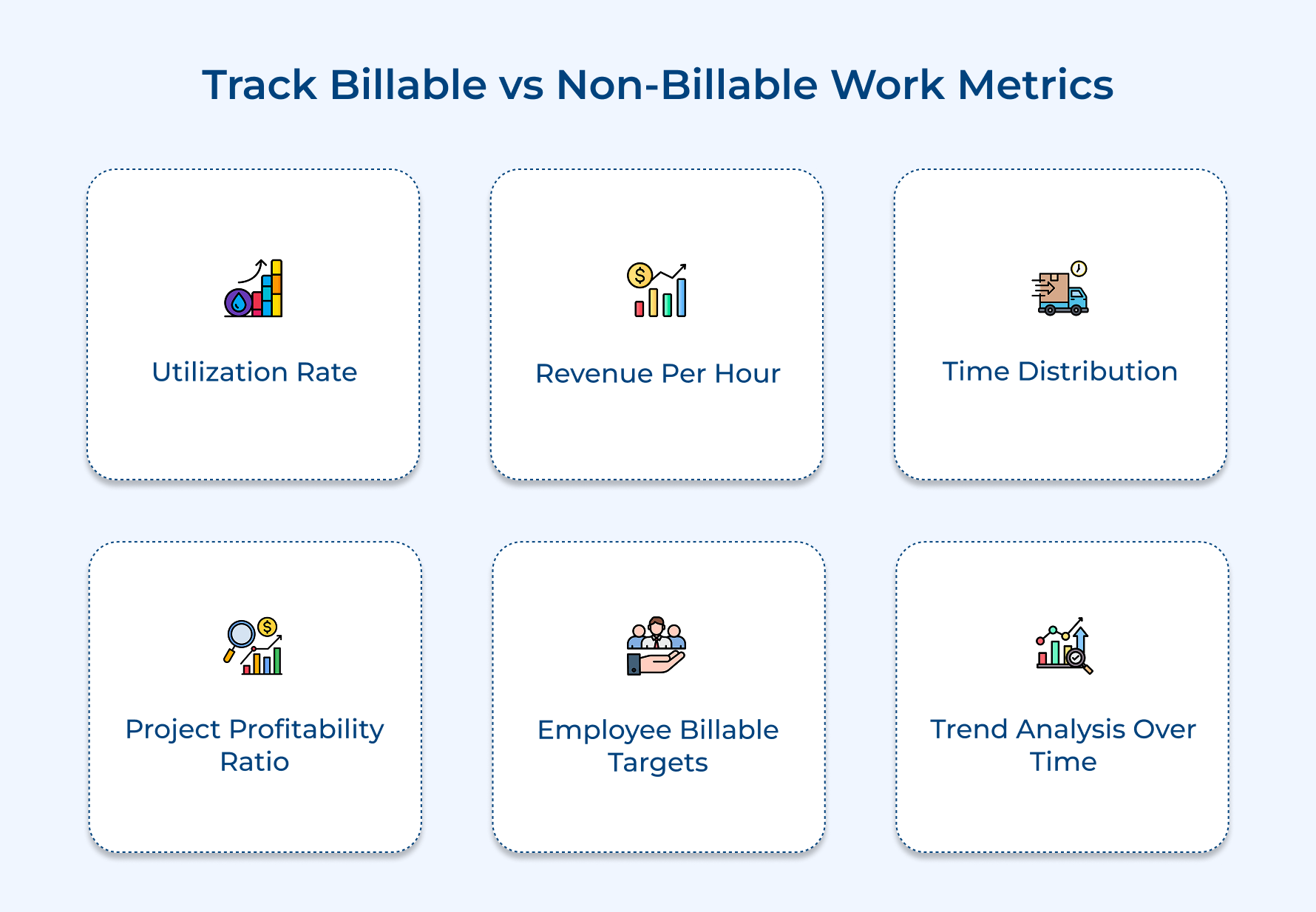
Billable: This percentage shows how much of your team’s available working time goes toward client-chargeable activities. A healthy utilization rate typically falls between 70-85% depending on your industry and role types.
Non-Billable: The remaining percentage represents time consumed by internal operations and overhead activities. Monitoring this helps you identify if administrative burdens are eating too heavily into productive capacity.
2. Revenue Per Hour
Billable: Calculate the actual income generated for each billable hour worked across different projects and clients. This reveals which engagements deliver strong returns versus those underperforming financially.
Non-Billable: While these hours don’t generate direct revenue, you can assess their cost impact on overall profitability. Divide total non-billable hours by overhead expenses to understand your true operational cost per hour.
3. Time Distribution by Category
Billable: Break down billable hours into specific categories like client meetings and deliverable creation and revisions. This granular view shows where billable time actually goes within each project.
Non-Billable: Similarly categorize internal time into buckets such as training and admin and business development. Patterns emerge showing which non-billable activities consume the most resources across your organization.
4. Project Profitability Ratio
Billable: Compare billable hours logged against the revenue each project generates after accounting for all costs. This ratio identifies your most and least profitable client relationships.
Non-Billable: Factor in non-billable hours spent supporting each project for true profitability calculations. Some projects require heavy internal coordination that erodes margins despite strong billable totals.
5. Employee Billable Targets
Billable: Set individual targets for billable hours based on role expectations and capacity availability. Track actual performance against these goals weekly or monthly to spot issues early.
Non-Billable: Establish acceptable thresholds for non-billable time that account for necessary internal responsibilities. Employees exceeding these thresholds may need workload rebalancing or process improvements.
6. Trend Analysis Over Time
Billable: Monitor how billable percentages shift across weeks and months as well as quarters throughout the year. Seasonal patterns and project cycles become visible helping you plan resources more effectively.
Non-Billable: Track whether non-billable time is growing or shrinking relative to your overall capacity. Increasing non-billable trends might signal process inefficiencies or scope creep in internal activities.
Examples of Billable and Non-Billable Work
Recognizing which activities fall into each category helps you track time accurately and invoice clients correctly. Here are common examples you’ll encounter in project management.
Examples of Billable Work
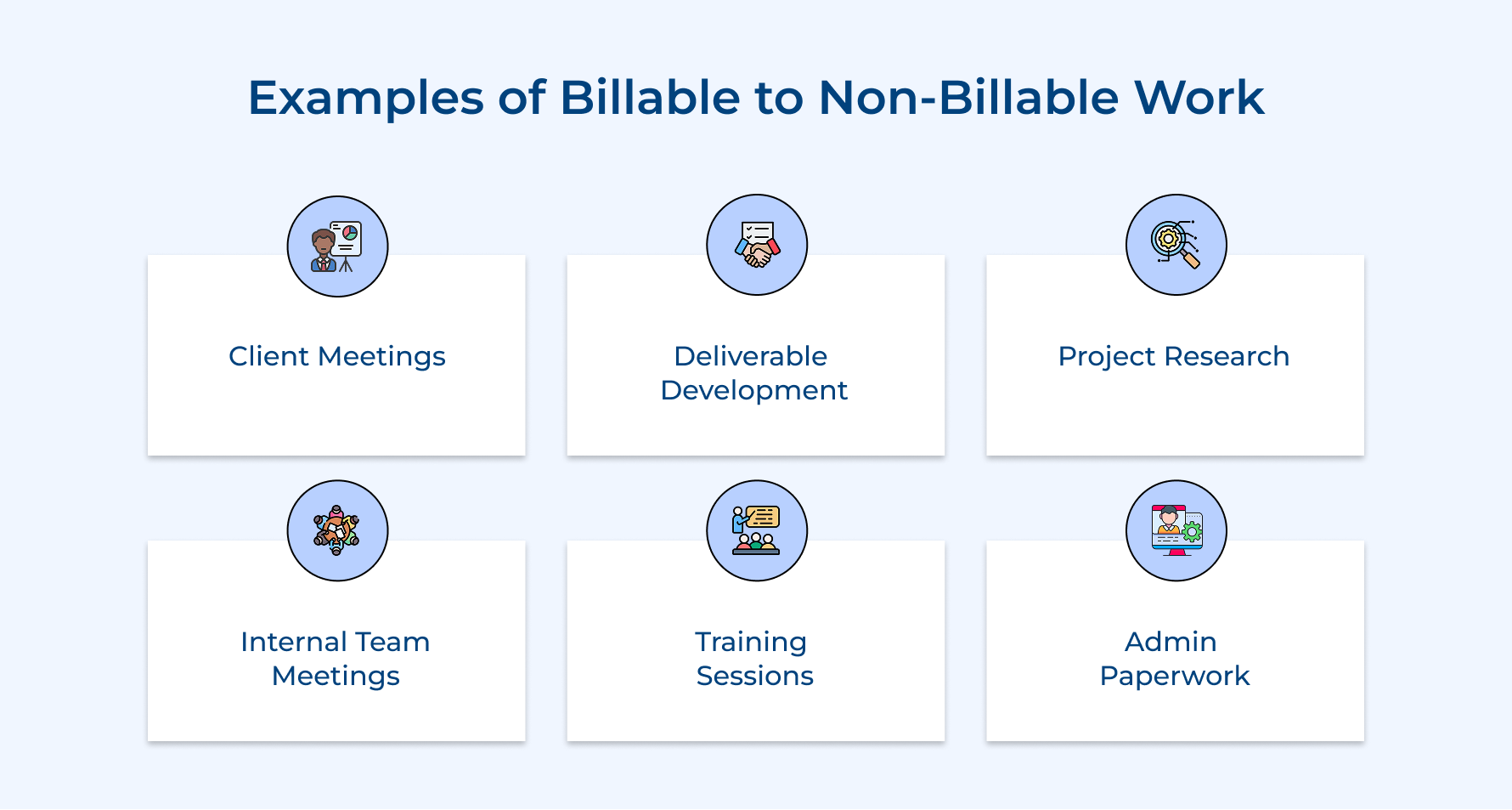
- Client meetings and consultations: Time spent in scheduled calls or face-to-face meetings discussing project requirements and progress with clients is always billable. These conversations directly advance the work clients are paying you to complete.
- Deliverable creation and development: Hours dedicated to producing the actual outputs clients have contracted you to create qualify as billable work. This includes writing reports and designing assets while building software features specified in your agreement.
- Project-specific research and analysis: When you research topics directly related to solving a client’s problem, that time goes on their invoice. This includes competitive analysis and market research as well as technical investigation needed for their specific project.
- Revisions and client-requested changes: Time spent modifying deliverables based on client feedback falls under billable work within agreed revision limits. Each round of edits consumes budget and moves the project closer to final approval.
Examples of Non-Billable Work
- Internal team meetings and coordination: Weekly staff meetings and department huddles as well as cross-team coordination sessions are necessary but never charged to clients. These gatherings keep your organization aligned but don’t produce direct client value.
- Professional development and training: Hours spent learning new skills and attending workshops while obtaining certifications benefit your business long-term. Clients don’t pay for your team’s growth even though they eventually benefit from it.
- Administrative tasks and paperwork: Processing invoices and updating internal systems as well as completing HR documentation consume significant time without generating revenue. These operational necessities keep your business running but stay off client invoices.
- Business development and sales activities: Prospecting for new clients and writing proposals while attending networking events build your future pipeline. This crucial work secures tomorrow’s billable projects but cannot be charged to any current client.
Master Efficiency with Billable vs. Non-Billable Work Tracking
Clear clarity around billable vs non-billable work can completely change how you manage projects and protect profitability. Accurate tracking of both categories shows exactly where your team’s time goes and highlights gaps that often stay hidden in daily operations.
These insights make it easier to improve pricing decisions, balance resources and strengthen client communication with better transparency. Start applying consistent tracking and you’ll notice project efficiency as well as financial control improve step by step.
Limit time — not creativity
Everything you need for customer support, marketing & sales.

Neeti Singh is a passionate content writer at Kooper, where he transforms complex concepts into clear, engaging and actionable content. With a keen eye for detail and a love for technology, Tushar Joshi crafts blog posts, guides and articles that help readers navigate the fast-evolving world of software solutions.