How to Resolve Project Resource Conflicts Without Delays
- What are Resource Conflicts in Project Management?
- 6 Types of Project Resource Conflicts in Project Management
- Causes and Triggers of Project Resource Conflicts
- How To Avoid Project Resource Conflicts In Project Management: 7 Best Practices
- 5 Strategies for Resource Conflict Resolution in Project Management
- Turn Resource Chaos Into Clarity with Project Resource Conflicts
- FAQs about Project Resource Conflicts

Key Highlights:
- Clear forecasting and visibility reduce project resource conflicts before deadlines slip while teams face overload across complex portfolios.
- Structured prioritization handles resource conflict in project management while protecting quality, morale and stakeholder confidence during high demand.
- Defined roles, centralized tools and smart negotiation resolve clashes faster while keeping projects moving predictably amid changing scope, capacity, constraints.
Ever had a project slip simply because three teams needed the same developer at the same time? Suddenly, calendars clash, work overlaps and no one spots the issue until deadlines are already at risk.
That’s the real cost of project resource conflicts. Productivity drops, burnout creeps in and instead of delivering smoothly, your teams are stuck in constant firefighting mode.
The good news? These conflicts are preventable. This guide walks you through how to spot project resource conflicts early and handle them before they disrupt delivery. You’ll learn practical ways to allocate resources realistically and resolve clashes without stress – so your projects move forward with control as well as confidence.
What are Resource Conflicts in Project Management?
Resource conflicts happen when multiple projects or tasks compete for the same limited resources at the same time. These resources include people, equipment, budget, or facilities. When demand exceeds availability, project managers must make tough choices about priorities.
These conflicts emerge because organizations typically run several projects simultaneously with shared resource pools. Team members often get assigned to multiple projects, creating bottlenecks when deadlines overlap. The situation worsens when project managers lack visibility into resource allocation across the organization.
Key objectives:
- Optimal allocation: Distribute available resources efficiently across all competing projects and tasks.
- Minimize delays: Reduce project slowdowns caused by resource unavailability or scheduling conflicts.
- Prevent burnout: Avoid overloading team members by balancing workloads across reasonable timeframes.
- Maximize utilization: Ensure resources are productively engaged without sitting idle between assignments.
- Enable prioritization: Create clear frameworks for deciding which projects receive resources first.
6 Types of Project Resource Conflicts in Project Management
Resource conflicts come in different forms depending on what’s scarce and when those shortages hit your projects. Understanding each type helps you spot problems early and develop targeted solutions.
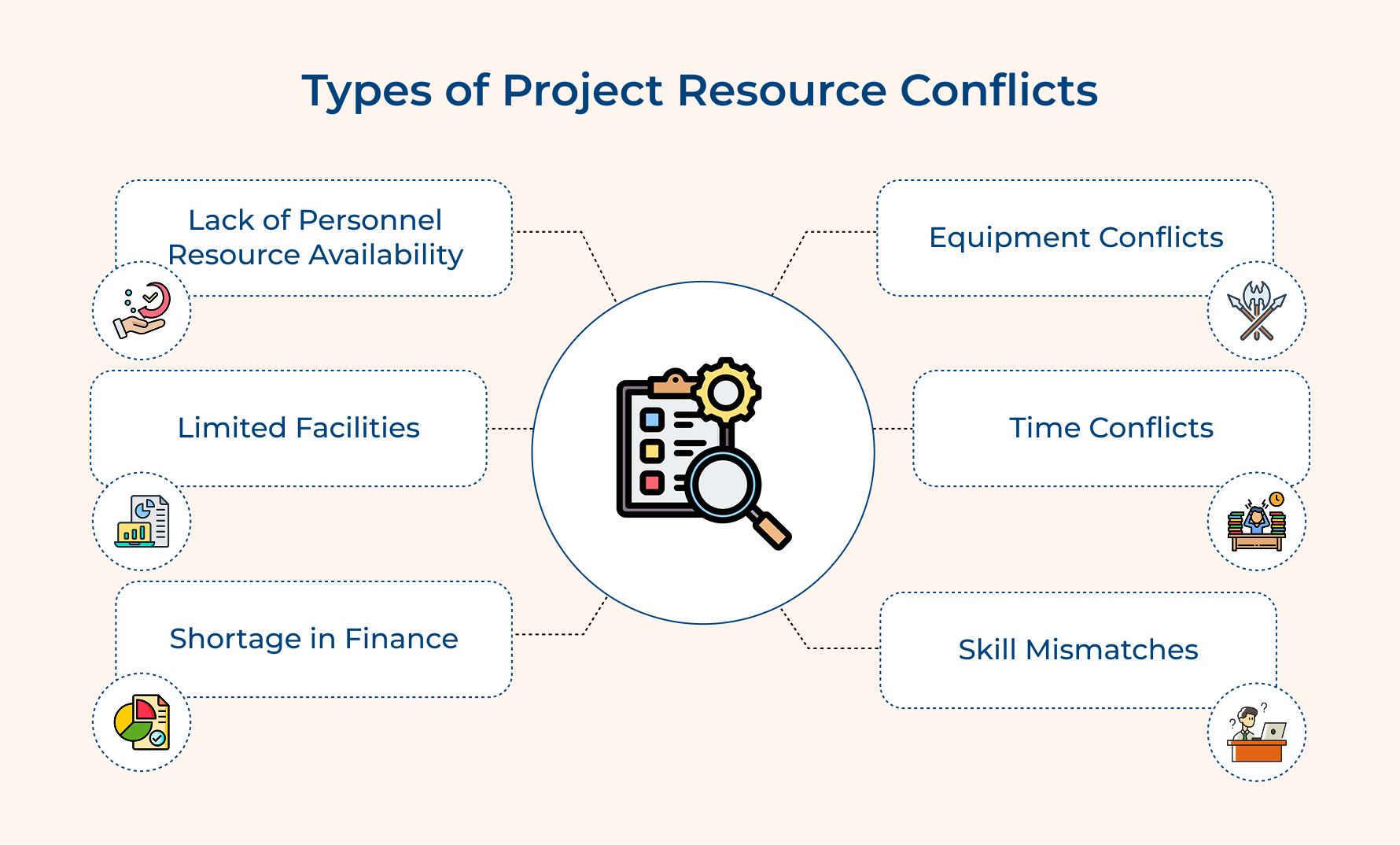
Lack of Personnel Resource Availability
This is one of the most common pain points. Your best people are spread across too many projects and when you need a developer or specialist, everyone’s booked for weeks. Without a clear view from a resource management tool, these clashes stay hidden until work slows or completely stalls.
Limited Facilities
Shared spaces like labs, conference rooms, or production floors can quickly turn into scheduling headaches. One team’s testing window overlaps with another team’s demo and suddenly timelines slip. This is where strong coordination across cross-functional teams becomes critical to avoid unnecessary friction.
Shortage in Finance
Budget limitations force tough decisions. Funding one project often means putting another on hold. When finances dry up faster than planned, projects lose momentum midway, impacting delivery and even downstream areas like customer care if priorities aren’t aligned.
Equipment Conflicts
Specialized tools and technology are rarely abundant. When multiple teams rely on the same equipment, bottlenecks form – especially during critical phases. A good resource management tool helps forecast demand so these conflicts don’t catch you off guard.
Time Conflicts
Overlapping deadlines create impossible expectations. Sprint cycles collide and team members are pulled in different directions. Clear planning and better collaboration between cross-functional teams help balance workloads before timelines become unrealistic.
Skill Mismatches
Sometimes you have people available, but not the right skills. Critical tasks slow down because expertise is missing and training or hiring takes time. These gaps don’t just affect delivery; they can also impact customer care when quality or responsiveness drops.
Causes and Triggers of Project Resource Conflicts
Resource conflicts don’t appear randomly. They stem from specific organizational problems and management gaps that create recurring allocation issues across projects.
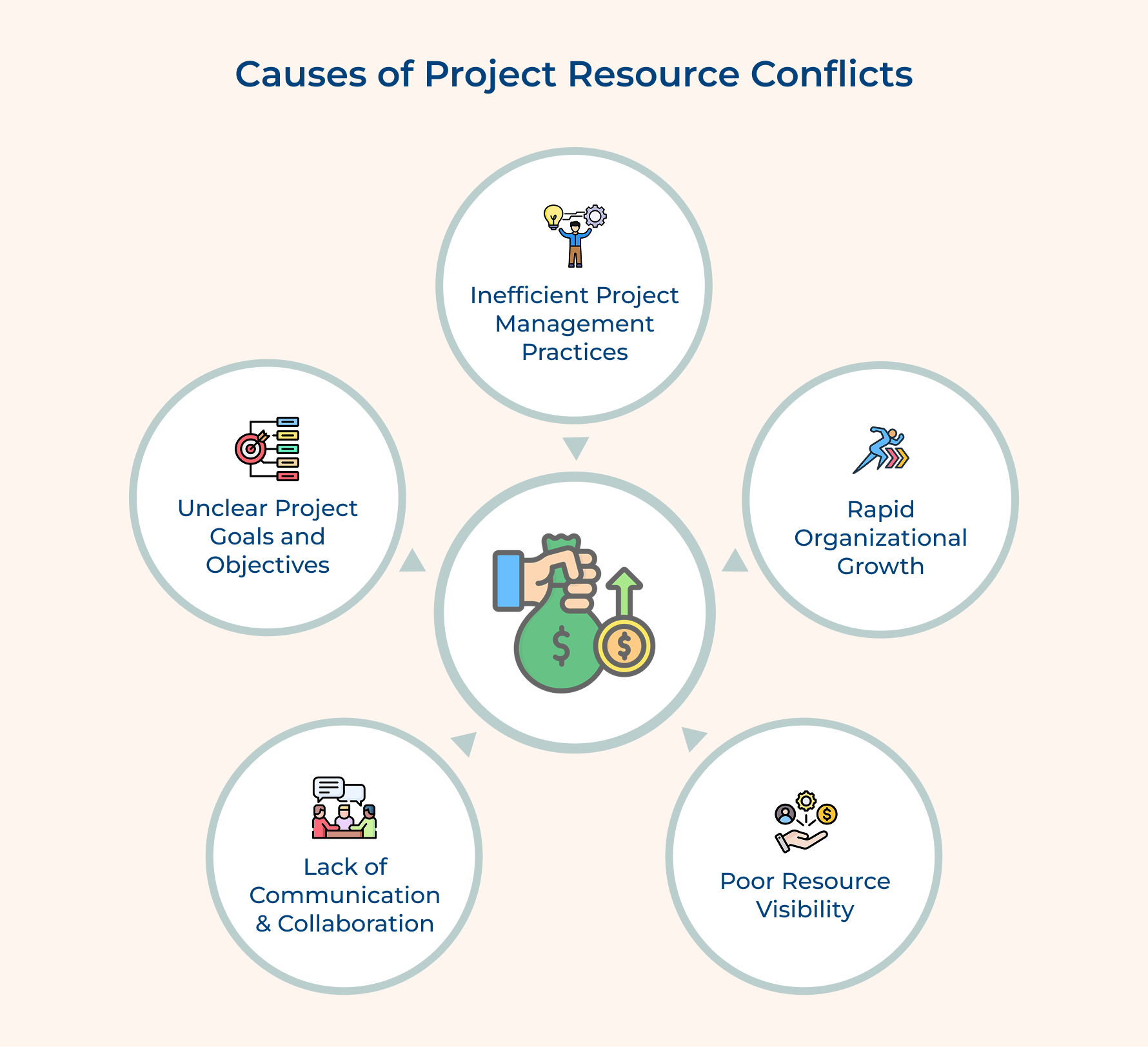
Lack of Communication and Collaboration
Teams working in silos don’t share information about their resource needs or availability schedules. Project managers remain unaware of conflicting demands until collisions happen. Nobody knows what others have already claimed.
Poor communication means last-minute surprises when resources suddenly become unavailable. Stakeholders fail to coordinate timelines or discuss shared dependencies. The left hand doesn’t know what the right hand is doing.
Unclear Project Goals and Objectives
Vague objectives make it impossible to determine which projects deserve priority when conflicts arise. Leadership can’t decide resource allocation without clear strategic direction. Everyone thinks their project matters most.
Otherwise, project scope keeps expanding and consuming more resources than originally planned. Teams request additional support because success metrics remain fuzzy. Resource planning becomes guesswork instead of strategic decision-making.
Inefficient Project Management Practices
Weak planning methods fail to account for resource constraints before projects launch. Managers skip capacity planning and overcommit their teams. Nobody tracks actual availability versus planned allocation accurately.
Outdated tools and manual processes hide resource conflicts until they become crises. Project schedules don’t reflect real-world dependencies or limitations. Reactive management replaces proactive resource optimization completely.
Rapid Organizational Growth
Expanding too quickly means project volume outpaces resource acquisition and development efforts. New projects pile up faster than hiring brings people onboard. Infrastructure and systems can’t scale at growth speed.
Companies take on more work to capitalize on opportunities without building adequate support structures. Existing resources get stretched thinner across more initiatives. Growth creates chaos instead of sustainable expansion.
Poor Resource Visibility
Centralized tracking systems don’t exist so managers can’t see organization-wide resource allocation patterns. Each department maintains separate schedules that never sync up. Data stays fragmented across multiple disconnected tools.
Lack of visibility leads to constant double-booking because teams don’t know current commitments. Resource utilization remains a mystery shrouded in spreadsheets. Decision-makers lack the information needed for smart allocation choices.
How To Avoid Project Resource Conflicts In Project Management: 7 Best Practices
Here are seven best practices that will help you avoid project resource conflicts and streamline your project management efforts.
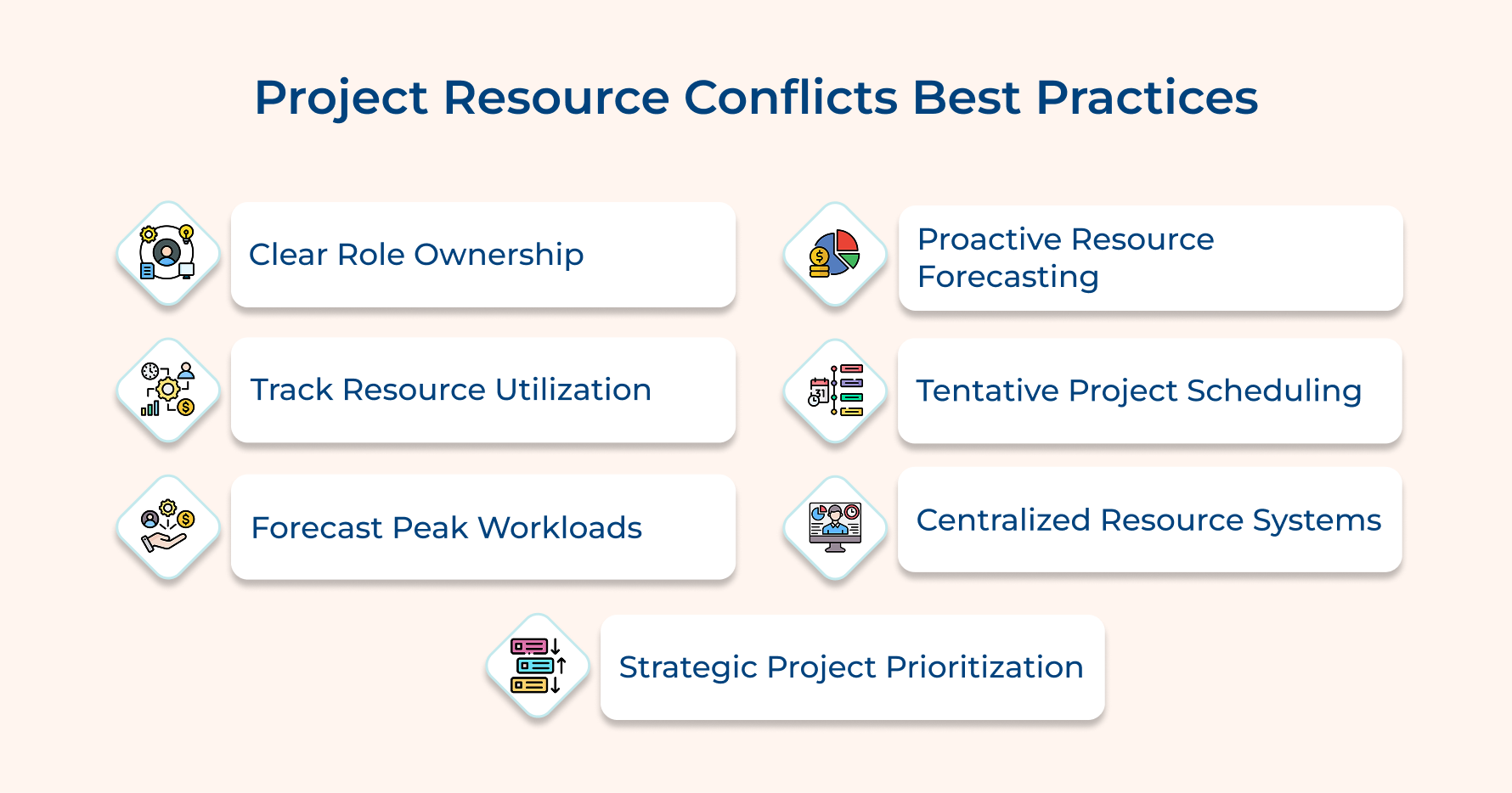
1. Assign Clear Roles and Responsibilities
Role clarity prevents multiple managers from claiming the same resources simultaneously. Clear accountability eliminates confusion about who can authorize resource allocation decisions. The foundation keeps conflicts from emerging in the first place.
Use cases of how assigning clear roles helps:
- Prevents duplicate assignments: Team members know exactly which project manager has authority over their time.
- Speeds up decision-making: Clear ownership means no waiting while multiple stakeholders debate who gets resources.
- Reduces scheduling chaos: Everyone understands who controls the calendar and can approve time commitments.
- Enables accountability tracking: When conflicts arise, you know exactly who made which allocation decisions.
How do you actually implement role clarity across multiple projects? Create a responsibility matrix that maps every team member to their primary project owner. Update it whenever assignments change and make it accessible to everyone. Hold a kickoff meeting where you explicitly state who has final say.
2. Regularly Monitor Resource Utilization Rates
Tracking utilization reveals when resources approach capacity limits before conflicts explode. Real-time visibility lets you intervene early and redistribute work proactively. Prevention beats firefighting every single time.
Key questions for resource utilization monitoring:
- Are team members consistently working beyond their planned capacity hours each week?
- Which resources are sitting idle while others are drowning in assignments?
- How accurate were our initial capacity estimates compared to actual consumption?
- What patterns emerge during specific project phases that predict future bottlenecks?
Pro tips:
- Set threshold alerts: Configure your system to notify you automatically when resources exceed 80% capacity.
- Review trends not snapshots: Look at utilization patterns over four weeks instead of single bad days.
3. Forecast Peak Activity and Stagger Workloads
Predicting when demand spikes lets you spread intensive work across calmer periods strategically. Poor forecasting causes projects to reach critical phases together, creating impossible resource crunches.
Effective ways to forecast and stagger workloads:
- Analyze historical project patterns: Review past projects to identify when resource demand typically peaks during each lifecycle phase.
- Map critical paths across projects: Identify which phases require the most specialized resources and cannot be delayed. Schedule non-critical activities from other projects during gaps when key resources have lighter loads.
- Create resource calendars with buffer zones: Block out high-demand periods on a master calendar and deliberately schedule less intensive work during those windows.
Your design team handles three product launches scheduled for the same quarter. By moving one launch to the following month, you prevent designers from creating assets for three campaigns simultaneously.
4. Implement Proactive Resource Forecasting Methods
Forecasting anticipates resource needs before projects start so you can plan allocation strategically. Proactive forecasting transforms resource management from chaotic to controlled and predictable.
Key factors for implementing resource forecasting:
- Historical utilization data: Past project consumption rates provide the baseline for predicting future requirements.
- Project pipeline visibility: Knowing which projects will launch soon helps you anticipate when demand will surge.
- Skill inventory tracking: Understanding who has which capabilities lets you forecast availability of specialized talent.
- Capacity constraints mapping: Identifying your organization’s maximum resource levels prevents unrealistic forecasting assumptions.
How do you actually build forecasts from these factors? Pull your historical data and calculate average resource consumption per project type. Apply those rates to your upcoming pipeline and compare against available capacity. The gap shows where conflicts will emerge.
5. Practice Tentative Project Scheduling Techniques
Flexible scheduling builds adaptability into your timelines so resource conflicts don’t derail entire projects. Rigid schedules break when reality changes but tentative planning absorbs disruptions gracefully.
Create Flexible Timelines With Contingency Plans
Build schedules that include backup options when primary resources become unavailable unexpectedly. Identify alternative team members who can step in or adjust task sequences if conflicts arise.
Schedule Non-Critical Tasks As Movable Placeholders
Mark lower-priority activities as flexible items that can shift when resource conflicts emerge suddenly. These movable tasks fill gaps when key resources have downtime between critical assignments.
Allow Breathing Room Between Major Milestones
Insert buffer time between significant deliverables so teams can recover and handle unexpected delays. The breathing room absorbs shocks and prevents one problem from destroying your entire timeline.
6. Establish Centralized Resource Management Systems
Centralized systems provide single-source visibility into who’s working on what across your entire organization. Shared tools enable coordination that prevents double-booking and enables smart allocation decisions.
Select tools that integrate with your existing platforms and update in real-time automatically. Choose software that your teams will actually use instead of overly complex solutions.
Use cases of resource management systems for centralization:
- Real-time allocation visibility: Project managers see instantly if a resource is already committed before making new assignments.
- Conflict detection alerts: The system automatically flags when someone gets double-booked across multiple project schedules.
- Cross-department coordination: Teams from different departments can view shared resources and coordinate their scheduling needs.
- Capacity planning dashboards: Leadership gets organization-wide views of resource utilization to make strategic allocation decisions.
Train all project managers on the system and make resource entry mandatory for every project. Without consistent data input, your centralized system becomes useless.
7. Prioritize projects using strategic framework’s
Strategic prioritization ensures resources go to initiatives that deliver the most organizational value first. Frameworks create objective criteria that make allocation decisions transparent and defensible.
Score each project against defined criteria like revenue impact and strategic alignment before allocating resources. Communicate these scores to all stakeholders so everyone understands why certain projects receive priority.
Pro tips:
- Assign different importance levels to various criteria so strategic fit matters more than urgency.
- Post current project rankings where everyone can see them to prevent constant re-litigation of decisions.
5 Strategies for Resource Conflict Resolution in Project Management
Even with careful planning, resource conflicts still happen when demand suddenly spikes or unexpected issues arise. These resolution strategies help you navigate conflicts effectively and keep projects moving forward.
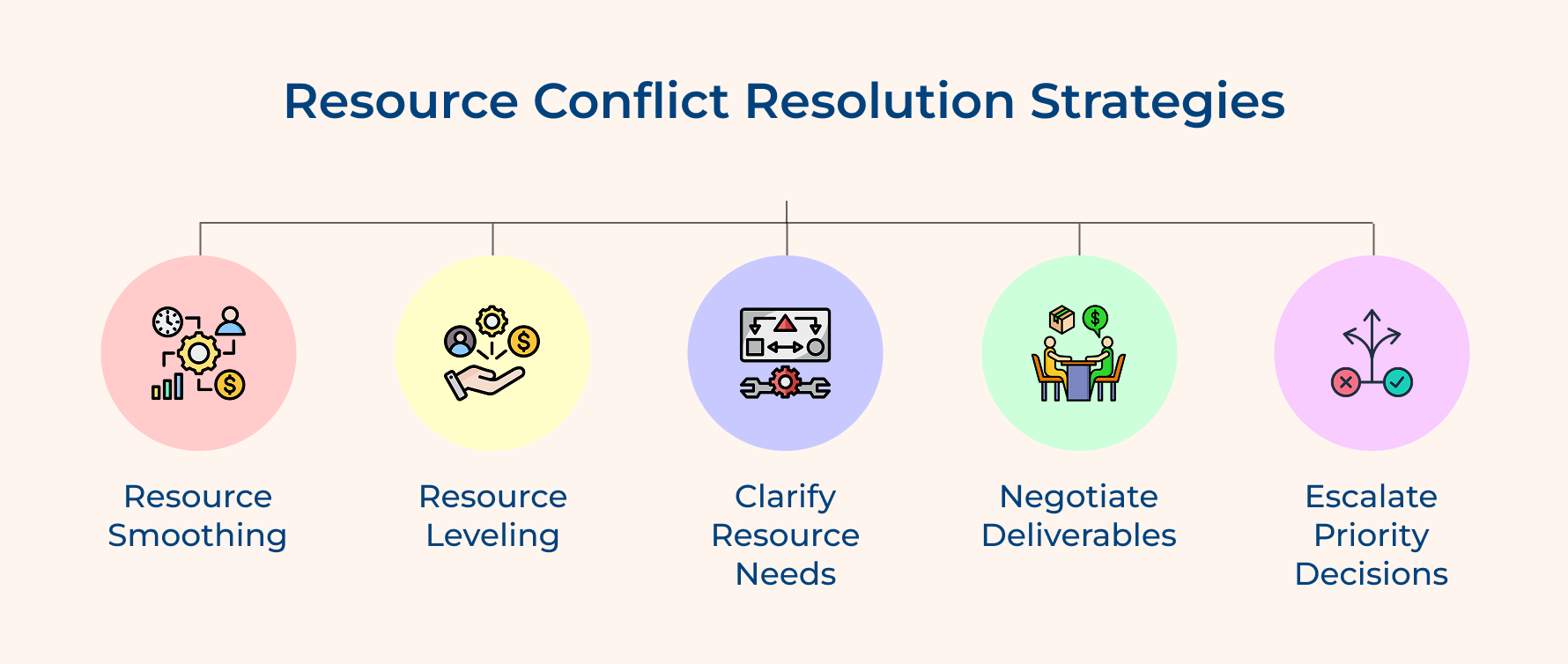
Resource Smoothing
Think of resource smoothing as fine-tuning your schedule rather than changing it. You keep deadlines and the critical path intact, but shift non-critical work into quieter periods so people aren’t overloaded.
How resource smoothing works:
- Move tasks that have slack into time slots where workloads are lighter
- Leave critical path activities exactly as planned
- Balance demand so teams stay productive, not overwhelmed
This approach relies on understanding how much flexibility actually exists. You review the project network, spot tasks that can slide earlier or later and smooth out resource spikes using a calm, proactive conflict management style.
Resource Leveling
Resource leveling steps in when smoothing simply isn’t enough. Here, timelines change intentionally to match real-world capacity and availability.
Use resource leveling when:
- The original schedule cannot realistically be executed
- Team health and work quality matter more than aggressive deadlines
- Stakeholders agree that burnout is a bigger risk than delays
Leveling means honest conversations. You reset expectations, focus on the most critical work and push lower-priority activities out. This often requires leadership alignment across the wider portfolio management view.
Outline Resource Needs and Purpose Clearly
Clear documentation removes emotion from resource conflicts. When everyone understands what is needed and why, decisions become far easier.
What effective resource documentation includes:
- Required skills and experience levels
- Timing and duration of each resource need
- Business impact if resources are unavailable
Link these needs directly to business value. This shifts discussions from opinion-based debates to objective, fair decision-making.
Negotiate and Compromise on Deliverables
Sometimes the fastest way to resolve conflicts is adjusting scope rather than fighting for more resources.
Practical negotiation approaches:
- Define minimum viable deliverables
- Suggest phased releases to spread resource demand
- Offer clear trade-offs between features, quality and timelines
Start by understanding what stakeholders truly need versus what they would like ideally. Position compromises as strategic choices, not project failures.
Escalate to Leadership For Priority Calls
Some conflicts need executive direction. Leadership has the authority to set priorities when trade-offs become unavoidable.
Prepare for escalation by:
- Presenting clear data on resource gaps and project impact
- Offering realistic options with pros and cons
- Asking for explicit priority decisions, not vague support
Approach escalation as a request for guidance. A structured, data-driven conflict management style helps leaders act quickly and decisively.
Turn Resource Chaos Into Clarity with Project Resource Conflicts
Project resource conflicts don’t have to derail your work or burn out your teams constantly. Smart planning prevents most conflicts while proven resolution strategies handle the rest effectively. The key is staying proactive rather than reactive when managing your limited resources.
Start by implementing clear roles and centralized tracking across all your projects today. Monitor utilization regularly and forecast demand before conflicts emerge unexpectedly. When conflicts do happen, use smoothing as well as leveling techniques strategically. These practices transform resource management from constant firefighting into controlled and predictable operations.
Limit time — not creativity
Everything you need for customer support, marketing & sales.

Neeti Singh is a passionate content writer at Kooper, where he transforms complex concepts into clear, engaging and actionable content. With a keen eye for detail and a love for technology, Tushar Joshi crafts blog posts, guides and articles that help readers navigate the fast-evolving world of software solutions.