What Is a Cost Breakdown Structure? Definition & Benefits
- What is Project Management Cost Breakdown Structure (CBS)?
- What is the Cost Breakdown Analysis (CBA)?
- Why is Cost Breakdown Structure Important in Project Management?
- Key Components of the Cost Breakdown Structure
- How to Make a Cost Breakdown Structure? 7 steps
- Cost Breakdown Structure Vs Work Breakdown Structure
- Practical Cost Breakdown Structure Examples
- Unlock Clarity in your Project Budget with Cost Breakdown Structure
- FAQs about Cost Breakdown Structure
Key Highlights:
- Clear cost breakdown structure helps organize expenses, improve project cost management and maintain accurate budget control across every project phase.
- Practical cost breakdown structure examples show how teams track equipment costs, labor, overheads and contingencies with better financial clarity.
- Step-by-step cost breakdown analysis supports smarter resource allocation, reliable cost forecasting and early identification of budget risks.
Budget overruns can derail even the most carefully planned projects. You start with confident estimates but costs spiral out of control without warning. Tracking expenses becomes a frustrating guessing game that nobody wins.
The real problem is scattered financial data with no logical organization. Scattered costs across spreadsheets and departments make it hard to see where the money actually goes. Small overages compound into major budget disasters.
A Cost breakdown structure solves this by organizing every expense into clear categories. This guide shows you exactly how to build one that keeps your project finances visible and controlled.
What is Project Management Cost Breakdown Structure (CBS)?
A Cost Breakdown Structure is a hierarchical framework that decomposes and organizes all project costs into logical categories as well as subcategories by work packages. It essentially takes your total project budget and breaks it into smaller manageable pieces. This structure lets you track spending at every level and understand exactly where your money is flowing.
The CBS begins with your complete project budget sitting at the top level. You then divide that budget into major cost categories like labor and materials. Each category splits further into work packages and specific activities tied to your project scope.
Key objectives:
- Detailed cost visibility: Reveals exactly where your project money flows across all departments and activities.
- Budget control: Establishes clear cost targets that teams can monitor and manage during execution.
- Resource allocation: Helps distribute funds to different project areas based on what you actually need.
- Risk identification: Exposes major cost drivers and budget shortfalls before they become real problems.
What is the Cost Breakdown Analysis (CBA)?
Cost Breakdown Analysis examines project expenses by category to identify spending patterns and actual costs versus planned budgets. It takes all your project costs as well as organizes them systematically. This gives you clear visibility into your financial health and where money really goes.
Think of it as your financial microscope that examines every dollar your project spends across different activities and departments. You break down costs by category and see which areas consume the most budget while where money actually flows.
Comparing what you planned versus what actually happened helps you spot trends as well as catch spending problems before they grow. This analysis lets your team make smarter decisions about resource allocation and budget adjustments when needed.
Key metrics Included for cost breakdown analysis:
- Cost variance: The difference between your budgeted amount and what you actually spent on the project.
- Cost performance index: A ratio showing how efficiently you’re using your budget relative to work completed.
- Budget utilization rate: The percentage of your total project budget that has been consumed so far.
- Cost per work package: The actual expense assigned to each specific project activity or deliverable category.
- Actual vs planned cost ratio: A comparison that shows how your spending aligns with original cost projections.
Why is Cost Breakdown Structure Important in Project Management?
A Cost Breakdown Structure isn’t just about organizing numbers – it’s your financial roadmap that keeps projects on track and stakeholders confident in your management. Understanding its importance helps you avoid costly mistakes while staying in control.
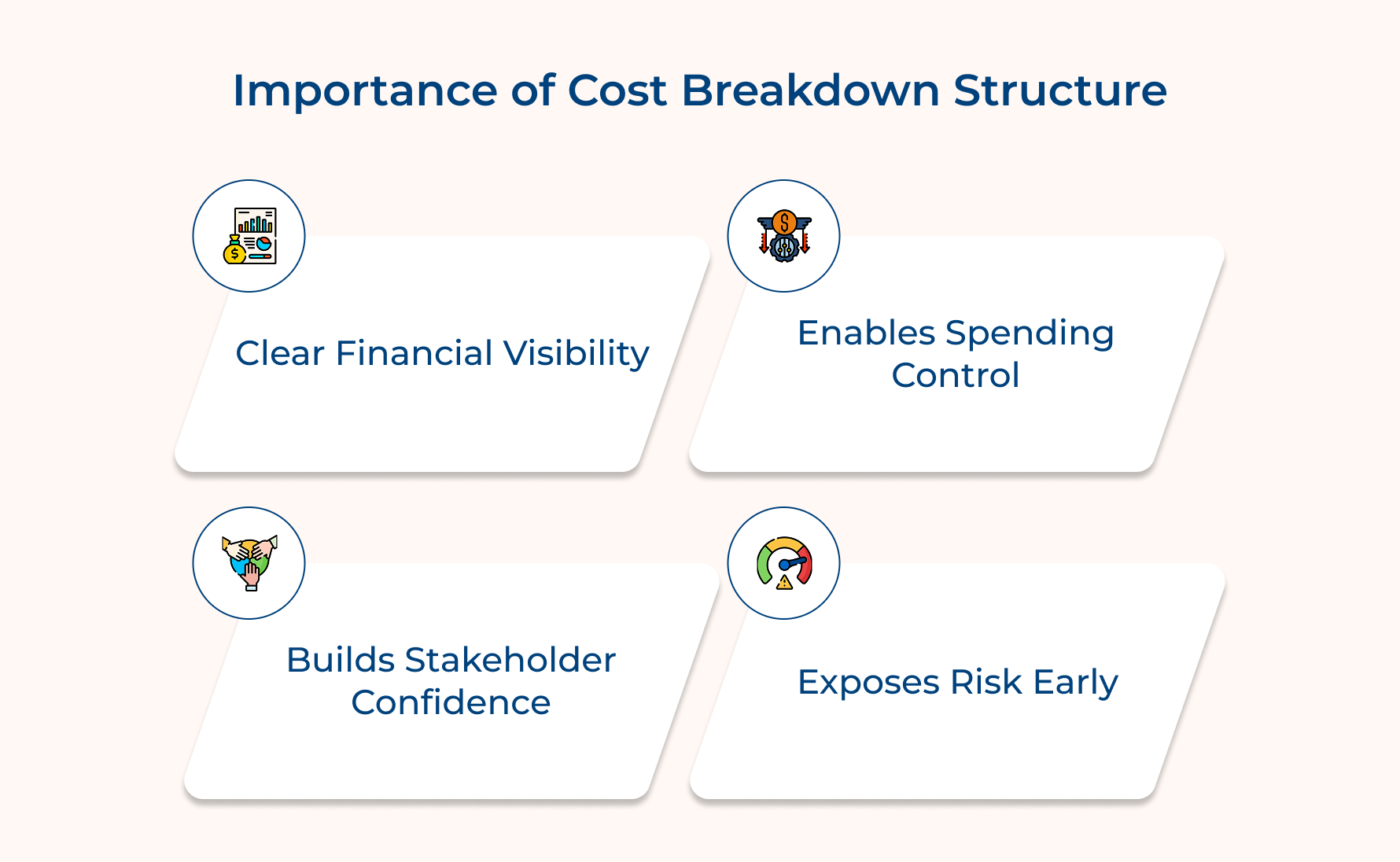
Clear Financial Visibility
What is essential for success? Knowing exactly where project money goes which eventually supports smarter decisions throughout execution. Clear visibility shows which activities consume the most budget and where attention is needed, including high equipment costs.
Enables Spending Control
CBS strengthens project cost management by tracking expenses at every level, helping teams spot issues early. Early insight prevents surprise overruns and allows timely adjustments before problems escalate.
Builds Stakeholder Confidence
Stakeholders value transparency and CBS delivers detailed breakdowns that support reliable cost analysis. Clear numbers build trust in financial planning and reassure everyone that project finances are under control.
Exposes Risk Early
Cost-heavy activities and departments stand out quickly, making risks easier to manage. Early visibility creates room to plan mitigation strategies and resolve issues before they affect delivery.
Key Components of the Cost Breakdown Structure
A Cost Breakdown Structure splits all project expenses into five distinct components that together create your complete financial picture.
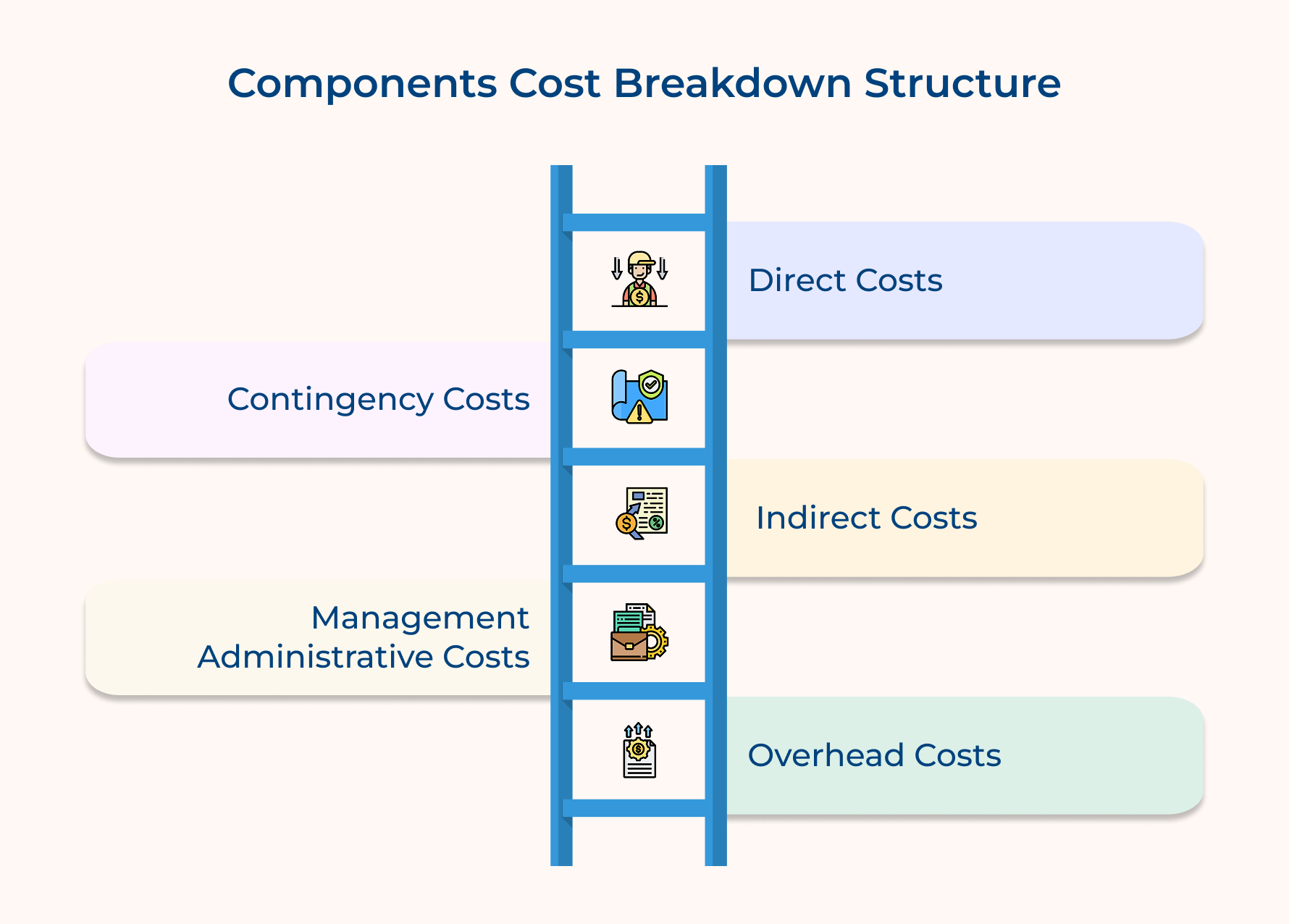
1. Direct Costs
Direct costs are the expenses that make your project possible. If these aren’t funded, the work simply doesn’t get done. They sit at the core of project cost management because they directly impact what you deliver.
Common direct cost categories include:
- Labor hours for team members working on specific tasks
- Raw materials, tools and equipment costs needed to produce deliverables
- Third-party vendors, consultants, or specialized contractors
These costs usually form the largest part of your Cost Breakdown Structure (CBS). That’s why accurate cost analysis is critical. Even small estimation errors here can ripple through your entire budget and hurt profitability.
2. Indirect Costs
Indirect costs support project execution but don’t directly produce deliverables. They’re less visible, harder to track and often underestimated during planning.
Typical indirect costs include:
- Quality assurance and testing resources
- PMO, coordination and administrative support
- Utilities, shared facilities and common infrastructure usage
While they may seem minor individually, indirect costs add up over time. Ignoring them creates gaps in project cost management and leads to inaccurate financial forecasting.
3. Overhead Costs
Overhead costs keep your organization running and are shared across all projects. They’re not tied to a single initiative, but every project carries a portion of them.
Examples include:
- Office rent, maintenance and shared facilities
- HR, finance and accounting teams
- Insurance, compliance and legal expenses
These costs are usually allocated as a percentage of labor or total budget. Including them gives you a realistic view during cost analysis and prevents overstated profit margins.
4. Contingency Costs
Contingency costs are your financial buffer for the unexpected. No matter how detailed your plan is, surprises happen.
Contingency typically covers:
- Unidentified risks that emerge mid-project
- Approved scope changes or client requests
- Schedule delays that increase labor or equipment costs
Most teams calculate contingency as a percentage of the overall budget based on risk level. Strong project cost management always includes contingency because uncertainty is part of delivery.
5. Management & Administrative Costs
Management and administrative costs fund the leadership as well as coordination that keep the project on track. Without them, execution quickly becomes chaotic.
They usually include:
- Project managers and delivery leads
- Reporting, documentation and stakeholder communication
- Governance and coordination activities
While these expenses don’t create deliverables directly, they protect timelines, budgets and outcomes. Reasonable management costs are essential for effective project cost management and long-term project success.
How to Make a Cost Breakdown Structure? 7 steps
Here are seven essential steps to build a comprehensive and accurate CBS, ensuring your project stays on budget as well as on track.
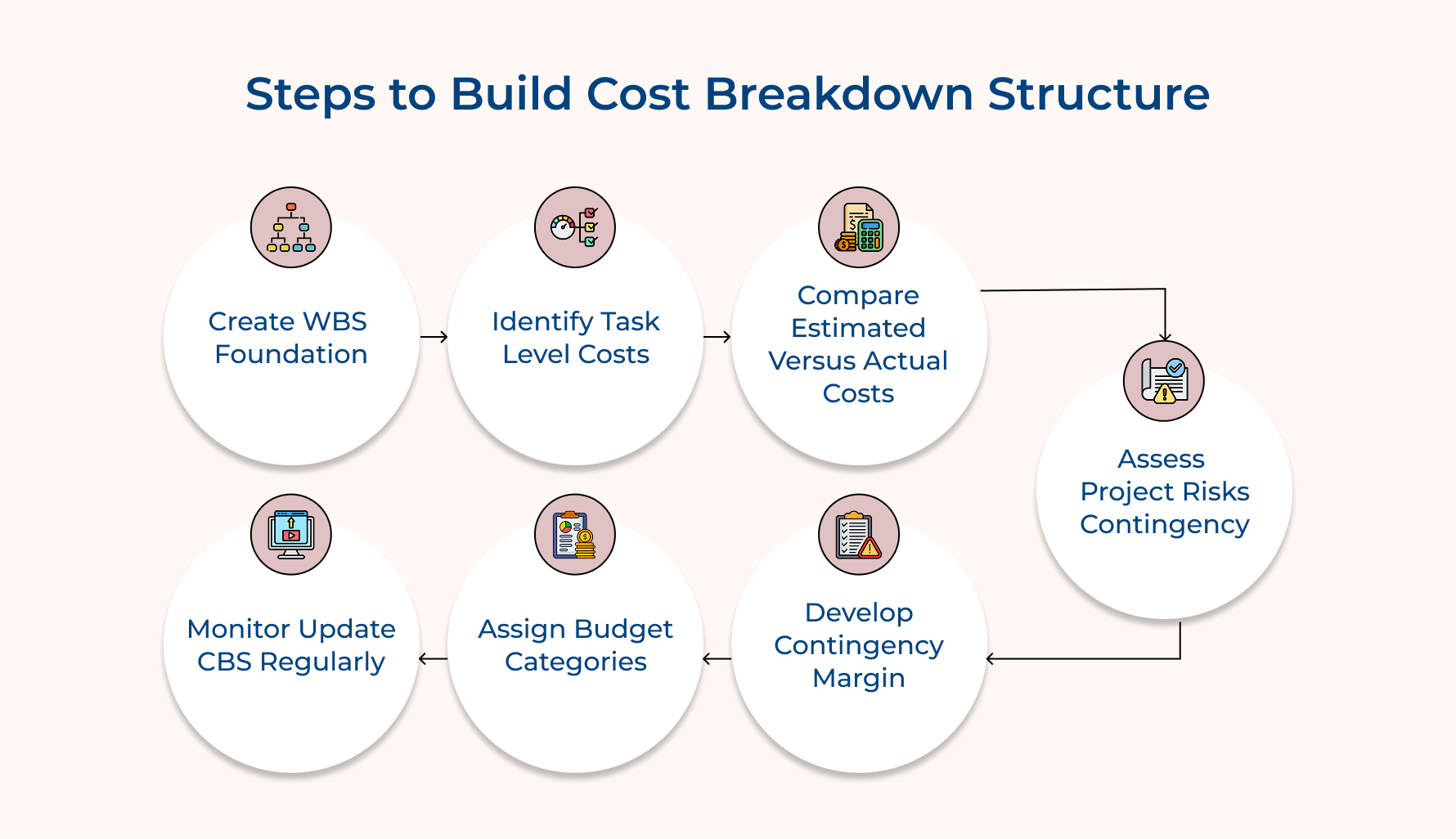
1. Create a Work Breakdown Structure (WBS) Foundation
A Work Breakdown Structure forms the foundation for your Cost Breakdown Structure by organizing all project work systematically. Without a solid WBS your CBS becomes difficult to track accurately.
Key considerations for work breakdown structure: Your WBS must capture all project deliverables comprehensively so nothing gets missed during cost estimation. It should be detailed enough for accurate costing but simple enough for teams to understand their responsibilities.
Ideal WBS Examples for Service-Based Organizations
- Software development services: Project divided into discovery and design, development, testing as well as deployment.
- Consulting services: Project broken into research, strategy development, implementation and training phases.
- Digital marketing services: Project split into strategy, content creation, campaign launch and analytics.
- Graphic design services: Project organized into concept development and design iterations, client reviews as well as delivery
How to start building a WBS for your project? List your main deliverable at the top. Break it into major phases and then into smaller work packages your team can estimate. Keep dividing until each package represents one to two weeks of work.
2. Identify Costs for Each Project Task
Identify costs for each task to transform your WBS into a financial roadmap showing where money flows. This step bridges project scope and actual budget allocation for tracking.
Key Questions to Guide Your Cost Identification
- What labor hours and skill levels are required for each work package?
- What materials and equipment does each task need?
- Are external vendors or contractors needed for specific activities?
- What overhead and indirect costs apply to each package?
- What contingency percentage should be added for uncertainties?
These questions ensure you think critically about every project aspect so nothing gets overlooked. Answering them thoroughly builds a comprehensive cost picture for tracking and controlling spending.
Start implementing based on these questions by gathering your team members and ask them these questions directly about the actual work. Document their estimates in a spreadsheet linking each cost to specific work packages. Have someone review all estimates for accuracy before finalizing.
3. Compare Estimated vs. Actual Costs
Compare estimated versus actual costs to see how your original budget predictions matched reality. This comparison reveals spending patterns and helps you make smarter budget decisions.
Five key factors to compare
- Labor costs: Compare hours worked against budgeted hours for each team member and activity. Examine wage rates, overtime and productivity variations that caused differences.
- Material and equipment expenses: Review actual purchases against original estimates carefully. Identify price changes, quantity variations and supplier differences.
- Subcontractor and vendor fees: Examine actual payments against contracted rates and agreed scope. Look for change orders and additional services that affect your budget.
- Indirect and overhead costs: Compare allocated costs against budgeted percentages fairly. Analyze if overhead was higher due to project duration or resource intensity.
- Contingency usage: Review how much contingency was actually used and what risks materialized. Document which unexpected costs were covered versus estimation errors.
Based on the comparison, document your findings and share them with stakeholders so everyone understands cost performance. Use this analysis to improve future estimates and prevent similar overruns.
4. Assess Project Risks and Contingency
Assessing project risks involves identifying potential cost problems before they occur and planning financially for them. Skipping this step leaves your project vulnerable to budget surprises that damage stakeholder confidence.
Three Effective Ways to Assess Risks and Contingencies:
- Qualitative risk assessment: Gather your team and rate them by probability as well as impact. Focus contingency funds on the most likely and damaging risks.
- Quantitative risk analysis: Use historical data and industry benchmarks to calculate statistical probabilities as well as impacts. Apply mathematical modeling to determine realistic contingency percentages.
- Expert judgment and lessons learned: Consult experienced team members and review documentation from similar past projects. Factor real experiences into your contingency planning.
For example a software company building a custom e-commerce platform identifies risks like changing requirements and integration challenges. They estimate a 15 percent contingency reserve based on similar project history. This allows them to handle unexpected work without exceeding budget.
5. Develop a Contingency Margin for Uncertainties
Develop a contingency margin to set aside financial reserves for unexpected costs and risks that emerge during execution. This step protects your project from budget crisis when surprises inevitably happen and keeps stakeholders confident.
Your contingency margin acts as a financial buffer that absorbs unexpected expenses without derailing the overall budget. You can draw from it when risks materialize and when scope changes occur unexpectedly during project delivery phases.
Pro Tips:
- Calculate contingency as a percentage of total project cost and allocate it separately so you can track while controlling its usage.
- Document every contingency usage with clear justification and approval so stakeholders understand why reserves were needed.
6. Assign Budget to Cost Categories
Assign a budget to cost categories that helps distribute your total project funds across different expense types systematically. This step is critical because it creates clear spending targets and accountability for each category.
Distribute Total Budget Across All Categories
Breaking your total budget into specific categories ensures funds align with actual work and resource needs appropriately. Each category gets allocated money based on what you estimated during cost identification and planning phases.
Set Spending Limits Per Work Package
Setting spending limits for each work package gives teams clear boundaries and prevents overspending on individual tasks. Team members know exactly how much they can spend on their assigned work packages.
Link Budget Responsibility to Accountable Owners
Assigning budget responsibility to specific team members creates accountability and ensures someone monitors spending carefully. Each owner takes ownership of their budget and makes decisions about resource allocation within their scope.
7. Monitor and Update CBS Regularly
Monitoring and updating CBS regularly means reviewing your costs continuously while adjusting your breakdown as project circumstances change. This step keeps your CBS accurate and relevant throughout the entire project lifecycle.
Your team tracks actual spending against budgeted amounts, documents variances and identifies trends that emerge over time. You then adjust your CBS based on new information and lessons learned so it stays current.
Key Metrics for Monitoring CBS Regularly. Keep a close eye on these metrics as you monitor your CBS throughout the project:
- Cost Variance (CV)
- Cost Performance Index (CPI)
- Budget Utilization Rate (BUR)
- Actual vs Planned Cost Ratio (APCR)
These metrics provide visibility into your financial performance and show if you’re spending within budget or exceeding it. They alert you early when costs drift from plan so you can make corrections before problems escalate.
How to Update and Improve CBS Based on Metrics? Review your metrics weekly or biweekly, depending on project pace. When metrics show variance or problems update your CBS estimates and reallocate budget where needed. If certain categories consistently overspend, increase their allocations for future projects. Share metric results with your team so they understand spending trends and adjust their behavior.
Cost Breakdown Structure Vs Work Breakdown Structure
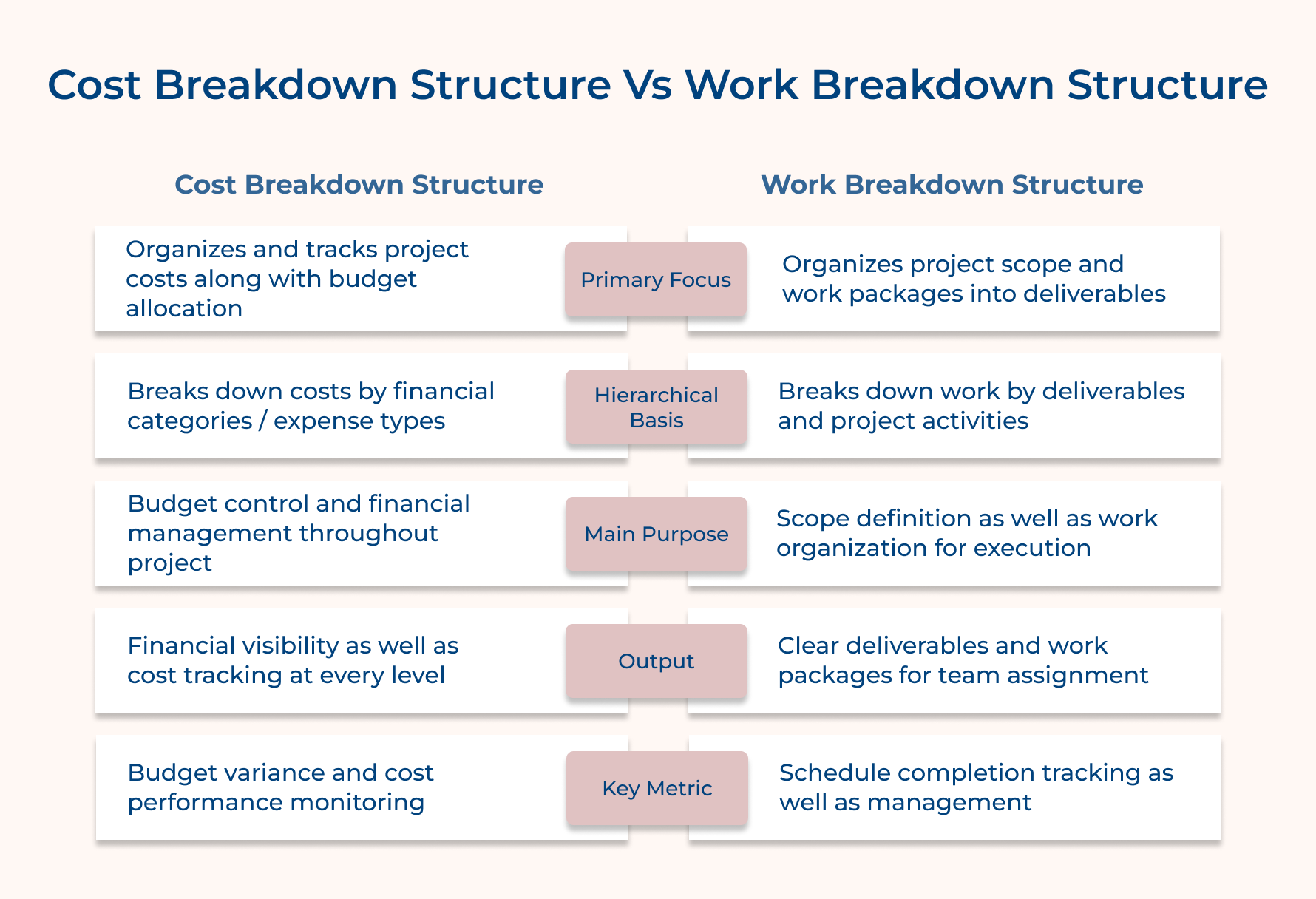
While both CBS and WBS are hierarchical frameworks that organize projects differently, they serve distinct purposes in project management. Understanding their differences helps you use each tool effectively for its specific purpose.
1. Primary Focus and Purpose
A Cost Breakdown Structure (CBS) is all about money. It helps you organize project finances and clearly see where your budget is going. CBS helps you control spending, track costs and make smarter financial decisions.
A Work Breakdown Structure (WBS) focuses on the work itself. It breaks the project scope into clear deliverables and tasks so teams know exactly what needs to be done and who’s responsible.
2. Hierarchical Organization Method
CBS is structured around cost categories such as labor, materials and equipment. As you move down the hierarchy, costs are broken into smaller, trackable pieces that simplify cost forecasting.
WBS is structured around deliverables and outcomes. Each level breaks work into smaller tasks that can be scheduled, assigned and tracked—often visually mapped later in a Gantt chart.
3. Primary Function in Projects
CBS supports financial control. It helps project managers monitor spending, avoid overruns and understand budget performance throughout execution.
WBS supports planning and execution. It defines scope clearly, prevents missed work and ensures teams stay aligned on what’s being delivered.
4. Information Provided
CBS gives you financial insight, including allocated budgets, actual costs and variances. This makes it easier to spot issues early and take corrective action.
WBS provides structural clarity. It shows how tasks relate to each other, who owns them and how individual activities roll up into final deliverables.
5. Integration with Project Management
CBS integrates closely with financial tracking and earned value systems, helping you evaluate cost efficiency throughout the project lifecycle.
WBS integrates with scheduling, resource planning and risk management processes. It lays the groundwork for realistic timelines, balanced workloads and early risk identification.
Practical Cost Breakdown Structure Examples
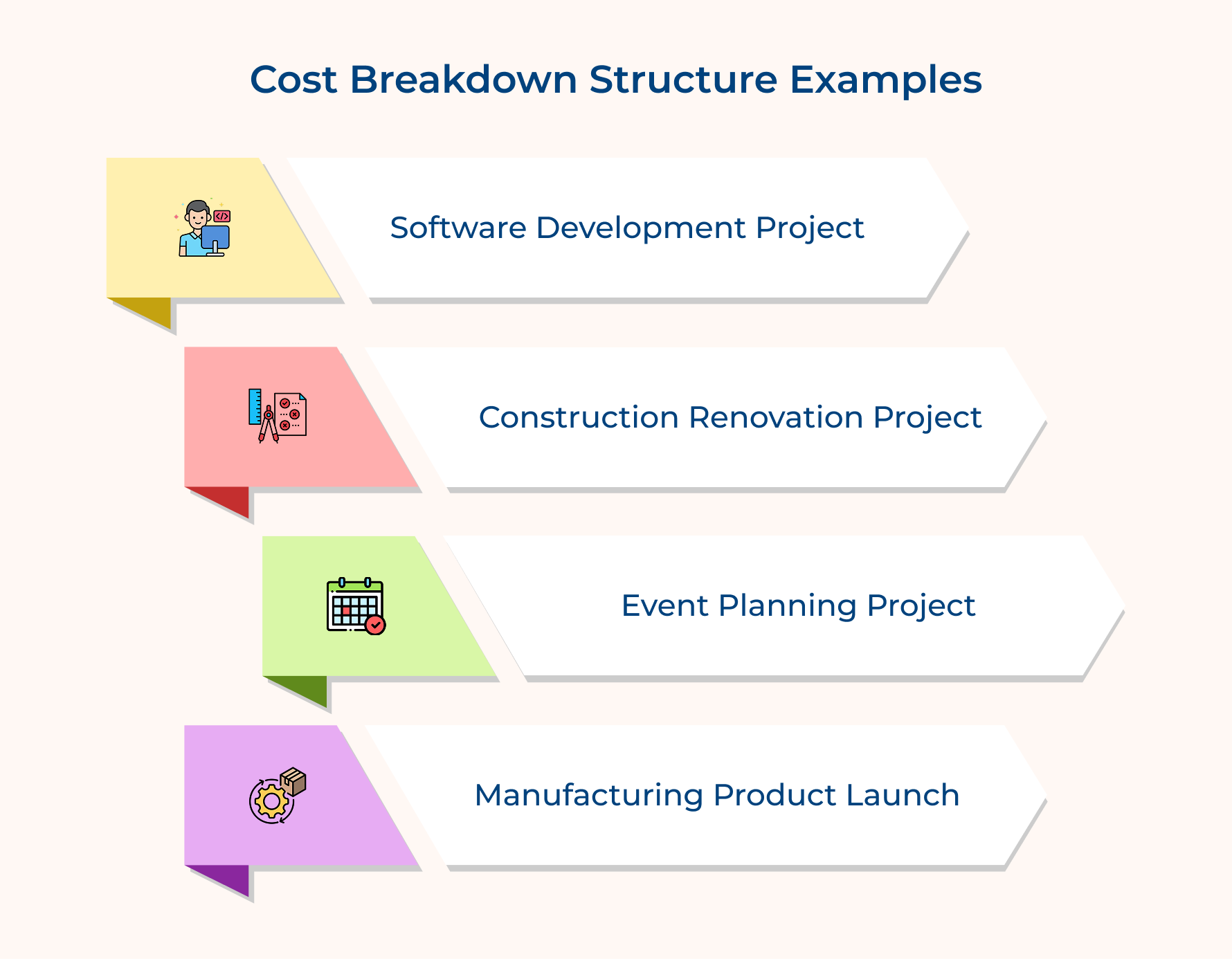
A Cost Breakdown Structure helps you organize project expenses into logical categories so you can track spending and maintain budget control throughout your project lifecycle.
1. Software Development Project
This CBS divides costs into development labor and infrastructure. You would include programmer salaries alongside server hosting fees. Testing and quality assurance get their own category while licensing costs sit separately for clear visibility.
2. Construction Renovation Project
A renovation CBS splits expenses across demolition and site preparation work. Material costs cover everything from lumber to fixtures and finishes. Labor gets broken into skilled trades like electrical and plumbing. Permits and inspections form another distinct cost bucket.
3. Event Planning Project
Event planners structure costs around venue rental and catering services. Entertainment and speaker fees occupy their own category for easy tracking. Marketing and promotional materials need separate allocation while staffing as well as coordination costs round out the structure.
4. Manufacturing Product Launch
This CBS organizes spending into raw materials and component sourcing costs. Production equipment and tooling investments get dedicated categories. Quality control testing sits alongside packaging expenses while distribution and logistics form the final cost grouping.
Unlock Clarity in your Project Budget with Cost Breakdown Structure
A Cost Breakdown Structure gives you complete visibility into where your money goes throughout any project. It transforms vague estimates into organized categories you can actually manage and control effectively.
When you break costs into logical groups, you spot potential overruns early and make smarter spending decisions. Your stakeholders gain confidence because they see exactly how funds are being allocated across every project phase.
Limit time — not creativity
Everything you need for customer support, marketing & sales.

Neeti Singh is a passionate content writer at Kooper, where he transforms complex concepts into clear, engaging and actionable content. With a keen eye for detail and a love for technology, Tushar Joshi crafts blog posts, guides and articles that help readers navigate the fast-evolving world of software solutions.