Capacity Requirements Planning (CRP): Process & Benefits
- What is Capacity Requirements Planning (CRP)?
- Why Is Capacity Requirements Planning Important?
- 7 Step Process of Capacity Requirements Planning
- Types of Capacity Requirement Planning
- Key Benefits of Capacity Requirements Planning in Organizations
- Challenges in Implementing Capacity Requirements Planning
- Examples of Capacity Requirements Planning
- Transform Data into Decisions with Efficient Capacity Requirements Planning
- FAQs about Capacity Requirements Planning

Key Highlights:
- Capacity requirements planning replaces guesswork with clear visibility into demand, resources and delivery feasibility.
- Teams avoid burnout and missed deadlines by balancing workloads through structured capacity planning processes.
- Capacity requirements planning CRP helps identify bottlenecks early and prevents last-minute hiring decisions.
Your team feels constantly stretched, yet new opportunities keep passing by because no one has a clear picture of available capacity.
Production demands change fast, resources are shared across projects and decisions are made without strong inventory control or visibility into market trends. This leads to missed deadlines, rushed hiring and burnt-out teams, while clients lose trust when commitments fall apart.
Capacity Requirements Planning helps you move from guesswork to clarity. It connects demand with available resources, balances workloads as well as supports smarter planning so you can respond to market trends, meet production demands while growing confidently without chaos.
What is Capacity Requirements Planning (CRP)?
Capacity Requirements Planning (CRP) is a systematic process that determines if your organization has enough resources—people, equipment and facilities—to meet project demands within planned timeframes. It compares the capacity you need against what you actually have available. This planning tool helps project managers identify bottlenecks before they become problems and make informed decisions about resource allocation.
The process starts by analyzing your project schedule to calculate exactly how much work needs doing and when. You then compare these requirements against your current resource availability to spot any gaps. When you find mismatches between demand and capacity, you can adjust either your schedule or your resources to bring things back into balance.
Key principles:
- Realistic assessment: Base your capacity calculations on actual historical performance data rather than optimistic assumptions about how fast work gets done.
- Forward visibility: Look ahead across multiple time periods to catch capacity problems early enough that you can actually do something about them.
- Load balancing: Distribute work evenly across your available resources to prevent some team members from burning out while others sit idle.
- Flexibility planning: Build in buffer capacity to handle unexpected changes or urgent requests without derailing your entire schedule.
Why Is Capacity Requirements Planning Important?
Service organizations face constant firefighting as projects compete for limited resources and deadlines slip, especially when there is no proper capacity planning. This foresight prevents costly bottlenecks and keeps client commitments on track.
Capacity Requirements Planning directly impacts your bottom line through improved delivery predictability and resource efficiency. Companies that master this discipline consistently outperform competitors in profitability and client satisfaction. The investment in proper capacity planning pays dividends across every aspect of service delivery.
7 Step Process of Capacity Requirements Planning
Let’s explore a 7-step process designed to streamline your planning efforts, ensuring you have the right resources in place at the right time to meet your production needs.
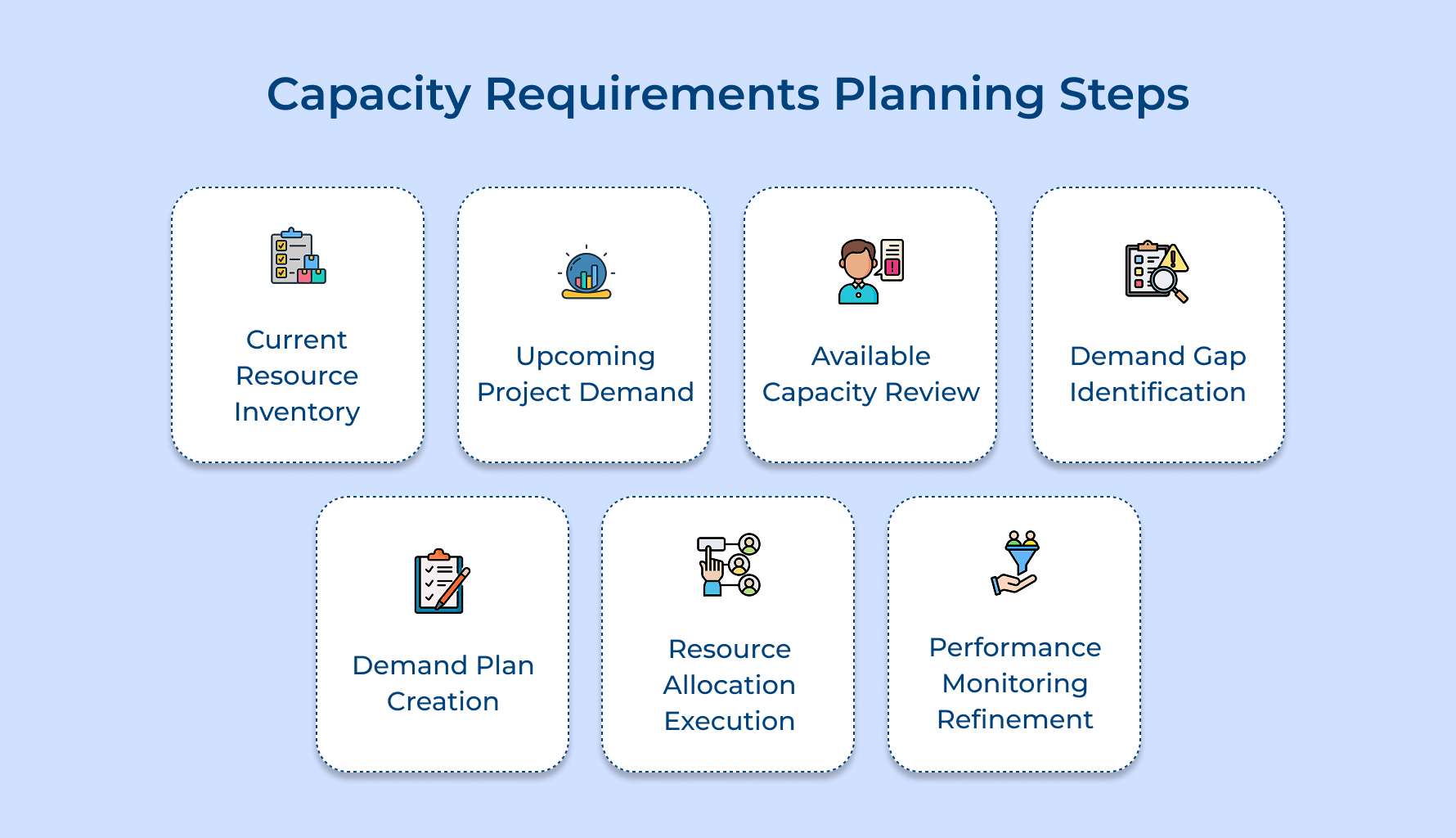
1. Analyze Current Resource Inventory
The first step is gaining a clear view of the resources you have available right now and how they’re currently being used. Capacity management turns into guesswork without this baseline. And when you’re guessing, it’s easy to overcommit as well as miss gaps until it’s too late.
Here’s how to build a practical resource inventory:
- List real skills, not just roles: Capture certifications, experience and proficiency levels – not just job titles.
- Track current allocations: See exactly which projects each person is working on and how much time they’re spending.
- Calculate true availability: Factor in meetings, admin work and internal tasks to get realistic productive hours.
- Spot skill dependencies: Identify skills owned by only one person versus those with backups.
- Note work preferences: Engagement matters, people do better work on projects they enjoy.
If skills and availability change often, treat this as a living document. Update it weekly. Strong capacity management depends on current, accurate data and not assumptions.
2. Forecast Upcoming Project Demand
Forecasting upcoming project demand turns your sales pipeline into clear, time-based capacity needs. Without it, teams scramble when multiple projects start at once and fight for the same resources.
Start by asking the right questions:
- Which projects are likely to move from proposal to delivery next quarter?
- What skills will be needed at each project stage?
- How many hours will each phase realistically require?
- When are clients expecting deliverables?
These questions replace guesswork with clarity. You move from hoping capacity works out to knowing exactly what’s needed and when.
Strong forecasting depends on close collaboration between sales and delivery teams. Include both confirmed projects and high-probability deals, weighted by their chance of closing. Using predictive analytics and advanced technologies makes this process far more accurate.
Improve forecast accuracy by:
- Looking at past data to estimate effort based on similar projects
- Planning by phases instead of treating projects as one big block
- Applying probability weighting to account for deal uncertainty
- Updating forecasts regularly as pipeline data changes
Done right, demand forecasting helps leaders make confident growth decisions without overloading the team.
3. Assess Available Resources and Capacity
The next step focuses on figuring out how much real, productive work your team can deliver—not the ideal hours listed on a spreadsheet.
Ignoring this reality leads to constant overcommitment because plans assume everyone delivers eight billable hours every day. In practice, sick leave, training, meetings and internal work always reduce availability.
Get accurate numbers by applying realistic productivity factors to your resource inventory. Look at how past projects were actually delivered instead of relying on assumptions.
For example, a consultant scheduled for 40 hours a week usually delivers only 28–32 billable hours once meetings and admin work are factored in. Planning with this level of honesty helps you commit with confidence and avoid burnout.
Pro tips:
- Track actual billable versus available hours for three months to establish your organization’s true capacity multiplier instead of guessing.
- Build separate capacity models for different seniority levels since junior staff typically need more support time while senior consultants spend more hours on business development.
4. Identify and Bridge Demand Gaps
See the real gap between what your projects demand and what your team can actually deliver. It’s where sales expectations meet delivery reality and where you see if commitments are realistic or risky. The gaps you uncover here guide every planning decision that follows.
Here’s what identifying demand gaps helps you do:
- Measure the shortfall clearly
Turn “we’re overloaded” into real numbers, like being short five developers in Q2. - Spot timing issues early
See exactly when bottlenecks will hit—next week, next month, or next quarter. - Uncover skill mismatches
Identify areas with excess capacity and others where shortages threaten delivery. - Focus on what matters most
Prioritize gaps that could derail deadlines or quality, not minor workload swings.
So what’s a real gap versus normal variation? A real gap puts committed timelines or quality at risk. Normal variation just means uneven workloads for short periods.
Identify gaps effectively:
- Overlay demand on capacity charts to spot mismatches fast
- Run scenarios for best- and worst-case pipeline outcomes
- Identify critical roles that create delivery bottlenecks
For example, if demand calls for 800 writing hours but only 500 are available, that 300-hour gap needs immediate action before deadlines slip.
5. Build Demand Plan to Address Gaps
The next stage turns your gap analysis into clear, practical actions that close the space between what your projects need and the capacity you actually have. Identifying problems alone isn’t enough—projects still fail if shortages aren’t addressed in time. A strong demand plan gives you a clear roadmap to make sure the right capacity is available exactly when it’s needed.
An effective demand plan balances speed, cost and quality. It helps you decide where quick fixes make sense to cover immediate gaps and where longer-term investments are needed to build sustainable capacity. Planning both short-term and long-term responses helps you protect delivery timelines while setting your team up for healthier growth tomorrow.
An effective demand plan addresses gaps through coordinated approaches:
- Hiring roadmap: Specify which full-time roles to recruit with target start dates aligned to when capacity shortfalls impact projects.
- Training schedule: Plan skill development programs that convert existing team members into the specialized resources your forecast shows you’ll need.
- Workload redistribution: Determine which lower-priority internal projects can be postponed to free capacity for critical client commitments.
Strong implementation requires assigning ownership for each plan element with specific deadlines and budget allocations. Your demand plan should include contingencies for scenarios like key hires taking longer than expected.
6. Execute Resource Allocation and Adjustments
The step here puts your capacity plan into action by making specific resource assignments to actual projects. Execution is where planning meets reality and you discover if your calculations work with real people and constraints. Even perfect planning fails without disciplined execution that respects capacity limits.
Assign Resources to Confirmed Projects
Match individual team members to specific project roles based on their skills and capacity calculations. Ensure assignments align with planned availability and don’t accidentally double-book critical resources across multiple projects needing them simultaneously.
Balance Workload Across Team Members
Distribute work evenly to prevent some consultants from burning out while others sit underutilized. Monitor allocation percentages to keep everyone in the productive zone between 70-85% utilization.
Communicate Assignments and Expectations Clearly
Tell each team member exactly what they’re working on and when contributions are needed. Clear communication prevents surprises when someone discovers they’re suddenly needed on three projects simultaneously.
7. Monitor Performance and Refine Continuously
Ensure that your capacity plan stays relevant as actual execution reveals differences between planning assumptions and reality. Monitoring is essential because every plan contains estimates that turn out wrong and external factors change constantly.
Key monitoring activities keep planning aligned with reality:
- Compare actual vs. planned utilization: Track if resources spend time where expected or if actual project demands differ from estimates.
- Review pipeline changes: Update demand forecasts as deals close or fall through since assumptions about which projects would start have changed.
Use monitoring data to trigger mid-cycle adjustments rather than waiting for the next planning cycle. When you notice a critical gap or excess capacity emerging, update your demand plan immediately.
Best practice:
- Schedule weekly capacity reviews with delivery leadership to catch emerging issues while you still have time to course-correct.
- Build feedback loops where project managers report estimation variances back to capacity planners so forecasting accuracy improves over time.
Types of Capacity Requirement Planning
Professional service firms need different lenses to view their capacity depending on what constraints they’re managing. Each planning type addresses specific resource challenges that impact project delivery.
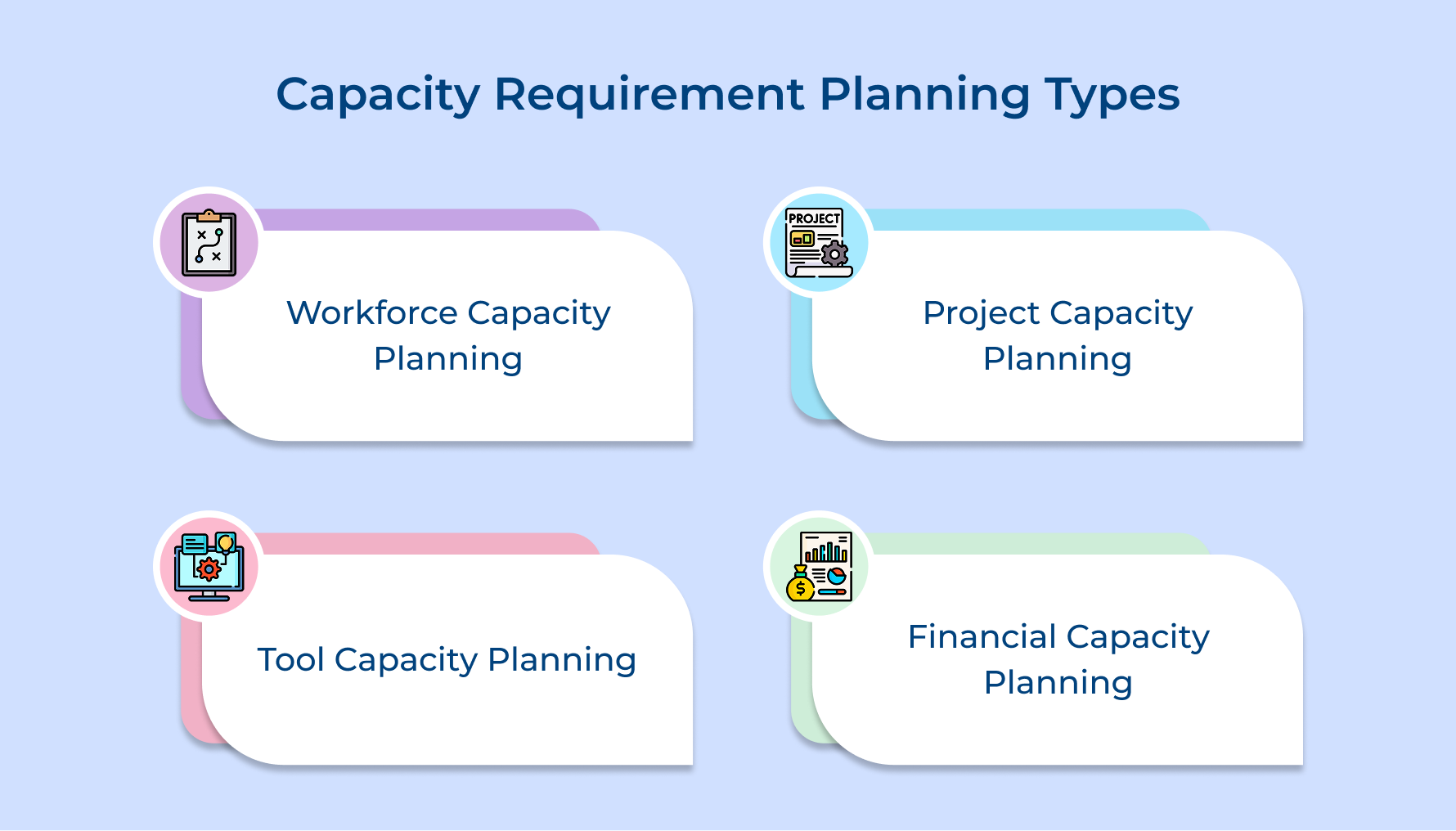
1. Workforce Capacity Planning
This focuses on whether you have enough people with the right skills to handle current and upcoming project demands. You analyze headcount across different roles and expertise levels to identify staffing gaps that could derail delivery.
Here’s what workforce capacity planning helps you understand:
- Skill distribution: Which specialized capabilities exist within your team and where you’re dangerously thin on critical expertise
- Availability patterns: When key resources will be tied up on existing commitments and unable to support new projects
- Growth needs: In case you should hire full-time employees or rely on contractors to fill anticipated capacity shortfalls
The second layer involves matching individual consultant strengths and preferences to upcoming project requirements for optimal engagement. You balance workload across your team while ensuring client projects get consultants who’ll excel in those specific environments.
2. Project Capacity Planning
You’re essentially asking how many projects your firm can realistically handle simultaneously without quality or timeline degradation. This type examines your organization’s bandwidth from a portfolio perspective rather than focusing on individual resources.
Consider these critical questions about your project capacity:
- Does taking on this enterprise-level engagement mean we must decline three smaller projects?
- What happens when discovery phases for multiple clients coincide and compete for our senior strategists?
Project capacity planning reveals the hidden costs of context-switching when consultants juggle too many simultaneous client engagements. You identify the tipping point where adding one more project actually reduces overall throughput across your portfolio.
3. Tool Capacity Planning
It examines if your technology infrastructure and specialized equipment can support the volume of work flowing through projects. Many service firms overlook this until software licenses or testing environments become bottlenecks that slow entire teams.
Key considerations for tool capacity include:
- License availability: Should you have enough software seats for everyone who needs access during peak project periods
- System performance: If your collaboration platforms and databases can handle increased load without frustrating slowdowns
- Specialized resources: If shared assets like testing labs or design studios have enough capacity for current demand
Tool capacity planning prevents situations where your team sits idle waiting for access to necessary technology or equipment. You forecast needs based on project pipelines and make procurement decisions before shortages impact delivery schedules.
4. Financial Capacity Planning
You’re determining if your firm has sufficient cash flow and financial reserves to support project operations until client payments arrive. This often-neglected capacity type can throttle growth even when you have available workforce and tools.
Financial capacity planning forces you to answer uncomfortable questions:
- Can we cover payroll and expenses during the 60-90 day gap between project delivery as well as payment?
- Do we have capital to hire and train new consultants before they become billable contributors?
- How much unpaid work can we sustain if a major client delays payment or disputes invoices?
Key Benefits of Capacity Requirements Planning in Organizations
Implementing capacity requirements planning creates measurable advantages that ripple through your entire organization. These benefits touch everything from day-to-day operations to long-term strategic planning.
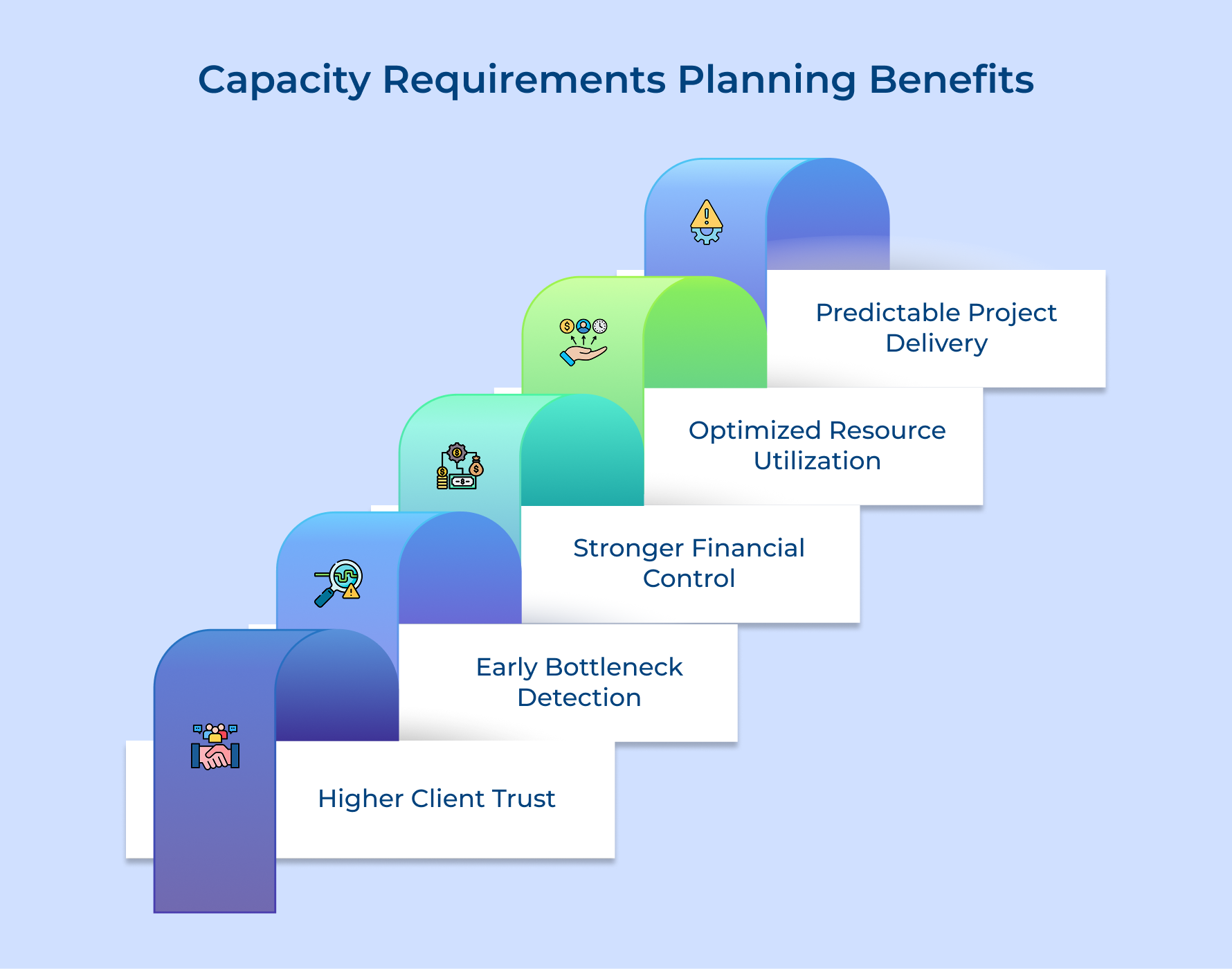
1. Improved Project Delivery Predictability
You can commit to deadlines with confidence when you know exactly what resources you’ll have available throughout the project lifecycle. CRP eliminates the guesswork that causes missed milestones and disappointed clients. Your team spends less time firefighting as well as more time delivering quality work on schedule.
2. Enhanced Resource Utilization
CRP helps you maintain the sweet spot where team members stay productively busy without becoming overwhelmed or burning out. You identify underutilized resources who could contribute to other projects while preventing overallocation that leads to quality problems. This optimization directly improves your return on labor investment across the organization.
3. Better Financial Planning and Cost Control
Knowing your capacity needs in advance lets you budget accurately for contractors or new hires rather than making expensive last-minute decisions. You reduce costs from rush hiring and premium contractor rates while avoiding the waste of paying idle resources. Financial forecasts become reliable tools rather than wishful thinking.
4. Proactive Bottleneck Identification
CRP surfaces capacity constraints weeks or months before they actually impact your projects and derail your schedule. This early warning gives you time to train existing staff or bring in additional resources before problems materialize. You shift from constantly reacting to problems to preventing them from happening in the first place.
5. Increased Client Satisfaction and Trust
Clients notice when you consistently deliver on promises because your commitments are backed by realistic capacity assessments. You avoid the reputation damage that comes from overpromising and underdelivering due to resource shortages. Strong delivery track records lead to repeat business and valuable referrals that fuel sustainable growth.
Challenges in Implementing Capacity Requirements Planning
Even organizations that understand the value of capacity planning often struggle to implement it effectively. These common challenges can undermine your planning efforts if you don’t anticipate and address them.
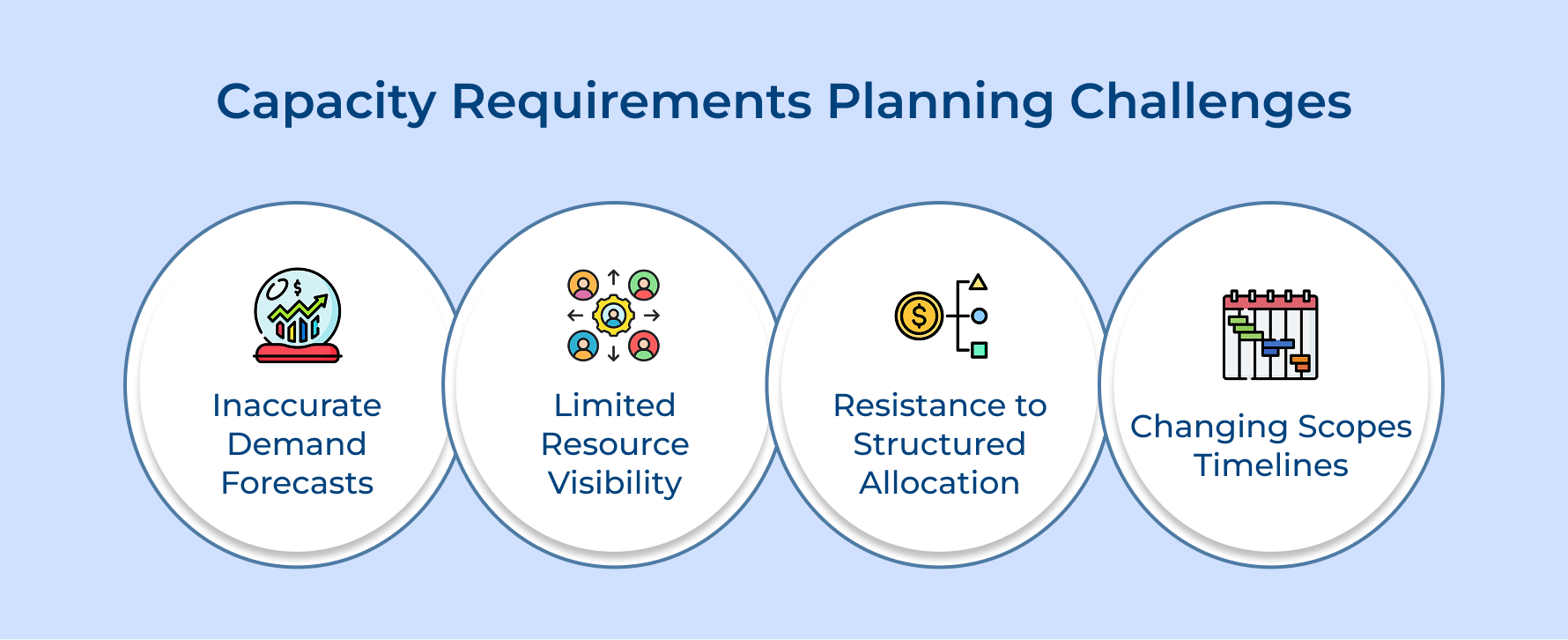
1. Inaccurate Demand Forecasting
Your sales team says three major deals will close next month but only one actually comes through. This forecasting unreliability makes capacity planning feel like guesswork because you’re building resource plans around probabilities that rarely match reality. When demand predictions constantly miss the mark, teams lose faith in the entire process.
2. Limited Visibility into Resource Availability
Team members work across multiple projects and nobody has a clear real-time view of who’s actually available. Calendar systems show people as “busy” without revealing if they’re at 40% or 140% capacity. The opacity leads to accidental double-booking and surprises when someone you counted on is already overcommitted.
3. Resistance to Structured Resource Allocation
Senior consultants resist having their time planned because they prefer autonomy to choose their assignments. Project managers want to handpick favorite team members rather than accepting whoever capacity planning assigns. This cultural resistance creates friction between efficient resource utilization and individual preferences.
4. Constantly Changing Project Scopes and Timelines
Clients request additional features mid-project or compress timelines unexpectedly and your capacity allocations become obsolete overnight. The dynamic nature of service delivery means your plan requires constant updates that consume significant effort. Maintaining accuracy feels like chasing a moving target that never holds still.
These practical approaches help organizations implement capacity planning successfully despite common obstacles.
- Update demand predictions every two weeks rather than relying on quarterly forecasts that become stale.
- Use centralized tools that provide real-time visibility into team availability and allocation.
- Link capacity planning compliance to team goals to overcome cultural resistance.
- Require formal approval before project scope changes that impact resource allocations.
Examples of Capacity Requirements Planning
Capacity requirements planning looks different across industries based on their unique service delivery models and resource constraints. Here’s how organizations in various sectors apply CRP effectively.
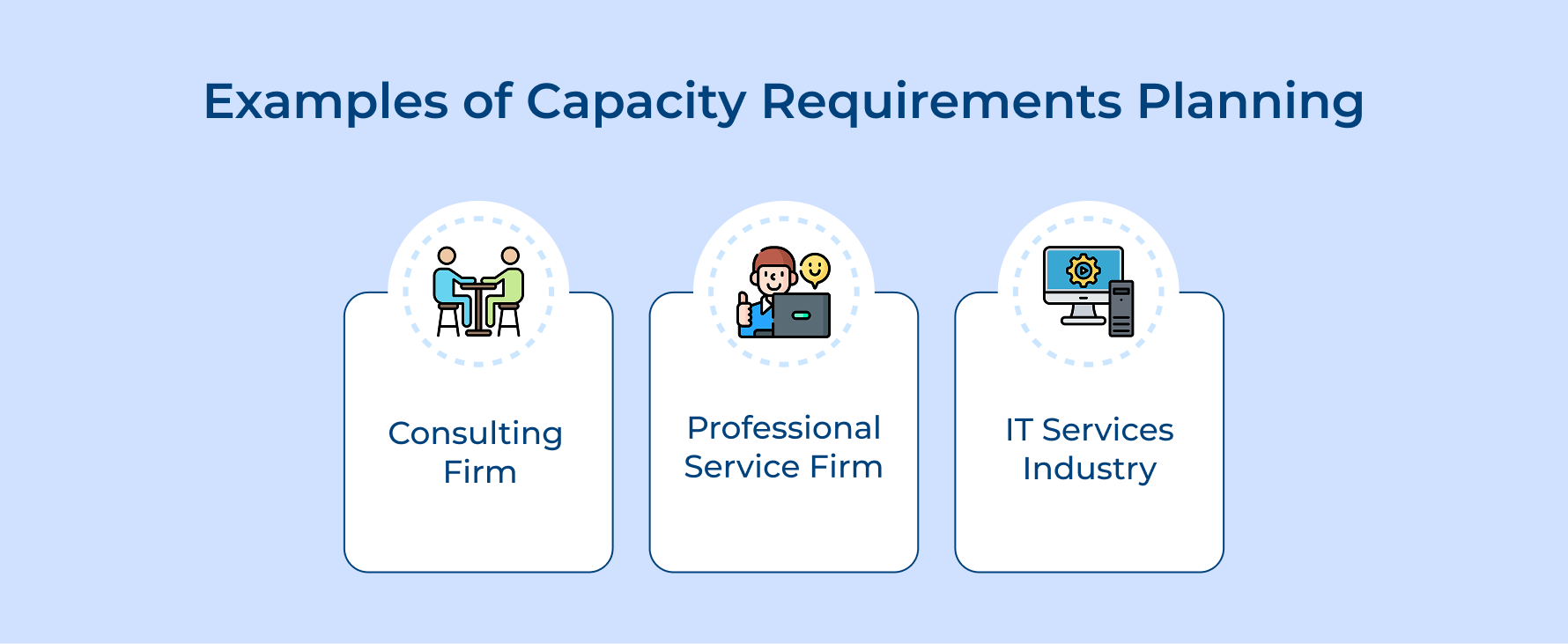
Consulting Firm
A management consulting firm tracks partner and consultant availability across engagement types from strategy work to implementation projects. They forecast demand by analyzing sales pipeline and historical win rates while assigning consultants based on industry expertise.
This approach allows the firm to commit confidently to client timelines and avoid overextending senior partners. They reduce bench time by identifying capacity gaps early enough to pursue smaller projects. The planning prevents burnout from unexpected workload spikes that damage quality and retention.
Professional Service Firm
An accounting firm plans capacity around tax season peaks and audit cycles that create predictable demand patterns. They analyze client portfolios to forecast when different industries will need services. The firm balances permanent staff with seasonal contractors to handle volume fluctuations.
Effective planning helps them staff appropriately during April without maintaining excess headcount year-round that kills profitability. They identify opportunities to shift work timing for flexible clients to smooth demand peaks. The firm maintains quality by preventing critical staff from becoming overloaded.
IT Services Industry
A software development company plans capacity by tracking developer availability across different technology stacks and methodologies. They forecast demand based on contracted projects and anticipated maintenance needs while balancing specialists as well as versatile generalists.
Strong planning allows them to commit to realistic delivery timelines that account for testing and quality assurance. They prevent technical debt that occurs when teams rush because capacity was overcommitted. The company maintains competitive advantage by ensuring developers aren’t burned out from constant overtime.
Transform Data into Decisions with Efficient Capacity Requirements Planning
Capacity requirements planning turns guesswork into strategy by showing you exactly what resources you need and when you’ll need them. Organizations that master CRP make confident commitments because their decisions rest on solid data rather than hopeful assumptions.
The difference between struggling service firms and thriving ones often comes down to how well they plan capacity. Start implementing these principles and watch your delivery predictability improve while your team’s stress levels drop significantly.
Limit time — not creativity
Everything you need for customer support, marketing & sales.

Neeti Singh is a passionate content writer at Kooper, where he transforms complex concepts into clear, engaging and actionable content. With a keen eye for detail and a love for technology, Tushar Joshi crafts blog posts, guides and articles that help readers navigate the fast-evolving world of software solutions.