Capacity Building Strategies to Scale Project-Based Teams
- What is Capacity Building?
- Why Are Capacity Building Strategies Important?
- Important Types of Capacity Building Strategies
- 8 Capacity Building Strategies for Client Project-Based Organizations
- Capacity Building Examples You Should Know
- Grow Your Organization with the Best Capacity Building Strategy
- FAQs about Capacity Building Strategies

Key Highlights:
- Capacity building strategies help project-based teams scale without overloading top performers
- Strengthening skills, systems and tools enables sustainable growth across multiple client projects
- Smart capacity building strategies reduce burnout while improving delivery speed and quality
Your project-based business wants to grow, but your teams keep hitting capacity limits. The same few experts get overloaded, projects slow down and you’re forced to say no to good opportunities. New hires take too long to get up to speed, which makes growth feel even harder.
Meanwhile, competitors who invest in their teams move faster and win the work you couldn’t take on. Your top performers feel stretched, burned out and stuck doing the same work without time to learn new skills.
This is where capacity building strategies helps. Instead of fixing problems one by one, it focuses on strengthening your team in a structured way. The eight strategies we’ll cover help you take on more projects, improve quality and grow without burning out your people.
What is Capacity Building?
Capacity building refers to the systematic process of strengthening an organization’s abilities to fulfill its mission and sustain project delivery over time. It involves developing the skills, knowledge, systems and resources that enable teams to execute projects more effectively.
Think of capacity building as equipping your organization with better tools and sharper skills rather than just completing individual tasks. When a project-based agency invests in capacity building, it creates lasting improvements that benefit every future project.
Main objectives:
- Enhanced workforce competencies: Developing staff expertise through training and mentorship programs that address current while emerging project needs.
- Strengthened organizational systems: Building robust processes and infrastructure that support consistent project planning, execution and evaluation.
- Improved resource management: Establishing better methods for allocating budgets, time and personnel across multiple concurrent projects.
- Sustainable knowledge transfer: Creating systems that capture lessons learned and institutional knowledge so expertise remains even when team members change.
Why Are Capacity Building Strategies Important?
Strong capacity building strategies transform how project-based organizations operate and deliver value. Let’s explore why these strategies matter so much for long-term success.
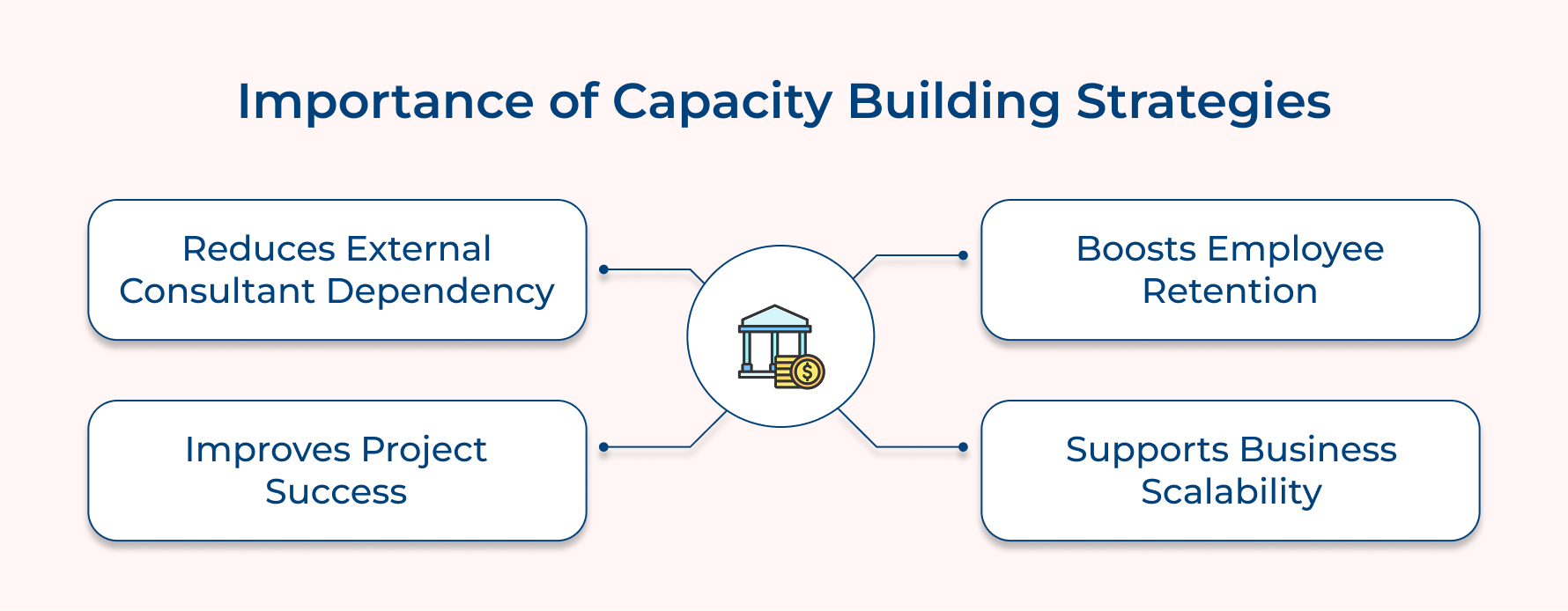
Reduces Dependency on External Consultants
Internal capabilities reduce the need to rely on outside experts for every challenge. Your team learns to solve problems on its own, which saves money and keeps critical knowledge inside the organization. This approach supports sustainable growth instead of short-term fixes.
Increases Project Success Rates
Proper training and the right tools help teams deliver consistent results. Fewer errors mean smoother projects as well as happier clients. A strong delivery record also strengthens insights gained from a SWOT analysis and improves decision-making.
Improves Employee Retention
Clear development paths make employees feel valued and motivated. People stay longer when they see future opportunities through succession planning as well as skill-building initiatives. Lower turnover protects hard-earned experience and team stability.
Enables Scalability
Strong systems and capable teams make it easier to take on more work. Growth becomes manageable when goals follow the SMART framework and teams know how to execute. The organization scales confidently without sacrificing quality.
Important Types of Capacity Building Strategies
Different approaches to capacity building address various organizational needs and challenges. Understanding these types helps you create a comprehensive development plan that strengthens your project-based organization.
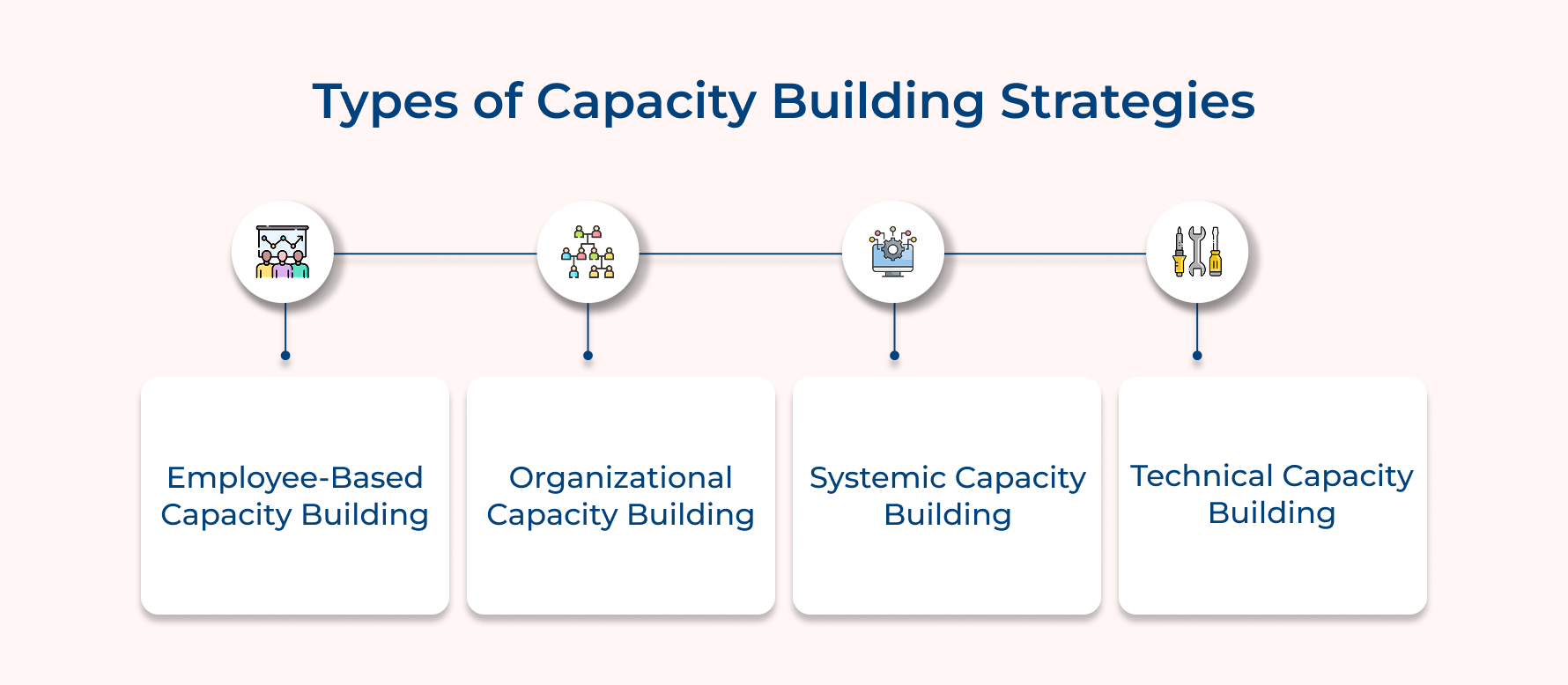
Employee-Based Capacity Building
The employee-based capacity building strategy focuses on developing individual skills and knowledge of team members executing projects daily. You invest in people through training addressing technical competencies and soft skills.
Key development areas include:
- Technical skill enhancement: Software training, certification programs and workshops keeping your team current with industry tools.
- Leadership development: Coaching sessions and management courses preparing employees to handle larger responsibilities effectively.
- Cross-functional training: Opportunities for learning about other departments, creating versatile employees and understanding the full project lifecycle.
Enhanced capabilities from training translate directly into better project outcomes and innovative client solutions. Skilled individuals bring fresh perspectives to challenges and mentor others, multiplying your investment.
Organizational Capacity Building
The organization capacity building approach strengthens structures and systems supporting how your entire organization operates as well as delivers. You examine processes and workflows to identify inefficiencies while creating better execution frameworks.
Strategic improvements focus on:
- Process standardization: Developing unified project management methodologies and quality protocols that teams follow consistently.
- Technology infrastructure: Implementing collaborative platforms and tracking systems that streamline communication as well as reduce overhead.
Centralized systems create predictability and reliability that clients notice in your deliverables immediately. When coordination becomes smoother, teams spend more time creating value rather than managing chaos.
Systemic Capacity Building
The strategy looks beyond your organization to strengthen the broader ecosystem where you collaborate. You build relationships with partners and engage networks contributing to sector-wide improvements.
Industry consortiums provide opportunities for knowledge exchange and open doors to collaborative projects otherwise impossible. Your organization’s success connects directly to the health of your entire professional community.
Technical Capacity Building
Technical capacity building focuses on upgrading tools, equipment and technological capabilities that enable project delivery. You invest in infrastructure that supports team efficiency and expands what projects become possible.
Technology investments include:
- Advanced software systems: Adopting specialized tools for design, analysis, or project management that improve accuracy.
- Hardware upgrades: Providing modern equipment and devices that eliminate bottlenecks slowing down project completion.
- Digital transformation: Implementing cloud platforms and automation tools that modernize how your organization operates daily.
Modern technology allows teams to handle complex projects that older systems couldn’t support efficiently. The right tools reduce manual work and free people to focus on strategic thinking.
8 Capacity Building Strategies for Client Project-Based Organizations
Let’s explore eight effective capacity building strategies specifically tailored for project-based organizations.
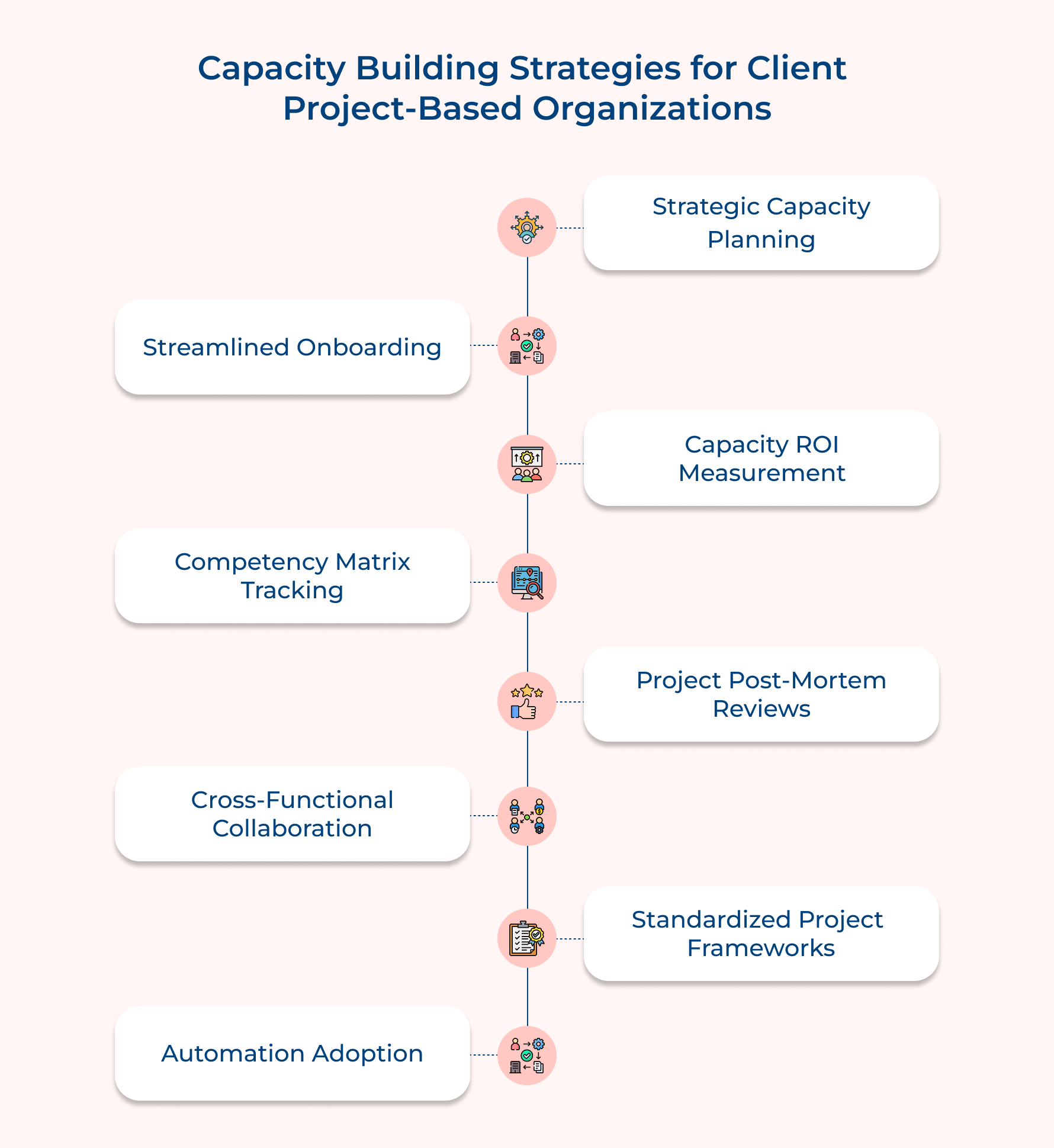
1. Streamline the Onboarding Process
A streamlined onboarding process integrates new team members efficiently into your project workflows and organizational culture. This strategy matters because every unproductive day represents lost capacity that affects project delivery timelines.
You implement this by creating structured pathways combining formal training with hands-on project work under mentorship. New hires absorb institutional knowledge faster when they learn by doing rather than attending passive orientation sessions.
Best practices:
- Develop customized 30-60-90 day plans outlining exactly what new hires should learn and accomplish.
- Meet with new team members weekly to address questions and ensure proper integration.
2. Track and Analyze Competency Matrix Regularly
A competency matrix maps skills present across your organization and identifies gaps limiting project capabilities. This strategy proves significant because you cannot build capacity in areas you haven’t properly assessed or documented.
Here’s how regular tracking builds organizational capacity:
- Skills gap identification across project teams: Quarterly assessments comparing required project skills against current team capabilities reveal where training investments generate highest returns.
- Performance benchmarking against industry standards: Compare team competencies with market expectations using industry frameworks to ensure your organization remains competitive.
- Personalized development plans for individual growth: Use competency data to create targeted learning paths aligning individual career aspirations with organizational needs.
For example a digital marketing agency discovered through competency analysis that only two employees understood advanced SEO techniques. They trained six additional team members over three months. Within six months the agency could staff three simultaneous SEO-heavy projects instead of turning clients away.
3. Build Team Collaboration through Cross-Functional Initiatives
Cross-functional collaboration breaks down departmental silos and builds capacity by spreading knowledge across traditional boundaries. When ignored during capacity building, you create isolated expertise pockets that become bottlenecks when key people are unavailable.
Creating collaboration begins with inter-departmental project assignments exposing team members to different delivery aspects. You assign a designer to shadow the development team or have project managers participate in client strategy sessions.
Strategic rotation approaches include:
- Temporary role swaps for complete project cycles
- Shadowing programs paired with deliverable ownership
- Cross-functional teams for complex initiatives requiring diverse perspectives.
Moving beyond rotations, incorporate knowledge sharing sessions where team members present recent project challenges and solutions rather than theoretical concepts. These work best as informal learning touchpoints creating regular knowledge exchange opportunities.
Next come collaborative problem-solving workshops for complex tasks benefiting from multiple viewpoints working together simultaneously. You gather representatives from different departments to tackle actual project challenges in real-time. These workshops transform capacity building from abstract training into immediate practical application.
4. Leverage Automation Technology and Innovation
Automation technology eliminates repetitive manual tasks and frees your team for high-value project work building expertise. This strategy proves essential because every hour saved on administrative tasks becomes available for learning and creative problem-solving.
Effective use cases demonstrate how automation builds capacity:
- Workflow orchestration for project tracking: Automated task assignments and status updates eliminate manual coordination while giving managers clear visibility into team capacity as well as project bottlenecks.
- Data aggregation and performance reporting: Systems that automatically compile metrics from multiple sources save hours of manual work and provide consistent insights into project health.
- Centralized communication and documentation: Tools that organize conversations by project and auto-archive decisions create searchable knowledge bases that preserve institutional memory.
Based on these use cases and considerations, here are technology categories supporting capacity building:
- Project management platforms: Cloud-based systems providing visual workflows and automated notifications that keep distributed teams aligned without constant manual updates.
- Integration and workflow automation tools: Middleware solutions that connect different applications so data flows automatically between systems rather than requiring duplicate entry.
- Team collaboration and communication systems: Structured messaging platforms that replace scattered emails with organized channels preserving context while making information findable.
- Business intelligence and analytics dashboards: Visualization tools that transform raw project data into actionable insights without requiring manual spreadsheet analysis.
The real capacity building happens when automation handles routine decisions and frees your team to tackle novel challenges developing their skills. Technology becomes the foundation supporting human growth rather than replacing it entirely.
5. Develop a Clear Strategic Plan
A clear strategic plan defines where your organization needs to build capacity and allocates resources accordingly over time. This strategy proves important because scattered capacity building efforts waste money and energy on skills that don’t align with future project needs.
Here are three effective ways to create strategic capacity plans:
- Long-term organizational goals and milestones: Define specific capabilities your organization needs in 12, 24 and 36 months based on market trends as well as target client types. This forward-looking approach ensures training investments today prepare your team for tomorrow’s project opportunities.
- Resource allocation frameworks for capacity growth: Establish budgets and timelines showing exactly how much time as well as money goes toward different development areas each quarter. Clear frameworks prevent capacity building from becoming an afterthought that only happens when projects slow down or when someone requests training.
- Regular strategic reviews and adjustments: Schedule quarterly assessments comparing actual capacity gains against planned targets and pivot when market conditions change. These reviews catch situations where your original plan no longer matches reality before you’ve wasted significant resources moving in the wrong direction.
For example a software development agency created a three-year strategic plan targeting machine learning projects as their growth area. They allocated 15% of annual revenue to AI training and hired two ML specialists. Within two years they successfully transitioned from basic web development to commanding premium rates for AI-powered applications.
6. Measure ROI of Capacity Building Initiatives
ROI measurement evaluates whether your capacity building investments actually improve project outcomes and organizational performance. This measurement proves necessary because organizations often continue ineffective training programs simply because they’ve always done them without verifying actual results.
You implement ROI tracking by establishing baseline metrics before capacity building begins and comparing performance after interventions complete. Track specific indicators like project completion rates, client satisfaction scores, or revenue per employee to determine which investments generate real returns.
Pro tips:
- Compare projects completed before and after specific training programs to isolate the impact of capacity building efforts.
- Delayed feedback reveals whether new skills actually get applied in real project work or simply fade away.
7. Establish Project Post-Mortem Review Sessions
Post-mortem review sessions systematically capture lessons learned after each project concludes and transform experience into organizational knowledge. This strategy proves important because the most valuable capacity building often comes from reflecting on real project challenges rather than theoretical training scenarios.
To implement effective post-mortems, consider these essential questions:
- What specific project outcomes exceeded expectations and what actions or decisions made those successes possible?
- Which project challenges created the most significant delays or quality issues and what early warning signs did we miss?
- What skills or resources would have prevented our biggest problems if we had possessed them at project start?
- What process improvements should we implement immediately based on what we learned from this specific project experience?
These questions help by directing team attention toward actionable insights rather than vague complaints or unproductive blame discussions. When you focus on concrete causes and specific skills, you identify exactly what capacity building efforts will prevent similar problems in future projects.
8. Create Standardized Project Management Frameworks
Standardized frameworks establish consistent methods for planning, executing and delivering projects across your entire organization regardless of team composition. This strategy proves important because inconsistent approaches mean every project reinvents basic processes instead of building on proven methods that let teams focus energy on unique challenges.
You implement standardization by creating documented templates, checklists and methodologies that every team member follows when initiating as well as managing projects. These frameworks capture best practices discovered through experience and ensure new team members can quickly adopt approaches that work.
Best practices:
- Provide structured starting points that teams can adapt to specific project needs instead of prescriptive requirements that become obstacles.
- People who will use the frameworks daily should help create them to ensure practical applicability and gain buy-in.
Capacity Building Examples You Should Know
These practical examples show how different capacity building strategies work in practice across project-based organizations.
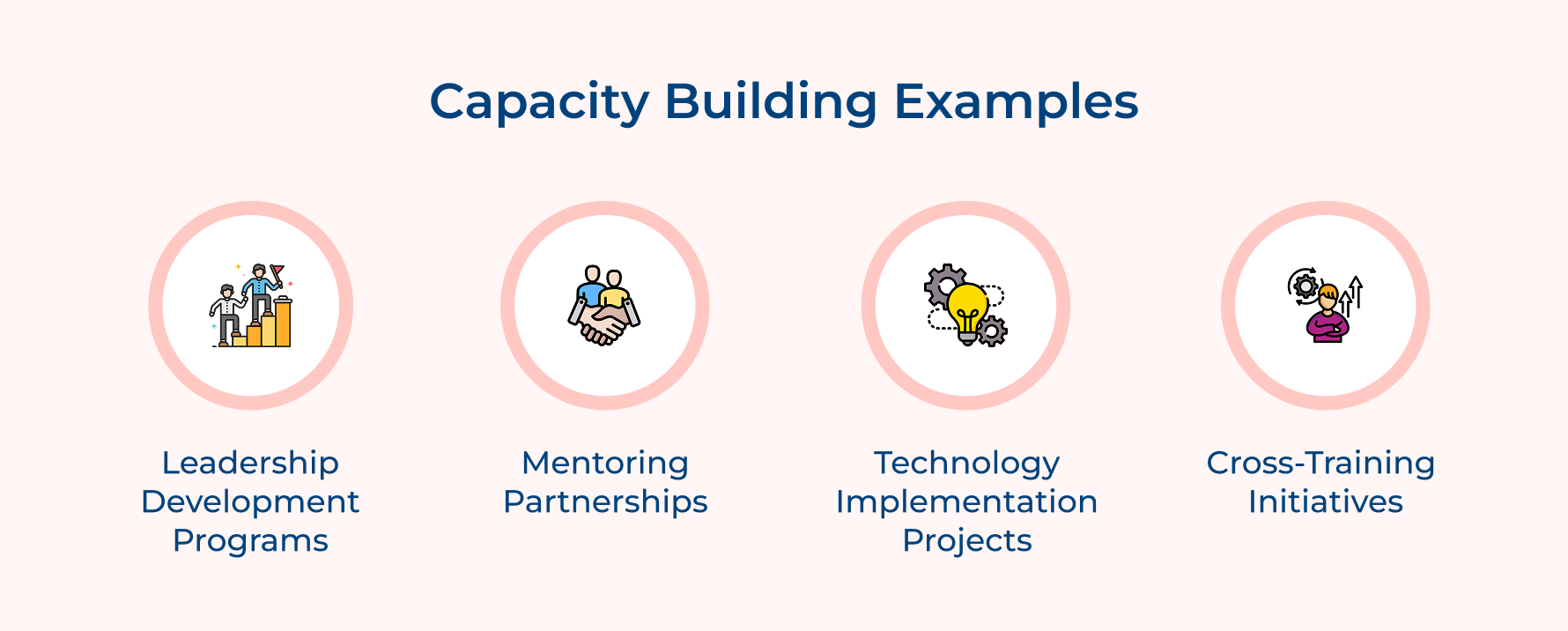
Leadership Development Programs
Leadership development programs systematically prepare high-potential employees to take on management responsibilities and guide project teams effectively. Organizations invest in workshops and stretch assignments that develop strategic thinking alongside people management skills. These programs build capacity by creating a pipeline of capable leaders ready to handle increased complexity.
Mentoring Partnerships
Mentoring partnerships pair experienced team members with newer employees to transfer tacit knowledge that formal training cannot easily capture. A senior project manager might guide a junior colleague through stakeholder negotiations during challenging projects. This approach builds capacity by accelerating individual development while preserving institutional wisdom.
Technology Implementation Projects
Technology implementation projects upgrade organizational infrastructure by adopting new tools that eliminate manual bottlenecks and enable sophisticated delivery. An agency might implement integrated software that connects time tracking as well as resource allocation in one centralized system. These implementations build capacity by freeing staff from administrative tasks and creating scalable processes.
Cross-Training Initiatives
Cross-training initiatives deliberately develop versatile team members who can contribute across multiple project functions rather than narrow specializations. A design agency might train graphic designers in basic user research while teaching researchers fundamental design principles. This approach builds capacity by reducing dependency on specific individuals and creating flexible teams.
Grow Your Organization with the Best Capacity Building Strategy
Capacity building strategies transform your project-based organization from reactive to proactive by strengthening the people, systems and processes that drive success. Strategic investments in skills development and operational improvements create compound returns that accelerate growth while maintaining quality standards.
The most effective approach combines multiple strategies that address both immediate gaps and long-term organizational needs simultaneously. Start with streamlined onboarding and competency tracking to build your foundation, then layer in automation as well as cross-functional collaboration as your capacity grows steadily over time.
Limit time — not creativity
Everything you need for customer support, marketing & sales.

Neeti Singh is a passionate content writer at Kooper, where he transforms complex concepts into clear, engaging and actionable content. With a keen eye for detail and a love for technology, Tushar Joshi crafts blog posts, guides and articles that help readers navigate the fast-evolving world of software solutions.