What is Billability? How to Calculate and Improve Profitability
- What is Billability?
- Common Types of Billability
- Key Differences Between Billability vs Utilization
- How to Calculate Project Billability?
- Essential Benefits of Billability in Project Management
- How Do You Calculate Billable Utilization?
- How to Boost Billability in a Firm?
- Streamline Client Projects and Boost Revenue with Billability
- FAQs about Project Billability

Key Highlights:
- Understand what is billability, meaning, formula and calculation methods to measure revenue impact across teams as well as professional services performance.
- Learn how billability rate as well as resource billability improve forecasting, utilization balance, profitability tracking and smarter client pricing decisions.
- Automation strategies help calculate, manage and improve billability without increasing burnout or reducing long-term team productivity.
Running a professional services firm often feels confusing when revenue stays unpredictable despite having a fully occupied team. Everyone looks busy throughout the day, yet profits rarely reflect the level of activity happening across the business.
The real challenge lies in not knowing how much of that effort actually turns into billable client work. Clear billability tracking reveals who is driving revenue and who is caught in internal meetings or administrative tasks that add little financial impact.
This guide explains billability in simple terms and walks through the formula used to calculate it. You’ll also discover practical ways to convert everyday time tracking into meaningful insights that strengthen profitability.
What is Billability?
Billability refers to the percentage of an employee’s working hours that can be charged directly to client projects. It’s a critical metric in professional service firms that measures how much of your team’s time generates revenue versus being spent on internal activities.
What Is Billable Utilization?
Billable utilization calculates the proportion of available working hours that employees spend on client-billable tasks. This metric helps firms understand if their teams are productive enough to meet revenue targets while maintaining profitability. It’s typically expressed as a percentage and varies by role as well as seniority level.
Strategic goals:
- Maximize revenue generation by ensuring more hours are spent on client work that can be invoiced.
- Improve resource allocation so you assign the right people to the right projects at the right time.
- Identify capacity gaps that show when you’re overstaffed or need to hire more talent.
- Benchmark employee performance against utilization targets to spot high performers and those needing support.
Common Types of Billability
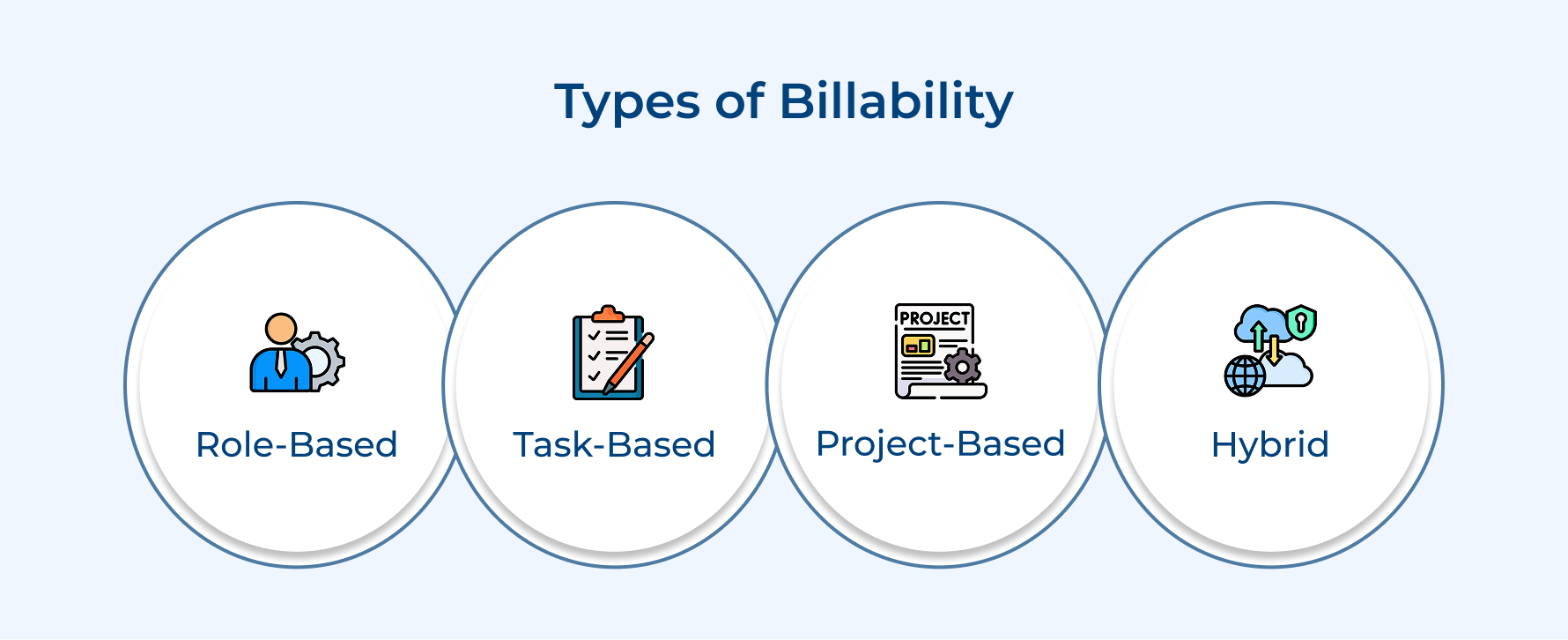
Professional service firms track billability in different ways depending on how they structure their pricing and projects. Understanding these types helps you choose the right approach for your business model.
Role-Based Billability
Role-based billability sets billing rates according to an employee’s position or level of seniority. A senior consultant typically carries a higher hourly rate than a junior analyst, regardless of the task at hand.
Simplicity and transparency make this model easy for clients to understand because they know exactly what each team member’s time will cost. Strong alignment between expertise, experience and perceived value makes this approach especially effective in professional services environments.
Task-Based Billability
Task-based billability focuses on the activity being performed instead of the person performing it. Research work may carry one hourly rate, while strategy development or specialized analysis may be priced significantly higher.
Flexibility becomes the biggest advantage here because pricing reflects complexity and client value rather than hierarchy. Smart task allocation also allows junior team members to contribute to high-value work without reducing overall revenue potential.
Project-Based Billability
Project-based billability centers on fixed-fee agreements tied to a defined deliverable. Client invoices depend on the agreed project price rather than the number of internal hours spent completing the work.
Profitability still depends heavily on accurate scoping, efficient execution and disciplined resource use. Greater responsibility shifts to the firm, encouraging teams to focus on smarter delivery and stronger outcomes instead of simply tracking more hours.
Hybrid Billability
Hybrid billability blends multiple pricing approaches to suit different client needs or project phases. Fixed fees may apply to defined deliverables, while hourly billing covers ongoing support, revisions, or scope changes.
Real-world engagements rarely fit neatly into a single structure, which makes this flexible model highly practical. Clear communication remains essential so clients fully understand pricing logic and feel confident about the value they receive.
Key Differences Between Billability vs Utilization
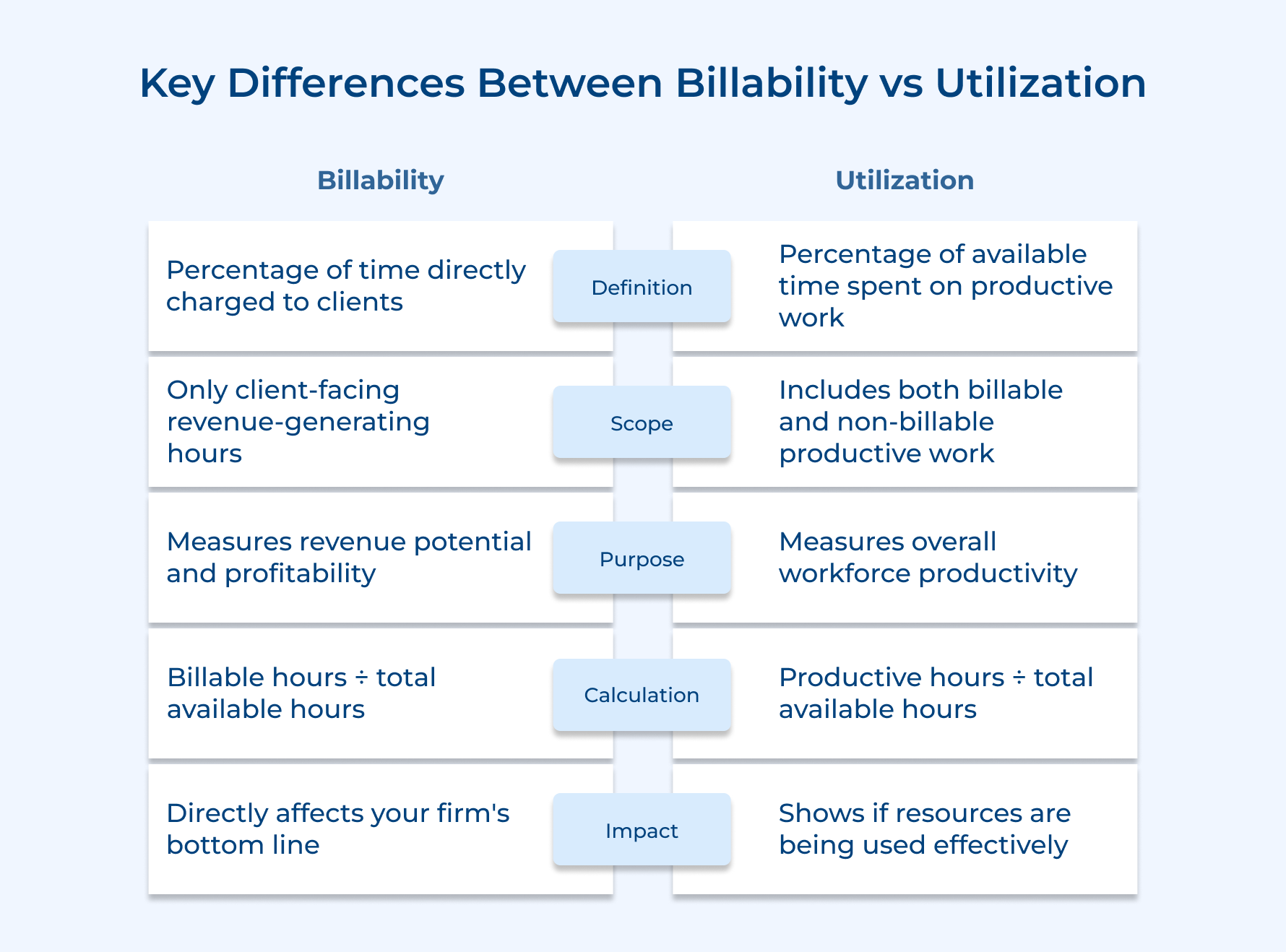
While these terms often get used interchangeably, billability and utilization measure different aspects of how your team spends time. Knowing the distinction helps you track both revenue generation and overall productivity.
1. Definition and Scope
Hours that can be invoiced to clients form the core of this metric, leaving out internal meetings, admin work and other necessary but non-chargeable tasks.
A broader productivity view includes proposal writing, training, collaboration and knowledge sharing, offering a clearer picture of how working hours are actually spent.
2. Revenue Connection
A direct link exists between chargeable hours and the money entering your firm, so higher percentages usually mean stronger revenue – assuming payments are collected.
Support activities that keep the business running may fill the schedule but don’t always generate income, which explains how teams stay busy while revenue stays flat.
3. Target Percentages
Most industries aim for roughly 60% to 80% in chargeable time, since expecting perfect coverage ignores learning, planning and internal responsibilities.
Overall productivity goals tend to sit closer to 85% to 95% and the difference between the two numbers highlights time invested in essential non-revenue work.
4. Performance Implications
Profitability at both individual and organizational levels often depends on how much client-ready work gets delivered. Lower numbers can point to gaps in demand, planning, or resource distribution.
General workload balance reveals if people remain meaningfully engaged or drifting toward overload, where sustained pressure may eventually lead to burnout.
5. Strategic Value
Pricing choices and project margins become clearer once true revenue-generating effort is visible in measurable terms. Leaders gain confidence in whether current work truly sustains the business.
Workforce planning improves through a complete view of efficiency, helping determine hiring needs, skill gaps and the right balance of capacity across teams.
How to Calculate Project Billability?
Calculating project billability gives you concrete insights into how efficiently your team converts working hours into revenue. It’s the foundation for understanding profitability and making data-driven decisions about resource allocation.
Project Billability Formula
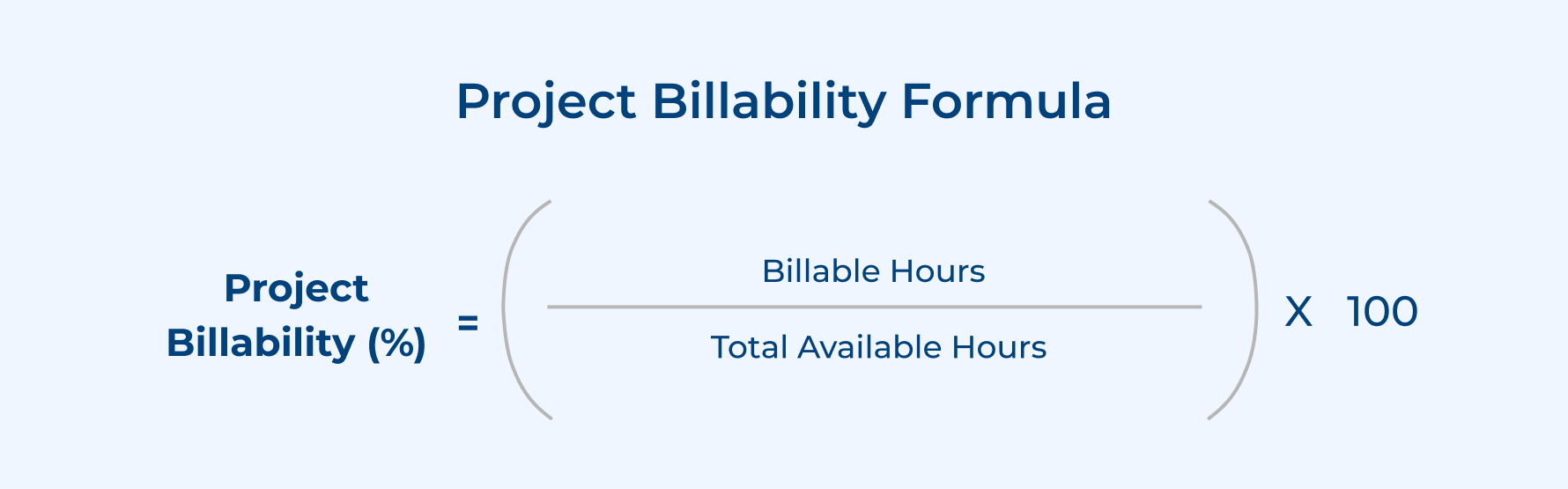
Here are the essential elements you need to understand:
- Billable hours: Time spent on client work that can be invoiced including meetings, deliverables and direct project activities.
- Total available hours: The complete working hours available during the measurement period minus vacation, holidays and approved leave.
- Measurement period: The timeframe you’re analyzing such as weekly, monthly, quarterly, or for the entire project duration.
- Exclusions: Time that doesn’t count as available such as sick days, public holidays and other non-working periods.
Standard Benchmarks for Project Billability
Industry benchmarks help you gauge if your billability rates are healthy. Here’s what different professional service sectors typically aim for:
- Consulting firms generally target 70-80% billability for senior staff and 80-85% for junior consultants
- Creative agencies often operate at 60-75% billability due to significant pitching and internal creative time
- Legal and accounting firms frequently achieve 75-90% billability especially during busy seasons like tax time
Example Calculation
Sarah is a project manager at a consulting firm. We’re calculating her billability for March.
Given Data:
- Total working days in March: 22 days
- Standard working hours per day: 8 hours
- Total available hours: 22 × 8 = 176 hours
- Hours spent on client projects: 132 hours
- Hours on internal meetings and admin: 44 hours
Calculation:
Project Billability = (132 / 176) × 100 = 75%
Result:
Sarah’s billability rate of 75% falls within the healthy range for consulting professionals. She’s spending three-quarters of her time on revenue-generating work.
5 Crucial Steps for Calculating Project Billability
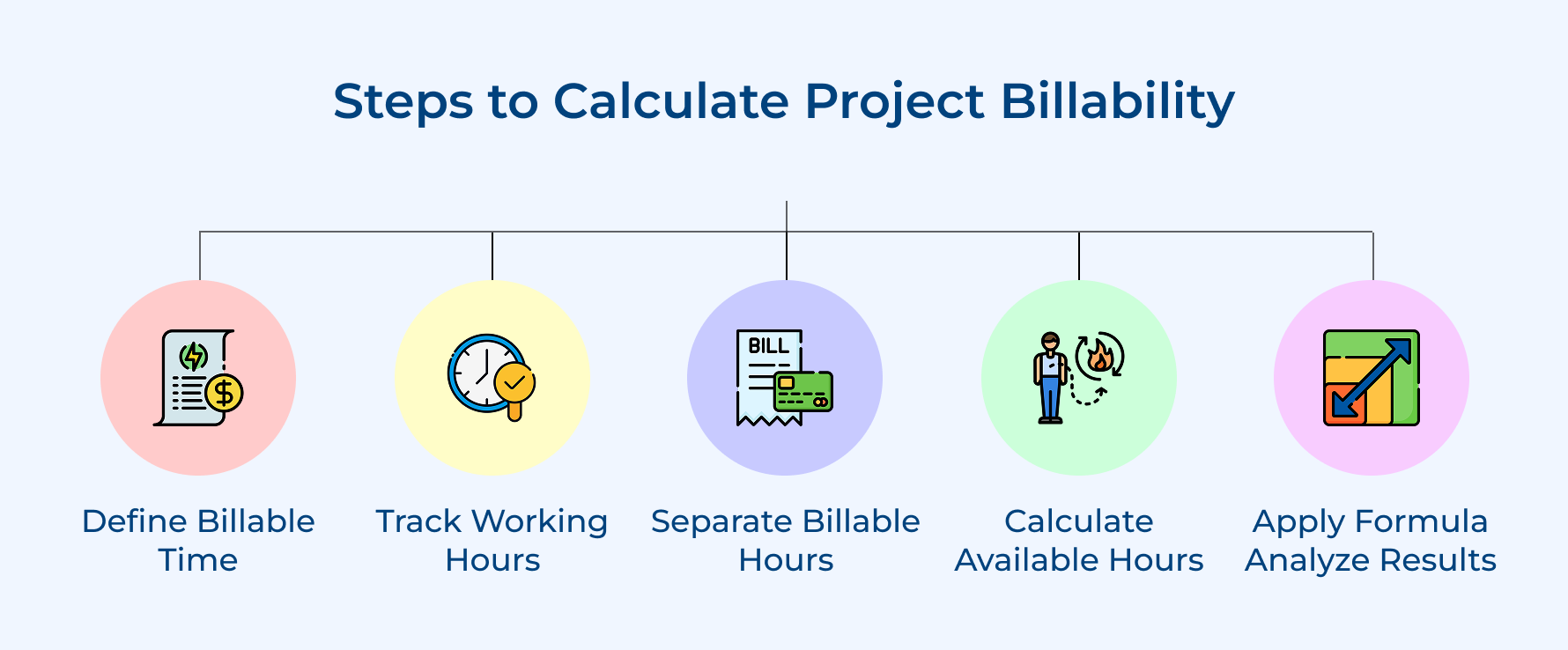
Step 1: Define What Counts as Billable Time
This step establishes clear boundaries between revenue-generating activities and internal work. Without these definitions your billability calculations become subjective and inconsistent across different team members or projects.
Here are the categories you need to clearly define:
- Client meetings and calls including discovery sessions, status updates, presentations and stakeholder discussions that move projects forward
- Direct project work such as research, analysis, design, development, writing deliverables and any tasks specified in your scope
- Client communication like emails and messages that require substantial time investment and contribute directly to project deliverables
How do you actually implement this in practice? Start by creating a simple chart that lists common activities your team performs. Mark each one as billable or non-billable based on if a client would reasonably expect to pay for it.
Clear definitions prevent disputes with clients and ensure your team tracks time consistently. They also help new hires understand expectations from day one without confusion about what activities generate revenue.
Step 2: Track All Working Hours Accurately
Time tracking captures every hour your team spends so you have reliable data for calculations. It ensures you’re working with facts rather than estimates or guesses about how time was spent.
Accurate tracking reveals patterns you might otherwise miss like projects that consistently run over budget. It also provides the documentation you need if clients question invoices or dispute the hours logged on their accounts.
Pro tip:
- Use time tracking software that integrates with your project management tools to reduce double entry and improve accuracy.
- Track time daily rather than trying to reconstruct your week on Friday when details get fuzzy and hours slip through the cracks.
Step 3: Separate Billable from Non-Billable Hours
Categorize your tracked time into buckets that either generate revenue or support operations. It’s necessary because not all productive work translates into money you can invoice to clients.
Before categorizing your hours, ask yourself these key questions:
- Was this work explicitly included in the client’s project scope or statement of work?
- Would the client reasonably expect to pay for this activity based on our agreement?
- Does this task directly contribute to a deliverable the client will receive?
- Is this an overhead activity that benefits the firm rather than a specific client?
These questions help you avoid the common mistake of marking internal work as billable. They force you to think from the client’s perspective about what constitutes legitimate project work versus your firm’s operational needs.
Separate your hours by reviewing your time entries and applying your billable definitions consistently. Tag each entry as billable or non-billable in your tracking system and verify that borderline activities align with client contracts.
Step 4: Calculate Total Available Hours for the Period
Determine the denominator in your billability formula by counting actual working hours available. If you ignore this and use a generic number, your calculations will misrepresent reality especially during months with holidays or team vacations.
Here are three effective ways to nail this calculation:
- Start with standard hours: Multiply working days by daily hours then subtract scheduled time off, holidays and approved leave for accurate availability.
- Account for part-time arrangements: Calculate available hours separately for part-time team members based on their specific schedules rather than full-time equivalents.
- Exclude true unavailability: Remove sick days, bereavement leave and jury duty from available hours since these aren’t controllable or predictable time losses.
The main challenge is that people forget to update available hours when team members take unexpected leave. Overcome this by reviewing actual attendance records at month-end rather than relying on planned schedules alone.
Step 5: Apply the Formula and Analyze Results
The final step converts your data into a percentage that reveals project and team performance. It’s important because the percentage tells you at a glance if you’re meeting targets or need to adjust resource allocation.
Use this calculation to compare billability across different projects, team members and time periods. Trends matter more than single snapshots so track your billability monthly to spot patterns and address problems before they impact profitability.
Pro tip:
- Set realistic targets by role since senior staff spend more time on business development while junior staff maintain higher billability.
- Review billability alongside utilization to understand if low numbers stem from insufficient client work or excessive internal activities consuming productive time.
Essential Benefits of Billability in Project Management
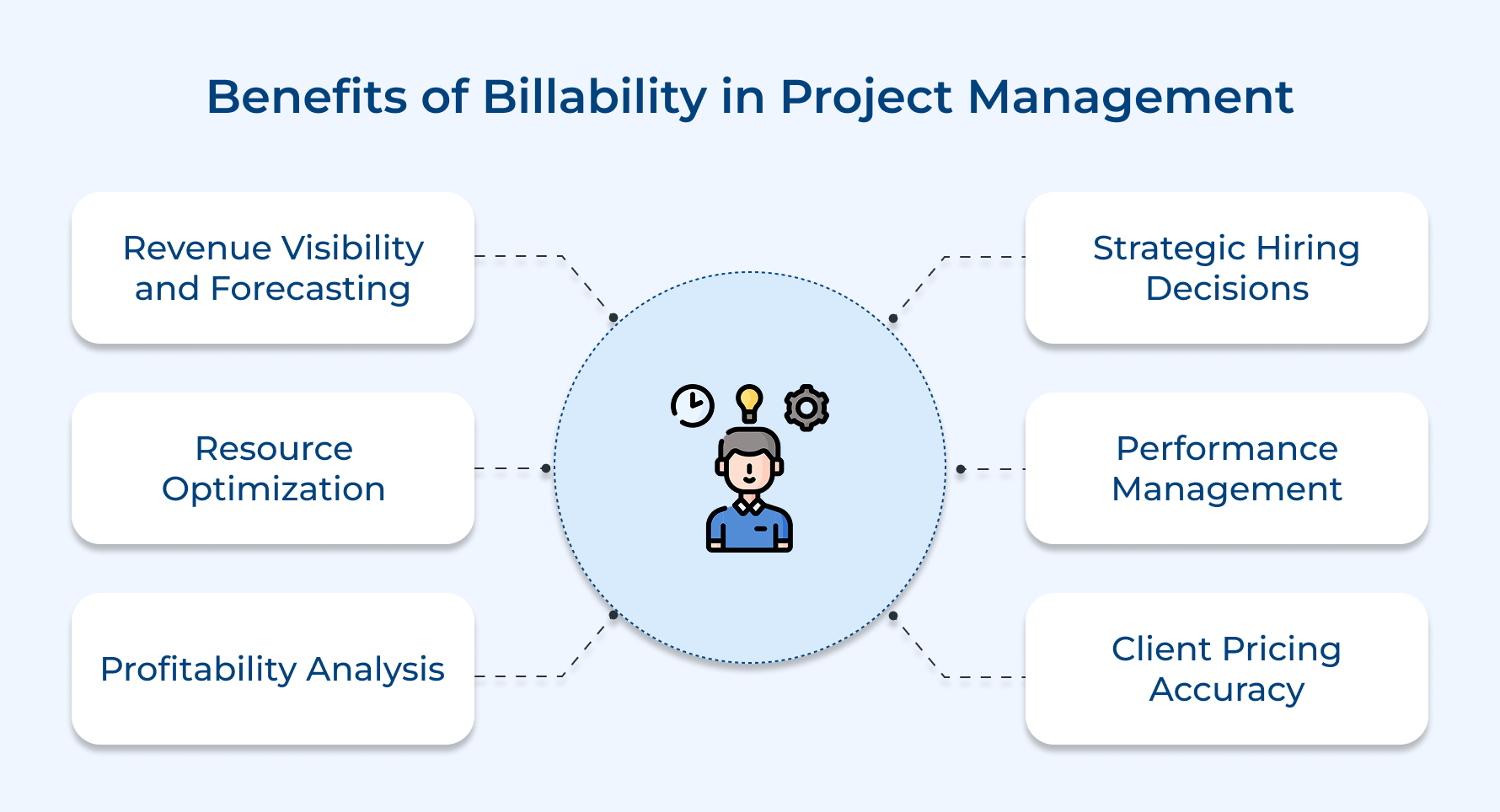
Tracking billability isn’t just about counting hours. It’s a powerful tool that drives smarter decisions across your entire professional services operation.
1. Revenue Visibility and Forecasting
Clear billability metrics reveal how much revenue each team member and project truly generates. Reliable insight like this makes it easier to forecast future income based on current utilization trends and the strength of your upcoming project pipeline.
2. Resource Optimization
Accurate visibility into who is contributing billable hours and who has unused capacity allows smarter work distribution. Balanced allocation prevents burnout for overloaded employees while helping others stay meaningfully engaged in client work.
3. Profitability Analysis
Detailed billability data highlights which clients and projects genuinely support your margins. Early awareness of underperforming engagements creates room for pricing changes, scope corrections, or thoughtful decisions about continuing the relationship.
4. Strategic Hiring Decisions
Consistently high billable workloads across the team often indicate growing demand and the need for additional hiring. Lower numbers may point toward excess capacity or gaps in business development rather than staffing shortages.
5. Performance Management
Objective measurement of revenue-generating contribution brings fairness and clarity to employee evaluation. Strong performers become easier to recognize, while others can receive targeted coaching, training, or role adjustments that better match their strengths.
6. Client Pricing Accuracy
Historical billability patterns show how long similar work actually takes compared to original estimates. Better awareness of real effort leads to more accurate proposals, healthier margins and realistic commitments that protect team capacity.
How Do You Calculate Billable Utilization?
Understanding billable utilization requires a systematic approach that transforms raw time data into actionable insights. This calculation reveals how effectively your team converts their capacity into revenue-generating work for clients.
Billable Utilization Formula
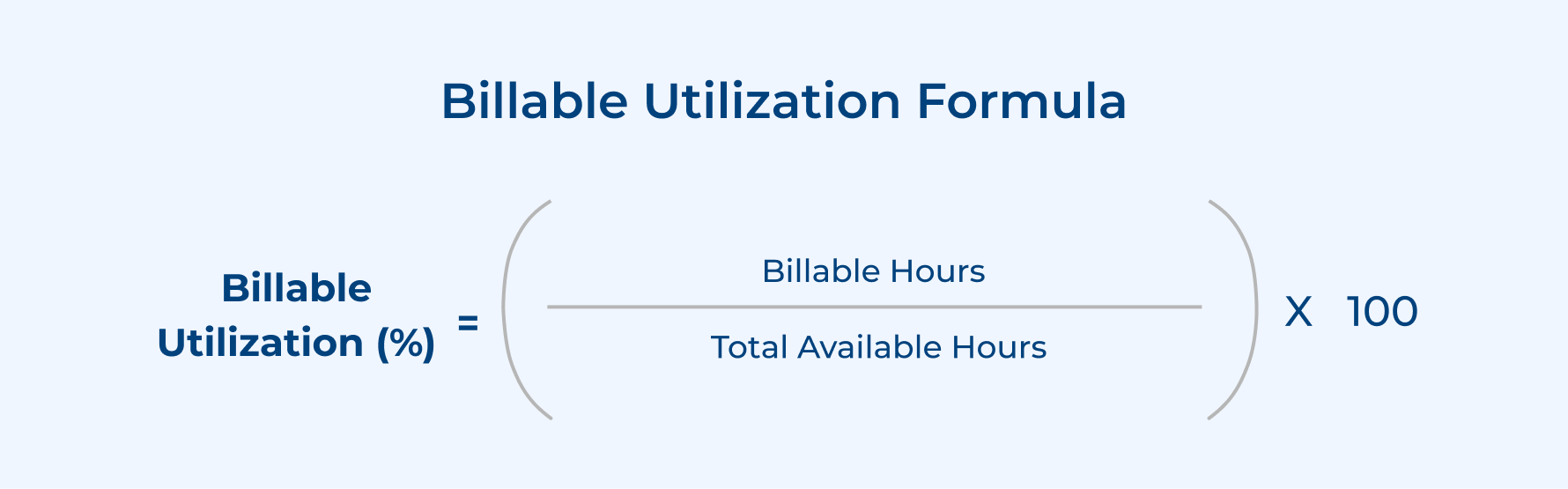
Here are the essential elements that make up this calculation:
- Billable hours: The total time logged on client projects that can be invoiced and directly generates revenue for your firm.
- Total available hours: The complete working hours in the period minus vacations, holidays, sick leave and other approved time off.
- Measurement period: The specific timeframe being analyzed if daily, weekly, monthly, quarterly, or annually for tracking purposes.
Standard Benchmark for Billable Utilization
Professional service firms typically target billable utilization between 70% and 85% depending on industry as well as role. Lower targets apply to senior leadership who spend more time on business development while individual contributors often maintain higher rates.
Example Calculation
Scenario:
Marcus is a consultant at a digital agency. We’re calculating his billable utilization for the second quarter.
Given Data:
- Total working days in Q2: 63 days (April, May, June)
- Standard working hours per day: 8 hours
- Planned vacation: 5 days (40 hours)
- Public holidays: 2 days (16 hours)
- Total calendar hours: 63 × 8 = 504 hours
- Available hours after exclusions: 504 – 40 – 16 = 448 hours
- Hours billed to clients: 336 hours
Calculation:
Billable Utilization = (336 / 448) × 100 = 75%
Result:
Marcus achieved 75% billable utilization for Q2, which falls right in the target range. He spent three-quarters of his available working time on client projects while dedicating the remaining quarter to training, internal meetings and administrative tasks.
How to Boost Billability in a Firm?
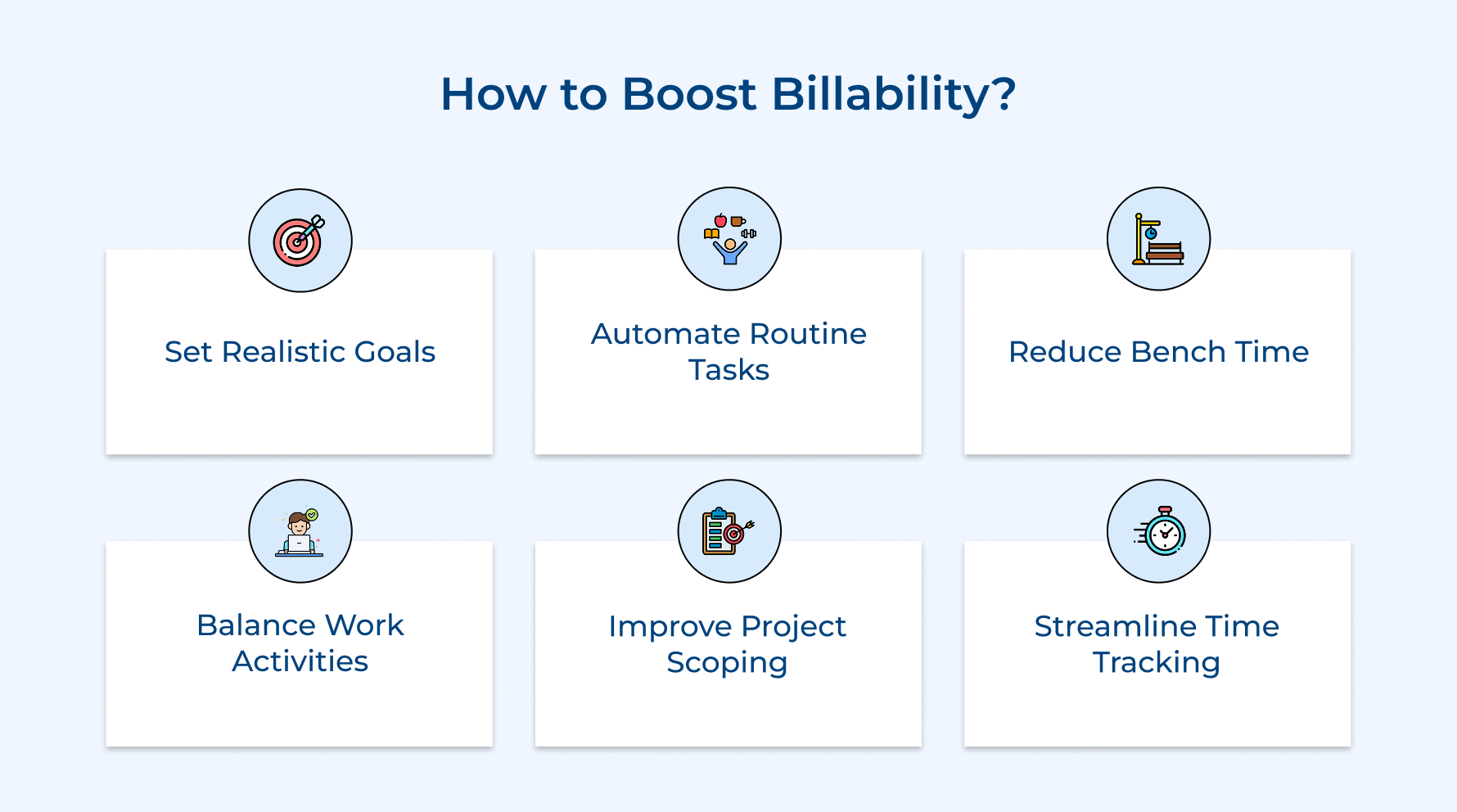
Improving billability doesn’t mean working your team harder. It’s about working smarter by eliminating inefficiencies and creating systems that naturally maximize the time spent on revenue-generating activities.
1. Set Realistic Billability Goals
Establish targets that reflect actual role requirements rather than aspirational numbers that demoralize your team. Senior staff need time for client development while junior consultants can maintain higher billability since they focus primarily on project execution.
2. Automate Repetitive Mundane Tasks
Use technology to handle time-consuming administrative work like timesheet reminders and expense reporting. Automation frees up hours that your team can redirect toward client work rather than drowning in paperwork that doesn’t generate revenue.
3. Minimize Employee Bench Time
Keep a pipeline of upcoming projects so team members transition smoothly from one engagement to the next. The gap between projects kills billability so proactive resource planning and early client conversations prevent people from sitting idle waiting for assignments.
4. Balance Billable vs Non-Billable Activities
Recognize that some non-billable time is essential for professional development and firm growth. Schedule internal activities strategically during naturally slower periods rather than letting them randomly consume hours throughout the week when client work is available.
5. Improve Project Scoping and Estimations
Accurate scopes prevent scope creep that creates unbillable work when you underestimate project requirements. Detailed planning upfront ensures you capture all necessary tasks in your proposals so everything your team does can legitimately be charged to clients.
6. Implement Efficient Time Tracking Systems
Make time tracking effortless with tools that integrate into your team’s existing workflow and send gentle reminders. When tracking takes seconds instead of minutes, compliance improves and you capture all billable hours rather than losing revenue to forgotten or approximated entries.
Streamline Client Projects and Boost Revenue with Billability
Billability transforms how you manage resources and drive profitability in your professional services firm. It reveals exactly where time goes and helps you make smarter decisions about pricing as well as capacity planning.
Start tracking billability to uncover hidden inefficiencies and maximize your team’s revenue potential. The data you gather becomes your roadmap for sustainable growth and happier clients who receive focused attention from properly allocated resources.
Limit time — not creativity
Everything you need for customer support, marketing & sales.

Neeti Singh is a passionate content writer at Kooper, where he transforms complex concepts into clear, engaging and actionable content. With a keen eye for detail and a love for technology, Tushar Joshi crafts blog posts, guides and articles that help readers navigate the fast-evolving world of software solutions.