Best Customer Onboarding Templates for Faster Client Setup
- What is a Customer Onboarding Template?
- Key Benefits of a Customer Onboarding Template
- 7 Essential Types of Client Onboarding Templates
- How to Use the Client Onboarding Process Template?
- Best Practices for a Swift Client Onboarding Experience
- Elevate Your Client Experience With Tailored Onboarding Templates
- FAQs about Customer Onboarding Checklist Templates

Key Highlights:
- Most client relationships break down during onboarding because there is no structured template to guide the process.
- The best client onboarding templates eliminate inconsistency and give every client a clear execution path with the right onboarding template.
- A personalized email sent within 24 hours of signing shifts the client’s mindset to confidence immediately.
A new client understands if they made the right decision to work with your team based on how organized and consistent your onboarding process feels.
The recent customer success report suggests that 63% of customers form their long-term loyalty based on post-sale experience. An unstructured client onboarding template can drop critical steps that silently damage trust before delivery starts.
The guide explains important customer onboarding templates, such as sales handoff, kickoff meetings, status reports and post-onboarding surveys. Understand the complete onboarding workflow for teams to deliver a consistent client experience every time.
What is a Customer Onboarding Template?
A client or customer onboarding template is a document that must be completed to move a new client from a signed contract to active engagement. It makes sure nothing critical falls through the cracks during those first few weeks.
A well-designed and new checklist template works by breaking the onboarding journey into clear phases, such as document collection, tools as well as kickoff calls. Each stage has assigned owners, so the team has a clear idea about their task in onboarding.
Use it as a communication bridge between the internal team and the client. A common structured path with expectations that stay aligned once the relationship starts.
Key objectives:
- Clarity: set every task and milestone to reduce guesswork.
- Accountability: define clear ownership and roles for each action across your team.
- Speed: keep the process structured and predictable by reducing back-and-forth delays.
- Trust: Maintain transparency to the client on how the team operates with professionalism.
Key Benefits of a Customer Onboarding Template
Structured onboarding templates are one of the fastest methods to retain clients. Let’s explore what a solid checklist actually does for your business.
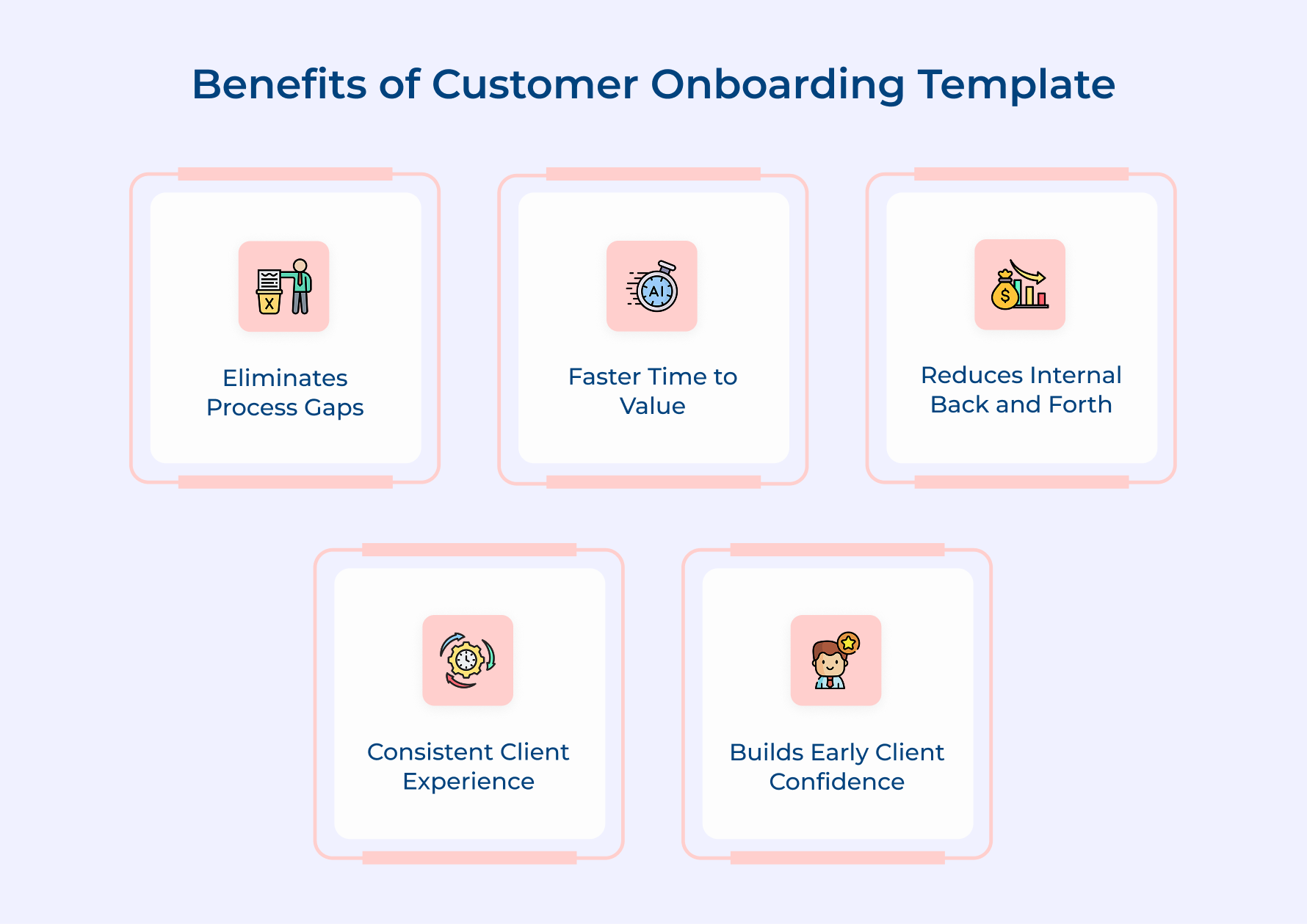
1. Eliminates Process Gaps Before They Become Client Problems
Do you think most onboarding fails due to bad intent? No, it happened because of a misstep by the wrong person at the wrong time. A use onboarding template helps in closing those gaps before it reaches clients.
2. Cuts Down the Time-to-Value for Every New Client
The faster a client sees results from your business, it helps to strengthen the relationship. An onboarding template keeps your team moving in sequence to keep your client engaged across the entire process.
3. Reduces Internal Back-and-Forth Significantly
Most teams spend hours chasing updates and clarifying ownership of tasks without a structured template. It helps in maintaining deadlines, so everyone works from the same page without a proper follow-up.
4. Creates a Consistent Experience Across Every Client
Onboarding based on guesswork or individual effort affects your impressions from client to client. A standardized new onboarding template helps all your customers or clients to receive the same attention as the first.
5. Builds Early Client Confidence in Your Process
Clients monitor closely in the first few weeks of the onboarding to check if they made the right choice. A good checklist-driven onboarding helps the client to understand you are organized and serious about delivering outcomes.
7 Essential Types of Client Onboarding Templates
The right template separates a smooth experience from guesswork. Here are the seven templates every customer success manager should form before onboarding starts.
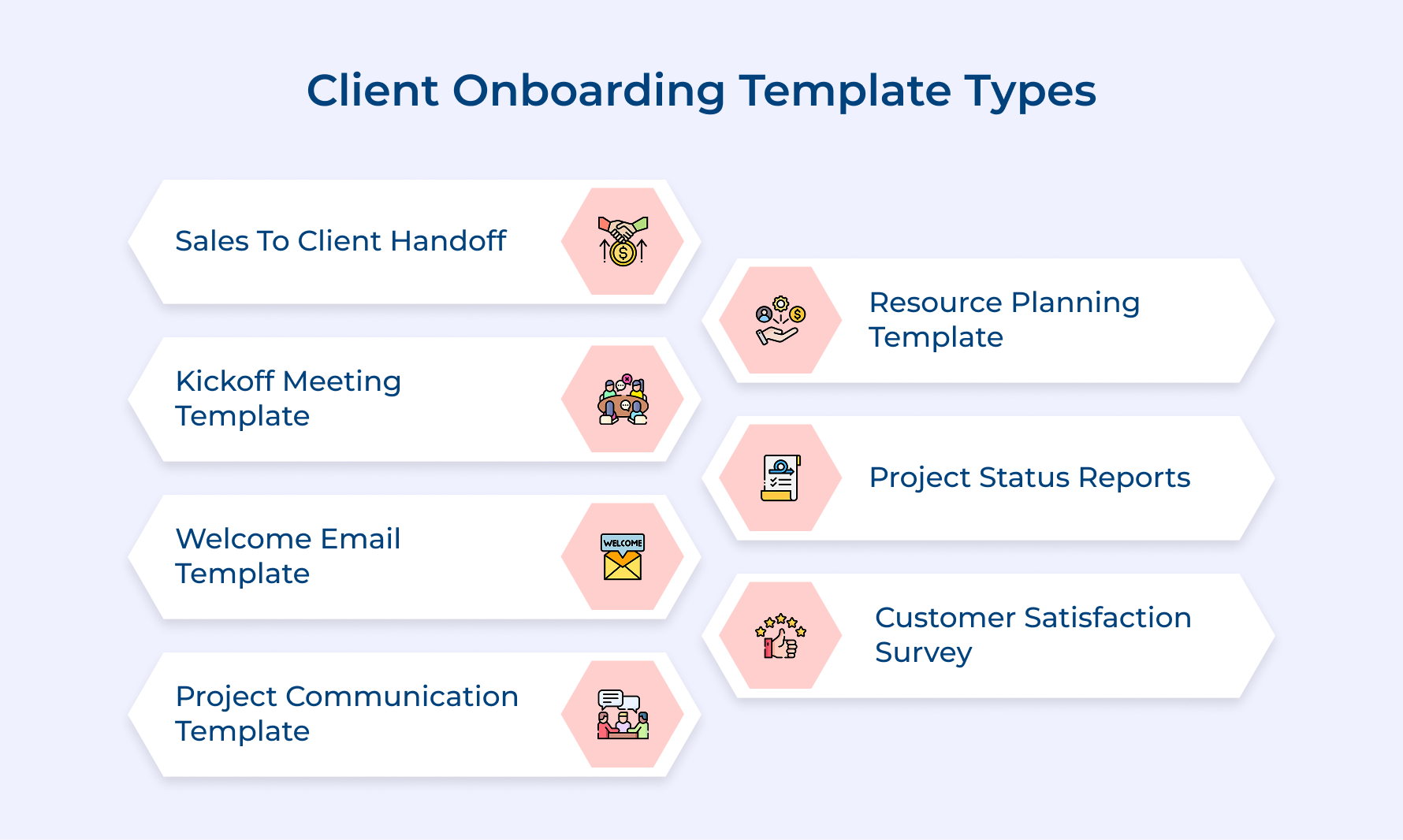
1. Client Onboarding Templates for Sales-to-Client Success Handoff
The template makes sure that whatever the sales team has learned about the client should be transferred to the delivery team. What happens without this transfer? The team again has to start the relationship from zero.
What does it genuinely deliver?
- Continuity: The delivery team can pick up the conversation exactly where sales left off without asking clients the same thing.
- Accountability: Proper documentation of all commitments made during sales is visible to the success team.
- Speed: Onboarding kicks off faster because teams already have brief information before the first client call.
A well-executed template helps a successful team to walk into onboarding sounding like they already know the client. The team avoids the so-called awkward moment of asking “Can you remind us what you need?”.
The framework must carry all important information to set the foundation. Every handoff document that skips customer details creates confusion in onboarding and damages trust.
- Discuss client goals and success metrics during sales.
- Clear documentation of pain points and specific client challenges
- Document sales rep’s promises or custom arrangements to customers.
2. Onboarding Template for a Kickoff Meeting
A kickoff meeting onboarding template is an agenda document that guides the formal meeting between your team and the customer after signing. It makes sure that the conversation covers everything along with clear next steps, instead of vague excitement.
The core purpose of the template is to align both teams on goals, roles as well as onboarding timelines before actual work starts.
When does this user’s onboarding template work best? If it includes discovery questions to identify gaps in onboarding, to prevent costly assumptions in the first few weeks of work.
A well-structured kickoff template includes:
- Meeting agenda with time blocks for each topic
- confirmed live client goals and success metrics
- Team introductions, along with roles for both client and the customers
- Agreed on communication cadence followed by preferred tools
3. Welcome Email Template
A welcome onboarding email template is the direct communication a new client or customer receives after signing up to set the tone of the relationship. So what happens if the message is generic? Clients immediately lose trust and think they are just another account.
An email delivers the following things immediately:
- Reassurance: The client feels confident about their decision to choose your team.
- Clarity: clear transparency about what happens next and what is expected
- Warmth: The tone signals help the client that they will actually enjoy working.
Emails that are specific and action-oriented in the kickoff help to respond to clients faster in more prepared ways. It also cuts the “what do I do now” messages your team receives in the first two days of onboarding.
“`
Subject: Welcome to [Company] — Here’s What’s Next
Hi [Client Name],
Your contact is [CSM Name].
This week:
[Day 1 Action]
[Day 3 – Tool Access]
[Day 5 – Kickoff Call]
[Single CTA]
“`
4. Client Onboarding Template for Project Communication
The template defines correct information flows between team and the client across the entire engagement. What’s the purpose of this? Prevent communication gaps such as missed updates, duplicate messages and unclear escalation paths that quietly kill client relationships.
Template includes below key questions to tailor the communication plan:
- Whether your team likes to receive weekly updates via email or live call?
- Who should be assigned for any major decisions and routine updates?
- Are there any internal tools the team needs to work with?
A good communication checklist template includes meeting frequency, reporting formats and protocols for urgent issues. This keeps your project on track during the most critical phases of delivery. It includes the following elements:
- Defined multiple communication channels for types of updates
- Meeting schedule in proper agenda formats for recurring calls
- Proper escalation path for issues that need senior attention
5. Client Onboarding Template for Resource Planning
The template maps all team members, tools and time blocks allocated to the client from the start of onboarding. It helps in preventing expensive onboarding mistakes such as:
- Overcommitting your team
- Under-delivering on the first experience.
Resource planning gets the most benefit from this template, as it contains the right details to keep allocation accurate. Plans that are built on assumptions instead of a pre-defined onboarding template create delivery failures, damaging client trust. it includes:
- Names and roles of every team member assigned to each task
- Weekly allocation for each resource for the first few weeks.
- List of licensed tools and software provisioning timelines
Pro tip: Clients respect teams that identify constraints early instead of overpromising and scrambling later.
6. Onboarding Template for Project Status Reports
Keep clients consistently informed about the progress, blockers and upcoming milestones throughout the engagement with the right template. It replaces anxious clients’ emails that start with ” checking in on where things stand.”
The purpose of this customer onboarding template is to give customers a reliable rhythm of data to form better engagement. A complete status report template includes:
- Overall project health is on track or delayed
- A summary of work achieved since the last report
- Ongoing and upcoming milestones that the client needs to action
This template also covers budget tracking, risk flags and upcoming decisions that need client input to prevent small issues to become large problems.
Example Template
“`
Health: On Track / At Risk / Delayed
Completed: [Task 1], [Task 2]
Blocker: [Issue] → [Resolution]
Next Milestone: [Name] – [Date]
Client Action Needed: [Item] by [Date]
“`
7. Post-Onboarding Customer Satisfaction Survey Template
A structured feedback checklist template used at the end of customer or client onboarding to measure the process delivered based on initial expectations. What’s the result when teams skip this? It ends up repeating the same sign-up mistakes across every customer.
What does this template give teams beyond feedback?
- Improvement data: Reveal exactly where your onboarding process loses momentum.
- Relationship signal: Asking for feedback to show you care about client experience.
- Retention indicator: Clearest early signals of churn risk with low scores at onboarding.
Your onboarding process improves faster when survey results are reviewed and acted on within the same quarter. The client’s voice is the most accurate feedback to understand the standing of your onboarding.
How to Use the Client Onboarding Process Template?
Explore how exactly the user onboarding template can be used in each step to work for consistent outcome:
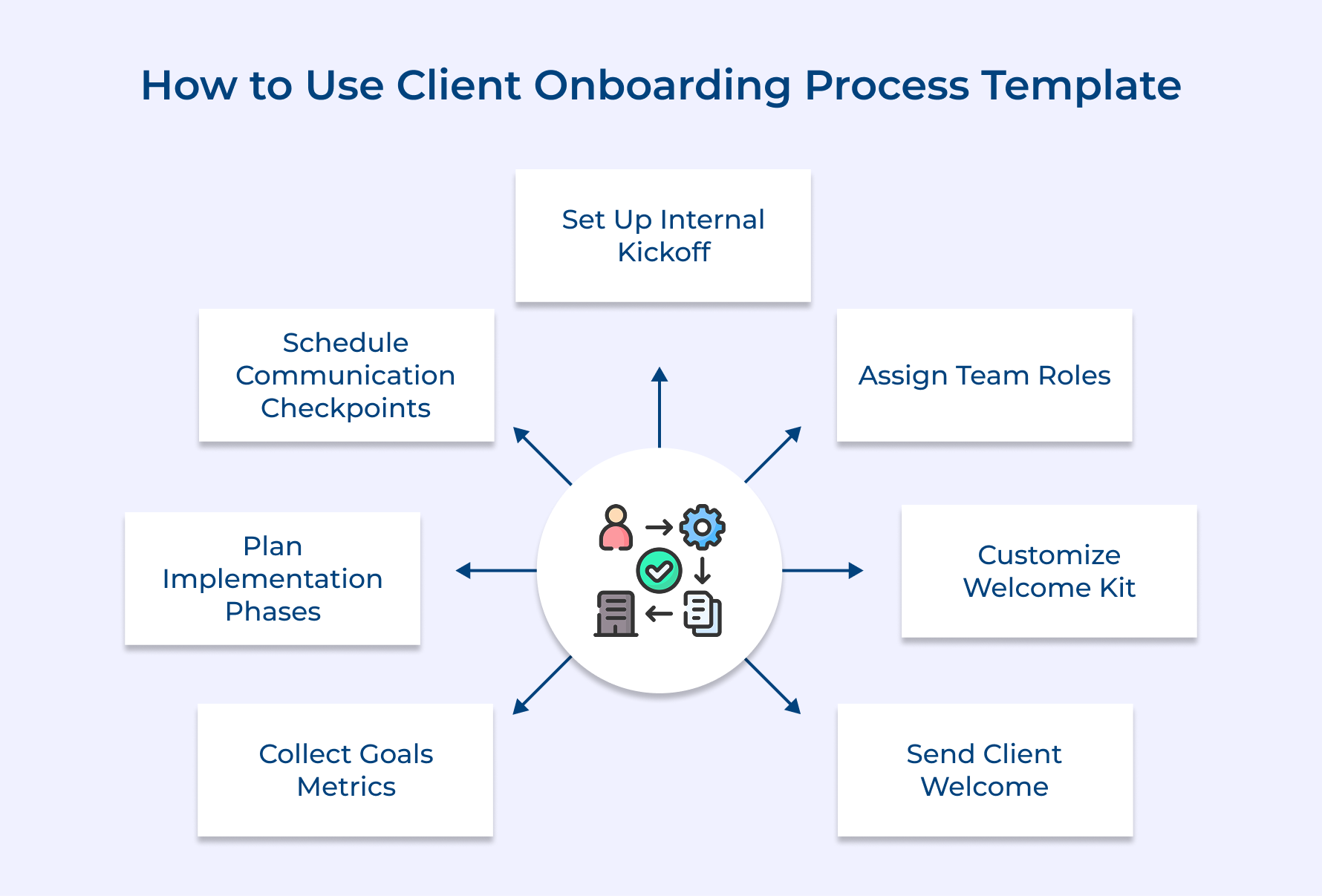
1. Set Up Your Internal Kickoff and Assign Roles
Internal kickoff is like the engine room of the entire onboarding process, where every role, deadline and dependency gets mapped before client face.
The decisions cannot live in just scattered messages or by assumption. They belong inside the user onboarding template, so that team members work from the same form.
Consider these questions before starting your internal kickoff meeting:
- Who has ownership of this account’s day-to-day progress?
- Are there resource conflicts to flag before client work starts?
- What does sales handoff documentation say about client expectations?
The process helps surface hidden dependencies when the full team reviews the plan together. Before moving to client-facing steps, the internal setup covers:
- Role assignment: Every task has individual ownership and not just a team label.
- Briefing completion: The CSM has fully reviewed sales handoff before client communication escalated.
- Workspace readiness: The internal space is mapped live with tasks, owners and deadlines mapped.
2. Customize and Send the Client Welcome Kit
Client experiences in the first 24 hours after signing are all about the emotional tone. A welcome kit sent within 24 hours helps to convey to the client about being fully prepared.
This level of readiness moves the client’s mindset from “I hope it works” to “these people know they are doing.” It tells about your professionalism more than any sales conversation could ever happen.
The welcome kit should address the following elements:
- Personalized welcome message directly to the client based on their goals
- A clear breakdown of the onboarding process based on the demand.
- Point of contact with direct availability, as well as preferred communication channel
3. Collect Goals and Success Metrics
Proper goal collection is a discovery exercise instead of a quick end-of-call question. Goals collected without a framework are just like a written document. The team needs a structure to convert the client statement into a trackable form.
Consider the example of a marketing agency skipping structured goal collection and spending three months improving engagement. Leaders only cared about the paid channel discovered at the quarterly review.
Start identifying your measurable goals early with these discovery questions:
- What specific outcome would make this engagement a clear success at the 90-day mark?
- Which internal KPIs are used to evaluate vendor performance?
- Have you tried solving this problem before the approach fell short?
Answers to this question protect your team from clients who say everything is fine until renewal. It removes ambiguity before it escalates to a relationship problem.
How to practically implement this?
- Goal statement: Define exact client goals and needs in unambiguous terms.
- Success metric: Identify the benchmark that confirms goals are actually reached.
- Baseline: mention a proper current point to measure progress against it.
4. Plan Implementation or Service Delivery Phases
Defined delivery phases give the client a transparent view of what is happening and when. They also give your team a defensible structure when scope creep inevitably appears.
So what happens when you don’t have a phased plan? Your team has no clean way to respond to mid-onboarding flow. It turns a customer onboarding into a structured process because both sides reference the same document plan.
Start structuring each delivery phase based on the core components:
- Timeline boundaries: set a clear start date, end date and key milestones within the phase of onboarding
- Ownership map: Assign proper ownership to each team member for deliverables inside each phase.
- Client dependencies: Keep each phase moving on schedule by asking the client about the team’s needs.
5. Schedule Touchpoints and Communication Checkpoints
A proper schedule inside the onboarding template checklist works as a simplified contract between both teams as well as the client. Consistent updates rarely send panic-driven check-in emails mid-week.
Consider the example of a project management firm focusing only on weekly status emails during onboarding, which eliminates mid-week messages. It saves hours every month and keeps clients informed.
Answer these questions upfront to define your communication structure:
- Which updates are best suited – written reports in comparison to live calls?
- Which leaders from the client side need to be included to inform decisions and routine updates?
- What is the agreed response for approvals as well as feedback requests?
Establishing a communication structure after the onboarding starts is similar to negotiating rules mid-game in a football match. It is recommended to lock decisions before the end of the first week. Lock for this communication touchpoints before moving onboarding past the week:
- Week one check-in: A short call for delivery confirmation of all materials and clear outstanding questions before the start.
- Weekly status update: A recurring report that includes progress, current blockers and next week’s priorities.
- Monthly review: A deeper session with stakeholders for assessing progress based on the agreed goals.
Best Practices for a Swift Client Onboarding Experience
A fast onboarding means every step has a goal. No client ever waits for your process. Let’s explore the five practices that make the process possible.
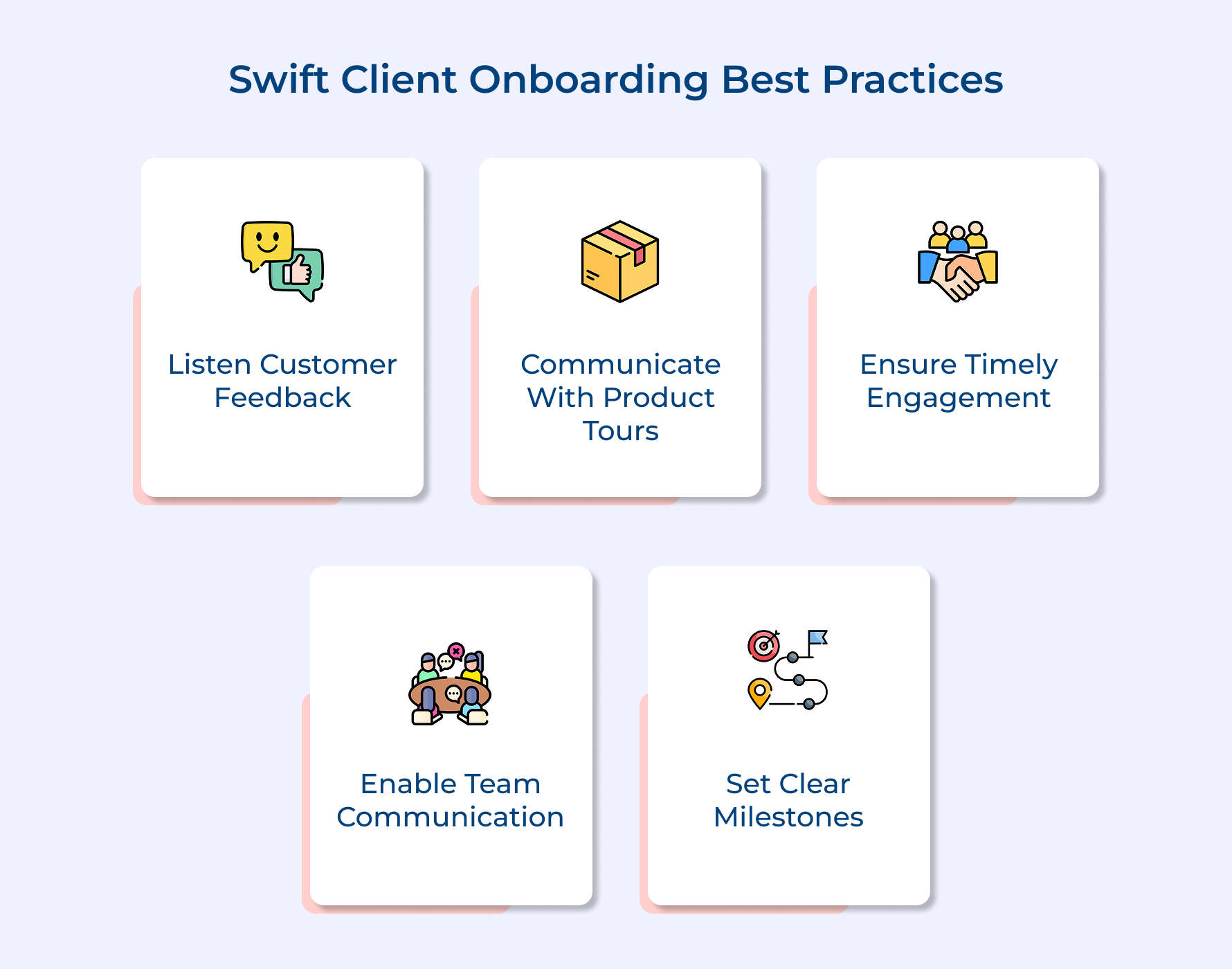
1. Listen and Track Customer Feedback
A tracking system without a feedback loop is just noise that gets heard once and forgotten before the changes happen. Build a streamlined process to log, categorize and revisit what clients need at every onboarding stage.
2. Effectively Communicate Customer Experiences With Product tours
The gap between clients’ experience and product teams is where the avoidable friction lives longest. Routing onboarding feedback in real-time directly to teams turns client pain points into actionable improvements.
3. Ensure Timely Engagement Between Customers and Agents
A delayed response during onboarding signals to the client that they are not a priority. Specify proper response time standards for every touchpoint. Also, hold your team accountable to those standards without compromise.
4. Foster Smooth Communication Within the Customer Success Team
Clients feel the inconsistency when CSMs operate in silos, even though they cannot name exactly what is wrong. Internal communication standards directly determine the seamless client-facing experience that actually feels.
5. Set Clear Milestones and Celebrate Early Wins With the Client
Clients who see progress early stay confident throughout the journey. Mapping small visualizations into your onboarding template checklist gives clients confidence to stay from week one.
Elevate Your Client Experience With Tailored Onboarding Templates
The best customer onboarding template is the first real proof a client sees about how you understand their specific needs. A generic process loses clients quietly while a structured one increases customer retention across every engagement.
- A complete client onboarding checklist template gives a clear pathway from contract signing to full client activation.
- Structured communication templates replace a common check with a consistent onboarding rhythm that improves customer satisfaction across every project phase.
Start by auditing your current onboarding process to identify the first step where client confidence consistently drops off. Customer success teams that build with intention don’t just onboard clients but also convert every new relationship into a foundation for long-term expansion.
Limit time — not creativity
Everything you need for customer support, marketing & sales.

Neeti Singh is a passionate content writer at Kooper, where he transforms complex concepts into clear, engaging and actionable content. With a keen eye for detail and a love for technology, Tushar Joshi crafts blog posts, guides and articles that help readers navigate the fast-evolving world of software solutions.