What Is a Customer Onboarding Playbook & How to Build It?
- What Is A Customer Onboarding Playbook?
- Why is a Customer Onboarding Playbook Important?
- Types Of Customer Onboarding Playbook
- Key Benefits of A Customer Onboarding Playbook
- How To Build An Effective Customer Onboarding Playbook: 7 Steps
- Key Strategies For Your Customer Onboarding Playbook
- Simplify Customer Success With The Best Onboarding Playbook
- FAQs about Customer Onboarding Playbook Template
Key Highlights:
- A structured customer onboarding playbook prevents 20% of B2B churn in the first 90 days.
- Build a playbook around customer pain points and journey stages to separate retention-focused teams from reactive teams.
- Role-specific playbook content reduces support ticket volume by delivering the right information to the right person.
Do you know what the fastest way to lose a customer that you worked hard to win is? An unstructured and inconsistent onboarding experience was promised during the sale.
More than 20% of B2B churn is directly linked to poor onboarding experiences in the first few weeks. An unstructured customer onboarding playbook is always improvised at scale, but quietly kills retention.
The guide covers everything from what a client onboarding playbook is to the types, benefits, stages and best practices that actually work. Get a clear implementation path that helps your team scale onboarding without compromising customer experience quality.
What Is A Customer Onboarding Playbook?
A customer onboarding playbook is a structured document that tells your team exactly what to do, when to do it, and who owns each step from contract signing. Even the most experienced managers without a proper framework end up improvising at scale, killing retention.
A customer success playbook for SaaS works by breaking the onboarding journey into clear phases. Stages include kickoff, configuration, training and value realization. Each phase has defined actions and expected outcomes to maintain proper progress tracking for the customer.
So what do most teams miss in this process? The SaaS team doesn’t think of customer onboarding as an internal checklist that directly shapes how a customer feels. It is exactly when churn decisions are quietly taken.
Key industries need a playbook:
- Service firms: Misaligned expectations in week one create friction that persists throughout the client relationship.
- Agencies: Managing multiple onboarding processes without a repeatable process leads to inconsistent delivery; overcome it with a good playbook.
- B2B businesses: Enterprise customers need a professional handoff and an onboarding playbook to make it feel intentional.
Why is a Customer Onboarding Playbook Important?
A good onboarding playbook separates a client retention team from those who constantly fight churn. Let’s explore the benefits of it in detail:
- 63% of customers make their decision to subscribe or purchase a product based on the post-sale support.
- Educational and welcoming onboarding playbook content increases client loyalty as well as retention by 86%.
- SaaS firms using trigger-based messaging see 25–30% higher conversion during onboarding.
Teams that treat the playbook as a structured process always outperform. It makes sure that a deliberate and consistent post-sale experience is delivered based on the investment in acquisition.
Types Of Customer Onboarding Playbook
Does every customer need the same process? No, it depends on products and industry. Choosing the right type of playbook determines the success of your customer onboarding from sign-up to actual value.
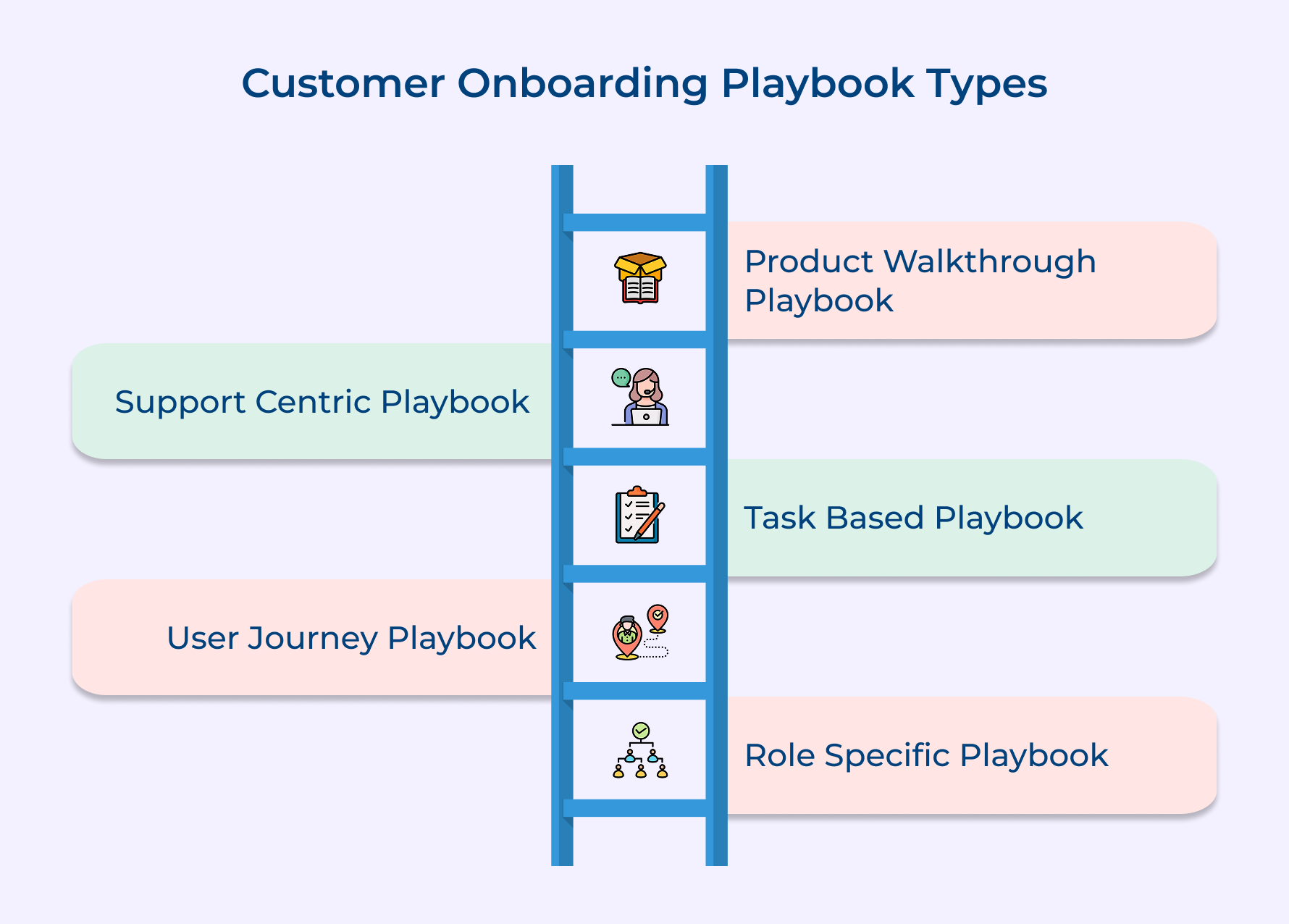
1. Product Walkthrough Playbook
Most customers do not churn due to a bad product. It is because nobody guides them towards a connected goal. Knowing that “where do I even start” is the moment where the first 30 days go wrong.
This playbook creates a structured discovery path for your team to make sure every client or customer has their first onboarding moment with confidence. It sets the tone for the entire relationship from start to end.
When does this work best:
- Steep learning curve: A situation when product has multiple modules that cannot be tracked without a proper walkthrough
- High drop-off after sign-up: Several new users go inactive within the first two weeks of onboarding
- No standardized demo process: Each success manager is delivering different product demos without following a consistent structure.
2. Task-Based Playbook
Customers never think in terms of features or product modules. They look for the outcomes and a task-based playbook is built around reality. The text-based process organizes onboarding with respect to specific tasks tied to each stage.
Follow the elements that make it effective:
- Shared onboarding workspace: A live documentation for both customers and the success team to track task progress.
- Escalation path: A structured process for situations when customers gets stuck to get it resolved without delaying entire timeline
3. Role-Specific Playbook
Consider an example when your customer success teams send the same onboarding content to an admin as well as an end user, causing an increase in churn rate. It is because each role has a different definition of value and a playbook, which is missing this thing that ends up irrelevant.
Role-specific playbook includes what each role actually cares about, product adoption and improving overall account-wide customer engagement.
Best suited for:
- Enterprise and mid-market accounts, where stakeholders with different responsibilities are part of the onboarding process
- Products with distinct role functionality for admins as well as customers interact with the platform in a separate approach.
4. User Journey Playbook
Most businesses, such as SaaS, B2B, etc., build onboarding playbooks based on what success teams need to succeed internally and consider customers. User journey playbook maps every phase from initial setup through training based on where the customer actually stands.
It keeps the success team customer-led instead of process-led. So what happens in a situation when a customer skips ahead in the playbook? It provides a pre-built response ready to make sure that the account doesn’t churn.
Key elements in this playbook:
- Bi-directional visibility for customers and the success team to get transparency in the entire onboarding journey.
- Stage exit criteria with clear conditions that need to be met before moving forward to the next phase
5. Support-Centric Playbook
This onboarding playbook is designed for a product-centric business where customers or clients need adoption support before they operate it independently. It shifts onboarding toward a proactive support team structure that addresses friction before escalating.
How is this playbook helpful? Teams that use this playbook well never have to wait for customers to raise support tickets for help. It identifies the most common friction points and embeds guided walkthroughs directly into the flow.
Key Benefits of A Customer Onboarding Playbook
A successful playbook converts scattered onboarding knowledge into a unified system that delivers consistent results for each account.
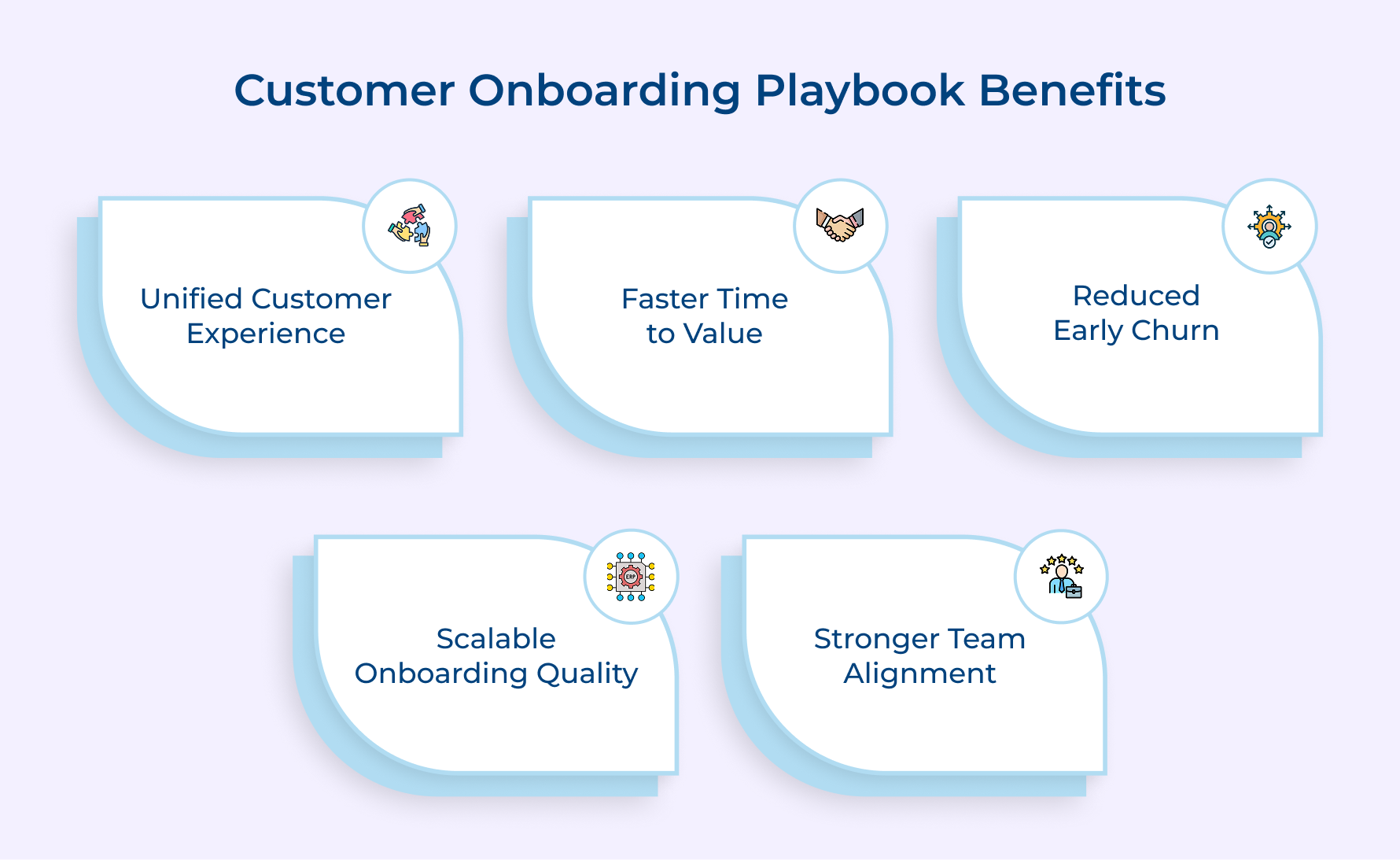
1. Unified Customer Experience Across Every Account
Do you know what happens when two customer success managers try to onboard a client? They follow a different approach without a common documentation. A playbook is used to make sure a customer gets the same experience regardless of who has the ownership.
2. Faster Time-To-Value For New Customers
A pre-defined playbook means the team stops wasting time figuring out the next step. It helps customers reach their first meaningful outcome faster. That early builds confidence of customers in continuing using the product.
3. Reduced Churn In The First 90 Days
The first 90 days are the high time when customers’ churn decisions are made based on how they feel supported. A good playbook keeps the success team proactive, so clients or customers never feel alone in the onboarding journey.
4. Scalable Onboarding Without Losing Quality
A playbook helps teams to scale onboarding without quality compromise. It is because the system includes knowledge instead of individual people. Hiring new team members becomes a serious risk without proper documented processes.
5. Stronger Internal Alignment Between Teams
Most onboarding fails when there is no alignment with sales promises and success team’s delivery. A clear playbook creates a reference point for all the teams to maintain proper coordination. Customers always experience a seamless handoff.
How To Build An Effective Customer Onboarding Playbook: 7 Steps
Follow the eight important steps to develop a customer onboarding playbook template that sets your business apart, to make sure loyalty and satisfaction are achieved from the first interaction
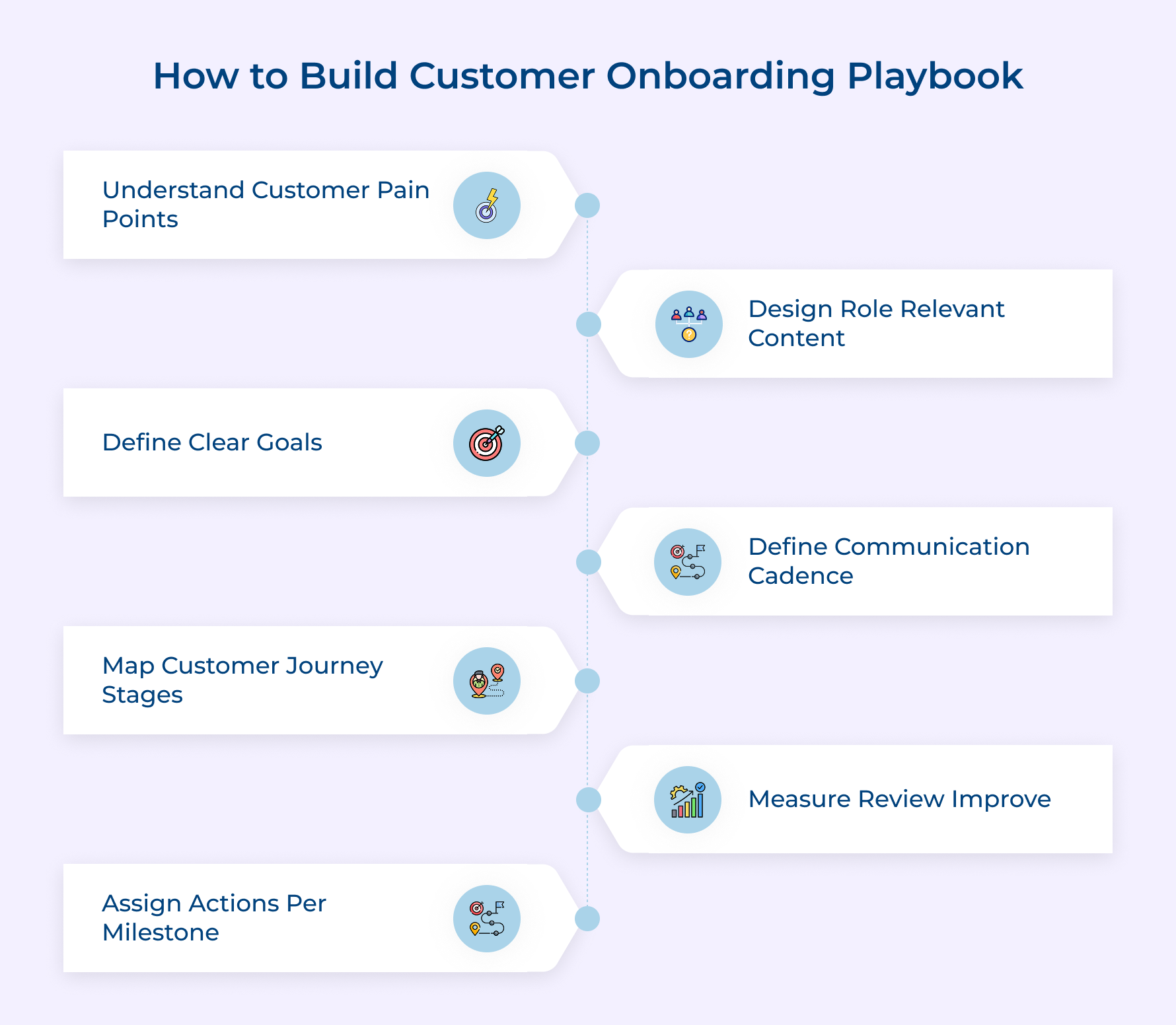
1. Research And Understand Your Customer’s Pain Points
An effective onboarding playbook starts with a deep understanding of your client or customer’s needs and goals. Build your playbook on assumptions without clarity and you fail consistently.
Think of it like a roadmap to a destination; the customer never agrees when your success team skips customer research and jumps straight into the onboarding playbook template. It ends up just serving the team’s convenience instead of actual success.
Do not know how to understand customer pain points, ask these questions:
- What does success look like for this customer in the first few weeks?
- What is the pain point that stops them from achieving this goal earlier?
- In which situation did they struggle with their previous solution?
- Are there any internal challenges that slow down their progress?
What can be done other than asking this question? To understand customer sentiment better, running a discovery call before onboarding begins gives the success team real context. No CRM can capture this fully. It reveals operational realities that directly shape your playbook execution.
So, after the discovery call, how to make sure sales insights are reaching the success team? The sales-to-success handoff is the point where critical context gets lost and that gap directly creates friction. Maintain proper collaboration and follow up after successful handoff.
2. Define Clear Goals For Your Playbook
Clear onboarding goals convert a customer playbook from a simple checklist into a structured system that drives better outcomes.
So, how to define goals that are actually best for the playbook? Separate internal team goals from customer success outcomes. Both need clear representation inside the playbook structure.
Here are some examples of customer onboarding playbooks to focus on first:
- Reduce average time-to-value by 10 to 15 days
- Achieve 80% task completion rate within the first 20 days of onboarding
- Target a minimum CSAT score of 8 post customer onboarding
So, what next? Make sure goals are aligned with customer needs. A playbook goal misaligned with the client’s business is like a situation where you celebrate completion while the customer is dissatisfied.
Pro tips: Set internal success benchmarks to provide management with a shared standard for measuring onboarding performance. It makes it easier to spot which accounts are falling behind early.
3. Map The Customer Journey Stages
Customer journey mapping gives the playbook a backbone that shows exactly where the customer stands in every stage of onboarding. Three effective ways to map customer journey stages:
- Interview recently onboarded customers: Talk to customers who have just completed onboarding. It reveals the real path they took in comparison to path the team assumed to expose critical gaps.
- Analyse product usage data by cohort: Look for situation customer segments drop off within the product. It helps to identify which stages have the highest friction and need most support
- Collaborate with the sales team on handoff insights: Sales interactions provide early signals about your customers to help build a journey map based on them.
Consider examples of SaaS project management tools where the journey map reveals 60% of customers did not complete the initial step, which suggests reshaping the early onboarding playbook sequence.
4. Assign Actions And Owners Per Milestone
Assign specific actions and owners in each milestone to transform the playbook into an operational system. What happens when you create a playbook without ownership? It’s just a simple documentation everyone reads, but nobody executes with proper accountability.
Start assigning team actions by breaking the milestone into specific tasks to act on immediately without confusion. This clarity separates customer success teams that consistently hit onboarding milestones from those that are constantly overdue.
Follow these practical methods to do this effectively:
- Use a milestone matrix with its owner and its due date in one unified view
- Break larger milestones into 3 to 5 smaller tasks with individual deadlines
- Tag each task at the customer-owned or team-owned level to make sure accountability is visible from the first day.
Once tasks are broken down, distribute ownership clearly between the customer and team to make it the next critical move. For example, when the milestone is “integration complete,” the customer owns API credentials while the success manager has the ownership to schedule the technical walkthrough.
So, once ownership is distributed, set deadlines and follow-up triggers per action. It keeps the onboarding moving because both sides will quietly deprioritize when other priorities compete for attention.
5. Design Engaging And Role-Relevant Content
Design onboarding playbook content is for delivering the correct information to the right person. Generic content can’t connect with anybody and onboarding engagement drops.
Key factors to consider to drive engaging content:
- Audience role clarity: identify exactly which playbook content is built for an admin and which for clients or decision-makers
- Outcome-led messaging: Each piece of content must connect directly to the customer goals that they want to achieve
- Format relevance: personalize content format based on roles to consume information
What happens when you build content around a role? It gets consumed by most users that do not get bookmarked and ignored. Below are the customer’s role-relevant content types for the onboarding playbook:
- Interactive product walkthroughs: Step-by-step guides for end users to learn by doing in their workflow
- Role-specific SaaS customer onboarding checklists: Separate tasks based on admins, end users based on distinct responsibilities across the onboarding.
- Use-case based help docs: Clear documentation around customer scenarios instead of product features to stay actionable.
Pro tip: Do not just build content once and never update. Fix it quarterly based on a proper review assigned by the success team’s calendar.
6: Define Your Onboarding Communication Cadence
Design a playbook touchpoint based on needs, with a defined timing, channel and purpose to keep customers progressing without churn.
Consider these questions before implementing communication cadence:
- What is the right channel for each onboarding communication?
- How frequently successful teams reach out during the first few weeks?
- What triggers prompt unplanned outreach to a customer that churn?
These questions make sure that communication decisions are made proactively to create a rhythm that customers can feel and consistency builds trust.
A defined cadence protects from over-communicating with engaged customers. Touchpoints with a trigger help the team to stop debating and start delivering value.
best practices:
- Set an automatic alert system when a customer has not logged into a milestone within a timeframe
- A full communication sequence to the playbook for the success manager to follow the same standard
7. Measure, Review And Continuously Improve
A customer onboarding playbook template that once built silently fails until churn. A proper measurement identifies if the playbook is delivering the goal that it was designed to achieve.
Monitor these basic onboarding KPIs:
- Time-to-value: Number of days taken for customers to reach their meaningful outcome after onboarding starts.
- Onboarding completion rate: The total percentage of customers completing defined milestones within the time span.
- Early churn rate: number of customers who disengage within the first few weeks
Once KPIs are tracked consistently, build a review cycle that turns insights into improvements. Think of your playbook as a living document that gets sharper with every customer onboarding cohort that passes through.
Pro tips:
- Track churned accounts along with expanded accounts to identify playbooks that create the biggest outcome difference
- After every onboarding completion, send a short survey to improve based on the real customer experience
Key Strategies For Your Customer Onboarding Playbook
A structured playbook is only half the work. Embedding the right strategy inside it determines how customers actually reach success through the motions of onboarding.
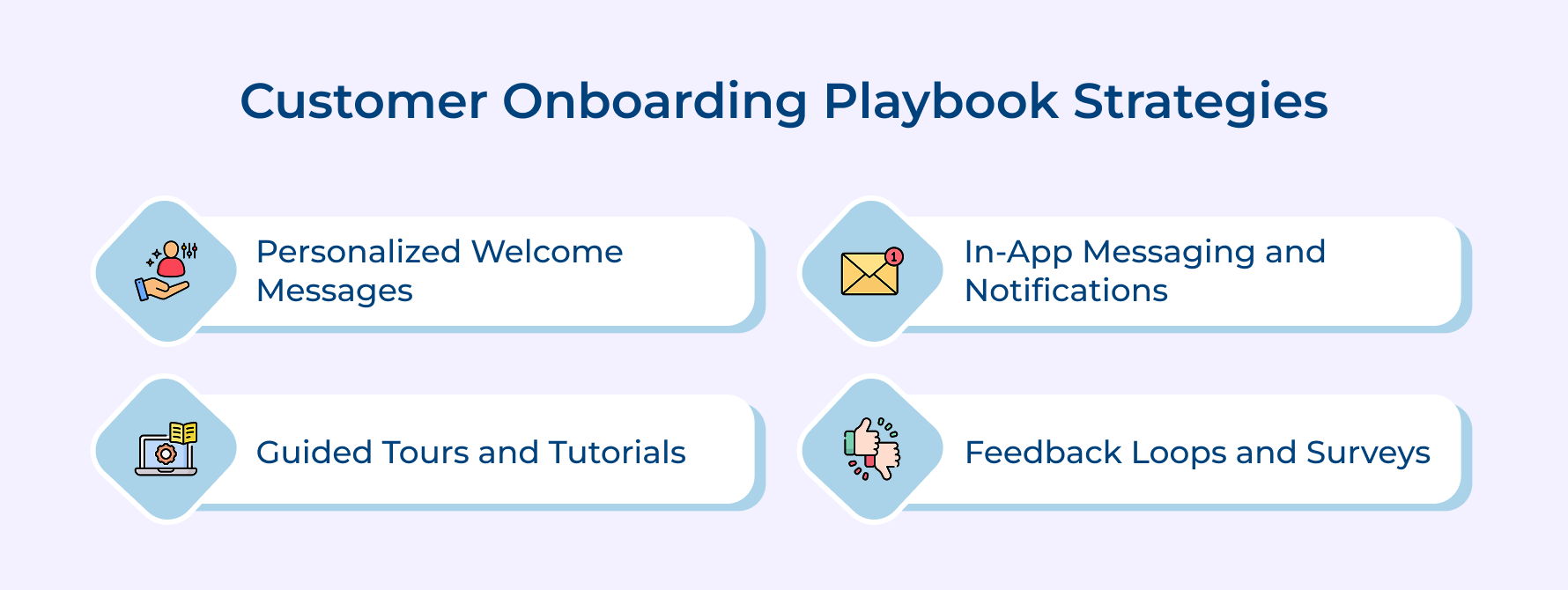
1. Personalized Welcome Messages
A welcome message is the real signal to customers about how well teams know their specific goal. It immediately builds customer confidence that onboarding ahead will be equally intentional.
2. Guided Tours and Tutorials
Is a guided tour just a product demo replay? No, it’s more than that. It is a sequenced experience walking customers through the value moments they need. Works best by adding the necessary cognitive load that drives retention.
3. In-App Messaging and Notifications
In-app messaging delivers the right text at the right moment inside the product, which makes it much more efficient than a follow-up email. Send it in the morning, just after a customer has disengaged, to get better results.
4. Feedback Loops and Surveys
Onboarding playbook failures are invisible because clients never complain before they churn. A good customer feedback loop is best. It gives early warning before disengagement becomes an irreversible retention.
Simplify Customer Success With The Best Onboarding Playbook
A strong customer onboarding playbook builds the foundation for long-term retention and predictable revenue expansion. Customer success teams that continuously refine their playbook consistently outperform those that rely on guesswork and individual effort.
- Build your playbook around customer pain points so every onboarding touchpoint drives engagement and confidence.
- Assign clear ownership per milestone along with a defined communication cadence, so that success managers don’t improvise during engagement drops.
- Consider your success onboarding playbook as a living system and optimize it after cohort to convert customer retention into a scalable growth driver.
Start auditing your current customer onboarding playbook and identify the first stage where engagement is consistently missed. Teams that treat it as a strategic system are the ones that turn new customers into long-term advocates.
Limit time — not creativity
Everything you need for customer support, marketing & sales.

Neeti Singh is a passionate content writer at Kooper, where he transforms complex concepts into clear, engaging and actionable content. With a keen eye for detail and a love for technology, Tushar Joshi crafts blog posts, guides and articles that help readers navigate the fast-evolving world of software solutions.