7 Ways AI in Professional Services Is Changing Firms
- What Is AI in Professional Services?
- Factors Affecting AI Workflows in Professional Services
- Key Benefits of AI for Professional Services
- Implementation Strategies for AI in Professional Services
- Practical Examples of AI in Professional Services
- Challenges of Implementing AI in Professional Services
- Metrics to Measure the ROI of AI in Professional Services
- What is The Future of AI in Professional Services?
- Harness the Power of AI to Elevate your Professional Services.
- FAQs about AI in Professional Services

Key Highlights:
- AI in professional services is the deployment of intelligent systems that automate heavy tasks without replacing the humans on whom firms are built.
- Firms using AI reportedly deliver in 60% less time before ever reaching firm-wide rollout across all critical workflows.
- Make AI deployments scale without breaking under pressure with workflow auditing combining with data cleaning foundations and team training.
Do you know what the real cost of running your firm on manual workflows in 2025 is? It’s slower delivery, inflated overhead and senior professionals buried in tasks with no client value.
Generative AI has the potential to automate tasks that absorb 60-70% of employees’ time, while most service firms have only done the initial research.
AI in professional services is all about deploying intelligent systems powered by natural language processing and machine learning to manage data-intensive tasks. It includes task management such as contract analysis, financial reconciliation, regulatory research and client reporting.
Explore how AI restructures firm operations with the key factors shaping successful deployments, implementation strategies and metrics that measure ROI. Also, get a structured roadmap for evaluating for the first time or scaling an existing deployment.
What Is AI in Professional Services?
AI in professional services is all about deploying intelligent systems to handle tasks that require human expertise. These systems process data to identify patterns and generate outputs that support decision-making across firms such as legal, financial as well as consulting work.
Professional service firms are built on human judgment, but generative AI is now handling the heavy lifting of data processing. It focuses on higher-order thinking instead of spending hours on repetitive analysis.
The firms that are adopting AI are fundamentally changing project delivery to clients. It creates a measurable difference in professional output across speed, accuracy and quality.
Primary objectives:
- Efficiency: AI reduces the time spent on repetitive and heavy tasks so professionals can focus on important work.
- Accuracy: Automated systems minimize human error in operations such as document review and financial reconciliation.
- Scalability: Professional service firms use Gen Ai to handle workloads without increasing headcount in operational tasks.
- Client Value: Improves the quality of advice delivered to clients for Faster turnaround and deeper data insights.
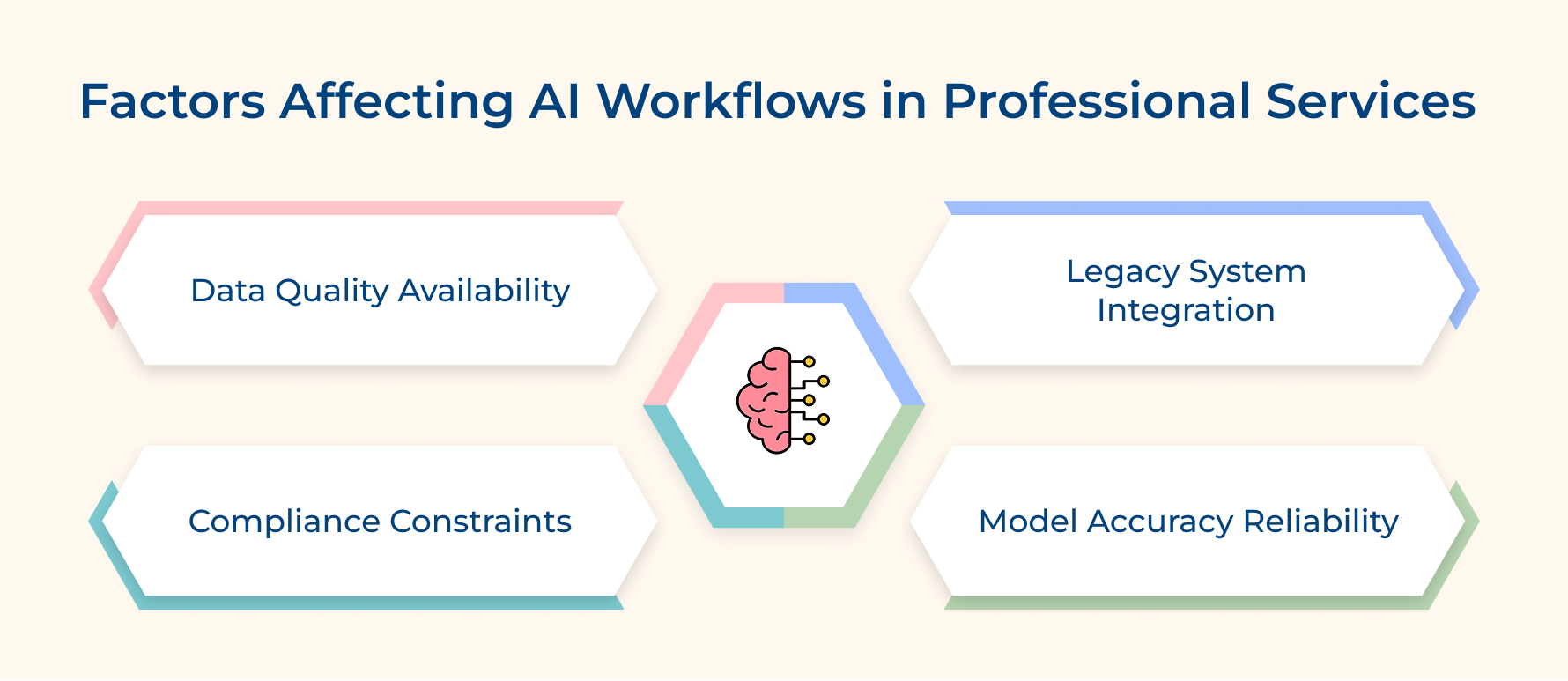
Factors Affecting AI Workflows in Professional Services
Use cases of AI fail because most professional services underestimate what shapes them. Consider these factors to determine AI deliverables.
1. Data Quality and Availability
Poor data is the key factor in every AI workflow in professional services to fail. Irrelevant data produces false output. In high-stakes environments such as legal or finance, the cost is enormous.
So what does good data actually look like?
- Data should be structured consistently across departments and systems.
- Are all outdated data records to be eliminated that could skew AI outputs
- Maintain a proper framework for the firm for better data integrity.
2. Integration With Legacy Systems
Most professional services still depend on legacy software that can’t integrate with modern types of AI tools. New layers, when forced onto old infrastructure, create friction that slows the entire workflow.
3. Regulatory and Compliance Constraints
Professional services operate in heavily regulated environments, so use AI in those areas to streamline the workflow. It works brilliantly in one jurisdiction, but can be non-compliant in others.
Some of the Critical compliance considerations include:
- Data privacy: Laws such as GDPR restrict how AI stores client information.
- Industry regulations: Sector-specific rules govern AI in financial advice as well as legal documentation.
4. Model Accuracy and Reliability
A good AI model that performs well during testing still fails in real-world environments. So reliability in live workflows depends mainly on continuous monitoring instead of one-time deployment.
What are the core reliability factors to consider?
- Edge cases: The capability of the model to handle situations outside AI training data to determine real-world dependability.
- Output consistency: Results remain stable and accurate across similar inputs over time.
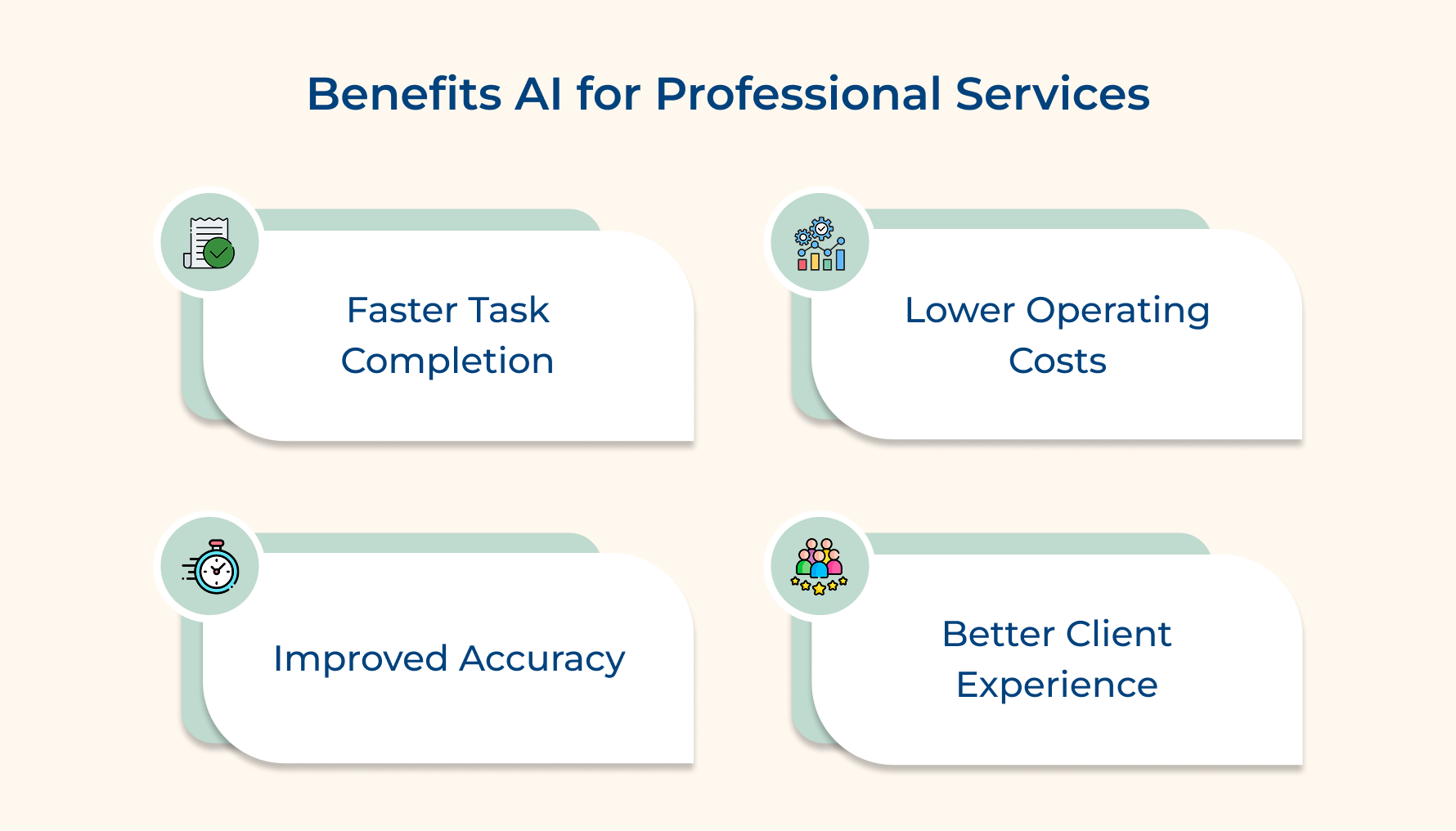
Key Benefits of AI for Professional Services
AI not only improves operations in professional services but also redefines what’s possible and the measurable value created.
Faster Turnaround on High-Volume Tasks
Think of a situation where tasks such as contract review or financial reconciliation that require more hours of senior professionals now get completed easily with AI. It directly translates into faster client project delivery without sacrificing quality.
Reduced Operational Costs
AI handles heavy work without the overhead cost that comes. It leads to significant reductions in labor costs once AI is used in core operational workflows.
Enhanced Accuracy and Error Reduction
AI brings a level of consistency that manual processes cannot match in environments where a single compliance error can trigger penalties. Automated checks run frequently across documents without the fatigue that affects human reviewers.
Stronger Client Experience
What do most clients expect in today’s environment? Faster responses, deeper insights and proactive advice from service providers. AI enables professional service firms to meet those expectations by automating background work that used to delay client-facing deliverables.
Implementation Strategies for AI in Professional Services
Explore the key strategies that provide a roadmap to achieve effective use cases of AI integration in professional services firms.
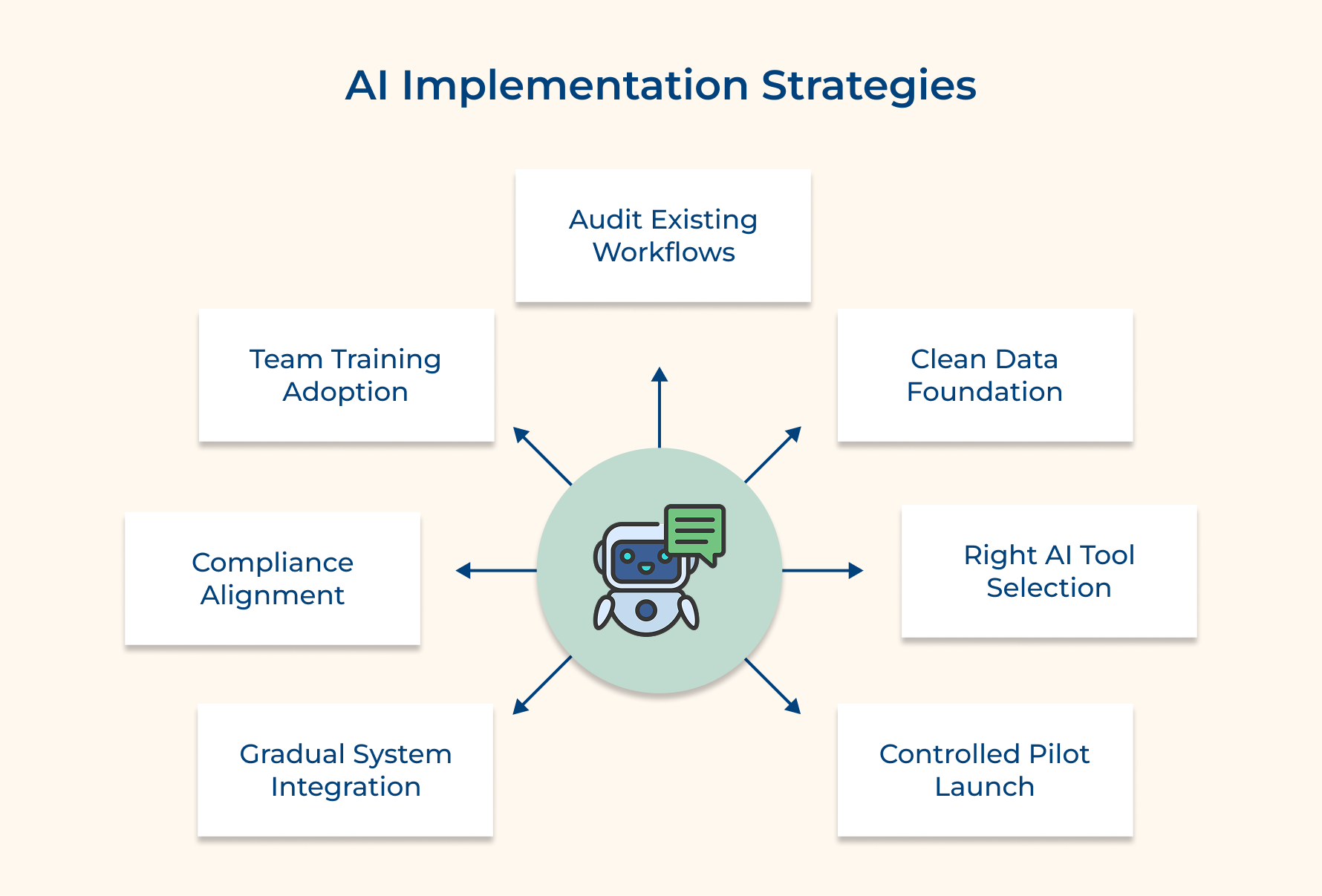
1. Audit Workflows Before Deploying AI
Most firms are deploying AI without understanding their operational inefficiencies. Maintain a thorough workflow audit to create a diagnostic foundation. It determines how AI will generate the highest ROI.
Follow these effective ways to audit your existing workflows before deploying AI:
- Process mapping: Start by shadowing teams that build workflows daily instead of relying on documented charts. Real execution always changes from what is written, which is where AI opportunities hide.
- Time tracking analysis: Track task completion time across team members managing identical workflows to identify inconsistencies. A high time variance means process standardization through AI becomes operationally necessary.
- Output quality review: Track error rates across workflows before making any AI decision. Persistent rework patterns reveal the exact position where inconsistency is creating downstream costs. AI systematically eliminates the issue.
Firms underestimate that sensitive workflow audits can become problematic when they expose inefficiencies to specific teams. Overcome it by framing the audit as a growth initiative instead of a performance review.
2. Build a Clean Data Foundation
AI agents depend on the data they are trained and operate in professional service environments. Firms that are treating data as an afterthought are consistently struggling to generate outputs worth acting on.
Inconsistency in data formats also creates errors that compound as AI models process larger volumes. Built a firm-wide data library along with a defined structure to eliminate reconciliation problems across every critical field.
Consider these key actions to eliminate further inconsistency:
- Audit data entry practices across every department into shared systems
- Maintain a consistent format for client records, financial entries and case data
Outdated records encode obsolete patterns that actively mislead outputs over time. Proper governance protocols help in preventing data quality from degrading.
3. Choose the Right AI Tool
The right artificial intelligence tool selection is the key strategy that many professional services make mistakes. They prioritize features over fit. The tool must integrate easily into existing workflows and deliver reliable outputs on specific tasks.
So, what are the factors to evaluate when choosing the right solution?
- Domain relevance: AI Tools built for generic enterprise use can rarely handle the nuance of professional services such as legal, financial or advisory workflows.
- Accuracy benchmarks: Streamline performance data on tasks that mirror the actual workflows, where vendor demos are rarely representative.
- Integration compatibility: Choose a tool that does not need to rebuild existing infrastructure.
So, how do firms avoid vendor noise to make a selection decision? Run a structured evaluation with actual firm data against a defined scorecard to get a clear visibility into the decision.
Pro tip: Make a benchmark of shortlisted tools against peer organizations of comparable size and complexity.
4. Start With a Controlled Pilot
Generative AI deployment without a controlled pilot in professional services ends up creating more operational disruption than eliminating. A proper framework generates the performance evidence to scale AI responsibly across workflows.
Consider this checklist before launching a pilot:
- Is the workflow low-risk to tolerate errors during real-time testing?
- Are success metrics defined before starting the pilot testing?
- Is there any documentation for a rollback plan if AI performance is below thresholds?
Consider the example of a mid-sized financial firm that piloted AI for client report generation. It reduces draft preparation time by 60% while keeping advisors in the review loop. That parallel structure made the results credible enough to justify a firm-wide rollout.
Pro tips:
- Define a failure threshold before the pilot launches, as the post-result process can introduce biases.
- Keep at least one senior skeptic on your team for stress-test outputs without defaulting to enthusiasm.
5. Integrate Gradually With Existing Systems
Service firms that attempt full-scale AI adaptation within a single phase encounter operational disruption. Maintaining a gradual integration flow to enable each AI component to prove its reliability before deploying the next layer.
Most legacy systems in professional services carry institutional data and workflow that can’t be recreated. It is better to treat these systems as integration partners rather than replacements.
Effective integration methods for embedding AI into existing systems:
- API-based connectivity: Use APIs to connect AI tools to existing platforms to preserve underlying system architecture and enable intelligent data sync.
- Middleware layering: Translate communication between legacy software and modern AI applications by deploying middleware solutions that do not require system modification.
- Phased module replacement: replace individual components with AI-powered equivalents so each replacement is validated.
Pro tip: Test each integration phase in a controlled staging environment to catch compatibility failures before they appear in live workflows.
6. Align AI Tools With Compliance Requirements
A compliance failure in professional services triggered by a general AI tool carries consequences that extend beyond financial penalties. It leads to loss of firm reputation and client trust. It is so how building a compliance alignment into AI deployment helps? It is comparatively cheaper and safer than retrofitting it after problems are identified.
Key factors that determine AI compliance alignment:
- Data residency: AI systems must store client data within jurisdictions permitted by applicable regulatory frameworks and client agreements.
- Explainability standards: AI-assisted decisions affecting a client outcome must be defensible by a qualified human under regulatory scrutiny.
- Consent frameworks: Client data flowing into AI workflows covered by consent agreements that explicitly account for AI processes.
So how do firms move beyond treating compliance as a deployment checklist? Teams must collaborate with technology leads during vendor evaluation. Their input prevents the contractual mistakes that become expensive later.
7. Invest in Team Training and Adoption
The gap between AI tool capability and firms’ actual use of it is almost always a people problem instead of a technology problem. A structured training adoption program helps in converting AI investment into measurable operational performance across firms, such as professional services, legal, etc.
Follow the training and adoption methods for AI integration:
- Role-Specific Workflow Training
- Peer Champion Programs
- Scenario-Based Simulation Exercises
- Micro-Learning Modules
Role-specific training works best as professionals adopt gen AI tools faster when they understand the proper use cases in solving problems they encounter. It creates awareness but rarely changes how teams actually behave within the real workflow.
Best practices:
- Identify those who embrace AI early and formalize their role as internal champions that accelerates peer adoption.
- Track adoption through utilization metrics tied to workflow outputs, as only the completion of training doesn’t tell you anything about behavioral change.
Practical Examples of AI in Professional Services
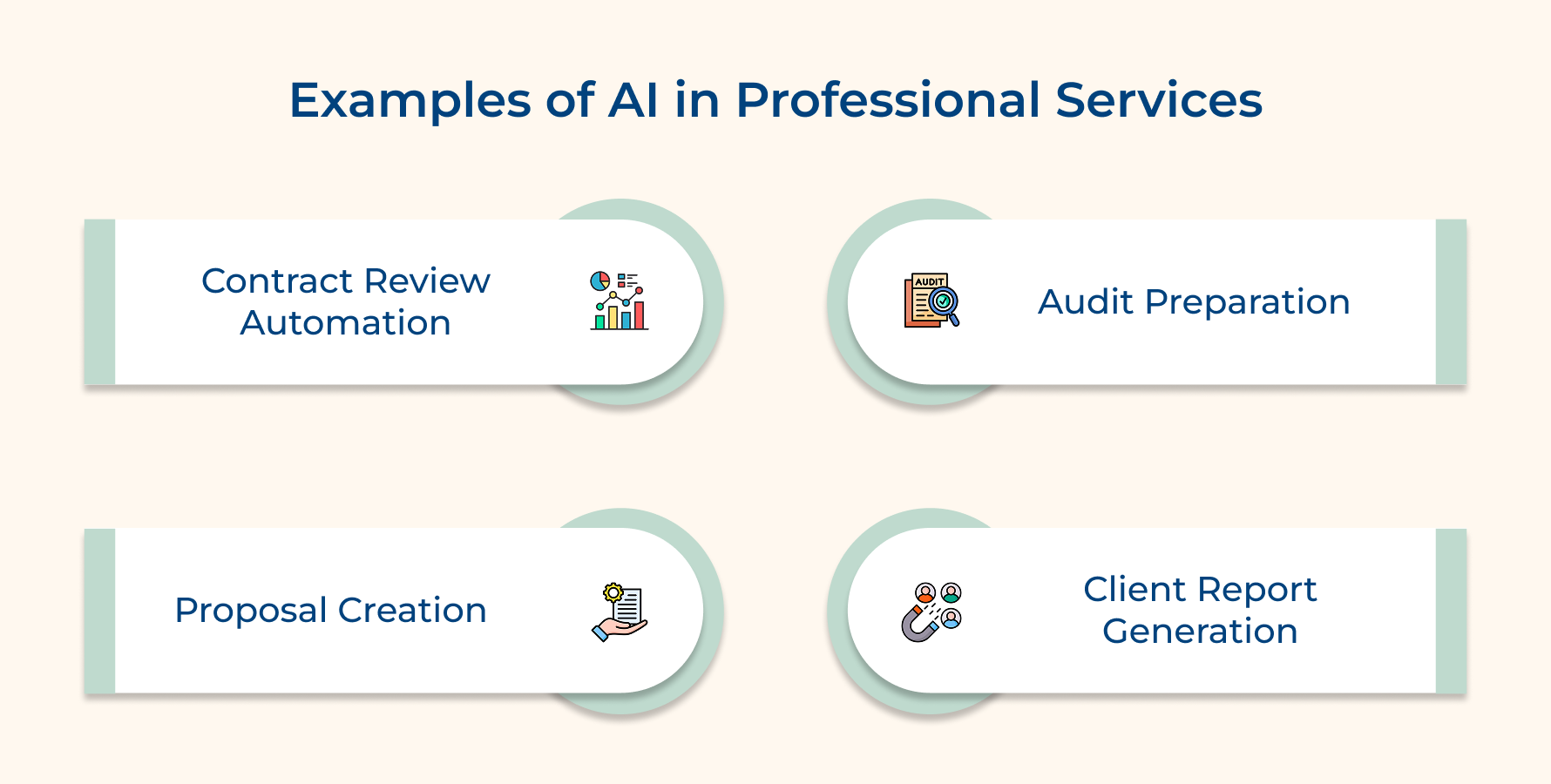
Consider the examples that show the exact gap that AI deployment can eliminate in professional services:
1. Contract Review in Law Firms
Law firms use AI to scan thousands of contracts simultaneously and identify non-standard clauses that carry risk. Previously, a group of junior associates used to spend days identifying, but now it gets completed with greater consistency in a fraction of the time.
2. Financial Audit Preparation in Accounting Firms
Most accounting firms deployed AI to cross-reference transaction records against benchmarks and identify anomalies that warrant auditor attention. It transforms an auditor’s role from manual data checking to higher-value judgment calls that need more expertise.
3. Proposal and Pitch Development in Consulting Agencies
Consulting agencies now analyze past proposal performance data and identify the content patterns with AI that consistently win mandates. It helps the team to invest less time in building decks from scratch and spend more time redesigning the strategy that differentiates their pitch.
4. Client Reporting in Financial Advisory Firms
Advisors spend hours on report assembly by reducing that time toward proactive client relationship management. AI helps in auto-generating client portfolio reports by pulling live data and using it against specific investment parameters.
Challenges of Implementing AI in Professional Services
Understand these challenges before AI deployment separates firms that scale AI successfully across their entire workflow.
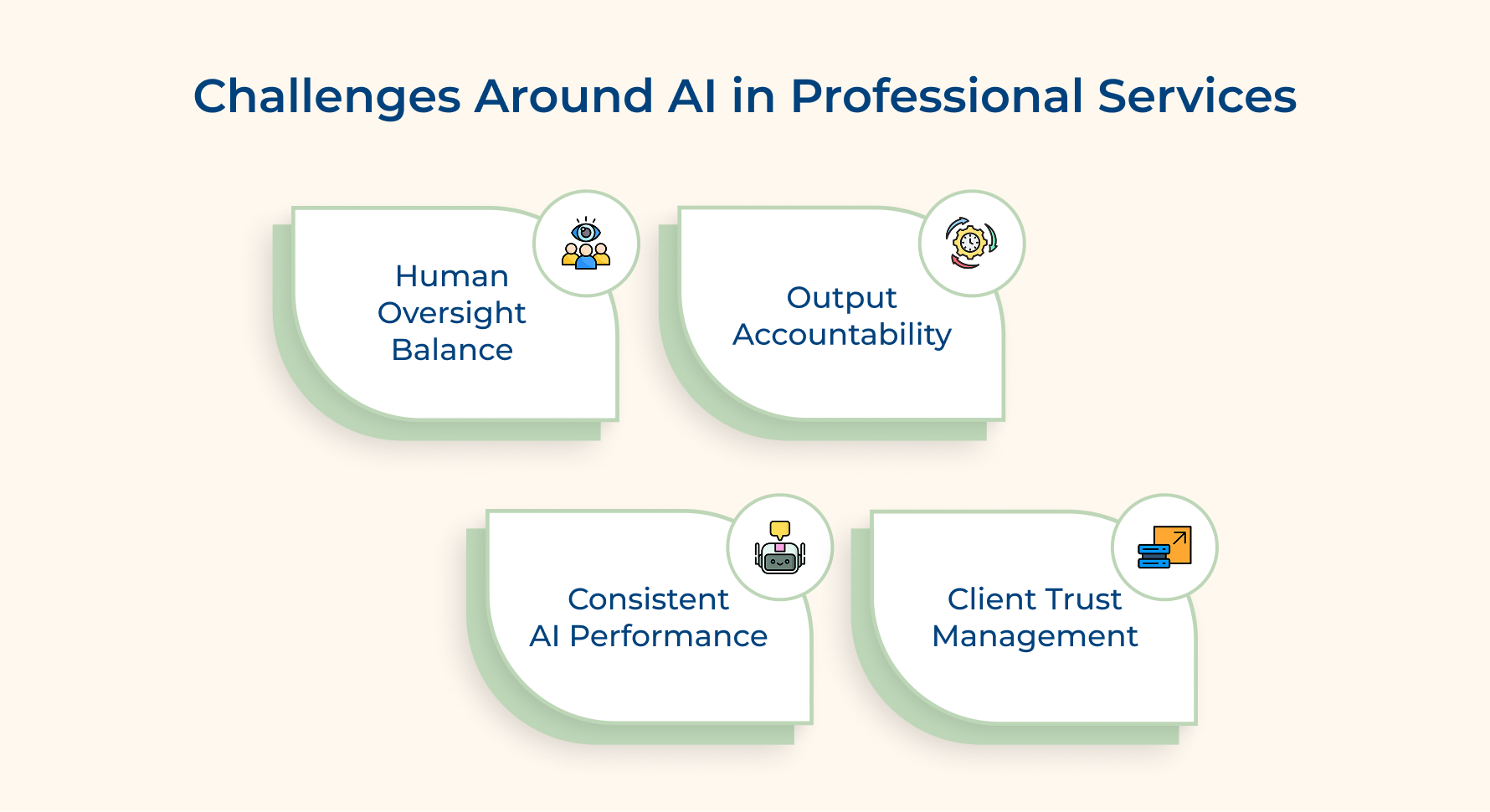
1. Maintaining Human Oversight Without Slowing Down Workflows
The more AI automates, the harder it becomes to maintain meaningful human review without recreating bottlenecks AI meant to eliminate. It leads firms into a paradox where oversight protocols designed for manual workflows actively undermine AI deliveries.
How to overcome it?
- Design tiered review structures for AI to manage volume while humans focus on exceptions
- Maintain a clear thresholds that trigger human review instead of applying it uniformly
2. AI Output Accountability in Client-Facing Deliverables
When an artificial intelligence generates an error and it reaches the client, professional service accountability becomes complicated. The ambiguity around ownership of AI creates serious liability for the firm.
Overcome it by?
- Establishing a sign-off protocol to provide personalized human accountability at every AI output
- Maintain proper documentation along with a review process for AI-assisted deliverables in client agreements
3. Keeping AI Performance Consistent Across Complex Cases
AI tools work best on standardized tasks but face difficulty when work involves jurisdictional or multi-layered client circumstances. Most agencies and firms identify this inconsistency after deploying in live workflows.
How to address it?
- Test AI tools on complex edge cases before approving live deployment.
- Limit AI on higher-stakes engagements that need more professional judgment
4. Managing Client Perception and Trust Around AI Use
Many clients in professional services require human expertise. AI involvement can trigger concern when outputs feel standard instead of personalized. Not being able to manage this perception risk can damage relationships over the years.
Overcome it by developing a transparent communication policy that explains AI involvement in service delivery. Also, giving clients real-time visibility into human judgment contributes to their engagement
Metrics to Measure the ROI of AI in Professional Services
Measuring the ROI of artificial intelligence in professional services needs to look beyond cost savings and move towards operational and client outcomes.
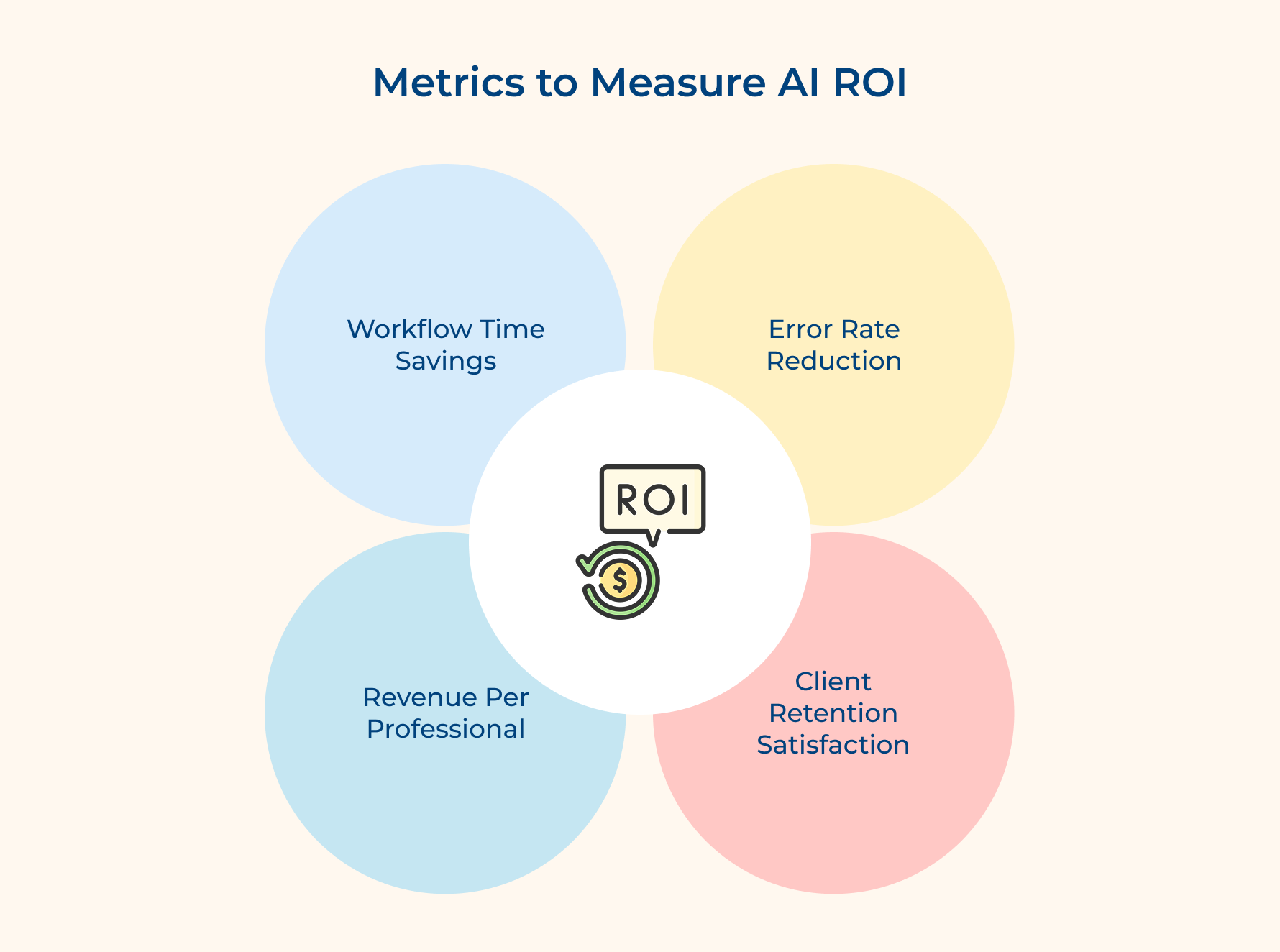
1. Time Saved Per Workflow
Time saved per workflow indicator is the performance of your integrated AI in the current workflow. Track the average completion time before and after integration to identify a credible performance gap.
2. Error Rate Reduction
The metrics track AI consistency in delivering accurate outputs in comparison to manual processes managing the same tasks. A declining error rate means reduced rework costs and stronger outcomes across all operational workflows.
3. Revenue Per Professional
Revenue per professional reveals the impact of AI on each team member to deliver more billable value within working hours. An increase in the rate means AI is expanding capacity instead of simply shifting the time spent.
4. Client Retention and Satisfaction Scores
Client satisfaction and retention scores connect AI performance to relationships that sustain growth. After AI deployment, an increase in score means faster project delivery and higher output accuracy in creating the client experience.
What is The Future of AI in Professional Services?
Explore how developments define how professional service firms operate and compete in the next decade of operations:
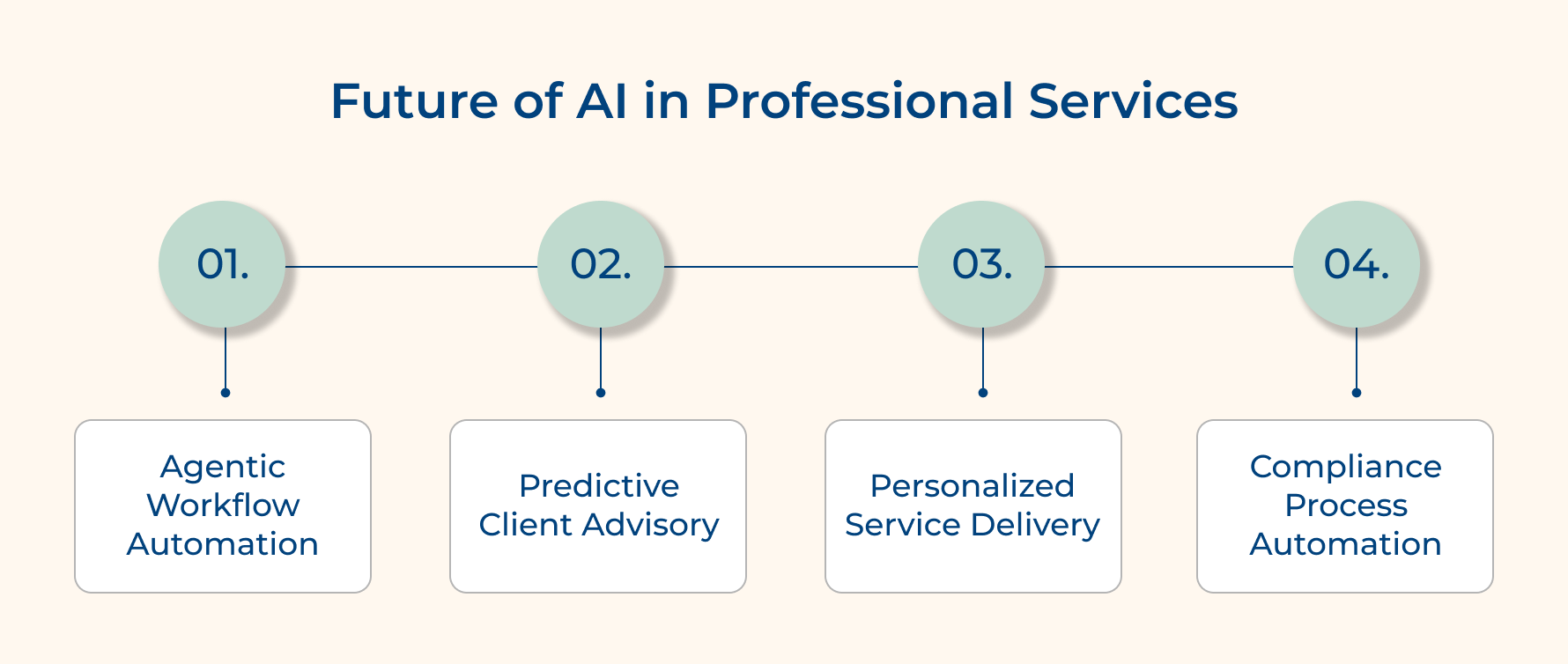
1. Agentic AI Tools Taking Over Multi-Step Workflows
Agentic AI tools move beyond single-task automation in professional services to execute complex workflows without human prompting. The entire process, such as client onboarding, gets completed end-to-end with an AI system.
Firms that build infrastructure for AI today will operate at a speed as well as scale that manual-dependent simply cannot match.
2. AI-Powered Predictive Client Advisory
AI shifts agencies from a reactive delivery toward predictive client advisory by continuous data analysis. It helps in identifying client risks and opportunities before they recognize themselves.
The capability transforms the advisor role to a proactive strategic partner with data-backed foresight. Firms delivering predictive insights will lead to stronger client relationships and higher retention.
3. Hyper-Personalized Client Service Delivery
AI helps to tailor every client interaction based on preference data, engagement history and real-time needs. Personalization at this level was impossible without disproportionate resource investment.
4. AI-Driven Compliance Automation
Regulatory environments become complex and move for manual monitoring to remain viable. AI will track regulatory changes and automatically update business workflows to maintain compliance without human involvement.
Harness the Power of AI to Elevate your Professional Services.
AI deployment in services firms involves building a structured layer that delivers consistent value to client engagement without depending on human efforts. Firms that treat AI for professional services as a strategic priority are improving workflows and also building an advantage at every touchpoint.
- Audit workflows before deploying, as AI built on a broken process delivers a broken experience.
- Build data quality alignment into deployment and not as an afterthought once problems surface in live workflows.
- Measure outcomes across touch points such as saved per workflow, error rate reduction, and revenue per professional.
Build your AI professional services framework and measure the impact on delivery speed within the first full deployment. Firms that scale AI with intention consistently transform efficiency into long-term client trust.
Limit time — not creativity
Everything you need for customer support, marketing & sales.

Neeti Singh is a passionate content writer at Kooper, where he transforms complex concepts into clear, engaging and actionable content. With a keen eye for detail and a love for technology, Tushar Joshi crafts blog posts, guides and articles that help readers navigate the fast-evolving world of software solutions.