Proven Strategies for Sustainable Agency Growth in 2026

Key Highlights:
- Developing agency growth requires building specialized service niches, which positions your agency as the go-to expert and attracts premium clients.
- Recurring revenue models are essential for agency growth, providing predictable income and enabling strategic planning for long-term business stability.
- Leveraging technology boosts agency growth by streamlining operations, improving efficiency, and freeing up your team for higher-value work.
Most professional service agencies struggle with unpredictable revenue streams that create constant stress about where the next project will come from. You watch competitors achieve seemingly effortless growth while your team works harder without meaningful progress.
Every month brings exhausting patterns of scrambling for new clients, managing cash flow gaps, and watching talented team members leave for better opportunities. Meanwhile, specialized competitors command premium rates for similar work through superior positioning.
The eight proven agency growth strategies we explore provide systematic roadmaps for breaking free from reactive business models and building sustainable competitive advantages. These approaches help agencies develop specialized expertise and create predictable revenue streams.
What is Agency Growth?
Agency growth represents the strategic expansion of your professional services business through increased revenue streams, expanded service offerings, and enhanced market presence. Think of it as building a stronger foundation while simultaneously reaching higher – you’re not just getting bigger but becoming more valuable to clients.
Growth focuses on building new revenue sources and expanding what you offer, while scaling emphasizes maximizing efficiency from existing operations. Growth asks “what new things can we do?” whereas scaling asks “how can we do current things better?” Growth often requires investment in new areas, while scaling optimizes what already works.
Key objectives:
- Revenue diversification creates multiple income streams that reduce dependence on any single client or service.
- Service expansion allows you to solve bigger problems for clients and command higher fees.
- Market positioning establishes your agency as the go-to expert in specific niches or industries.
- Team development builds the talent and expertise needed to deliver expanded services effectively.
- Client relationship deepening transforms transactional work into strategic partnerships that generate recurring revenue.
Best Benefits of Growing an Agency
Growing your agency is about unlocking opportunities that transform how you operate and compete. Here’s how growth makes a real difference:
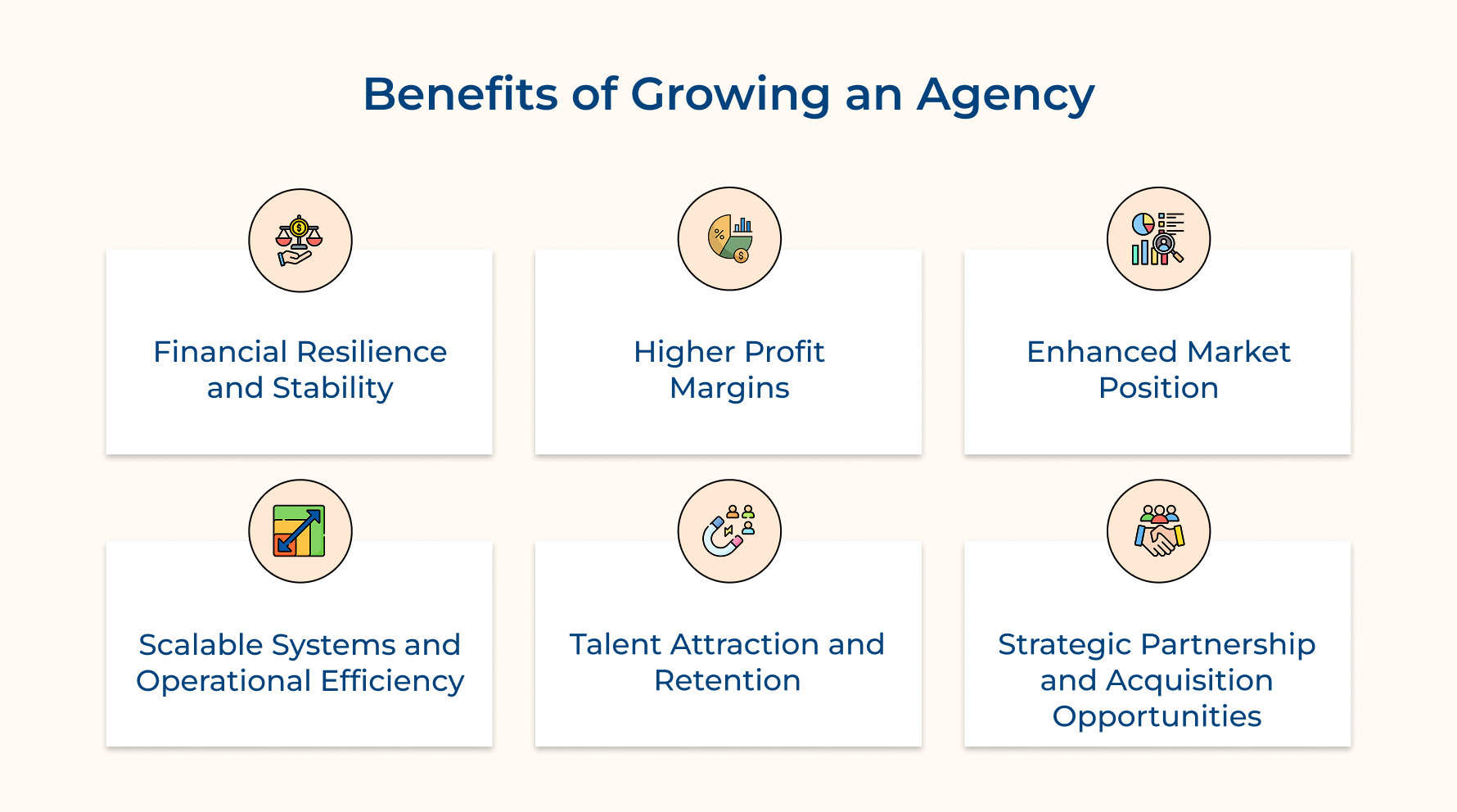
Financial Resilience and Stability
Multiple revenue streams protect you from client losses or market dips. One client leaving won’t shake your business.
Higher Profit Margins Through Specialization
Growth allows you to focus on what you’re best at. Specialization leads to higher perceived value and higher rates.
Enhanced Market Position and Credibility
As you take on more complex work, your credibility grows. You attract better clients with bigger budgets and more exciting projects.
Scalable Systems and Operational Efficiency
Growth pushes you to streamline operations. With better systems in place, you reduce per-project costs and free up time for strategic work.
Talent Attraction and Retention Benefits
Top talent looks for opportunity. A growing agency offers clear career paths and learning options that keep your best people motivated.
Strategic Partnership and Acquisition Opportunities
Bigger, successful agencies catch the eye of investors and partners. Growth gives you options, from joint ventures to acquisition opportunities.
8 Effective Ways to Scale and Grow Your Agency
Here, we present eight proven strategies to help your agency not only survive, but thrive. These are the keys to unlocking your agency’s potential and fueling its journey to success.
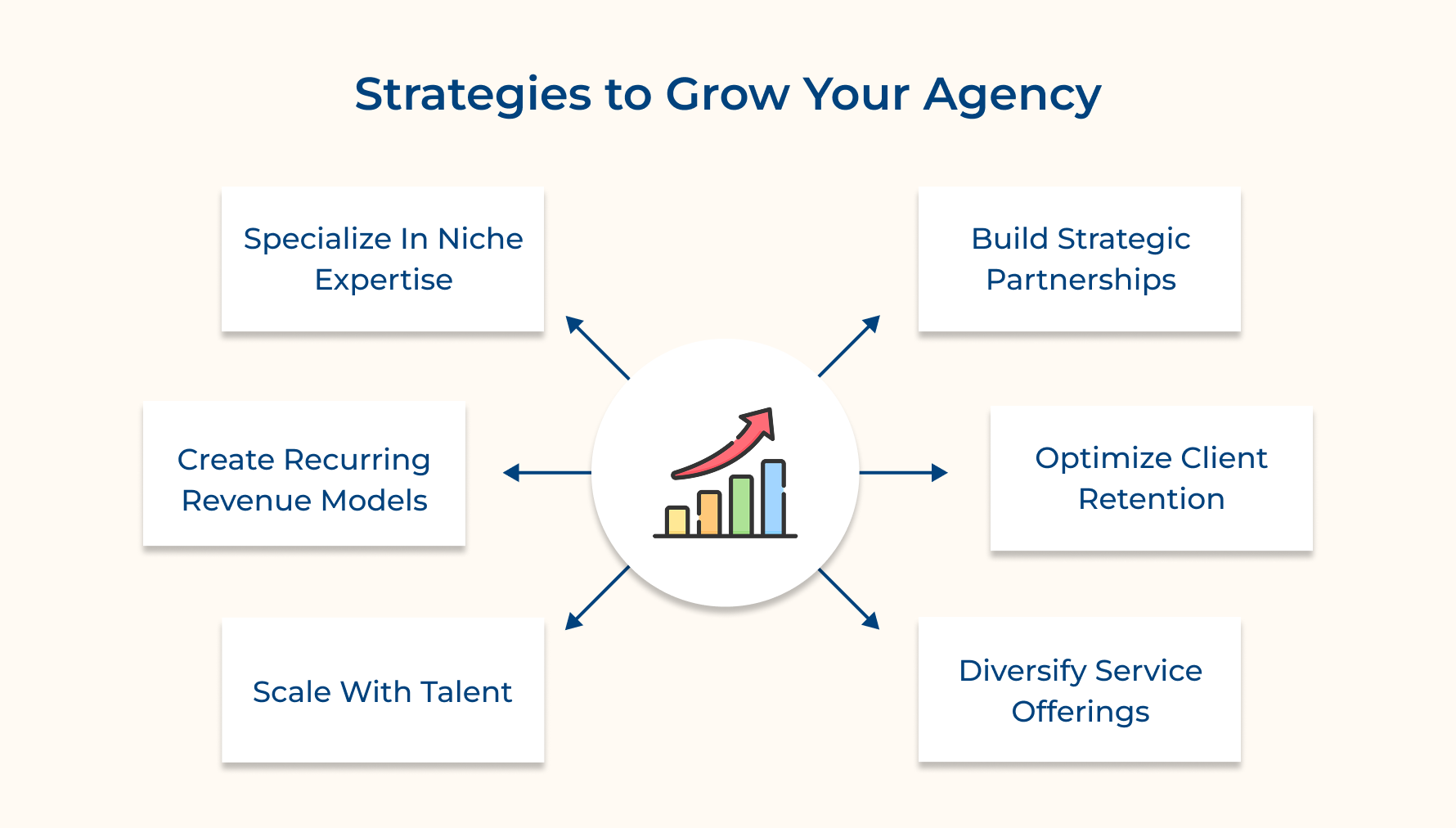
1. Develop Specialized Service or Client Project Niche Expertise
Specialization turns your agency into the go-to expert, not just another option on a long list. When you focus deeply on a niche, clients trust you to handle their toughest challenges.
Here’s where to sharpen your edge:
- Industry know-how: Know the rules, regulations, and quirks of your client’s sector. It builds trust fast.
- Technical expertise: Go beyond the basics. Build deep skills your competitors can’t match, backed by real experience and certifications.
- Thought leadership: Share what you know. Write articles, speak at events, and publish insights that prove you’re the expert.
A marketing agency focused on healthcare compliance easily wins premium clients because they know HIPAA like the back of their hand.
2. Build Strategic Partnership Revenue Channels
Partnerships can supercharge your agency’s growth without heavy marketing spend. By teaming up with trusted organizations, you tap into their networks and earn instant credibility.
Here are four high-impact partnership channels to explore:
- Law firms: Often need expert consultants for litigation support or compliance-heavy projects.
- Tech companies: Look for implementation partners to help clients roll out and optimize their software solutions.
- Industry associations: Want training partners who can provide workshops, certifications, or thought leadership for their members.
- Complementary agencies: Serve similar clients with different services. Create referral loops that benefit both sides.
Identify partners whose clients need your services, but aren’t in direct competition. Start by mapping your ideal client’s journey and spotting who they trust along the way.
3. Create Recurring Revenue Service Models
Recurring revenue can be a game-changer for service agencies. Instead of chasing the next big project to keep the lights on, you build a steady, predictable income that lets you plan with confidence and grow strategically.
Here’s how to do it:
Proven Recurring Revenue Models:
- Monthly Retainers
Offer ongoing consulting or strategy hours for a fixed monthly fee. Clients love having expert access without starting from scratch every time. - Subscription-Based Advisory Services
Package industry insights, regular updates, and priority Q&A into tiered plans. Great for clients who need support, but not full-time hand-holding. - Ongoing Optimization & Performance Monitoring
Continue supporting your past projects (whether it’s analytics, campaigns, or systems) with monthly check-ins, refinements, and reports.
Before You Launch, Ask Yourself:
- What valuable support can we offer monthly that clients can’t easily do themselves?
- What pricing and commitment levels will match our clients’ budgets as well as decision cycles?
- Can we turn any of our one-time services into long-term optimization offerings?
- Do we have the systems and capacity to deliver consistent value—without stretching our team too thin?
Clients get continuous results and your agency gets dependable income with the right model.
4. Optimize Client Retention and Expansion
Client retention is about growing with them. When clients stick around, they trust your work, already know your value, and are far more likely to invest in new services. In fact, retained clients often generate 67% more revenue than new ones.
Want to turn one-time projects into long-term partnerships? Try this:
Quarterly business reviews: Use these meetings to uncover new opportunities before clients even ask for help. It shows foresight and positions you as a strategic partner.
Exceed expectations: Deliver a little more than promised. Small wins and surprises go a long way in building loyalty.
Loyal clients don’t just stay, they grow with you and send more business your way.
5. Scale Through Team and Talent
Grow without burning out your team, strategic talent acquisition and development is key. It helps you take on bigger projects, serve more clients, and still maintain top-notch quality.
Hire to Fill Growth Gaps
Bring in talent that complements your current strengths like:
- Data & BI experts for insights-driven decisions
- Digital marketing pros for scalable campaigns
- Financial strategists to align services with ROI
- Tech implementers to integrate systems smoothly
Invest in Team Development
Ongoing training shows commitment to excellence. Prioritize:
- PMP certification for project managers
- Compliance training for industry trust
- Tech platform certifications for implementation confidence
Want a true ownership mindset? Offer equity or profit sharing. When employees benefit from business success, they think like owners and act like it too.
6. Diversify Service Offerings and Solutions
Diversifying your services is essential. It reduces risk and helps you stay relevant as client needs evolve beyond your core offerings.
Here’s how to expand strategically:
- Follow client signals: If clients keep asking for services just outside your current scope, that’s your cue. Build those capabilities around real, proven demand.
- Add digital transformation consulting: Help clients modernize operations through automation and tech adoption. These high-impact services often justify premium pricing and long-term value.
- Offer training programs: Teach clients how to sustain what you’ve built. Workshops, guides, and onboarding sessions turn into extra revenue streams while deepening trust.
Service expansion done right doesn’t dilute your focus, it makes your agency more indispensable to every client you serve.
7. Leverage Technology for Operational Efficiency
Integrating the right technology doesn’t just make your agency more efficient, it boosts client satisfaction and frees your team from time-draining admin work.
Here are four tech upgrades worth prioritizing:
- Project Management Automation Tools
Automate task tracking, deadlines, and reporting across all projects. So, your team stays focused on delivery, not chasing updates. - Client Portals
Give clients real-time access to progress, documents, and billing. It builds transparency and cuts down on endless email threads. - Data & Performance Dashboards
Track profitability, team output, and client feedback in one place to make smarter, faster decisions. - Document Version Control
Ensure everyone’s always working with the latest files, no more digging through old emails or duplicates.
Choose tools that enhance existing workflows, not overhaul them. Keep it seamless, smart, and scalable.
8. Establish Thought Leadership and Brand
Thought leadership positions your agency as the authoritative voice in your industry while attracting clients who specifically seek recognized experts rather than commodity service providers.
This strategy works by creating content and speaking opportunities that demonstrate your deep expertise while building trust with potential clients before they ever contact your agency. When prospects already know your reputation and capabilities they arrive as warmer leads who are more likely to engage premium services.
Best practices:
- Focus on solving real industry problems through your content rather than promoting your services directly.
- Consistency in publishing and speaking creates cumulative credibility that compounds over time along with market visibility.
Challenges of Growing an Agency and Tips to Overcome Them
Growing agencies face complex obstacles that can derail expansion efforts and strain existing operations. These challenges often emerge unexpectedly when success creates new problems.
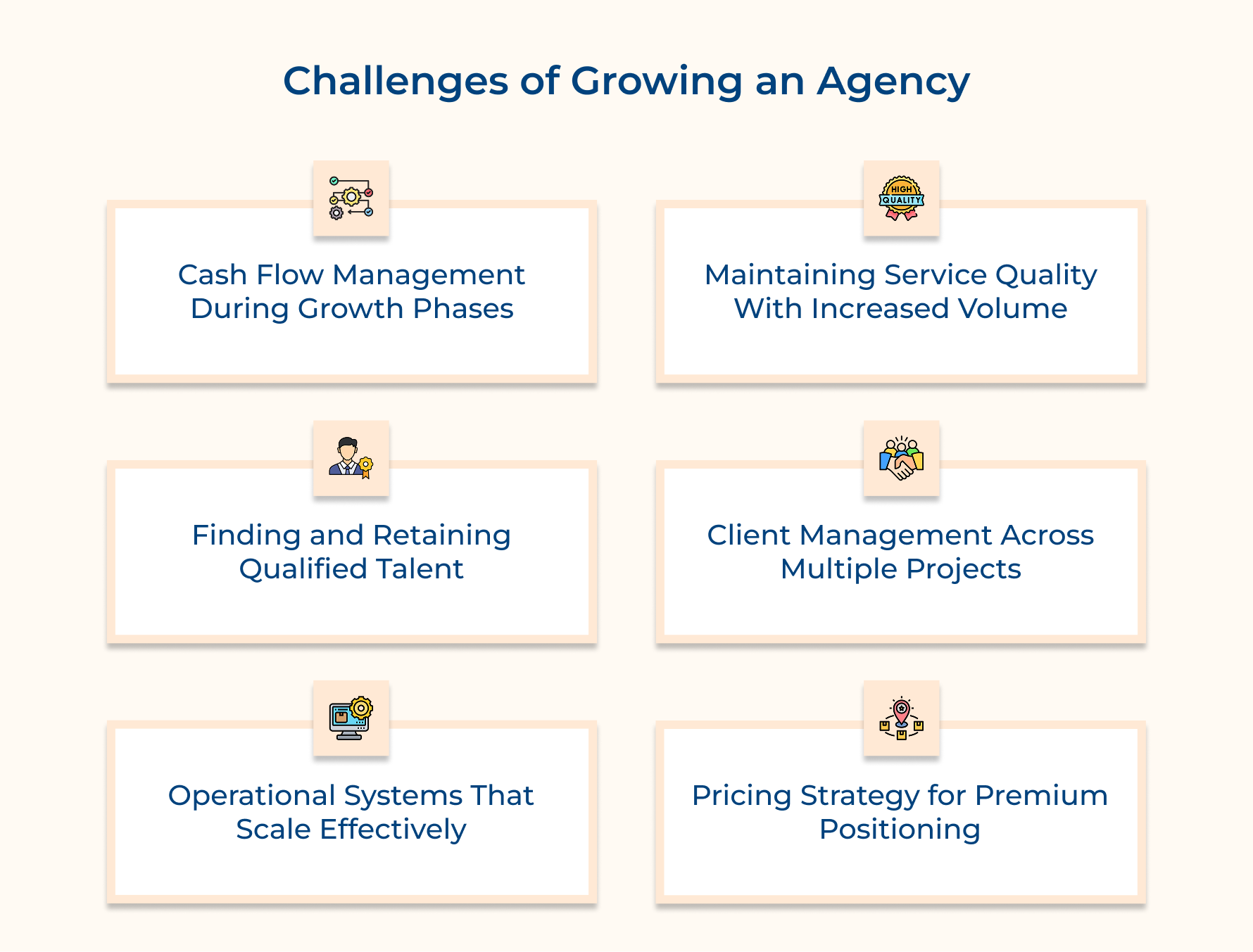
Cash Flow Management During Growth Phases
As you take on bigger projects and hire new talent, there’s often a delay between investment as well as payment. Even profitable agencies can hit a cash crunch. That’s why smart agencies forecast aggressively and keep larger reserves to stay financially sound.
Maintaining Service Quality with Increased Volume
Rapid growth means more clients, tighter timelines, and more pressure. Without the right systems, quality can slip. Agencies solve this by creating standardized processes, clear quality checkpoints, and scalable workflows that preserve excellence no matter the volume.
Finding and Retaining Qualified Talent
You can’t deliver great work without great people. But as competition for skilled professionals rises, so do expectations. Successful agencies offer career growth paths, upskilling opportunities, and compensation that makes people want to stay.
Client Management Across Multiple Projects
Your target audience expects consistent, personalized service, even when your client list multiplies. Dedicated account roles and clear client communication plans ensure no one gets lost in the shuffle.
Operational Systems That Scale Effectively
What worked with 5 clients won’t work with 20. Growth-ready agencies invest early in scalable tools and document processes before things get chaotic.
Pricing Strategy for Premium Positioning
Growth means it’s time to stop undercharging. Value-based pricing reflects your enhanced capabilities and credibility, just make sure you’re clearly showing that value to prospective clients.
Successful Agency Growth Examples and Key Lessons
These real-world examples demonstrate how different agency types successfully implement growth strategies while maintaining their core client service excellence. Each case illustrates specific approaches that other agencies can adapt to their unique circumstances.
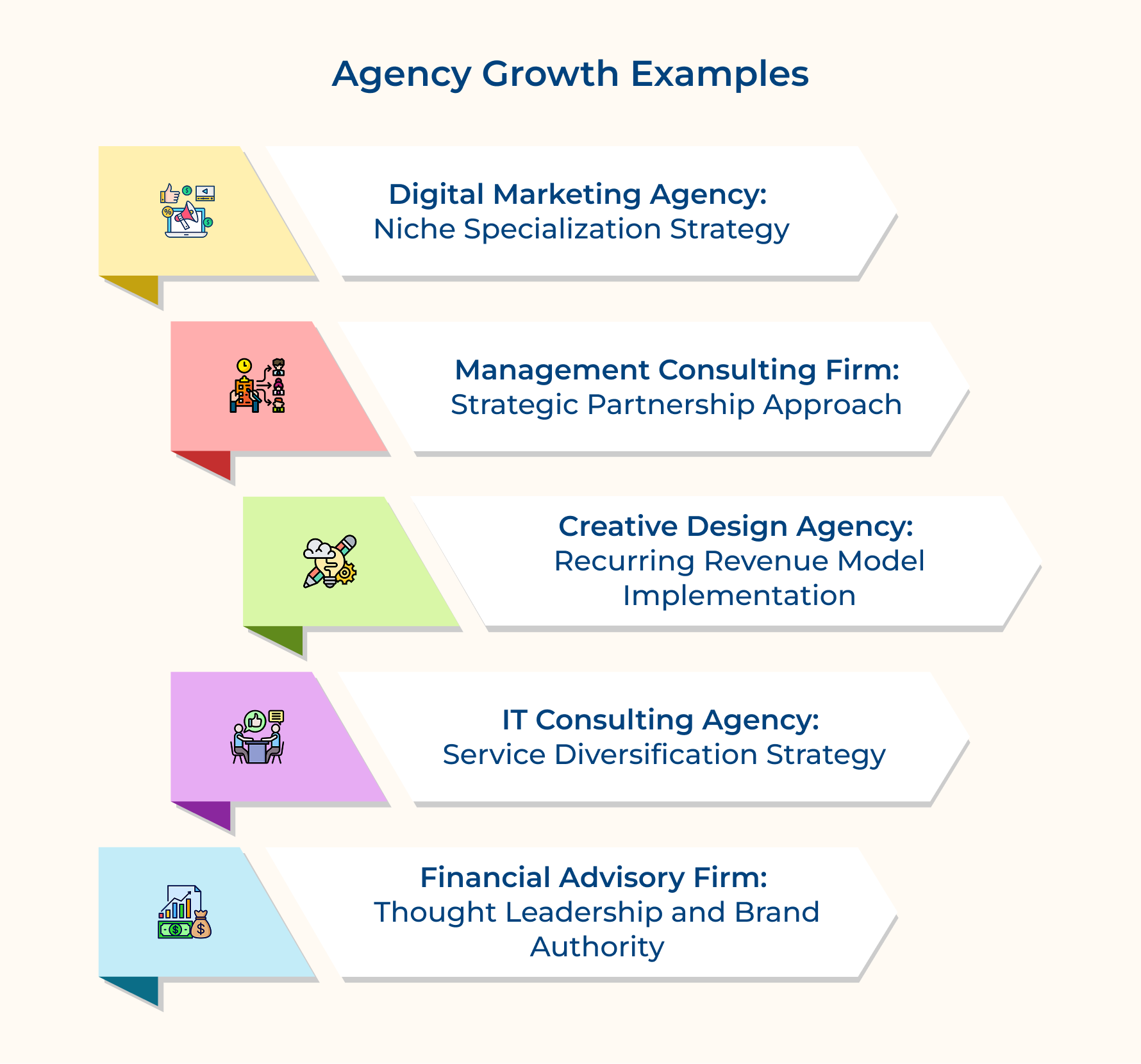
Digital Marketing Agency: Niche Specialization Strategy
This agency transformed from a general digital marketing provider into the definitive expert for healthcare practices seeking HIPAA-compliant marketing solutions. They developed specialized knowledge of medical industry regulations as well as created service packages designed specifically for doctors, dentists, and medical device companies.
The specialization strategy enabled them to charge premium rates because competitors couldn’t match their regulatory expertise and industry-specific case studies. Client retention increased significantly because healthcare practices valued working with consultants who understood their unique compliance challenges and could navigate complex marketing restrictions confidently.
Management Consulting Firm: Strategic Partnership Approach
The consulting firm built partnerships with major enterprise software vendors like Salesforce and SAP to become their preferred implementation specialists. They trained their team on specific platforms and developed proprietary methodologies for helping clients maximize their technology investments through change management as well as process optimization.
These partnerships provided a steady stream of qualified leads from technology vendors while positioning the firm as the trusted advisor for complex digital transformation projects. Revenue became more predictable because software implementations typically require ongoing support and optimization services that extend well beyond initial project completion.
Creative Design Agency: Recurring Revenue Model Implementation
The design agency shifted from one-time logo and website projects to comprehensive brand management retainers that included ongoing content creation, brand guideline enforcement, along with marketing material development. They created tiered service packages that gave clients consistent access to creative resources without the unpredictability of project-based billing.
This model transformation stabilized cash flow and allowed for better resource planning while clients benefited from having dedicated creative support whenever marketing opportunities arose. The agency could invest in better talent and technology because they had predictable monthly revenue that supported long-term business planning as well as strategic initiatives.
IT Consulting Agency: Service Diversification Strategy
The IT consultancy expanded beyond basic technical support to offer cybersecurity assessments, cloud migration planning, and digital workplace transformation services. They identified adjacent services that their existing clients needed but were sourcing from multiple vendors, then developed capabilities to become a comprehensive technology partner.
This diversification reduced client acquisition costs because existing relationships provided natural expansion opportunities while creating multiple touchpoints that strengthened client relationships. The agency became harder to replace because clients valued having one trusted partner who understood their complete technology ecosystem rather than managing multiple vendor relationships.
Financial Advisory Firm: Thought Leadership and Brand Authority
The advisory firm invested heavily in creating educational content, speaking at industry conferences, and publishing research reports that addressed emerging trends in corporate strategic planning. They positioned their principals as recognized experts who regularly contributed insights to trade publications and participated in panel discussions.
The thought leadership approach attracted larger clients who specifically sought advisors with proven expertise and industry recognition rather than competing primarily on fees. Referrals increased dramatically because other professionals viewed them as subject matter experts worth recommending, while speaking opportunities provided direct access to decision-makers at target companies.
Empower Your Agency’s Potential with Strategic Growth
Strategic growth transforms your agency from a reactive service provider into a proactive market leader that shapes industry standards. When you implement specialized expertise, strategic partnerships, and recurring revenue models, your agency becomes the preferred choice for premium clients seeking proven results.
The journey requires patience and systematic execution, but the rewards extend far beyond increased revenue. Growth creates opportunities for your team to develop expertise, tackle challenging projects, and build lasting professional relationships that sustain success for years ahead.
Limit time — not creativity
Everything you need for customer support, marketing & sales.

Shivank Kasera is part of the marketing team at Kooper, where he focuses on building content that helps agencies and service providers grow. With a keen interest in SaaS, operations, and scalability, he translates practical insights into actionable resources for business leaders.