7 Steps to Scale Customer Onboarding Framework
- What is Scalable Customer Onboarding?
- What is the Importance of Scalable Customer Onboarding?
- Why Does Client Onboarding Break at Scale?
- How to Build a Scalable Customer Onboarding in 7 Steps
- Mistakes to Avoid When Implementing Scalable Client Onboarding
- Metrics to Track While Scaling Customer Onboarding Processes
- Maximize Your First Impression Through Powerful Client Onboarding Strategies
- FAQs about How to Scale Customer Onboarding
Key Highlights:
- Scalable customer onboarding is a structured framework that guides the first value without depending on manual intervention at each step.
- Poor onboarding loses new clients within the first week before reaching a meaningful product or service outcome.
- Automated segmentation to self-serve layers and successful team integration scale customer onboarding without breaking.
Most onboarding processes work best for the first few clients. So why does it quietly collapse the moment growth scale? It is rarely the team or the tools. The process was never designed to scale and every new client added exposes that gap more.
Businesses that invest in onboarding frameworks see more than 86% of improvement in long-term client retention. Scalable customer onboarding uses automation, client segmentation and self-serve workflows to guide new users to their first value moment.
Explore the key steps to scale customer onboarding, starting from closing expectation gaps to standardizing the journey and building a self-serve layer. Also, get a clear framework for building a process that grows with your business under pressure.
What is Scalable Customer Onboarding?
Scalable customer onboarding is a structured framework that guides new users to their first value moment without depending on the team to manually intervene. It is built to deliver a quality experience even when the business is serving 100 users or 100,000 users.
The onboarding process efficiently handles the rapidly growing load without breaking down or losing quality. It uses workflow automation and smart segmentation to deliver a consistent experience.
So, what is the difference between a regular client onboarding and scalable onboarding? The way it responds to growth. Regular onboarding relies on human intervention, while a scalable system is built to expand without proportional headcount.
Core goals of Scalable user onboarding:
- Drive activation: Transform users from sign-up to first action inside the product.
- Reduce time-to-value: Let users experience the core benefit of the product as fast as possible.
- Minimize drop-off: Identify missing touchpoints and eliminate those friction points early.
- Build product habit: Guide users to repeat behaviors that make it a part of their workflow.
What is the Importance of Scalable Customer Onboarding?
A weak framework silently kills retention, so build a client onboarding that helps to scale your growing business.
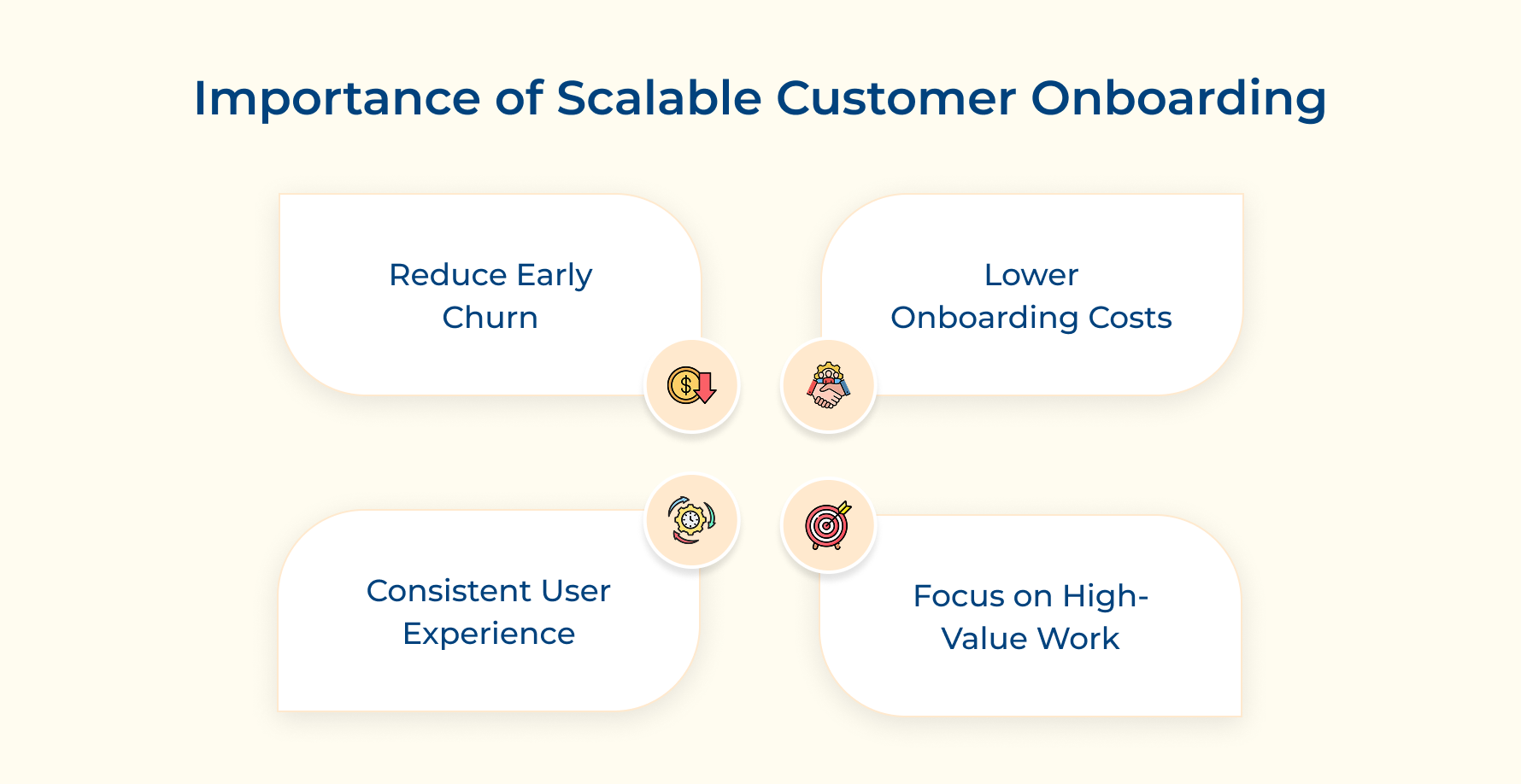
1. Reduces Customer Churn Early
Most news customers exit the onboarding process within the first week because they never reach their “wow moment.” A proper onboarding framework removes the risk by guiding every client toward value before confusion, also leading to scale business operations.
2. Lowers the Cost Per Onboarded User
The onboarding cost scales linearly when it depends heavily on manual effort with every new customer added. A good system uses automation and self-serve resources to onboard thousands without increasing the success team size.
3. Creates a Consistent User Experience
Human-led onboarding is inconsistent because different team members understand and explain things differently. So, how does a scalable customer onboarding framework help? It makes sure everyone has the same quality experience regardless of their time to sign up.
4. Frees Up the Customer Success Team for High-Value Work
Automation in routine onboarding tasks enables the success team to stop spending time on repetitive handholding. The time capacity can be redirected toward managing strategic, complex use cases.
Why Does Client Onboarding Break at Scale?
An onboarding that works smoothly for a few clients might completely break when it scales. The cracks do not just disappear with growth, instead get wider.
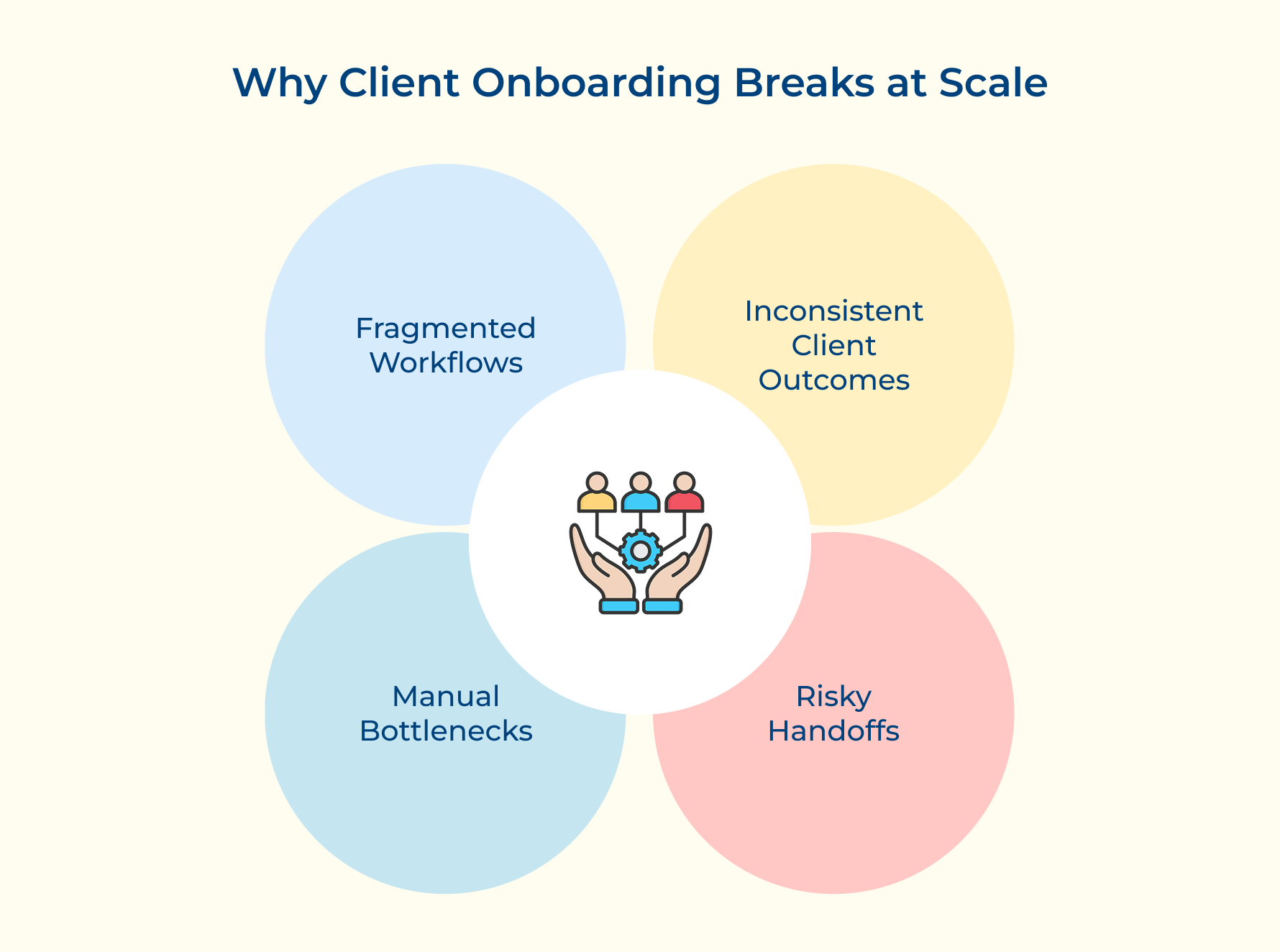
1. Fragmented Processes Multiply Confusion
Onboarding maintained across spreadsheets, emails and disconnected tools leads to increases the chance of losing new users. There is no single source of truth, so different team members operate from different versions of the framework at the same time.
2. Handoffs Amplify Risk Instead of Reducing It
Every time a client moves from sales to customer success, the most critical context gets lost in transition due to not having a unified system. It leads the client to repeat themselves, which erodes trust before the starting relationship.
3. Manual Tasks Become Unsustainable Bottlenecks
What feels unmanageable when onboarding is handled manually for 10 clients becomes a serious drag when scaling to 200 clients? Tasks such as sending welcome emails, scheduling kickoff calls and document submissions pile up faster than your team can process.
4. Lack of Standardization Leads to Inconsistent Client Outcomes
Team members that run onboarding based on their own understanding, provide a scalable customer experience, while others get a rushed or incomplete one. The inconsistency affects adoption rates and long-term retention, which are hard to diagnose.
How to Build a Scalable Customer Onboarding in 7 Steps
Follow these essential steps to build a client onboarding framework that adapts to your scaling business needs.
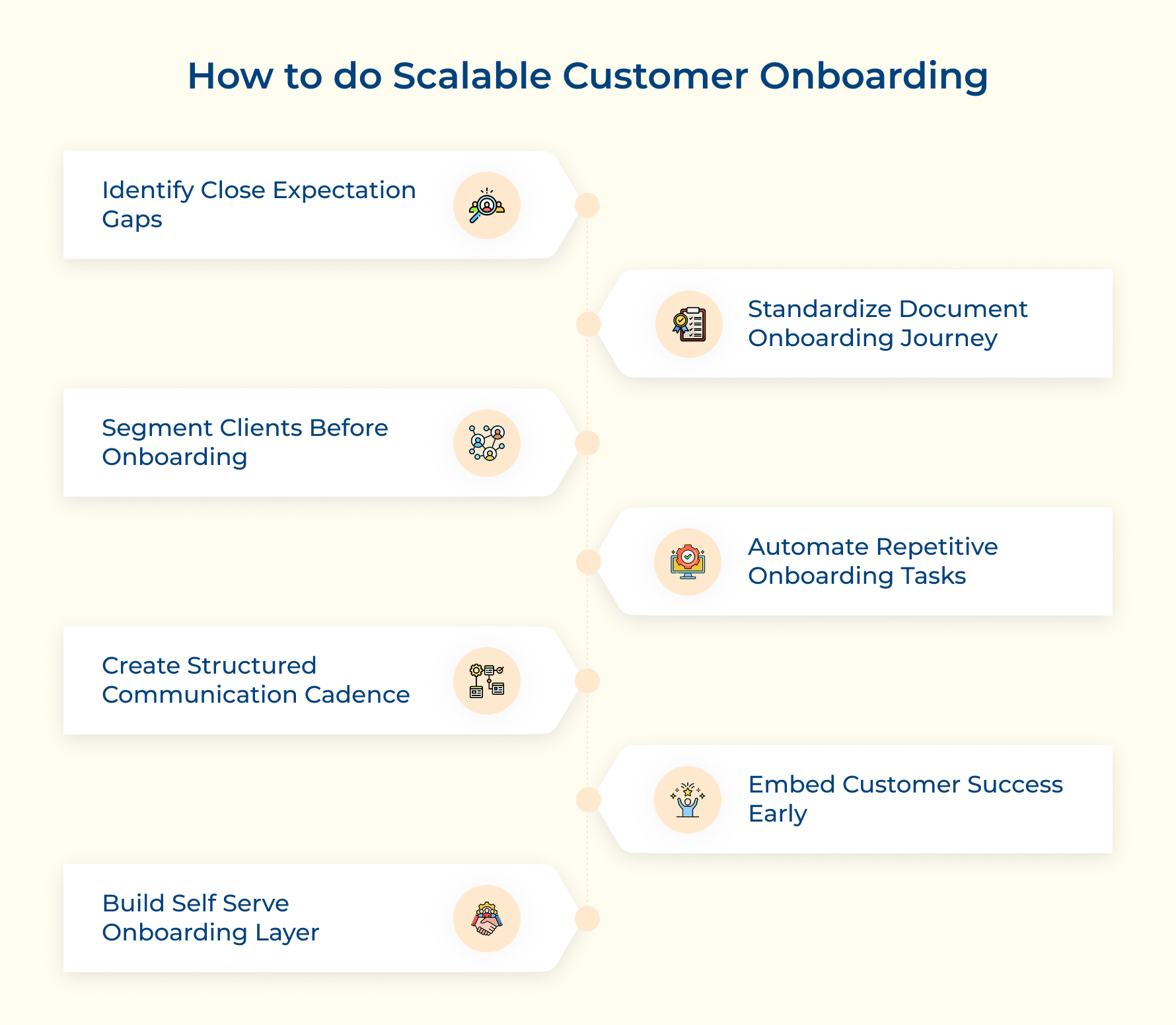
1. Identify and Close Expectation Gaps
Onboarding not only breaks during execution but also during the sales conversation that happened weeks before. Every unaddressed expectation mentioned by the sales team becomes a trust problem that the onboarding team inherits without context.
So, where to start for identifying the expectations mentioned by the team during deal closure:
- Where does the client’s “success” differ from the product’s capabilities?
- Which deliverables were communicated informally without proper documentation?
- What assumptions are clients carrying into onboarding that have never been mentioned?
The questions identify the gap between sold and actually delivered. It prevents early-stage onboarding conflicts that escalate into churn.
Consider an example of a mid-sized consulting firm that lost two enterprise clients because the sales team had overpromised. The customer success team had zero visibility into the commitments due to not having a scalable onboarding framework, which meant they failed from the first day.
So how to implement it in your onboarding flow:
- Create a sales-to-onboarding handoff document: Keep a record of every promise and expectation mentioned during the sales cycle before onboarding starts.
- Run a pre-onboarding expectation audit: Maintain proper internal collaboration between sales and success teams to identify commitments never been formally documented.
- Conduct an expectation alignment call with the client: Review your goal after the first onboarding session, so both sides operate from the same point.
2. Standardize and Document the Onboarding Journey
Most onboarding failures are process problems and not people problems. Every team member runs onboarding differently, without a standardized journey, leading to inconsistent client experience at scale.
Follow these ways to standardize and document the onboarding journey:
- Build a master onboarding playbook: A playbook documents every stage, task, owner and timeline so that onboarding runs consistently regardless of the ownership. New team members can use it without facing any difficulties.
- Create specific templates for every interaction: Standardized templates for each agenda to eliminate guesswork from client communication. It makes sure no important data gets missed due to a team member’s unavailability.
- Map every decision point and escalation path: Most onboarding rarely goes as planned. Teams need a clear path for handling exceptions. Define proper escalation triggers to prevent small issues from becoming major relationship problems.
Standardization means not just making onboarding rigid. It is all about building a strong onboarding framework that is scalable enough to handle customer exceptions without the process falling apart. The team’s energy should go toward high-value interactions instead of figuring out what happens next.
3. Segment Clients Before Onboarding Begins
Treating every client the same during onboarding leads to a mediocre experience for everyone. For example, a two-person startup and a 500-seat enterprise account cannot have the same onboarding journey. They should have a personalized framework based on clients’ needs.
Segment your clients and customers based on these critical factors:
- The complexity of the client’s use case and environment
- Team Size that will actively use the product
- The client’s familiarity with a similar process
The same level of adoption support is not needed by every client. Some customers arrive with dedicated IT teams, while some clients just need a simple onboarding that can scale based on their needs to reach value fast.
Below are a few categories needed to classify:
- Self-serve clients: Accounts that navigate independently using self-service resources and guidance.
- Tech-touch clients: Mid-tier accounts that need frequent automated nudges without heavy human involvement.
- High-touch clients: More complex accounts that need a dedicated success team along with personalized implementation support.
Segmentation transforms onboarding into a targeted framework that allocates the right resources to the right clients. The precision is what allows the scaling onboarding function without sacrificing the client experience.
4. Automate Repetitive Onboarding Tasks
The onboarding team’s most valuable asset is their attention and every minute spent on manual tasks is taken from high-impact client work. Automation in onboarding protects it by handling work that requires no human judgment.
Below are the use cases of automation that directly streamline onboarding tasks:
- Automated welcome and milestone email sequences: Triggered sequences deliver the right message at the right stage. The sequences can be personalized by segment, so self-serve clients get a separate communication flow from enterprise clients.
- Real-time task completion tracking and alerts: Automated dashboards identify incomplete milestones. A client misses a critical setup step. The system triggers an intervention prompt before it transforms to a serious blocker.
So what challenge do most teams run into when implementing automation in onboarding? Automation only performs when you feed proper data. Poorly structured client data produces unstructured emails and wrong task assignments. It means all data needs to be audited and before setting up any workflow automation.
5. Create a Structured Client Communication Cadence
A good communication cadence is what separates clients who feel guided through onboarding from those who feel abandoned. Even the best onboarding process erodes client confidence without defined touchpoints.
Explore what an ideal client communication cadence looks like:
- Welcome touchpoint: On day one, confirm next steps along with an introduction to the onboarding team and set clear expectations for the client.
- Progress check-in: Review the weekly completed milestones to address early blockers and refine the success criteria defined.
- Bi-weekly status updates: Share progress against agreed goals and identify risks before they become escalation points.
- End-of-onboarding transition call: Close the onboarding phase and hand the client over to the next team.
So how does this cadence work? Clients have a clear understanding of exactly when they will hear from the team. It reduces unnecessary escalation emails.
A predictable cadence also maintains internal ownership within the onboarding team. A defined owner, along with a clear objective of every touchpoint, ensures nothing is missed.
6. Embed Customer Success Early in Onboarding
One of the costly mistakes most scaling businesses make is bringing customer success into onboarding after the handoff. Critical context is lost and client trust will start to quietly erode.
Consider this checklist for implementing the steps:
- Introduce the success manager at kickoff: Schedule a meeting with the client’s long-term point of contact from day one instead of after onboarding ends.
- Set 30-60-90 day goals collaboratively: Define success milestones for the client that extend beyond the onboarding phase.
- Track client health scores from the first touchpoint: Start monitoring engagement signals such as login frequency and feature adoption.
- Run a formal internal handoff: Provide a proper brief to the success team regarding client expectations and open risks before taking ownership.
For example, a SaaS company that embedded customer success from day one gets a 34% improvement within 90 days. It is because relationship continuity removes post-onboarding friction. The client never had to repeat their goals again, leading to the entire experience being significantly smoother.
Pro Tips:
- Schedule a session where the success manager observes at least one onboarding call before the formal handoff.
- Share a live account health document that both teams update in real time throughout the onboarding phase.
7. Build a Self-Serve Onboarding Layer
A self-serve client onboarding separates a process that scales from one that depends on human bandwidth. II enables clients to complete steps independently without waiting for the team to respond.
Your self-serve system starts with a structured knowledge base and client portal that customers can access from the beginning of onboarding. It is a curated learning path that shows the exact journey the client is going through.
What should an ideal onboarding knowledge base include?
- Stage-by-stage setup guides: Step-by-step documentation of each onboarding milestone that the client needs to complete.
- Video walkthroughs for complex workflows: Short tutorials to explain technical processes faster.
- An FAQ section built from real client questions: A document that is updated frequently with the most common FAQs during onboarding calls.
- A searchable troubleshooting library: Self-diagnose common issues without needing to raise a customer support ticket.
Generally speaking, in-app guidance delivers exactly where the client needs help without any team intervention. Clients can scale through the onboarding without hitting dead ends. It becomes empowering instead of stressful.
Consider these self-serve processes that help scale customer onboarding:
- Automated onboarding progress dashboards: Provide clients with real-time visualization of their own progress status without having a status call.
- On-demand webinars for onboarding milestones: Pre-recorded sessions for clients to access without scheduling constraints.
Mistakes to Avoid When Implementing Scalable Client Onboarding
Scaling Client onboarding without fixing the foundation is similar to automating a broken process, which will break even faster. Explore key mistakes that consistently derail onboarding.
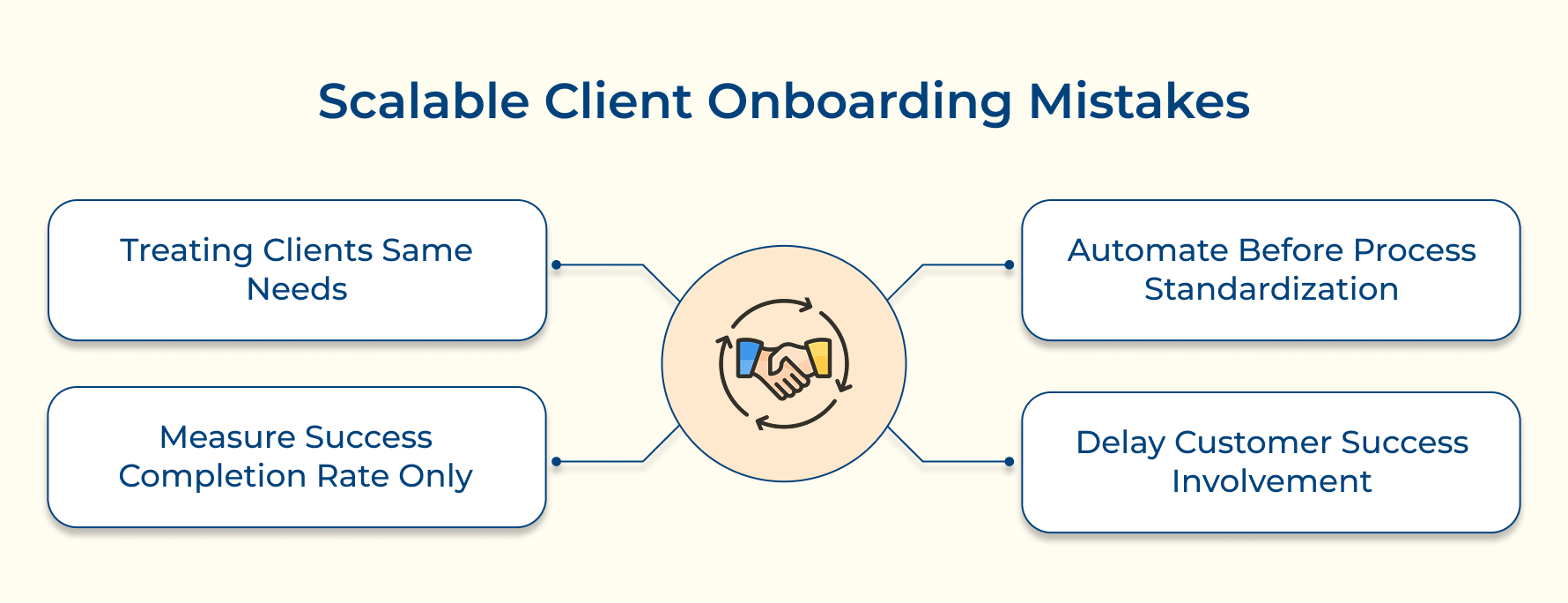
1. Treating Every Client as if They Have the Same Needs
Every client goes through an identical journey. Ignoring the difference creates a mismatch, frustration on both ends, and accelerates churn.
How to overcome it? Build a segmented client onboarding process before scaling any part. The right experience for the right segment makes the journey personal instead of automated.
2. Automating Before the Core Process is Standardized
What happens when you automate an unstandardized process? Onboarding accelerates and multiplies across every new customer but consistently delivers the wrong experience at scale.
Overcome it by:
- Fix the process with proper documentation
- layer automation on top of a proven workflow.
3. Delaying Customer Success Involvement Until After Handoff
Customer success out of onboarding till the handoff stage means client relationship starts from zero. It destroys user trust and the context that the onboarding team spent weeks building.
Involve the customer success team from the kickoff call to maintain a relationship without any disruptive reset. Followed by a warm handoff and retention strategy that impacts long-term account health.
4. Measuring Onboarding Success by Completion Rate Alone
A client who completed every step without understanding the real value has not been successfully onboarded. It masks the real question of if the client is genuinely equipped to succeed.
How to overcome:
- Track time-to-value and early product adoption metrics
- Measure completion rate to get an accurate picture.
These metrics reveal that user onboarding is scalable and moving clients through a checklist without building capability.
Metrics to Track While Scaling Customer Onboarding Processes
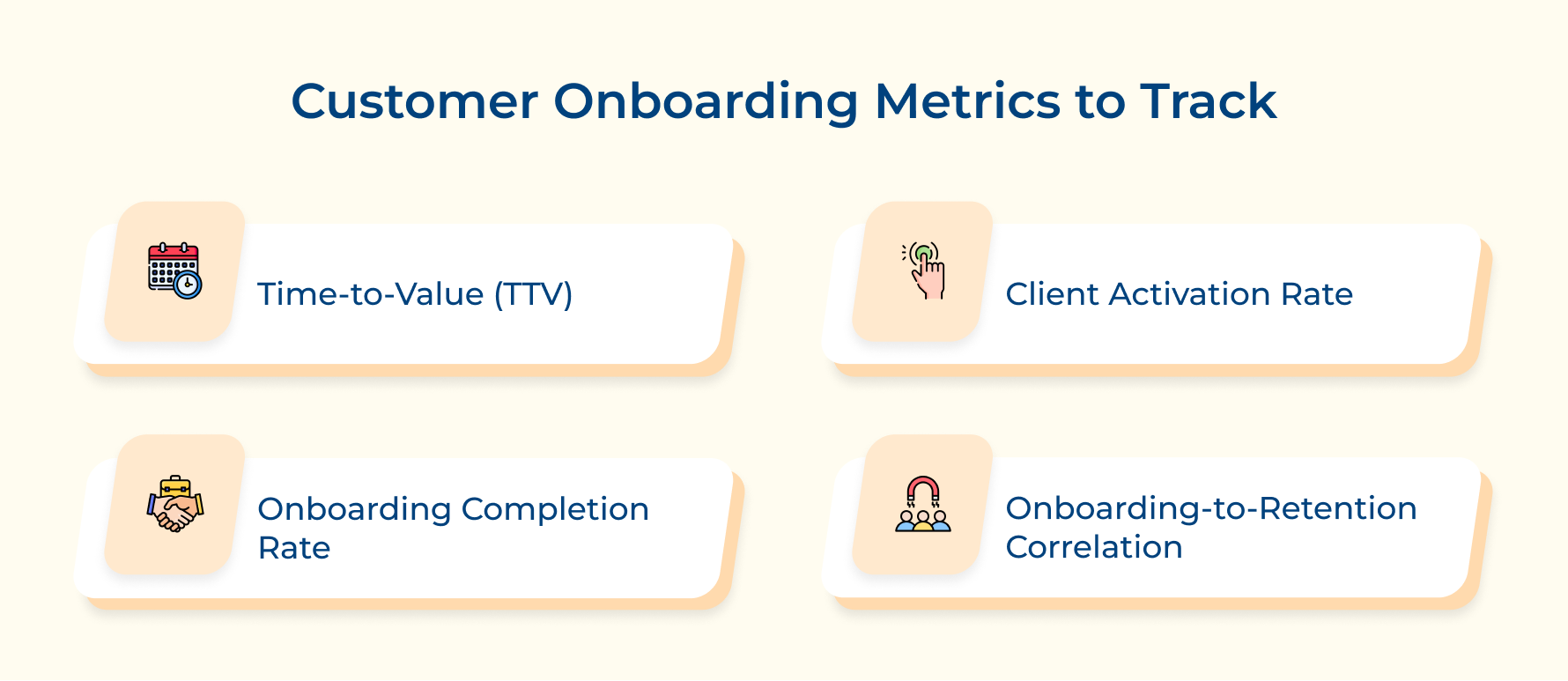
Consider using these key metrics to get a clear and honest picture of your onboarding process at scale. Before diving into the metrics, consider these questions:
- Is the current user onboarding framework consistently scaling before the client’s patience runs out?
- At what stage of the journey is causing the highest number of client churn?
- How do new clients take to complete their first action inside the product?
1. Time-to-Value (TTV)
Time-to-value measures the amount of time a client takes to experience the core benefit that made them choose the product. What does a high TTV indicate? It is a warning sign that onboarding is adding friction instead of accelerating client success.
2. Onboarding Completion Rate
Onboarding completion rate is the percentage of clients finishing every defined stage of the journey. A low completion rate does not mean loss of interest. It is often the case that the process has unclear next actions.
3. Client Activation Rate
Track the percentage of onboarded clients who reach a milestone that signals proper product adoption. It separates clients who are set up for long-term success from those quietly heading churn.
4. Onboarding-to-Retention Correlation
Tracks the relationship between client onboarding and paying customers. Teams that measure it quickly discover poor onboarding. It is always the root cause behind early-stage churn numbers
Maximize Your First Impression Through Powerful Client Onboarding Strategies
Scaling customer onboarding is about building a structured system that delivers consistent value without depending on team effort. A proper investment is not improving a workflow but compound client trust at every touchpoint.
- Segment clients before onboarding starts so every account receives consistent support based on complexity and use cases.
- Automate repetitive tasks only after standardizing the core process, as building on a broken process delivers a broken experience.
- Embed success team from the start, so customer relationship management consistently damages trust and retention.
Start building your scalable onboarding framework and measure the impact on churn rate as well as customer lifetime value. The first 30 days of a customer relationship reveal more about a business’s operations than a sales pitch.
Limit time — not creativity
Everything you need for customer support, marketing & sales.

Neeti Singh is a passionate content writer at Kooper, where he transforms complex concepts into clear, engaging and actionable content. With a keen eye for detail and a love for technology, Tushar Joshi crafts blog posts, guides and articles that help readers navigate the fast-evolving world of software solutions.