Top Benefits of Time Tracking for Boosting Team Productivity

Key Highlights:
- The benefits of time tracking include improved productivity, accurate billing, and smarter resource allocation for more profitable operations.
- Real-time time tracking empowers teams to identify workflow bottlenecks and make data-driven decisions that boost efficiency.
- Transparent time tracking builds trust with clients and employees, supporting stronger relationships as well as timely project delivery.
If you run a professional service firm, you’ve probably felt the pain of invisible productivity drains, inaccurate client billing, and the constant guessing game of resource allocation. These issues quietly chip away at your profit margins.
Every hour that goes unbilled is money left on the table. And when resource planning isn’t backed by solid numbers, deadlines slip, teams get stressed, as well as clients start to question your invoices. Without detailed documentation, payments can get delayed and client relationships become strained.
That’s where the benefits of time tracking come in. By tracking employee time strategically, you get real-time insights into productivity patterns, which means you can bill clients accurately and make smarter, data-driven decisions. Understanding the benefits of time tracking can help you transform these everyday challenges into real competitive advantages for your agency.
What is Time Tracking in Project Management?
Time tracking is the systematic process of monitoring how employees spend their working hours across different projects, tasks, and clients. It involves capturing start and stop times, project codes as well as task descriptions to create detailed records of work activity. This practice helps agencies as well as consultancies understand resource allocation, project profitability, and productivity patterns across their workforce.
How Time Tracking Works?
Employees log their work activities using digital tools or manual timesheets, recording project details and duration for each task. The system automatically or manually calculates total hours spent on specific projects and clients. Managers then analyze this data to assess project progress and make informed decisions.
Time tracking tracks your route and tells you exactly where you’ve been, it shows you precisely where your work hours go. This visibility becomes especially valuable in professional services where time literally equals money. Understanding these patterns helps you make better decisions about pricing, staffing, project management, etc.
Key objectives:
- Accurate client billing: Ensure precise invoicing based on actual time spent on client work rather than estimates.
- Project profitability analysis: Determine which projects generate the highest returns by comparing time invested versus revenue earned.
- Resource planning: Understand team capacity and workload distribution to optimize future project assignments.
- Performance measurement: Identify productivity patterns and areas where teams excel or need improvement.
- Scope management: Track whether projects stay within their allocated time budgets and identify scope creep early.
Importance of Employee Time Tracking
Employee time tracking creates accountability and transparency in how work hours are allocated across projects as well as clients. It transforms invisible work patterns into measurable data that drives strategic decision-making and operational efficiency.
- Boosts productivity: When employees track their time, they become more aware of how they spend their workday. This helps them cut down on distractions and focus on what really matters, leading to better results.
- Ensures accurate payroll: Time tracking makes sure everyone gets paid for the hours they actually work. No more payroll errors or disputes, just fair compensation for everyone.
- Improves project planning: By understanding how long tasks really take, managers can plan projects and allocate resources more effectively. This means fewer missed deadlines and less team stress.
- Builds accountability and trust: Transparent time tracking fosters trust between employees and management. Everyone knows their efforts are recognized, and it’s easier to spot as well as fix any issues early on.
- Supports compliance: Keeping accurate records helps businesses stay compliant with labor laws and policies, reducing the risk of costly fines or legal trouble down the road
Top 8 Benefits of Employee Time Tracking
Time tracking converts hour logging into business intelligence that drives profitability, client satisfaction, and operational excellence across professional service environments.
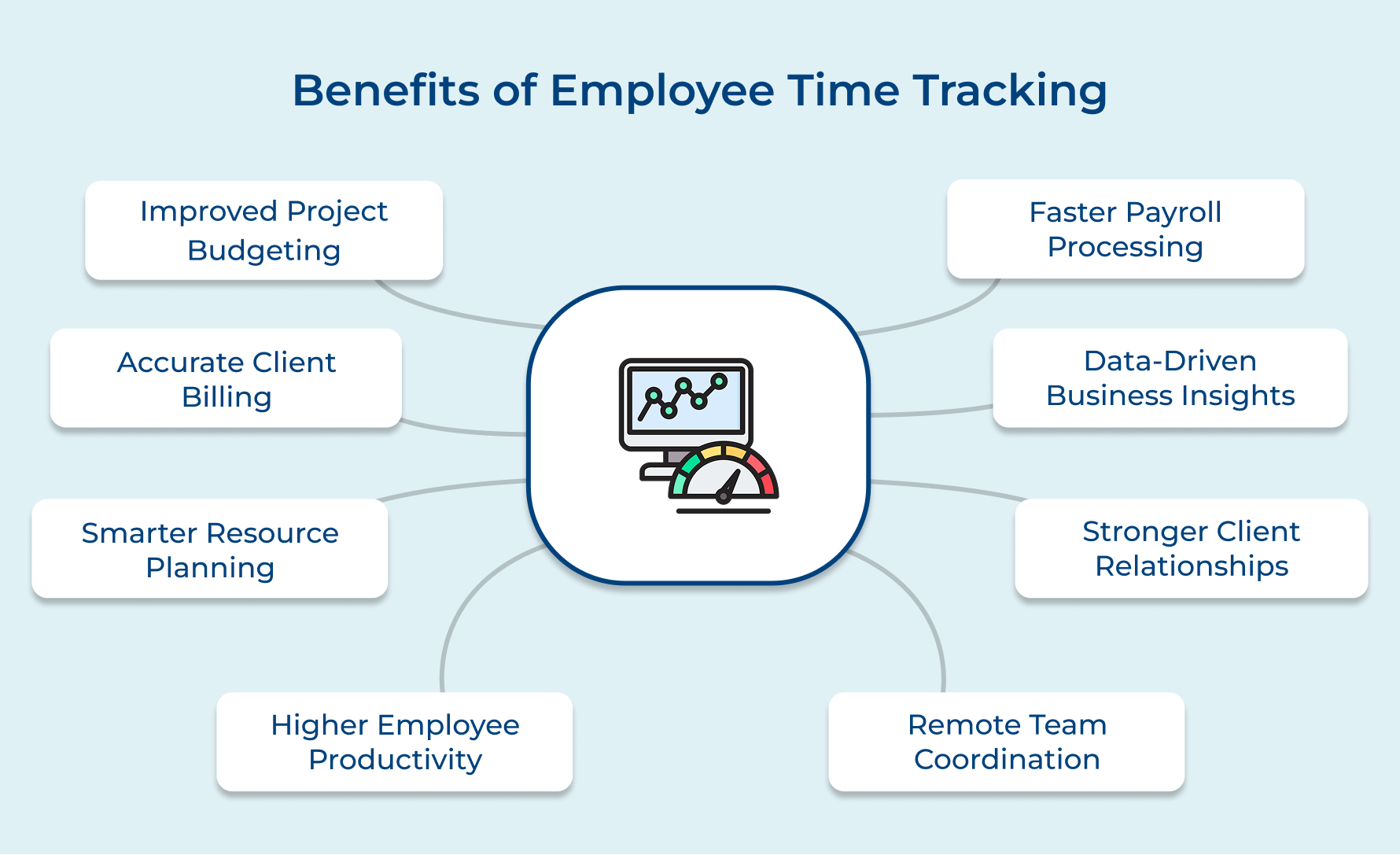
1. Improved Project Cost Control Budgeting
Project cost control forms the backbone of profitable service delivery. Time tracking removes guesswork from budget management by providing real-time visibility into labor costs against project estimates.
Real-time budget tracking reveals spending patterns immediately rather than after project completion. Project managers can spot discrepancies early and adjust scope or timelines before profit margins erode.
Here are essential checkpoints to verify your budget control implementation is working effectively:
- Do we have automated alerts set when projects reach 75% of allocated hours?
- Are we tracking actual hours against estimated hours for each project phase?
- Have we established a weekly budget review process with project teams?
- Do our project managers have real-time access to budget vs. actual data?
Early identification of cost overruns protects profit margins before damage occurs. Scope creep often happens through small additions that compound into major budget impacts. Time data reveals when projects consume more hours than planned for specific deliverables.
2. Enhanced Client Billing Accuracy Transparency
Billing accuracy directly impacts cash flow and client relationships. Time tracking removes invoicing guesswork by documenting all billable activities with precision. Clients receive detailed breakdowns rather than broad estimates that create confusion or disputes.
Professional billing transparency requires three fundamental components that build client trust progressively:
- Automated invoicing: Time tracking tools convert billable hours into detailed invoices with task and phase breakdowns, ensuring transparent client documentation.
- Real-time billing: Clients access up-to-date budget utilization anytime, enabling informed scope and cost decisions during project execution.
- Historical insights: Past billing data informs accurate pricing, realistic expectations, and fair structures for future client engagements.
Detailed time breakdowns strengthen professional relationships. Many clients appreciate regular reports showing project budget utilization across team members and activities.
3. Better Resource Planning Team Allocation
Resource planning becomes complex as agencies manage multiple concurrent projects. Time tracking provides the data foundation for informed team assignment decisions. Managers see actual utilization patterns rather than assumptions about how team members spend time across projects.
Clear visibility into team capacity enables proactive resource management. Time tracking reveals actual hours spent on projects and identifies when team members approach capacity limits.
Strategic Resource Management Approaches:
- Maintain a visual capacity planning board showing each team member’s current and upcoming project commitments.
- Track utilization rates by skill set to identify potential bottlenecks in specialized expertise areas.
- Create buffer time in project schedules for unexpected priority shifts or urgent client requests.
Data-driven staffing decisions replace intuition-based assignments with objective analysis. Historical time data shows which team members work most efficiently on specific project types or client engagements.
4. Increased Employee Productivity Through Awareness
Employee productivity improvements often result from increased self-awareness rather than external monitoring. Time tracking helps team members understand their work patterns and identify efficiency opportunities. Personal productivity insights allow individuals to optimize daily routines.
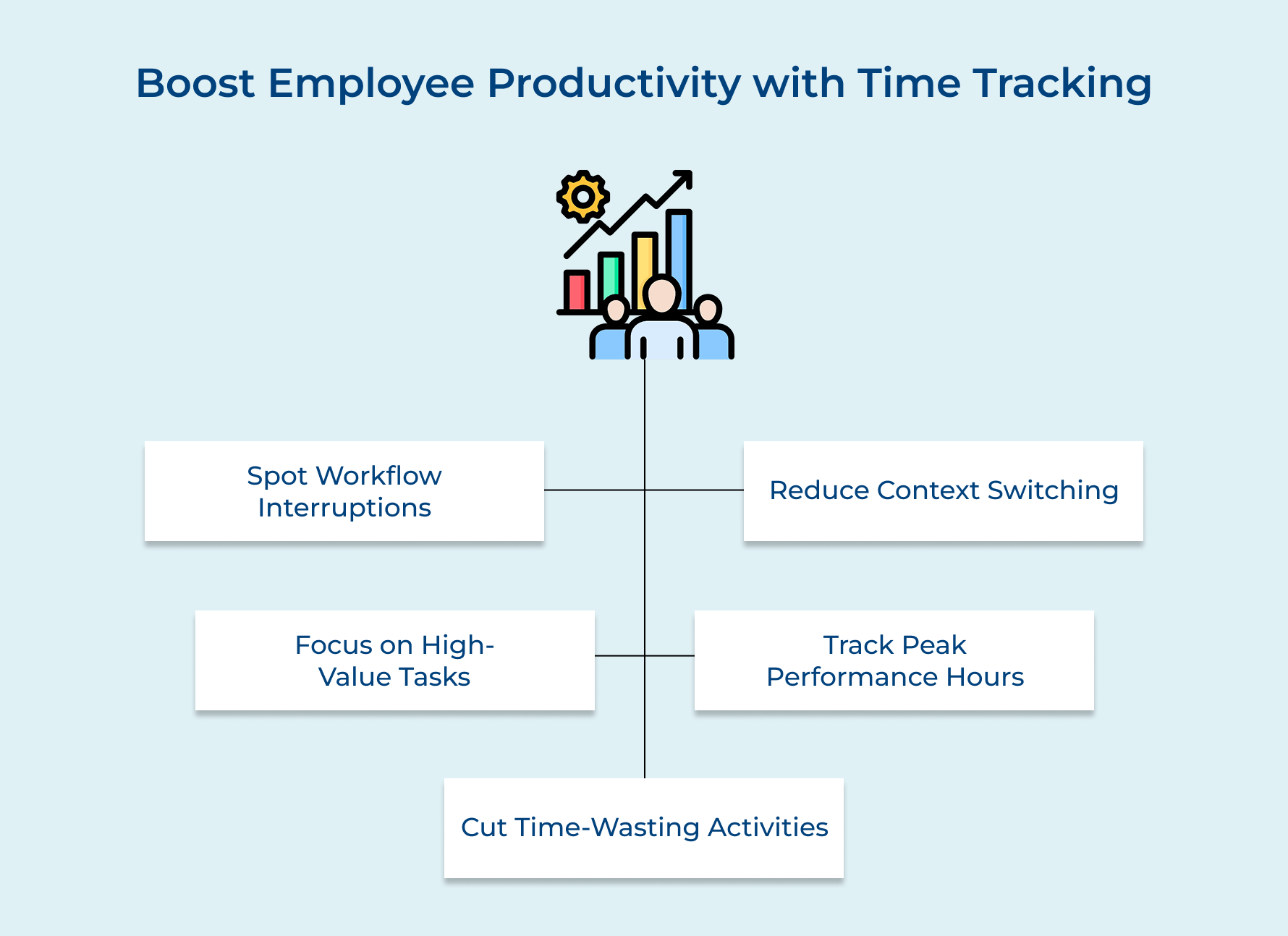
Understanding your team’s productivity requires examining several key indicators of work effectiveness:
- Are your employees experiencing frequent interruptions that fragment their deep work time?
- How many context switches does each team member make per day between different projects or tasks?
- What percentage of their tracked time gets spent on high-value activities versus administrative overhead?
- Do team members have visibility into their own productivity patterns and peak performance hours?
Identification of time wasters reveals hidden inefficiencies in daily workflows. Many professionals underestimate time spent on non-productive activities like excessive email checking, lengthy meetings without outcomes, or context-switching between projects. Time data highlights these patterns and enables conscious decisions about time allocation.
Self-awareness of work patterns empowers employees to optimize performance independently. Understanding peak performance periods helps employees tackle complex work when mentally sharp.
5. Streamlined Payroll Processing Administrative Tasks
Administrative efficiency becomes crucial as service firms scale operations. Time tracking automation reduces manual payroll work while improving accuracy and compliance. Integrated systems remove duplicate data entry and reduce human error opportunities in compensation calculations. Modern payroll integration creates seamless workflows through three essential automation capabilities:
- Payroll integration: Time tracking syncs with payroll software, auto-transferring hours to save admin time and reduce manual errors.
- Overtime automation: Systems apply labor laws to calculate overtime and compliance accurately, removing the need for manual interpretation.
- Exception reporting: Payroll teams review only anomalies like missing entries or unusual hours, streamlining approval and reducing workload.
Automated timesheet compilation removes manual data collection and transfer processes. Payroll administrators focus on exception handling rather than routine data entry.
6. Strategic Business Intelligence Revenue Optimization
Business intelligence capabilities transform time data into strategic revenue growth insights. Service firms analyze profitability patterns across client types, service offerings, and team configurations. These insights inform pricing strategies, service development decisions, and client acquisition focus areas.
Project profitability analysis reveals which engagements generate the highest returns on invested time. Time data enables precise project margin calculation by comparing billable hours and rates against actual time invested.
Strategic revenue optimization begins with asking the right questions about your business patterns:
- Which client segments consistently generate the highest profit margins per hour invested?
- How do project profitability rates vary across different service offerings in your portfolio?
- What seasonal patterns emerge in your billable hours that could inform staffing and cash flow planning?
- Are there specific team configurations that deliver superior results for certain project types?
Revenue forecasting based on historical time patterns improves financial planning and resource allocation decisions. Time data reveals seasonal patterns, client behavior trends, and project lifecycle characteristics affecting revenue timing. Agencies predict future revenue more accurately by analyzing historical patterns.
7. Improved Client Relationship Management Trust
Client relationships thrive on transparency, accountability, and consistent value delivery. Time tracking provides documentation needed to demonstrate professional service quality and maintain client confidence. Regular reporting based on time data keeps clients informed about project progress.
Professional documentation builds client confidence in service quality and project management capabilities. Evaluating your client relationship strength requires honest assessment of communication and transparency practices:
- Are we providing clients with regular progress updates that include specific hour breakdowns?
- Do our invoices clearly connect billable hours to completed deliverables and project milestones?
- Are clients able to see the value they receive relative to their investment through our reporting?
- Do we proactively communicate about project changes before they impact timeline or budget?
Proactive communication about project progress strengthens client relationships through regular engagement and transparency. Time data allows project managers to provide accurate status updates based on actual hours invested and remaining work estimates.
8. Remote Work Management Team Coordination
Remote work environments require new approaches to team coordination and productivity management. Time tracking provides visibility into distributed team activities while maintaining accountability without micromanagement. Modern remote work success depends on clear communication as well as shared understanding across locations and time zones.
Successful remote team coordination relies on three interconnected elements that work together seamlessly:
- Async coordination: Time tracking shows active work hours across locations, enabling smoother handoffs and better collaboration in distributed teams.
- Fair evaluations: Objective time data ensures consistent, equitable performance assessment for remote team members without relying on observation.
- Digital accountability: Transparent tracking fosters trust and autonomy while maintaining accountability in remote work environments.
Effective oversight of distributed team productivity maintains project momentum without compromising team autonomy. Remote work removes traditional visual cues managers use to assess team engagement. Time tracking provides objective data about work patterns and project contributions without intrusive monitoring.
5 Unique Ways to Track Your Employee’s Time
Time tracking methods vary significantly in their approach, technology requirements, and data accuracy. Understanding these different approaches helps you choose the most effective system for your team’s specific workflow and project management needs.
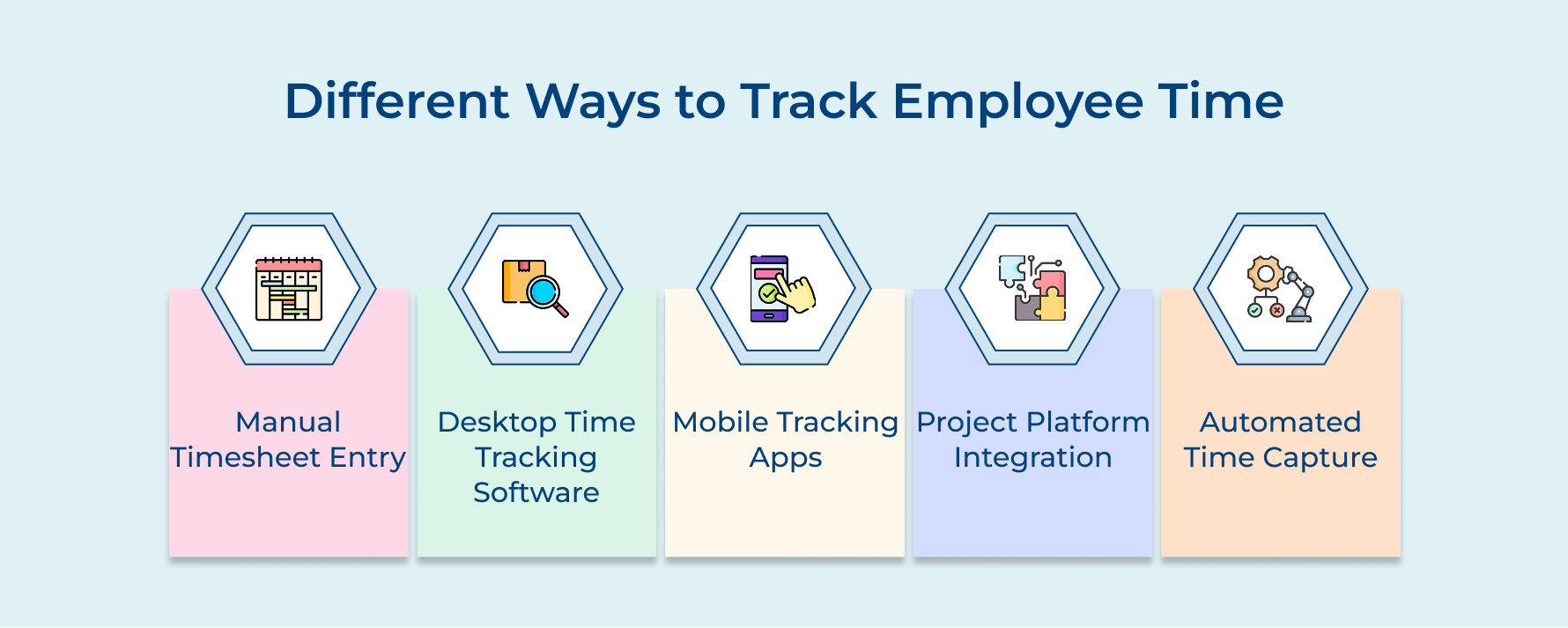
Manual Timesheet Entry Systems
Manual timesheets help employees record start times, end times, and project tasks on paper or simple spreadsheets. While this old-school method gives employees full control, it often leads to accuracy issues – mainly because memory and estimates aren’t always reliable.
Desktop Time Tracking Software
Desktop tools run directly on employee computers, tracking application usage, websites visited, and active work sessions to generate detailed productivity reports. They remove the hassle of manual entry and deliver precise data, but can sometimes raise privacy concerns for employees.
Mobile Time Tracking Applications
Mobile apps let employees clock in and out on smartphones or tablets, making them perfect for remote teams as well as field workers. Many come with GPS verification and project sync, but they still depend on employees remembering to log their hours consistently.
Project Management Platform Integration
Here, time tracking is built right into project management tools like Asana or Kooper. Employees log hours against tasks without leaving the platform, making workflows smoother and cutting down on extra steps.
Automated Time Capture Technology
This advanced option uses AI and machine learning to automatically identify as well as categorize work activities from computer use or calendars. It offers rich insights without manual effort, though it takes some upfront setup to get running smoothly.
Maximize Productivity with Seamless Employee Time Tracking
Seamless employee time tracking transforms how professional service firms operate by converting scattered work hours into actionable business intelligence. When implemented thoughtfully, time tracking becomes an invisible backbone that supports better decision-making, accurate billing, and improved project outcomes without disrupting daily workflows.
Maximizing productivity starts with choosing the right time tracking method that balances detailed data collection with employee autonomy. The benefits of time tracking include real-time productivity insights, accurate billing, smarter resource allocation, data-driven decisions, while building accountability, all crucial for building a more efficient and trusted team.
Limit time — not creativity
Everything you need for customer support, marketing & sales.

Shivank Kasera is part of the marketing team at Kooper, where he focuses on building content that helps agencies and service providers grow. With a keen interest in SaaS, operations, and scalability, he translates practical insights into actionable resources for business leaders.