What is Project Demand Management? Steps, Strategies & Benefits
- What is Project Demand Management?
- Benefits of Project Demand Management
- 7 Proven Steps for Effective Demand Management Success
- 5 Essential Demand Management Strategies to Balance Capacity and Requests
- Demand Management Challenges in Project Management
- Demand Management Examples
- Mastering Project Flow Through Strategic Demand Management
- FAQs about Project Demand Management

Key Highlights:
- Demand management helps organizations filter high-value projects from distractions, preventing overcommitment and burnout.
- Without it, urgent requests overshadow strategic priorities, causing missed deadlines and quality compromises.
- Project demand management boosts profitability by prioritizing high-value work and avoiding resource-draining projects.
Organizations drowning in project requests struggle to distinguish high-value opportunities from resource-draining distractions, leading to overcommitted teams and frustrated stakeholders who watch their initiatives compete for limited attention.
Teams operate in constant firefighting mode where urgent requests overshadow strategic priorities when there isn’t systematic demand management. This chaos creates burnout, quality compromises and damaged relationships when promises exceed delivery capabilities consistently.
Project demand management provides the structured framework that transforms overwhelming project influx into strategic advantage. This comprehensive guide reveals implementation processes and proven practices that enable organizations to maximize impact.
What is Project Demand Management?
Project demand management is the strategic process of evaluating and prioritizing client requests to ensure resources are allocated to the most valuable work. This systematic approach helps organizations make informed decisions about which projects to pursue and which to decline or defer.
Think of project demand management as the bridge between client needs and your available capacity. When demands exceed resources, this process becomes your decision-making compass. It helps you balance workload across teams while ensuring high-priority client work gets the attention it deserves.
Project demand management aims to:
- Maximize resource utilization by aligning project intake with actual team capacity and skills.
- Improve client satisfaction through realistic timelines and better communication about project feasibility.
- Increase profitability by prioritizing high-value work and avoiding resource-draining projects.
- Reduce project failures by thoroughly vetting requests before committing resources and timelines.
- Enable strategic planning by creating visibility into future workload and resource requirements.
Benefits of Project Demand Management
Project demand management transforms how organizations evaluate and prioritize incoming requests, creating a structured framework that drives better outcomes across all operations.
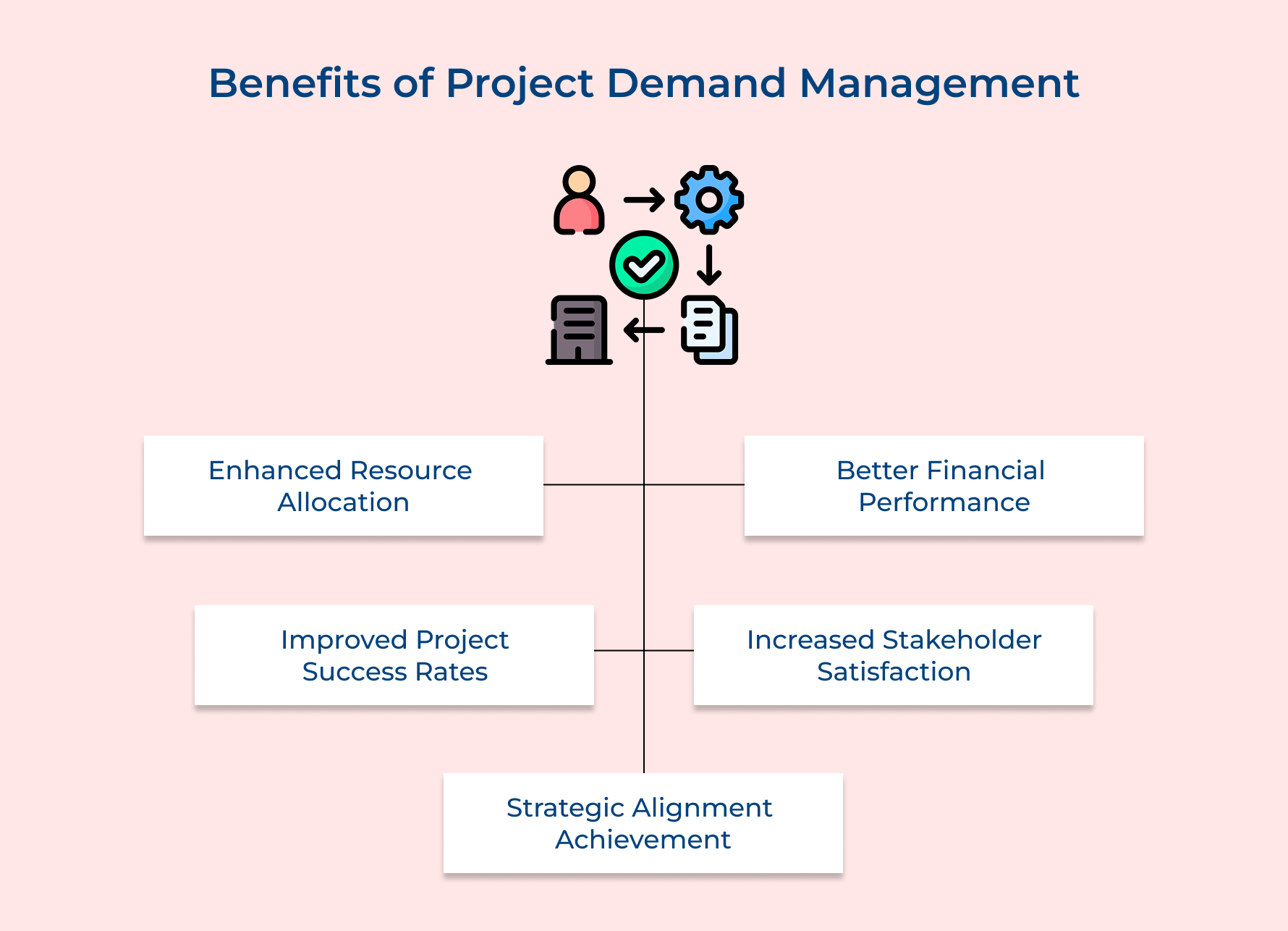
Enhanced Resource Allocation
Strategic planning ensures skilled team members focus on high-value work instead of low-priority tasks. This makes order fulfillment faster and more efficient. Using real-time data helps match the right people to the right jobs. It also prevents burnout and maintains quality across the organization.
Improved Project Success Rates
Careful review of requests before approval helps spot roadblocks early. Teams can see service demand clearly and plan resources better. With real-time data, potential issues are identified quickly. This reduces project failures and ensures results meet expectations.
Better Financial Performance
Prioritizing profitable work avoids wasting time on low-value projects. A strong demand chain directs resources toward initiatives that bring real returns. This helps the service provider improve margins and build long-term growth.
Increased Client Satisfaction
Making realistic commitments builds trust with clients. Aligning service demand with actual capacity reduces delays and disappointments. This creates confidence in the service provider’s promises.
Strategic Alignment Achievement
Demand management keeps projects aligned with business goals. By focusing on the right service demand, companies avoid distractions. This keeps the demand chain strong and supports long-term success.
7 Proven Steps for Effective Demand Management Success
Follow these seven steps to be able to align resources with organizational goals, optimize productivity and ensure your projects are completed successfully.
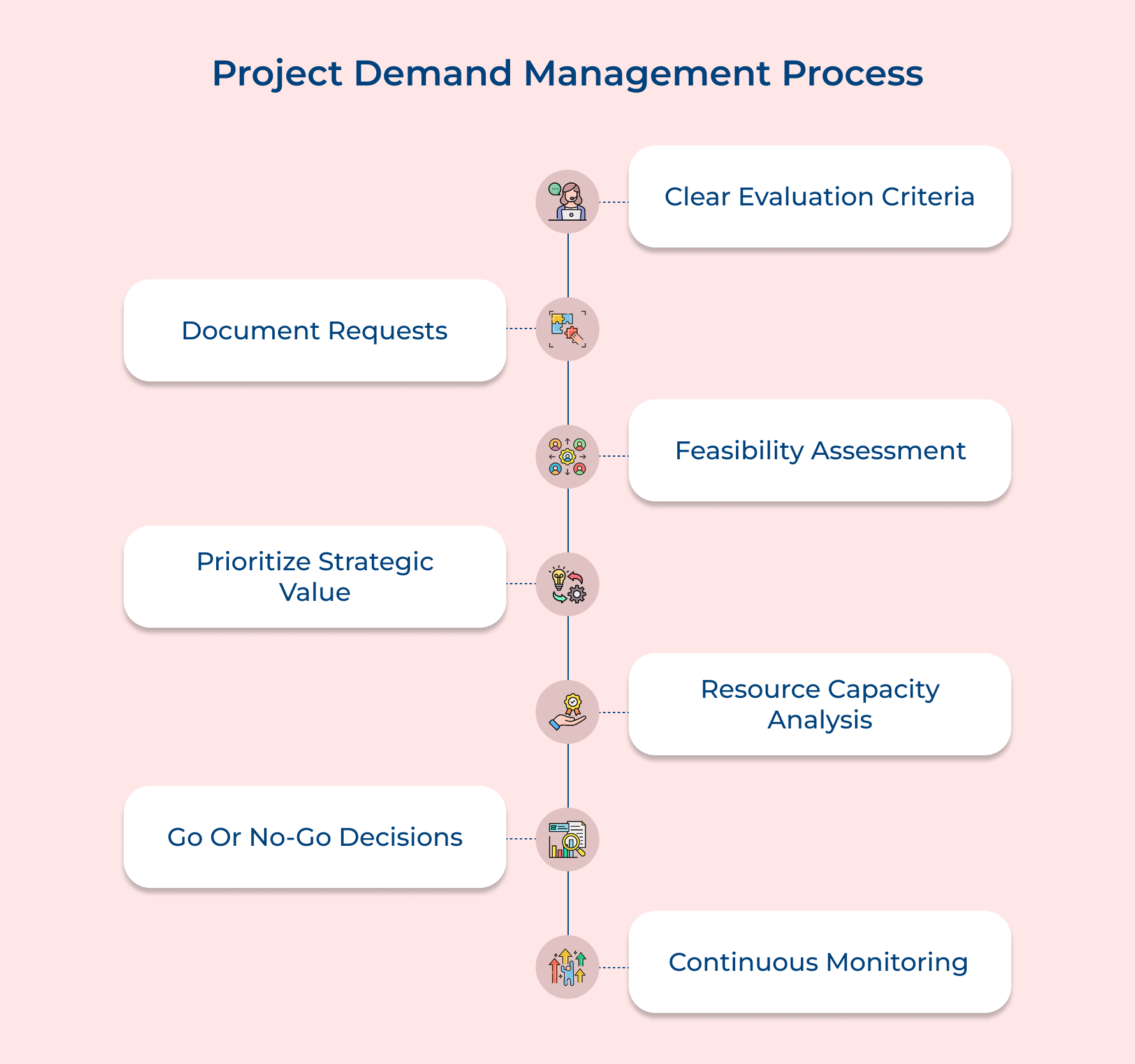
1. Establish Clear Evaluation Criteria
The first step in demand management is to set measurable and transparent evaluation criteria. A clear framework also strengthens Strategic Portfolio Management by aligning every decision with business goals.
Four evaluation criteria organizations can use:
- Strategic alignment: Each project must support long-term business goals and core strategies.
- Financial impact: Revenue potential or cost savings should meet a minimum threshold.
- Resource requirements: Internal teams must have the capacity and skills to handle project complexity.
- Risk assessment: Technical or operational risks should remain within acceptable limits.
Key considerations when building criteria:
- Criteria should be specific and measurable to avoid confusion.
- Standards must reflect real business priorities and available capacity.
- Flexibility is needed to adapt to different project types and changing demand strategies.
- Component assessment of each factor ensures accuracy in selection.
Combining measurable standards with input from POS data and past outcomes helps organizations make smarter decisions that balance opportunities with capacity constraints.
2. Capture and Document Requests
Capturing requests is the entry point of effective demand management. Without proper documentation, organizations lose opportunities and accountability. Turning informal talks into structured requests helps in building a clear inventory plan and strengthens Strategic Portfolio Management.
Best practices for capturing requests:
- Use digital intake systems to centralize submissions.
- Ensure requests automatically reach the right decision-makers.
- Maintain complete audit trails for transparency.
- Link captured requests with POS data to validate business needs.
Pro Tips:
- Ask requesters to define success metrics before submission.
- Set automated acknowledgment emails with timelines to manage expectations.
Key benefits of request documentation:
- Eliminates scattered emails or missed verbal discussions.
- Builds consistency in evaluating demand strategies.
- Improves collaboration between internal teams by giving visibility into upcoming needs.
- Creates historical data that supports future component assessment.
Businesses avoid confusion and align demand planning with overall strategy by documenting every request. This structured process ensures fair evaluation and strengthens resource allocation.
3. Conduct Initial Feasibility Assessment
The feasibility assessment is the first filter that ensures only viable projects move forward. This step saves time, effort and prevents resources from being tied up in unrealistic work. It focuses on aligning projects with existing capacity and organizational goals defined in Strategic Portfolio Management.
Ways to run feasibility checks:
- Technical review: Confirm compatibility with current systems and infrastructure.
- Skills gap analysis: Evaluate whether internal teams have the expertise needed or if new skills must be developed.
- Resource estimation: Compare required time, cost and effort against what the inventory plan can realistically support.
Other considerations:
- Check for long-term scalability to avoid short-lived solutions.
- Include component assessment of cost, technology and skills to ensure sustainability.
- Engage stakeholders early to validate assumptions.
Having feasibility assessments set in place, organizations avoid wasting resources on projects that don’t align with broader demand strategies. It ensures focus remains on achievable initiatives that deliver measurable outcomes.
4. Prioritize Based on Strategic Value
Not every project request can be accepted at once, so prioritization becomes crucial. Ranking requests based on Strategic Portfolio Management ensures the most valuable and impactful work is executed first.
Key questions to guide prioritization:
- Does the project support long-term organizational goals?
- Will it improve margins or reduce costs effectively?
- Does it strengthen the company’s competitive edge?
- Can internal teams execute within the defined inventory plan?
- Do benefits outweigh risks revealed in component assessment?
Practical prioritization methods:
- Use weighted scoring models for objectivity.
- Build ranking frameworks tied directly to organizational demand strategies.
- Involve multiple stakeholders to avoid bias.
Benefits:
- Ensures high-value projects move forward quickly.
- Improves clarity for internal teams.
- Creates transparency in decision-making.
When prioritized strategically, businesses avoid wasted effort on low-impact projects and ensure that capacity as well as resources deliver the greatest value.
5. Analyze Resource Capacity Availability
Even the best ideas fail without the right resources. Analyzing resource capacity availability ensures projects align with current workloads, skills and the inventory plan.
Steps for accurate capacity analysis:
- Map ongoing commitments across all internal teams.
- Factor in holidays, training and non-project time.
- Compare project needs with available expertise.
- Account for additional effort required when adopting new tools.
Types of skill gaps to assess:
- Technical gaps: Missing platform or coding expertise.
- Industry knowledge gaps: Lack of regulatory or compliance understanding.
- Process gaps: Weak project management or testing frameworks.
- Collaboration gaps: Poor communication across teams.
Benefits:
- Prevents overloading staff and causing burnout.
- Ensures demand strategies remain realistic and achievable.
- Keeps the inventory plan aligned with true capacity.
- Builds trust by committing only to projects that can be delivered.
This evaluation avoids overpromising, protects quality and ensures projects contribute to long-term organizational success.
6. Making Decisions
Decision-making is where analysis turns into action. After assessing feasibility, value and capacity, organizations must decide which projects to accept, delay, or reject. This step creates alignment between demand strategies and the organization’s inventory plan.
How to make better decisions:
- Present findings in a structured, fact-based format.
- Document approvals and rejections clearly.
- Involve leadership and relevant internal teams.
- Maintain transparency so stakeholders understand why choices are made.
Pro Tips:
- Use structured templates to avoid inconsistency.
- Hold regular review meetings to update the decision pipeline.
- Link final approvals to results from component assessment.
Key benefits:
- Reduces bias by using data-driven reasoning.
- Builds credibility with clients and internal stakeholders.
- Ensures resources are directed toward meaningful outcomes.
7. Monitor and Adjust Continuously
Demand management doesn’t stop once projects are approved. Continuous monitoring helps refine processes, identify gaps and adjust demand strategies over time. This cycle ensures ongoing alignment with business goals and improves future planning.
Ways to monitor effectively:
- Track performance against initial goals.
- Review whether projects fit the inventory plan and timelines.
- Gather input from internal teams to identify bottlenecks.
- Run component assessment reviews to test cost, quality and system alignment.
Additional best practices:
- Schedule quarterly reviews to balance oversight and efficiency.
- Capture lessons learned and apply them to new requests.
- Refine evaluation criteria as the market and priorities shift.
5 Essential Demand Management Strategies to Balance Capacity and Requests
Effective demand management requires strategic approaches that balance organizational capacity with stakeholder expectations while maintaining quality standards. Let’s explore the best practices:
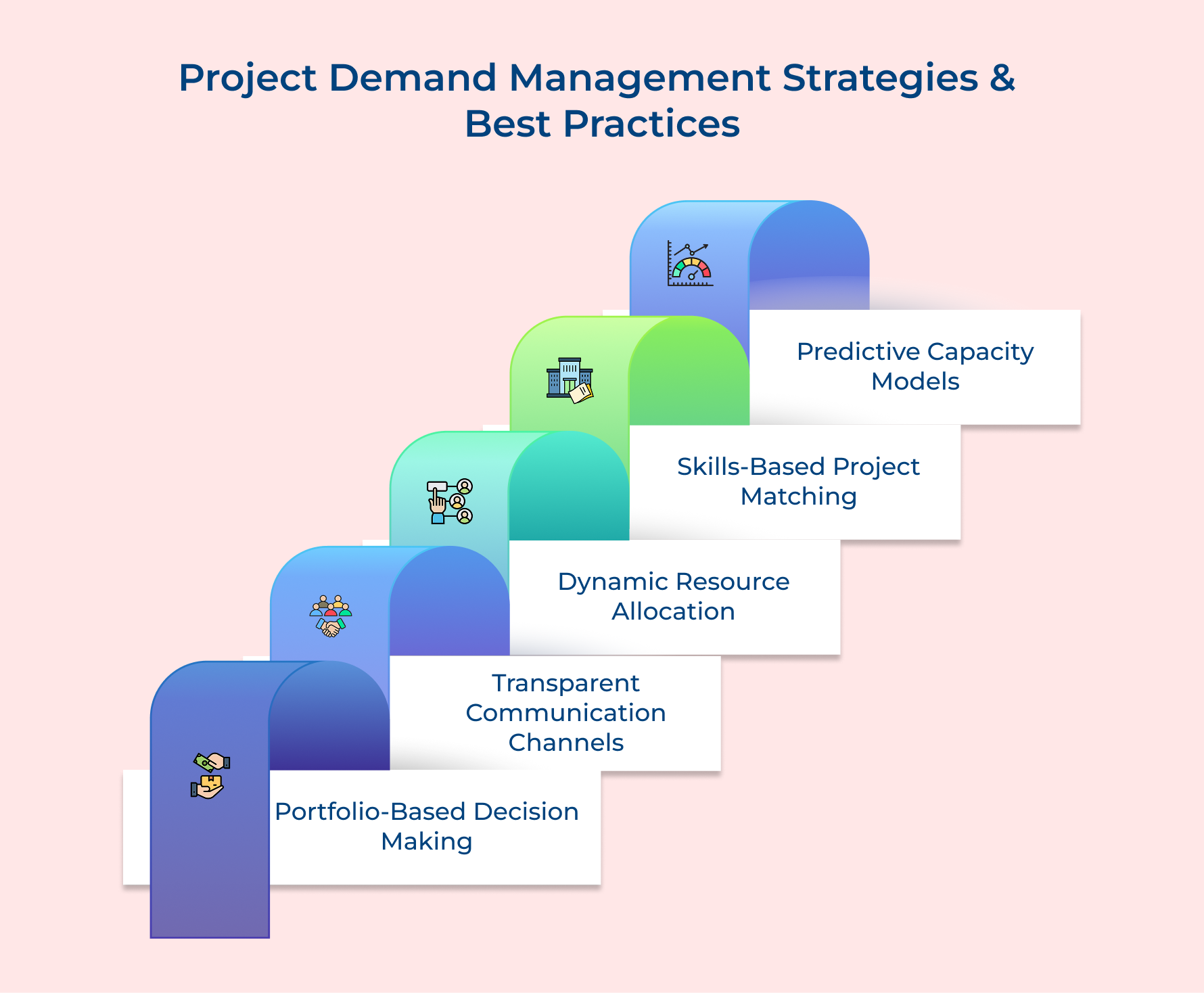
1. Implement Portfolio-Based Decision Making
Consider portfolio-based decision making as looking at the big picture instead of treating projects separately. It helps connect all requests into one strategy that supports business goals.
Visual dashboards make this easy by showing active and proposed projects, their resource needs as well as how well they align with objectives. Leaders can then make smarter trade-offs and avoid saying yes to everything at once.
This improves forecast accuracy because decisions are based on clear data, not guesswork. By using this approach, organizations create balance, avoid wasted effort and make sure resources are directed where they’ll have the biggest impact.
2. Create Transparent Communication Channels
Clear communication builds trust. When stakeholders know how requests are reviewed and when to expect updates, they feel more engaged. Regular updates keep everyone aligned, while clear explanations for declined requests show how proposals can improve.
Having escalation paths also ensures urgent requests are reviewed quickly without disrupting the overall flow. Transparency improves customer insights because you understand how people perceive the process.
Stakeholders appreciate honesty (even if their project is declined) because expectations are set early and consistently managed. Over time, this creates confidence in your sales and operations planning process while strengthening collaboration across the demand chain.
3. Establish Dynamic Resource Allocation
Resources and priorities change often, so flexible allocation is key. Dynamic resource allocation ensures teams can shift smoothly without overloading people or leaving them idle.
Regular capacity planning sessions help check upcoming workloads against available staff and adjustments are made as needed. This flexibility allows resources to move between projects when business goals change.
A strong resource schedule supports stability, while the ability to pivot ensures no project gets left behind. In the end, dynamic allocation makes your production plan realistic and adaptable.
4. Develop Skills-Based Project Matching
Not every project needs the same skills and not every team member is the right fit for every task. Skills-based project matching makes sure people work on what they’re best at. Organizations start with a skills inventory to map out strengths and growth areas.
Complex projects go to experienced staff, while simpler tasks help newer members learn. Cross-training expands capabilities and reduces risk if one person isn’t available.
Matching skills this way not only keeps timelines on track but also boosts team morale. It’s like fine-tuning your production plan, using the right resource for the right task so everything runs smoothly.
5. Build Predictive Capacity Models
Predictive capacity models help you plan ahead instead of reacting at the last minute. They analyze past projects to show patterns in timelines, resource use and outcomes.
This boosts forecast accuracy and helps identify bottlenecks early. By knowing future needs, organizations can decide whether to hire, train, or adjust priorities well before challenges arise. These models also feed into sales and operations planning by giving leaders a clearer view of demand.
Adding contingency plans ensures teams are ready for unexpected shifts. Together, these steps make your production plan smarter, more flexible and capable of supporting long-term growth.
Demand Management Challenges in Project Management
Demand management in project management is about balancing incoming requests with available resources. Here are some challenges and tips to overcome them:
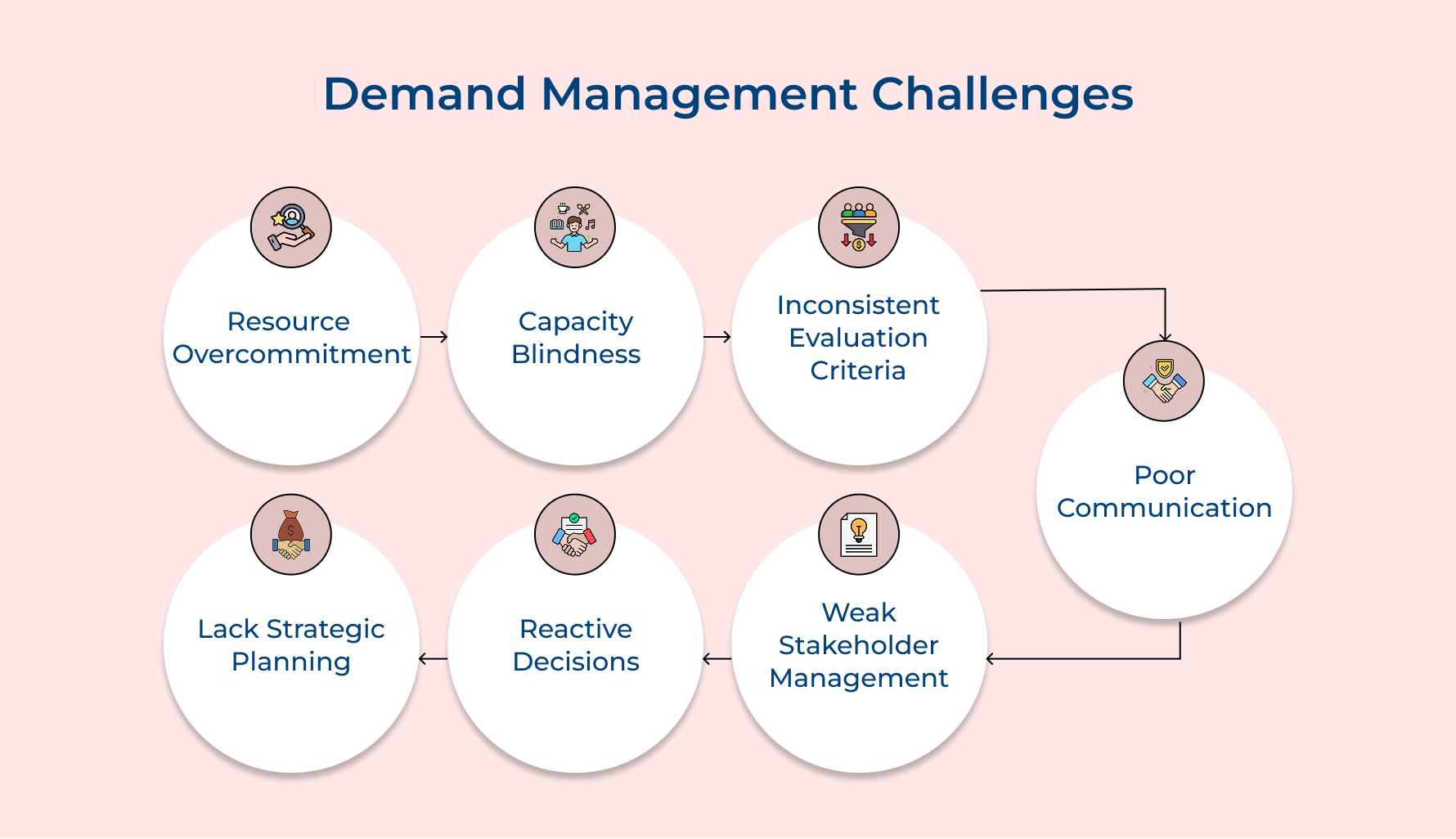
1. Resource Overcommitment and Capacity Blindness
Organizations frequently accept more projects than teams can realistically handle because they lack visibility into actual available capacity. This overcommitment leads to burnout, quality degradation and missed deadlines that damage stakeholder relationships over time.
2. Inconsistent Evaluation Criteria and Decision Making
Different stakeholders often apply varying standards when assessing project value, leading to inconsistent decisions that confuse teams. Without standardized evaluation frameworks, organizations struggle to explain why certain projects receive approval while others face rejection.
3. Poor Communication and Stakeholder Management
Request originators frequently feel left in the dark about their project status, creating frustration and repeated follow-up inquiries. This communication breakdown occurs when organizations focus on internal evaluation while neglecting to keep stakeholders informed.
4. Reactive Decision Making Without Strategic Planning
Many organizations operate in constant firefighting mode, responding to urgent requests rather than following strategic priorities. This reactive approach prevents teams from working on initiatives that advance business objectives.
Addressing these challenges requires systematic approaches that create structure and transparency throughout the demand management process.
- Implement capacity planning tools that provide real-time visibility into team availability and workload distribution across projects.
- Establish standardized scoring matrices with weighted criteria that ensure consistent evaluation regardless of who performs the assessment.
- Create automated communication workflows that provide regular status updates to stakeholders throughout the evaluation timeline.
- Develop quarterly strategic planning sessions that align project selection with business objectives and prevent reactive decision making.
- Build cross-functional review committees that bring diverse perspectives to project evaluation while maintaining accountability for decisions.
Demand Management Examples
Demand management scenarios demonstrate how organizations transform chaotic request handling into structured strategic processes that align resources with priorities.
1. Software Development Agency Portfolio Prioritization
A software development team receives fifteen new project requests within one month but can only handle five concurrent projects effectively. They implement a scoring system that evaluates each request based on revenue potential, technical complexity, strategic fit and timeline requirements to create an objective ranking system.
2. Marketing Department Campaign Selection Process
An internal marketing department faces competing demands from different business units requesting promotional campaigns during the same quarter. They establish evaluation criteria including budget availability, expected ROI, brand alignment and resource requirements to determine which campaigns receive immediate attention versus future scheduling.
3. Consulting Firm Resource Allocation Strategy
A consulting firm must choose between three potential large contracts that would each require their entire senior team for several months. They analyze each opportunity using strategic criteria including long-term relationship potential, skill development opportunities, profitability margins and alignment with their expertise positioning to make the optimal selection.
Mastering Project Flow Through Strategic Demand Management
Project demand management serves as the strategic foundation that transforms chaotic request handling into systematic decision-making processes. When implemented effectively, it creates sustainable workflows that balance stakeholder expectations with realistic organizational capacity constraints.
Organizations that master demand management experience improved project success rates, enhanced resource utilization and stronger client relationships. This disciplined approach enables teams to focus their expertise on high-value initiatives while maintaining quality standards across all deliverables.
Limit time — not creativity
Everything you need for customer support, marketing & sales.

Shivank Kasera is part of the marketing team at Kooper, where he focuses on building content that helps agencies and service providers grow. With a keen interest in SaaS, operations, and scalability, he translates practical insights into actionable resources for business leaders.