How to Build a Sales to Service Handoff That Protects Revenue
- What Is Sales to Service Handoff?
- Why is the Sales-to-Service Handoff Important in Agencies and Consultancies?
- Types of Sales Handoff Every Professional Service Firm Needs
- Strategies for Smooth Sales to Service Handoff in Professional Services
- How to Improve Sales to Service Handoff: 7 Ways
- Tools for Managing the Sales to Service Handoff
- Elevate Your Client Experience With Smooth Sales To Service Transitions
- FAQs about Sales to Service Handoff

Key Highlights:
- Sales to service handoff helps in transferring a new client from sales to the service team, including every commitment made during the sales cycle.
- A dedicated handoff owner role, pre-handoff checks and standardized templates give the client transition a single source of truth.
- Metrics such as handoff-to-kickoff time, client satisfaction and post-handoff scope queries give real-time visibility into the success of your handoff process.
Every professional service firm wonders why so many lose clients before the project even begins? If you are thinking of poor delivery, then it is wrong.
It is the silent gap between the sales conversation and the point at which the project team takes over.
The gap is called a sales-to-service handoff, which most agencies are handling poorly. 69% of businesses say that a good handoff significantly impacts the customer experience. The relationship starts with a deficit when the project team walks into a kickoff without a client context.
Explore where your handoff breaks down to build a process that protects the client first. Each handoff framework is built based on what actually works in professional services and consultancies that manage sales-to-service handoff.
What Is Sales to Service Handoff?
The sales to service handoff is the strategic process of transferring a new client from the sales team to the service team. It makes sure that every commitment made during the sales cycle is carried out.
In professional services and consultancies, a poor sales-to-service handoff not just causes internal confusion but directly erodes the client’s confidence in your ability to deliver.
Most failures happen in the first two weeks, but why does the sales to service handoff matter in professional services? The expectations set during the sales set a benchmark against which your entire delivery will be judged.
Key Factors:
- Client context: A deep knowledge of the client’s business goals and pain points discussed during sales process
- Expectation alignment: Clear documentation of scope, timelines, outcomes and deliverables.
- Relationship continuity: An introduction that makes the client valued instead of just a transaction
- Internal knowledge transfer: Structured communication between teams discussing deal history and client sensitivities
Why is the Sales-to-Service Handoff Important in Agencies and Consultancies?
A well-executed sales-to-service handoff process determines the quality of your client relationship from start to end.
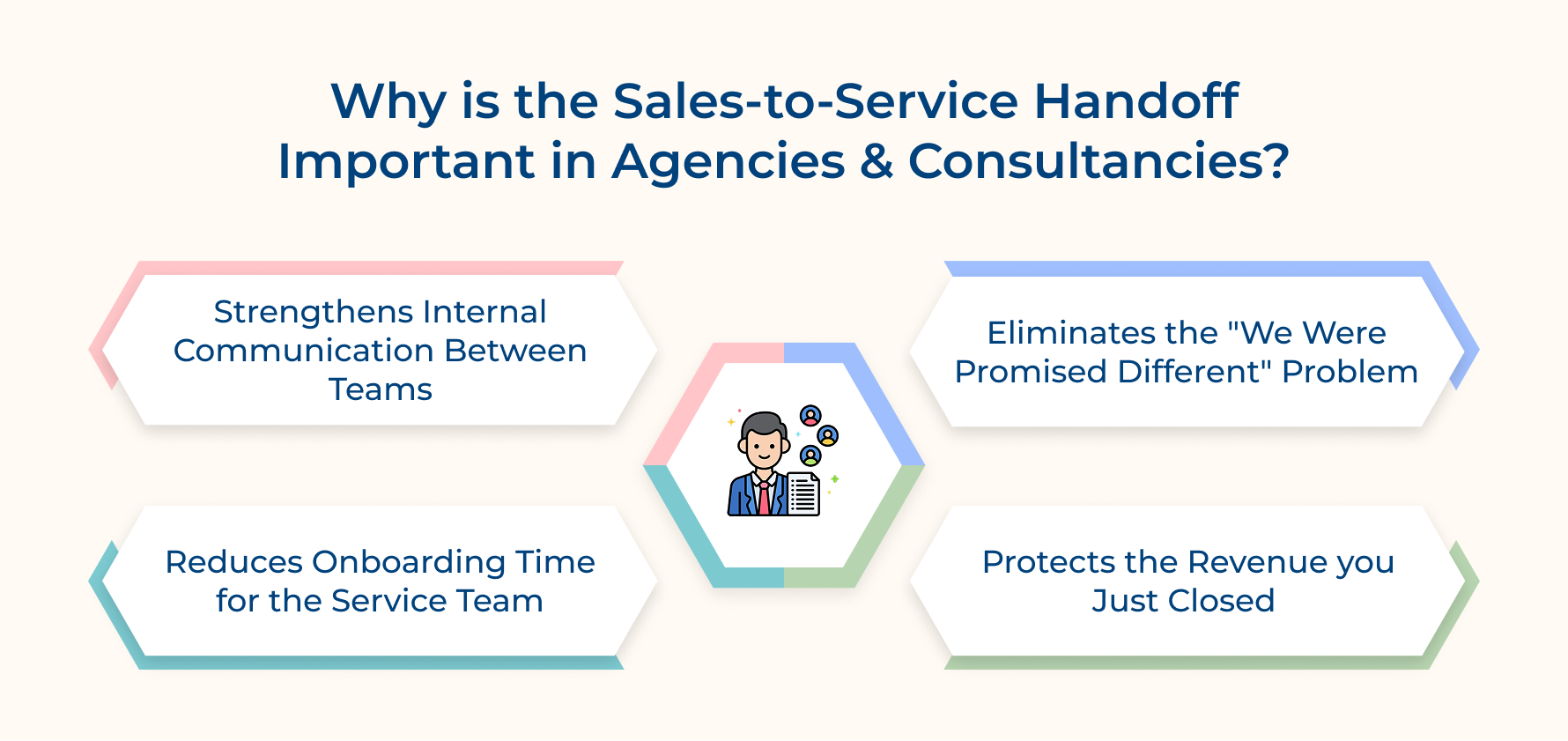
1. Eliminates the “We Were Promised Different” Problem
Think of it like when the sales team’s commitments are not properly transferred to the delivery team, scope misunderstandings lead to damage to trust before real work starts. A well-structured hand-off flow makes both your team confident in the commitment.
2. Protects the Revenue You Just Closed
One of the leading causes of early churn in most firms is a poor handoff. Clients feel lost or ignored during the process and start questioning their decision. It leads to difficulty in renewals or expansions of the client base.
3. Reduces Onboarding Time for the Service Team
A structured information gathering during the handoff helps the delivery team spend less time in repeating questions that the sales team has already answered. It accelerates project kickoff and operational maturity for the client.
4. Strengthens Internal Communication Between Teams
A common inefficiency in consultancies is the miscommunication between sales and delivery. A formal sales handoff process enables both teams to work on the same rhythm to reduce internal friction and align on the same goals.
Types of Sales Handoff Every Professional Service Firm Needs
Explore the different handoff types that help to build the right process instead of applying one generic approach.
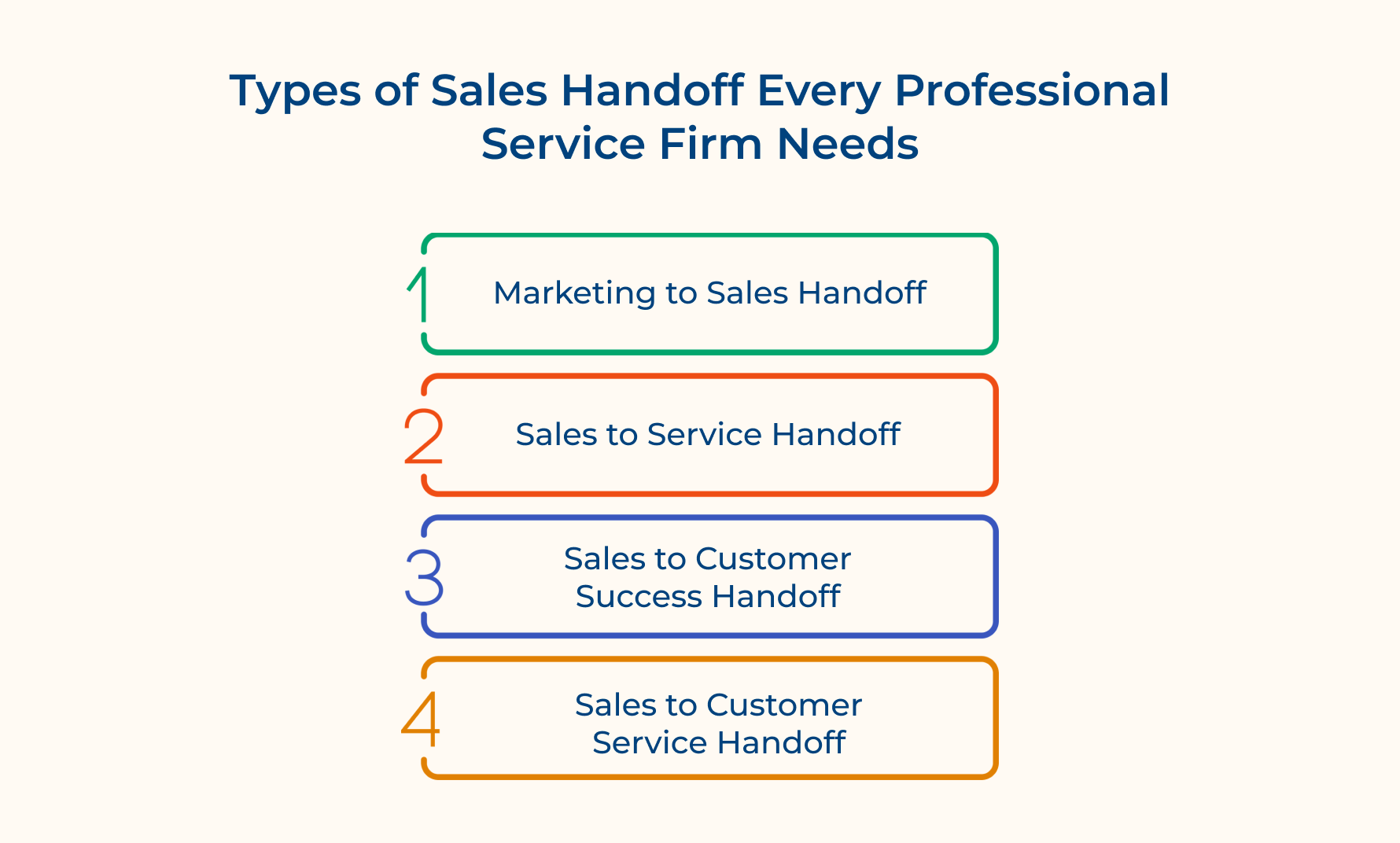
1. Marketing to Sales Handoff
The revenue journey begins once a marketing-qualified lead is handovered to a sales rep with useful context. The handoff process fails in most consultancies because marketing passes while sales need to cover the gap, which kills conversion.
A proper documentation of lead behavior and specific pain points by the marketing team before transferring to the sales team directly shortens the sales cycle. It is because the rep is addressing a real problem instead of qualifying from scratch.
2. Sales to Service Handoff
This is the most critical transition in any firm and also the one likely to be handled with good intentions.
So what happens when a delivery team transfers a client without proper context? They are starting blind. A good handoff process of shifting clients from sales to service enables the team to step in as an informed partner.
- Was the project scope properly documented before the transition?
- Does the service team understand which stakeholders carry the most influence?
- Are there any commitments made during the sales conversation?
3. Sales to Customer Success Handoff
Running retainers or long-term engagements in consultancies enables the success team to properly own the relationship after it kicks off. This transition directly protects revenue protection that most firms underinvest in.
Consider an example when the sales team knows client intent and goals, they are staking their reputation but when this data never reaches the success team, it ends up as relationship management without understanding actual cares.
4. Sales to Customer Service Handoff
Sales to customer service handoff becomes important for situations when a client raises an escalation that needs service response beyond the team’s scope. It is the most underestimated transition, as it only becomes visible when things have already gone wrong.
A service team without data on the client’s relationship sensitivity leads to a poorly landed response. So what does it ensure? The service team has full context before stepping into a resolution, leaving to retain clients from those who lose them quietly.
Strategies for Smooth Sales to Service Handoff in Professional Services
Explore the strategies that high-performing consultancies use to make every sales service handoff deliberate and damage-proof.
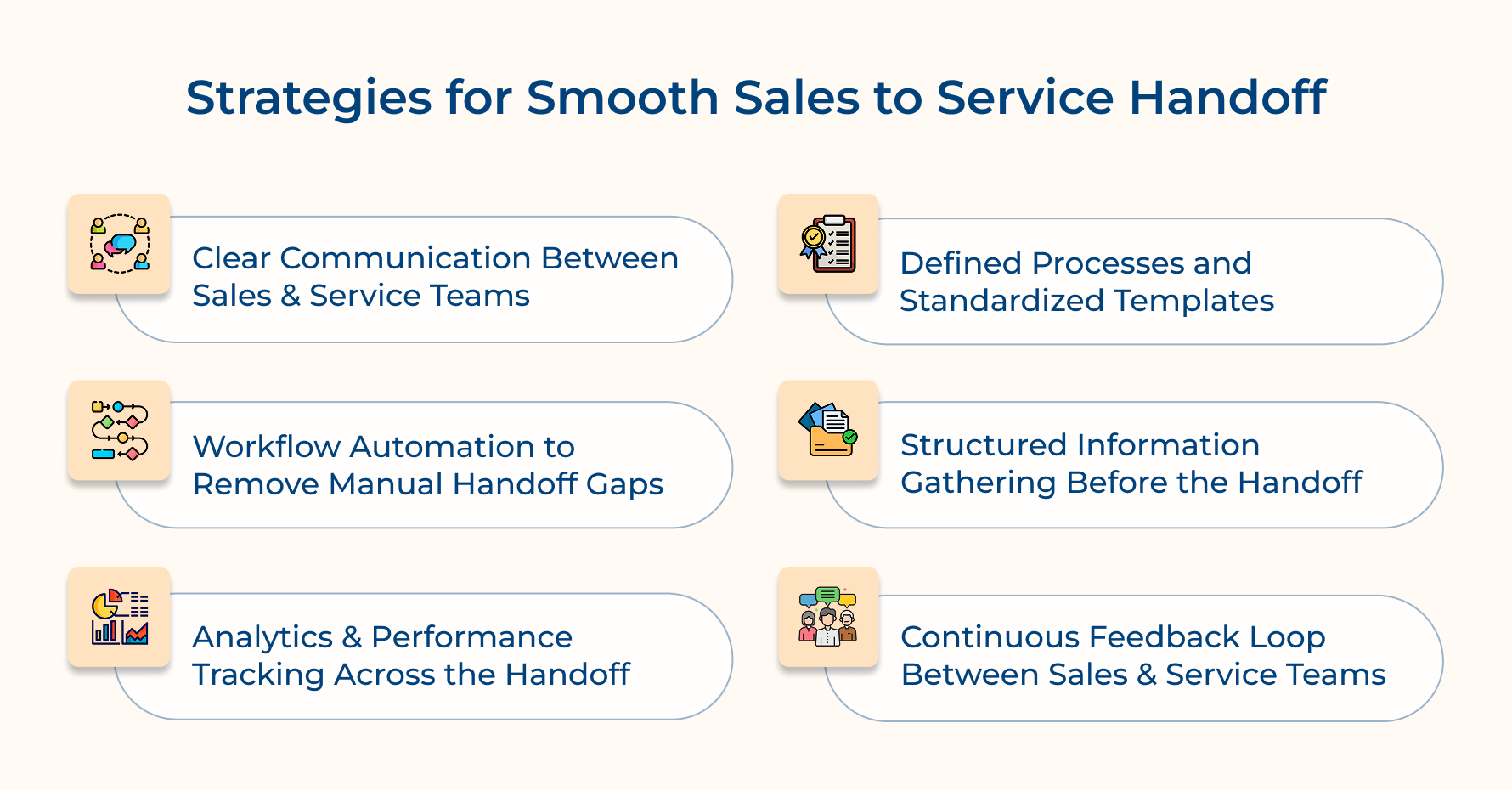
1. Clear Communication Between Sales and Service Teams
What does clear communication look like in a handoff? The sales rep walks the delivery lead through the client’s real motivations that almost killed the deal.
Pro tip: A 30-minute internal team collaboration before any client interaction reduces weeks of costly misalignment
Most handoff breakdowns are due to assumed communication between teams:
- The sales team assures they have shared everything
- The service team assumes they will cover the gaps
- Clients as a result face the consequences.
So, you want to implement this practice? Make an internal handoff call before the welcome meeting to share the sales story directly to the success team. It helps to absorb context that a document cannot.
For example, when a consultancy flagged in their sales to service handoff and called it the skepticism of engagement. The service lead managed the concerns directly and turned a skeptic into a project champion within two weeks.
2. Defined Processes and Standardized Templates
A structured template transition became the single source of truth for sales to service handoff capturing the client’s scope, stakeholder map and success metrics in one place.
So, what happens when it becomes a non-negotiable step? An enforced template completion before “closed-won” status was considered onboarding escalations drop while the delivery team had a documented clarity from start.
Pro tips:
- Build the template directly into your CRM deal-closing checklist for better data access
- As a dedicated section for commitments that were discussed but never delivered
- Need a service lead sign-off before the client welcome gets scheduled
3. Workflow Automation to Remove Manual Handoff Gaps
Manual transfer depends on people needing the right steps, which is an important process built on guesswork. Workflow automation makes sure that nothing is missed, regardless of your team.
Think of your automation as a CRM trigger that creates onboarding tasks and schedules the alignment call once the deal is closed. The team manages execution and keeps focused on the client.
So what needs to be done?
- Automate onboarding tasks directly from deal closure in your CRM
- Set up an instant alert system for the service lead when a contract is signed
- client welcome sequence without manual input with workflow trigger
4. Structured Information Gathering Before the Handoff
Structured information gathering means documenting the client’s expectations and internal dynamics. It separates a delivery team from one that spends weeks catching up.
Key consideration for implementing this strategy:
- What is the aligned business outcome that the client’s leadership is being measured internally?
- What’s the client experience with the past vendor that shaped their expectations?
- Which proposal generated the most engagement during the sales process?
Consider the example of a consultancy that built a pre-handoff form completed within 24 hours of deal closure. Teams used that data to make personalized kickoff agendas, while clients consistently remarked that the firms are prepared from the start.
5. Analytics and Performance Tracking Across the Handoff
Total revenue closed is the most common KPI measured by Consultancies, but very few track the specific revenue generated in the 30 days after the handoff. Analytics tied to the transition process helps firms to make real time decisions at the critical stages of the client lifecycle.
What KPIs do firms actually measure in their handoff process? Each of these identifies a breakdown point during transition:
- Time-to-onboarding-completion
- client satisfaction at 30 days
- Number of scope clarifications post-handoff.
6. Continuous Feedback Loop Between Sales and Service Teams
A seamless Sales service handoff process improves when both are providing proper reports on what is working and breaking down. Firms are struggling to refine their team collaboration, not due to a lack of effort, but also due to an unstructured feedback mechanism.
For example, a legal firm introduced quarterly handoff reviews where delivery leads scored the information received. The sales team restructured their questions and onboarding complaints within two review cycles.
Best practice:
- Build a scoring system for service teams to rate handoff quality after each onboarding
- Use feedback patterns to update the handoff template after every quarter
- Identify sales reps that consistently deliver quality handoff documentation
How to Improve Sales to Service Handoff: 7 Ways
Follow these seven strategies to perfect the sales-to-service transition and improve customer satisfaction.
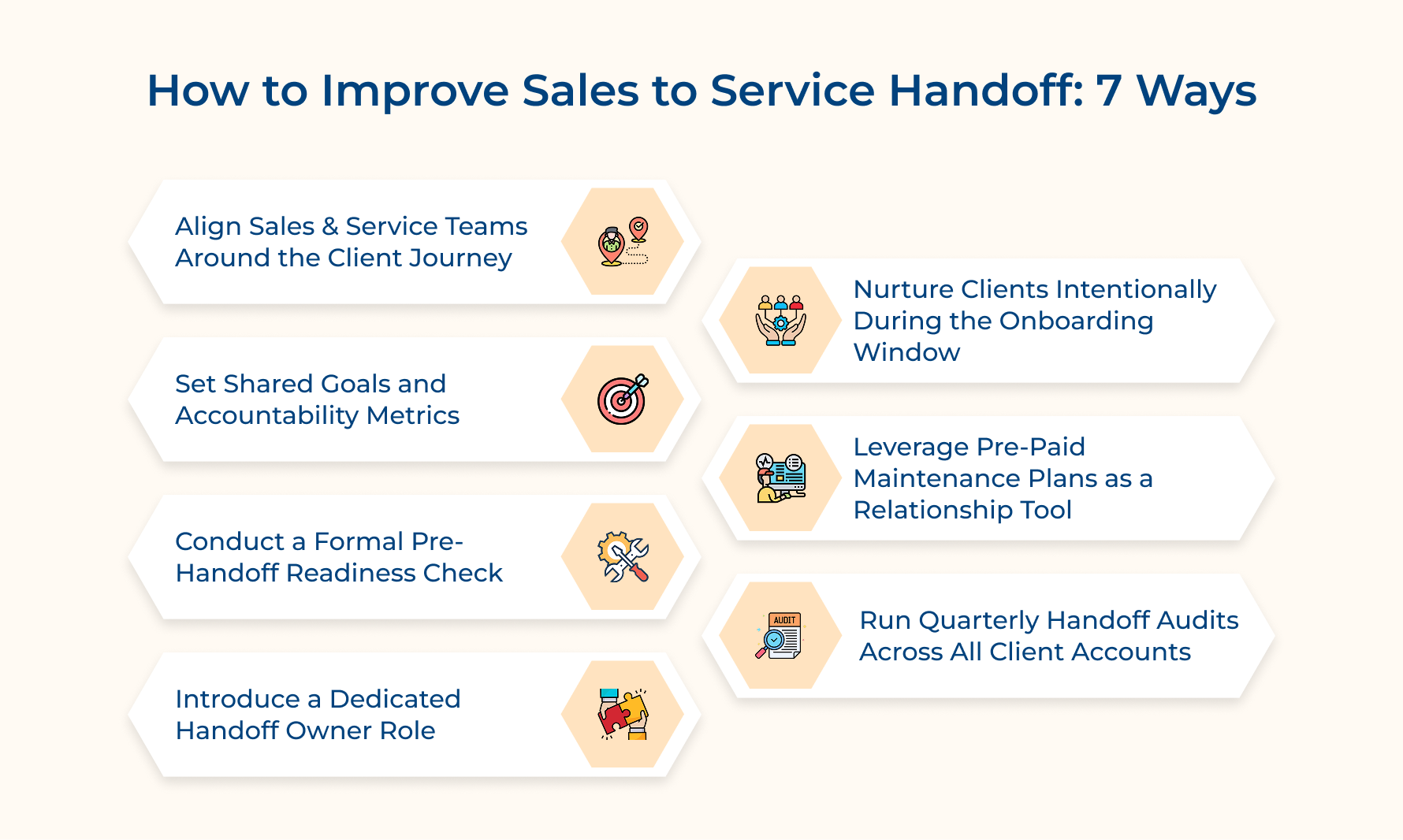
1. Align Sales and Service Teams Around the Client Journey
Sales and service teams operating in silos are the root cause of handoff failures in professional services. Both teams’ alignment around the client journey makes the transition into a structured project start that builds client confidence.
So, how to align both teams effectively:
- Shared Project Brief: A unified documentation for both the sales and service teams that contribute to the first delivery interaction
- Joint Kickoff Preparation: Sales and service leads collaborate in each new project before the client meeting
- Cross-Team Project Visibility: Maintain a shared dashboard measuring metrics in real time, such as project status, open commitments and client expectations
A common challenge around it is that sales teams are wired for closure speed, while project teams are for structured delivery and the rhythms naturally clash. Overcome it by sharing accountability metrics based on project outcomes that bridge the gap.
2. Set Shared Goals and Accountability Metrics
Certain firms lead their sales and project teams to measure accountability on separate outcomes, making the handoff nobody’s priority. A common goal makes the client’s transition easy, instead of a hand-off-and-forget moment.
Below are some of the shared goals that work best:
- 90-Day client retention rate: Both teams measured client satisfaction with the first project quarter
- Project kickoff time: Joint accountability on the client’s transition from signed contract to active project
- Scope clarity score: How good the project team understood the client’s expectations.
- Day-30 client satisfaction: A structured check-in that reflects both the sales promise and project delivery
So what’s the outcome when teams own the same goal? Sales starts thinking about what the project team can deliver instead of just committing. The sales-to-service handoff documentation improves overnight when quality is tied to a sales rep’s performance review.
Consider these key metrics to streamline sales-to-project handoff:
- Handoff-to-kickoff time: Number of days between deal closure and formal project team interaction
- Post-handoff scope queries: How frequent service team revert to sales for missing information
- Early escalation rate: Percentage of dissatisfied clients within the first 30 days of project start
3. Conduct a Formal Pre-Handoff Readiness Check
A readiness check before moving from deal closure into project onboarding consistently identifies avoidable early-stage problems. It makes sure that the project team is prepared to deliver..
Verify Project Commitments Are Documented Before Transfer
Every promise made during sales must be captured before the handoff happens. Undocumented commitments are the main cause of scope disputes within the first 60 days of handoff.
Confirm Project Team Capacity Before Onboarding Is Triggered
Will the client experience be affected when a client lands with a project where the team is already stretched? No, it is not negotiable. Clients experience slow responses and early interactions question their decision. Do it before onboarding to prevent the team from starting an engagement.
Identify Project Risks Flagged During the Sales Process
Sales teams regularly uncover unrealistic timelines along with stakeholder conflicts that never make it into the handoff. Identifying it early and sharing it with the service team helps to address them before they derail delivery momentum.
4. Introduce a Dedicated Handoff Owner Role
Most handoffs fail in agencies as sales thinks service teams have ownership for the transition, while the project team is there to manage it. A dedicated ownership provides clear accountability focused entirely on making the handoff flow work.
The owner cannot be managing active projects or closing deals; instead, it handles the transition window with full attention. It is best to put them between sales and project delivery within either team.
Consider this question for implementing the handoff owner role:
- Has the handoff owner reviewed project documentation before onboarding starts?
- Do both of the teams have direct access to the sales rep and the project lead for quick queries?
- Are there introduction meetings for clients with the handoff owner?
Pro Tips:
- Make proper role-based rotation on quarter basis for understanding both sales and project delivery realities
- keep accountability meaningful by tying incentives directly to the client’s 30-day project satisfaction score.
5. Nurture Clients Intentionally During the Onboarding Window
The phase between contract signing and project kickoff is the right time to build client confidence. Most firms treat this gap between the sale to service team handoff flow as an administrative phase.
During onboarding, what does client nurturing look like? It is all about the project team reaching out within 48 hours of signing with a message based on specific outcomes. The single touchpoint allows the project team to be properly briefed and already invested in the client’s success.
Clients enter delivery with higher trust as well as lower anxiety when they feel informed before the project begins, leading to directly reduce early escalations
Best practices:
- Assign a project contact immediately after signing to make sure the client knows whom to communicate.
- Maintain a reference of sales conversations during early communications for seamless knowledge transfer
6. Leverage Pre-Paid Maintenance Plans as a Relationship Tool
Consultancies that extract real value from PPM plans treat scheduled interaction as an opportunity to enhance client relationships.
So what makes a PPM plan beyond its contracted deliverables? It consistently shows with relevant insights instead of completing a checklist. The project team uses PPM to identify evolving client needs transforming into problems while the firm moves from vendor advisor.
Follow these steps to merge PPM plans into your existing value delivery:
- Align PPM deliverables to project goals: Connect every outcome agreed upon during the sales process with maintenance interaction.
- Use PPM touchpoints for proactive reviews: Treat scheduled calls as check-ins to identify risks the client has not identified.
- Document evolving client needs: Update the client profile after each interaction and feed intelligence back into the project as well as sales teams.
7. Run Quarterly Handoff Audits Across All Client Accounts
Most consultancies examine their sales to service handoff process only during situation breaks. It means always reacting instead of improving. A frequent audit helps in continuous improvement into operations so that transitions improve based on every new client.
What does it examine? It analyzes recent project onboardings to identify touchpoints when context was lost between both teams. This multiple client pattern reveals systemic failures that individual case reviews never surface.
An ideal quarterly handoff audit includes:
- Context loss analysis: At which touchpoints the project team lacks critical information that sales had?
- Deal type breakdown: Which engagement consistently produces the most difficult transitions?
- Template gap review: Which document is routinely incomplete when handed over to the project team?
All the identified needs to be directly updated in the sales to service handoff template and inform sales training not sit on one report. The audit is only as valuable when process changes are generated within 30 days.
Pro Tips:
- Involve project leads in the auditing as they hold the most accurate data of where handoffs break down
- Track audit-driven improvements frequently to identify whether process changes are actually reducing handoff failures
Tools for Managing the Sales to Service Handoff
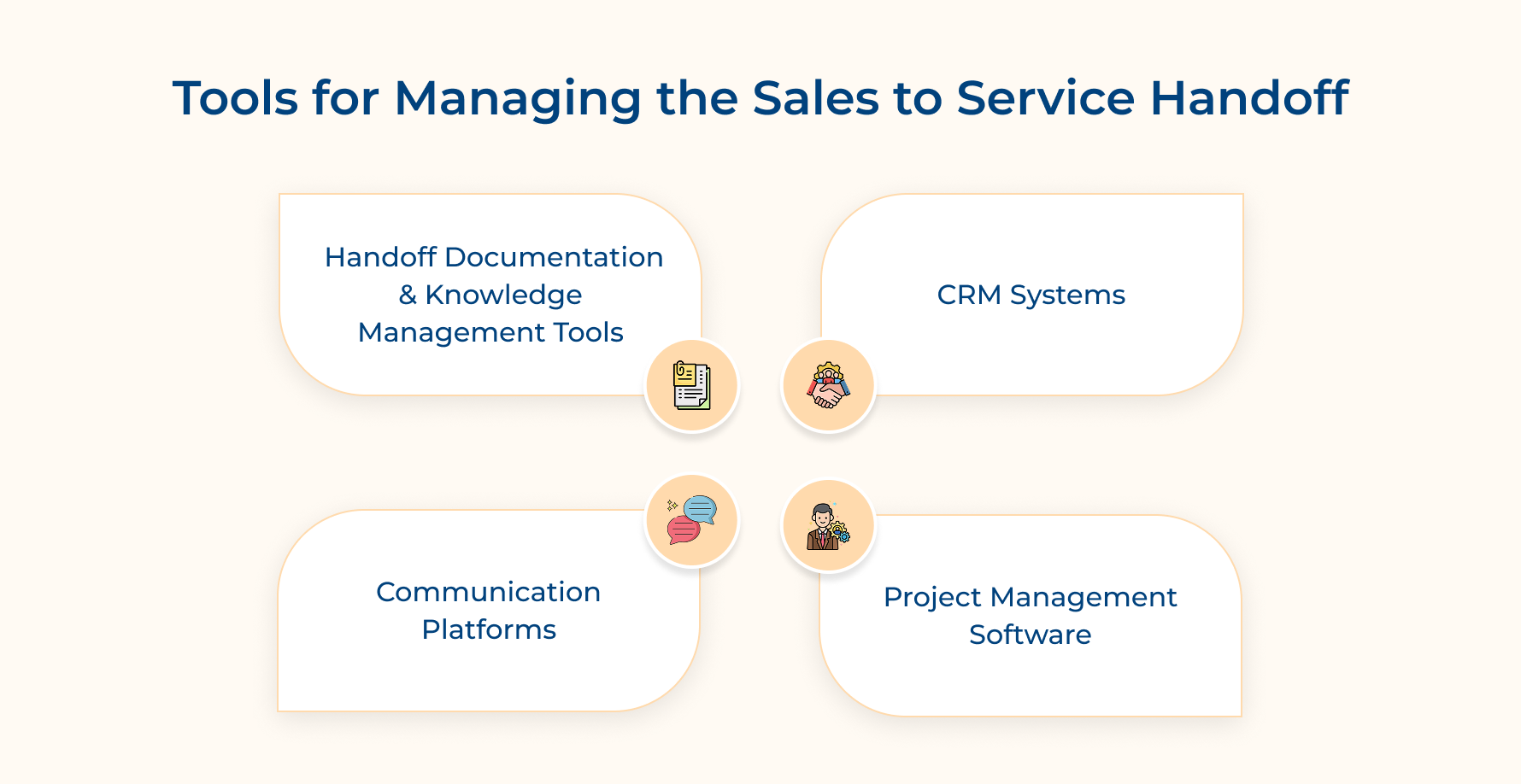
Follow these tools that high-performing consultancies use to manage the transition from sales to project delivery handoff.
1. CRM Systems
A CRM is the backbone of any structured sales-to-service handoff, where deal, client history and committed scope are live before the project team takes over. The trigger onboarding workflows are automated at deal closure to make sure the transition starts without manual intervention.
2. Project Management Software
Project management tools help in bridging the gap between sold and delivered by giving both teams a shared view of the scope as well as timelines. It maintains a proper handoff to be documented directly inside the platform. The project team imports the full context instead of starting from an email thread.
3. Communication Platforms
A dedicated communication platform eliminates scattered back-and-forth handoff between sales to service teams that typically happens in most agencies as well as consultancies. A shared client channel where both teams collaborate to make sure no critical context gets lost between the handoff and kickoff.
4. Handoff Documentation and Knowledge Management Tools
Knowledge management gives sales and service teams a centralized place to store handoff templates, client profiles as well as pre-project intelligence. The centralized library enables the project team to access a structured document for every client, leading to onboarding time drops and early-stage confusion being eliminated before it starts.
Elevate Your Client Experience With Smooth Sales To Service Transitions
A broken sales-to-service handoff costs your client trust at the critical moment. Firms that treat every transition as a delivery in itself win in the long term..
- A structured handoff process eliminates scope disputes and protects the revenue your sales team closed
- Shared goals between sales and project teams change the transition from a hand-off moment into accountability.
Ready to elevate your client experience? Start by auditing your last five onboardings and identifying where context was lost. Build a structured process for closing that gap. Agencies and consultancies that invest in a structured sales-to-service handoff process outperform those that depend on individual effort..
Limit time — not creativity
Everything you need for customer support, marketing & sales.

Neeti Singh is a passionate content writer at Kooper, where he transforms complex concepts into clear, engaging and actionable content. With a keen eye for detail and a love for technology, Tushar Joshi crafts blog posts, guides and articles that help readers navigate the fast-evolving world of software solutions.