Top 8 Client Onboarding Best Practices That Drive Retention
- What is Client Onboarding?
- 8 Practical Customer Onboarding Best Practices That Works
- Why Is Client or Customer Onboarding Important for Business?
- Examples of an Effective Client Onboarding Process
- Empower Your Business With Expert Client Onboarding Best Practices.
- FAQs about Client Onboarding Best Practices
Key Highlights:
- Customer onboarding best practices give businesses a structured path to reduce early churn within the first 48 hours of signing up.
- Businesses using structured client onboarding retain up to 86% of customers, making it a measurable driver of revenue and loyalty.
- Metrics such as time-to-value, activation rate and churn rate give teams real visibility into onboarding success along with touchpoints where clients exit.
Most businesses lose their newest clients because of a broken first experience after the sales process. The gap between signing and succeeding is the point of gaining churn, leading competitors to quietly win.
Businesses that invest in onboarding content can retain 86% of customers through loyalty. It shows why onboarding is a direct revenue and customer retention lever that growth-focused businesses must get right.
Explore the key client onboarding best practices that cover everything from automation to personalization, metrics and sales alignment. Every practice is built for teams managing real clients across SaaS, B2B and service-based businesses.
What is Client Onboarding?
Client onboarding is the process of welcoming new users and guiding them to achieve their first outcome with your product or service. It includes everything from initial handoff after a sales phase up to the moment a client feels confident about their purchase.
So, how is onboarding different from “getting started”? It is all about providing someone a map vs actually walking them to the outcome they are trying to reach. Even the best product can feel overwhelming to a new client without a guided experience.
This builds the foundation of a long-term client relationship by aligning your knowledge with the client’s goals and expectations. It is an intentional journey that shapes the client’s perception of your brand going forward.
Key objectives:
- Set clear expectations: Define the structure of success for the client starting from the very first interaction.
- Reduce time-to-value: Help clients experience a win as quickly as possible after signing.
- Build early trust: Develop confidence in your team’s ability to deliver before doubt.
- Align internal teams: make sure all your teams are working from the same client context.
8 Practical Customer Onboarding Best Practices That Works
Consider these key customer onboarding best practices to help you lay a strong foundation for success and maximize lifetime value.
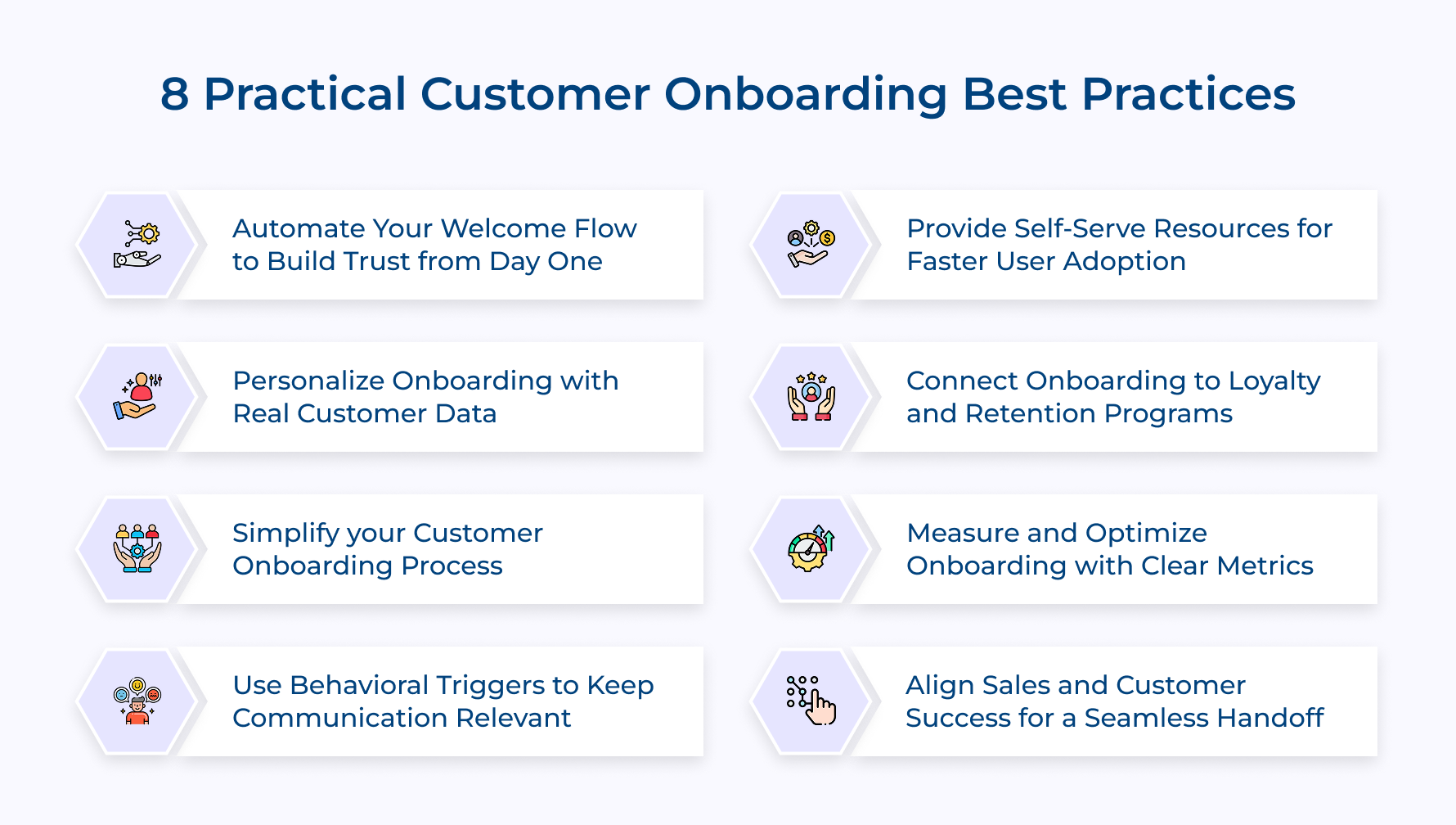
1. Automate Your Welcome Flow to Build Trust from Day One
After the client signs up, the first 48 hours are the most critical window you have to make an impression. Automating makes sure that every new customer receives a consistent and timely experience.
So, how much can a well-timed automated sequence do for early trust-building? It is not only about sending emails but also about showing clients an organized system to indicate they have made the right decision.
A typical automated welcome email looks like:
- Email 1: A thank-you message to confirm the next steps that sets the tone for your brand communication and support.
- Email 2: A delivery guide that walks the client through the expected outcome, along with a soft introduction to your resources or communication channels.
- Email 3: A value-reinforcement email that shows clients success with your product — using real examples, tutorials or social proof to build initial confidence.
Is automation enough, or does it need a human touch? Automation handles consistency, but cannot replace human judgments. Situations when customers face confusion with automated emails, the success team should be the first one to monitor responses and address.
2. Personalize Onboarding with Real Customer Data
One of the best client onboarding practices is moving away from a one-size-fits-all approach. Build experiences based on what customers actually demand. Personalization separates forgettable signup from onboarding that drives real adoption.
So, how does real customer data work here? It enables you to touchpoints early when the client might struggle to proactively address before it turns into a reason for disengagement. A proper onboarding tailored to a client’s specific industry immediately signals perfection.
Follow these effective ways to collect customer data for personalization:
- Onboarding intake form: Capture role, company size, goal and prior experience with similar tools right during the start of sign-up.
- CRM and sales notes: Set a collaborative meeting to brief the success team on everything the sales team learned during the deal. Those insights are used for personalizing early conversations.
- In-app behavior tracking: Track what features a new user clicks first to use the data for serving relevant guidance at the right moment.
Consider the example of the best B2B SaaS customer onboarding practices of a mid-sized logistics firm. Instead of a generic product walkthrough, the team uses real-time data to build a custom sign-up focused on the client’s specific workflow. This level of specificity builds more trust in weeks in comparison to months.
What personalization look like across different industries:
- For SaaS customers: Customize the in-app onboarding checklist based on the customer’s role, such as a developer needs API documentation first, while a manager needs reporting dashboards.
- For B2B service clients: Decide the kickoff agenda around the client’s defined objectives instead of walking through a standard service overview.
- For E-commerce customers: Use purchase history and browsing data for recommending relevant product tutorials.
3. Simplify Your Customer Onboarding Process
As the name suggests, “Complexity” is what means a silent killer of early client engagement. When a new user faces too many steps with unclear information, they don’t complain, simply disengage. One of the best high-impact client onboarding practices is to implement a simplified signup flow.
Remove Steps That Do Not Directly Serve the Client’s First Goal
Every step in your onboarding flow should offer unique value by moving the client closer to their first outcome. If a step exists for internal convenience instead of the client’s progress, then it’s best to automate.
Create One Clear Source of Onboarding Truth for Every Client
Clients must never face the situation of guessing where to go next. A single onboarding hub, whether it is a shared project doc, a portal or a dedicated success plan, keeps everything organized.
Reduce Friction at the Critical First-Time Setup Stage
The first time a client tries to set up your product is the highest-risk moment in the entire journey. Even one confusing step at this stage creates doubt that takes weeks to fix. Your team must audit this experience regularly.
4. Use Behavioral Triggers to Keep Communication Relevant
Generic drip sequences on a fixed schedule are the most common mistake made in new onboarding. Maintain a behavioral trigger-based communication to send messages based on what a client actually does inside your product, making every touchpoint feel relevant.
Follow this quick client onboarding checklist to guide your implementation:
- Have you done proper mapping of the key actions that signal the client progressing?
- Have you identified the drop-off points where clients exit from the flow?
- Are your trigger-based messages personalized based on a specific action?
Behavioral triggering practices work best in an onboarding follow-up for meeting clients exactly where they are, rather than making assumptions. For example, a client who logged in for five days needs a separate communication from one who completed the third session. Your onboarding system should know the difference.
Pro Tips:
- Always pair a trigger email with a clear single call-to-action, such as one message, one next step, to maintain no decision fatigue.
- Review your trigger performance monthly and remove messages that get ignored by clients.
5. Provide Self-Serve Resources for Faster User Adoption
A self-service ecosystem empowers clients to find answers independently during the onboarding flow. Clients, when they move forward without waiting for support, increase the adoption rate faster.
So, how does a self-serve resources drive faster adoption:
- Searchable knowledge base: Gives clients access to step-by-step guides organized based on real tasks.
- Role-specific video walkthroughs: Break down complex features into focused videos based on users’ actual needs.
- Interactive product tours: Let new users explore core features without the need of any live demo or scheduled call.
Consider the example of a mid-sized consulting firm that built the best self-serve user onboarding portal with templated project plans, practices and tutorial videos. Their support ticket volume dropped by 35% and improved client confidence.
Is self-serve onboarding all about less human involvement? No, it enables your success team to focus on high-value conversations as the best onboarding practice blends a self-serve process with proactive human touchpoints where required judgment.
6. Connect Onboarding to Loyalty and Retention Programs
Onboarding and retention are deeply connected. Treated separately is a costly mistake. Link your onboarding practices to the best loyalty programs to build the habit of customer engagement before churn.
Consider these effective ways to connect onboarding:
- Reward early activation milestones: Assign loyalty points as well as exclusive perks when a client achieves a milestone to make progress feel rewarding.
- Introduce the loyalty program during onboarding: Integrate the retention program into the early journey for clients to understand the long-term value of engagement.
- Use onboarding engagement data to predict retention risk: Identify disengaged clients and trigger personalized retention outreach efforts before the contract review arrives.
So, when to bring loyalty programs into the onboarding conversation? Ideally, after signing up, clients have experienced enough value. Loyalty introduction at that moment is similar to a natural next step instead of a sales push.
7. Measure and Optimize Onboarding with Clear Metrics
You cannot improve specific touchpoints in the onboarding flow when you are not actively measuring. These small friction points scale into serious churn risks. So what is the best thing to do? Use the best metrics to turn your onboarding process into an improved practice for delivering consistent results.
Key metrics to measure the success:
- Time-to-value (TTV): Measures how quick a new client reaches the first outcome after starting the signup.
- Onboarding completion rate: Tracks the number of clients who complete all onboarding steps within the timeframe.
- Product activation rate: Monitors the number of users’ engagement with core features that are directly tied to long-term retention.
- Early churn rate: Identifies clients’ exit within the first 30 to 90 days, signaling direct gaps in the onboarding flow.
Based on the data from the metrics, analyze customer behavior patterns instead of reacting to individual cases. Consider these methods to optimize your onboarding based on this data:
- Run monthly onboarding audits: Review trends on a monthly basis to prioritize fixing the single drop-off point.
- A/B test key onboarding touchpoints: Test different versions of your impactful emails and setup guides to identify what moves clients faster.
8. Align Sales and Customer Success for a Seamless Handoff
Seamless handoff between sales and success team is the most fragile moment in any onboarding journey. Both teams, when working on a different context client, had to repeat themselves and trust was eroded before onboarding started.
A poor handoff impacts the client’s value and their confidence in your organization. In B2B customer onboarding best practices, this internal transition determines whether a client retains or churns early. A strong sales-to-success handoff always includes:
- Documented client goals: Every client objective shared during the sales process must be passed to the success team before kickoff.
- Shared account visibility: Teams must be provided with real-time access to account data so no client ever starts from zero.
Pro Tips: Build a standardized internal handoff document that sales need to complete before passing a client to the success team.
Why Is Client or Customer Onboarding Important for Business?
Client onboarding is the best practice to transform the post-sale experience into a new and guided path to achieving real customer outcomes with your product or service.
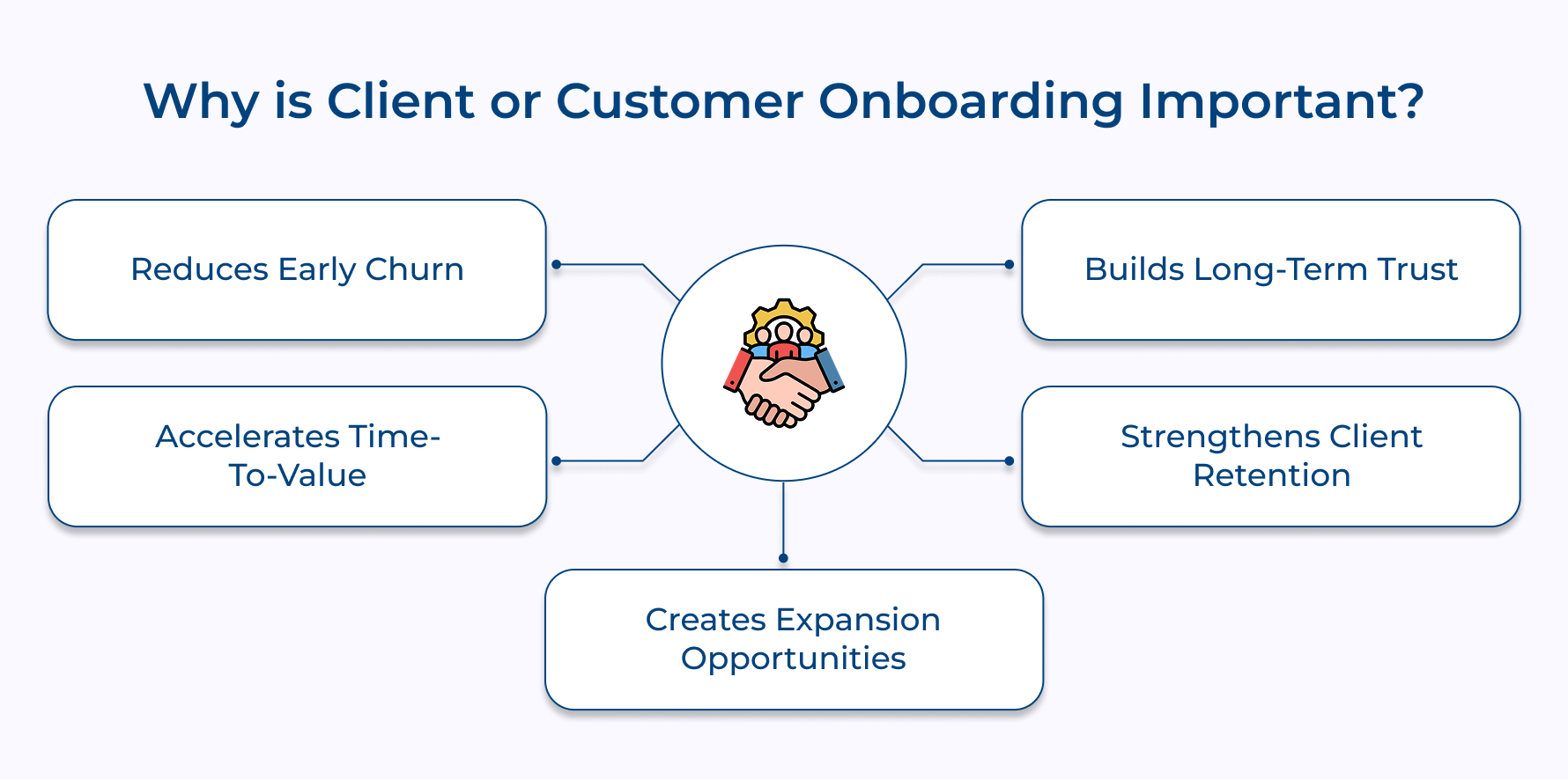
1. Reduces Early Churn
Most clients exit because they never truly understood how to use it. A structured onboarding process closes that gap to make sure the client reaches value before frustration sets.
2. Accelerates Time-to-Value
The faster a client experiences a real win, the stronger their confidence in the decision made. A popper customer onboarding best practice means you are deliberately building those early wins instead of leaving them to guesswork.
3. Builds Long-Term Trust
Trust is not built in the sales call. It is built in the first 30 days of actual delivery. Clients stop second-guessing their investment when they see that your team is organized, proactive and aligned with their goals.
4. Strengthens Client Retention
Retention starts from the first day onboarding. Businesses that implement strong B2B customer onboarding best practices consistently have higher retention rates, as the client feels supported throughout the adoption.
5. Creates Expansion Opportunities
A well-onboarded client understands the product deeply to recognize where it can help. The awareness is what opens the door to upsells and cross-sell opportunities without the need for hard selling.
Examples of an Effective Client Onboarding Process
Understanding best practices of the onboarding process is one thing, but how they translate into the real world is where the learning truly starts.
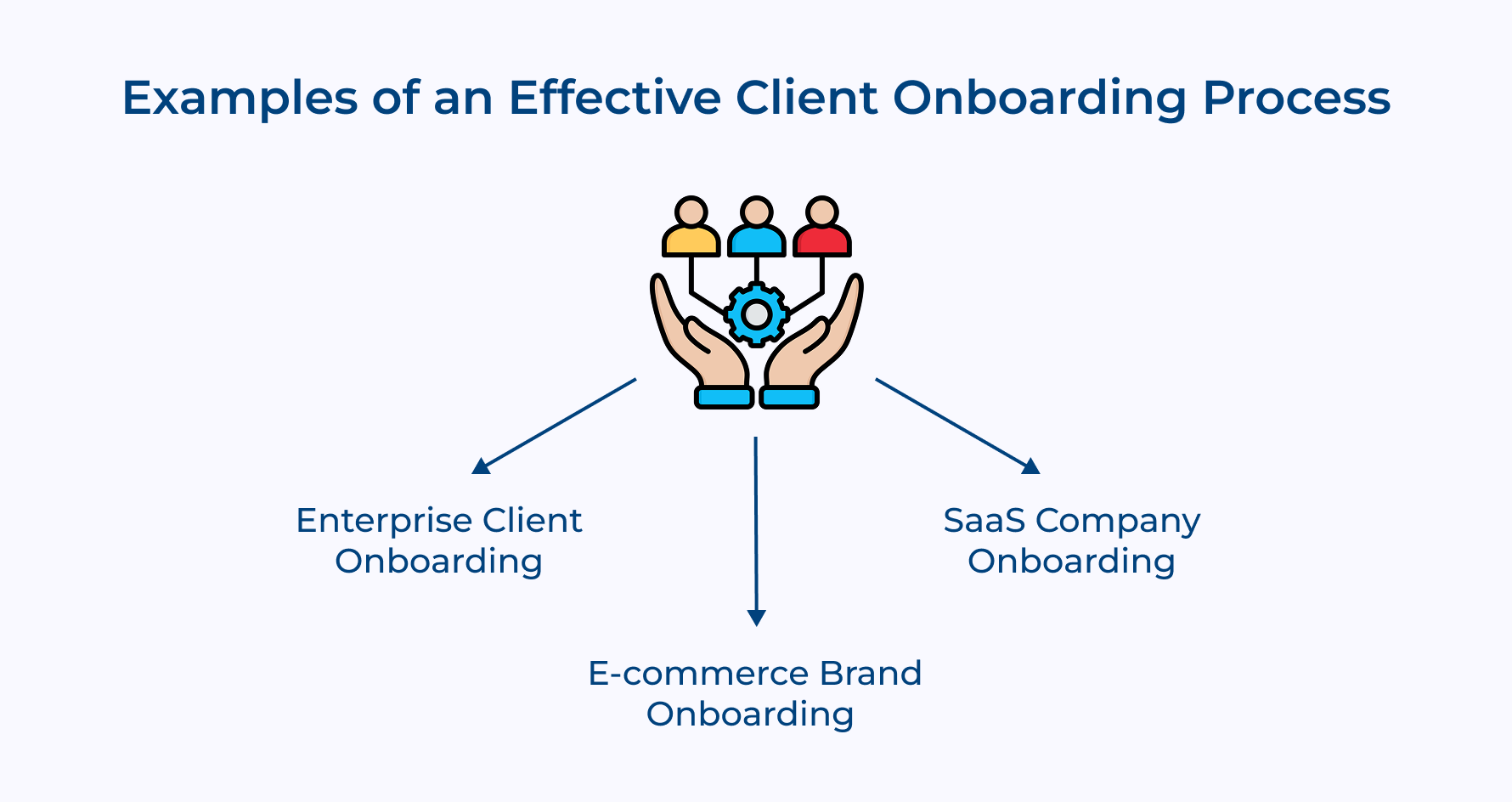
SaaS Company Onboarding: Guided Activation with Behavioral Triggers
A SaaS platform assigns a new user a role-based onboarding checklist just after signup. Behavioral triggers send targeted in-app messages based on the features the user engages with first to drive faster activation.
The system automatically sends a personalized nudge along with the relevant tutorial. It reduced average time-to-value by 40% and improved 30-day retention numbers.
E-commerce Brand Onboarding: Post-Purchase Education Sequence
A direct-to-consumer runs a three-part automated email sequence immediately after the customer’s first purchase. Each email delivers deeper product education from setup to community resource management and personalized product recommendations.
The sequence builds a relationship by showing customers how to get maximum value. This approach consistently sees higher repeat purchase rates with lower early return volumes.
Enterprise Client Onboarding: White-Glove Onboarding with Phased Milestones
An enterprise software provider allocates a dedicated success manager to new accounts and builds a phased onboarding plan. Each phase includes defined deliverables, so the client always has visibility into where they stand.
The white-glove approach is one of the strongest customer onboarding best practices examples for high-value accounts where complexity counts are high. It transforms overwhelming implementation into a structured and confidence-building experience from start
Empower Your Business With Expert Client Onboarding Best Practices.
Strong client onboarding best practices are the foundation of every retained as well as expanded customer relationship. Businesses that skip it not only lose clients early but also leave long-term revenue and loyalty permanently.
- A personalized automated onboarding flow reduces churn as well as accelerates time-to-value for new clients.
- Align both sales and success teams to make sure no client experiences a knowledge gap at the critical stage.
- Measure onboarding metrics to turn your process from guesswork into a retention-driving system that improves over time.
Businesses that treat onboarding as a strategic priority outperform those that make it a formality. The right customer onboarding best practices implementation is the most impactful investment you can make in long-term retention.
The best customer onboarding practices not only welcome new clients but also trust, confidence and habits that turn buyers into long-term advocates for the business.
Limit time — not creativity
Everything you need for customer support, marketing & sales.

Neeti Singh is a passionate content writer at Kooper, where he transforms complex concepts into clear, engaging and actionable content. With a keen eye for detail and a love for technology, Tushar Joshi crafts blog posts, guides and articles that help readers navigate the fast-evolving world of software solutions.