How to Write an Agile Project Charter That Works
- What is Agile Project Charter?
- 5 Benefits of Writing an Agile Project Charter
- Key Components To Include in an Agile Project Charter
- How to Create an Agile Project Charter: 7 Steps
- Tips and Best Practices for Agile Project Charter Management
- Launch Projects with Confidence Using Agile Project Charter
- FAQs about Agile Project Charter

Key Highlights:
- An agile project charter is documentation of vision, scope and success criteria to align teams before execution begins.
- 48% of projects are considered agile project management charter closes that gap by setting objectives before starting.
- Core elements such as kickoff meetings, mission statements and charter reviews help prevent scope creep while optimizing delivery.
The first question that arises in most service firms is why agile projects do not collapse during execution. Instead, it happens because the team never had a common definition of “what success is.” This gap explains exactly what a well-structured agile project charter does in the entire project cycle.
A recent report from PMI’s Global Project Success suggests that only 48% of projects are considered successful, while the rest fall into the mixed-results category.
Even well-resourced agile teams end up with outputs that miss the actual goal when vision and objectives are not locked.
Explore the core charter components in a step-by-step process for project managers who need practical guidance. Also, understand how to build an agile project charter that drives real project success.
What is Agile Project Charter?
An agile project charter is a strategic document that defines vision, goals and boundaries while keeping teams aligned to changes. Think of it as a single source of truth for every stakeholder and team member to refer to during priority shifts or decision-making.
Why Does an Agile Project Management Charter Matter?
Complex project management without a well-defined agile project charter is the root cause of scope creep, misaligned expectations and wasted sprints. A clear charter gives the team the shared context needed to move without direction.
Even the most skilled teams end up solving the wrong problems. The agile project charter’s meaning stops at an agreement that keeps every stakeholder on the same page until delivery.
Key objectives:
- Define project vision: Set a clear understanding of the project goal and why it matters.
- Align stakeholders: make sure every sponsor and team member is working toward the same goals.
- Set scope boundaries: A well-defined scope management prevents scope creep before it starts.
- Enable adaptive planning: A flexible framework that enables teams to pivot without losing core objectives.
5 Benefits of Writing an Agile Project Charter
Explore the benefits of writing a project charter that directly impacts project efficiency from vision to delivery.
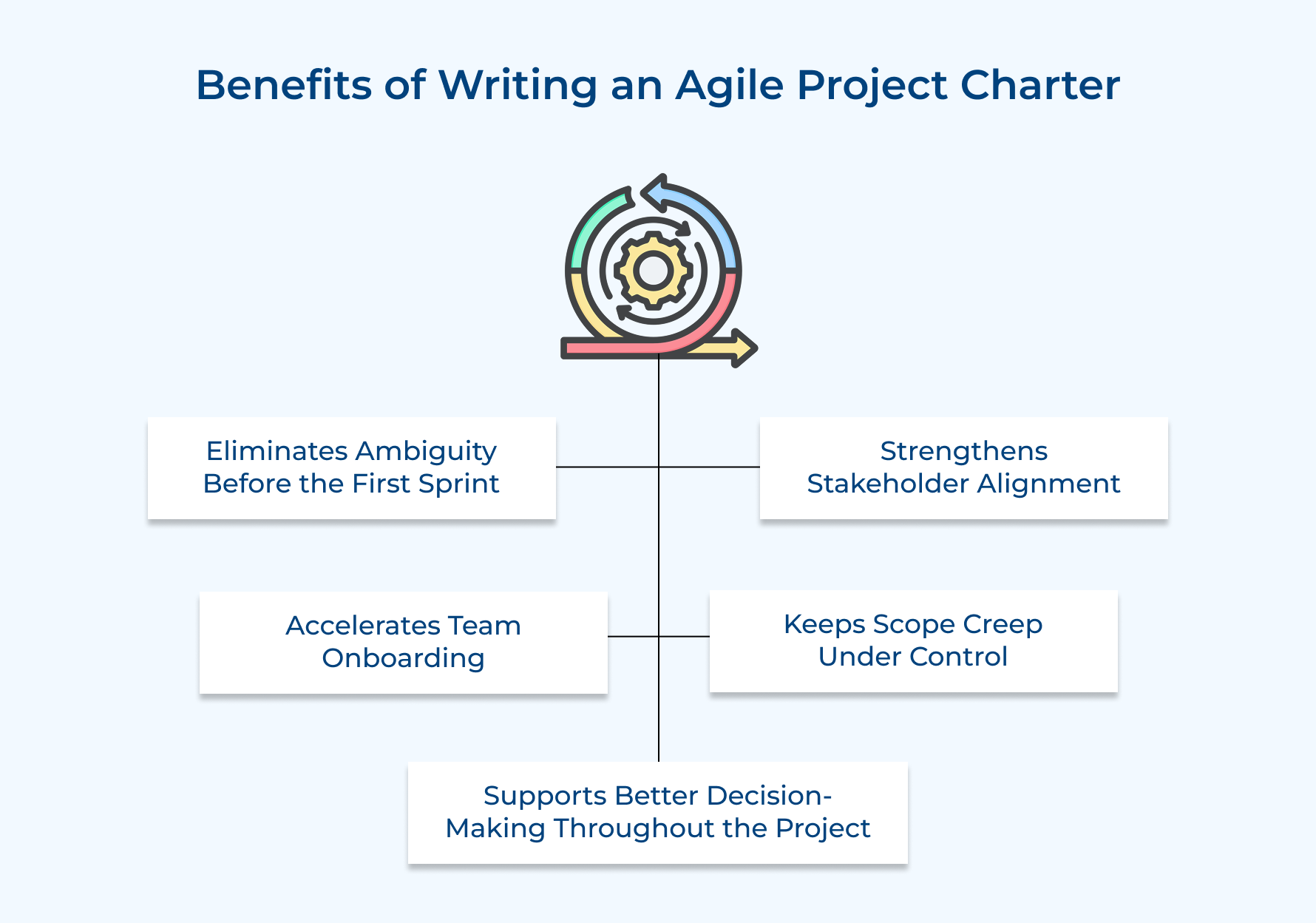
1. Eliminates Ambiguity Before the First Sprint
A structured charter enables teams to answer the hard questions before any work begins:
- Scope
- Ownership
- Success criteria
This upfront transparency prevents costly mid-project corrections that derail timelines and drain resources.
2. Strengthens Stakeholder Alignment
The most overlooked benefit of defining a project charter early in agile methodology is stakeholder alignment across a shared vision before conflicting priorities. It makes collaboration a natural outcome instead of a forced effort.
3. Keeps Scope Creep Under Control
Scope creep affects projects in which defined boundaries are missing from the beginning. A proper charter document creates a reference point for teams to confidently push back on external scopes.
4. Accelerates Team Onboarding
A well-prepared charter during the initial project planning stage acts as an instant document that communicates everything without lengthy handholding sessions. It streamline deliver process and reduces time lost in repeated context-setting conversations.
5. Supports Better Decision-Making Throughout the Project
Decisions made without reference create inconsistencies that scale over time. An agile project management charter gives teams a proper structure to evaluate trade-offs while staying consistently aligned with project objectives.
Key Components To Include in an Agile Project Charter
Below are the key elements that separate an agile project charter from one that only collects dust.
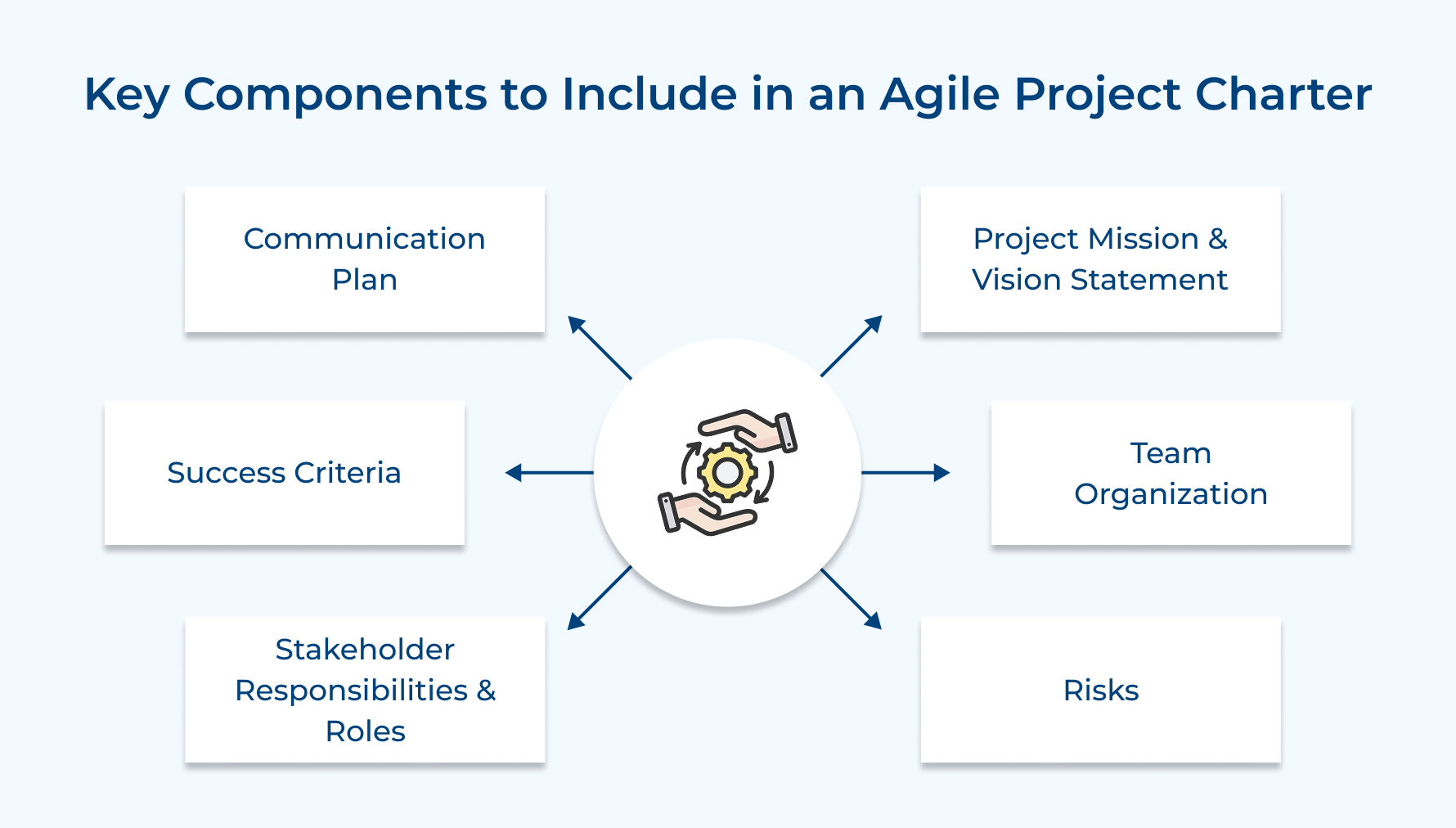
1. Project Mission and Vision Statement
The heartbeat of any agile project charter includes the mission and vision statement. It answers the fundamental question of the scope and goal of the project that is being tried to achieve. Even the most capable teams end up optimizing wrong outcomes without a strong vision.
So, how is a vision statement useful in practice? Nothing is rocket science, just specific enough to make real-time decisions while maintaining the flexibility to survive changes. Consider these questions when drafting this section:
- What problem do we solve and for whom?
- What does success look like in the last six months from now?
- How does the project connect with the organizational objective?
A sharp mission statement keeps every decision anchored to something meaningful. It enables the team to spend less time making decisions and more time delivering value.
2. Team Organization
Another practice element an agile project charter includes is a team structure and organization that directly impacts execution. Define a team organization effectively by documenting these aspects:
- Decision authority: Clearly define ownership of the final calls on scope, budget and priority changes.
- Workstream ownership: Assign an owner for each deliverable to prevent accountability.
- Sync cadence: Establish proper team communication to maintain touchpoints that are designed to accomplish.
This proper organization removes the guesswork from collaboration. The team moves faster and with greater confidence when members understand their targets.
3. Risks
Every project comes with its own risk, which a charter can identify early, instead of scrambling to manage mid-sprint. A good charter reflects a mature project management approach that enables the team to respond instead of only reacting.
The documentation should not only be listed but also paired with a preliminary mitigation. It keeps projects on track during situations when things go out of plan.
4. Stakeholder Responsibilities and Roles
Unclear stakeholder ownership leads to project delays. This component becomes a non-negotiable part in any well-structured charter. Defining responsibility and accountability saves countless hours of back-and-forth across the project.
- Sign-Off authority: Identify final approval on project decisions and deliverables.
- Communication frequency: Distinguish stakeholders who need weekly updates from only milestone-based reporting.
- External involvement: Flag third-party stakeholders whose input is needed at specific project stages.
Well-defined stakeholder responsibilities make communication structured instead of reactive. It enables agile teams to deliver at speed without confusion at the leadership level.
5. Success Criteria
Success criteria is what “task done” actually looks like. Teams risk delivering output without a defined criterion, leading to complete misses of targets. It transforms vague project goals into outcomes that your team can heavily depend on.
Think if every member knows how success is measured after project delivery? If no, then the gap causes misalignment between team deliverables and stakeholders’ expectations.
- Progress metrics: Define the proper structure of progression measurement that will be tracked at each stage of the project cycle.
- Value indicators: Specify outcomes to confirm that the project delivered real value.
- Validation of ownership: Clarify accountability of formal sign-off that the criteria have been met.
6. Communication Plan
A communication plan within an agile project charter keeps the entire project in one ecosystem, which includes:
- Team members
- Stakeholders
- Sponsors.
They are connected without overloading information. So what is proper communication all about? Structured updates across deliverables from the start.
Situations when communication is missing, stakeholders are out of the loop, while the lead team is spending more time managing confusion than executing. A practical communication includes :
- Channel selection: Identify platforms that handle daily updates with respect to formal milestone reporting.
- Reporting frequency: Define clear expectations on how different stakeholders receive project updates and on how frequently.
- Escalation path: Maintain proper documentation for those responsible for communicating blockers.
How to Create an Agile Project Charter: 7 Steps
Consider this seven essential steps to craft an agile project charter that aligns your team and boost your project forward
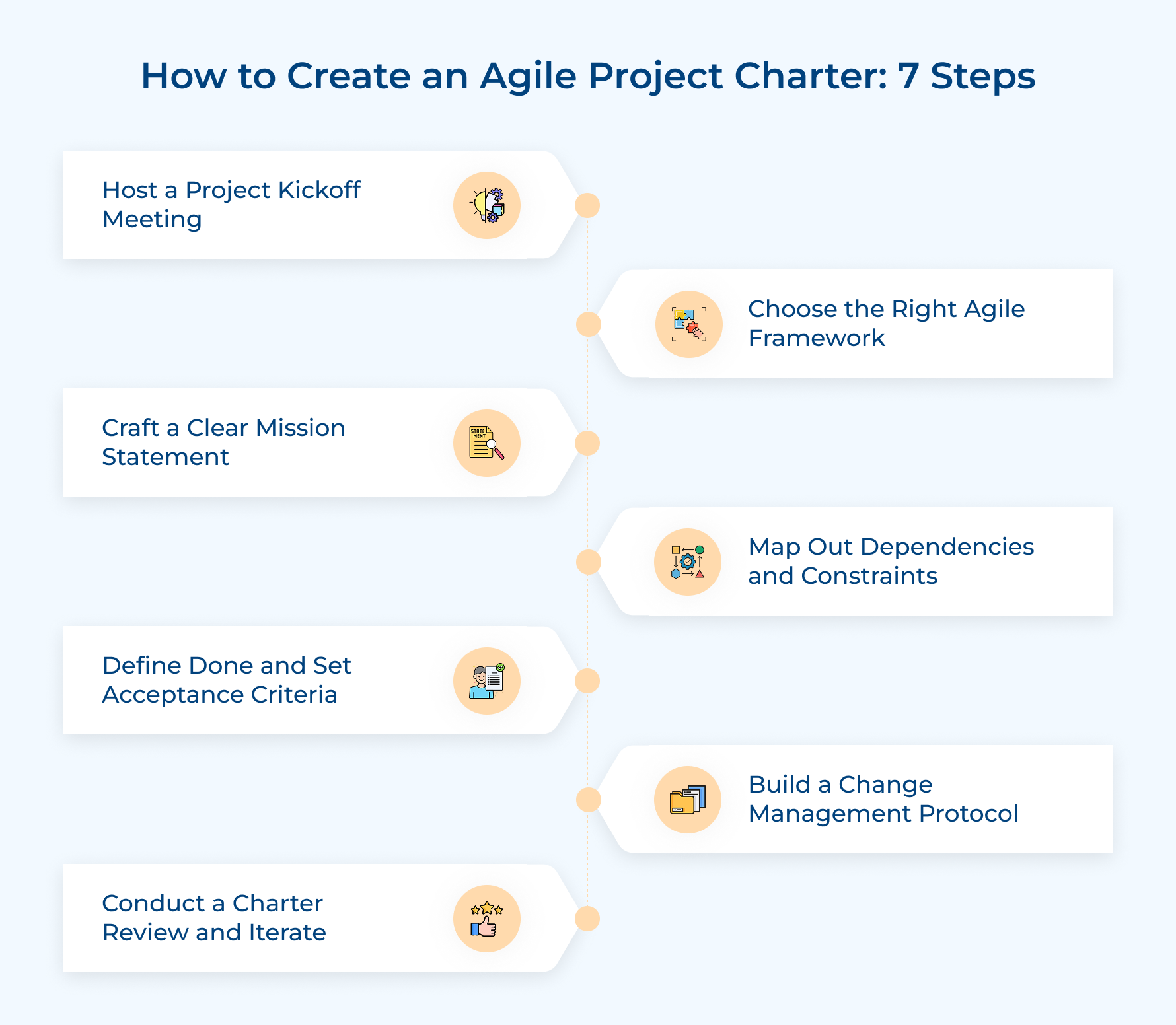
1. Host a Project Kickoff Meeting
A kickoff meeting is the moment where the entire project gets its real heartbeat by allocating the right people before work starts. It is what sets the tone for everything that follows in the documentation process.
Now the question is, who exactly should join the meeting? Everyone whose decision will shape the project. It means the project sponsor, product owner, key stakeholders or any cross-functional team whose work directly impacts outcomes.
Every effective kickoff meeting should include the following things:
- Project context: Define the goal of the project and what business problem it solves.
- Role clarity: Define ownership and decision makers throughout the project.
- Communication agreement: Set norms around meeting frequency, reporting and channels.
- Charter scope discussion: Move through the initial process of the project to identify conflicts or misalignments.
The outcome of this meeting directly feeds into every section of the agile project charter. So the quality of this conversation defines the quality of the charter. Rushing to the flow leads to revisiting foundational decisions more expensively mid-project.
2. Choose the Right Agile Framework
The right agile charter framework creation process shapes team planning, execution, and delivery throughout the entire project lifecycle. A framework that does not match the team’s structure creates friction that slows delivery.
Before committing, different projects call for different frameworks and understanding each is essential:
- Scrum: Ideal for teams working in fixed iterations with defined sprint goals and a dedicated product owner.
- Kanban: Suited for teams that manage continuous flow where priorities shift frequently, while rigid sprints create more overhead than value.
- SAFe (scaled agile framework): Best for large enterprises coordinating multiple teams across complex programs with shared dependencies.
Can your team actually decide what fits best? It depends on three things that are likely to shift during execution:
- Team size
- Nature of the work
- Frequently stakeholder prioritization
Before locking the framework, take one step back and validate the choice with stakeholders. A framework that the delivery team might prefer cannot be liked by a stakeholder.
3. Craft a Clear Mission Statement
A mission statement in an agile charter in PMP is about giving the team a precise understanding of project goals and why it matters. Teams interpret objectives differently when this statement is vague, leading to misalignment.
Run through this checklist before writing a single word of the statement
- What is the specific problem this project will solve?
- Who is directly affected by the outcome of this project?
- What does a measurably successful outcome look like after the project closure?
- How does the project connect to the broader organizational goal?
These questions force the team to cover the gaps in their understanding before they turn into mid-sprint surprises.
Once the statement is drafted in the project charter, it should be tested against a simple standard. Can every team member read it and understand their target?. If no, then the statement needs another pass before moving the charter.
Best Practices:
- Keep it to 2-3 sentences as brevity forces clarity and makes the statement easy to refer.
- Avoid internal jargon so that any new team member can understand without additional context.
4. Map Out Dependencies and Constraints
Dependencies and constraints derail even the most well-defined agile project and aligning them at the charter stage separates proactive management from reactive ones. It gives the team visibility to plan around them instead of getting blindsided mid-execution.
Identifying Cross-Team and Third-Party Dependencies
Cross-team dependencies are another risk in any agile project because they sit outside the team’s direct control. This early mapping includes third-party vendors, shared platforms or parallel workstreams that create the visibility needed to build realistic timelines.
Documenting Budget and Resource Constraints Upfront
Budget and resource constraints not documented in the project charter help identify the worst-case scenarios during execution. It gives the team a realistic framework that prevents scope commitments that the project simply cannot support.
Flagging Technical Limitations Before Sprint Planning Begins
Technical limitations at the charter stage become blocking issues that the team did not identify. Flag these constraints early to the architecture and delivery teams so they can build practical workarounds before they become critical-path problems.
5. Define Done and Set Acceptance Criteria
The acceptance criteria are the backbone of any agile project charter, as without them, “done” becomes only an opinion. It eliminates the ambiguity that turns final project delivery reviews into stakeholder disagreements.
Now comes the question of what happens on projects where acceptance criteria are skipped in the charter? The team delivers what they built but stakeholders reject it because no one documented the expectation gap early to close it.
Here are four practical acceptance criteria examples that need to be defined in the agile project charter for a professional services firm:
- Delivery timeline adherence: All project milestones must be achieved within the defined schedule without scope compromise.
- Documentation completeness: Every deliverable should be synced with updated process documentation.
- Quality benchmark met: All output must go through a predefined quality checklist before being presented to the client.
Does defining criteria inside the agile project charter create pushback from stakeholders who need flexibility? Consider these criteria as protection for both sides to eliminate subjective judgment calls when everyone agrees upfront on success.
6. Build a Change Management Protocol
A change management protocol in agile project charter prevents well-intentioned scope from dismantling the project’s timeline and budget. An unstructured process for handling change requests leads to every stakeholder’s idea being a potential derailment.
Build this protocol into the charter to deliver immediately:
- Scope protection: A defined change process creates a buffer that prevents unreviewed additions from entering sprints.
- Stakeholder accountability: Formalize the approval process to make sure stakeholders think critically before introducing changes mid-execution.
What does change management actually look like in practice? It defines how a request is submitted, along with the approval process that gets absorbed without disturbing active work.
Consider this to build an effective protocol into the charter:
- Request submission process: Define a simple format for submitting change requests so that every request carries detailed context.
- Impact assessment requirement: Every request must include a documented assessment of how the changes affect the timeline, budget and scope.
- Approval threshold definition: Separate minor changes that team leads can approve while major changes require sponsor-level sign-off.
7. Conduct a Charter Review and Iterate
An agile project charter that never gets reviewed after creation is just a snapshot of early assumptions that will become outdated. Teams that treat charter reviews as a recurring step keep the team aligned across every phase of delivery.
Below are methods to conduct a meaningful agile charter PMP review:
- Scheduled milestone reviews: After every achieved milestone, revisit the charter to validate alignment with original objectives before the start of the next phase. Use this checkpoint to reconfirm commitments and adjust deliverables as needed.
- Sprint retrospective integration: Include a brief charter alignment check into the existing milestone for teams to continuously evaluate scope boundaries. It prevents small misalignments from scaling into major course corrections later.
- Stakeholder feedback loop: Schedule dedicated charter review sessions at frequent intervals to identify any shifts in business priorities. It helps in keeping each stakeholder actively involved to reduce the risk of late-stage surprises.
Consider an example of a software implementation team working on a mid-project agile charter review to discover key third-party integration deprioritized by the vendor. Since the review is done at the milestone stage, the teams get time to restructure the delivery plan and protect the timeline before the dependency becomes a cause of delay.
Tips and Best Practices for Agile Project Charter Management
An agile project charter is less about following a template and more about building a document that the team uses in real time..
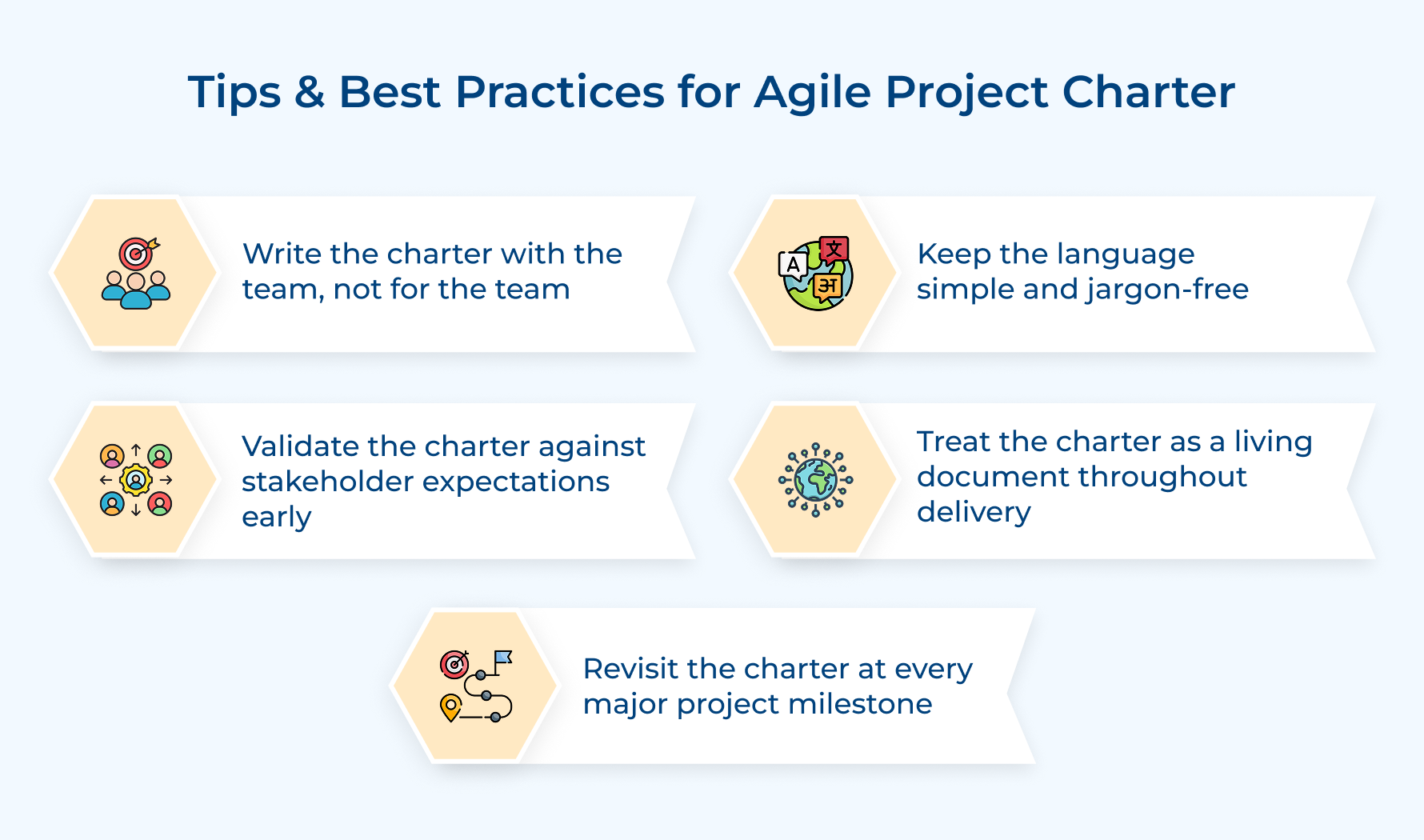
- Write the charter with the team, not for the team: A well-built project charter generates stronger team buy-in and identifies blind spots that a top-down approach misses.
- Keep the language simple and jargon-free: Every stakeholder should be able to clearly read the charter and understand the project’s boundaries.
- Treat the charter as a living document throughout delivery: Keep your agile project charter updated frequently after kickoff, as it quickly becomes irrelevant to the reality the team is actually working.
- Validate the charter against stakeholder expectations early: A charter can look complete internally, but in reality, it has never been cross-checked with stakeholders, leading to misalignment that will surface later.
- Revisit the charter at every major project milestone: Scheduled reviews at every milestone to keep the team aligned and prevent guesswork from scaling into costly project corrections.
Launch Projects with Confidence Using Agile Project Charter
A well-built agile project charter is a strategic foundation that determines if your project will succeed or struggle. Teams that invest time in getting the right charter once can spend more time delivering real outcomes.
- A charter with undefined criteria and scope boundaries leads to mid-project misalignment as well as scope creep.
- Treat the agile project management charter as a living document and update it regularly to keep teams aligned across every phase of delivery.
- Stakeholder alignment, risk documentation and scope change management are the key charter elements that separate successful projects from stalled ones.
An agile project charter, combined with the right elements and reviewed consistently, transforms project vision into measurable delivery success. Use the right framework for building the organizational muscle to launch every future project with the same confidence.
Limit time — not creativity
Everything you need for customer support, marketing & sales.

Neeti Singh is a passionate content writer at Kooper, where he transforms complex concepts into clear, engaging and actionable content. With a keen eye for detail and a love for technology, Tushar Joshi crafts blog posts, guides and articles that help readers navigate the fast-evolving world of software solutions.