Practical Guide to Sales and Marketing Alignment Success
- What is Sales and Marketing Alignment?
- Benefits of Aligning Sales and Marketing
- 5 Essential Stages of Marketing and Sales Alignment in Business
- How to Align Sales and Marketing in 7 Simple Steps
- 6 Actionable Best Practices for Sales and Marketing Alignment
- Bridge the Gap Between Sales and Marketing for Unstoppable Business Growth
- FAQs about Sales and Marketing Alignment

Key Highlights:
- Sales and marketing alignment accelerates revenue growth, it also shortens sales cycles.
- Aligned teams improve lead quality, conversion rates and overall business efficiency.
- Shared goals, unified metrics and regular feedback strengthen sales marketing alignment.
Most businesses struggle with sales and marketing teams working in isolation which creates confusion for prospects as well as wastes valuable resources.
When these departments operate separately companies lose millions in potential revenue through longer sales cycles and higher customer acquisition costs. Teams blame each other for missed targets while prospects slip away to competitors who deliver more cohesive experiences.
This comprehensive guide to sales and marketing alignment provides a proven roadmap for transforming disconnected departments into a unified revenue engine. You will discover practical strategies, battle-tested frameworks as well as actionable steps that create seamless collaboration between your sales and marketing teams for sustainable success.
What is Sales and Marketing Alignment?
Sales and marketing alignment means both teams work together toward shared goals using coordinated strategies along with unified messaging. When these departments collaborate effectively they create a seamless customer journey from initial awareness through final purchase.
Aligned sales and marketing teams accelerate revenue growth by delivering qualified leads as well as shorter sales cycles. They reduce customer acquisition costs while improving conversion rates and customer satisfaction. This coordination creates predictable revenue streams and stronger competitive positioning in the market.
Key principles:
- Shared goals and metrics: Both teams measure success using the same revenue-focused objectives rather than department-specific vanity metrics.
- Unified customer journey mapping: Teams collaborate to understand every touchpoint and ensure consistent messaging throughout the buyer’s experience.
- Regular communication and feedback loops: Weekly meetings and shared platforms keep both sides informed about lead quality as well as market insights.
- Integrated technology and data sharing: Common CRM systems and dashboards provide real-time visibility into prospect behavior along with campaign performance.
- Joint content creation and messaging: Marketing creates materials based on sales feedback while sales provides real customer language for authentic messaging.
Benefits of Aligning Sales and Marketing
When sales and marketing work as unified partners rather than separate departments the results speak for themselves through measurable business improvements.
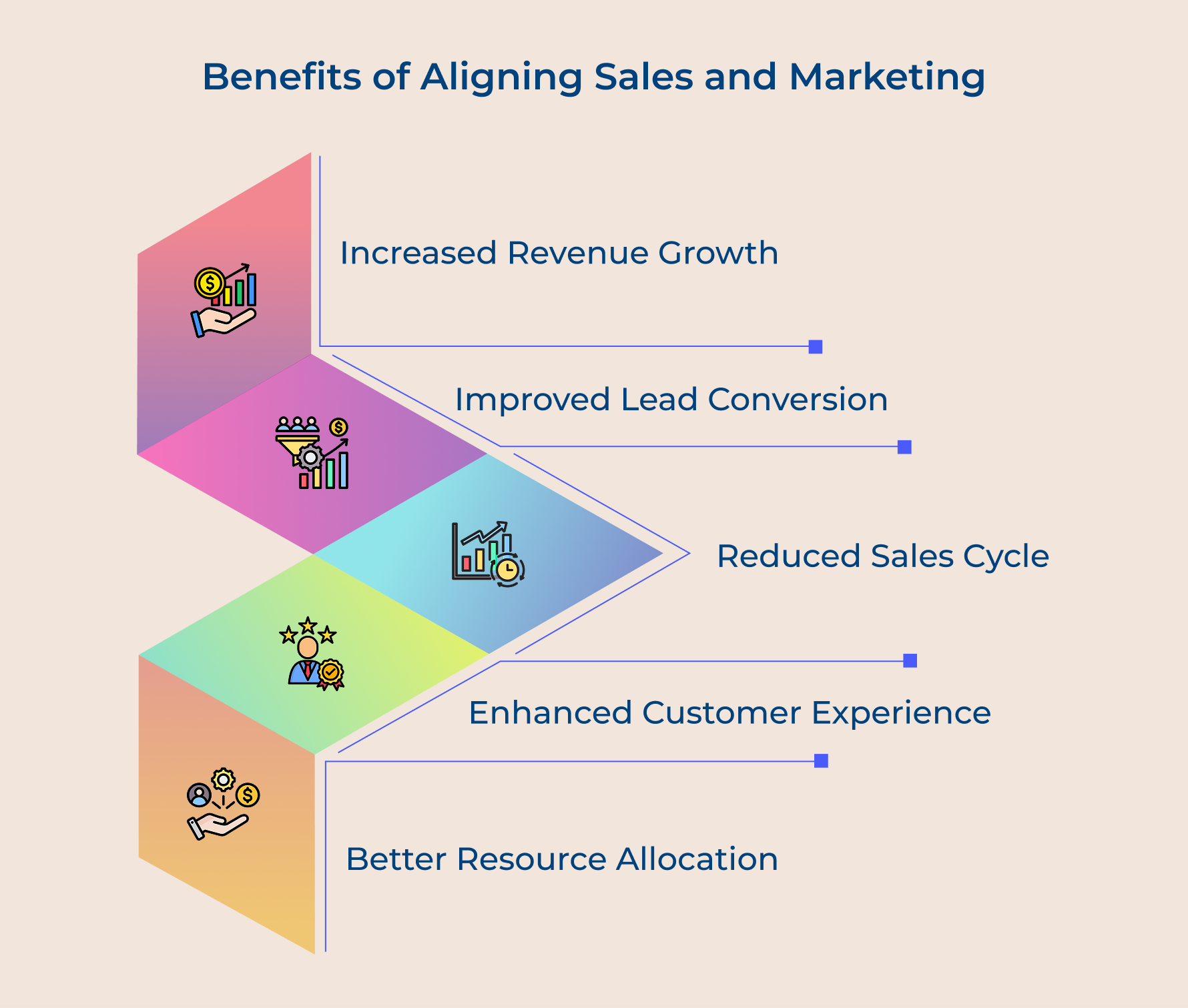
Increased Revenue Growth
When sales and marketing alignment happens, revenue grows faster. Marketing delivers stronger leads, while sales shares feedback that sharpens future campaigns.
Improved Lead Quality and Conversion
Aligned teams know exactly what makes an ideal customer. Marketing attracts the right prospects and sales closes more deals in less time.
Enhanced Customer Experience
Prospects get consistent messaging and smooth handoffs. This trust-building approach creates loyal customers and repeat business opportunities.
Reduced Sales Cycle Length
Aligned efforts mean prospects are well-prepared before sales talks. Deals close faster with fewer touchpoints and quicker time-to-revenue.
Better Resource Allocation and ROI
Sales and marketing alignment eliminates wasted effort. Budgets and time focus only on strategies as well as leads most likely to convert.
5 Essential Stages of Marketing and Sales Alignment in Business
Understanding alignment as an evolutionary journey helps businesses recognize where they currently stand and plan their next moves strategically.
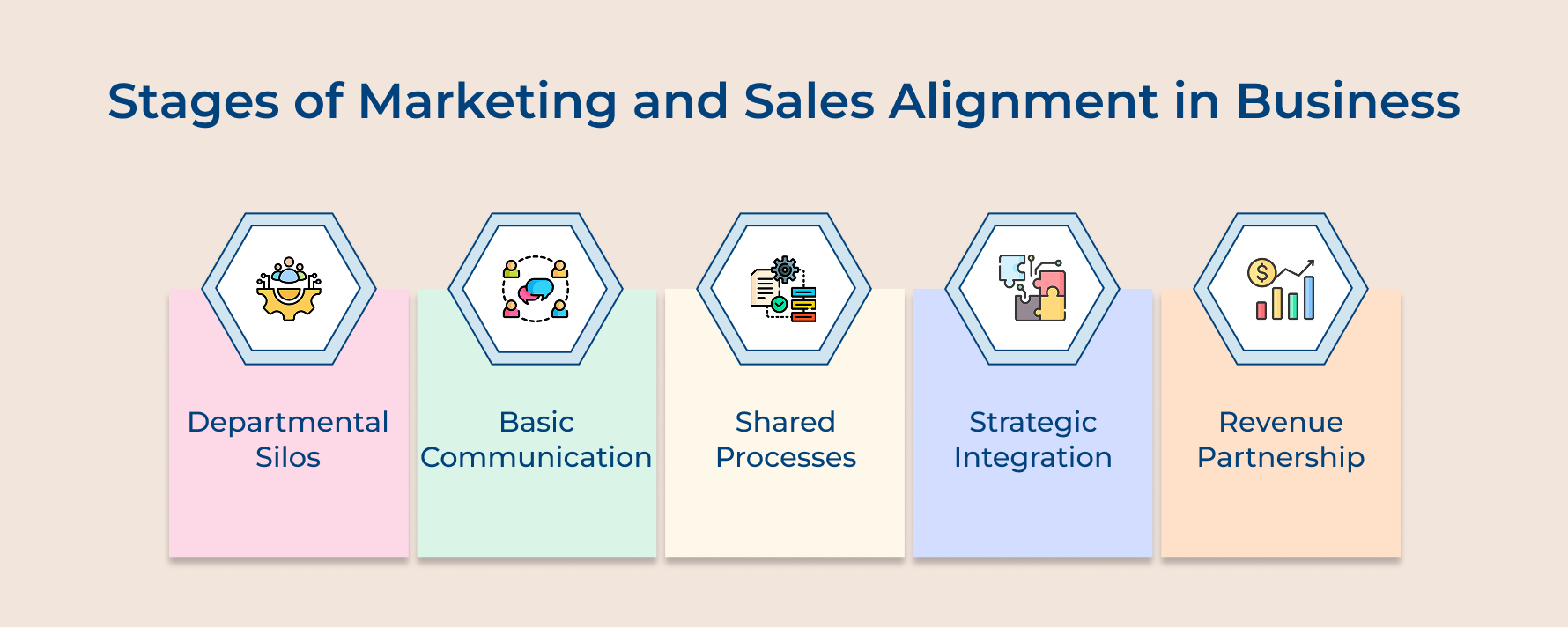
Stage 1: Departmental Silos
Many organizations start in a disconnected phase where sales and marketing work in silos with little alignment. Marketing chases awareness and lead volume, while sales focuses only on closing deals without thinking about the entire customer journey.
Key signs of this stage include:
- Separate goals and performance metrics
- Minimal cross-department collaboration
- A culture of finger-pointing when targets are missed
This lack of sales and marketing alignment creates major inefficiencies. Prospects get mixed messages, experience clunky handoffs and often feel misunderstood. Frustrated customers, unpredictable revenue as well as opportunities lost to competitors offering a smoother experience.
Stage 2: Basic Communication
Teams start sharing information occasionally through monthly meetings or informal conversations but still maintain separate strategies and objectives. Marketing begins asking sales about lead quality while sales occasionally provides feedback about prospect concerns and common objections they encounter.
Questions that reveal basic communication gaps worth addressing:
- Are we meeting regularly enough to catch problems before they impact our revenue goals?
- What specific feedback does sales need from marketing to improve their closing rates?
- How can we create better systems for sharing insights without overwhelming either team?
However, communication remains sporadic and reactive rather than systematic which means teams still miss opportunities for deeper collaboration. The handoff process between marketing qualified leads and sales accepted leads often lacks clear criteria as well as consistent follow-through.
Stage 3: Shared Processes
In this stage, organizations move beyond silos by creating formal procedures for lead handoffs and setting basic service-level agreements (SLAs). Marketing and sales begin to define clear rules for when a prospect transitions from nurturing into active sales engagement.
Key developments include:
- Lead scoring systems that identify sales-ready prospects with greater accuracy
- Documented handoff processes so no qualified lead slips through the cracks
- Regular feedback loops where sales data improves marketing campaigns
This structured collaboration is a big step forward. Still, separate goals and disconnected technology can cause friction when priorities clash or data doesn’t align.
Stage 4: Strategic Integration
At this stage, marketing and sales move beyond cooperation to true alignment by rallying around shared revenue targets. Instead of chasing separate metrics, both teams focus on common objectives and use integrated platforms that give visibility into the full customer lifecycle.
Key developments include:
- Shared goals and KPIs tied directly to revenue
- Joint development of the ideal customer profile
- Coordinated campaigns and sales activities around unified objectives
The result is a seamless customer experience. Marketing delivers prospects perfectly primed for sales, while sales provides continuous insights that sharpen marketing strategies and improve future conversions.
Stage 5: Revenue Partnership
At the highest level of sales and marketing alignment, the two teams merge into a unified revenue organization where customer success matters more than departmental boundaries. Both functions share full accountability for revenue growth and customer satisfaction, while still bringing their own expertise to the table.
Key markers of this stage include:
- Joint responsibility for predicting and preventing customer churn
- Coordinated efforts to expand relationships with existing customers
- Shared strategies that create lasting competitive advantages
Companies that reach this level operate as a single revenue engine, consistently outperforming competitors through seamless customer experiences and efficient resource allocation.
How to Align Sales and Marketing in 7 Simple Steps
Let’s uncover seven actionable steps that can help your organization align sales and marketing efforts, leading to improved communication as well as more robust bottom line.
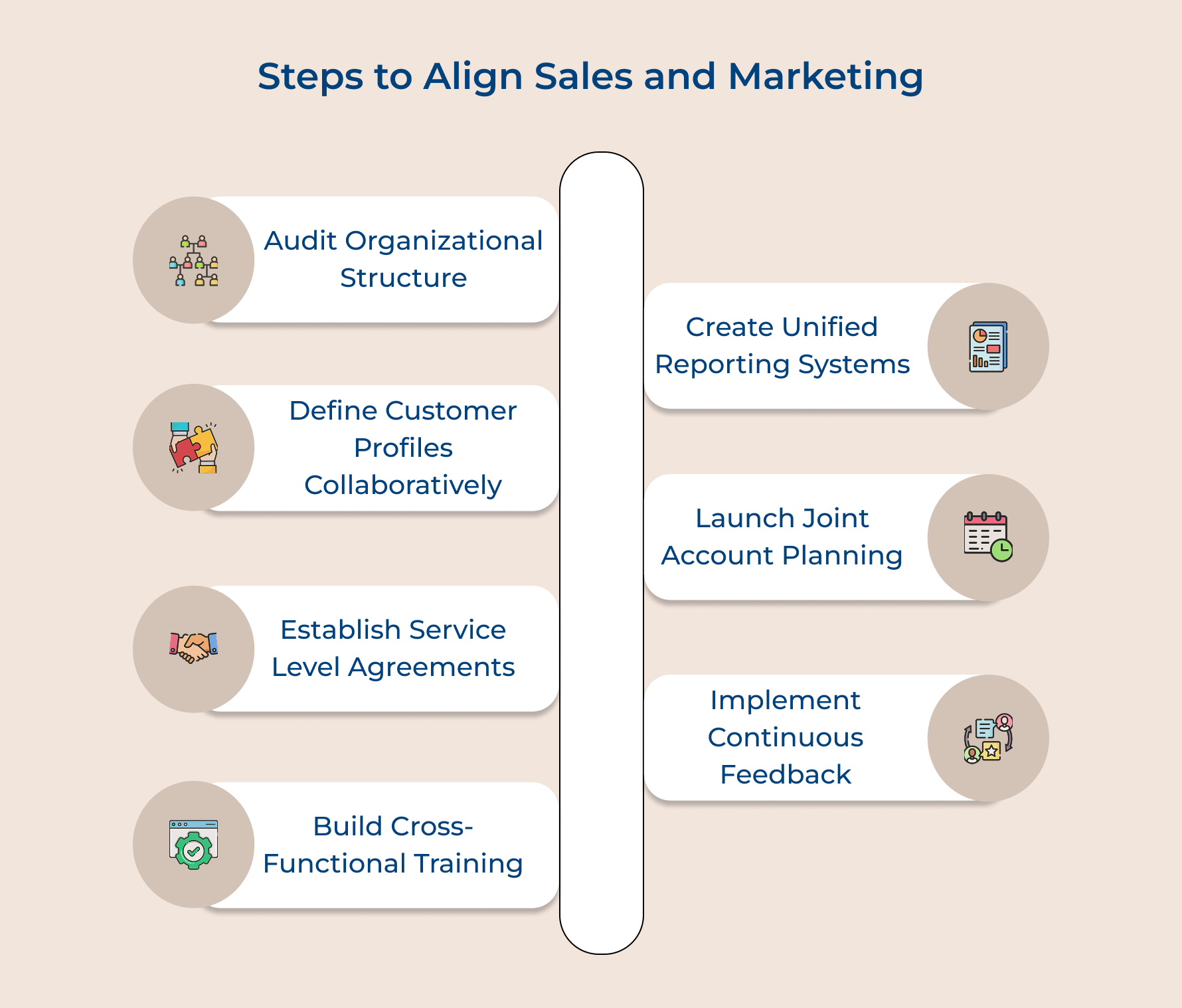
1. Audit Current Organizational Structure
Before you can align sales and marketing, you need to know how things currently work. An organizational audit helps uncover barriers that slow collaboration and block smooth movement through the sales funnel. This step shows where workflows break down and where communication gaps exist, giving business leaders a clear view of what needs fixing.
Three practical ways to run an audit:
- Interview key stakeholders to uncover daily challenges and frustrations.
- Map workflows to see where handoffs and lead progress stall.
- Review tools and systems to spot data silos.
Take a software company, for example: marketing generated hundreds of leads every month, but sales dismissed them as low quality. The audit revealed mismatched qualifying leads criteria – marketing’s definitions didn’t align with what sales expected. This wasted effort and created frustration across teams.
2. Define Ideal Customer Profiles Collaboratively
Great alignment begins with knowing exactly who you’re targeting. Collaborative profiling means combining sales insights from the field with marketing’s data-driven research to build accurate buyer personas. This shared view ensures marketing attracts prospects who are genuinely sales-ready, making qualifying leads faster and smoother.
Key benefits of this approach include:
- Unified focus: Both teams target the same prospects rather than chasing different definitions.
- Better lead quality: Marketing delivers contacts sales can confidently convert.
- Consistent messaging: Sales builds on marketing promises instead of contradicting them.
- Less friction: Teams stop debating lead quality because standards are agreed upfront.
To create these profiles, start simple: ask sales which customer traits matter most for closing deals. Then have marketing research where these prospects spend time online and what content influences their decisions.
3. Establish Service Level Agreements
Service level agreements (SLAs) keep expectations crystal clear. They define exactly what each team commits to, ensuring a smoother sales funnel and consistent delivery against shared revenue goals. With SLAs in place, neither team wastes time guessing what the other needs.
Three elements make SLAs effective:
- Response times: Sales follows up on marketing leads quickly while marketing delivers materials within agreed timeline.
- Quality standards: Clear lead data requirements prevent debates and make qualifying leads more efficient.
- Accountability: Regular tracking ensures both sides uphold commitments and any gaps can be corrected quickly.
Done right, SLAs eliminate confusion and replace finger-pointing with collaboration. They also give business leaders confidence that both departments are pulling in the same direction.
4. Build Cross-Functional Training Programs
Training is one of the fastest ways to improve empathy between teams. When sales and marketing learn each other’s roles, assumptions disappear and collaboration improves. The outcome? A more seamless buyer experience across the entire sales funnel.
Four training approaches that work well:
- Sales process workshops: Marketing learns objection handling to create stronger content.
- Campaign sessions: Sales gains insight into lead generation and provides useful feedback.
- Customer journey mapping: Both teams work together to optimize touchpoints.
- Technology training: Teams learn each other’s tools to improve data flow.
Some companies even use job shadowing to deepen understanding. For example, one tech firm found that marketing produced whitepapers sales were ignored. After shadowing calls, marketing redesigned the content to address objections, which significantly boosted close rates.
5. Create Unified Reporting Systems
Collaboration often breaks down without shared data. Unified reporting ensures both teams have visibility into the same performance metrics, from lead generation to conversions, so they can track progress through the sales funnel together.
Start by building dashboards that show how marketing’s efforts feed directly into sales outcomes. Attribution models are essential too, since they fairly credit both teams for their role in qualifying leads and driving deals.
Key attribution approaches include:
- First-touch tracking for initial marketing wins.
- Multi-touch analysis to highlight nurturing efforts.
- Sales-assisted attribution to reflect relationship-building.
Monthly or quarterly reporting cycles also create time to celebrate joint successes and spot areas needing adjustment. For business leaders, this shared view strengthens decision-making and makes collaboration measurable.
6. Launch Joint Account Planning
When sales and marketing collaborate on account strategies, it creates a seamless buyer experience that strengthens relationships with high-value prospects. Joint account planning ensures both teams pursue the same objectives instead of sending mixed messages.
Here’s how it works: teams research target accounts together, then co-design strategies. Marketing drives awareness and education, while sales focuses on relationship-building as well as closing. The transition between departments feels natural to the customer.
Pro tips:
- Assign ownership so everyone knows who’s responsible at each stage of the sales funnel.
- Build shared account documents that store insights, preferences and updates for easy access.
This approach keeps both teams aligned and prevents wasted effort or duplicated outreach.
7. Implement Continuous Feedback Mechanisms
The alignment only lasts if you keep improving. Continuous feedback loops give both teams a chance to share insights, address issues early and adapt strategies for changing markets.
Three proven approaches:
- Monthly retrospectives: Teams discuss wins, challenges and process gaps.
- Customer insight sharing: Sales communicates what prospects say, while marketing shares campaign results.
- Quarterly performance reviews: Deep dives into conversion data and revenue outcomes reveal where collaboration works best.
When people feel safe giving honest feedback without blame, both departments learn faster and collaborate more effectively. Over time, this approach helps business leaders maintain alignment while delivering a seamless buyer experience across every stage of the sales funnel.
6 Actionable Best Practices for Sales and Marketing Alignment
Beyond foundational steps these advanced practices help organizations maintain and continuously improve their alignment efforts.
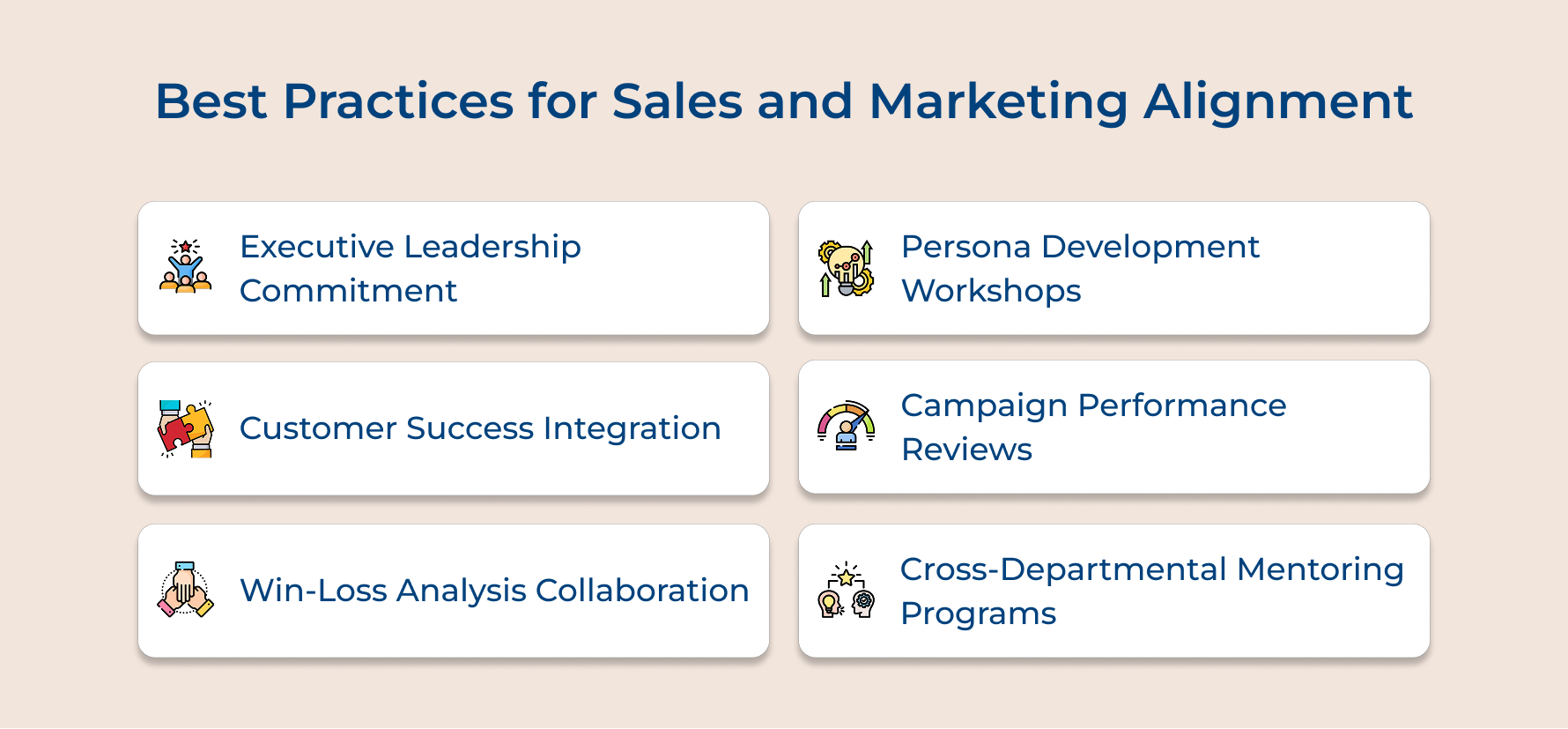
- Executive leadership commitment: Senior leadership must actively champion alignment by participating in joint meetings and holding departments accountable for collaboration. Without visible executive support teams revert to old habits when facing pressure.
- Customer success integration: Include customer success teams in alignment discussions to provide insights about post-purchase experiences and renewal patterns. This collaboration reveals customer journey gaps as well as long-term relationship dynamics.
- Win-loss analysis collaboration: Conduct joint sessions on successful deals as well as lost opportunities to identify patterns and improvement areas together. Marketing learns what messaging resonates while sales discovers which qualification criteria predict success.
- Persona development workshops: Host regular sessions where teams update buyer personas based on recent interactions and market changes. Marketing contributes research while sales provides conversation insights creating accurate customer profiles.
- Campaign performance reviews: Schedule monthly meetings analyzing marketing campaign results and their sales pipeline impact. These sessions help marketing optimize targeting while sales provides feedback about lead quality.
- Cross-departmental mentoring programs: Pair marketing and sales members for ongoing knowledge sharing beyond formal meetings. These partnerships create deeper understanding and build natural collaboration during urgent situations.
Bridge the Gap Between Sales and Marketing for Unstoppable Business Growth
Sales and marketing alignment transforms your organization from two competing departments into one powerful revenue engine that drives predictable growth. When teams share goals and collaborate seamlessly they create exceptional customer experiences that competitors struggle to match.
This strategic partnership eliminates costly inefficiencies while accelerating deal velocity and improving conversion rates throughout your entire customer lifecycle. Organizations that master alignment consistently outperform their markets by turning departmental friction into collaborative advantage.
Limit time — not creativity
Everything you need for customer support, marketing & sales.

Pooja Deshpande is a content contributor at Kooper, focused on creating insightful resources that help agencies and service providers scale efficiently. Passionate about SaaS trends, content strategy, and operational excellence, she delivers practical, easy-to-implement guidance for modern business leaders.