Project Charter vs Business Case: Key Differences to Consider
- What is a Project Charter in Project Management?
- Purpose of a Project Charter
- What is a Business Case?
- Purpose of a Business Case in Project Management
- Project Charter Vs Business Case: Key Elements to Consider
- A. Project Charter Elements
- B. Business Case Elements
- What Are the Key Differences Between a Project Charter and a Business Case?
- Business Case Vs Project Charter: How They Work Together
- Best Practices for Creating a Business Case and Project Charter
- Success Starts with the Difference Between Project Charter Vs Business Case
- FAQs about Project Charter Vs Business Case Comparison

Key Highlights:
- Project charter vs business case is a distinction that determines project approval and delivery, managing entirely different decisions.
- A business case evaluates costs, risks and strategic goals, while a project charter authorizes execution with scope, milestones as well as deliverables.
- Understand the comparison, eliminate mid-project misalignment, scope creep and build a complete framework from approval to delivery.
Most service firms spend weeks planning a project, but never think about which document is actually governing that work. It quietly drives more budget and missed deadlines than most managers like to accept.
This missing project documentation causes 37% of projects to fail due to a lack of clear goals. Teams that do not have a clear view of business cases and project charter are not able to streamline anything. They are building a governance problem that will appear mid-execution.
Explore the real differences between this documentation and how they combine, where tight resource margins leave no room for confusion. Know exactly how to use the project charter and business case with precision at every stage.
What is a Project Charter in Project Management?
A project charter is a proper document that formally verifies the project and gives managers the authority to apply resources across deliverables. Think of it like an agreement between team and stakeholders to define a proper direction before any work starts.
When to Use a Project Charter?
The project charter is used right at the moment any project moves from a planning stage to an actual initiative that needs resources, timelines and accountability. In a service firm, this aligns everyone before the first billable hour is spent.
One question that most project managers face is whether we really need a charter for smaller projects, too.? The answer is simply yes, even for a 4-week consulting engagement, a charter is needed to prevent scope creep and keep client expectations locked.
Key consideration:
- Scope boundaries: Document the clear scope range that is the minimum and maximum threshold.
- Authority level: Define the decision-making power of the project manager.
- Resource availability: Validate people and budget you are committing to are actually accessible
- Approval process: Set the formal sign-off process along with the person to whom to do it.
Purpose of a Project Charter
A project charter in service form is not only a document intended but also drives clarity and creates accountability from start.
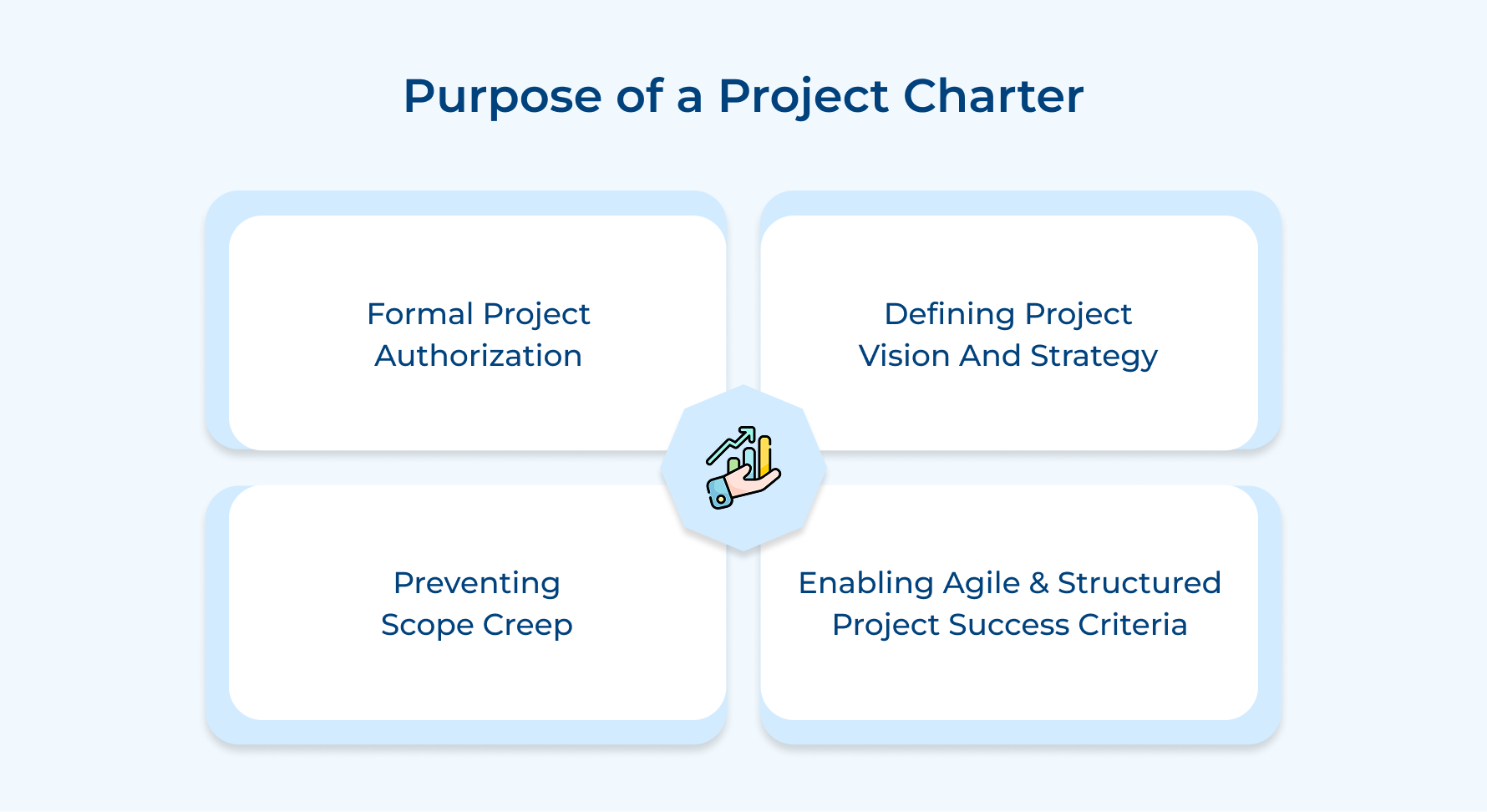
1. Formal Project Authorization
A project charter gives the green light to allocate the right amount of resources and start execution. Teams without this formal authorization start work on guesswork. It is where costly misalignments start.
2. Defining Project Vision and Strategy
The charter records the project’s vision and aligns it directly with the business strategy that is meant to serve. It makes sure every decision-making process during execution connects back to a measurable goal.
3. Preventing Scope Creep
An unchecked scope expansion is the silent killer in service projects and for that charter is your first line of defense. It defines firm boundaries so that any additions go through the proper change approval process.
4. Enabling Agile and Structured Project Success Criteria
The charter gives your team a north star to return to, whether you are running a waterfall model or an agile framework. It supports project success by keeping priorities stable even after execution evolves.
What is a Business Case?
A business case justifies the need for the project by evaluating its costs, benefits and risks. It gives an answer to the question that every stakeholder asks before any resource commitment: “What is the worth of doing this project?”
Consider a situation of onboarding a project, but before formal approval, a business case is needed that makes the argument for the project’s existence in the first place. It is important when pitching large client engagements that need internal investment.
So, can you skip the business case if leadership is already convinced? No, because a verbal agreement is not documented and when budgets get reviewed, you need that written statement for the project’s approval.
Key consideration:
- Problem clarity: Define the business problem the project is addressing before starting.
- Financial viability: Assess whether the projected returns genuinely justify the costs and resources being committed
- Risk register: Identify early risks so that decision-makers start approving with full awareness
- Strategic alignment: Make sure that the proposed project supports the organization’s business strategy
Purpose of a Business Case in Project Management
A business helps leadership evaluate whether a project deserves to move forward at all or just halts at one stage, leading to a delay in delivery.
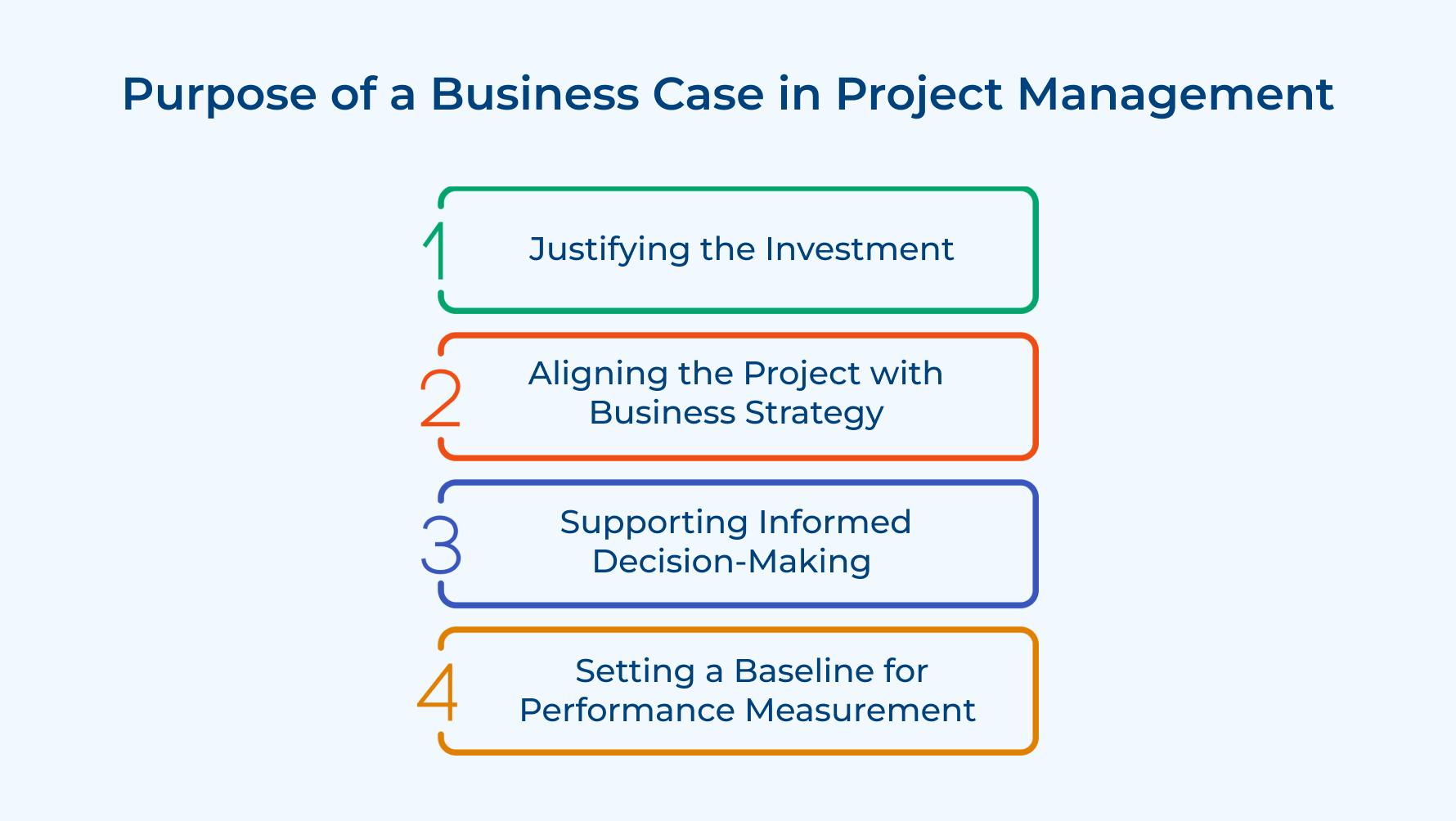
1. Justifying the Investment
A business case forces putting numbers and rationale behind every resource request. It makes it harder for gut-feel decisions to drive project approvals. Leaders can use this financially grounded agreement to evaluate objectively before committing to a budget.
2. Aligning the Project with Business Strategy
Most projects trace back to a strategic priority and the business case is where that connection gets established. A project if not able to demonstrate strategic alignment probably should not move forward.
3. Supporting Informed Decision-Making
A strong business case gives decision-makers a clear view of costs, benefits, risks and alternatives to make sure approvals are based on evidence. It separates organizations that invest smartly from those that chase projects with no clear return.
4. Setting a Baseline for Performance Measurement
After the project is approved, the business case transforms into a benchmark for measuring project deliverables against the promised. Teams that use a business case and use a project charter struggle to defend project continuity when leaders ask hard questions mid-execution.
Project Charter Vs Business Case: Key Elements to Consider
The distinct elements of each project charter and Business caste helps teams to use them with precision, as thinking of both as one is the most common mistake.
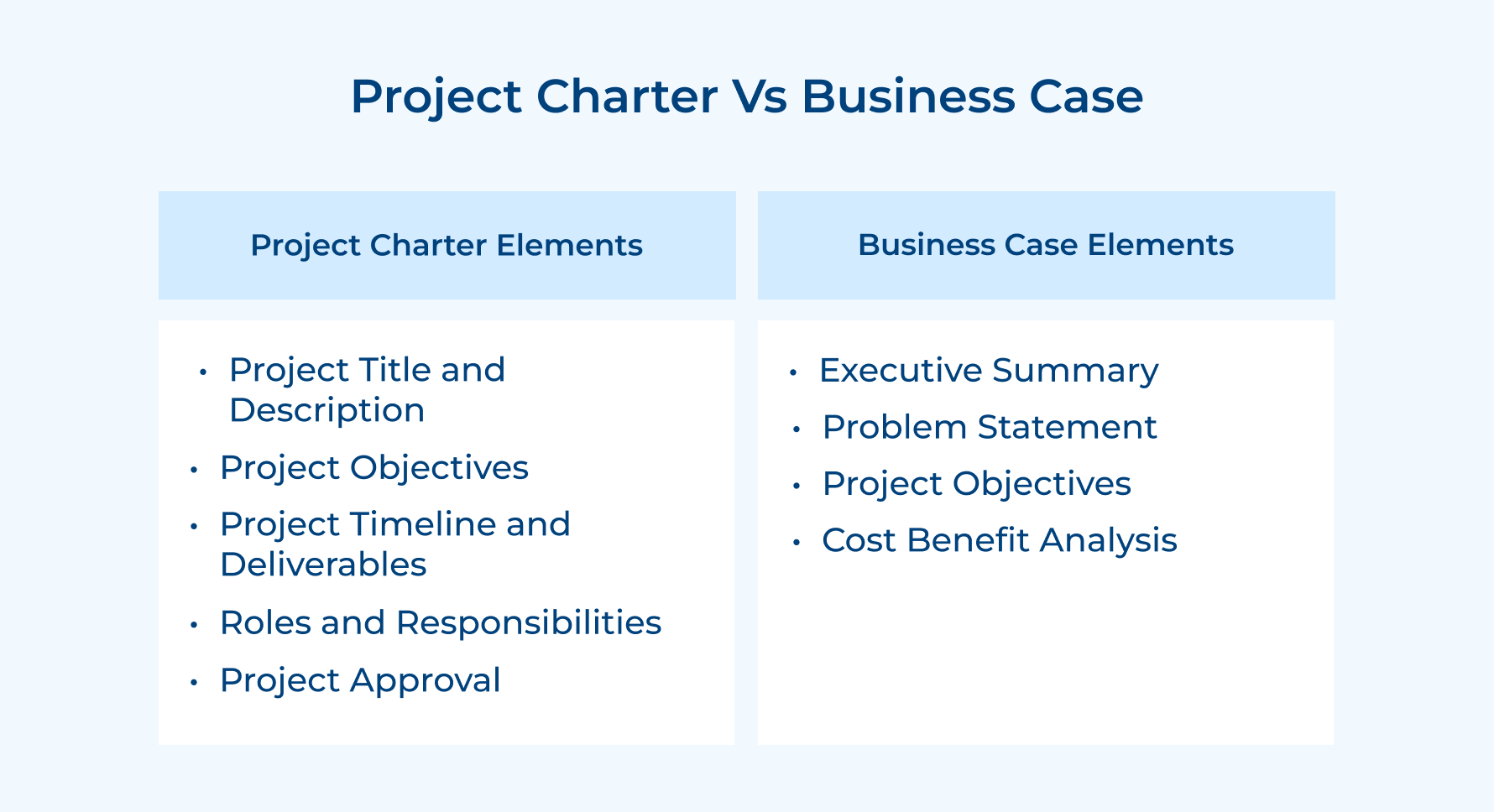
A. Project Charter Elements
1. Project Title and Description
The project title and description in a charter are the formal declaration of project existence within the organization. It defines the tone for every conversation to make sure everyone is talking about the same initiative.
Use a description that is specific enough to eliminate ambiguity. It should also be concise enough for a new stakeholder to grasp it easily. What happens when you create a vague project title? It leads to vague accountability.
2. Project Objectives
Project objectives in a charter define what success looks like in terms of measurable and time-bound terms. It is the actual outcomes that the team is held accountable for delivering. At this point, the project charter and business case start to overlap with a critical difference in intent.
A strong charter’s objectives include:
- Success metrics that the team and stakeholders have mutually agreed upon
- Time-bound targets connecting directly to the project milestones
- Accountability markers give ownership for each objective at every stage
The business case is all about “should we do this?” and the project charter objective answers “what exactly will we deliver?” Understand that this difference separates reactive project teams from high-performing ones.
3. Project Timeline and Deliverables
The timeline and deliverables convert the project vision into a schedule with clear checkpoints. It is non-negotiable as the team’s capacity is split across multiple client projects efficiently.
4. Roles and Responsibilities
The charter earns its keep in real project execution through proper role assignment. Unclear ownership is the cause of most project failures. A person named in the charter should be aware of what decisions they can make and what to escalate.
A The solid roles section capture:
- The sponsor who holds accountability for business outcomes and resource approval
- The project manager who manages day-to-day execution and stakeholder communication
- Core team members are combining with specific responsibility areas clearly mapped out
5. Project Approval
The formal signature that converts planning into an authorized initiative, along with real resources behind it. It is the solemn commitment from leaders proving that the project has organizational backing.
In a comparison between a project charter and a business case, the approval section truly separates them in terms of execution authority. The business case gives the go-ahead decision while the charter grants the power to act on that decision.
B. Business Case Elements
1. Executive Summary
The executive summary is read by senior stakeholders and it is the only section they will read before giving any opinion. Every word included in the summary carries the weight of the full business case.
A strong summary makes the strategic argument for the reason the project deserves approval. Consider it as an elevator pitch that is backed by data and documented for the record.
2. Problem Statement
A well-crafted problem statement enables the team to validate real business needs before resources are committed. A strong problem statement is separated from a weak one based on the following elements:
- Quantified impact showing what the problem is costing your organization in time
- Root cause clarity distinguishes the actual underlying issue
- Stakeholder relevance that connects the problem to priorities they already care about
The difference between a business case and a project charter is well evaluated when the problem statement is exclusively a business case element. The charter, in comparison, considers that the problem is already approved.
3. Project Objectives
Yes, both documents include project objectives, but they differ between the business case and the project charter. So why are objectives written? It justifies the investment and demonstrates alignment but does not assign accountability.
4. Cost Benefit Analysis
The cost-benefit analysis faces the most scrutiny from finance and leaders during the approval process. A proper analysis helps in identifying hidden costs such as change management, training and transition periods.
What Are the Key Differences Between a Project Charter and a Business Case?
A wrong project charter vs business case difference does not just create confusion, but also derails approvals and wastes planning time. Consider these differences that actually matter in real execution.
Purpose and Intent
A project charter authorizes action and gives the project manager formal execution to streamline resources. It works based on the assumption that a strategic decision has already been made and approved.
The project charter, in comparison to the business case, is like the “go build it” document that comes after leadership signs off. The moment a charter is approved, the project converts into an active organizational commitment.
Validate the purpose of your document by asking these questions:
- Does the document grant resources just recommend a course of action?
- Is decision-making the leader’s primary audience group?
- Will the project stop or slow down after removing this document?
A good business case makes the strategic and financial analysis before any execution planning starts. Even a well-structured charter has no legitimate foundation to stand on without a business case.
The business case answers “should we do this?” and the project charter, on the other hand, answers “how we are authorized to proceed.”
Key Takeaways:
- Charter activates the project after strategic decisions are made
- The business case has the right for the project to exist at all
Timing in the Project Lifecycle
A project charter is only applicable after the project approval. It formalizes what the complete execution will look like. Straight using a charter without a business case is similar to drawing a blueprint without deciding what to build and how.
Consider this checklist to confirm you are using the right documentation:
- Has the project already received strategic approval before drafting the charter?
- Is the team making an execution plan or still working on the case?
- Are stakeholders asking, “How will this be done,” or “why should this be done?”
A business case is activated in the pre-project phase, where the organizations are still evaluating investment viability. Comparison between business case vs project charter is all about timing, making it a significant difference that affects project outcomes.
Teams that skip the business case and shift to a project charter need to revisit justification questions midway through execution. It is far more disruptive to course-correct than to address it during initiation.
Audience and Decision-Making Authority
A project charter is for the project team and stakeholders who need clarity on scope as well as roles to start execution. It acts as an internal alignment tool because it ensures everyone is working based on the same boundaries.
So what happens when the charter is unclear to the intended audience? It gets written at the wrong level. Target the right audience to determine if the charter was actually used during execution or just untouched.
Below are the target audiences of your project charter:
- The project sponsor who validates if the charter accurately reflects the approved scope and organizational boundaries
- A project manager considers it as the primary reference for scoping management and decision authority
- The core delivery team relies on it to understand individual responsibilities and escalation paths.
A business case is used by senior leadership and finance committees, who manage budget approval along with strategic decision-making. From an audience perspective, the business case and project charter it is clear that these serve different readers.
Key Takeaways:
- Charter audience: The people directly responsible for giving defined project outcomes
- Business case audience: People who control the budget and organizational priorities
Level of Financial Detail
A project charter includes a high-level budget estimate, explores resource availability and sets financial boundaries. It acts as a sanity check and not a detailed investment model.
So what happens when charter budgets are over-engineered with financial modeling? It identifies that the business case was skipped entirely.
Before finalizing either document consignor these financial review questions:
- Is the budget estimation realistic given the defined scope and delivery timeline?
- Has the other relevant department confirmed the resource allocation before charter sign-off?
A business case contains a cost-benefit analysis with financial risk scenarios for leadership review. It is the right moment when the difference between a project charter vs business case becomes financially tangible. One is used for execution while the other convinces decision-makers.
Scope Definition and Boundaries
A charter determines project scope in operational terms that includes what is excluded and what the delivery boundaries are. The project manager actively uses methods to manage request changes and prevent scope creep.
A well-defined charter scope is an effective tool for protecting the team from unplanned work additions requested by clients.
Validate the scope definition in your documents with these key factors:
- In-scope and out-of-scope boundaries are written clearly to resolve disputes during execution
- Scope alignment and the timeline should be present in the same charter
- Key stakeholder review and signed off on the defined scope boundaries
A business case defines scope at a higher strategic level that outlines the project objective without locking operational details. The scope in the business case is to support the investment argument, unlike the project charter scope that manages and guides day-to-day execution decisions.
The two levels of scope definition lead to misaligned stakeholder expectations. The scope serves entirely differently across these documents in the comparison of project charter vs the business case.
Risk Treatment and Documentation
A project charter acknowledges key risks that are enough to identify execution challenges. It includes operationally focused risk that is directly tied to delivery timelines and resource availability.
Risk execution is captured in the charter so that there is no documented basis for escalating issues. It creates an accountability structure to manage problems before escalating.
A business case treats risk at a strategic and financial level to evaluate what could go wrong with the investment. The difference between a business case and a project charter becomes most visible here for decision-making.
Key Takeaways:
- Charter risks are operational threats that could affect delivery time and performance
- Business case risks strategic threats that affect approval and as well as returns
Business Case Vs Project Charter: How They Work Together
The difference between a project charter & busines car are not only about competition, but also they are sequential partners that form positive project governance in service firms.
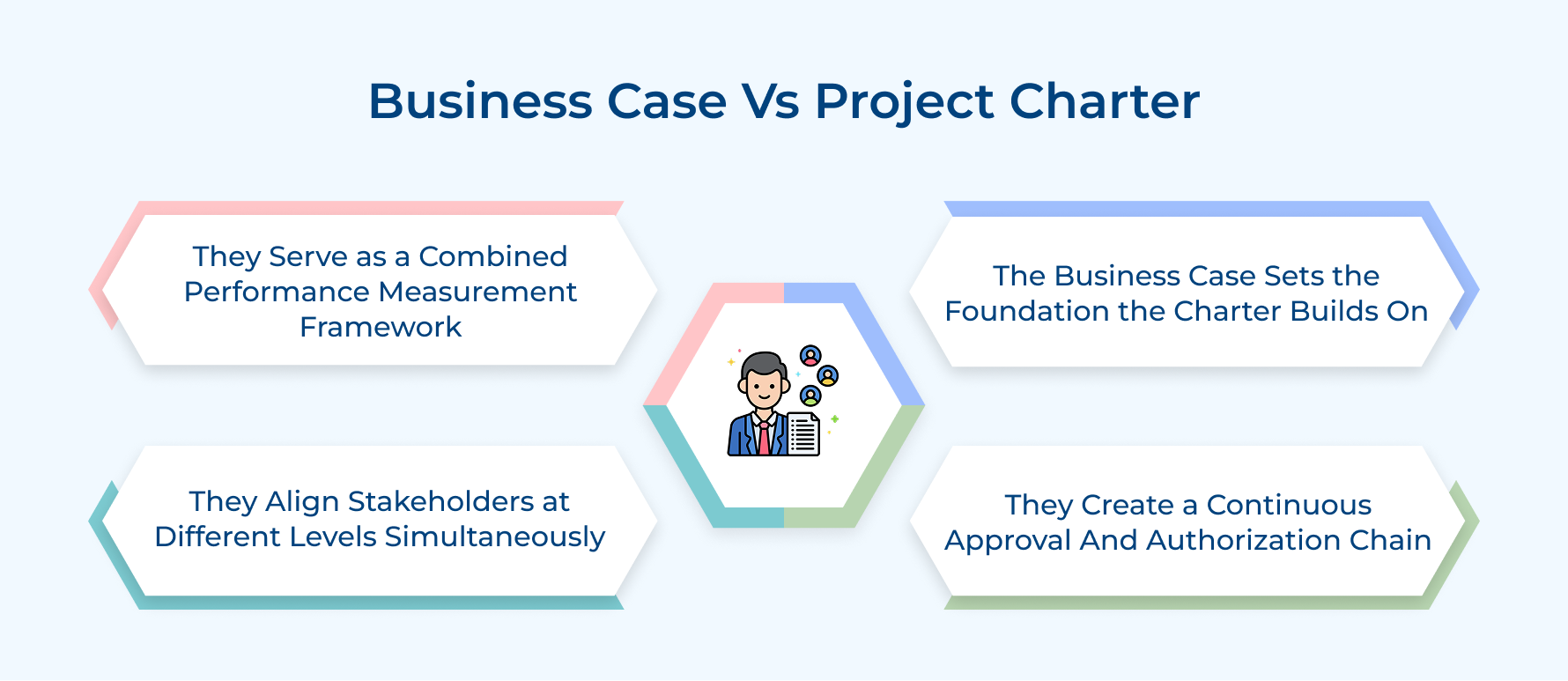
1. The Business Case Sets the Foundation the Charter Builds On
The business case manages the “why,” while the project charter converts the validation into an executable plan. The charter without this handoff lacks strategic grounding.
Every scope boundary, budget figure and success metric in the charter link directly to the business case. Treat both these documents as connected and the transition from approval to execution becomes smoother.
2. They Create a Continuous Approval and Authorization Chain
The business case includes leadership approval, while the charter document transforms project approvals into formal project authorization. Together, closing the governance loop effectively.
Consider the example of a firm where multiple projects compete for the same resources. The chain documentation protects prioritization decisions. Leaders can always trace an active project to justify a business case and an authorized charter.
3. They Align Stakeholders at Different Levels Simultaneously
Both documentation combines together to make sure every level of the organization is working from a consistent and documented understanding of the project.
In projects where either document is missing, a stakeholder alignment gap always appears. The project charter vs business case combination prevents the disconnect between leadership approval and team deliverables.
4. They Serve as a Combined Performance Measurement Framework
Defines what financial and strategic outcomes the project must achieve with the business case, while the charter document defines the deliverables of the outcome. Together, they create a complete performance framework covering both investment and delivery accountability.
Best Practices for Creating a Business Case and Project Charter
Consider the best practices for creating documentation that gives your projects the strongest foundation from the start.
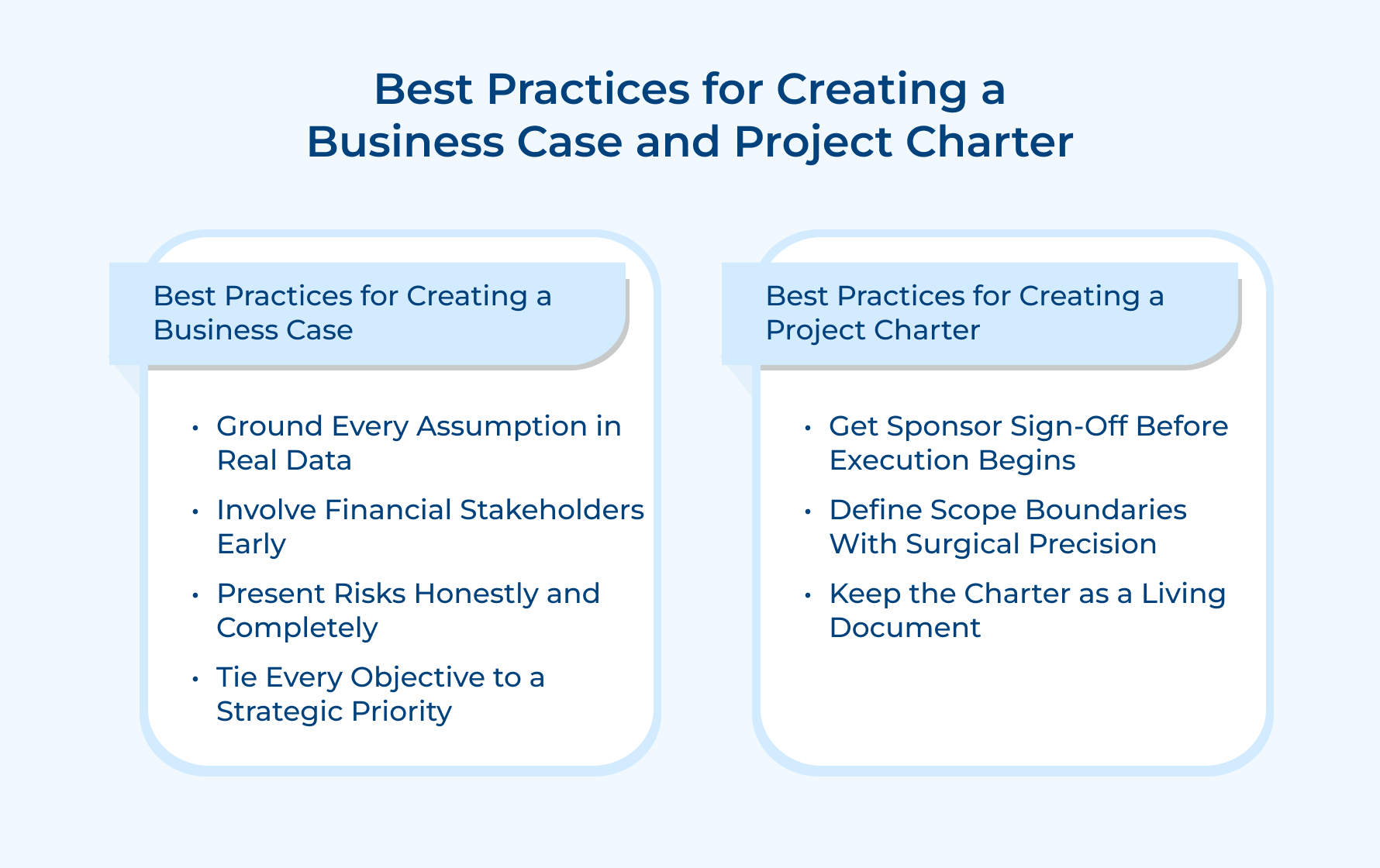
Best Practices for Creating a Business Case
- Ground every assumption in real data: Never build a business case without validation against actual organizational data. The fastest way to lose leadership confidence during the approval process is to make weak assumptions.
- Involve financial stakeholders early: collaborate with finance and leadership in the business case conversation before final documentation. It prevents costly revisions and builds internal buy-in before approval.
- Present risks honestly and completely: A business case that downplays risks damages credibility when those risks appear during execution. Maintain proper transparency with decision-makers, as they prefer it more than optimistic projections.
- Tie every objective to a strategic priority: The project objective must be connected directly to an organizational goal that leadership cares about.
Best Practices for Creating a Project Charter
- Get sponsor sign-off before execution begins: A charter without sponsor approval carries no real organizational authority. Secure your signature before a single resource is mobilized or even a timeline is communicated.
- Define scope boundaries with surgical precision: Vague scope language in a charter is similar to scope creep and disputes during delivery. Every exclusion needs to be specific enough to streamline disagreements without interpretation.
- Keep the charter as a living document: Treat the charter as an active project reference instead of a simple document created after the kickoff meeting. Maintain a regular update flow every time a scope change is approved during execution.
Success Starts with the Difference Between Project Charter Vs Business Case
The right project charter vs business case distinction is not a documentation exercise but also a governance decision that impacts delivery outcomes. Firms that treat both documents equally can consistently execute a project with more clarity and fewer mid-project surprises.
- The business case justifies the objective of the project, while the charter authorizes the execution
- Wrong documentation at the wrong stage creates misalignment that is expensive to correct later
- Combine these documents to form a chain that protects investment decisions and accountability
The difference between a project charter and a business case is the fine line between projects that get approved confidently from the one that stalls in planning indefinitely. Firms and agencies that master both documents build a reputation for delivering exactly to the commitment.
Limit time — not creativity
Everything you need for customer support, marketing & sales.

Neeti Singh is a passionate content writer at Kooper, where he transforms complex concepts into clear, engaging and actionable content. With a keen eye for detail and a love for technology, Tushar Joshi crafts blog posts, guides and articles that help readers navigate the fast-evolving world of software solutions.