Professional Services Budgeting Guide: Steps & Benefits
- What is Professional Services Budgeting?
- Components of Effective Budgeting for Professional Services
- 6 Benefits of Budgeting for Professional Services
- How to Implement Professional Services Budgeting in 7 Steps?
- Best Practices to Improve Professional Services Budgeting
- Common Challenges in Professional Services Budgeting
- Transform Your Financial Planning with Professional Services Budgeting
- FAQs about Professional Services Budgeting

Key Highlights:
- Professional services budgeting aligns revenue forecasts with realistic capacity, utilization and actual billable hours.
- Traditional product-based budgeting fails when people, not inventory, drive service business profitability.
- Budgeting for professional services helps track true project costs beyond salaries and visible expenses.
Your talented consultants bill clients at premium rates but somehow profits don’t match the revenue coming through the door. Projects that looked profitable on paper end up breaking even once you account for actual hours invested.
The challenge stems from treating people as your inventory when budgeting methods were designed for companies selling physical products. Your biggest asset walks out the door every evening and utilization rates fluctuate based on factors you can’t control.
This guide to professional services budgeting walks you through building budgets specifically designed for services firms where human expertise drives value. You’ll learn how to forecast revenue based on realistic capacity and track the metrics that actually predict profitability.
What is Professional Services Budgeting?
Professional services budgeting is the process of planning and allocating financial resources for service-based businesses where human expertise drives revenue. This approach accounts for labor costs and project expenses while forecasting billable hours to maintain profitability.
This budgeting method differs from traditional business budgeting because it centers on people as the primary asset and expense. Professional services firms must balance employee utilization rates with project profitability.
Key objectives:
- Resource allocation: Assign the right people with appropriate skills to projects without overextending or underutilizing your team.
- Profitability tracking: Monitor which services and clients generate healthy margins versus those that drain resources.
- Capacity planning: Forecast how many projects your team can handle based on available hours and expertise levels.
- Cash flow management: Predict when project payments arrive while ensuring enough working capital to cover payroll during gaps.
- Strategic decision-making: Use financial data to guide hiring decisions and determine which service offerings deserve expansion or elimination.
Components of Effective Budgeting for Professional Services
A solid budget for professional services requires multiple interconnected components that work together like gears in a machine. Each element influences the others and contributes to your firm’s financial health.
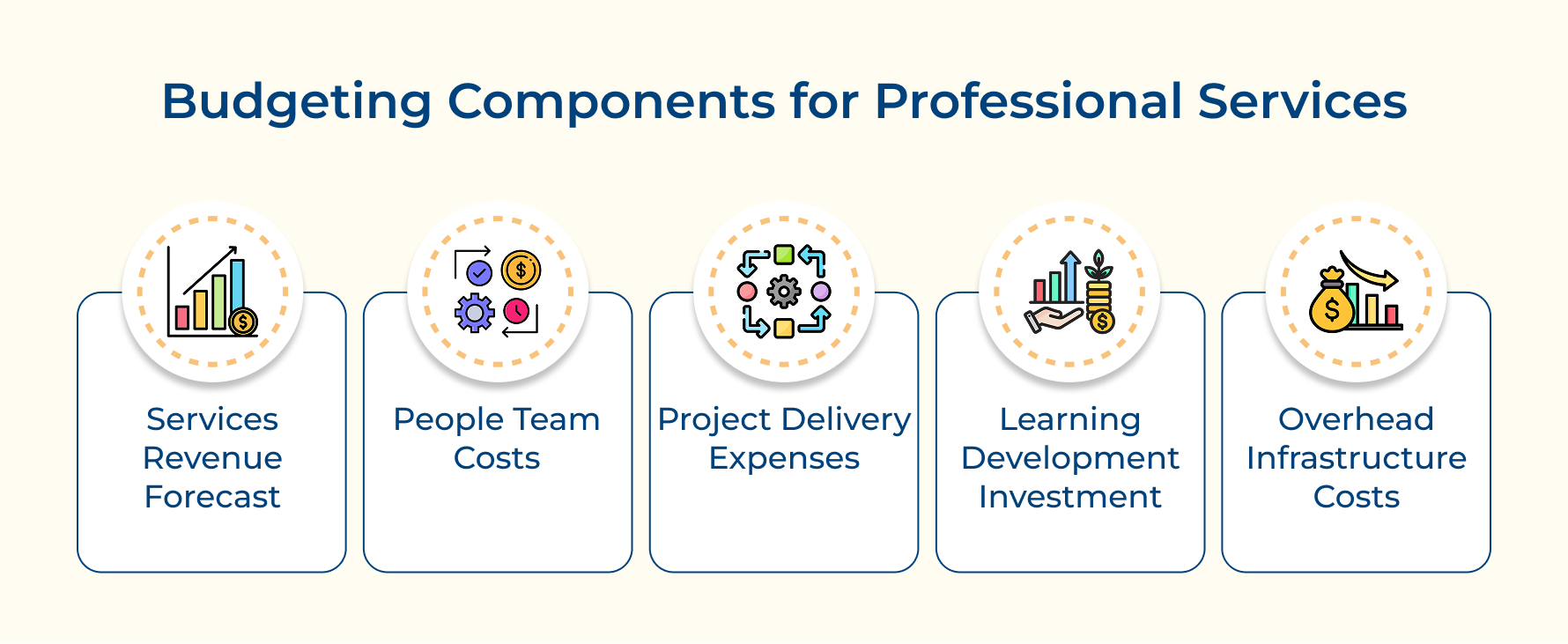
Professional Services Efforts and Revenue Forecast
This is where you get real about how many billable hours your team can actually deliver and what clients will pay for them. You’re estimating utilization while factoring in non-billable work like admin and meetings. For any business owner, this forecast becomes a key reference point for checking if the projects are truly contributing to net income and supporting growth.
People and Team Costs
Your team is both your biggest investment and your biggest revenue driver. Beyond salaries and benefits, you also need to plan for bench time between projects. A realistic budget acknowledges these gaps so your finances stay steady even during slower months, rather than looking good only on paper.
Projects and Delivery Expenses
Every project comes with its own set of costs—tools, licenses, travel, or external support. Tracking these separately helps you see which engagements are profitable and which ones quietly eat into margins. Over time, this clarity allows for better pricing decisions and more accurate scenario analysis.
Learning and Development Investment
Skills determine what you can sell and how much clients are willing to pay. Investing in training keeps your team relevant and more efficient, while also enabling you to offer higher-value services. When aligned with your strategic plan, learning budgets become a growth lever, not just an expense.
Overhead and Infrastructure
Office space, systems and platforms keep the business running but don’t directly earn revenue. These fixed costs still need to be covered, regardless of project volume. Spreading overhead across services helps you understand true profitability and make smarter decisions as you scale.
6 Benefits of Budgeting for Professional Services
Professional services budgeting transforms how firms operate by turning financial guesswork into strategic planning. The impact shows up in profitability and team satisfaction alike.
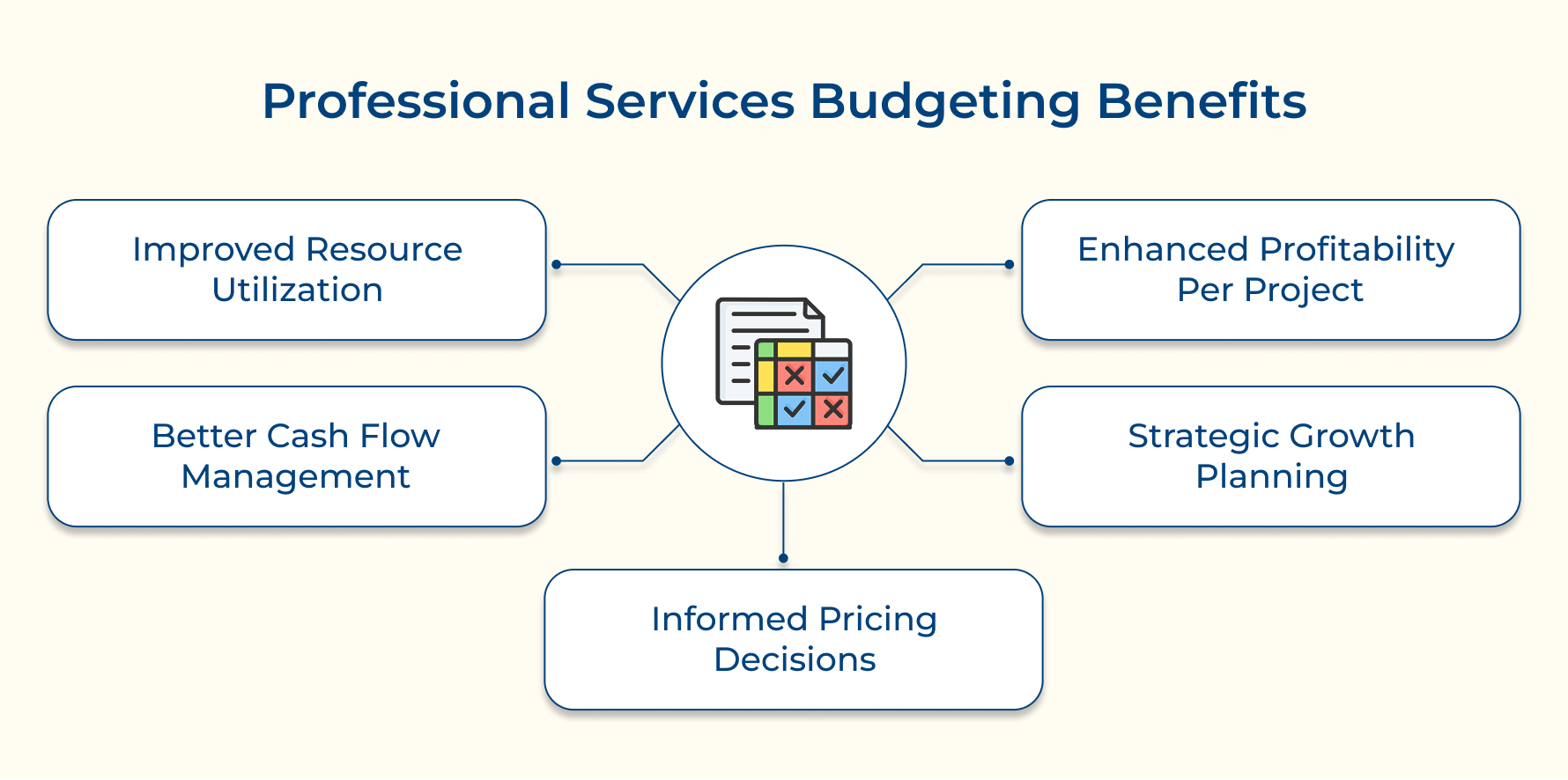
Improved Resource Utilization
Budgeting helps you clearly see where your team’s time is going and in case it actually supports revenue goals. It highlights people sitting idle on the bench as well as those who are stretched too thin. The insight helps you shift work more thoughtfully, balance workloads and make sure everyone is contributing at the right level without burning out or wasting capacity.
Enhanced Profitability Per Project
When you budget properly, you understand the real cost of delivering each service before you sign the deal. It prevents underpricing that slowly eats into margins and makes it easier to spot which project types truly make money. Over time, you can focus on high-margin work instead of chasing revenue that’s expensive to deliver.
Better Cash Flow Management
In professional services, there’s often a delay between finishing the work and getting paid. A well-planned budget anticipates these gaps so you’re prepared to cover payroll and operating costs during slower periods. This kind of foresight removes the stress of last-minute cash crunches when client payments don’t arrive on time.
Strategic Growth Planning
Budgeting shows in case you have room to take on more clients or if hiring needs to happen first. You can test different growth scenarios and see how they affect finances before making big commitments. It turns expansion decisions into informed choices backed by numbers, not just instinct or optimism.
Informed Pricing Decisions
Knowing your costs through budgeting gives you confidence when pricing projects for clients. You understand your break-even point and can negotiate from a place of clarity, not guesswork. As a result, your pricing reflects the real value of your work while protecting margins from unexpected changes in scope.
How to Implement Professional Services Budgeting in 7 Steps?
Let’s delve into these seven steps that can transform your budgeting strategy and set you on the path to success.
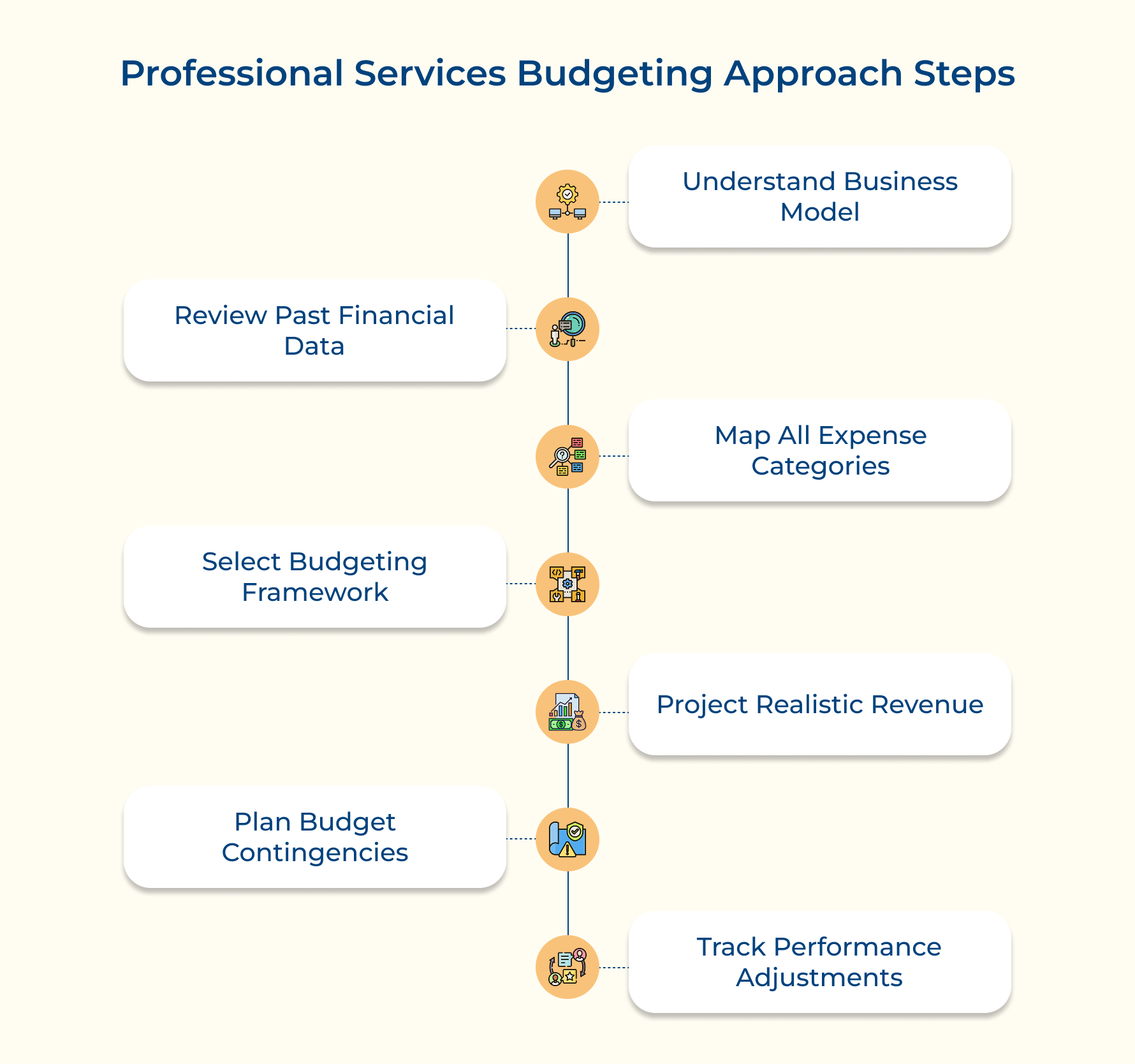
1. Understand Your Business Model Before Budgeting
Your business model determines how money flows into your firm and which costs matter most for profitability. This step establishes the foundation that makes every subsequent budgeting decision more accurate as well as actionable.
Four questions guide you toward business model clarity:
- What percentage of our revenue comes from retainers versus one-time projects?
- Do we charge clients based on time spent or deliverables completed?
- Which services require the most senior expertise versus those junior staff can handle?
- How much of our team’s time goes to non-billable work like proposals and administration?
These questions expose the mechanics of how your firm actually makes money rather than how you wish it worked. You’ll discover if your pricing model matches the effort required or if misalignment is quietly eroding margins.
Now that you’ve mapped your revenue model, start documenting typical project workflows and resource requirements for each service. This documentation becomes your reference point when building budgets that reflect how work actually flows through your organization.
2. Analyze Historical Financial Performance Data
Historical data shows patterns that predictions alone would miss like seasonal revenue dips or services with hidden costs. You’re essentially learning from experience rather than building budgets on optimistic guesses about utilization and profitability.
Pull financial reports from the past 12 to 24 months and calculate key metrics like revenue per employee. Look for months where utilization spiked or dropped and investigate what business factors drove those swings.
Pro tips:
- Track the ratio between estimated and actual hours on completed projects to build more accurate future estimates.
- Analyze which clients consistently generate scope creep versus those who respect project boundaries for smarter engagement selection.
3. Categorize and Map All Expenses
Expense categorization reveals the true cost structure of delivering your services beyond obvious salary numbers. Professional services firms often underestimate indirect costs that chip away at margins like software subscriptions per employee.
The key is separating costs you can directly attribute to specific projects from those that benefit the entire organization. This distinction affects how you price services and evaluate which engagements actually make money. Here is the list of mapping different project tasks:
- Direct project costs: Client-facing expenses like travel or specialized software licenses purchased specifically for one engagement.
- Personnel compensation: Base salaries plus bonuses and benefits calculated as fully loaded rates per employee hour.
- Infrastructure overhead: Office rent and utilities that support operations regardless of how many projects you’re running.
- Technology and tools: Collaboration platforms and project management systems that enable service delivery across all clients.
- Professional development: Training programs and certifications that maintain team expertise and market competitiveness.
- Sales and marketing: Business development costs including proposal creation and attendance at industry conferences.
Your expense map should make it easy to calculate the total cost of running your business monthly. This visibility helps you set minimum revenue targets that cover all expenses before generating any profit.
4. Choose Your Budgeting Method and Framework
Your budgeting method shapes how much detail you track and how often you can adjust to changing circumstances. This choice should match your firm’s size and how predictable your revenue streams actually are.
Four questions help you select the right budgeting approach:
- Does our work follow predictable patterns or does every engagement differ significantly?
- How far in advance can we reliably forecast client demand and project pipeline?
- Do we need project-level profit tracking or firm-wide financial visibility?
- Can our team handle detailed tracking or do we need a simpler approach?
Professional services firms commonly use these four budgeting methods:
- Zero-based budgeting: Start each budget cycle from scratch by justifying every expense rather than incrementing last year’s numbers.
- Rolling forecasts: Update your budget continuously by adding new periods as old ones complete instead of annual cycles.
- Activity-based budgeting: Build budgets around the activities required to deliver services like client meetings and report creation.
- Incremental budgeting: Use last period’s actuals as baseline then adjust for expected changes in volume or pricing.
Your chosen method should make budget reviews feel useful rather than like compliance exercises that waste time. Consider starting simple then adding complexity only when your current approach leaves important questions unanswered about profitability.
5. Forecast Revenue Using Realistic Assumptions
Revenue forecasting translates your team’s capacity into expected income based on what you can actually deliver. Accurate revenue projections become your measuring stick for whether the business can support planned expenses and investments.
Calculate total available hours across your team then subtract realistic amounts for vacation and internal work. Multiply remaining hours by expected billable rates and target utilization percentages to arrive at achievable revenue.
Pro tips:
- Set different utilization targets by role since senior consultants typically spend more time on business development than junior staff.
- Build in buffer time for scope changes and client delays that inevitably reduce billable hours below theoretical maximums.
6. Build Contingency Plans for Budget Scenarios
Contingency planning prepares your firm to respond quickly when reality diverges from your budget assumptions. Having pre-built responses prevents panic-driven cost cuts that damage long-term capabilities or missed opportunities when performance exceeds expectations.
Three effective approaches strengthen your contingency planning:
- Scenario modeling with percentage variations: Create three budget versions showing what happens if revenue lands 20% below or above target. Map out specific expense adjustments for each scenario like delaying hires in the downside case. This reveals how sensitive your profitability is to revenue swings.
- Tiered investment priorities: Rank potential investments from essential to nice-to-have so you know what to fund first if cash allows. Essential items might include replacing a departing senior consultant while lower priorities could be expanding office space. This prevents arguments about what deserves funding when resources get tight.
- Early warning triggers and decision points: Establish specific metrics that trigger contingency actions like pipeline falling below three months of capacity. Define exactly what you’ll do when each trigger hits rather than waiting to figure it out under pressure.
Consider a boutique strategy consulting firm that budgeted for 75% utilization and $2.5 million in annual revenue. Their downside scenario at 60% utilization meant delaying two planned hires and cutting conference travel. When a major client unexpectedly doubled their engagement mid-year the firm immediately enacted their upside plan and brought in contractors within two weeks.
7. Monitor Performance and Adjust Budget Regularly
Budget monitoring transforms your plan from a static document into a dynamic management tool that guides decisions. Regular monitoring catches variances early when you still have time to course-correct rather than discovering problems after they’ve compounded.
Key metrics provide visibility into your financial performance trajectory:
- Monthly revenue actual versus budget with breakdown by service line
- Utilization rates by team level and department
- Project profitability margins comparing estimated to actual costs
- Sales pipeline value and conversion rates
- Cash flow runway showing months of operating expenses covered
These metrics reveal leading indicators of financial health before problems show up in profit and loss statements. Utilization dropping signals revenue will likely miss targets in coming months even if current revenue looks fine.
When metrics show meaningful variance from budget you can adjust spending or sales focus to realign with targets. A marketing agency noticing lower utilization might pause hiring and intensify business development efforts to fill the pipeline.
Two critical adjustments help you maintain budget relevance throughout the year:
- Reforecast remaining periods: Update future months based on current trends rather than sticking to original assumptions when reality has clearly shifted direction.
- Flex variable costs: Scale expenses like contractor usage and marketing spend to match actual revenue performance instead of spending as if everything went according to plan.
Best Practices to Improve Professional Services Budgeting
Even solid budgets can become more effective with refinements that address common pain points. These practices help you avoid the traps that turn budgets into irrelevant paperwork instead of useful management tools.
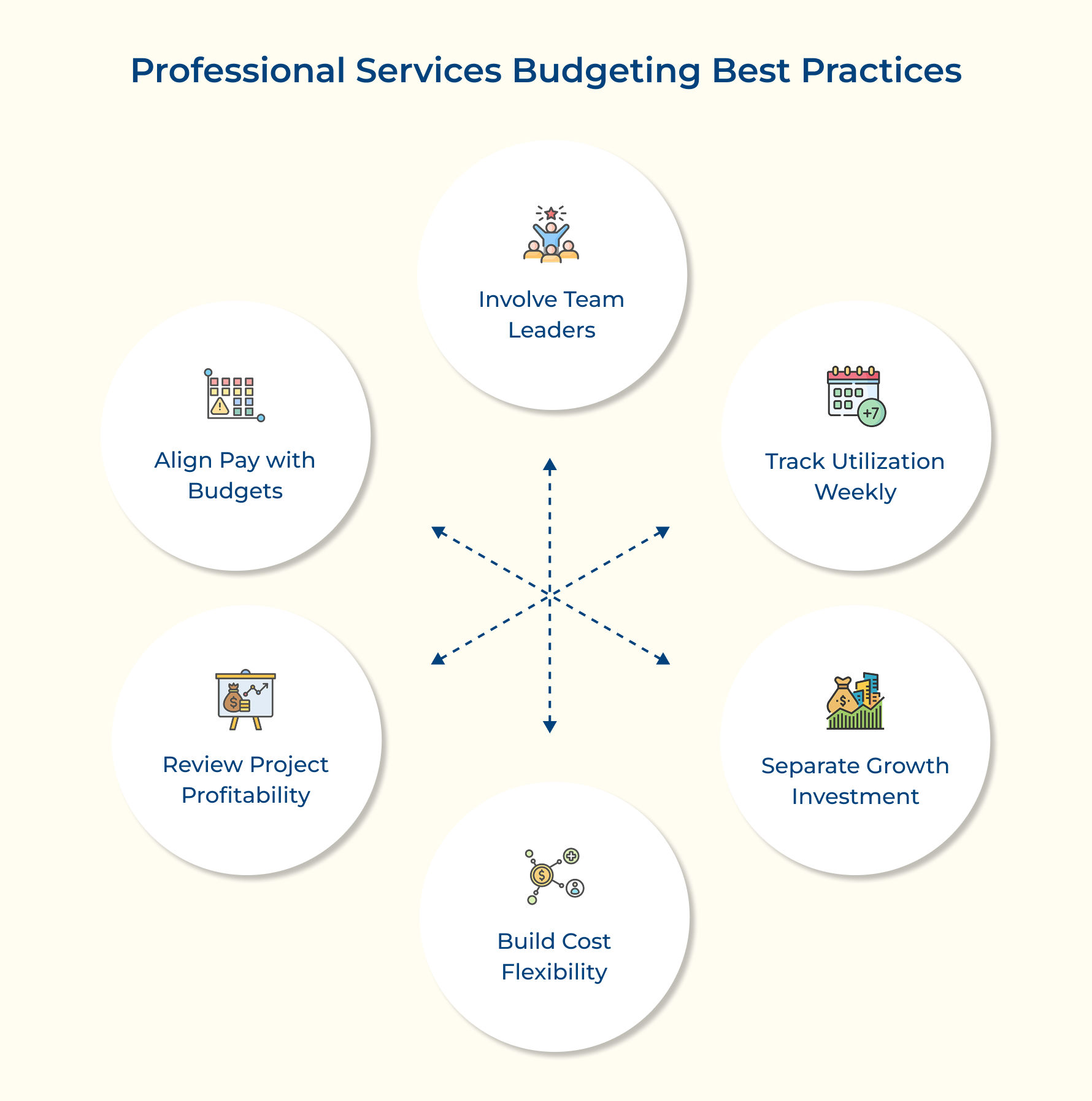
Involve Team Leaders in Budget Creation
Budgets created only by finance teams often miss what really happens on the ground. Project and delivery leaders understand capacity limits as well as timeline realities far better. Bringing them into financial budgeting ensures assumptions are practical and aligned with how work is actually delivered, not how it looks in spreadsheets.
Track Utilization Weekly, Not Monthly
If you wait a month to review billable hours, issues have already done damage. Weekly tracking gives you time to act—moving people onto active projects, slowing hiring, or adjusting workloads before revenue takes a hit. It turns utilization tracking into a proactive habit instead of a reactive report.
Separate Growth Investment from Operations
Blending sales or market expansion costs with delivery expenses makes it hard to see if your core services are healthy. By separating these budgets, you can clearly measure how existing work performs while still investing in growth. This clarity helps leadership make smarter calls about where to double down.
Build Flexibility into Fixed Cost Assumptions
Long-term software contracts or office leases can quickly become painful when demand dips. Wherever possible, negotiate shorter commitments or usage-based pricing. A flexible cost structure supports better Resource Management and allows the business to adapt without cutting into essential delivery capability.
Review Project Profitability After Completion
Looking back after a project ends shows where estimates were off and why. Maybe effort was underestimated or scope expanded quietly. Using these insights to adjust future budgets helps protect margins and keeps planning aligned with financial goals instead of repeating the same mistakes.
Align Compensation with Budget Performance
If budgets feel purely administrative, teams won’t take them seriously. When bonuses or recognition connect to utilization, margins, or delivery efficiency, people pay attention. This alignment gives everyone a reason to care about budgets and contribute to healthier financial outcomes.
Common Challenges in Professional Services Budgeting
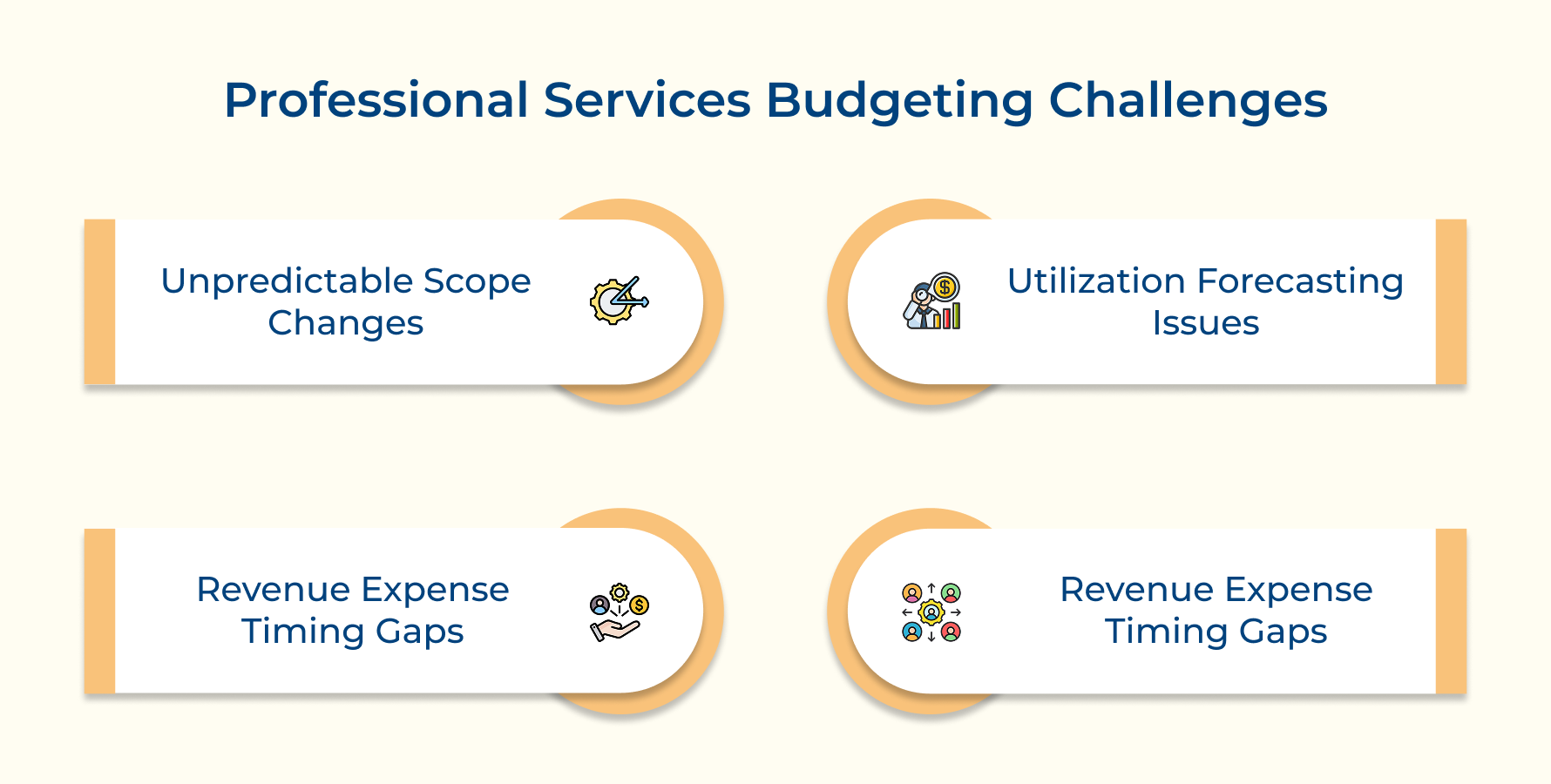
Professional services budgeting comes with unique hurdles that don’t affect product-based businesses in the same way. Understanding these challenges helps in finding workarounds easily.
Unpredictable Project Scope Changes
Clients need to evolve mid-engagement in ways that throw off your original time and cost estimates quite dramatically. A marketing campaign that seemed straightforward suddenly requires additional research phases when the client realizes their target audience differs from assumptions.
Difficulty Forecasting Utilization Rates
Your team members toggle between billable client work and necessary internal activities like training or proposal development throughout each month. One consultant might hit 80% utilization while another sits at 50% despite both being equally skilled and available.
Revenue Timing Versus Expense Timing Gaps
You pay salaries and overhead costs every month regardless of when clients actually send payments for completed work. A project finished in March might not get invoiced until April and payment could arrive in June.
Balancing Bench Time Against Growth
Keeping talented consultants on payroll during slow periods protects your capacity for future projects but drains resources in the present. You face the choice between maintaining bench strength or cutting costs when utilization drops below profitable levels.
These practical approaches help professional services firms build more resilient budgets that accommodate the inherent unpredictability of service delivery work.
- Require formal scope change approvals that adjust project budgets before starting additional work outside the original agreement.
- Build 10-15% padding into project estimates and maintain a general contingency line item for unexpected overruns.
- Structure client contracts so payments arrive as you complete defined project phases rather than waiting until final delivery.
- Monitor your sales pipeline value and average deal close rates to predict future utilization before current projects wind down.
- Maintain relationships with vetted contractors who can absorb overflow work during busy periods without full-time employee fixed costs.
Transform Your Financial Planning with Professional Services Budgeting
Professional services budgeting shifts your firm from reactive firefighting to proactive financial management that supports sustainable growth. The seven-step approach combined with best practices gives you a roadmap for building budgets that reflect operational reality.
Start with understanding your business model and progress through monitoring performance to create budgets that guide decisions rather than collect dust. Your budgeting process will evolve as your firm matures but the foundation remains constant across all stages of growth.
Limit time — not creativity
Everything you need for customer support, marketing & sales.

Neeti Singh is a passionate content writer at Kooper, where he transforms complex concepts into clear, engaging and actionable content. With a keen eye for detail and a love for technology, Tushar Joshi crafts blog posts, guides and articles that help readers navigate the fast-evolving world of software solutions.