Improve Resource Efficiency: Tips, Benefits & Examples

Key Highlights:
- Improving resource efficiency helps agencies deliver faster, more consistent client outcomes.
- Gain real-time visibility into team capacity to avoid conflicts and missed opportunities.
- Prioritize high-value projects to drive profitability and long-term, sustainable growth.
Landing big clients should feel like a win – but when your best designers are already stretched thin and junior talent is sitting idle, it quickly turns stressful. You know the work is there, but figuring out who should do what (and when) becomes a daily juggling act.
This is a common challenge in professional service firms. When resources aren’t used efficiently, strong talent gets overwhelmed, growth opportunities slip by and clients feel the impact.
This guide on how to improve resource efficiency breaks down how to measure and improve in a practical, no-nonsense way. You’ll learn how to match the right people to the right projects at the right time—so utilization improves without burnout, quality stays high and your team can handle growth with confidence.
What is Resource Efficiency?
Resource efficiency measures how well you’re using your team’s available time to deliver client work. It’s the ratio between billable hours your people actually work on projects and their total available capacity. Think of it as understanding whether your talented designers and consultants are spending their days on revenue-generating client work or sitting idle between assignments.
How Resource Efficiency Drives Client Satisfaction?
When agencies manage their teams well, clients feel the difference immediately. Projects start faster, delivery stays consistent and there’s far less last-minute pressure. Your best people show up at the right time instead of being stuck on the wrong work.
This kind of planning shows clients you can manage human resources confidently while supporting sustainable products through resource-efficient production. The payoff is trust—because clients see an organized team that delivers on promises without chaos.
Primary objectives:
- Maximize billable utilization: Keep your team working on paying projects rather than bench time or internal tasks that don’t generate revenue.
- Reduce project delays: Match the right skilled people to client needs quickly so projects start on time and maintain momentum.
- Balance workload distribution: Prevent burnout in some team members while others sit underutilized by spreading work evenly across your capacity.
- Improve forecast accuracy: Understand your true capacity so you can confidently commit to client timelines without overcommitting or leaving money on the table.
- Minimize resource conflicts: Eliminate the chaos of multiple clients competing for the same specialist by planning assignments strategically in advance.
Common Challenges of Resource Efficiency
Even with the best intentions, agencies face real obstacles when optimizing how they deploy their teams. Understanding these challenges helps you build strategies to overcome them.

1. Unpredictable Client Demand
Client requests don’t follow a tidy schedule. One week you’re rushing to staff urgent work, the next you’re wondering why half the team is free. When demand swings this much, planning material flows of work becomes guesswork, making steady utilization hard to achieve.
2. Skill Mismatches Across Projects
Even when people are available, the skills don’t always line up. A free content strategist won’t help when a client needs a developer right now. These gaps slow delivery and can even limit economic growth when good opportunities are passed up.
3. Limited Visibility Into Team Capacity
Many agencies simply don’t know who’s truly available. People juggle multiple projects and without resource management software, decisions are made on outdated assumptions – leading to overloads and missed capacity.
4. Resistance to Process Changes
New systems often feel like extra admin. A clear action plan helps teams avoid old habits, stay efficient, reduce wasted effort, and limit harm to the environment over time.
Here are five practical solutions to overcome these resource efficiency challenges:
- Review your upcoming three-month pipeline weekly to anticipate demand spikes and adjust hiring proactively.
- Cross-train team members in adjacent specialties so you have backup options when experts are unavailable.
- Use centralized platforms that provide real-time visibility and automatically calculate remaining capacity.
- Roll out new processes with one department first to demonstrate value before expanding company-wide.
How to Improve Resource Efficiency: 8 Strategies
Let’s delve into eight proven strategies that can help your organization significantly enhance its resource efficiency and drive long-term success.
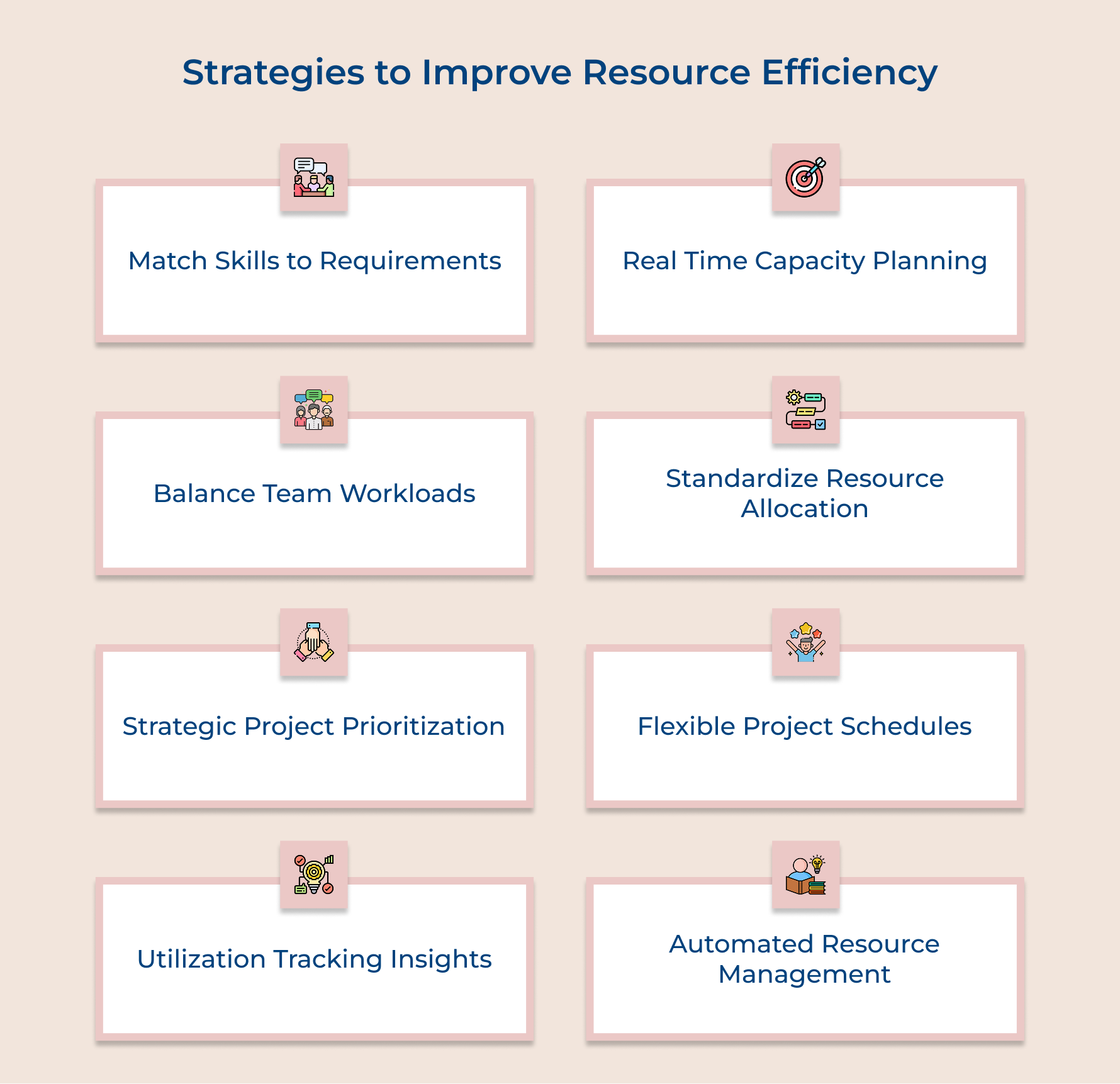
1. Match Skills to Project Requirements
Matching skills to project requirements means assigning team members based on their specific expertise rather than just availability. This prevents wasting your senior developer’s time on basic tasks while ensuring complex client challenges get the specialized attention they deserve.
Here are three effective ways to match skills properly:
- Maintain a skills inventory: Track each team member’s abilities to quickly match expertise with project needs.
- Conduct regular assessments: Review skills quarterly to spot new strengths and gaps.
- Avoid the expert trap: Don’t overload top talent; let mid-level team members grow by handling key projects.
A creative agency struggled with their art director stretched across twelve client accounts simultaneously. They discovered two junior designers had strong branding capabilities that weren’t being utilized. The agency reduced their lead creative’s workload by 40%, just by redistributing four accounts to these designers with art director oversight.
2. Implement Real-Time Capacity Planning
Real-time capacity planning involves continuously monitoring who’s available and what work is coming down the pipeline. Without real-time tracking, you’re essentially flying blind and hoping projects won’t collide.
Here’s how capacity planning improves resource efficiency:
- Visibility into team availability: You can instantly see who has open hours next week versus who’s already at 100% utilization.
- Proactive conflict resolution: When two clients need the same specialist simultaneously, you spot the clash early enough to negotiate timelines or find alternatives.
- Accurate delivery commitments: You know your true capacity before promising deadlines to clients instead of overcommitting and scrambling later.
- Resource reallocation speed: When a project gets delayed or a team member calls in sick, you can quickly reassign work to maintain momentum.
So how does this actually work in practice? Think of it like checking your calendar before accepting a lunch invitation. When a client requests a website redesign starting March 1st, you check in case your designers and developers have sufficient available hours during that period before saying yes.
3. Balance Workloads Across Your Team
Balancing workloads means distributing client projects evenly so no one drowns in assignments while others sit idle. Without this balance, your overworked team members burn out while underutilized staff feel disengaged.
Tracking workload balance requires monitoring these essential metrics:
- Individual utilization rates
- Average weekly billable hours
- Project count per team member
- Overtime hours logged
These metrics reveal if Sarah is consistently working 60-hour weeks while Tom averages just 25 billable hours. You can spot patterns like certain team members always getting overloaded during month-end client reporting cycles.
Once you have solid data, apply these methods:
- Redistribute active projects: Move lower-priority client tasks from overloaded team members to those with available capacity to immediately relieve pressure.
- Adjust future assignments: Factor in current workload when assigning new projects so you’re not automatically giving every incoming request to your busiest people.
- Create workload thresholds: Set maximum utilization targets like 85% so you have built-in flexibility and people aren’t constantly operating at breaking point.
4. Standardize Your Resource Allocation Process
Standardizing how you allocate resources means setting clear rules for assigning team members to projects, instead of letting whoever shouts the loudest get the best talent.
Before locking in a system, make sure your current process aligns with your real priorities. Think about what should drive decisions – like client contract value or strategic relationships – so your policy frameworks support better project outcomes and keep everyone focused on what matters most.
Here’s what an effective allocation process looks like:
- Request submission: Project managers submit resource needs through a centralized system with details on required skills and timeline urgency.
- Priority evaluation: Leadership reviews requests against predetermined criteria and ranks them by strategic importance.
- Capacity matching: Resource managers check team availability and assign people based on both skills fit as well as current workload balance.
- Approval and communication: Decisions get documented and communicated to all stakeholders so everyone understands who’s working on what.
To implement this, start by documenting your current informal process and identifying where bottlenecks typically occur. Design your standardized workflow to address those pain points and roll it out with one team first before expanding company-wide.
5. Prioritize Projects Based on Strategic Value
Prioritizing projects by strategic value means focusing on the work that truly moves the needle—ranking client projects based on revenue impact and overall business importance, rather than just who asked first. This way, your top talent is working on high-value accounts that boost profitability, instead of getting stuck on lower-priority tasks.
Put this into practice by assessing each project against factors like contract size and client relationship value. Allocating resources this way also helps reduce wasted effort, supporting sustainable development and minimizing negative environmental impacts.
Pro tips:
- Review and update your priority rankings weekly because client importance can shift when contracts renew or strategic accounts suddenly need urgent support.
- Communicate priority decisions transparently to your team so everyone understands why certain projects get preferential resource treatment.
6. Build Flexibility into Project Schedules
Building flexibility into schedules means creating buffer time and backup options within your project timelines. When agencies ignore this and pack schedules tightly with zero slack, a single team member’s illness or unexpected client revision cascades into missed deadlines across multiple accounts.
You build flexibility by adding cushion time between project phases and cross-training team members on each other’s specialties. This creates breathing room for inevitable surprises and ensures you have multiple people who can step into critical roles.
Here are four essential actions when building schedule flexibility:
- Add buffer periods: Include 10-15% extra time between major project milestones to absorb small delays without impacting final delivery dates.
- Identify backup resources: Designate secondary team members who can take over if the primary person becomes unavailable during critical phases.
- Schedule regular check-ins: Hold weekly status meetings to spot potential delays early while you still have time to adjust timelines.
- Document project knowledge: Ensure multiple team members understand each client’s requirements so work can continue seamlessly if someone leaves unexpectedly.
7. Develop Multi-Skilled Team Members
Developing multi-skilled team members means giving your staff the chance to grow beyond a single role, instead of keeping them narrowly specialized. When everyone sticks to one skill, it creates bottlenecks—only one person can handle certain client requests, which slows everything down.
You can make this happen by spotting complementary skills for each team member and offering structured training. For example, a graphic designer could pick up basic video editing, or a project manager could learn technical fundamentals. This approach aligns with a sustainable development guide and helps teams think more holistically, even considering Life Cycle Assessment when planning projects.
Best practice:
- Start cross-training with skills that complement existing strengths so the learning curve stays manageable and people can apply new knowledge immediately.
- Rotate team members through different project types regularly so they gain practical experience working in various client situations beyond their primary specialty.
8. Automate Resource Management Tasks
Automating resource management tasks means using software to handle repetitive scheduling and tracking activities that consume manager time. The strategy is important for agencies as well as professional firms because manual resource planning becomes impossibly complex once you’re juggling dozens of team members across multiple client projects.
Here are three powerful automation use cases for resource management:
- Automatic availability tracking: Software monitors assignments and capacity in real time, removing the need for manual updates.
- Scheduling conflict alerts: The system flags double-bookings or over-allocation before they become problems.
- Utilization reporting dashboards: Real-time reports reveal billable hours and efficiency trends, helping managers spot underused resources quickly.
The time you save through automation gets redirected toward strategic planning and client relationship building. Instead of wrestling with scheduling spreadsheets, your managers can focus on improving service quality and identifying new business opportunities.
How to Measure Resource Efficiency: 6 Key Metrics
Understanding your resource efficiency requires tracking the right numbers. These metrics reveal in case you’re maximizing your team’s potential or leaving money on the table.
Before diving into specific metrics, ask yourself these questions:
- How much of your team’s available time generates billable revenue?
- Are some team members consistently overworked while others remain underutilized?
- How accurately can you predict project timelines based on current capacity?
- What percentage of your overhead costs could be converted to profitable work?
- Do you know which clients consume disproportionate resources compared to their value?
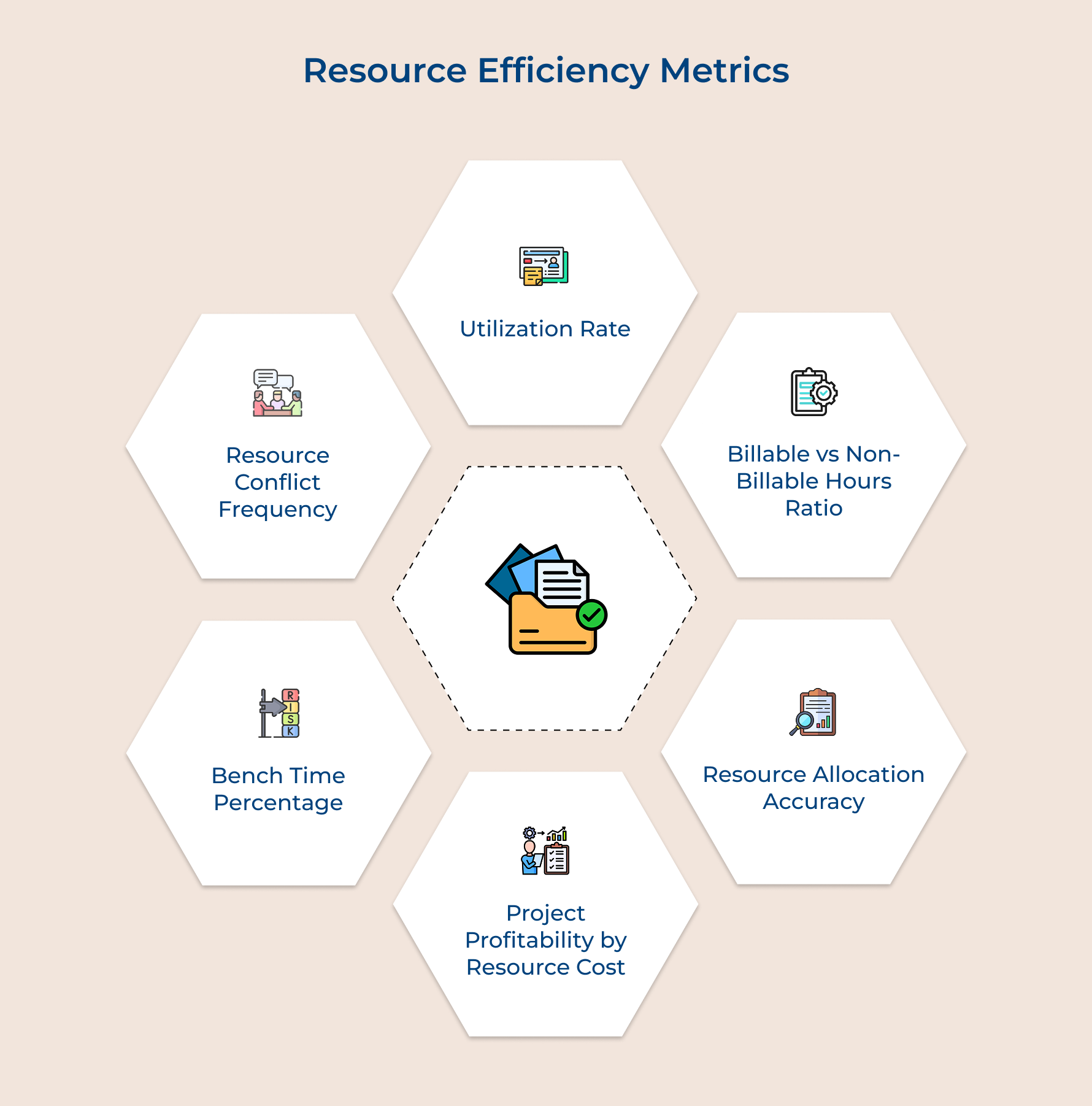
1. Utilization Rate
Utilization rate measures the percentage of available work hours your team spends on billable client projects. Calculate it by dividing total billable hours by total available hours in a given period. A rate of 75-85% is typically healthy because it leaves room for internal work and professional development.
This metric directly impacts profitability and reveals capacity gaps. If your utilization consistently sits below 65%, you’re either overstaffed or struggling to secure enough client work. Rates above 90% suggest your team is overworked with no buffer for unexpected requests.
2. Billable vs Non-Billable Hours Ratio
This ratio compares time spent on revenue-generating client work versus internal activities like meetings and administrative tasks. Most successful professional service firms aim for at least 60-70% of total hours being billable.
The ratio exposes hidden inefficiencies in how your organization operates daily. Excessive non-billable time often indicates too many internal meetings or unclear processes that waste productive capacity. When the ratio trends downward, investigate which activities consume time without generating revenue.
3. Resource Allocation Accuracy
Resource allocation accuracy tracks how closely your planned resource assignments match actual project execution. Measure it by comparing estimated hours per team member against actual hours worked and calculating the variance percentage. Accuracy above 85% indicates strong planning while consistent gaps below 70% suggest serious forecasting problems.
Poor accuracy creates chaos because you promise clients deliverables based on flawed assumptions about team availability. When you improve this number through better tracking and honest estimation, clients get more reliable timelines and your team experiences less scrambling.
4. Project Profitability by Resource Cost
Project profitability by resource cost examines if the team members assigned to each client generate appropriate returns. Calculate it by comparing project revenue against the fully loaded cost of everyone who worked on it including salaries and overhead.
Understanding this metric helps you make smarter staffing decisions for future similar projects. You might discover that assigning senior consultants to certain client types erodes margins because those clients won’t pay premium rates. Armed with this knowledge, you can deliberately staff projects with junior resources who deliver quality work at sustainable costs.
5. Bench Time Percentage
Bench time percentage measures how much of your team’s capacity sits idle waiting for project assignments. Track it by identifying team members without billable work and dividing their unassigned hours by total available hours. Healthy bench time ranges from 5-15% as it provides flexibility for urgent client needs.
Excessive bench time directly reduces profitability because you’re paying salaries for people who aren’t generating revenue. Zero bench time means you have no capacity to accept new business or handle client emergencies.
6. Resource Conflict Frequency
Resource conflict frequency counts how often multiple projects compete for the same team members simultaneously. Measure it by logging instances where project managers request people who are already fully allocated or where you must delay work because specialists are unavailable.
This metric matters because every conflict wastes leadership time in negotiation and often results in compromised client service. When conflicts occur regularly, project managers start hoarding resources or padding timelines defensively which creates even more inefficiency.
Fuel your Growth Sustainably with Improved Resource Efficiency
Improving resource efficiency isn’t about squeezing more hours from your team or cutting corners on quality. It’s about making smarter decisions that let your talented people focus on high-value client work instead of sitting idle or burning out from poor planning.
Start by measuring your current utilization and identifying where capacity gets wasted through mismatches or conflicts. Then implement even just two or three of these strategies to see measurable improvements in both profitability and team satisfaction within weeks.
Limit time — not creativity
Everything you need for customer support, marketing & sales.

Neeti Singh is a passionate content writer at Kooper, where he transforms complex concepts into clear, engaging and actionable content. With a keen eye for detail and a love for technology, Tushar Joshi crafts blog posts, guides and articles that help readers navigate the fast-evolving world of software solutions.