8 Strategies to Boost Consulting Services Profitability Fast
- What is Consulting Services’ Profitability?
- Key Benefits of Consulting Service Profitability
- 8 Proven Strategies to Improve Consulting Services Profitability
- Essential Metrics to Track Consulting Services’ Profitability
- 5 Real-Life Examples of Consulting Service Profitability
- Consulting Services Profitability: Where Strategy Meets Success
- FAQs about Consulting Services Profitability

Key Highlights:
- Automate resource allocation and engagement tracking to maximize consulting services profitability while minimizing operational waste.
- Leverage value-based pricing and specialized service offerings to differentiate as well as increase professional services profitability.
- Implement real-time consulting services profitability reporting for accurate forecasting and smarter business decisions.
Many consulting firms struggle with inconsistent revenue and thin margins, often competing on price instead of value. They juggle unprofitable client work that drains time and resources without real returns.
Not having a clear plan to boost consulting services profitability, you risk working more and earning less, while competitors land premium projects. Poor financial decisions can lead to cash flow issues and missed growth opportunities.
But it doesn’t have to be that way. The right pricing, services, and operations can help you turn your consultancy into a profitable, scalable business—this guide shows you how.
What is Consulting Services’ Profitability?
Consulting services profitability measures how much money remains after covering all project costs and overhead expenses. It represents the financial health of consulting engagements and determines if firms can sustain operations while generating returns for stakeholders. This metric goes beyond simple revenue to examine the actual value created through professional expertise and project delivery.
Profitability directly affects a consulting firm’s ability to attract top talent and invest in growth initiatives. When margins remain healthy firms can develop new service offerings and expand into emerging markets. Poor profitability forces companies to cut corners on quality or reduce compensation which creates a downward spiral affecting client satisfaction and employee retention.
Key objectives:
- Resource optimization: Maximize billable hours while minimizing non-productive time across all team members and project phases.
- Pricing strategy: Set fees that reflect true value delivered rather than just covering costs plus a standard markup.
- Scope management: Control project boundaries to prevent scope creep that erodes margins without additional compensation.
- Talent utilization: Match consultant skill levels to project requirements so senior resources aren’t performing junior tasks.
- Client retention: Build long-term relationships that reduce costly business development efforts and increase repeat engagement opportunities.
Key Benefits of Consulting Service Profitability
Understanding profitability benefits helps consulting leaders make smarter business decisions and build sustainable practices.
Key questions to consider first
- What specific profit margins does your firm need to remain competitive in your market segment?
- How does current profitability compare to industry benchmarks and your firm’s historical performance?
- Which client relationships and project types consistently generate the highest returns on investment?
- What internal cost drivers most significantly impact your bottom line across different service offerings?
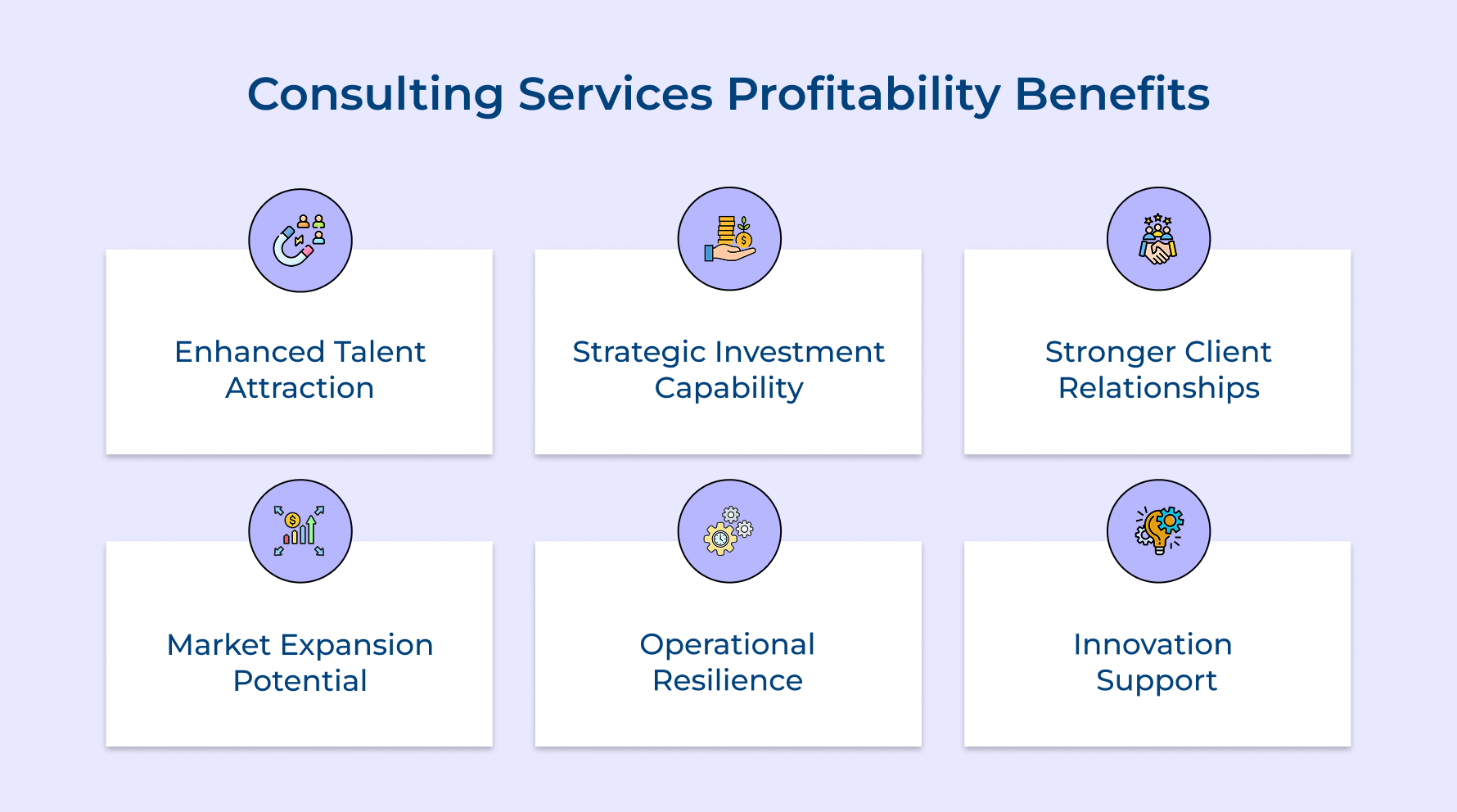
Enhanced Talent Acquisition and Retention
Higher profits enable competitive compensation packages that attract industry-leading consultants. Well-funded firms can offer better benefits and career development opportunities.
Strategic Investment Capability
Profitable firms can invest in cutting-edge tools and training programs without compromising cash flow. They fund research initiatives that keep services ahead of market trends. This investment capacity separates leaders from followers in competitive landscapes.
Client Relationship Strengthening
Strong margins allow firms to absorb occasional project overruns without damaging client relationships. Profitable companies can take calculated risks on innovative solutions. This flexibility builds trust and positions the firm as a true strategic partner.
Market Expansion Opportunities
Healthy profitability provides capital for geographic expansion and new service line development. Firms can enter emerging markets or acquire specialized capabilities. This growth potential creates long-term competitive advantages beyond current operations.
Operational Resilience Building
Profitable firms maintain cash reserves that weather economic downturns and unexpected challenges. They avoid desperate cost-cutting measures that damage service quality. The stability reassures both employees and clients during uncertain periods.
Innovation and Differentiation Support
Strong margins fund experimental projects and breakthrough methodologies that differentiate services. Profitable firms can afford to fail occasionally while pursuing game-changing innovations. The risk tolerance often leads to industry-defining capabilities and thought leadership positions.
8 Proven Strategies to Improve Consulting Services Profitability
Let’s delve into the strategies that will elevate your consulting services to new financial heights.
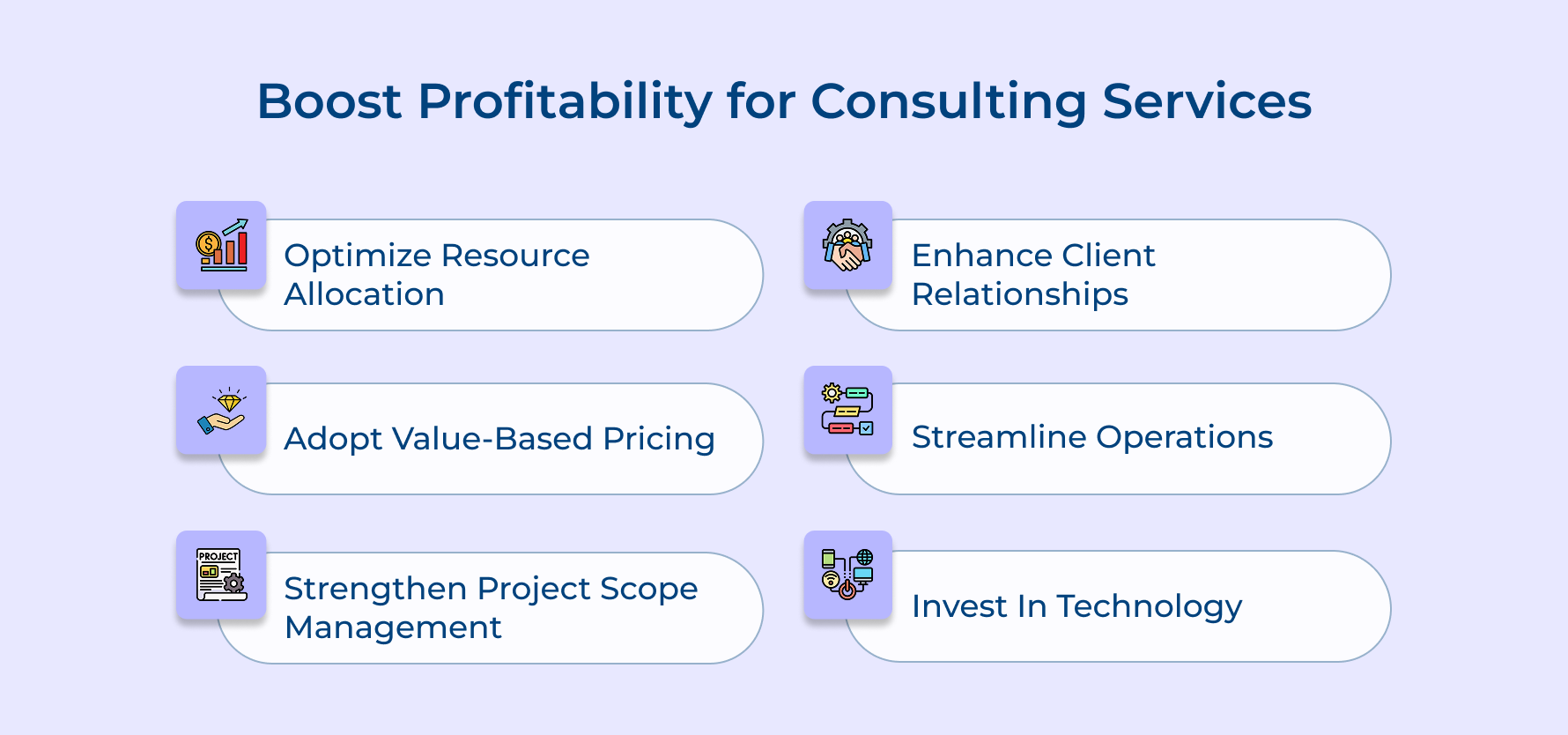
1. Optimize Resource Allocation and Utilization
Optimizing resource allocation is essential for consulting services profitability. Here’s how to make sure your team works smarter, not harder:
- Strategic skill matching: Assign consultants based on expertise and project complexity—not just availability. Avoid using senior talent for junior tasks.
- Utilization rate tracking: Monitor billable vs. non-billable hours weekly. Target 75–80% for senior staff and 80–85% for juniors to identify under- or over-utilized team members.
- Workload balancing systems: Spread assignments evenly, prevent burnout and build cross-trained backup coverage to avoid project delays.
The real test? Ask yourself: Are your most expensive consultants spending their time on high-value tasks only they can do? If not, you’re losing margin and missing growth opportunities. A smarter allocation strategy turns resource management into a profit engine.
2. Implement Value-Based Pricing Models
Value-based pricing helps boost consulting services profitability by aligning fees with results. Instead of billing for time, you charge for the value delivered. Here are four proven models:
- Outcome-based pricing: Fees are tied to measurable results, like cost savings or revenue gains.
- Project-based fixed fees: One set price for full project delivery, regardless of hours spent.
- Performance bonuses: Success fees are added for surpassing agreed targets.
- Retainer arrangements: Clients pay monthly for ongoing strategic access and advisory support.
Wondering which model fits your firm best? It depends on your client’s mindset. Risk-averse clients usually prefer fixed pricing, while growth-driven ones are open to outcome-based deals.
Pro tip: Offer tiered pricing. Basic tiers cover advisory only, while premium options can include hands-on implementation, priority response and executive access.
3. Strengthen Project Scope Management
Effective scope management is critical to consulting services profitability. Without it, profitable projects can quickly turn into break-even headaches.
Here’s how smart firms stay in control:
- Weekly scope check-ins: Regularly compare current progress to the original project scope to spot early signs of scope creep.
- Client expectation alignment: Keep deliverables clear through consistent communication and updated documentation at every stage.
- Change request documentation: Log all changes formally, along with their cost and timeline impacts without having any assumptions or surprises.
- Stakeholder sign-off requirements: Don’t start additional work without written approval from key decision-makers.
Think of it this way: every vague deliverable is a hidden profit leak. Clear project boundaries protect your margins and your team’s time. When everyone knows what’s included (and what’s extra), you avoid misunderstandings while building stronger, trust-based client relationships.
4. Enhance Client Relationship Management
Client relationship management is key to consulting services profitability. Strong relationships mean less time chasing new business and more time delivering results. Here’s how to turn clients into long-term partners:
- Build strategic partnerships: Go beyond one-off projects. Position your firm as a long-term advisor involved in your client’s ongoing strategy. This creates stable, recurring revenue and deepens trust.
- Use systematic account management: Check in regularly, stay proactive and look for new ways to help. Managing accounts intentionally helps uncover fresh opportunities while reducing the cost of client acquisition.
- Expand existing accounts: Identify other departments or teams that could benefit from your services. Cross-selling and upselling are faster as well as more cost-effective than starting from scratch with new leads.
Long-term client relationships aren’t just good for retention, they’re powerful growth drivers that increase efficiency and profitability.
5. Streamline Operational Processes and Workflows
Streamlining operations is a direct route to improving consulting services profitability. It cuts waste, reduces admin overhead and frees your team to focus on billable work. Start by asking:
- How much of your team’s time is spent on non-billable admin tasks?
- Which repetitive processes eat up hours without adding client value?
- How many tools do consultants juggle just to manage projects?
- What manual reporting slows things down and shrinks margins?
The answer? Smart automation.
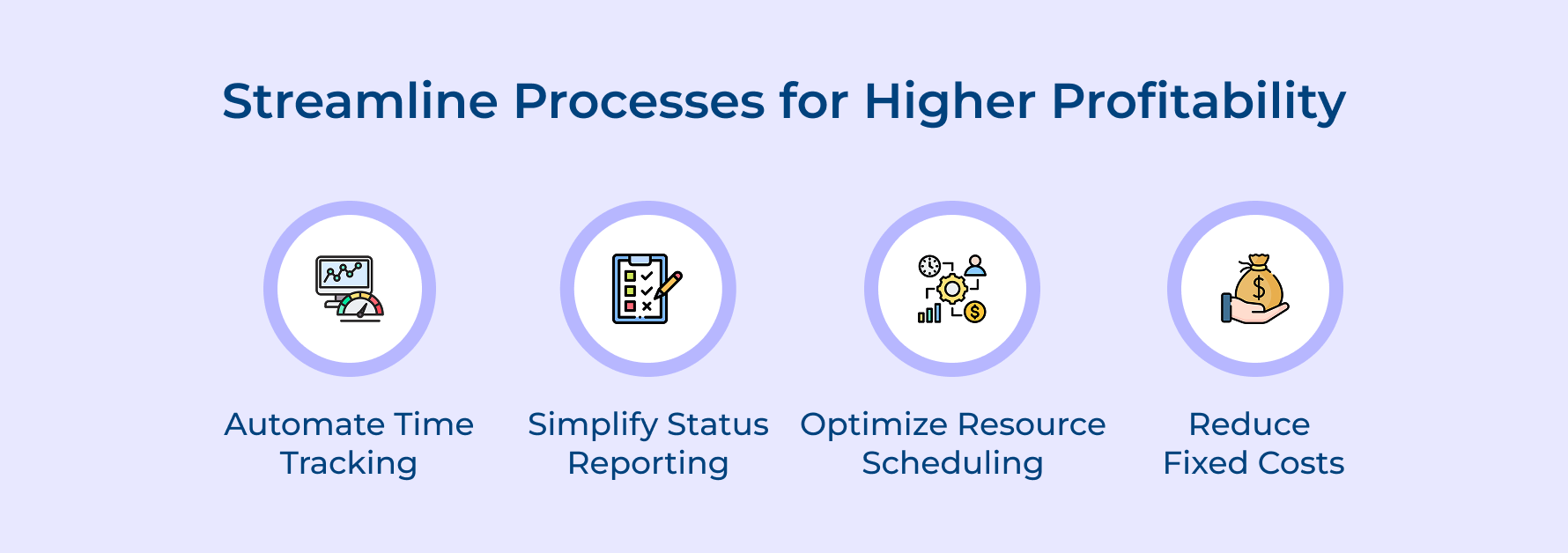
- Time tracking & invoicing: Automate billable hour capture and invoice generation, no more manual entry.
- Status reporting: Use dashboards for real-time updates and scheduled reports.
- Resource scheduling: Let software match consultants to projects based on skills and availability.
Bonus tip: Cut fixed costs. If your team’s rarely in-office, flexible space and remote tools can slash overhead by 30–40% without impacting delivery.
6. Invest in Technology and Tools
Investing in the right technology boosts consulting services profitability by enhancing productivity, improving service quality and increasing client satisfaction. Here are key tools that drive real impact:
- Project management platforms: Keep all timelines, deliverables and resources in one place, especially helpful when managing multiple clients at once.
- Data analytics software: Turn client data into clear, actionable insights that support stronger recommendations and justify premium pricing.
- Collaboration platforms: Enable smooth communication between consultants and clients, speeding up decisions while reducing misalignment.
- CRM systems: Track every client touchpoint and opportunity to strengthen relationships as well as uncover growth potential.
Wondering if the investment’s worth it? One consulting firm adopted project management software and cut delivery time by 15%, allowing them to complete projects faster or take on more work with the same team. That’s how tech turns into profit.
7. Develop Specialized Service Offerings
Specialized service offerings are a powerful driver of consulting services profitability. They help you stand out, command higher fees and attract ideal clients. Here’s how to make specialization work:
- Narrow your focus: Concentrate on specific industries or problem areas where your team consistently delivers strong results. Clients value depth over breadth.
- Charge premium rates: Specialized expertise solves high-stakes problems—clients are willing to pay more for proven, targeted solutions over general advice.
- Develop proprietary methodologies: Create repeatable frameworks as well as tools that deliver measurable outcomes and can’t be easily copied by competitors.
- Build thought leadership: Share insights through blogs, whitepapers and speaking gigs to position your firm as a go-to authority in your niche.
You gain credibility, attract better-fit clients and grow faster without competing on price.
8. Invest in Team Skills Development
Investing in team skills development is essential for consulting services profitability. It keeps your talent sharp, reduces hiring costs and builds a strong pipeline of future leaders. Here are four proven approaches:
- Technical certification programs: Keep consultants up to date with tools and industry standards through recognized certifications.
- Industry conference attendance: Expose your team to emerging trends, new ideas and valuable networking opportunities.
- Cross-functional training: Help consultants build versatility by learning skills outside their core discipline.
- Mentorship & coaching: Pair junior staff with experienced mentors to guide their career growth and confidence.
Formal programs are great, but real learning happens on the job. Create stretch assignments and collaborative projects that push your team to grow in real-world scenarios. It’s how junior consultants become senior-level problem solvers and how your firm builds long-term capability from within.
Essential Metrics to Track Consulting Services’ Profitability
Tracking the right profitability metrics transforms gut feelings into data-driven decisions that improve your consulting firm’s financial performance. These measurements reveal which projects generate real value and which ones drain resources without adequate returns.
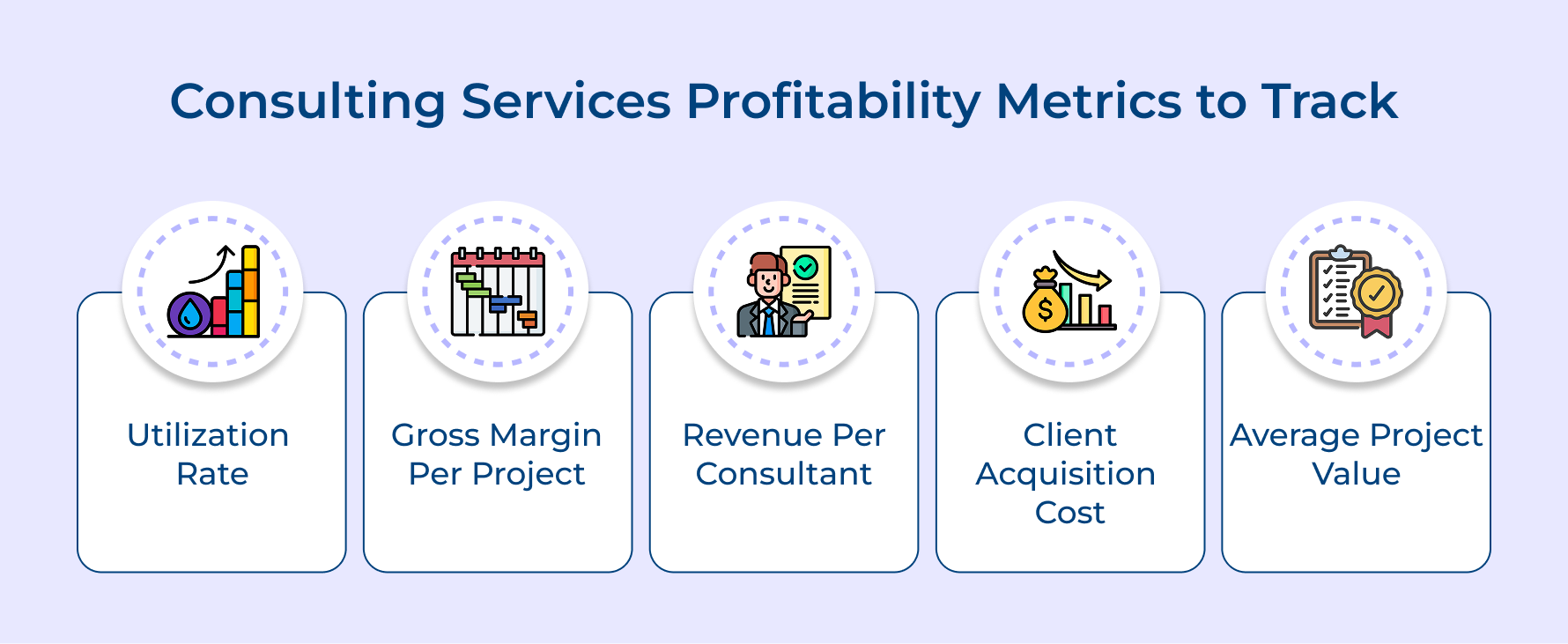
Utilization Rate
Utilization rate tracks the percentage of consultant hours spent on billable client work. It helps evaluate whether your team executes project plans efficiently and maintains profitability by minimizing internal tasks. Target rates typically range between 75–85% depending on role seniority and firm size.
Gross Margin Per Project
Gross margin per project measures revenue minus direct costs, showing true profitability before overhead. Use it to identify which project types yield the highest returns. Improving cost control and refining your work breakdown structure helps increase margins across similar client engagements and service offerings.
Revenue Per Consultant
This metric divides total firm revenue by the number of billable consultants. It highlights individual productivity levels and helps evaluate team performance. Aligning consultant skills with the right project plans boosts output and ensures sustainable revenue growth to support firm-wide overhead as well as operations.
Client Acquisition Cost
Client acquisition cost includes all spending on winning new business—sales outreach, proposal creation and meetings. Tracking this helps ensure your business development investments deliver high-value projects. A lower acquisition cost, paired with efficient project execution, leads to stronger consulting services profitability.
Average Project Value
Average project value reflects the typical size of consulting engagements. Larger values suggest strong positioning and trust in your expertise. Well-defined work breakdown structures and premium-tier project plans help justify higher pricing while ensuring clients clearly see the value of each engagement phase.
5 Real-Life Examples of Consulting Service Profitability
These consulting firms demonstrate how strategic project management and client relationships create sustainable profitability across different sectors. Each example shows practical methods that other practices can adapt.
McKinsey & Company’s Premium Positioning Strategy
McKinsey maintains profitability through selective client engagement and premium pricing that reflects their brand reputation. They focus on high-stakes strategic decisions where clients value outcomes over costs. Their rigorous consultant development ensures consistent quality that justifies higher fees.
This positioning creates a self-reinforcing cycle where successful outcomes attract prestigious clients willing to pay premium rates. Their influence extends beyond projects to shape industry practices. Clients view them as trusted advisors for critical decisions rather than vendors.
Deloitte’s Diversified Service Portfolio Approach
Deloitte achieves profitability by offering integrated services across multiple functions from strategy to technology implementation. This comprehensive approach increases project values while creating expansion opportunities within existing accounts. Their scale allows efficient resource allocation across service lines.
The diversification protects against market downturns while creating cross-selling opportunities between practice areas. Clients benefit from coordinated solutions addressing complex challenges. This integrated model strengthens relationships and reduces threats from specialized boutique firms.
Boston Consulting Group’s Innovation Focus
BCG maintains profitability through continuous innovation in consulting methodologies that differentiate their services. They invest in proprietary research and thought leadership that supports premium pricing. Their consultants combine analytical rigor with creative problem-solving for breakthrough results.
This innovation focus positions BCG as the preferred partner for unprecedented challenges or transformational growth. Clients seek their expertise when conventional solutions prove inadequate. Their reputation attracts top talent and high-profile engagements that enhance brand value.
Bain & Company’s Results-Oriented Partnership
Bain structures engagements with performance-based fees that align consultant incentives with client success metrics. This demonstrates confidence while sharing risks and rewards. They focus on measurable outcomes rather than deliverable completion which strengthens relationships.
The results-oriented model attracts clients wanting partners invested in actual improvements rather than just recommendations. This creates stronger accountability and often leads to extended engagements when results exceed expectations. Clients become advocates providing referrals and case studies.
Consulting Services Profitability: Where Strategy Meets Success
Consulting services profitability emerges when firms align strategic positioning with operational excellence across project management and client relationships. Success requires balancing premium pricing with value delivery while optimizing resource allocation and building sustainable competitive advantages.
The most profitable consulting firms focus on specialized expertise and long-term client partnerships rather than competing solely on price or availability. Smart measurement of key metrics combined with strategic investments in technology and talent development creates the foundation for sustained financial success.
Limit time — not creativity
Everything you need for customer support, marketing & sales.

Pooja Deshpande is a content contributor at Kooper, focused on creating insightful resources that help agencies and service providers scale efficiently. Passionate about SaaS trends, content strategy, and operational excellence, she delivers practical, easy-to-implement guidance for modern business leaders.