Agency Rate Card Explained: Create, Manage & Price Services
- What is an Agency Rate Card?
- Importance of Agency Rate Card
- 8 Essential Steps for a Profitable Agency Rate Card Setup
- When are Agency Rate Cards Used?
- 5 Practical Agency Rate Card Best Practices
- Common Challenges of Agency Rate Card
- Unlock Transparency with Our Advanced Agency Rate Card
- FAQs about Agency Rate Card
Key Highlights:
- Transparent agency rate cards build trust, streamline project management and protect agency profitability from inconsistent pricing.
- Implement six best practices to keep your agency rate card competitive, transparent and aligned with evolving market trends.
- Follow an 8-step process to research, define and package your agency for maximum clarity as well as profit.
Struggling with inconsistent pricing that confuses clients and reduces profitability? Many agencies lose revenue through team members quoting different rates and lengthy proposal processes that frustrate prospects.
Agency rate cards solve pricing challenges by creating structured frameworks that streamline sales processes and eliminate guesswork. Properly implemented rate cards transform chaotic pricing discussions into professional conversations.
This guide covers creating, implementing and managing effective agency rate cards that boost profitability while improving operational efficiency. It also explores how transparent pricing structures and professional presentation methods can strengthen client relationships.
What is an Agency Rate Card?
An agency rate card is essentially a pricing menu that advertising and marketing agencies use to show clients what their services cost. It displays hourly rates for different team members and project costs for various marketing services. This transparent pricing document helps both agencies and clients understand exactly what they’re paying for before any work begins.
Rate cards function as the foundation for project estimates and billing discussions between agencies as well as their clients. When a client needs marketing work done, the agency references their rate card to calculate costs based on required hours and team members involved. This creates consistency in pricing while giving clients clear expectations about investment levels for different types of projects.
Main elements of an agency rate card:
- Staff hourly rates: Different rates for account managers, creative directors, designers and other team roles based on experience levels.
- Project-based pricing: Fixed costs for common deliverables like logo design, website development or social media campaign creation.
- Retainer options: Monthly fee structures for ongoing services like content creation, account management or digital marketing support.
- Additional services: Costs for extras like rush delivery, revisions beyond included rounds or specialized consulting work.
- Terms and conditions: Payment schedules, cancellation policies and scope change procedures that protect both parties during projects.
Importance of Agency Rate Card
Rate cards serve as the backbone of professional agency-client relationships by establishing clear financial boundaries and expectations from the very beginning of any working partnership. Let’s delve into its importance.
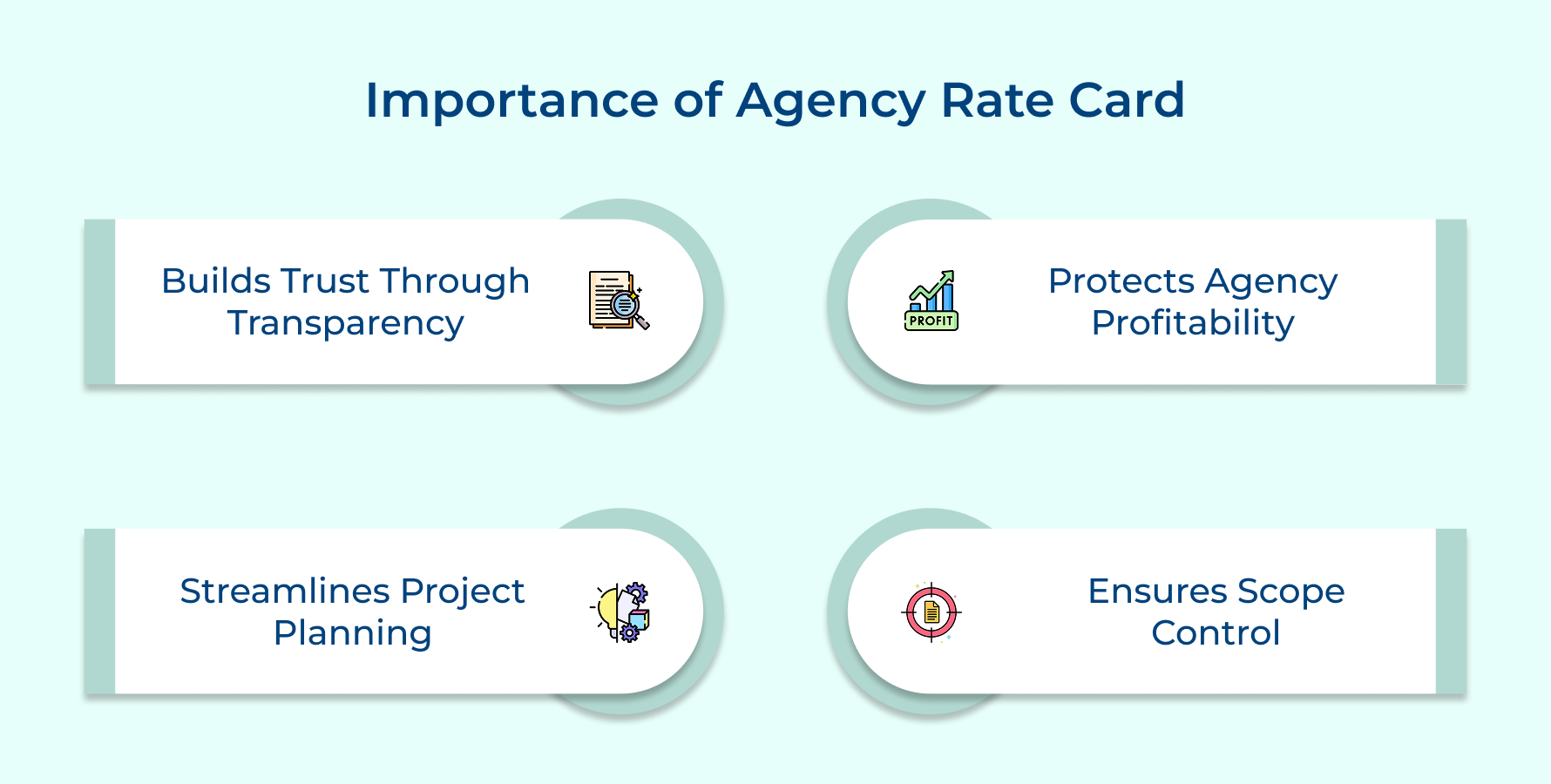
Builds Trust Through Transparency
Rate cards eliminate pricing mysteries by showing upfront costs for services and team members. Clients feel confident about budget planning without worrying about surprise charges. This transparency creates trust that strengthens long-term business relationships between agencies and their clients.
Streamlines Project Planning and Budgeting
Standardized rates allow quick project cost estimates without lengthy negotiations on every task. Clients plan marketing budgets effectively while agencies allocate resources efficiently. This speeds up project approvals and reduces administrative overhead for both parties involved.
Protects Agency Profitability and Sustainability
Rate cards ensure agencies charge fair prices covering costs plus reasonable profit margins needed for growth. Without structured pricing agencies risk undercharging and struggling financially. Consistent pricing prevents team members from accidentally quoting different rates to clients.
Creates Professional Boundaries and Scope Control
Clear rate structures help manage client expectations about service costs and scope changes. When clients understand additional revisions cost extra they make thoughtful decisions about requirements. This reduces scope creep and protects both parties from misunderstandings.
8 Essential Steps for a Profitable Agency Rate Card Setup
The 8-step process will guide you through crafting an effective agency rate card that reflects your services’ worth, aligns with market standards and supports sustainable business growth.
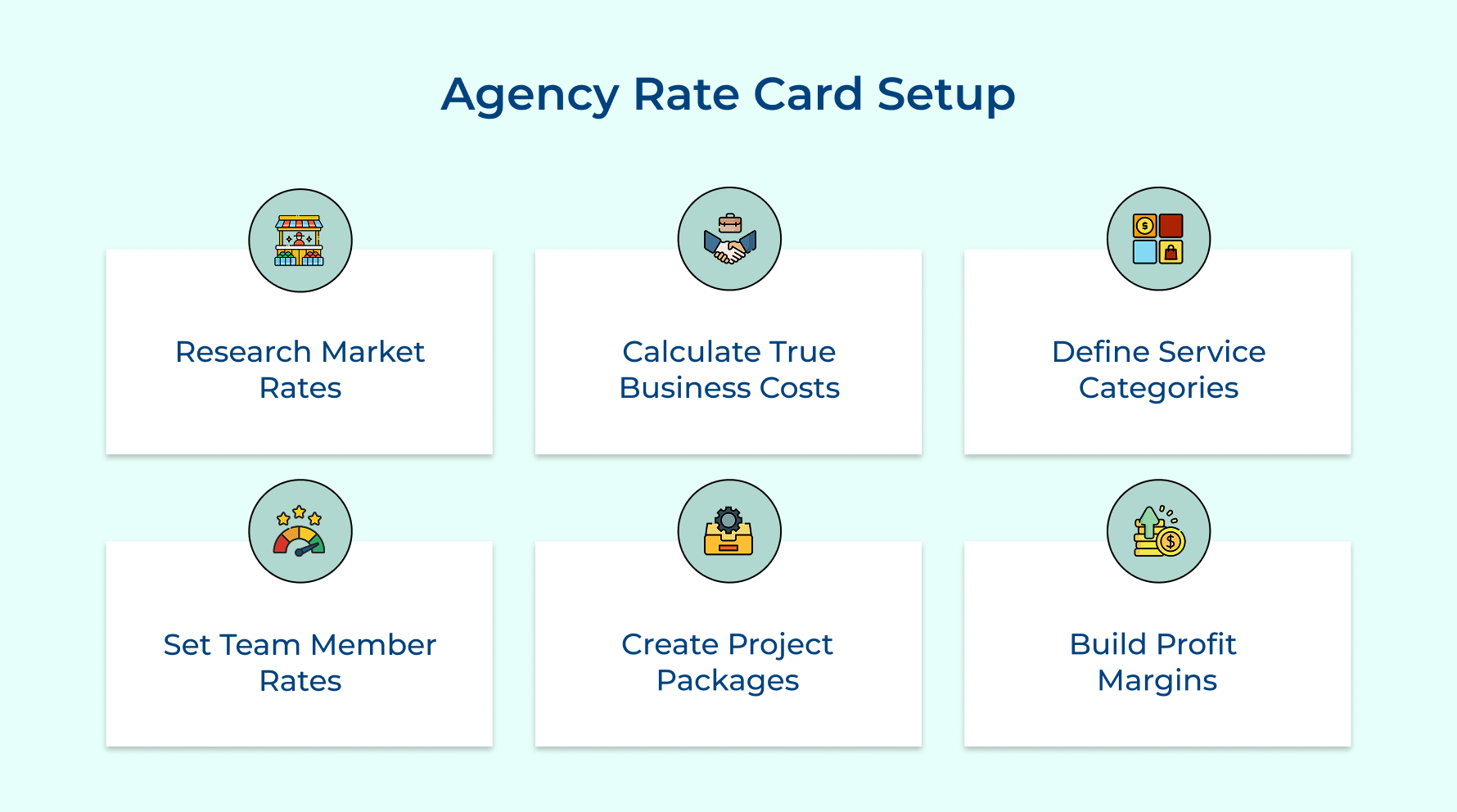
1. Research Market Rates Thoroughly
Getting your pricing right starts with smart research. You can’t build an effective agency rate card without knowing what others charge and why. To avoid underpricing your consultancy rate card or losing clients to cheaper options, use these strategies:
- Spy like a client: Request rate cards or estimates from competitors to compare real-world pricing.
- Tap into associations: Use industry reports from marketing groups or consulting bodies for benchmark data.
- Scan digital platforms: Check Upwork, Fiverr and similar sites to understand baseline pricing clients may already expect.
Why does this matter? If your project managers charge $200/hr but competitors charge $150, you may lose clients before even presenting your value.
2. Calculate your True Business Costs
Before setting prices, you need to know your real costs including the ones hiding in plain sight. Many agencies forget that billable hours must cover more than just salaries.
- Track all business expenses for at least three months.
- Don’t forget office rent, software, insurance, taxes and internet bills.
- Add a 10–15% buffer for unexpected expenses.
This helps ensure your consultancy rate card actually generates profit, not just covers costs. When project managers know the true cost of delivering work, they can quote confidently without worrying about losing money on each project.
3. Define your Service Categories Clearly
Clients as well as team members alike should instantly understand what services you offer and how they’re priced. A well-organized work breakdown structure helps keep your rate card focused and professional.
Ask yourself:
- Which services require the most strategic input?
- What tasks can be standardized vs. custom-built?
- Which offerings deliver the highest profit margins?
Typical categories include:
- Strategic consulting: High-level project plans and business strategy
- Creative development: Design, copy and branding
- Digital implementation: Websites, SEO, campaign builds
- Account management: Ongoing communication and project tracking
This breakdown supports more transparent project management and smoother client approvals.
4. Set Individual Team Member Rates
Not all hours are equal, senior project managers don’t cost the same as junior designers. Your rate card should reflect each team member’s skill set and revenue potential.
To calculate individual rates:
- Subtract vacation, admin and training time from annual hours.
- Understand billable capacity vs. total hours worked.
- Factor in each person’s unique value like certifications, leadership, or communication strengths.
Project management software can help track utilization and improve resource allocation accuracy across roles. Ultimately, clear individual rates support fair pricing for clients and sustainable planning for your agency.
5. Create Project Package Pricing Options
Packages make decision-making easier for clients and revenue more predictable for you. Instead of charging hourly, bundle services your clients often buy together.
Tips for packaging:
- Bundle smartly: Pair related services (e.g., website design + SEO).
- Set fixed prices: Quote for standard outcomes like branding kits or social media audits.
- Include revisions + timelines: Be clear on what’s included and expected.
This approach simplifies project management, sets boundaries and helps project managers deliver results on time.
6. Build in Your Profit Margins
Profit isn’t greedy, it’s necessary. To scale your agency, you need margins built into your rate card. Here are three ways to do it right:
- Cost-plus method: Add 25–50% markup on your break-even rate.
- Value-based pricing: Charge based on outcomes, especially when your work drives revenue.
- Competitive positioning: Research premium agencies and price slightly below if you’re still building reputation.
Your margins should support long-term growth, from hiring new project managers to investing in better project management software and tools.
7. Test Rates with Existing Clients
Before rolling out your new rate card, test it with a few trusted clients. Their feedback can highlight pricing gaps or reveal misaligned perceptions.
Questions to guide your testing:
- Which clients value your strategic thinking and transparency?
- Who’s been asking for expanded services?
- Can your best relationships handle open pricing conversations?
Ways to gather input:
- One-on-one chats
- Quick surveys
- Written scenarios for comparison
Adjust based on feedback, don’t toss your entire structure. Instead, refine specific areas like consultancy rate card tiers or project plans for better market fit.
8. Design Professional Rate Card Document
Your rate card is a tool for winning clients. A clean, clear format shows professionalism and makes it easy for decision-makers to get buy-in.
Best practices:
- Include both summary and detailed versions.
- Update quarterly to reflect service changes or market shifts.
- Use project management visuals like work breakdown structure snapshots to show how you price.
When clients can instantly understand your offerings, they’re more likely to trust your agency’s project managers and commit to working with you.
When are Agency Rate Cards Used?
Agency rate cards become essential business tools in scenarios where transparent pricing is crucial. They help both agencies and clients make informed decisions while setting clear expectations.
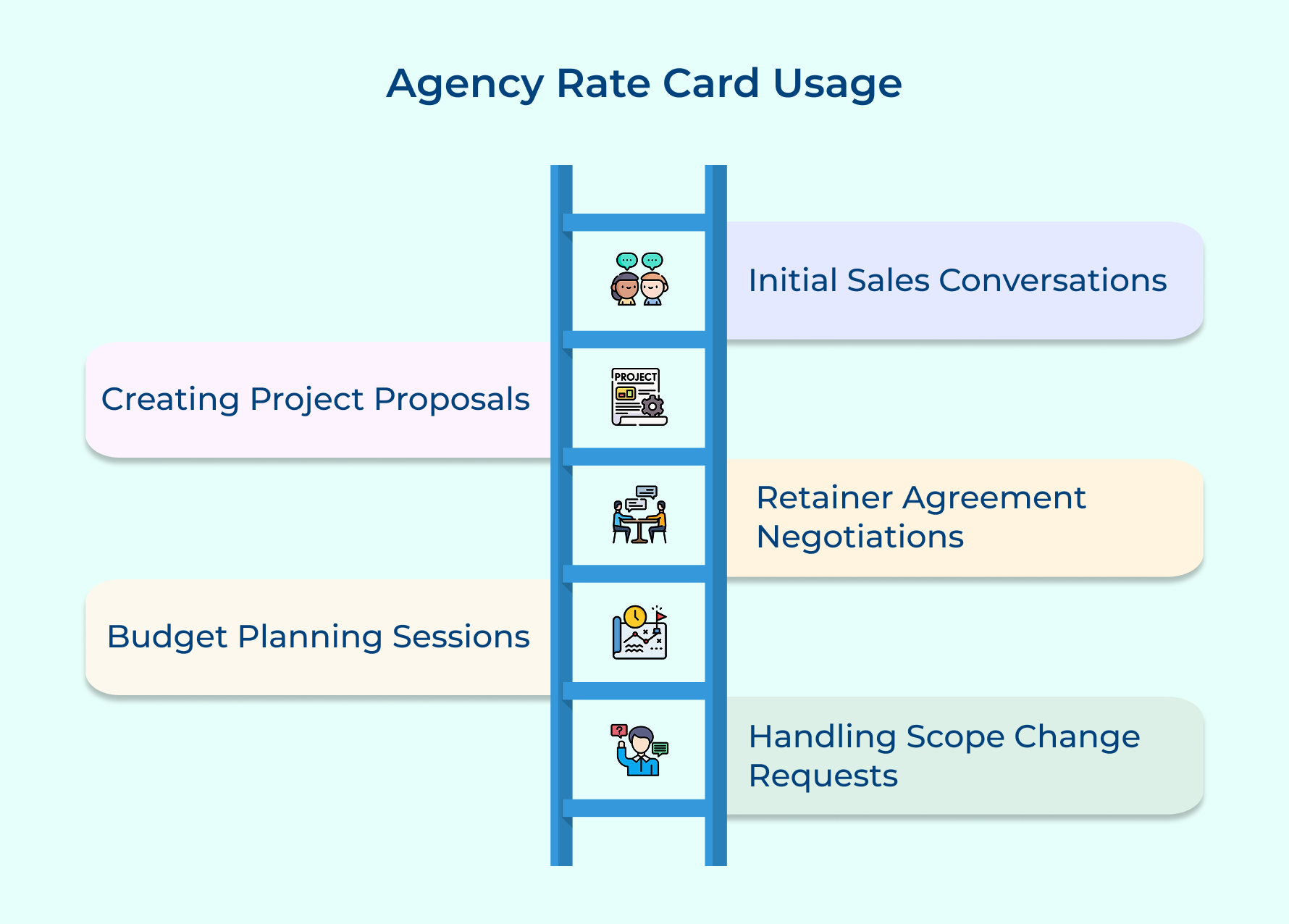
During Initial Sales Conversations
Rate cards streamline the discovery process when potential clients inquire about your services and want to understand investment levels upfront. Instead of lengthy back-and-forth discussions about pricing, you can quickly present your rate structure and focus conversations on strategy as well as value rather than cost negotiations.
When Creating Project Proposals
Detailed proposals require accurate cost calculations that rate cards make simple and consistent across all team members involved in pricing decisions. Your account managers can reference standard rates to build comprehensive project estimates without constantly consulting senior leadership or trying to remember individual pricing for different service types.
For Retainer Agreement Negotiations
Monthly retainer discussions become more structured when clients can see exactly how their investment translates into specific team member hours and service categories. Rate cards help justify retainer pricing by showing the hourly value clients receive and how bundled monthly fees create savings compared to project-by-project billing.
During Budget Planning Sessions
Clients often involve agencies in their annual marketing budget planning process where rate cards provide the foundation for realistic cost forecasting. Marketing directors can use your rate structure to estimate costs for upcoming campaigns and allocate appropriate resources for different types of agency support throughout the year.
When Handling Scope Change Requests
Project modifications and additional work requests require immediate pricing decisions that rate cards make straightforward as well as fair for both parties involved. Instead of delaying project momentum while calculating custom pricing, teams can quickly reference established rates to provide clients with accurate cost implications of their requested changes.
5 Practical Agency Rate Card Best Practices
Effective rate card management requires ongoing attention and strategic updates to ensure your pricing remains competitive while supporting business growth. Here are agency rate card best practices:
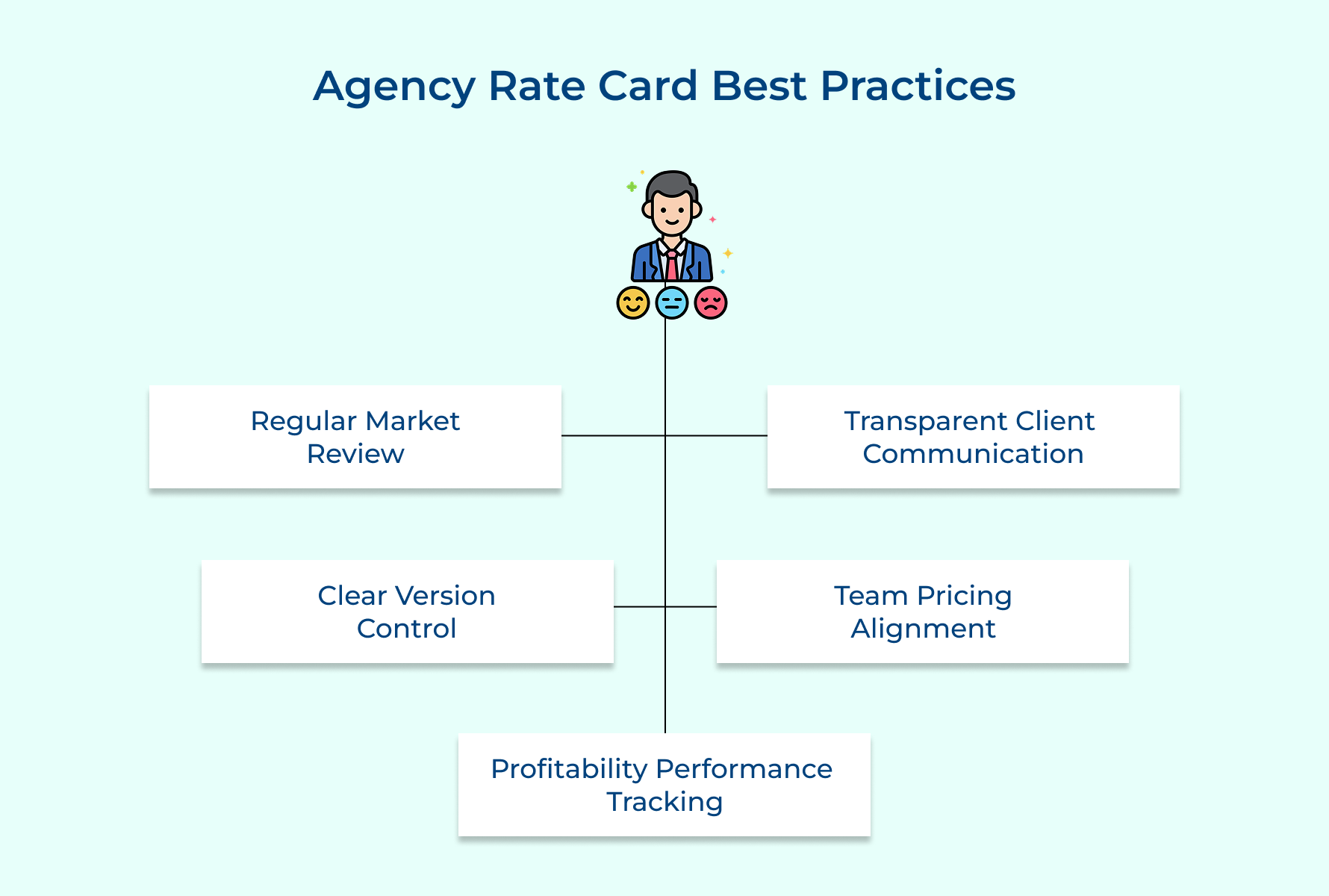
1. Regular Market Review and Rate Adjustments
Smart agencies conduct quarterly market research to understand how their pricing compares to competitors and if economic conditions require rate modifications. This proactive approach prevents you from accidentally undercharging while competitors raise their prices.
Here are essential factors to monitor during your market review process:
- Track competitor pricing changes through industry publications and networking conversations
- Monitor economic indicators that affect client budgets and spending patterns
- Analyze your win-loss ratios to identify pricing-related decision patterns
Annual rate increases of 3-5% help offset inflation and rising business costs while demonstrating that your services continue to evolve. Timing these increases strategically around contract renewals ensures clients accept changes more readily than random mid-project adjustments.
2. Transparent Communication with Existing Clients
Rate changes require clear advance notice and logical explanations that help clients understand the business reasons behind pricing adjustments rather than viewing them as arbitrary profit grabs. Most clients appreciate honest communication about rising costs and improved service capabilities.
Consider these communication strategies when announcing rate changes:
- How far in advance should you notify different types of clients about pricing updates?
- What specific improvements or added value can you highlight to justify increases?
- Which clients might need budget planning assistance to accommodate new rates?
Professional service relationships thrive on trust and transparency so explaining your rate evolution demonstrates respect for client partnerships while maintaining your business sustainability. Clients who understand your reasoning typically accept reasonable increases more readily.
3. Version Control and Documentation Management
Rate card versions must be tracked meticulously to prevent confusion about which pricing applies to different clients and project timelines. Maintaining clear records protects both your revenue and client relationships from billing disputes.
Digital version control systems help agencies avoid costly mistakes like billing clients at outdated rates or accidentally applying new pricing to existing contracts. Simple spreadsheet tracking can provide the organizational structure needed to manage multiple rate versions.
4. Team Training and Internal Alignment
Every team member who discusses pricing with clients needs thorough training on your rate structure and the reasoning behind different service categories. Inconsistent pricing conversations damage client confidence and create internal confusion that leads to revenue losses.
Consider these training elements to ensure team alignment:
- How do junior staff members learn to explain your value proposition effectively?
- What scenarios require senior approval before sharing pricing information with prospects?
- How do account managers handle client questions about rate increases or service bundling?
Regular training sessions help team members understand not just what you charge but why your rates reflect the value you deliver. When everyone can articulate your pricing rationale confidently, sales conversations become more professional and clients develop stronger appreciation for your expertise.
5. Performance Tracking and Profitability Analysis
Rate card effectiveness requires ongoing measurement of key metrics like project profitability, client retention rates and win-loss ratios on new business proposals. These numbers reveal whether your pricing strategy supports business goals or needs adjustment.
Essential metrics to track for performance analysis include:
• Project profitability margins
• Client lifetime value
• Competitive analysis
Monthly profitability reviews help identify which rates need adjustment and which services deserve premium pricing based on client demand as well as project success rates. This data-driven approach ensures your pricing evolves based on actual business performance.
Common Challenges of Agency Rate Card
Even the best-designed rate card for an agency can hit roadblocks. Here’s where things often go wrong and what you can do to stay flexible as well as profitable.
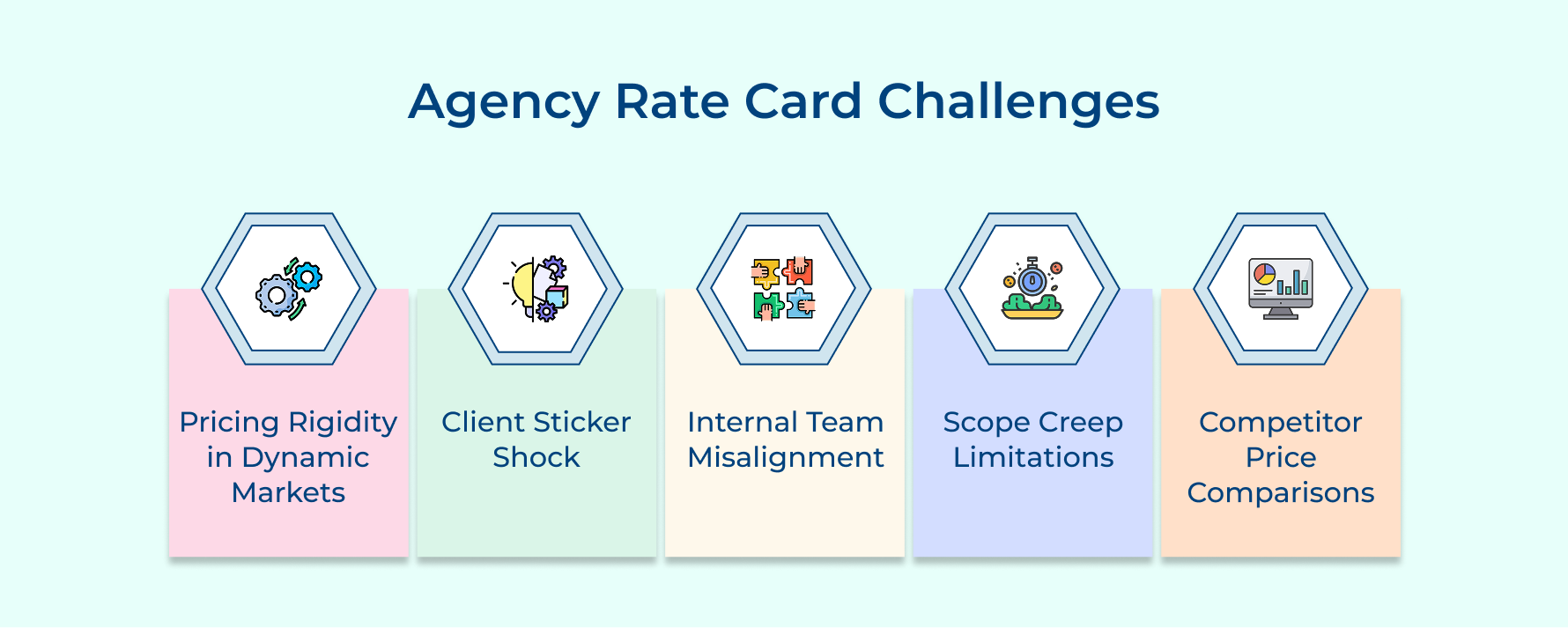
Pricing Rigidity in Dynamic Markets
A fixed pricing model doesn’t always match the real world.
- In the current market dynamics, client needs change quickly.
- A rigid creative agency rate card might cause undercharging for complex work or overpricing simple tasks.
- To fix this, create flexible pricing tiers that reflect varying levels of project complexity and client budgets.
Client Sticker Shock and Price Resistance
Numbers on paper can scare clients, especially without context.
- Many prospects react to your hourly rate before understanding the outcomes you deliver.
- An agency rate card, it’s essential to lead with value, not just cost.
- Present the “why” behind your rates: experience, efficiency and proven results.
Internal Team Confusion and Inconsistency
When your team isn’t aligned, your pricing falls apart.
- If different team members interpret your agency rate card template differently, you get inconsistent quotes.
- This confuses clients and damages trust.
- Regular training ensures everyone (especially project managers and account leads) explains pricing the same way.
Scope Creep and Rate Card Limitations
Creative projects often evolve, but your rate card needs to keep up.
- For example, a standard PR agency rate card may not account for strategy meetings or unexpected revision rounds.
- Include revision limits and clear definitions in your rate card to protect against scope creep.
- Use real-world examples and expected timelines to set client expectations upfront.
Comparisons with Competitors
Not all agencies are created equal and price isn’t everything.
- If you’re always defending your pricing, it’s time to rethink how you position your agency rate card meaning.
- Avoid direct comparisons and instead highlight your unique strengths like specialized expertise or faster turnaround times.
- A great agency rate card example not only lists prices but showcases the value clients get in return.
Unlock Transparency with Our Advanced Agency Rate Card
Agency rate cards serve as essential business foundations that eliminate pricing confusion and establish professional credibility with potential clients. Without clear rate structures, agencies struggle with inconsistent proposals, team confusion and lost revenue from underpricing valuable services.
Professional service businesses dramatically improve profitability through strategic rate card implementation that standardizes pricing while reducing proposal development time. Enhanced operational efficiency emerges when teams reference consistent rates, while transparent pricing builds stronger client trust and accelerates decision-making processes.
Limit time — not creativity
Everything you need for customer support, marketing & sales.

Pooja Deshpande is a content contributor at Kooper, focused on creating insightful resources that help agencies and service providers scale efficiently. Passionate about SaaS trends, content strategy, and operational excellence, she delivers practical, easy-to-implement guidance for modern business leaders.