How to Measure Capacity vs Demand Effectively
- What is Resource Capacity?
- What is Resource Demand?
- Importance of Measuring Resource Capacity vs Demand
- Fundamental Differences Between Resource Capacity Vs Resource Demand
- How to Measure Resource Capacity and Demand in 8 Easy Steps
- Challenges in Measuring Resource Capacity Vs Demand
- Best Practices for Balancing Demand and Capacity
- Unlock Efficiency with Seamless Management of Capacity vs Demand
- FAQs about Measure Capacity vs Demand
Key Highlights:
- Master our multi-step framework to systematically measure capacity vs demand, ensuring optimal resource allocation and preventing team overload.
- Implement proactive strategies like pipeline forecasting to balance workloads, avoid burnout and seize growth opportunities confidently.
- Leverage real-time data to align your team’s skills with client needs, boosting profitability and client satisfaction.
It’s a constant struggle for agencies: you need to measure capacity vs demand, but it feels impossible. Your team’s available time and what clients actually want never seem to match up. This leads to overworked staff as well as missed opportunities.
The real problem is guessing. When you don’t have a clear measurement system, you’re forced to make costly decisions based on gut feelings.
This guide will show you practical, proven steps to measure capacity vs demand accurately. You’ll learn how to see exactly what your team can handle and what clients need, so you can allocate resources perfectly while growing your business without the chaos.
What is Resource Capacity?
Resource capacity is simply the available time and skills your team has to get client work done. Think of it as your available inventory of talent.
Managing it well is crucial. If you get it wrong, your team burns out from too much work or sits idle with too little. Getting it right means your people work on the right projects, which keeps everyone productive, profitable and your clients happy.
Primary objectives:
- Maximize billable utilization rates across all team members without compromising work quality or employee wellbeing.
- Align available skills and expertise with incoming client demands to ensure optimal project staffing.
- Maintain strategic bench strength to handle unexpected project requirements or staff absences.
- Balance workload distribution to prevent bottlenecks in high-demand specializations while developing underutilized areas.
- Forecast future capacity needs based on pipeline opportunities and planned business growth.
What is Resource Demand?
Resource demand is the total amount of work and specific skills your clients need from your team, both now as well as in the future.
Measuring this demand will help you see exactly what you’ll need to deliver all your projects on time. This helps you avoid being short-staffed, plan hiring properly and make sure you never have to turn down good work because your team is already stretched too thin.
Key Factors:
- Project scope and complexity: The breadth and difficulty of work directly determines the number along with the type of specialists required for successful completion.
- Client timeline expectations: Delivery deadlines influence resource intensity and may require additional personnel to meet compressed schedules without quality compromise.
- Skill specialization requirements: Technical expertise needs vary significantly across projects and dictate which specific professionals must be allocated to each engagement.
- Seasonal business fluctuations: Predictable peaks and valleys in client activity create varying demand patterns that require careful resource planning as well as management.
Importance of Measuring Resource Capacity vs Demand
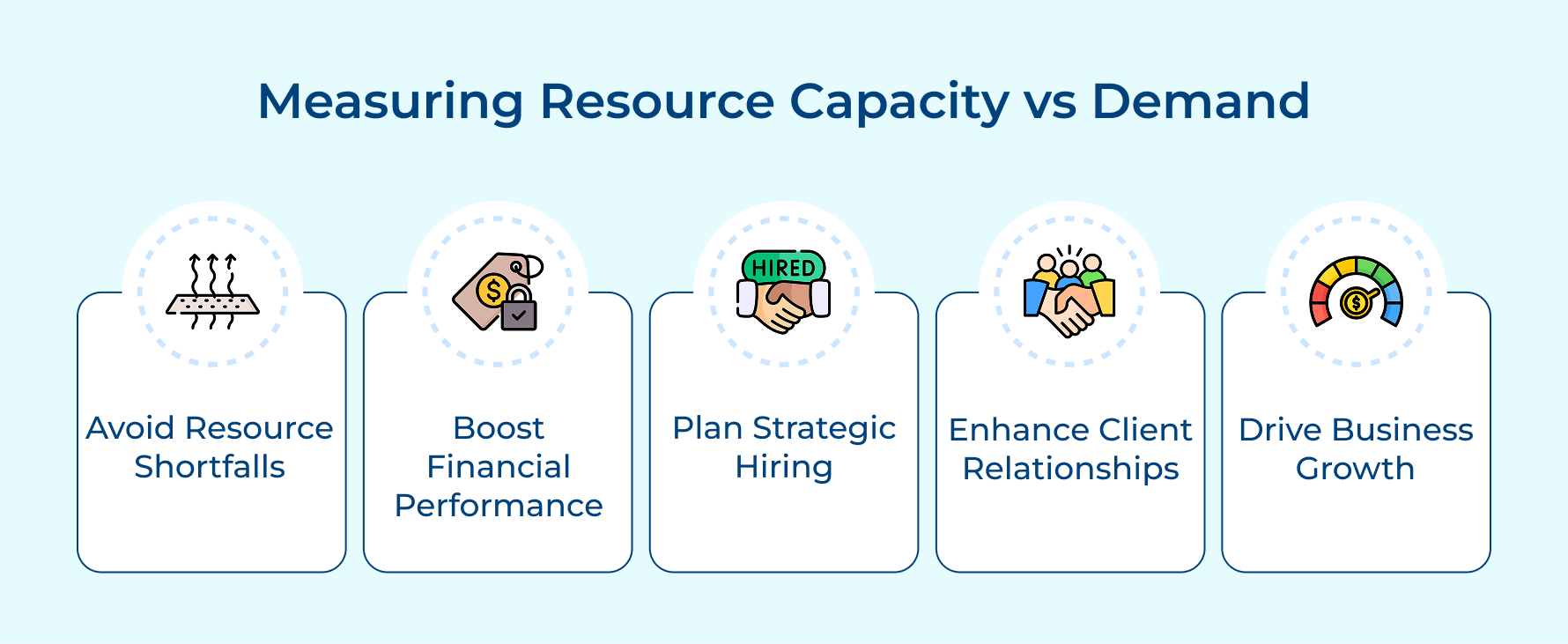
Understanding the gap between what you have (capacity) and what you need (demand) forms the foundation of successful resource management. This comparison reveals critical insights that drive operational efficiency.
Prevents Resource Shortfalls And Project Delays
Comparing your team’s available supply with project demand will help you spot staffing gaps early. This lets you find extra help or adjust timelines proactively, ensuring you never miss a client deadline.
Optimizes Financial Performance and Profitability
This analysis helps you maximize billable work while avoiding the high cost of overstaffing. Finding this balance is crucial for maintaining healthy profit margins, especially when market demand changes.
Enables Strategic Hiring and Workforce Planning
Understanding your future needs allows you to hire and train smarter, not faster. You can build a team with the right skills at the right time, moving beyond reactive staffing fires.
Improves Client Relationship Management
When you accurately measure what your team can handle, you set realistic promises and deliver consistent results. This reliability builds strong client trust and leads to more long-term partnerships.
Supports Business Development and Growth Decisions
A clear view of your capacity helps you decide which new projects to take on and when to expand. This prevents overcommitment and guides smart, sustainable business growth.
Fundamental Differences Between Resource Capacity Vs Resource Demand
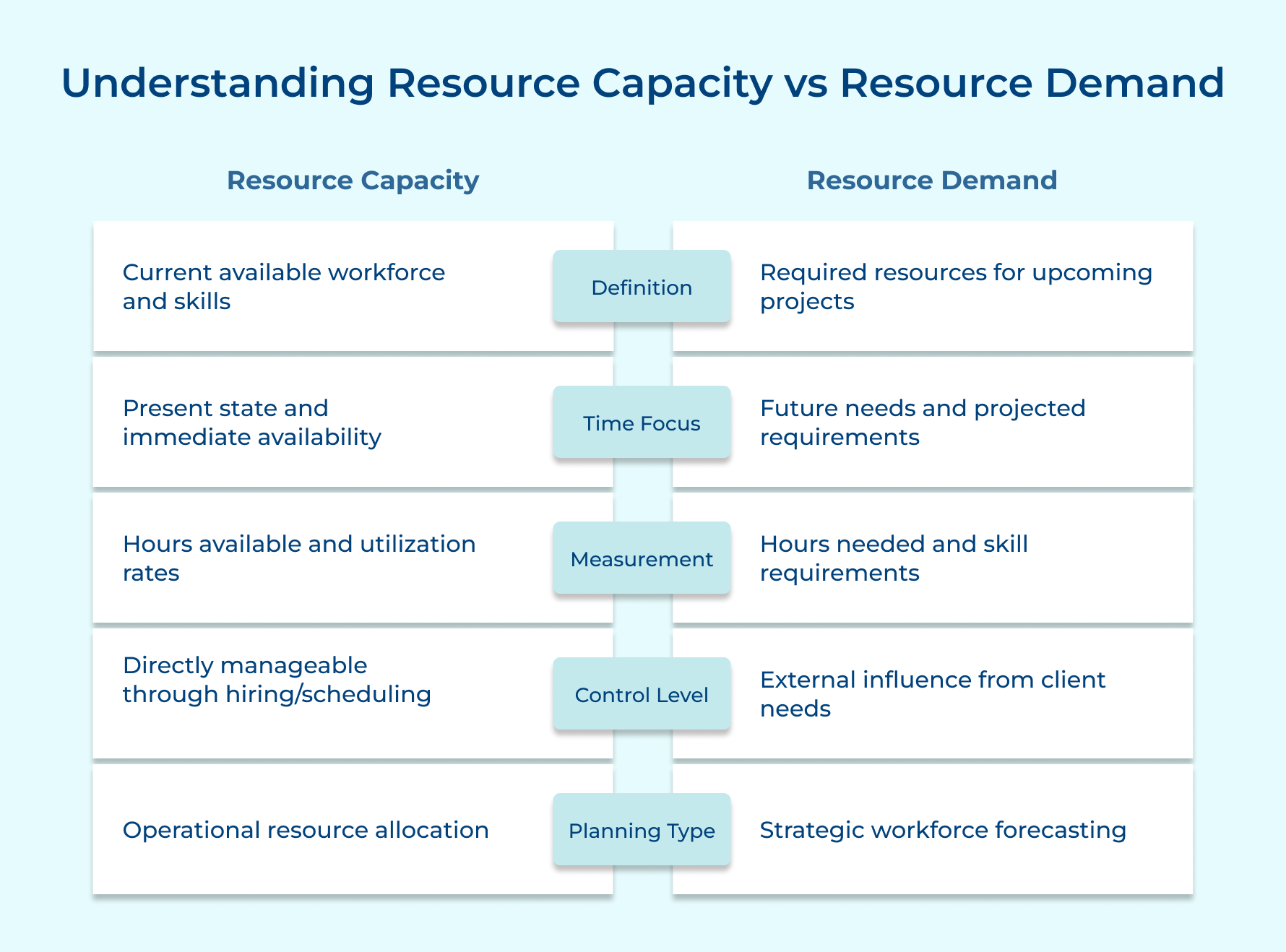
Resource capacity and resource demand represent two fundamental yet distinct aspects of workforce management in professional services. Let’s explore their differences in detail:
Time Orientation and Planning Horizon
Resource capacity focuses on your current state and what you have available right now for immediate deployment. It measures existing team members, their current workloads and available hours this week or month.
Resource demand looks forward to future requirements and what you will need to deliver upcoming projects successfully. It forecasts staffing needs for next quarter’s client engagements align with anticipated business growth.
Control and Management Authority
You have direct control over resource capacity through hiring decisions, training programs and internal resource allocation strategies. Management can immediately adjust capacity by reassigning team members or extending work hours.
Resource demand is largely influenced by external factors like client requests, market conditions and competitive pressures. While you can influence demand through business development, you cannot directly control when clients need specific services.
Measurement Methods and Metrics
Resource capacity uses concrete metrics like current headcount, billable hours per week and utilization percentages of existing staff. These measurements reflect actual availability and productivity levels you can observe as well as track daily.
Resource demand relies on forecasting techniques, pipeline analysis and project requirement estimates that involve uncertainty as well as assumptions. These projections require interpretation of client signals and market trends.
Business Impact and Consequences
Insufficient resource capacity leads to immediate operational problems like missed deadlines, quality issues and employee burnout. These capacity shortfalls directly affect current client relationships along with project delivery.
Misunderstanding resource demand creates strategic problems like wrong hiring decisions, missed business opportunities, or unnecessary overhead costs. Poor demand forecasting impacts long-term business growth and competitive positioning.
How to Measure Resource Capacity and Demand in 8 Easy Steps
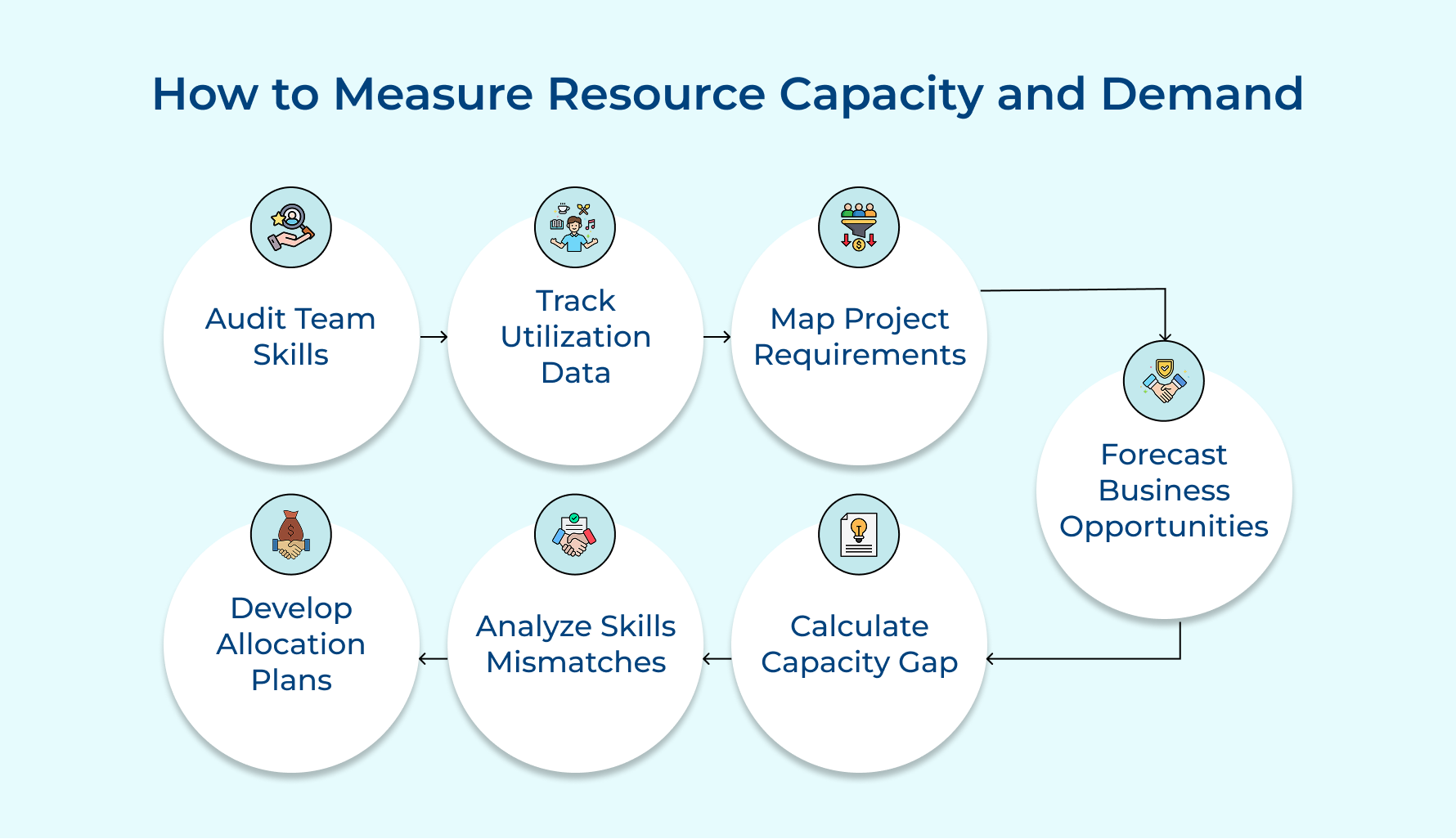
Whether you’re managing a small team or steering a large-scale operation, these eight steps will guide you towards efficiently measuring your resources. Here’s how you enhance productivity and project outcomes:
1. Audit Current Team Skills and Availability
This first step is all about getting a true picture of your team’s supply. You need to document their skills and current workload to see what you actually have available. Skipping this audit means you’re just guessing at your capacity.
Here’s how to build that foundation:
- Create a skills matrix: List every team member’s certifications and expertise. This is your go-to for matching the right person to the right project.
- Analyze real available time: Review calendars to see who has bandwidth after current projects and admin work. This prevents overloading anyone.
- Assess competency levels: Understand not just what they can do, but how well they do it. This helps you assign work appropriately.
For example, this process might reveal your demand for a specific skill is much higher than your current supply, showing you exactly where to hire or train.
2. Track Historical Utilization and Performance Data
The data analyzes past performance patterns to understand how your team actually works versus theoretical capacity assumptions. Historical data reveals the reality of productivity cycles and helps create more accurate future projections than guesswork alone.
Historical analysis turns raw timesheet data into predictive insights. These insights guide realistic capacity planning and show where to improve your resource allocation.
Pro tips:
- Seasonal pattern recognition: Analyze utilization rates across different months to identify predictable busy and slow periods that affect capacity planning.
- Performance benchmark establishment: Use historical completion rates to set realistic expectations for similar future projects and team productivity levels.
3. Map Existing Project Resource Requirements
Before taking on new work, you need a clear view of your current demand to understand your true available supply. This means mapping all your existing project commitments. If you skip this, you’ll likely overcommit your team because you can’t see everyone’s actual workload.
To build this picture, ask four key questions:
- What specific skills does each active project need right now?
- How many hours is each person already committed to?
- When do current projects end, freeing up capacity?
- Which deadlines are flexible and which are fixed?
Answering these with real-time data shows you not just who is busy, but when they become available again. Think of it like checking your team’s shared calendar before scheduling a new meeting, it prevents double-booking and ensures you only promise what you can actually deliver. This honest look at your current demand and supply is the only way to know your real new opportunities.
4. Forecast Upcoming Business Pipeline Opportunities
This step is about looking ahead at your sales pipeline to forecast future demand. If you don’t estimate what’s coming, you can’t prepare your team’s capacity or decide wisely which new projects to take on.
Here’s how to forecast accurately:
- Score each opportunity: Assign a realistic probability to every potential project. This keeps you from overplanning for unlikely work.
- Break down the needs: For each high-probability project, list the specific skills and hours required. This tells you exactly how many Full-Time Equivalent (FTE) resources you’ll need.
- Map out the timeline: Predict when each opportunity might start. This prevents the mistake of assuming everything will happen at once and helps you schedule your Full-Time Equivalent capacity smoothly.
By forecasting demand, you ensure you have the right people ready at the right time, turning your pipeline from a guess into an actionable plan.
5. Calculate Total Capacity Versus Demand Gap
This step quantifies the numerical difference between available resources and projected requirements to identify shortfalls or surplus capacity. This calculation transforms subjective feelings about workload into concrete data driving strategic workforce decisions.
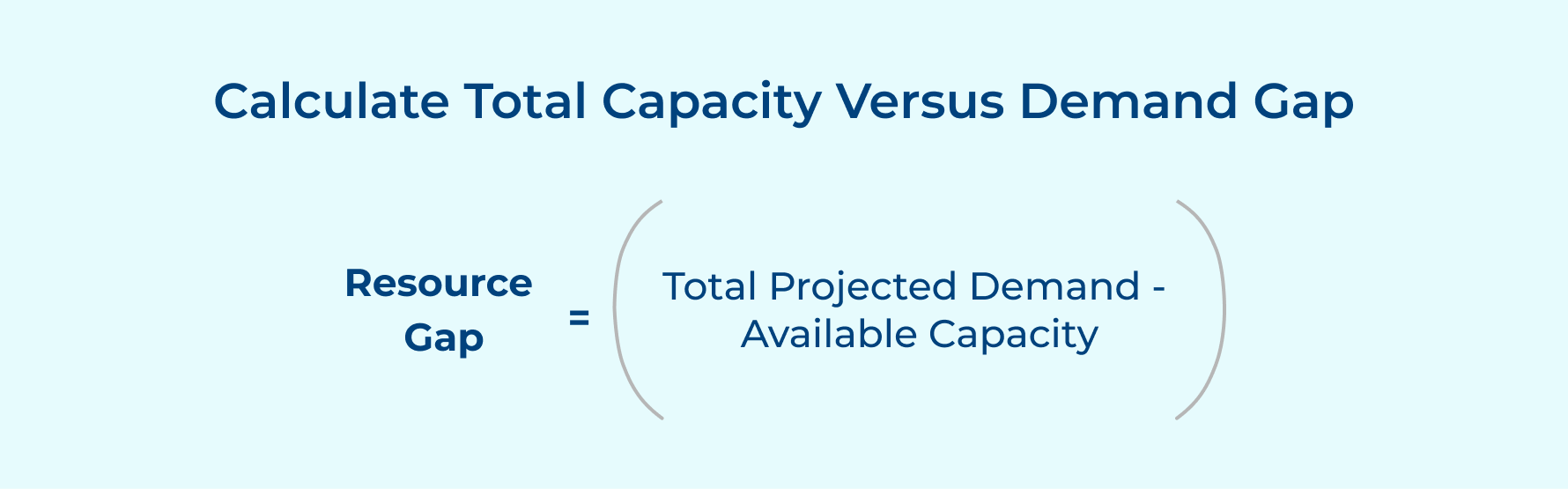
- Total projected demand: Sum of hours for active projects plus weighted pipeline opportunities
- Available capacity: Total team hours minus current commitments and administrative time
- Weighted pipeline hours: Estimated project hours multiplied by probability scores
Complete Calculation Process:
1. Calculate Available Capacity
Available Capacity = (10 people × 40 hours) – 300 committed hours – 50 admin hours = 50 hours per week
2. Calculate Projected Demand
Active Projects = 300 hours
Pipeline Project A = 80 hours × 70% = 56 hours
Pipeline Project B = 120 hours × 40% = 48 hours
Total Projected Demand = 300 + 56 + 48 = 404 hours
3. Calculate Resource Gap
Resource Gap = 404 hours (demand) – 350 hours (capacity) = 54 hours shortage
The ideal benchmark maintains a 10-15% capacity buffer above projected demand to handle unexpected opportunities without overwhelming your team.
6. Analyze Skills Mismatches and Training Needs
This step identifies gaps between the skills your pipeline demands and the expertise your team currently possesses. Without this analysis, you risk accepting projects your team cannot deliver effectively or missing opportunities due to perceived skill shortages that training could address.
Effective skills mismatch analysis requires structured approaches to identify where your team’s capabilities fall short of market demands. Three key consideration:
- Skills inventory comparison: Map required project skills against current team capabilities to identify specific expertise gaps that need addressing.
- Performance data analysis: Review past project outcomes to identify where skill limitations impacted quality or timelines for future improvement.
- Market demand assessment: Research industry trends as well as client requests to anticipate future skill requirements your team should develop.
After analyzing skills mismatches, you can make informed decisions about targeted training programs, strategic hiring, or project partnerships that align your capacity with demand requirements.
7. Develop Resource Allocation and Adjustment Plans
This step is about building flexible plans so your agency can handle surprises without dropping the ball. When actual demand doesn’t match your projections (and it often won’t), these frameworks let you adapt quickly instead of scrambling.
Start by imagining different “what-if” scenarios. What if you land 20% more work than expected? Having a plan for high-demand situations helps you scale up smoothly without sacrificing quality.
Key strategies include:
- Pre-approved freelancers: Build a list of trusted contractors you can call on during busy periods.
- Cross-train your team: Develop multi-skilled employees who can pivot between projects as needed.
- Flexible timelines: Negotiate buffer time with clients upfront to accommodate unexpected changes.
Think of this as creating playbooks for uncertainty. By planning your moves in advance, you ensure that sudden project changes or client surprises don’t derail your team or disappoint your clients.
Challenges in Measuring Resource Capacity Vs Demand
Figuring out your team’s true capacity versus client demand is tricky. Without clear processes, you’re often left guessing, leading to either overwhelmed teams or missed opportunities.
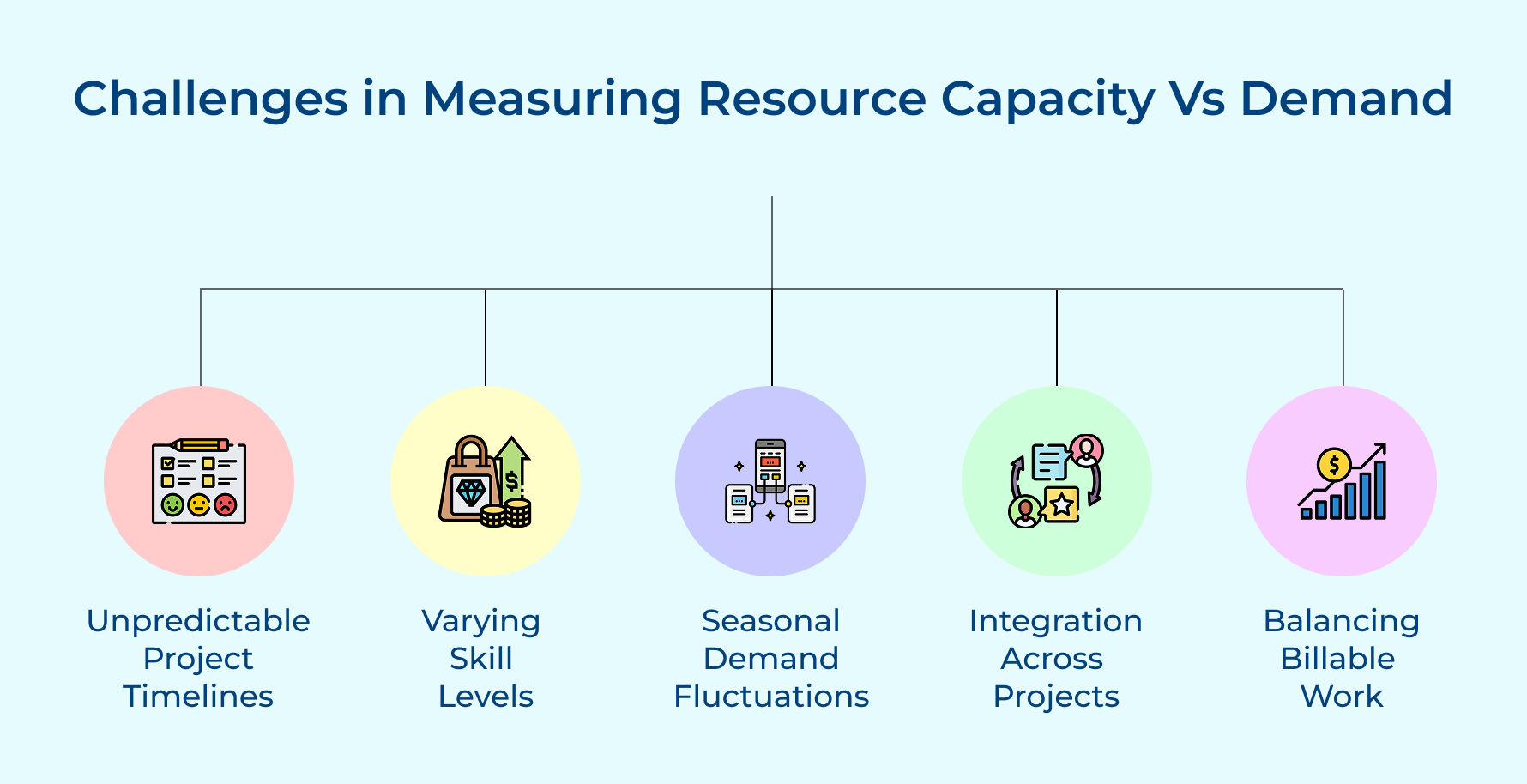
Unpredictable client project timelines and scope changes: Professional services projects rarely follow their original plans as clients modify requirements, extend deadlines, or accelerate deliverables. This constant flux makes it nearly impossible to maintain accurate capacity forecasts when project parameters shift unexpectedly.
Difficulty quantifying different skill levels and expertise values: Not all team members contribute equally to projects even within the same role or experience level. Measuring capacity becomes complex when you must account for varying productivity rates, specialization depths as well as individual performance differences across your workforce.
Seasonal and cyclical demand fluctuations affecting forecasting: Many professional services experience predictable busy seasons followed by slower periods, but external factors can disrupt these patterns. Economic conditions, industry changes and client budget cycles create demand volatility that challenges traditional forecasting methods.
Integration challenges across multiple project management: Agencies often use different tools for sales pipeline management, project tracking and resource scheduling, creating data silos. Without unified information systems, getting accurate real-time views of capacity utilization and demand projections becomes a manual as well as error-prone process.
Balancing billable utilization targets with non-billable activities: Teams need time for training, business development and administrative tasks that don’t generate immediate revenue but are essential for long-term success. Measuring true capacity requires accounting for these non-billable activities while maintaining profitable utilization rates.
Each solution addresses specific pain points while contributing to an overall framework for better capacity and demand planning.
- Implement integrated resource management platforms that consolidate pipeline, project and capacity data into unified dashboards for real-time visibility.
- Establish standardized skill assessment frameworks and productivity benchmarks that account for experience levels as well as specialization when calculating effective capacity.
- Develop scenario-based planning models with multiple demand forecasts and flexible resource allocation strategies to handle uncertainty along with seasonal variations.
- Create buffer time allocations in capacity calculations that account for non-billable activities while maintaining realistic utilization targets and professional development goals.
Best Practices for Balancing Demand and Capacity
Balancing resource demand and capacity in professional services requires treating these elements as interconnected parts of a dynamic system. Let’s explore its best practices:
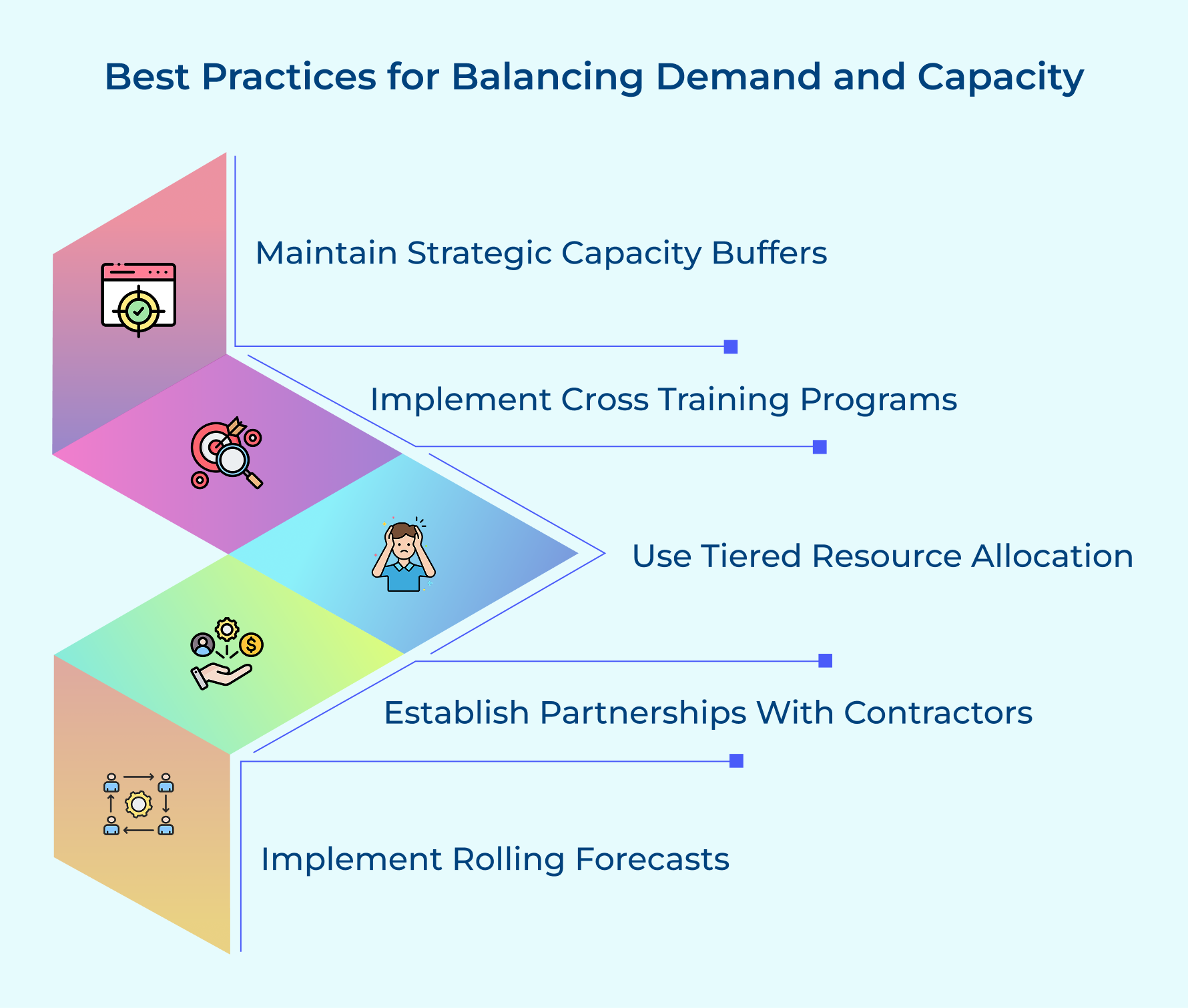
Maintain Strategic Capacity Buffers For Unexpected Opportunities
Professional services should operate at 80-85% capacity utilization rather than maximum efficiency. This buffer creates breathing room for rush projects and new business while preventing team burnout during peak periods.
Implement Cross-training Programs to Create Workforce Flexibility
Develop team members who can work across multiple service areas to increase internal agility. When demand shifts unexpectedly, cross-trained professionals can pivot quickly without requiring external hiring or turning away work.
Use Tiered Resource Allocation with Mixed Skill Levels
Structure teams using experienced professionals who guide junior members on complex tasks. It maximizes capacity by leveraging different skill levels while developing junior staff and maintaining cost-effective delivery.
Establish Partnerships with Specialized External Contractors
Build reliable relationships with freelancers who understand your standards and can supplement capacity during peak periods. These partnerships provide scalable resources without fixed costs during slower cycles.
Implement Rolling Forecasts with Regular Reviews
Update resource planning monthly rather than relying on outdated quarterly forecasts. Regular reviews help spot trends early and maintain better alignment between client needs and team capabilities.
Unlock Efficiency with Seamless Management of Capacity vs Demand
Successfully managing your operations requires you to continuously measure capacity vs demand. This crucial practice transforms professional services from reactive firefighting into proactive strategic planning. When agencies master this balance, they achieve predictable profitability while maintaining both service quality and team satisfaction.
The key lies in treating capacity and demand as interconnected elements that need ongoing adjustment, not just one-time calculations. Organizations that implement frameworks position themselves to seize new opportunities while avoiding the costly pitfalls of overcommitment or underutilization.
Limit time — not creativity
Everything you need for customer support, marketing & sales.

Shivank Kasera is part of the marketing team at Kooper, where he focuses on building content that helps agencies and service providers grow. With a keen interest in SaaS, operations, and scalability, he translates practical insights into actionable resources for business leaders.