Comprehensive Guide to Capacity Forecasting for Project Managers
- What is Capacity Forecasting?
- Why is Capacity Forecasting Important?
- Types of Capacity Forecasting Methods
- 7 Actionable Capacity Forecasting Steps for Smarter Allocation
- Challenges in Capacity Forecasting and How to Overcome
- Capacity Planning Vs Capacity Forecasting
- Essential Tips and Best Practices of Capacity Forecasting
- Capacity Forecasting Examples To Consider
- Mastering Capacity Forecasting for Project Excellence
- FAQs Capacity Forecasting

Key Highlights:
- Capacity forecasting predicts future resource needs to prevent team overloads and ensure projects finish on time.
- Combine data-driven methods and expert insights for accurate forecasts that align with business goals.
- Implement proactive strategies like gap analysis and flexible hiring to maintain optimal capacity amid changes.
Project managers often face resource allocation problems that can delay client deliverables and hurt their reputation. When capacity forecasting isn’t done properly, teams become understaffed, deadlines slip and clients lose confidence.
These mistakes create a chain reaction: overworked teams deliver lower-quality work, employees feel stressed and some may even consider leaving. Scrambling to find extra resources at the last minute is costly and forces tough conversations with clients about delays.
Capacity forecasting turns this chaos into smart planning. It helps predict resource needs and supports sustainable growth by keeping projects on track as well as clients satisfied.
What is Capacity Forecasting?
Capacity forecasting is the systematic process of predicting future resource requirements and availability to ensure project deliverables can be completed within specified timelines. This strategic planning approach involves analyzing current workloads. It projects human as well as technical resource needs across multiple project phases.
Project-based organizations rely on capacity forecasting to maintain competitive advantage and operational efficiency in dynamic market conditions. Accurate forecasting prevents resource conflicts between concurrent projects while ensuring optimal utilization of skilled personnel and critical assets.
Performance objectives:
- Resource optimization involves aligning available talent and equipment with project demands to maximize productivity across all active initiatives.
- Risk mitigation focuses on identifying potential capacity shortfalls early enough to implement corrective measures before project deadlines are compromised.
- Strategic planning enables leadership to make informed decisions about project portfolios and long-term organizational growth based on realistic capacity constraints.
- Cost control ensures that resource allocation decisions support budget targets while maintaining quality standards throughout project lifecycles.
- Client satisfaction improves when organizations can reliably commit to delivery schedules because their capacity forecasting accurately reflects actual capabilities and limitations.
Why is Capacity Forecasting Important?
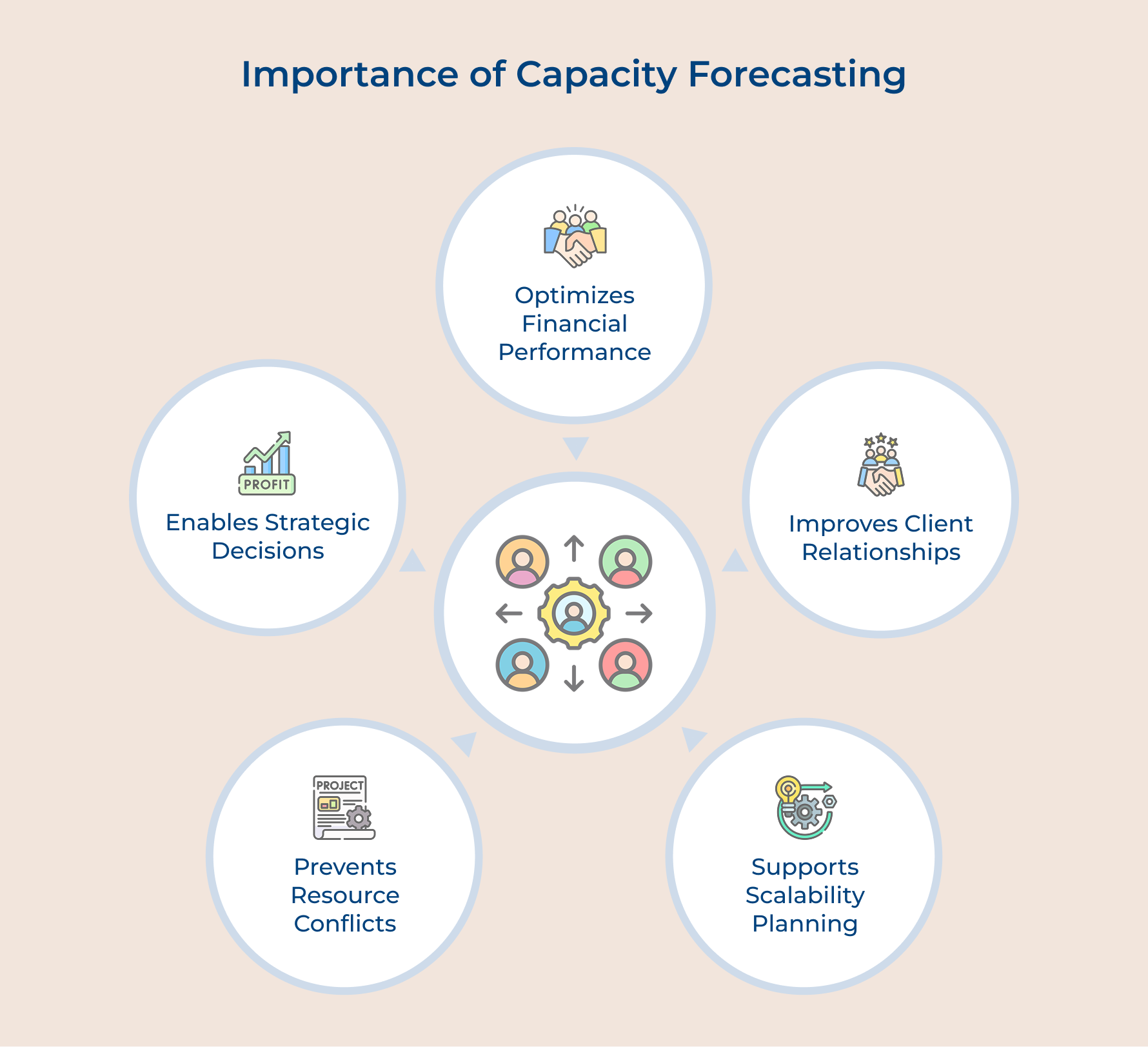
Capacity forecasting helps organizations plan resources effectively and avoid last-minute staffing crises. It ensures projects stay on track while maintaining client satisfaction. Let’s learn their importance:
Prevents Resource Conflicts
Effective capacity management helps organizations avoid double-booking skilled team members across multiple projects. Clear visibility into commitments and availability ensures nobody gets stretched too thin. This prevents costly project delays when key contributors suddenly become unavailable during critical phases.
Enables Strategic Decision Making
Capacity management gives leadership a clear lens to evaluate new opportunities against real resource constraints. Using tools like time series analysis, executives can decide which projects align with business goals. You experience sustainable growth while protecting quality standards and client commitments.
Optimizes Financial Performance
Accurate forecasting powered by capacity planning software helps balance workloads. Organizations avoid underutilization of resources and also prevent expensive overtime from creeping in. Consistent staffing levels makes sure that financial performance becomes steadier and profit margins improve as operational expenses remain under control.
Improves Client Relationships
Capacity management builds credibility by enabling realistic delivery schedules. When teams know true limitations, they set achievable expectations with stakeholders. This level of transparency fosters trust, ensuring clients see the organization as a dependable long-term partner.
Supports Scalability Planning
As businesses grow, capacity insights reveal when it’s time to hire or invest in new systems. Leveraging technological advancements and analysis, organizations scale smoothly instead of scrambling with reactive hiring. It ensures expansion dovetails with actual capacity needs.
Types of Capacity Forecasting Methods
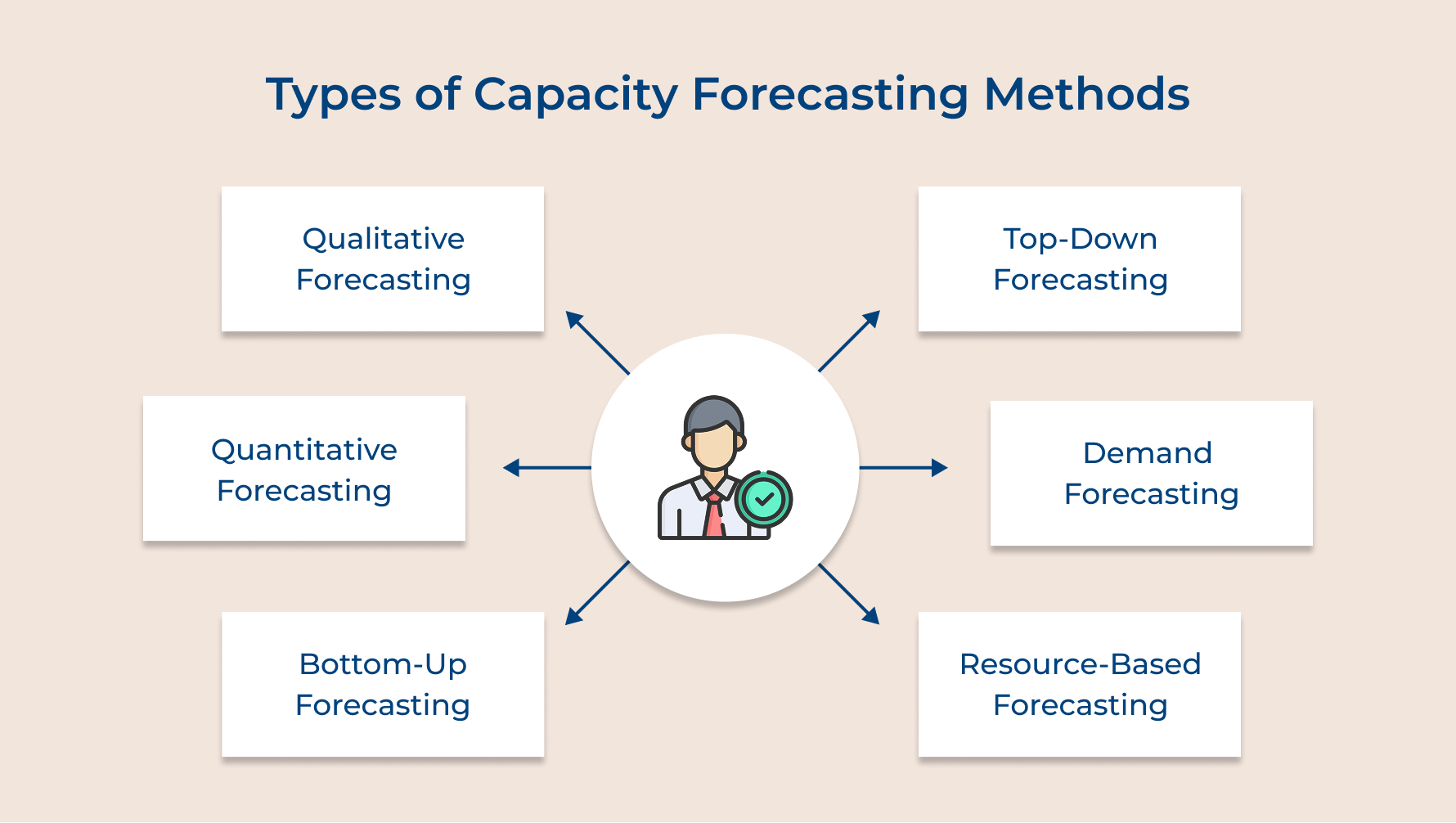
Understanding these six approaches allows project managers to choose the best technique. Their goal is to achieve reliable predictions that ensure client satisfaction.
Qualitative Forecasting
When you don’t have good past data, you rely on expert opinions. You basically ask experienced team members and stakeholders for their best guess on what you’ll need, using their gut feeling as well as knowledge of the market.
Quantitative Forecasting
This is the opposite; it’s all about the numbers. You use math and stats on historical project data to spot patterns. Then, algorithms use those patterns to make a solid, data-driven prediction for what’s coming next.
Bottom-Up Forecasting
You start by asking each project team what they’ll need to get their work done. Then, you add all those estimates up to see the company’s total needs. It’s accurate because the people doing the actual work are making the predictions.
Top-Down Forecasting
Here, leadership sets the big-picture capacity targets based on company goals and then tells projects what they get. It’s great for strategy but can miss the real-world resource constraints and complexities of each project.
Demand Forecasting
This method is like looking at your supply chain for projects. You analyze what clients want and what’s happening in the market to predict what kinds of projects are coming your way as well as how many, so you can be ready for that future workload.
Resource-Based Forecasting
You figure out what you can actually do with the people and tools you already have. Instead of dreaming about desired outcomes, you start with your actual capacity and calculate your maximum project load, which is crucial for managing resource constraints.
7 Actionable Capacity Forecasting Steps for Smarter Allocation
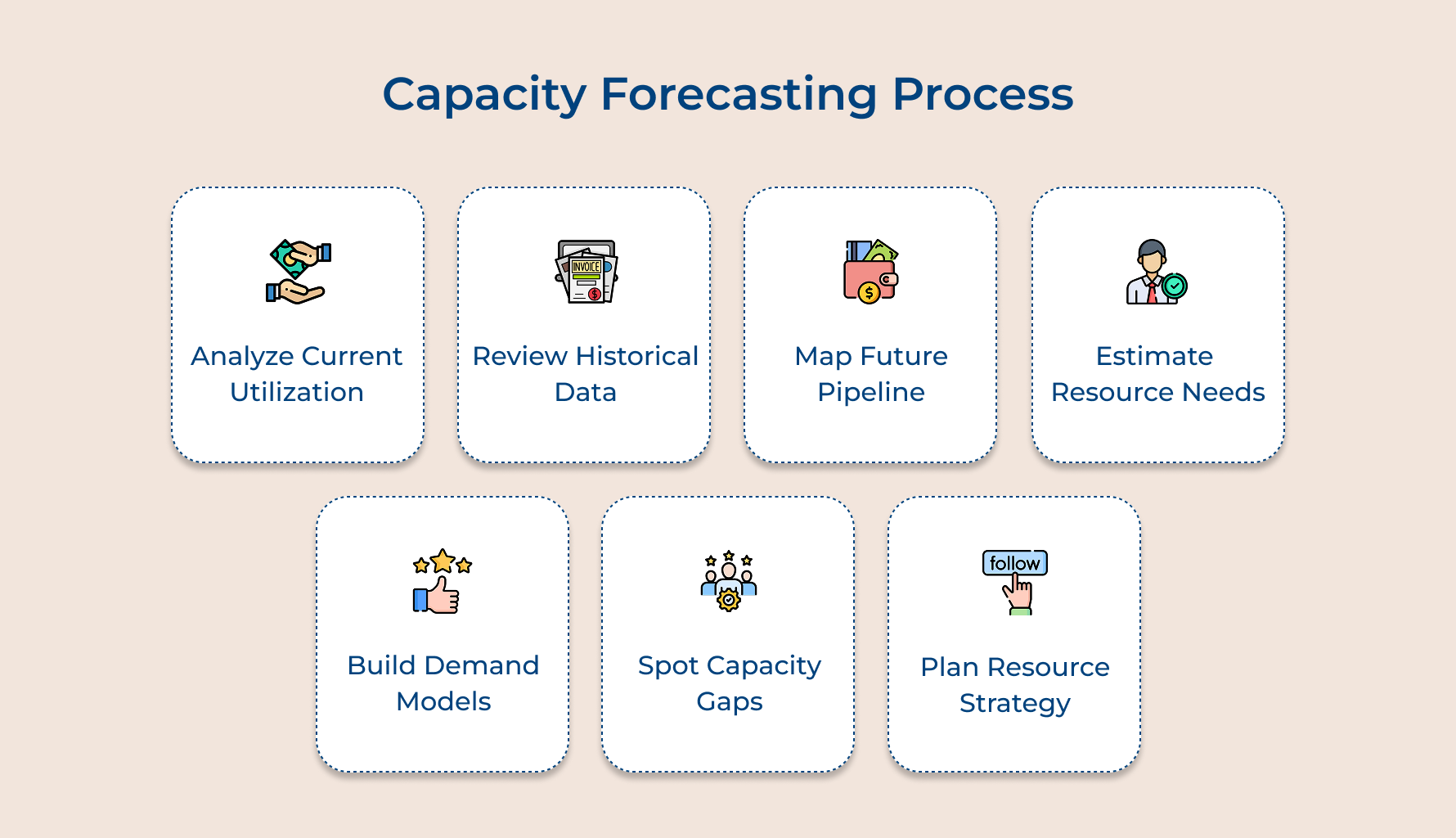
Mastering capacity forecasting ensures you have the right resources ready for upcoming projects without overextending your team. Follow these eight essential steps to build a reliable and actionable forecast.
1. Analyze Current Resource Utilization
Understanding your current resource landscape forms the foundation for accurate capacity forecasting because you cannot predict future needs without knowing your present situation. This baseline assessment reveals utilization patterns and identifies existing inefficiencies that could impact future project success.
Three effective ways to analyze current resource utilization:
- Resource mapping tools: Modern project management platforms offer detailed dashboards that show individual workloads. These tools instantly reveal who is over-allocated or underutilized across the organization.
- Time tracking analysis: Historical timesheet data compares actual effort against planned effort. This analysis helps identify recurring bottlenecks that delay project timelines.
- Skills inventory assessment: A comprehensive skills inventory enables better resource-to-task matching. It also reveals critical skill gaps that limit your organization’s capacity to take on new projects.
Remember that current utilization analysis should account for upcoming planned leave and training commitments to ensure your baseline data reflects realistic availability patterns.
2. Gather Historical Project Data
Historical project data serves as the crystal ball for capacity forecasting because past patterns reveal future resource consumption trends.
Ignoring this step forces organizations to make blind decisions about resource allocation and often leads to chronic understaffing or costly overinvestment in unnecessary capabilities.
This data forms a mathematical foundation. It powers predictive models that help organizations forecast busy seasons and plan for the resources needed across various projects.
Historical data transforms guesswork into data-driven decisions that improve forecast accuracy while reducing the risk of capacity shortfalls during critical business periods.
Pro tips:
- Focus on projects from the last two to three years to ensure your data reflects current business conditions and market demands.
- Include both successful and failed projects in your analysis because failures often reveal hidden resource requirements that successful projects managed to overcome.
3. Map Future Project Pipeline
Pipeline mapping gives you a clear view of upcoming work, so you can plan your team’s capacity proactively instead of scrambling later. It turns uncertain future projects into measurable resource needs you can actually budget for.
Start by cataloging all your confirmed projects. Gather the detailed specs from your sales team to understand the exact resource commitments you’ve already made.
Estimate your probable projects by analyzing your sales funnel. Use historical win rates and weigh opportunities based on how far along they are in the sales process. This helps you forecast what you might really win.
Using resource management tools to define project priorities and dependencies here is crucial. It’s like solving a puzzle; you need to know which critical pieces go first to avoid bottlenecks and ensure your most important projects get your best people.
4. Calculate Resource Requirements Per Project
Resource requirement calculation turns vague project ideas into specific staffing needs. It’s the essential data that makes capacity forecasting models accurate. Skipping this step often leads to underestimating work and last-minute scrambles for staff.
Here’s how to calculate what you’ll need for each project:
- Break it down: Divide big projects into small, manageable tasks for easier estimation.
- Match skills: Figure out the exact skills needed and see who on your team has them.
- Estimate effort: Use past project data to guess how long each task will take.
- Add a buffer: Include extra time for unexpected problems or delays.
- Level resources: Spread the work out evenly to avoid overloading anyone.
For example, a six-month software project might need two front-end developers for four months and one back-end expert for all six. This detailed view is far more precise than just guessing “three developers.”
5. Create Demand Projection Models
Demand projection models combine your past data along with future sales pipeline to predict what resources you’ll need and when. They let you see capacity needs months ahead, so you’re never caught off guard by a new project.
To build an effective model, make sure it includes:
- Historical baselines: Use past project data to spot trends and seasonal cycles.
- Growth assumptions: Factor in business expansion plans and market conditions.
- Pipeline probabilities: Weight your sales forecasts with realistic conversion rates.
- External factors: Consider how industry or economic shifts could affect demand.
- Start simple: Use a spreadsheet to multiply your average historical needs by your expected growth rate. This creates a basic but practical model you can refine over time.
6. Identify Capacity Gaps and Surpluses
Gap identification simply compares what you’ll need with what you have, spotting shortages and overbooked team members. This prevents project stalls and finds opportunities to use idle resources better.
Start by answering four key questions:
- Skill shortages: What specific skills will we lack during busy periods?
- Timing conflicts: When is the risk of resource overload the highest?
- Excess capacity: Where do we have more staff than upcoming work?
- Equipment limits: Could any tools or systems slow us down?
For a deeper analysis, try these approaches:
- Visual timelines to see overlapping demands and peak risks.
- Skill matrices to match team capabilities to project needs.
- Scenario planning to test your capacity against different business conditions.
7. Develop Resource Acquisition Strategy
A resource acquisition strategy turns your team’s capacity gaps into a clear plan for hiring or training. This prevents last-minute scrambles that often lead to delays or lower quality work.
Here are three proven ways to build your strategy:
- Plan hiring early: Start recruiting specialized roles 60-90 days in advance, including time for onboarding.
- Use flexible talent: Build a list of trusted freelancers or contractors for busy periods.
- Invest in training: Upskill current team members to fill critical skill gaps.
For example, if you need Java developers next quarter, you could: hire seniors now, train junior developers and have vetted freelancers ready as backup. This ensures you’re prepared, not panicked.
Challenges in Capacity Forecasting and How to Overcome
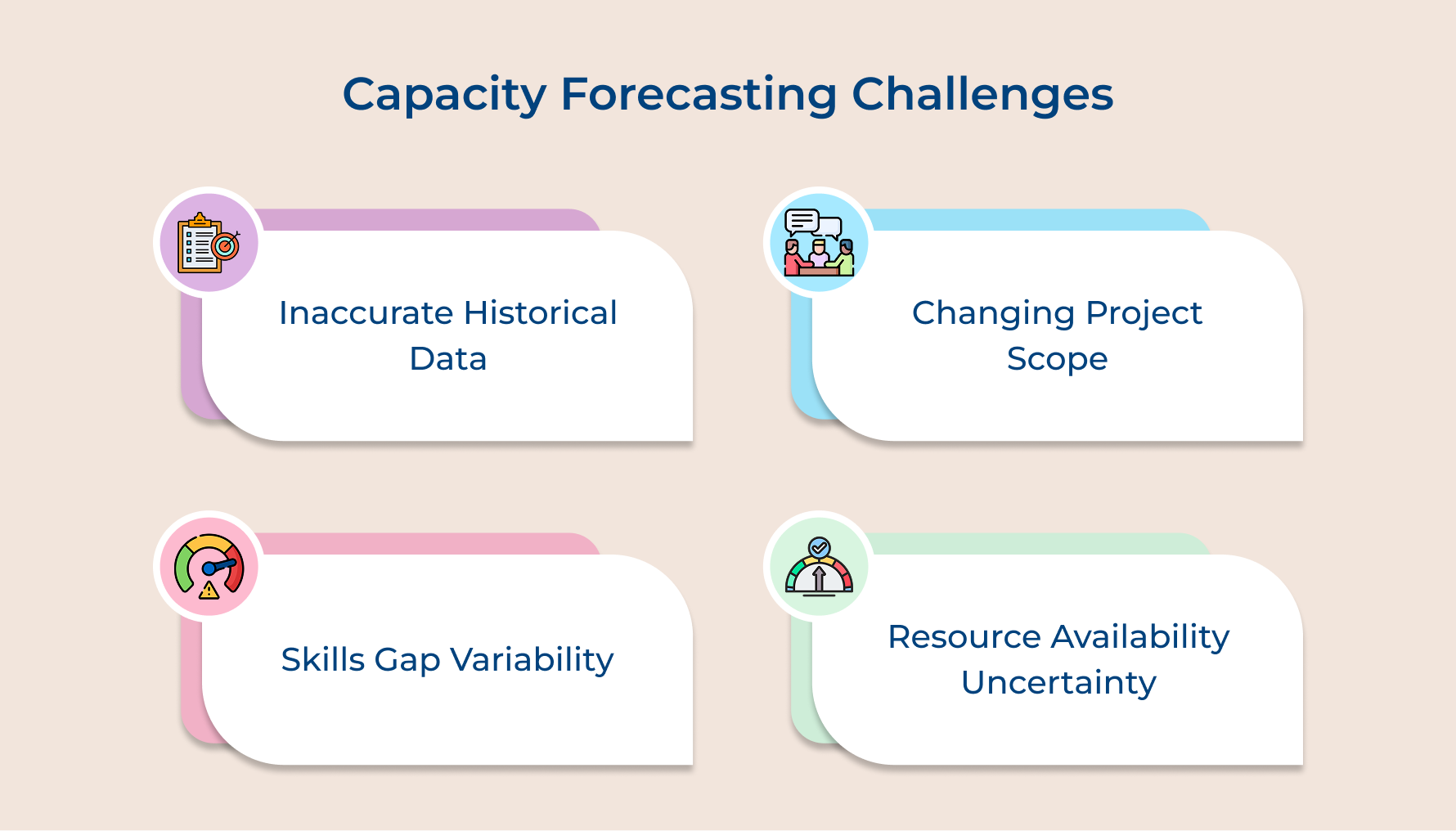
Capacity forecasting is crucial, yet it comes with significant challenges that can disrupt project flow. Fortunately, proven solutions exist to overcome these common obstacles.
Inaccurate Historical Data
Organizations struggle with incomplete project records that skew future predictions and lead to systematic underestimation of resource requirements. Poor data quality creates cascading effects where each forecast becomes less accurate and decision-making suffers from flawed information.
Changing Project Scope
Clients frequently modify requirements after planning phases which disrupts calculated resource allocations and creates unexpected capacity demands. These changes can transform balanced workloads into chaotic scrambles for additional specialized skills never anticipated in original forecasts.
Skills Gap Variability
Rapid technology evolution creates unpredictable demand for new competencies absent from historical data. Organizations cannot predict when emerging skills become critical as well as struggle to build capacity for capabilities they cannot quantify effectively.
Resource Availability Uncertainty
Team members leave unexpectedly or become unavailable due to personal circumstances creating sudden capacity gaps that jeopardize concurrent projects. This human factor introduces unpredictability that mathematical models struggle to accommodate within their calculations.
These strategies address both technical and human elements that make capacity prediction complex yet essential.
- Implement robust data collection systems tracking actual versus planned effort across projects to build reliable historical baselines for predictions.
- Establish formal change management requiring scope modifications to trigger immediate capacity reassessment along with client approval for additional resources.
- Create continuous learning programs anticipating emerging skill requirements and developing internal capabilities before market demand creates critical shortages.
- Develop multiple forecasting scenarios accounting for different economic conditions and allowing organizations to pivot quickly when circumstances change.
Capacity Planning Vs Capacity Forecasting
Capacity forecasting is about predicting what you’ll need and capacity planning is about preparing to deliver it. Understanding this difference is key to effective resource management.
| Aspect | Capacity Planning | Capacity Forecasting |
| Time Horizon | Focuses on immediate resource allocation for current and near-term projects | Predicts long-term resource requirements across future business cycles and growth |
| Primary Purpose | Optimizes existing resources to meet confirmed project deliverables and commitments | Anticipates future demand patterns to guide strategic resource investment decisions |
| Data Foundation | Uses concrete project schedules and defined scope requirements for calculations | Relies on historical trends and market analysis for predictive modeling |
| Decision Making | Enables tactical adjustments to current staffing levels and resource distribution | Supports strategic choices about hiring expansion and infrastructure development needs |
Essential Tips and Best Practices of Capacity Forecasting
These six practices help organizations build reliable prediction systems for project success.
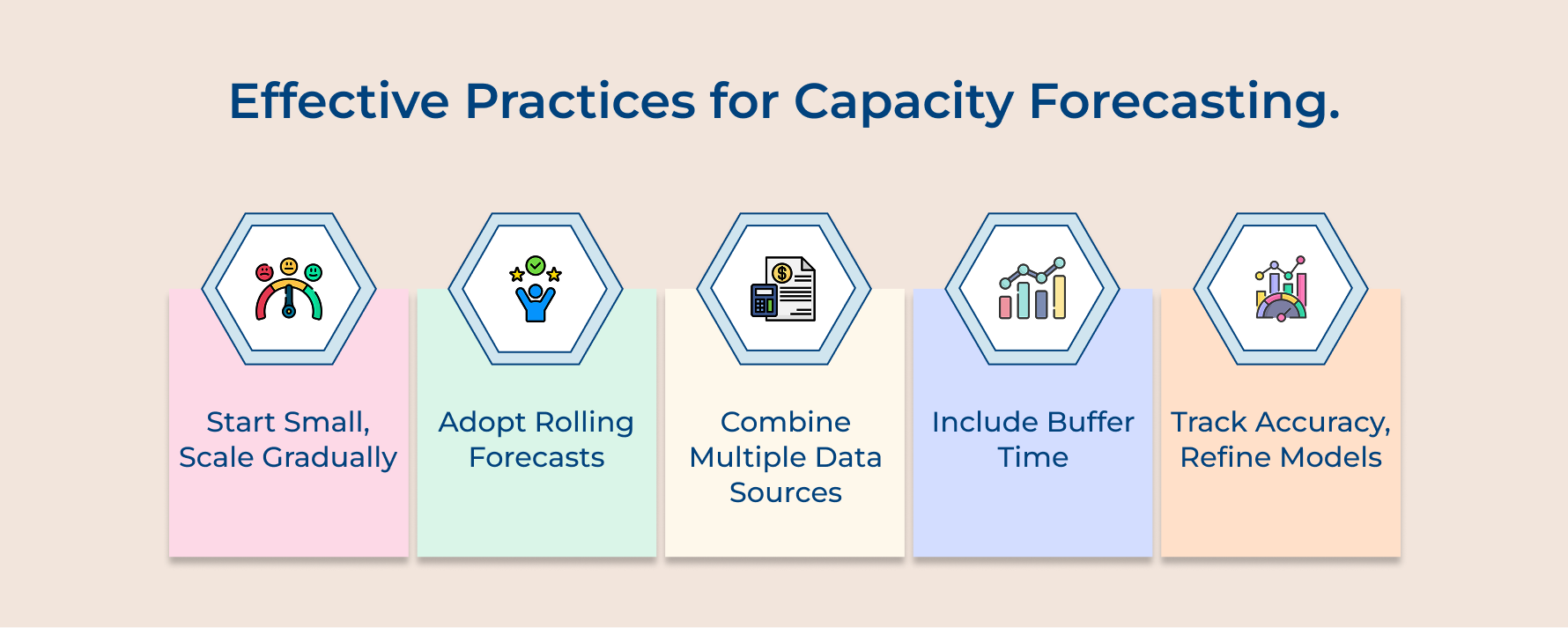
- Start small and scale gradually: Begin forecasting with one department or project type to perfect methodology before expanding organization-wide. This focused approach identifies process issues without overwhelming teams with complex analysis.
- Use rolling forecasts instead of annual plans: Update predictions quarterly rather than creating static yearly forecasts that become obsolete quickly. Rolling forecasts adapt to changing conditions and provide accurate resource planning.
- Combine multiple data sources for accuracy: Integrate historical data with sales pipeline information and market research to create comprehensive prediction models. Single-source forecasting misses critical variables affecting resource requirements.
- Build buffer time into resource calculations: Add 15-20% contingency capacity for unexpected complications and scope changes that commonly occur. Buffer time prevents conflicts when projects require additional effort.
- Track forecast accuracy and adjust models: Compare predicted versus actual consumption regularly and refine methods based on performance gaps. Continuous improvement transforms rough estimates into highly accurate prediction tools.
Capacity Forecasting Examples To Consider
The best way to grasp capacity forecasting is to see it in action. The following examples illustrate how to predict your team’s bandwidth and avoid overcommitment.
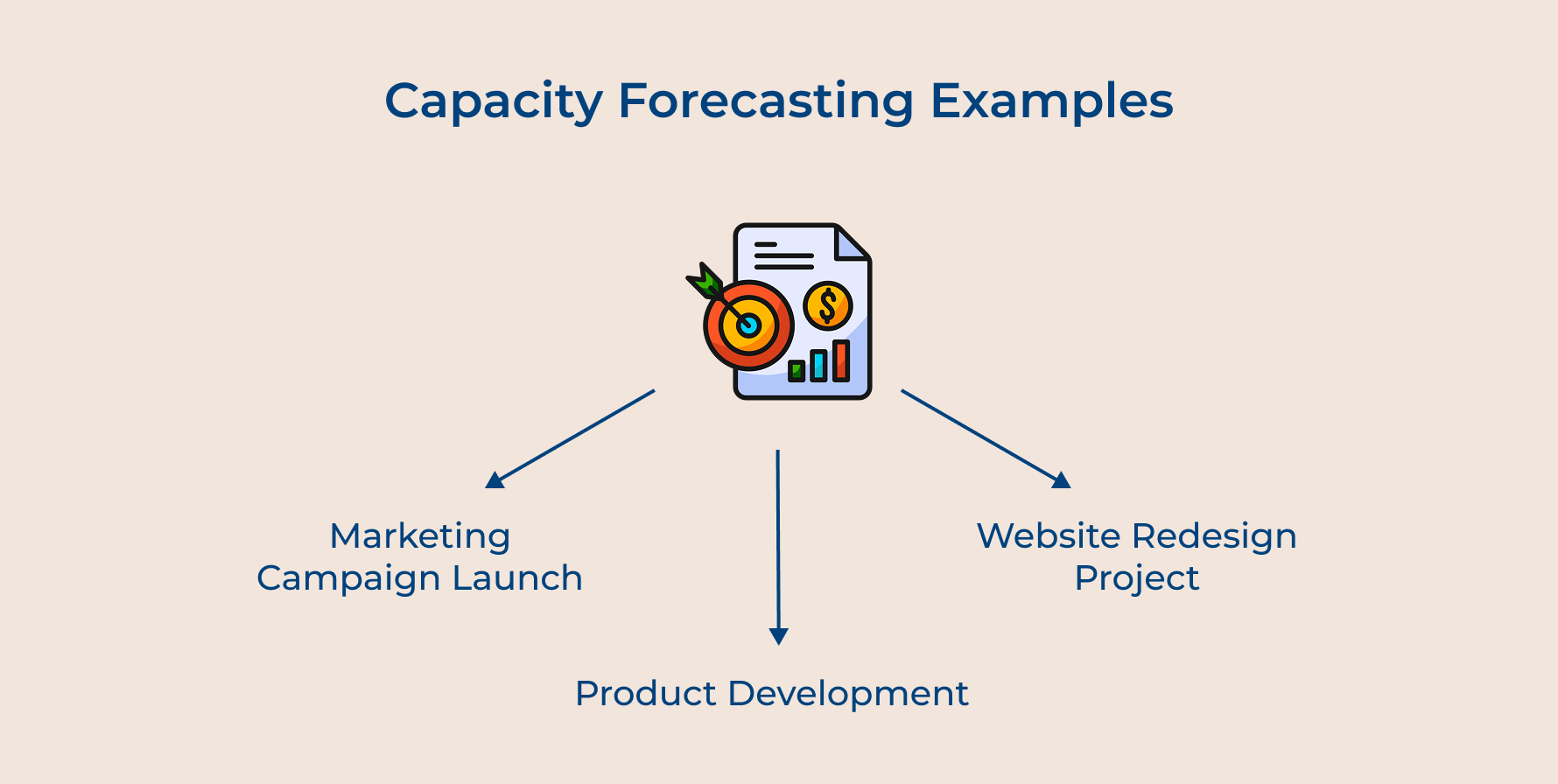
Marketing Campaign Launch
A digital marketing agency gets asked to run a full product launch campaign. To figure out what they’ll need, they first look at how much work similar past campaigns required and what specific skills were essential.
Their forecast shows they’ll need two graphic designers for three weeks, one copywriter for four weeks and a campaign manager for the entire six-week project. This clear plan lets them book the right people ahead of time, avoiding the last-minute scramble and resource conflicts that often happen after a client has already signed on.
Product Development
A software consultancy takes on a mobile app project. They start by breaking down all the technical tasks and figuring out what specific skills are needed for each part.
Their forecast shows they’ll need one senior developer for 12 weeks, two junior developers for 8 weeks and a QA tester for 4 weeks. This detailed plan helps them assign the right people at the right time, making sure no one is overbooked and the right expertise is available exactly when it’s needed.
Website Redesign Project
A web design agency is rebuilding an e-commerce site. They forecast needs for each phase—discovery, design, development and launch—while remembering to account for client feedback, which usually takes extra time.
They determine they need a UX researcher for 2 weeks, two designers for 6 weeks, a developer for 8 weeks and a project manager throughout the 12-week project. The phased plan ensures they have the correct skills for each stage and can stay flexible when the client’s requests change.
Mastering Capacity Forecasting for Project Excellence
Capacity forecasting serves as the strategic foundation that transforms unpredictable project chaos into systematic success through intelligent resource planning and allocation. Organizations that master these forecasting principles consistently deliver exceptional client results while maintaining healthy team workloads and sustainable business growth.
The journey from reactive scrambling to proactive planning requires commitment to data-driven decision making and continuous process refinement over time. Remember that effective capacity forecasting becomes your competitive advantage, enabling confident client commitments while building the operational excellence that distinguishes successful project-based organizations.
Limit time — not creativity
Everything you need for customer support, marketing & sales.

Shivank Kasera is part of the marketing team at Kooper, where he focuses on building content that helps agencies and service providers grow. With a keen interest in SaaS, operations, and scalability, he translates practical insights into actionable resources for business leaders.