Complete Guide to Agency Pricing Models for Profitable Growth
- What is the Agency Pricing Model?
- Why is the Agency Pricing Model Important?
- 8 Essential Types of Agency Pricing Models
- How to Select the Perfect Pricing Model for Your Agency?
- Tips to Boost Your Agency’s Profitability (Beyond Choosing the Right Pricing Model)
- Make Agency Billing a Breeze with Pricing Models
- FAQs about Agency Pricing Models

Key Highlights:
- Agency pricing models eliminate scope creep and enable predictable budget planning for agencies as well as clients.
- Choosing the right agency pricing model aligns with client industry, service complexity and agency operational capabilities.
- Monthly retainer-based agency pricing models are the most common, providing predictable revenue and consistent service access for agencies.
Running an agency shouldn’t feel like a constant tug-of-war between keeping clients happy and staying profitable. But for many, that’s the reality! Meanwhile, other agencies seem to glide along with steady revenue and clear client agreements.
The problem usually isn’t your work, it’s your pricing. Without a solid pricing structure, your team gets bogged down in admin instead of delivering results. Every new project feels like a fresh negotiation and that chaos can shake your confidence as well as your business.
Here we’ll walk you through eight proven agency pricing models that top firms use to stop the billing drama, protect profits and build transparent client relationships. Let’s make your pricing work for you, not against you.
What is the Agency Pricing Model?
An agency pricing model is the structured framework that service-based or marketing agencies use to determine how much they charge clients for their work. Instead of haggling over every individual task or deliverable, agencies establish clear pricing structures that outline costs upfront.
The agency presents their services with predetermined rates based on factors like project scope, time investment and resource requirements. Clients can see exactly what they’re paying for and agencies can predict their revenue more accurately.
Key components:
- Service scope definition: Clear boundaries of what work is included and excluded from the pricing structure.
- Rate structure: Whether charging hourly, per project, monthly retainers, or performance-based fees.
- Resource allocation: How team members’ time and expertise levels factor into the final cost.
- Timeline parameters: How project duration and deadlines influence the pricing calculation.
- Value measurement: Metrics that determine success and justify the investment to clients.
Why is the Agency Pricing Model Important?
Having a clear pricing model creates a foundation that benefits both agencies and their clients. Think of it as building a bridge where both sides know exactly where they stand.
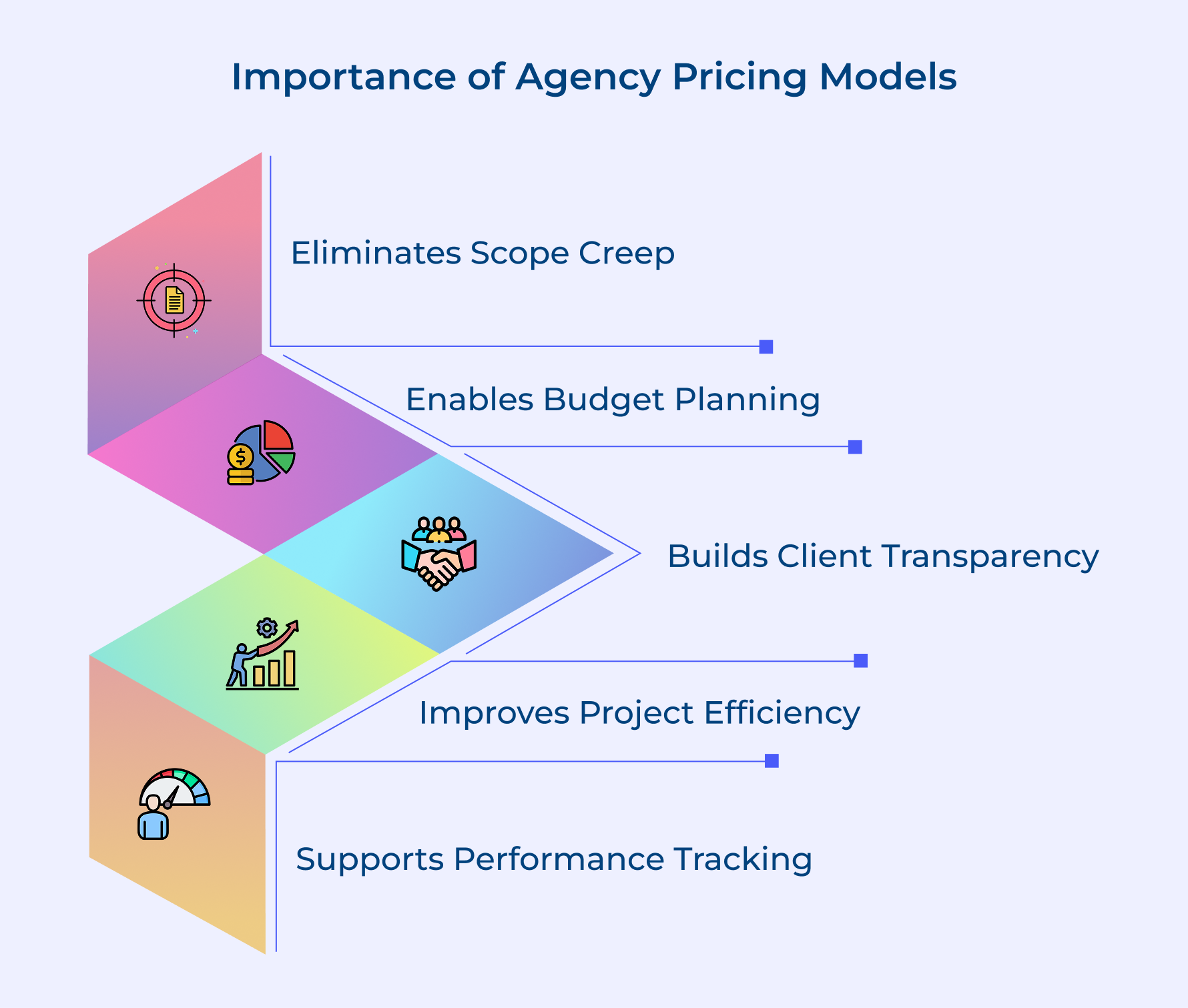
Eliminates Scope Creep and Unexpected Costs
When you establish clear boundaries upfront you avoid those awkward conversations about extra charges later. The pricing model acts like a contract roadmap that keeps everyone accountable. Both parties know exactly what work gets included and what triggers additional fees.
Creates Predictable Budget Planning
Your finance team can breathe easier when they know exactly what marketing will cost each quarter. This predictability helps with cash flow management and strategic planning. You can allocate resources more effectively across different business departments and initiatives.
Builds Trust Through Transparency
Open pricing discussions eliminate the guesswork that often damages agency relationships. Clients appreciate knowing how their money gets spent on specific activities. Transparency creates a partnership mentality rather than a vendor-client dynamic filled with suspicion and doubt.
Improves Project Efficiency and Focus
Clear pricing structures force agencies to be more strategic about resource allocation and time management. Teams work more efficiently when they understand the financial constraints along with deliverable expectations. This focus leads to better results within the agreed timeline and budget parameters.
Enables Better Performance Measurement
You can directly connect investment levels to specific outcomes and results when pricing aligns with deliverables. Performance discussions become more meaningful when tied to specific budget allocations and expected returns.
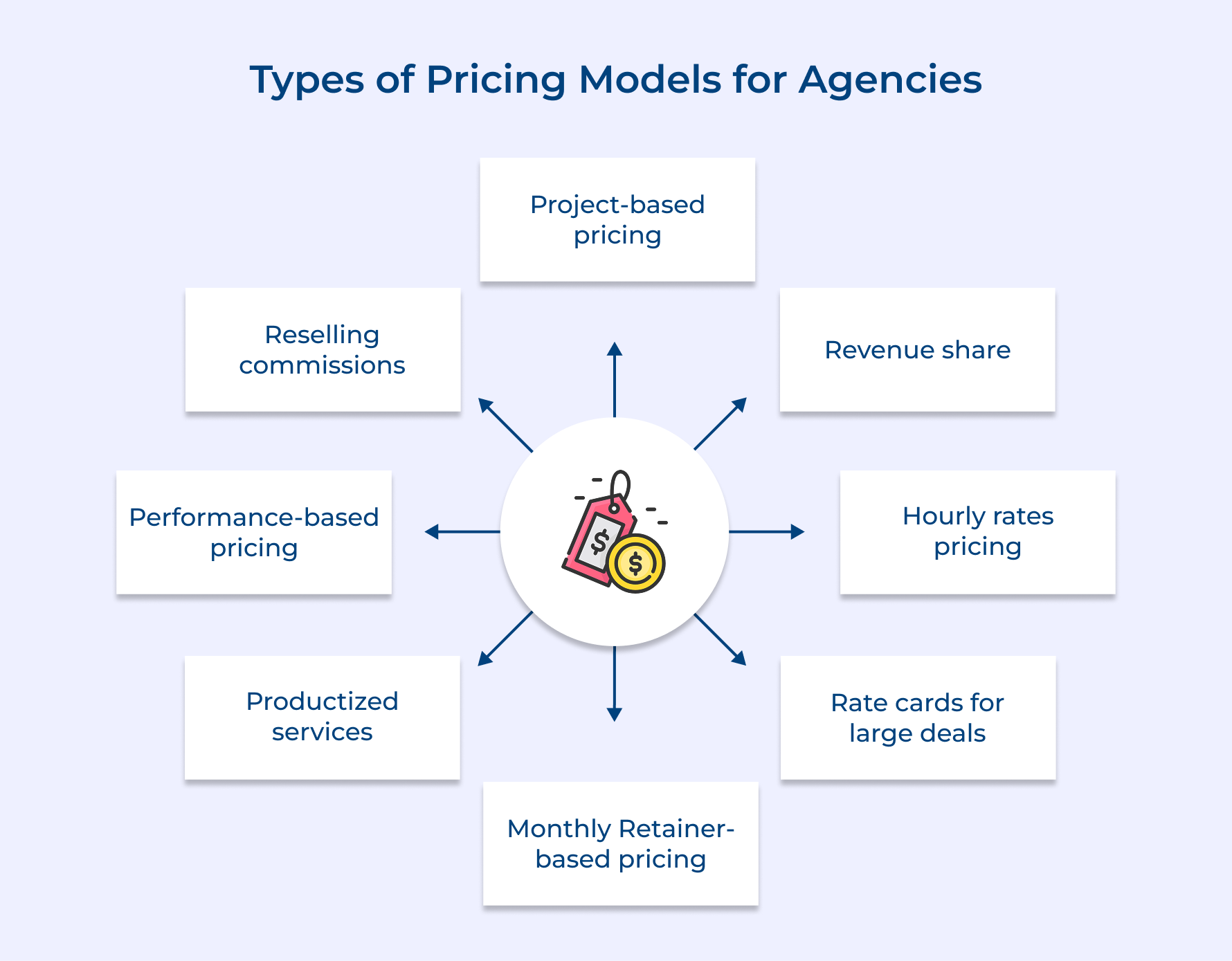
8 Essential Types of Agency Pricing Models
Let’s delve into eight distinct pricing models that agencies can leverage to enhance their offerings and drive business success.
1. Project-Based Pricing
Project-based pricing is all about quoting a single, fixed price for a clearly defined set of deliverables. It’s great for agencies as well as clients who want budget certainty and well-defined boundaries from day one.
However, if you don’t plan it right, you could end up eating unexpected costs. Before you lock in a price, take a step back and ask yourself a few critical questions:
Questions to ask before quoting:
- What exactly are we delivering? And just as important, what’s not included?
- Who’s working on it? Factor in each team member’s hourly rate.
- What could go wrong? Think about risks, delays, or things that might take longer than expected.
- What’s our ideal profit margin? Don’t just break even, plan for healthy returns.
- What if the client wants changes midway? Set clear rules for scope changes and additional charges.
Taking the time to answer these helps you avoid underestimating the work—and protects your bottom line.
Example: Let’s say a web design agency quotes $15,000 for an e-commerce website. This includes design, development and basic SEO. The client knows exactly what they’re paying for. The agency avoids surprises by mapping out every detail and planning for the unexpected.
Best practices:
- Document the scope in detail: Put everything in writing—deliverables, timelines, what’s included and what counts as extra.
- Add a buffer: Build in 20–30% more time than your estimate to cover revisions, delays, or surprise requests.
2. Revenue Share Pricing
Revenue share pricing can feel like the ultimate trust fall. Instead of charging a set fee, your agency earns a percentage of the client’s actual revenue. When done right, it creates a true win-win. But when it goes wrong? It can drain your team’s time and energy with little to show for it.
So why don’t more agencies jump in?
Because results are unpredictable. Market slumps, client missteps, or internal delays can tank revenue and your payout with it. Meanwhile, your team still needs to get paid.
When revenue share does make sense:
- E-commerce projects where you directly boost sales through CRO, paid ads, or SEO.
- Lead generation partnerships where you own the funnel and can clearly track leads to revenue.
- Long-term brand growth with clients who have stable revenue and scalable opportunities.
How smart agencies make it work:
Instead of going all-in, combine:
- A base retainer that covers essential costs and time
- Performance bonuses tied to clear, measurable outcomes (e.g. X% of new revenue above baseline)
This hybrid model gives you skin in the game and protects your team from chasing results they can’t control. Revenue share can be powerful but only when structured with strategy and a solid backup plan.
3. Hourly Rates Agency Pricing Model
Hourly rates are as simple as it gets, you charge clients based on the time your team actually spends on their work. It’s a flexible, no-guesswork model that’s ideal when the project scope isn’t fully defined or is likely to shift along the way.
Why agencies choose hourly:
- Transparency: Clients see exactly what’s being worked on and how their money’s being spent.
- Flexibility: You can quickly adjust to changing needs without rewriting contracts every time something shifts.
The drawbacks:
- Unpredictable costs: Clients may struggle to budget, especially if they prefer fixed pricing.
- Admin overload: Tracking every hour worked can eat into the very time you want to bill.
When hourly works best:
- Strategy-focused consulting where the path forward isn’t always clear at the start.
- Startup support like marketing consultants helping new businesses, where priorities and challenges shift constantly.
To make it work, set these up first:
- Reliable time-tracking tools: Automate logging hours to reduce manual work and increase accuracy.
- Clear communication protocols: Decide how often clients get time logs and updates, avoid surprise invoices.
- Transparent rate structure: Different team members = different rates. Lay it all out clearly so clients understand what they’re paying for.
4. Rate Cards for Large Deals
Rate cards establish standardized pricing across different service levels and team members to simplify complex enterprise relationships. This approach eliminates lengthy negotiations by providing transparent pricing that clients can reference when planning multiple projects or campaigns. Smart agencies use these proven approaches to make rate cards work in their favor:
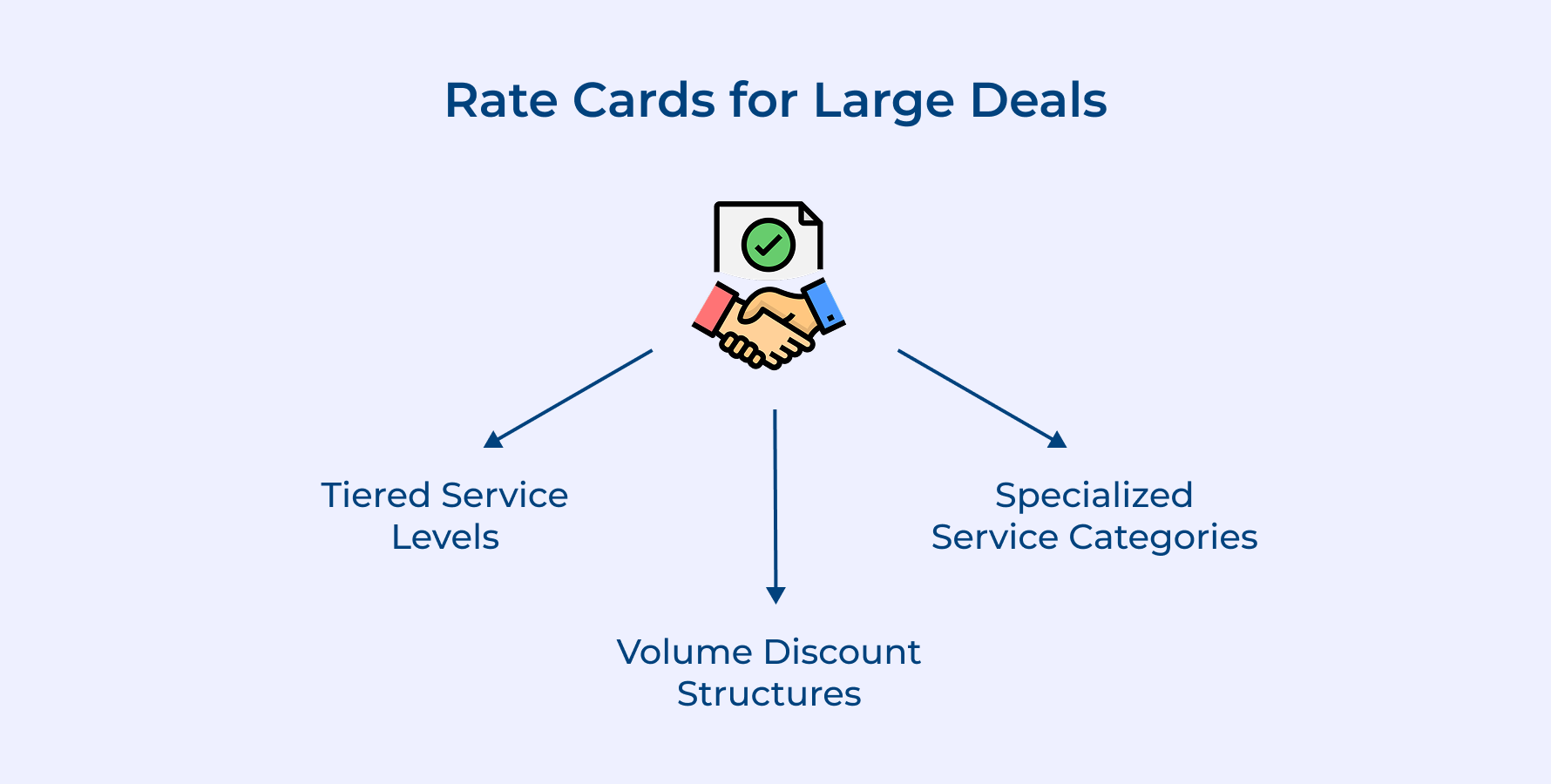
- Tiered service levels: Create clear distinctions between junior, senior and executive-level resources with corresponding hourly rates. This transparency helps clients understand why certain team members cost more and allows them to choose appropriate skill levels for different tasks.
- Volume discount structures: Offer reduced rates when clients commit to minimum monthly hours or annual contracts. It encourages larger commitments while providing clients with cost savings that make the partnership more attractive than working with multiple smaller agencies.
- Specialized service categories: Develop separate rate cards for strategy work, creative development and technical implementation since these require different skill sets. Clients appreciate understanding exactly what they’re paying for and can mix / match services based on their specific needs as well as budget constraints.
What happens when clients start cherry-picking only your lowest-priced services? Many agencies discover that rate cards can actually hurt profitability when clients avoid higher-margin strategic work. The solution lies in creating service bundles that combine high-value strategy with execution tasks to maintain healthy profit margins across all client relationships.
5. Monthly Retainer-Based Agency Pricing Model
Monthly retainers provide recurring revenue through fixed monthly fees that cover ongoing services and team availability. It creates predictable income streams while ensuring clients receive consistent attention and strategic support for their marketing initiatives.
Pros:
- Predictable monthly income allows agencies to plan resources effectively and invest in team development without worrying about project gaps.
- Long-term relationships develop naturally when clients work with the same team members month after month.
Cons:
- Scope creep becomes a constant battle when clients assume the retainer covers unlimited work and revisions.
- Client expectations can become unrealistic about response times and availability during busy periods.
Retainers are just like gym memberships for marketing services where clients pay monthly for access to your expertise and ongoing support. The key lies in setting clear boundaries about what gets included in the base retainer versus additional project work.
Pro tips: Provide detailed reports showing exactly how retainer hours get used and what results clients achieve from ongoing efforts.
6. Productized Services
Productized services turn custom, one-off projects into standardized offerings with clear deliverables and fixed pricing. Instead of reinventing the wheel for every client, you create repeatable packages that streamline delivery and boost profitability.
Rather than endless back-and-forth scoping, you offer ready-to-go packages, like a “Website Audit & Optimization” bundle. Clients know exactly what they’re buying and your team can deliver efficiently without surprises.
What makes productized services work?
- Fixed-price packages: Clear, upfront pricing tied to specific services. No guesswork or hourly tracking.
- Tiered options: Offer basic, standard and premium levels. For example:
- Basic: Technical audit
- Standard: Audit + competitor analysis
- Premium: Everything above + monthly reporting and continuous optimization
- Repeatable processes:
Use templates, checklists and workflows so your team can deliver consistent quality. It’s not just efficient, it’s scalable.
Why it’s a game-changer:
- Clients love the transparency and simplicity
- Your team avoids scope creep and pricing debates
- You build systems, not just projects which means more profit and less chaos
Productized services are perfect for agencies ready to scale without sacrificing quality or burning out the team.
7. Performance-Based Pricing
Performance-based pricing ties agency compensation directly to achieving specific measurable goals like increased sales or lead generation. It creates accountability while sharing both risk and reward between the agency as well as client based on actual results.
For example, a digital marketing agency agrees to manage PPC campaigns for 30% of base fee plus bonuses when cost-per-acquisition drops below target thresholds.
The arrangement motivates the agency to optimize campaigns aggressively while protecting the client from overspending on ineffective advertising.
Best practices:
- Clear baseline metrics: Establish current performance levels before starting work to create fair benchmarks for measuring improvement and success.
- Hybrid fee structures: Combine base retainer fees with performance bonuses to protect agency cash flow while maintaining incentive alignment.
8. Reselling Commissions
Reselling commissions allow agencies to earn additional revenue by recommending third-party tools and platforms to clients. This model creates supplementary income streams beyond core agency services while helping clients access necessary technology and software solutions.
Before pursuing commission opportunities consider these factors:
- Does the recommended tool genuinely solve client problems or are we pushing products for commission potential?
- How will commission arrangements affect our objectivity when advising clients about technology choices and platform selections?
- What disclosure requirements exist for revealing our financial relationships with recommended vendors and service providers?
- Can we maintain client trust while earning commissions from the tools we recommend for their business operations?
These questions help agencies navigate the ethical considerations that come with earning money from vendor relationships. When you answer these honestly you build sustainable commission strategies that benefit everyone involved in the partnership.
How to Select the Perfect Pricing Model for Your Agency?
Choosing the right pricing model determines your agency’s profitability and client satisfaction. This decision is selecting the foundation for your entire business relationship structure.
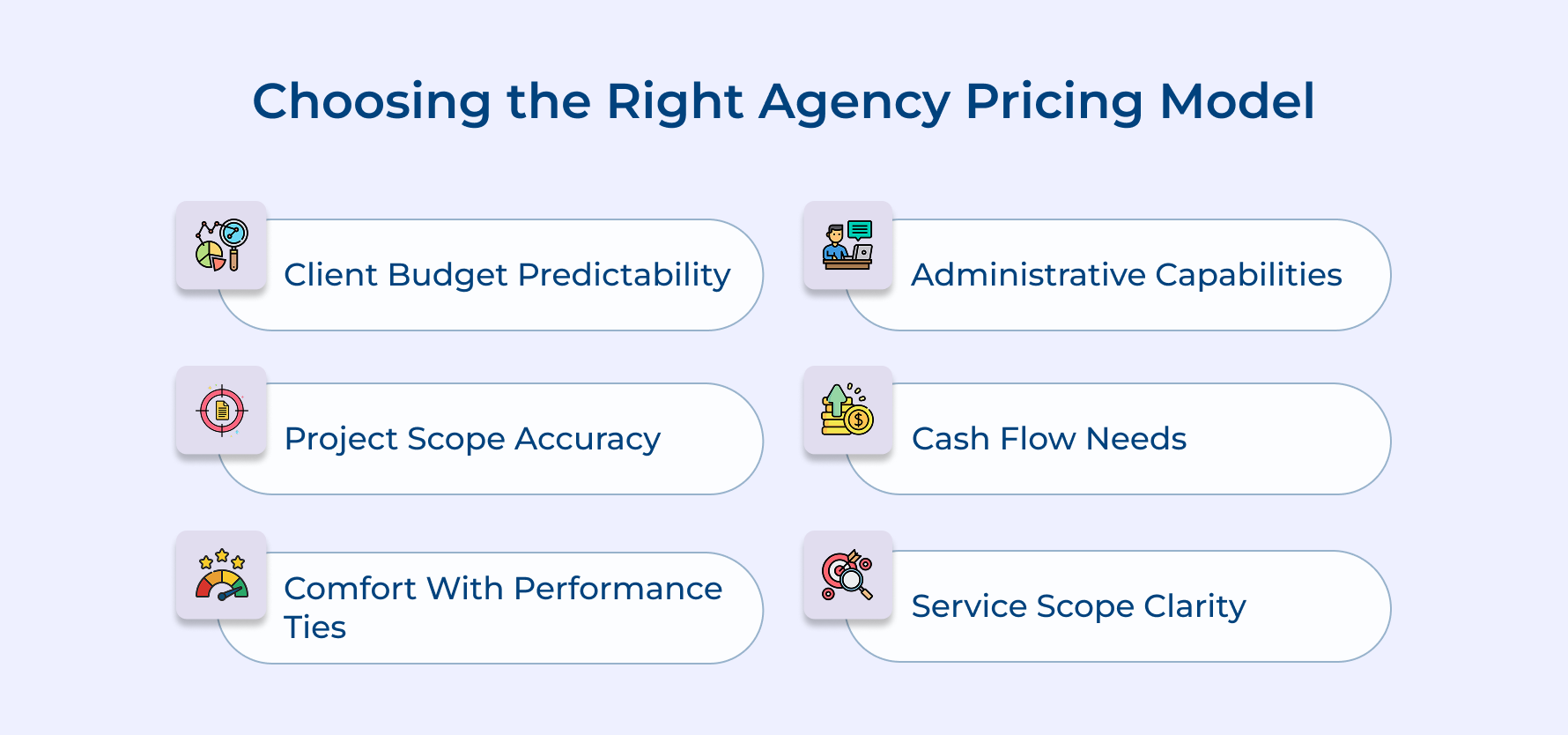
Critical questions to answer before making your choice:
- What level of budget predictability do your typical clients need for their financial planning processes?
- How accurately can you estimate project scope and timeline requirements based on your team’s experience?
- How comfortable are you with tying your compensation directly to client performance and business outcomes?
- What administrative resources do you have available for tracking time and managing complex billing arrangements?
Client Industry and Business Maturity Level
Different industries have distinct expectations about how agencies should price their services. Established enterprises often prefer predictable retainer arrangements while startups gravitate toward performance-based models. Understanding your target market’s financial planning cycles helps you align with their natural purchasing behaviors and decision-making processes.
Your Agency’s Operational Capabilities and Systems
Consider if your team can handle the administrative requirements that come with different pricing models. Hourly billing demands robust time-tracking systems while performance-based pricing requires sophisticated analytics and reporting capabilities. Choose models that match your current operational strengths rather than forcing your team into uncomfortable administrative burdens.
Cash Flow Requirements and Financial Stability
Think about your agency’s financial needs when selecting pricing approaches that impact cash flow timing. Project-based pricing creates lumpy revenue patterns while retainers provide steady monthly income streams. Performance-based models can delay payments significantly so ensure you have sufficient working capital to handle extended payment cycles.
Service Complexity and Scope Predictability Factors
Evaluate how well you can define project boundaries and estimate resource requirements for your typical engagements. Complex strategic work with unclear deliverables suits hourly or retainer models better than fixed-price arrangements. Simple repeatable services work perfectly with productized pricing while custom solutions require more flexible approaches.
Tips to Boost Your Agency’s Profitability (Beyond Choosing the Right Pricing Model)
Smart pricing gets you in the door but operational excellence keeps you profitable long-term. These strategies are the engine that transforms good pricing into sustainable business growth.
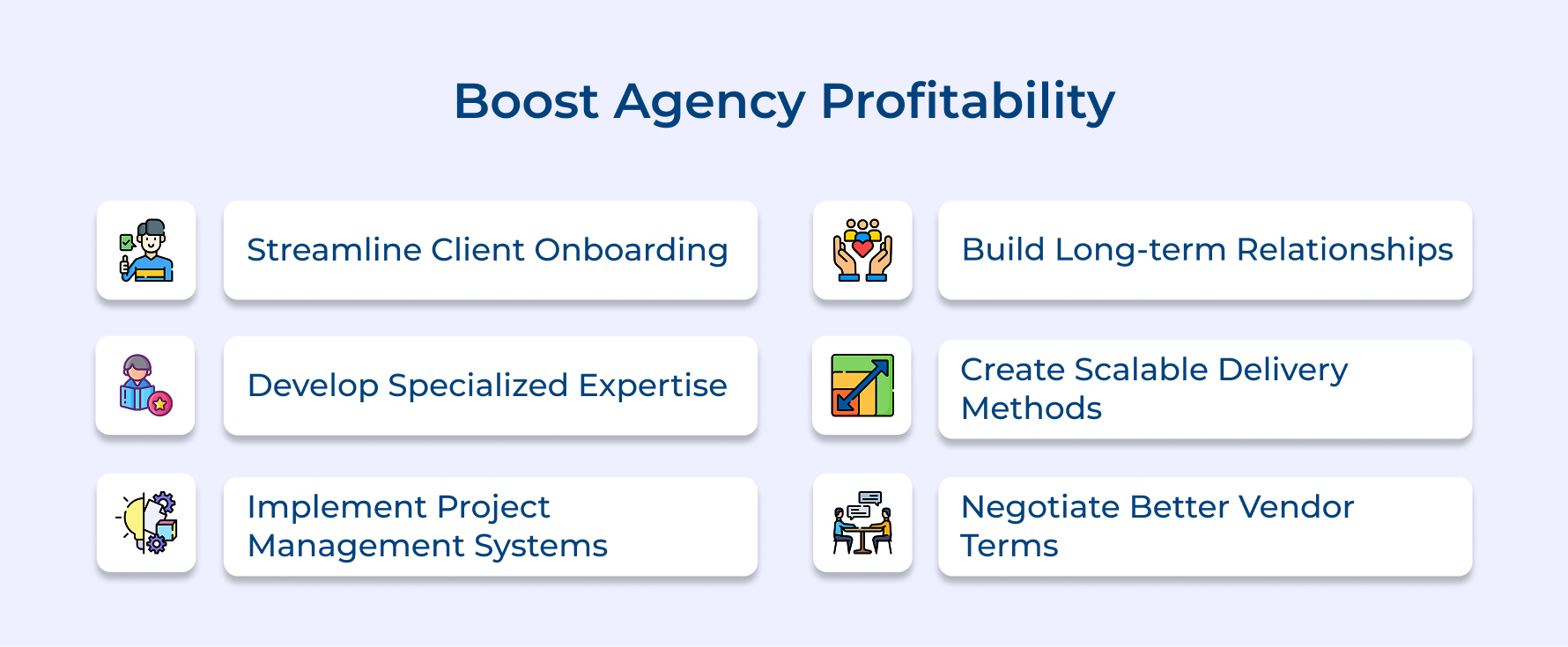
Streamline Client Onboarding to Reduce Time
Create templated workflows that guide new clients through information gathering efficiently. When you reduce onboarding time from weeks to days you free up billable hours while creating better first impressions.
Develop Specialized Expertise for Premium Pricing
Choose one or two areas where you can become the go-to expert rather than serving everyone equally. This focused approach allows you to charge higher rates for specialized knowledge.
Implement Efficient Project Management Systems
Invest in systems that automate routine tasks like status updates while providing clear project visibility. When teams spend less time on administration they focus on revenue-generating activities instead.
Build Long-term Client Relationships
Develop systematic approaches for nurturing current relationships through regular check-ins and proactive recommendations. Happy clients become your best marketing channel while providing predictable revenue streams for planning.
Create Scalable Service Delivery Methods
Develop standardized processes and leverage technology tools that allow serving more clients without proportional labor cost increases. It might include templates for deliverables or automation for routine tasks.
Negotiate Better Terms with Vendors
Review relationships with software providers and contractors to identify opportunities for volume discounts or improved payment terms. Small vendor cost improvements significantly impact bottom line profits.
Make Agency Billing a Breeze with Pricing Models
The right agency pricing model transforms chaotic billing into predictable revenue streams while eliminating constant negotiations and scope creep battles. These models are the foundation that supports every other business decision your agency makes.
Strategic pricing approaches boost profitability by enabling better resource allocation. They enhance operational efficiency through standardized processes. Also, they strengthen client relationships by setting transparent expectations and consistently delivering value across all engagements.
Limit time — not creativity
Everything you need for customer support, marketing & sales.

Pooja Deshpande is a content contributor at Kooper, focused on creating insightful resources that help agencies and service providers scale efficiently. Passionate about SaaS trends, content strategy, and operational excellence, she delivers practical, easy-to-implement guidance for modern business leaders.