What Is Resource Demand Planning? A Complete Guide
- What is Resource Demand?
- Why Is Resource Demand Planning Important?
- Resource Capacity vs Resource Demand: 5 Key Differences
- How to Create a Resource Demand? A 6-Step Process
- How to Forecast Resource Demand: 5 Strategies
- Best Practices For Managing Resource Demand
- Stay Ahead of the Curve with Smart Resource Demand
- FAQs about Resource Demand

Key Highlights:
- Resource capacity reflects current team availability, while resource demand forecasts future requirements of a project.
- Resource demand estimation maps effort, skill type and timeline at the individual task level.
- Technology-driven forecasting gives real-time visibility that spreadsheets cannot match at scale.
Ever wonder why most of your well-planned projects miss deadlines? No, the real culprit is not poor strategy. It is the unavailability of the right resource at the right time for project delivery.
Resource demand is the forecasted quantity of skills, roles and effort that project or portfolio needs over a timeline. Due to poor resource planning, organizations waste 11.4% of their investment. The number also scales fast across a growing portfolio.
Explore resource demand definition, strategies and best practices for proper management across distributed teams.
What is Resource Demand?
Resource demand moves beyond knowing the number of people required in a project. It is the process of identifying the skills, capacity and effort teams actually need to deliver tasks within a defined timeline.
Teams that understand the perfect definition of resource demand easily transform their reactive approach into a high-performing one. When you know a project’s needs, you stop the guesswork and start planning in real time.
Most organizations struggle because they never built a system to forecast resource demand before work hits the pipeline.
Key objectives:
- Identify the right skills needed across all upcoming projects before shortages.
- Align workforce availability with project timelines to avoid last-minute mess.
- Improve visibility into future resources and make sure leadership is confident in hiring or allocation decisions.
- Build a repeatable resource demand strategy that scales as the project portfolio grows.
Why Is Resource Demand Planning Important?
Even a properly planned project fails in the execution stage without a solid resource demand plan. Explore why getting this planning is non-negotiable.
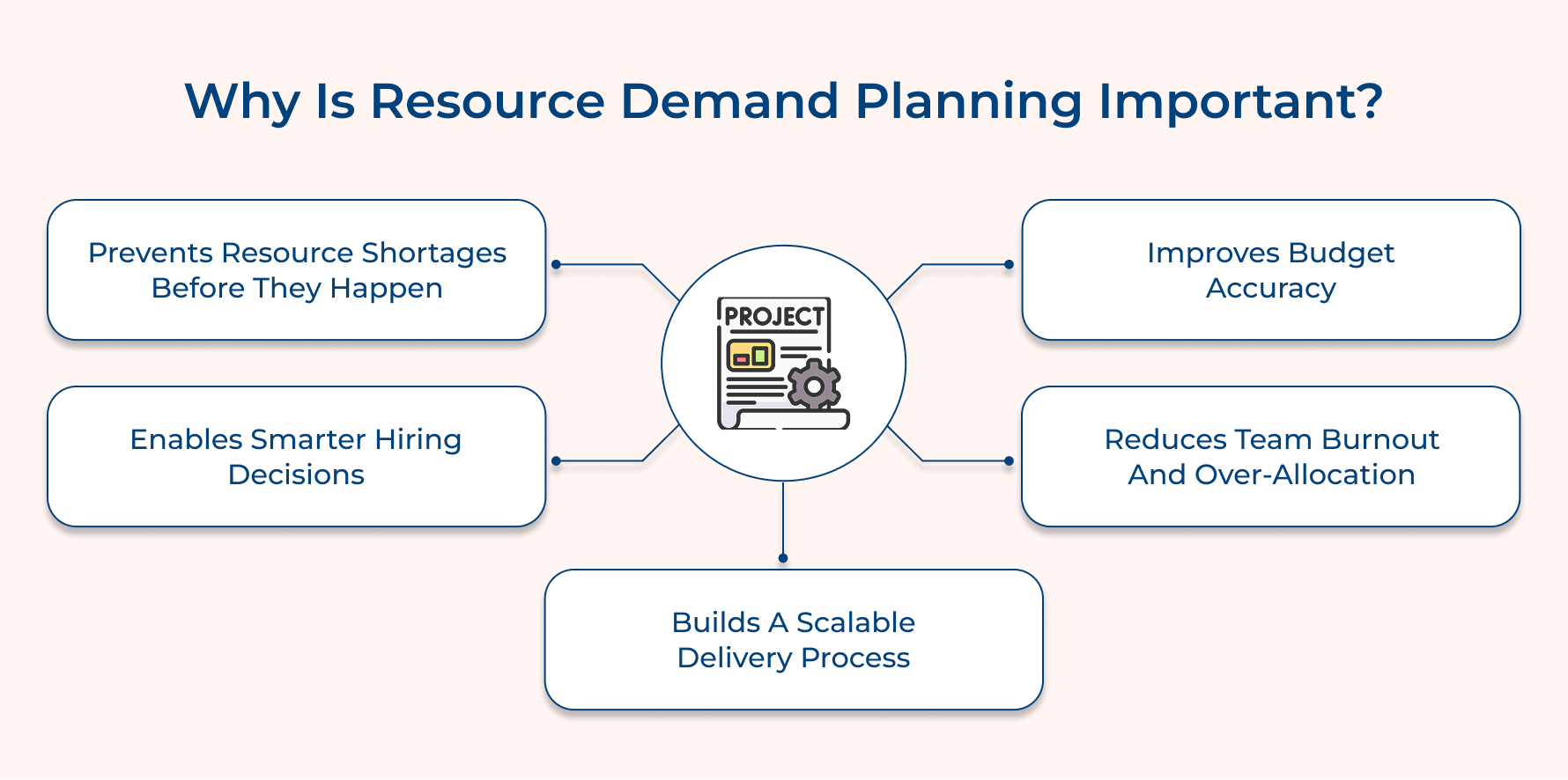
1. Prevents Resource Shortages Before They Happen
Project delays are not due to poor strategy at the start of the planning level. It generally happens when the right resource is not available at the right time due to a lack of demand forecasting.
2. Improves Budget Accuracy
Unplanned resource demands are the budget killers in most project deliveries. Cost estimations become far more reliable to stakeholders when teams build a demand forecasting model early in the planning phase.
3. Enables Smarter Hiring Decisions
What happens when managers get a clear future demand for resources? Reactive hiring calls become a thing of the past. It enables managers to plan talent acquisition weeks or months ahead of actual project needs.
4. Reduces Team Burnout and Over-Allocation
Most managers consistently underestimate the risk of top performers’ over-allocation, which causes project failure. Good resource demand management helps in distributing workloads evenly and protects the team over long delivery cycles.
5. Builds a Scalable Delivery Process
Organizations that invest in a resource demand system not only deliver better but also build operational growth. It also scales project delivery without chaos as the demand scales.
Resource Capacity vs Resource Demand: 5 Key Differences
One of the most critical distinctions in resource planning is understanding the capacity end point and the demand start point. Explore the difference for a proper understanding
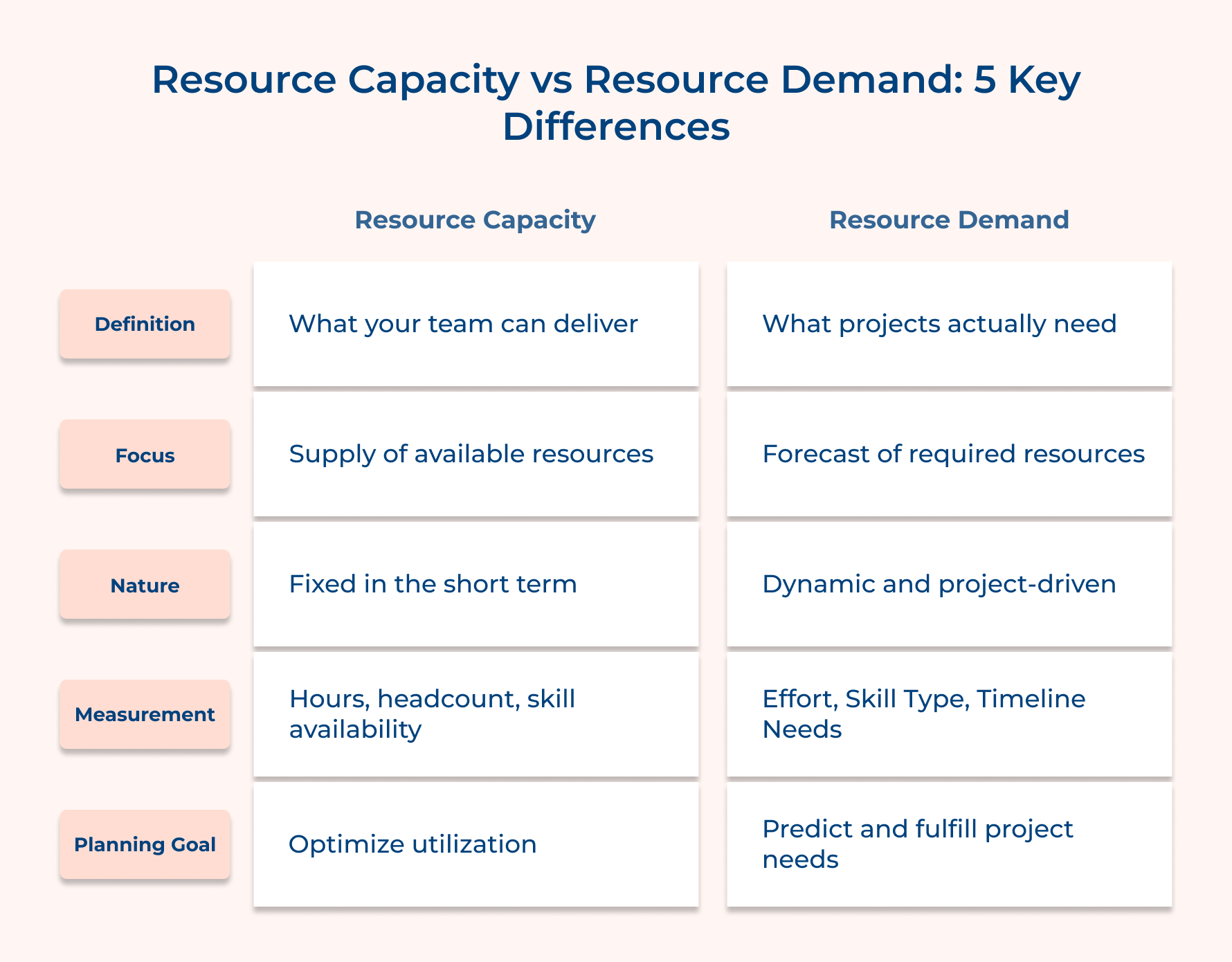
Definition
Resource capacity is all about an organization’s current resource availability to deliver work. The definition of resource demand explains the forecast of future resource requirements in projects that will actually require them.
Focus
Capacity planning is an inward-focused strategy on the existing supply of people, skills and time, while resource demand looks outward at project pipelines for proper resource forecasting before execution starts.
Nature
Resource capacity is relatively stable over a short planning window, while resource demand is quite dynamic, shifting constantly as project scopes and timelines evolve.
This is why demand for resources must be reviewed on a frequent basis and continuously. For example, a snapshot taken once a quarter is not enough for fast-evolving project environments.
Measurement
Available hours, headcount and skill coverage across the team are key metrics to measure capacity. Resource demand is measured by mapping required effort, specific skill types and delivery timelines per project.
Planning Goal
The goal of capacity planning is to maximize utilization without team burnout, while the goal of resource demand management is to predict requirements to make sure the right resources are utilized in the right place.
One is about protecting the existing resource, while the other is about preparing for the future. A proper resource demand strategy combines both in one unified planning cycle.
How to Create a Resource Demand? A 6-Step Process
A Resource demand strategy is an ongoing process that connects project pipelines, capacity and business priorities into one planning system.
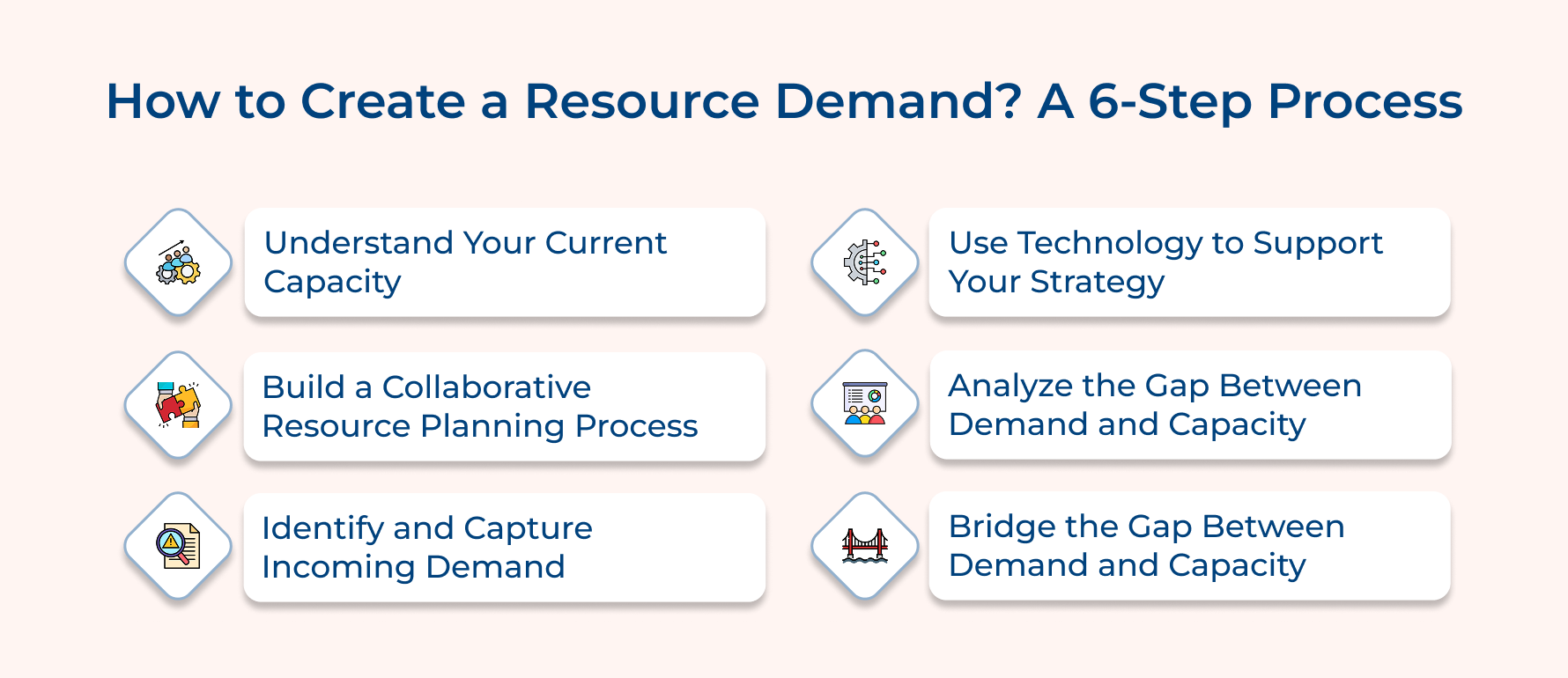
1. Understand Your Current Capacity
The foundation of forecasting starts with understanding your team’s current capacity and workload. Demand planning without a clear resource capacity benchmark is similar to navigation without a map.
Audit every resource across active projects to capture availability, skill sets, utilization rates and any planned leaves. Make your audit more effective by asking these questions:
- Which resource is fully allocated and who is free?
- Which skills are overrepresented and not valuable for the project?
- What are the resources that are shared across multiple project teams?
So what happens when teams skip straight into demand forecasting? This shortcut creates inaccurate demand data. A resource demand estimation needs the proper knowledge of the quality as well as the depth of expertise and not just the number of people benched
- skills available,
- Role-specific availability
- Contractual constraints
2. Identify and Capture Incoming Demand
A question that is worth answering first is, Where does this demand actually come from? Most of it is project requests, product initiatives and operational commitments that align in the pipeline.
Consider examples of organizations where demand for resources lives in scattered spreadsheets and only verbal commitments, which leads to inconsistency. Overcome it by centralizing the intake within the first real step toward building a working demand model.
Build a structured demand process that captures:
- Project details: Names, their priority level and expected start date for every incoming request.
- Skill and effort mapping: Document roles required along with approximate effort hours per skill type.
- Delivery constraints: record of the timeframe for the resource need, followed by any deadlines.
Once demand is captured centrally, the next process is to use a simple classification across resources to prevent teams from being committed to projects that never actually get the green light.
3. Analyze the Gap Between Demand and Capacity
The real planning starts with proper capacity mapping and demand capturing. Next, it is to analyze demand gaps with precision instead of looking for availability and digging into the availability of the right skills for the right projects.
Metrics to track in this analysis:
- Utilization rate: Track role- and skill-specific areas to identify over-allocation before it transforms into delivery risk.
- Demand coverage ratio: Make sure critical milestones have confirmed resource backing by measuring per project phase.
- Gap size: Quantify in hours equivalents by week for managers to get a actionable numbers for tracking
Pro tip: Reveals patterns that were never visible before, for example, a specific skill set may be consistently over-demanded while others underutilized.
So, how does a reliable forecasting view actually look? Use a resource demand forecast to review plot demand against capacity with a 13-week window. It gives the right balance of accuracy and planning flexibility.
4. Bridge the Gap Between Demand and Capacity
Gap identification is one thing, but knowing the bridging process is where real resource demand management expertise comes in.
Pro tip: The best approach depends on the size, urgency and nature of the demand gap, as jumping straight to hiring is rarely the right move.
Follow these few bridging options available:
- Workload rebalancing: Cover critical demand gaps immediately by shifting resources from lower-priority projects.
- Upskilling existing talent: Train your team members with adjacent skill gaps instead of doing external sourcing.
- Contractors and vendors: Hire external support for managing short-term demand that cannot wait.
A common question that comes to mind is, what happens when two critical projects require the same resource at the same time? No, it is not a resource problem, but a demand prioritization finalization that needs to be done at the manager level.
Consider these adjustments when supply cannot flex:
- Offset project kickoffs by two to three weeks to smooth out peak demand periods.
- Define capacity data for honest conversations about realistic delivery.
5. Build a Collaborative Resource Planning Process
The resource planning process works best when managers, department heads and resource owners are all accessing as well as operating from the same data.
Start with a proper collaboration that creates shared visibility to make decisions that account for the bigger picture. Consider these steps to build collaboration into the process:
- Collaborate with all department leads to identify conflicts and align on priorities in real time.
- Give all stakeholders a clear visualization of current demand and capacity data without a weekly report.
Now, it’s time to give ownership of this planning, but to whom? Resource Manager or PMO lead is the best option. They drive these end-to-end changes, which completely change the dynamic by becoming a connective tissue between demand and organizational capacity.
Key responsibilities for that role include:
- Data integrity ownership: Maintain accurate demand forecasting and capacity planning on which decisions rely.
- Conflict facilitation: Resolve resource needs between two project teams before escalating.
- Trend reporting: Identify demand patterns and report them on a regular cadence.
6. Use Technology to Support Your Strategy
Most organizations use spreadsheets as a key resource management tool, but they never scale. As project portfolios grow, the complexity of managing resource demand manually.
The complexity of manual resource demand management with spreadsheets becomes a significant operational risk as business operations scale. The best technology does not just replace thinking but also gives real-time visibility across demand that no spreadsheet can provide.
What are the factors to consider for evaluating the best tools?
- Real-time visualization: look for live capacity and demand data without manual data pulls.
- Scenario planning: Check different demand and supply configurations before finalizing a course of action.
- System integration: the right tool should sync with project management and HR platforms for data to flow without manual effort.
The technology should make the resource demand strategy proactive. Systems that work best help teams have conversations weeks ahead instead of rushing to fill gaps before project execution.
How to Forecast Resource Demand: 5 Strategies
Resource demand forecasting is all about building visibility for teams to plan and deliver constantly. Let’s explore these strategies to deliver resource demand efficiently
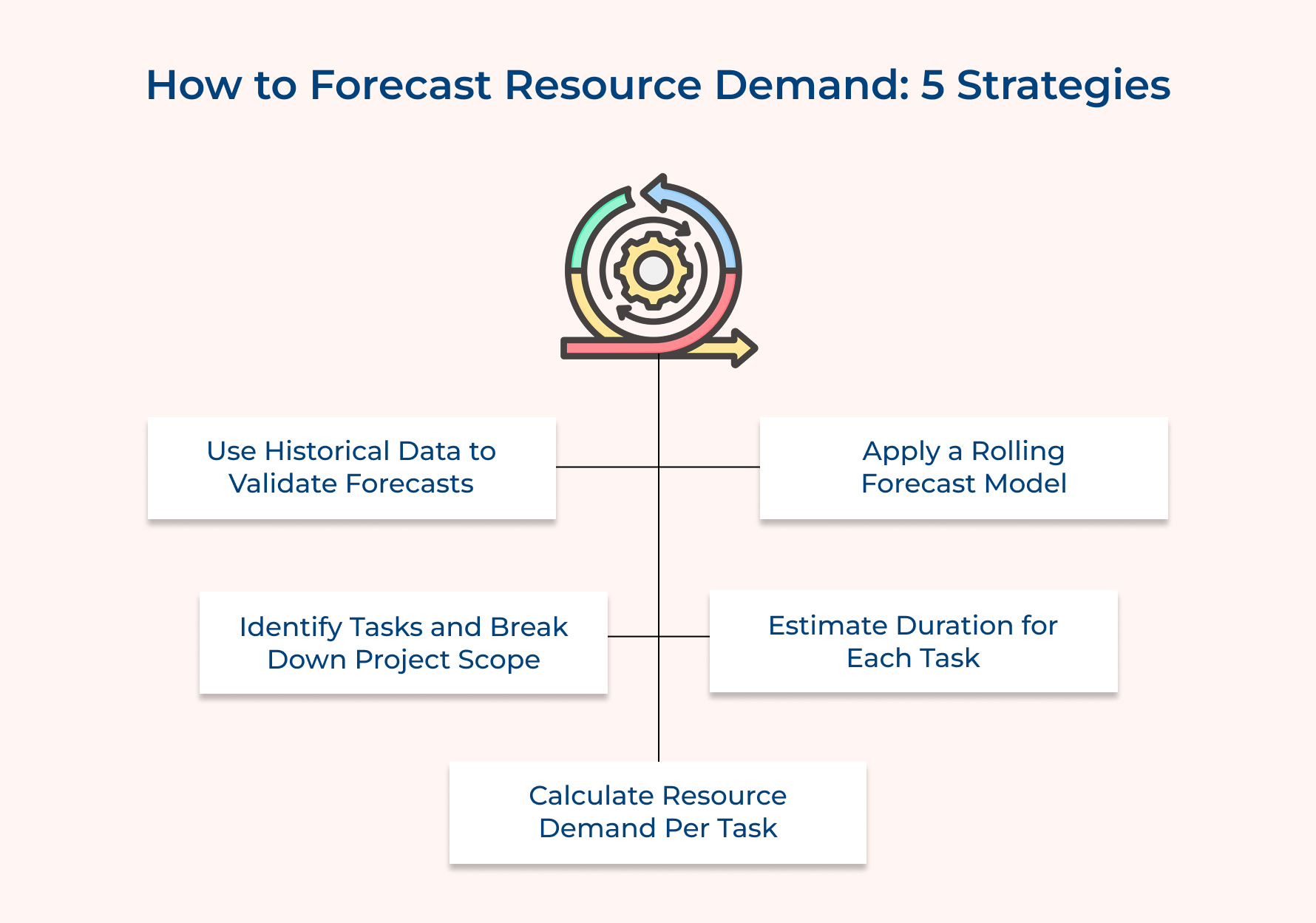
1. Identify Tasks and Break Down Project Scope
Start your resource demand forecasting by completely breaking down every project task into smaller milestones. A strong task identification process looks like:
- Involving the doers, not just the planners: The people will identify the tasks that a top-down resource planning view misses.
- Flag dependencies early: Identifying tasks that are blocked due to dependency chains across specific resources.
How to implement this?
Before any resource conversation starts, run a proper scope breakdown session, followed by using a WBS template, transforming every deliverable into tasks along with clear ownership. New tasks that will be added after forecasting trigger a formal scope change.
2. Estimate Duration for Each Task
Accurate resource demand estimation depends on reality, where the team estimates the duration of each task completion. So, how to put duration estimation into practice?
- Run a pressure-test review: Assign a senior team member to review every estimate against historical data before finalizing the forecast.
- Build an estimation log: keep a record of the rationale across every call for teams to maintain a proper reference point.
- Break down large estimates: identify any task estimated at more than 40 hours and decompose further, since large estimates hide complexity.
Consider the example of a software delivery team that estimated a UAT phase at two weeks based on guesswork, but with historical data, the duration was four weeks due to bug cycles. This data-driven adjustment prevents a 2x resourcing gap that stalled the go-live.
3. Calculate Resource Demand Per Task
“We need three developers” is the so-called generic estimate that is guesswork dressed up as planning. Resource on-demand calculation at the task level turns a rough plan into a reliable forecast. Define the calculation process effectively by:
- Mapping Role-to-task: Assign a specific role type to each task instead of using generic labels.
- Quantifying effort: Convert task duration into work hours and define the expected daily productive hours.
- Aggregating demand: sum up task-level resource demand into weekly totals to create a timeline view that capacity planning can use.
The output is a weekly demand profile showcasing specific roles that need a volume of resources. It makes human resource allocation decisions defensible across the entire portfolio.
Best practice:
- Build a linked demand template: Sync demand calculations with the task list to make sure scope changes flow through to resources without manual effort.
- Assign a planning validator: Make sure Managers verify all calculations before assigning the central demand view.
4. Use Historical Data to Validate Forecasts
Historical data is the most underused asset, as ignoring it leads to repeating the same demand estimation mistakes across every delivery cycle. Make it work best by tracking all data before locking in any forecast:
- Actual vs. estimated effort: Analyze planned hours with respect to hours delivered across past projects to identify estimation patterns.
- Phase-level overruns: Identify project phases that historically consume more hours than planned.
- Skill-specific demand patterns: make proactive plans now by tracking roles that were most frequently underutilized in past tasks.
Consider the example of a consulting firm that noticed its business analysis phase consistently ran 30% more than estimated. Historical data analysis tracking recommended a 30 percent buffer on future projects, eliminating a mid-project resourcing crisis.
Pro tips:
- Build a project library for capturing resource data after project closure so future forecasting has a reliable reference.
- Team compassion and velocity can scale over time, so track recent project data more heavily than older records.
5. Apply a Rolling Forecast Model
An updated rolling resource demand model helps to keep your planning actionable as project scope changes in real time. An organization that uses a static forecast method becomes outdated by the halfway point.
So, what makes a rolling forecast model work in practice?
- Fixed review cadence: Maintain a weekly update cycle for refreshing demand inputs based on the latest project status.
- Horizon segmentation: Treat the first four weeks as fixed resource demand, while from weeks five to thirteen, maintain active monitoring.
- Trigger-based updates: Define events such as scope changes, approvals and resource exits to automatically trigger a forecast update outside the cadence.
Teams that constantly review forecasts catch capacity conflicts earlier for managers to optimize, and this gap rarely becomes a crisis as the signal arrives before the problem.
Best Practices For Managing Resource Demand
Resource demand management is all about building the right habits across the entire planning process.
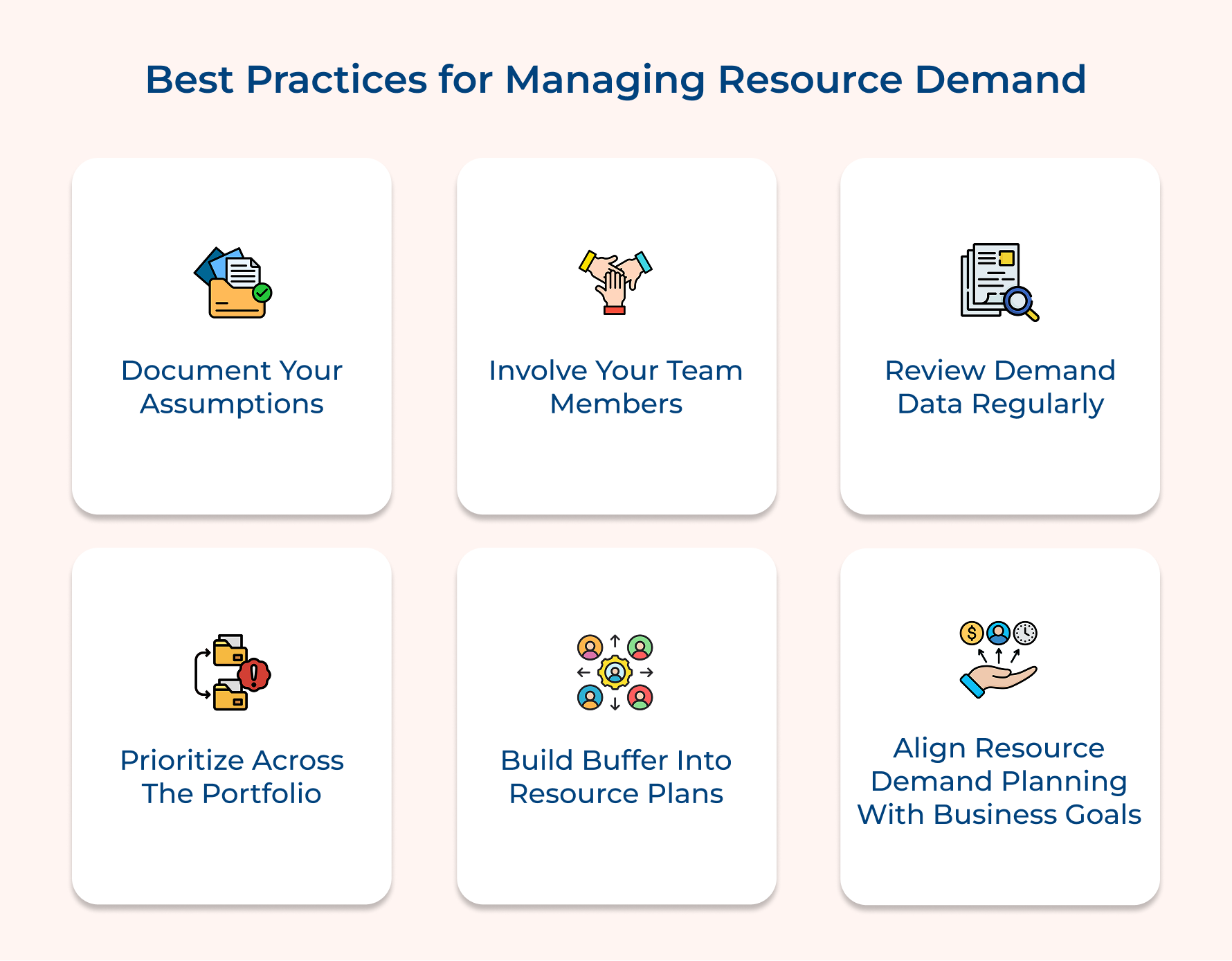
- Document your assumptions: Write down the demand forecast so that the team can revisit and validate them as project realities evolve or scale.
- Involve your team members: The right people doing the work will always have sharper insights into the demand in comparison to those planning it from a distance.
- Review demand data regularly: Build a weekly review rhythm to keep forecast current. Plans that are reviewed only at project start become irrelevant.
- Prioritize across the portfolio: Decisions must be made at the portfolio level when demand exceeds capacity instead of leaving it to individual project managers.
- Build buffer into resource plans: Most high-demand skills run tighter than forecasted. A planned buffer prevents it from becoming a delivery blocker.
- Align resource demand planning with business goals: Demand planning, when done differently from business priorities it leads to wrong resource commitment to the wrong work.
Stay Ahead of the Curve with Smart Resource Demand
Resource demand planning is the operational backbone for keeping your projects staffed and timelines intact. Organizations that build this systematically outperform those still managing gaps.
- Accurate resource demand forecasting begins with historical data validation.
- Portfolio-level prioritization is the key to bridging the gap between demand and capacity.
- Keeps planning live and decision-making proactive with a rolling forecast model.
Want to build a resource demand strategy for your organization? Explore our complete Capacity Planning guide to understand the team’s demand management at scale. Organizations that treat this as a continuous process scale more confidently.
Limit time — not creativity
Everything you need for customer support, marketing & sales.

Neeti Singh is a passionate content writer at Kooper, where he transforms complex concepts into clear, engaging and actionable content. With a keen eye for detail and a love for technology, Tushar Joshi crafts blog posts, guides and articles that help readers navigate the fast-evolving world of software solutions.