Project Risk Register: Components, Steps & Best Practices
- What is a Risk Register in Project Management?
- What is the Importance of Risk Registers in Project Management?
- What are the Common Risk Scenarios in a Risk Register?
- How To Create a Risk Register? 7 Actionable Steps
- How To Maintain a Risk Register Effectively: 5 Strategies
- What is Included in a Risk Register in Project Management?
- Common Pitfalls in Risk Register Management and How to Overcome
- Risk Register Example in Project Management for Business
- Keep Your Project on Track with Proactive Risk Management
- FAQs about Risk Register in Project Management
Key Highlights:
- A risk register is a centralised document that captures every risk with its probability, impact and assigned response plan.
- Most projects fail to deliver on time without a proper risk register, making structured risk identification a direct driver of success.
- Turn a static risk log into a project management decision tool with risk identification, ownership, probability assessment and stakeholder communication
Ever wonder why projects fail in most professional service firms? If you think it is only because risks are unavoidable, you are wrong. It is because risk goes untracked.
So what separates a successful project delivery from those that derail? It is the presence of a structured document that keeps risk visible. 92% of projects are failing to deliver on time without maintaining a proper risk register.
A risk register in project management is a centralised record that documents every identified risk, along with the probability and response plan. Discover everything from the definition, core components, step-by-step creation, real-world examples and best practices. Equip your teams with the right data to streamline the risk management process.
What is a Risk Register in Project Management?
A risk register is a document that captures every identified risk across the entire project lifecycle. It records the nature of the risk along with its potential impact and the response plan assigned to it.
When Should You Use a Risk Register?
The risk register starts the moment a project is officially kicked off. Teams that wait until risks actually appear derail even well-planned projects.
A risk register in project management is not a one-time document. It needs active updates from every project milestone. The earlier it enters the workflow, the more control the team has over the outcomes.
Use a risk register when:
- Project initiation: The start of the project needs an initial risk identification along with formal documentation.
- Scope changes: Analyse any change in scope that introduces new risk and potentially affects delivery.
- Resource allocation: Team and budget allocation might trigger potential risks.
- Project review cycles: Conduct audits or milestone reviews to monitor existing risks.
What is the Importance of Risk Registers in Project Management?
A risk register means not just a “document” but also the backbone of how teams perform risk management before turning into real damage across projects.
- 92% of projects fail to deliver on time and on budget as per Accenture’s report.
- Only 64% of project managers practice risk management, which leaves one-third of projects exposed to setbacks.
- Organizations with proper risk management complete 85% more projects successfully.
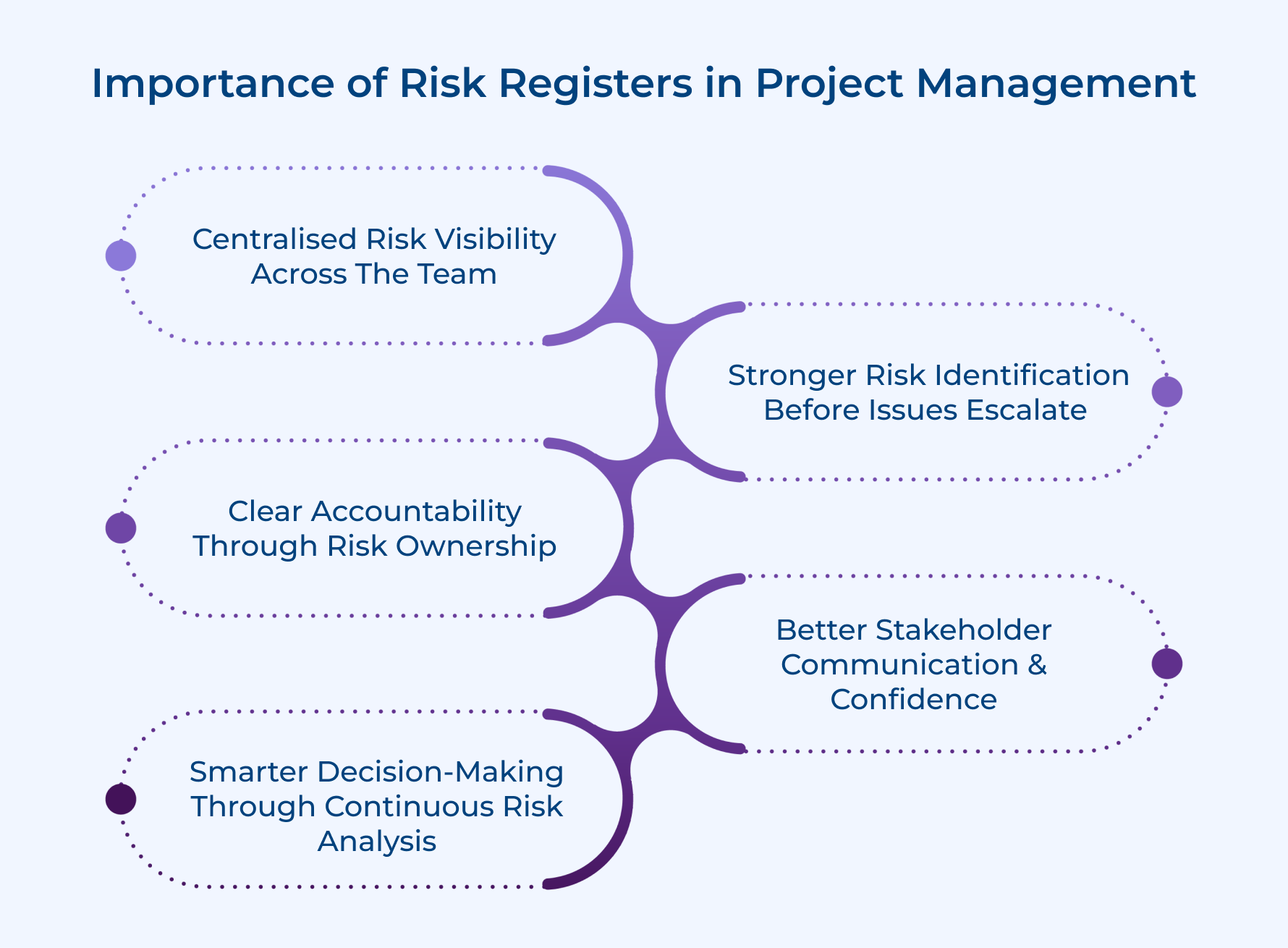
1. Centralised Risk Visibility Across the Team
A risk register in project management gives a unified place to view all identified risks and their current status. It streamlines the decision-making process around prioritisation and response becomes more consistent.
2. Stronger Risk Identification Before Issues Escalate
The process of building a risk register enables structured analysis of what could potentially go wrong at each stage. This early risk identification makes sure that threats are handled before scaling into blocking issues.
3. Clear Accountability Through Risk Ownership
A proper risk log in project management includes individual ownership for handling each threat. Responsibility for monitoring and responding to a specific risk reduces the chance of being ignored.
4. Better Stakeholder Communication and Confidence
Well-maintained risk documentation creates a trail that teams can present during stakeholder reviews. It displays how the risks are being managed, leading to building trust as well as reducing back-and-forth.
5. Smarter Decision-Making Through Continuous Risk Analysis
Situations when your project evolves or moves from one stage to another, new risks emerge. Regularly updating it allows teams to re-analyse risks with current data. It makes every decision grounded and proactive.
What are the Common Risk Scenarios in a Risk Register?
Every project carries its own uncertainties and knowing these risk patterns helps teams build a sharper as well as more targeted register.
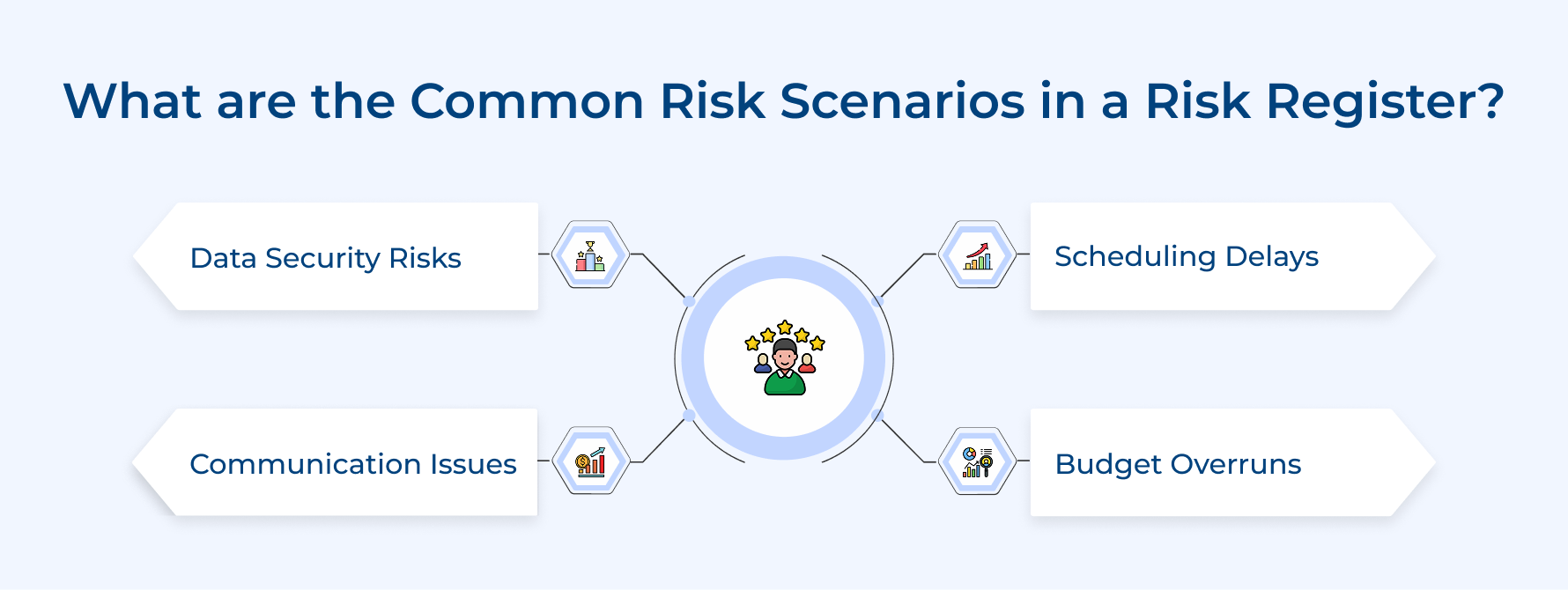
1. Data Security Risks
Data breaches and unauthorised access are damaging threats a project can face today. A small security gap compromises deliverables, exposes sensitive information and triggers compliance failures across the entire project.
So what makes data security risks tricky? It often goes undetected until the damage is done. Log them early in the project risk register, along with clear ownership to separate reactive teams from prepared ones.
Key data security risks log in your register:
- Unauthorised access to project files shared across third-party platforms
- Weak authentication that exposes internal systems during collaboration
- Unencrypted data transfers among vendors or cross-functional teams
2. Communication Issues
What do you think slows projects down? Not only that, but it also quietly creates risks that scale over time. Situations when updates are missed and decisions are made without full context, the project starts drifting without realising..
Common communication-driven risks worth capturing:
- Misaligned commitment between stakeholders due to inconsistent risk status updates
- Critical decisions made without looping in the right approvers
- Unclear reporting chains within the team structure lead to risk escalation.
3. Scheduling Delays
So what actually causes a project timeline to collapse? More often than not, it is not one big event — it is a chain of small, untracked risks that were never entered into the risk register in the first place.
A delayed schedule is like a snowball which piles up to become a threat and needs reworking. Capture this risk early to give your team a fighting chance to intervene before it is too late.
4. Budget Overruns
Budget overruns are warning signs that are almost always there, just not tracked formally. A structured risk register in project management pays for itself, making financial risks visible before affecting real costs.
Does your team revisit budget assumptions when scope changes? No, the gap is where overruns silently start. A proper ownership for risk ensures someone is actively watching and managing cost triggers.
How To Create a Risk Register? 7 Actionable Steps
Below are key actionable steps to create a risk register that is not about only filling a template but creating a system with proper management that actually works.
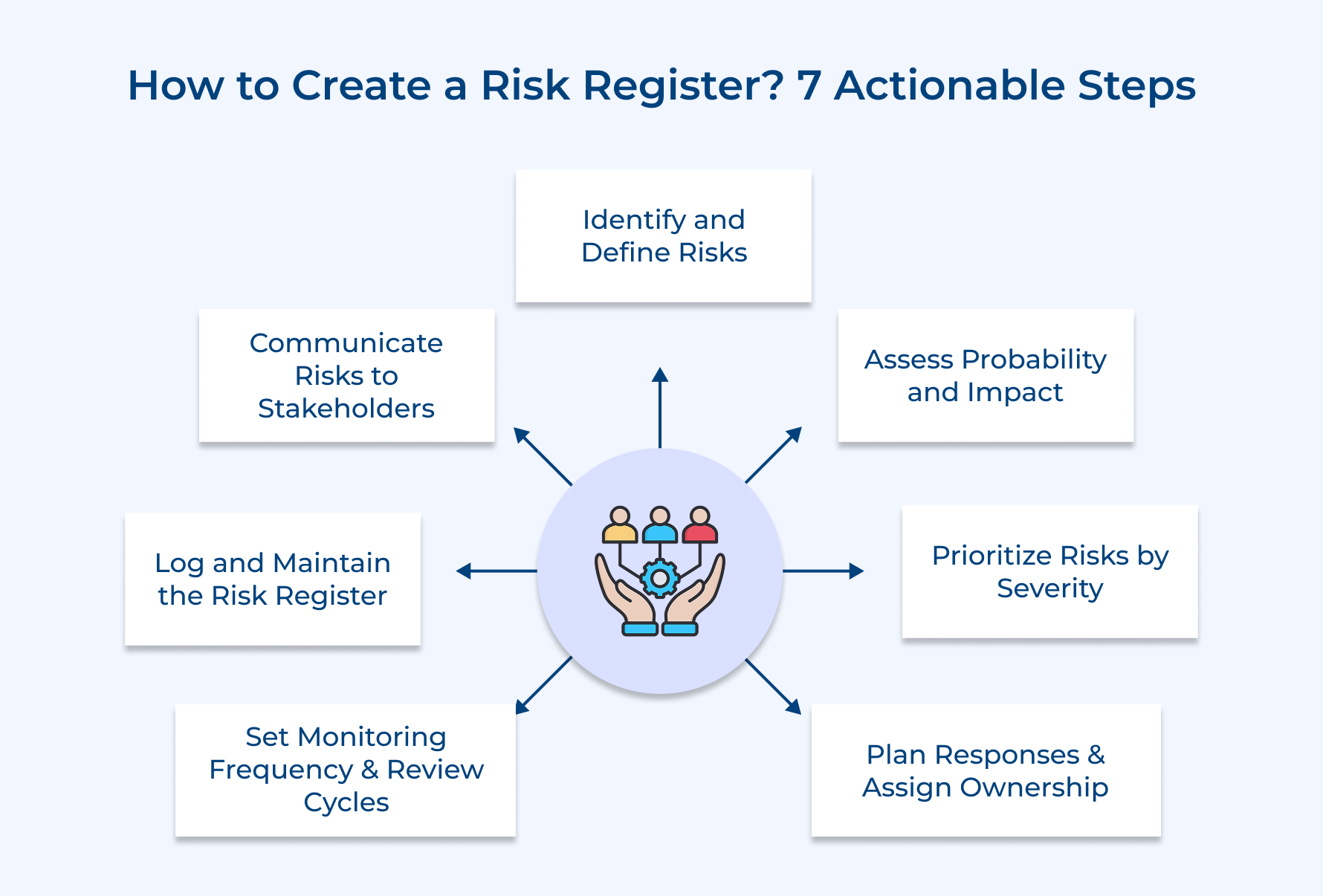
1. Identify and Define Risks
Risk identification is the key to every reliable risk register and skipping it means every step is built on guesswork. It goes beyond obvious threats to examine dependencies and assumptions that most teams skip.
Follow these proven methods for identifying risks:
- Brainstorming sessions: maintain proper cross-functional team collaboration to identify risks from every angle.
- Historical data review: Analyse past similar projects to identify patterns that cause repeats across engagements.
- Risk breakdown structure (RBS): Make proper segmentation in projects to systematically trace risks within each layer.
Once risk identification is done, it’s time to define them inside the register, but how? Each risk needs a proper description, for example, not “resource issue” but “key developer unavailable due to project demands.” It makes the register actionable and clearer.
Pro Tips:
- Never define a risk and cause in the same field instead, maintain separate entries.
- Review identification frequently, as new risks can emerge as the scope evolves.
2. Assess Probability and Impact
The next step after risk logging is all about understanding the frequency of each one to occur, separating a passive risk log from a register that drives real decisions. Apply both qualitative and quantitative methods to get a clear view of each risk.
Qualitative methods to assess risk:
- Probability-impact matrix: risks are plotted on each grid to separate high-priority threats from manageable ones.
- Risk scoring scales: Use three levels of rating, High, Medium, Low, to categorise risks across the team.
Quantitative methods to assess risk:
- Expected monetary value (EMV): Allocate a numeric cost to each risk to multiply probability by the financial impact.
- Monte carlo simulation: Scenario-based models to understand the range of project outcomes.
Once individual ratings are assigned, cross-validate scores with experts to identify underestimated ratings before they distort the priority list. Also, document the assumptions for each risk score to use it as a future reference at the time of assessment.
3. Prioritize Risks by Severity
Before proper risk management, consider that not every risk in the register needs the same level of attention. Prioritise effort toward the risk that is a threat to the project.
What factors should guide prioritization? It truly depends on:
- Cost
- Timeline
- Speed of onset
- Team’s response capacity
A moderate-probability risk with a rapid onset is more dangerous than a high-probability risk. Consider these key methods to prioritise risks by severity:
- Heat map visualization: Plot risks on a grid to communicate urgency across the team.
- Inherent vs residual risk comparison: Assess risk levels before and after controls to explore remaining exposure.
- Critical path alignment: Prioritize risks that threaten activities on the critical path.
4: Plan Responses and Assign Ownership
Every risk management needs a proper response strategy along with an owner, as without this, even a detailed risk register in project management fails. It converts your register from a tracking document into a decision-making reference.
How to plan responses and assign ownership?
- Avoid, mitigate, transfer or accept: Define a strategy based on severity and team capacity that eliminates the risk, while mitigation reduces it to a manageable level.
- Domain-based ownership assignment: assign an owner for each direct control over that area.
- Contingency budget allocation: Define a financial buffer against high-severity risks, as waiting till the risk surface naturally consistently leads to cost overruns.
So, what happens when no one wants to take a risk? Assign risk to the team member of the same project. It becomes a natural flow of the team’s operations.
5. Set Monitoring Frequency and Review Cycles
A risk register becomes a static document when not actively reviewed. Risks change their probability and impact as the project evolves. Define a monitoring cadence to make sure the register reflects the current state of the project.
What does an effective monitoring structure look like? It is all about matching review frequency to risk severity and project phase, like:
- High-severity risks need weekly attention
- Low-priority risks follow a milestone-based cycle.
Start defining your monitoring structure based on these questions:
- How often should each risk be reviewed? It depends on severity, as high-priority risks need weekly reviews while medium to low risks need a two to three-day review.
- Who is responsible for flagging status changes? After each review, the risk owner updates the register, as verbal updates do not count.
- What does a completed review actually produce? Updated probability ratings, revised response plans and a record of all changes.
6. Log and Maintain the Risk Register
Consistency of logging separates a risk documentation that gets used from one that is ignored. The register loses credibility and stops referencing when entries are updated only when something goes wrong.
Maintain a risk register in project management as an ongoing discipline. Every status change and every new risk identified mid-project needs a proper timeline. It also needs the name of the person who made the update.
A well-maintained documentation should always include:
- Risk ID and Description: A unique identifier combined with a specific risk statement.
- Current Status: The risk is open or being monitored for a proper response to be activated.
Pro tip: Archive closed risks instead of deleting them. These closed entries make the register a reference asset for future projects instead of a document discarded at close.
7. Communicate Risks to Stakeholders
Risk communication is where many teams lose. They maintain the register internally, but keeping stakeholders overwhelmed with detail or being too far from the actual risk picture does not work.
A Structured risk communication includes three levels:
- Executive-level view: Share a risk dashboard that includes all the top risks based on severity, response status and risks escalated. Keep financial exposure figures and decisions clearly visible.
- Team-level register access: The delivery team needs direct access to the register along with permissions to update risks. A proper weekly standup includes a two-minute risk flag for owners to identify status changes.
- Client-level filtered view: Risks that directly affect timelines or contracted costs. Frame communication around what is being done instead of what is wrong.
The most common failure in communication is treating it as an update. A risk review should produce:
- Contingency budget approvals
- Scope change sign-offs
- Escalations to leadership.
Situation when a risk communication meeting ends without a decision means it has not served its purpose.
How To Maintain a Risk Register Effectively: 5 Strategies
Want to make your register valuable? Follow these six best practices to keep your risk register accurate, relevant and useful across the project lifecycle.
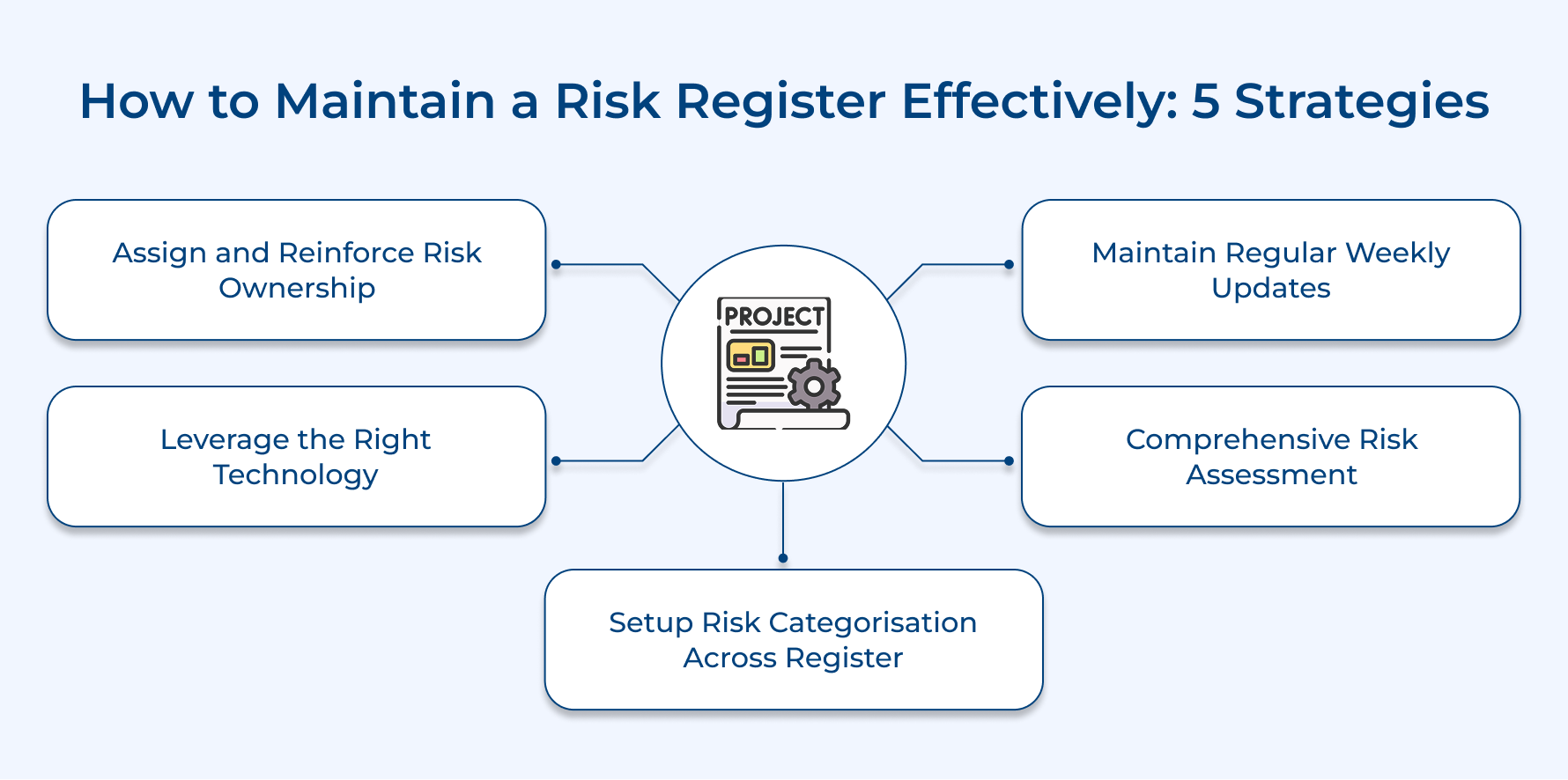
1. Maintain Regular Weekly Updates
Most teams create a risk register at kickoff and revisit it at the time of delivery. The gap is exactly where projects get missed. It needs scheduled updates into the project rhythm and not treating it as an afterthought.
What triggers an update outside scheduled reviews? Any changes in scope or resource shift immediately prompt a review of affected entries. Updates that must happen after the project event:
- Define probability ratings when a dependency changes.
- Log new risks that are identified during client feedback.
- Close risks that are no longer relevant.
2. Comprehensive Risk Assessment
A risk assessment is one of the common reasons the register fails to prevent issues, but identifying a risk as “high probability” without understanding the cause gives the team an incomplete picture.
So, how deep a risk assessment goes? Each entry should capture conditions that cause the risk to project elements and it should affect the level of analysis..
A comprehensive risk assessment covers:
- Root cause analysis: Identify the underlying condition that makes this risk possible.
- Trigger identification: Define the warning signal that indicates the risk of becoming active.
3. Setup Risk Categorisation Across Register
Log all risks in a flat list, which forces the team to read the entire document every time they need to focus on a specific area. Categorization brings structure to the register and makes it faster to navigate as well as act on.
What categories work best? Technical, resource, commercial, external and compliance risks are some of the best categorisations for risk documentation.
A practical framework includes:
- Known risks: Identified across historical data with defined response plans in place
- Known unknowns: Acknowledge as possible, but identify for deeper assessment
- Emerging risks: New risks identified mid-project need immediate ownership
Every project does not need the same category structure. Teams that use a fixed template across multiple project types generate more noise than clarity.
4. Leverage the Right Technology
Spreadsheet-based registers work at a small scale, but once a project involves multiple workstreams, manual tracking creates version control issues. The right risk register tool keeps teams running from the same data.
A good risk register should automate status reminders, flag risks and generate dashboards that stakeholders can access without the full register. The automation layer keeps a register actively maintained.
Below are the core capabilities to look for:
- Real-time collaborative editing for teams to update the same register simultaneously
- Automated notification when a risk’s review date passes or changes
- Role-based access for stakeholders to see only risk data relevant to the level
A dedicated risk register tool also ensures consistent entry so that every team member follows the same structure instead of adapting the format to personal preference. It is important when transitioning the project between delivery leads.
5. Assign and Reinforce Risk Ownership
A risk register without a named owner is an unmanaged risk identified during project management. Ownership determines whether a risk gets monitored or ignored until it scales to an issue.
So who should own the risk? A person with direct operational control over the task where the risk appears. For example, if you assign a senior stakeholder to technical risk, they will directly deprioritise it as it is not their expertise.
An effective risk ownership looks like:
- The owner monitors early warning indicators between review cycles
- Status updates appear directly from the owner instead of secondhand through the project lead
What is Included in a Risk Register in Project Management?
Below are the core components that form a complete risk register for better project management.
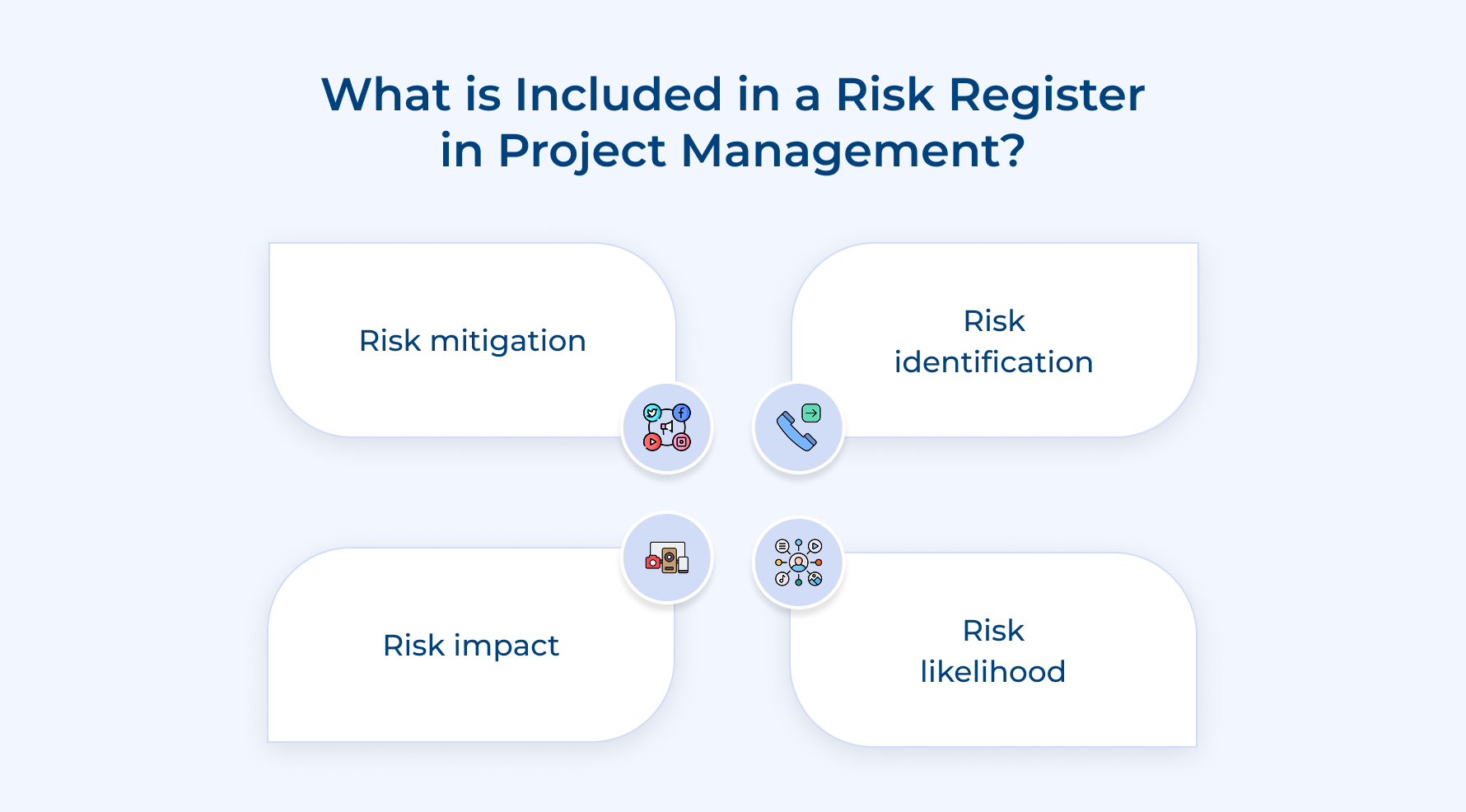
- Risk identification: Each risk entry starts with a clear identification, such as a unique ID, a precise description and the project area it belongs to. Vague entries like “technical issue” are the placeholders that delay response planning.
- Risk likelihood: A probability rating is needed for each identified risk that reflects its potential to occur in the future based on current project conditions. It should be revisited at a proper review cycle.
- Risk impact: Each risk needs a score that captures the severity of the risk across cost, timeline and quality. Track both likelihood and impact to produce the priority score that guides the team’s focus on attention.
- Risk mitigation: A risk without a mitigation plan is just a list. Each captures the chosen response strategy that is avoiding, transferring or accepting the risk with specific actions to execute the response.
Common Pitfalls in Risk Register Management and How to Overcome
Even well-structured projects fall into traps when managing a risk register, so identifying these early keeps your team ahead of risk.
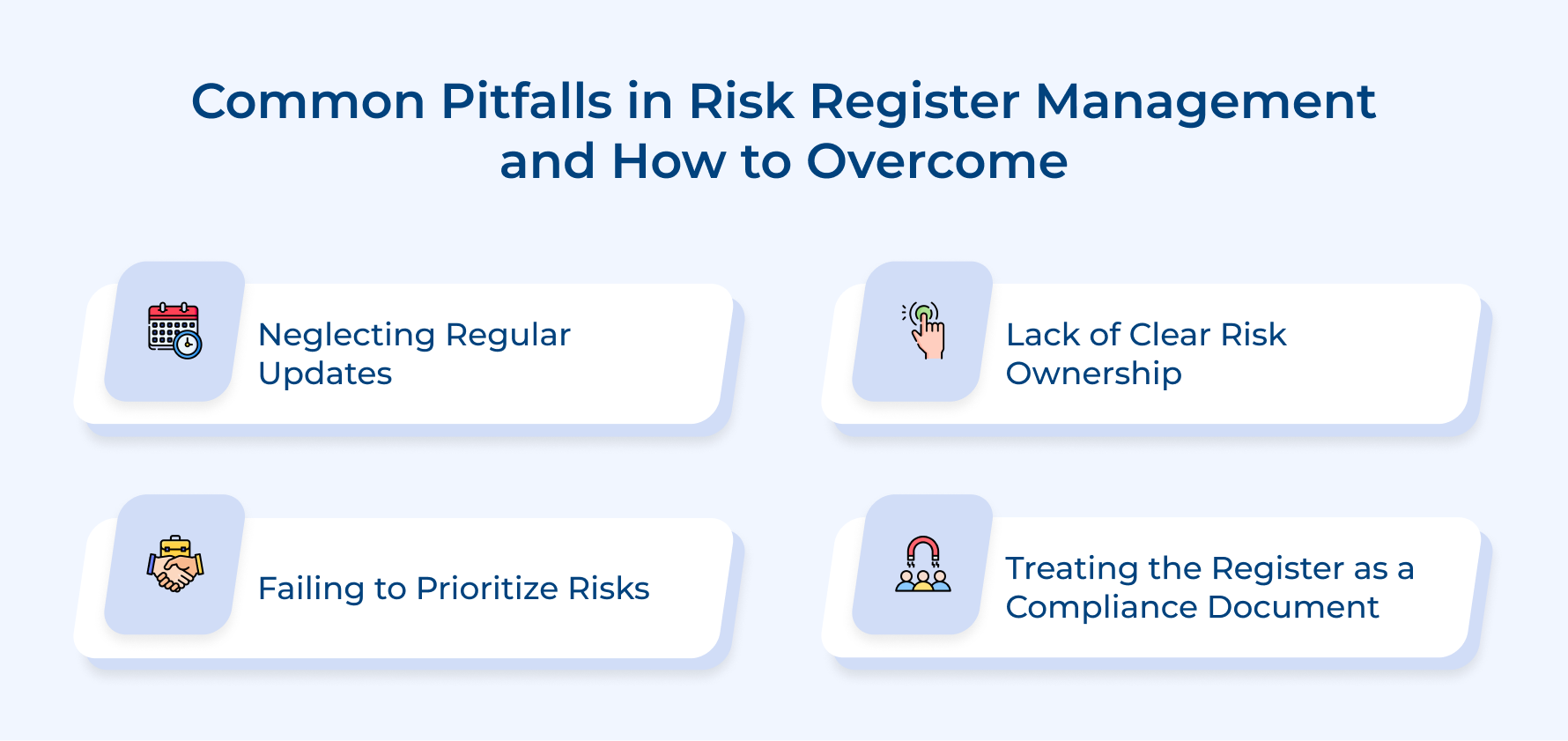
Neglecting Regular Updates
A risk register that is not regularly updated creates a false sense of control. Teams treat it as a one-time setup document and get caught off guard by risks that shifted in long before.
Failing to Prioritize Risks
Treat every risk with the same urgency and make your team’s thinking ability simple. High-severity risks sit alongside critical threats and get the same response time without a clear prioritisation framework.
Lack of Clear Risk Ownership
Risk without proper ownership is effectively owned by no one. It rarely gets monitored between review cycles. It is the common reason for risks escalating into live issues that the team has already identified.
Treating the Register as a Compliance Document
Many teams build a register because the methodology is needed, not because they use it actively. A risk register that exists to satisfy a process requirement loses value almost immediately after creation.
Consider these direct solutions to the most common failures:
- Schedule non-negotiable review cycles to project milestones so updates are performed by default.
- Build a priority scoring system to make sure every risk is ranked before it is logged.
- Assign proper ownership by linking each risk to the role responsible for the project area.
- Include the register within weekly project rituals to make it function as a live decision-making tool.
Risk Register Example in Project Management for Business
Below are the risk log examples that help teams with proper structure management in a real project context.
Third-Party Vendor Delays Delivery of Design Assets
- Risk description: The third-party vendor manages the delivery of design assets to meet the agreed-upon timeline.
- Impact: Key design phases to push dependent tasks beyond their scheduled start dates.
- Mitigation steps: Build a buffer into the project schedule and identify a backup vendor before the project design phase starts.
- Owner: The Project Manager monitors vendor delivery milestones and activates the backup plan when deadlines are missed.
Key Developer Becomes Unavailable Mid-Project
- Impact: Development velocity drops significantly, which puts sprint deadlines and the overall delivery timeline at risk.
- Probability: The likelihood is medium given the current resource demand across the portfolio.
- Mitigation steps: Identify and brief a secondary developer on the project from week one to maintain proper handover.
- Owner: The Delivery person is responsible for managing resource availability to identify conflicts that affect sprint output.
Keep Your Project on Track with Proactive Risk Management
A well-maintained risk register in project management is the foundation that keeps teams informed and prepared at each project stage. The building process comes down to a consistent execution across identification, prioritization and communication.
- A register is only important when actively maintained, instead of only being created at kickoff
- Every risk entry needs proper ownership, a response plan and a scheduled review cycle
- The right risk register tool eliminates the issue of version control while keeping teams aligned
Ready to strengthen your project’s risk process? Start using a project risk log register template or explore a dedicated risk management tool that fits the team’s workflow. A project team that regularly updates the register will always be in a better position to deliver on time and within budget.
Limit time — not creativity
Everything you need for customer support, marketing & sales.

Neeti Singh is a passionate content writer at Kooper, where he transforms complex concepts into clear, engaging and actionable content. With a keen eye for detail and a love for technology, Tushar Joshi crafts blog posts, guides and articles that help readers navigate the fast-evolving world of software solutions.