How to Create a Work Breakdown Structure (WBS) Easily
- What is the Work Breakdown Structure (WBS) in Project Management?
- Importance of Work Breakdown Structure in Project Management
- How To Create A Work Breakdown Structure in 7 Quick Steps
- Types of Work Breakdown Structures in Project Management
- Levels of Work Breakdown Structure in Project Management
- Key Components of a Work Breakdown Structure in Project Management
- Work Breakdown Structure Examples in Project Management
- Key Benefits of Using a Work Breakdown Structure
- Simplify Your Projects with a Work Breakdown Structure, Tools and Templates
- FAQs about Work Breakdown Structure

Key Highlights:
- A work breakdown structure transforms overwhelming project scope into clear, manageable and assignable pieces for every team.
- A poorly defined work package is the number one driver of scope creep in professional services environments.
- The four levels of a work breakdown structure move from total project scope down to individual assignable subtasks.
Most projects don’t fall apart because the team didn’t work hard enough. They fail because nobody took the time to break the scope down clearly before work began. That one planning gap alone is responsible for countless hours of rework, blown deadlines and budget overruns that nobody saw coming.
That’s exactly why a work breakdown structure matters!
A work breakdown structure takes the overwhelming whole of a project and slices it into clear, manageable pieces that your team can actually act on.
This guide covers everything you need to know – what a work breakdown structure is, what goes into one and a step-by-step process for building one yourself, with real examples along the way.
What is the Work Breakdown Structure (WBS) in Project Management?
A Work Breakdown Structure (WBS) is a hierarchical decomposition of a project into smaller, manageable components called work packages. It visually organizes the total scope of work into structured levels so every deliverable is clearly defined and assigned.
What is the Purpose of a WBS?
The core purpose of a WBS is to break down complex project scope into smaller pieces that are easier to plan, execute and monitor. It gives every team member a clear picture of what needs to be delivered and who is responsible for it.
A WBS also acts as the backbone of project planning by connecting scope directly to schedule, cost and resources. Without it, projects tend to drift into scope creep as well as missed deliverables because accountability is never clearly established.
Key objectives of a WBS:
- Scope clarity: A WBS defines every deliverable within the project so nothing is left ambiguous or overlooked.
- Accountability assignment: It maps each work package to a responsible team or individual for clear ownership.
- Progress tracking: It provides a structured baseline to measure actual progress against planned deliverables.
- Risk identification: Decomposing the project into smaller components makes it easier to spot potential risks at an early stage.
Importance of Work Breakdown Structure in Project Management
A WBS is the structural foundation that determines whether a project stays in control or delivers on its promise. Teams that invest time in building a solid WBS consistently see stronger outcomes across scope, cost and stakeholder satisfaction.
Here is what the data says about projects that use proper structure and planning:
- Projects with a defined WBS are more likely to meet their original scope and budget targets.
- Professional services firms that use structured work breakdown models report faster project delivery compared to teams relying on informal planning methods.
- Consultancies that implement WBS in their delivery models are 2.5x more likely to complete engagements within budget and with higher client satisfaction scores.
Projects built on a clear WBS give teams a shared understanding of scope that directly improves execution speed and stakeholder confidence. The structure does not just organize work, it becomes the single reference point that keeps every team member aligned from kickoff to closure.
How To Create A Work Breakdown Structure in 7 Quick Steps
This guide will walk you through seven essential steps to develop a WBS that will drive your project to success. Get ready to transform overwhelming projects into streamlined workflows.
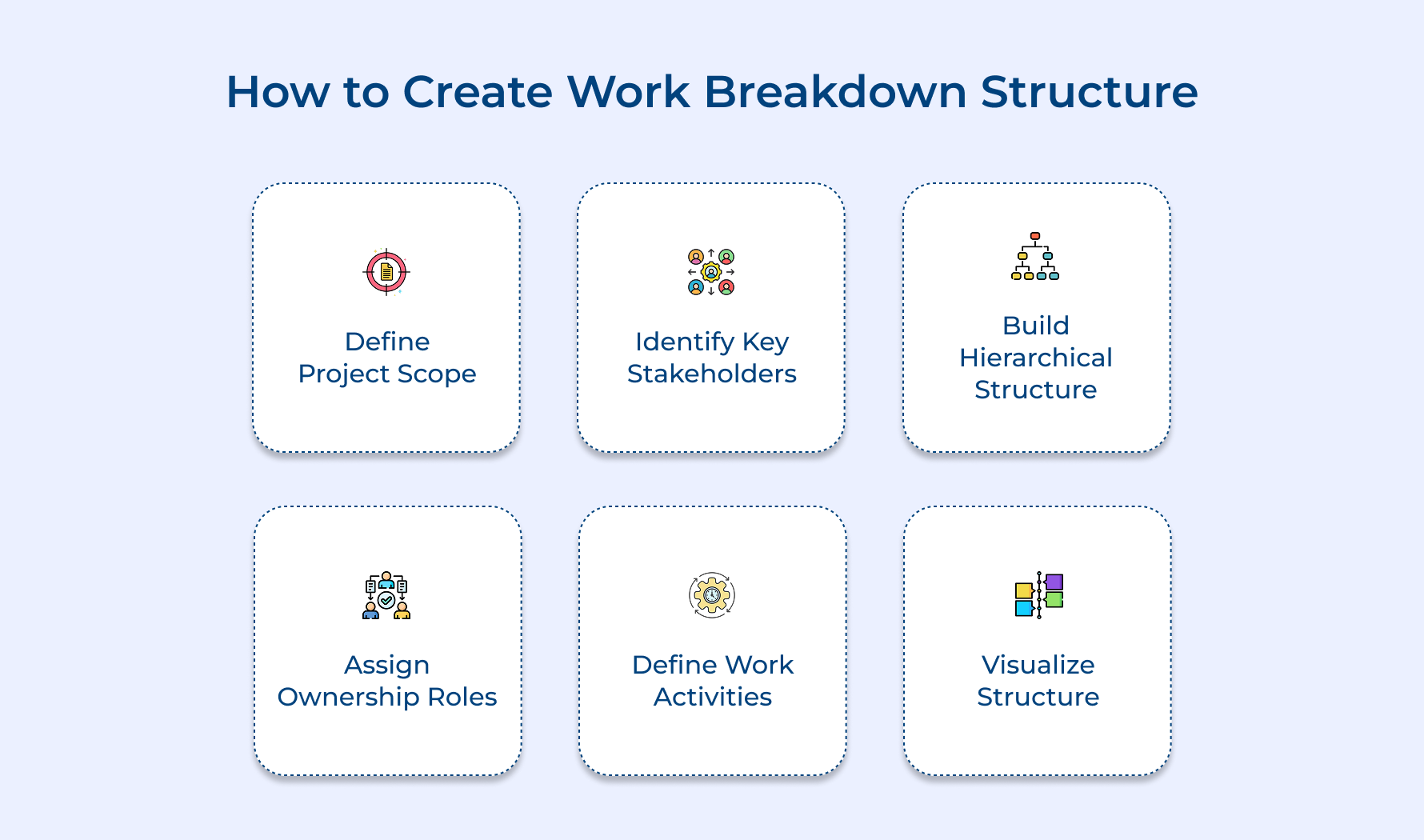
1. Define Project Scope and Identify Deliverables
Every WBS starts here. Without clear boundaries, the entire structure gets built on assumptions and every deliverable you identify at this stage becomes a direct input into the levels below it.
Here are 3 effective ways to define scope and identify deliverables:
- Scope statement documentation: Write a formal scope statement that captures what the project will produce and explicitly calls out what falls outside the boundary. This becomes the reference point for every scope decision made throughout the lifecycle.
- Stakeholder deliverable mapping: Sit with key stakeholders and map every expected output from their perspective before building anything. This surfaces hidden deliverables early – the kind that would otherwise show up mid-execution as unplanned scope additions.
Skip this step and the hierarchy ends up reflecting your team’s assumptions rather than actual project intent. Every level below it inherits that ambiguity and rework during execution becomes almost inevitable.
2. Identify and Engage Key Stakeholders
Getting the right stakeholders involved before building your WBS ensures no critical deliverable or dependency gets missed. Each stakeholder brings a different lens and that lens directly shapes how accurate your structure ends up being.
Use this checklist to map your stakeholders:
- Who owns the final deliverable and signs off on completion?
- Which teams are directly contributing effort or resources?
- Who gets impacted by project outcomes even if not directly involved?
- Which departments hold budget authority over specific work packages?
Once you have the map, the most effective way to engage stakeholders is through a structured WBS workshop where each person validates deliverables within their domain. That’s what turns the WBS from a top-down document into something the whole team actually owns.
Pro tips:
- Document stakeholder input during workshops and get written sign-off on their sections.
- Revisit the stakeholder map whenever scope changes, the right people need to be re-engaged immediately.
3. Create a Hierarchical Structure Using Work Types
The decisions made here determine how manageable and trackable the project will be, so each level needs a clear purpose – not just visual depth.
Go too deep too early and you create unnecessary complexity. Stay too shallow and your work packages become too broad to estimate or assign reliably.
Here’s how the hierarchy breaks down:
- Level 1 – Project: Total scope as a single node.
- Level 2 – Deliverable or phase: Major outputs defining primary accountability.
- Level 3 – Work package: Assignable units with defined scope and ownership.
- Level 4 – Activity: The activity level where granular tasks live with individual timelines that feed directly into schedule development.
The most common mistake? Teams mirror their org chart instead of their scope structure. It looks organized, but it doesn’t reflect how work actually needs to flow.
4. Assign Ownership and Define Accountability Per Work Package
Ownership is what converts a WBS from a planning document into an accountability framework. Every work package without a named owner is a gap waiting to become a delivery risk.
Here are 2 effective methods for assigning ownership:
- RACI mapping per work package: Assign a Responsible, Accountable, Consulted and Informed matrix to each work package directly in the WBS dictionary. This eliminates ambiguity and ensures everyone knows their exact role.
- Single point of accountability rule: One owner per work package, no exceptions. Shared ownership almost always leads to shared inaction when problems surface during execution.
The real challenge is that people accept ownership during planning but disengage when competing priorities hit. The fix is to build formal check-in points into the WBS schedule so accountability gets actively reinforced, not just assigned once.
Here’s how ownership looks in a real website redesign project:
- The content team owns copywriting and messaging work packages.
- The design team holds accountability for all visual and UX deliverables.
- The development team is assigned every build and integration work package.
5. Define Activities Within Each Work Package
Each work package transforms into a sequence of executable actions, bridging the gap between what needs to be delivered and how the team will actually deliver it.
Most teams list activities based on what feels logical rather than validating against effort data from similar past projects. That’s why schedules look complete in planning but collapse under real execution pressure.
Run every activity through this checklist before locking it in:
- Does it have a single clear output that confirms completion?
- Has the effort estimate been validated by the person doing the actual work?
- Are dependencies identified and sequenced correctly?
- Is it small enough to complete within one reporting cycle?
Capturing accurate task information at this stage (owner, effort, dependencies) is also what makes milestone tracking reliable later. Activities that pass this checklist become solid inputs for resource planning. Those that don’t will compound into delays the moment execution begins. When you add task entries that haven’t cleared this filter, you’re essentially scheduling future rework.
6. Visualize the Work Breakdown Structure
Visualization makes scope tangible and gives every team member a shared reference point that written documents alone can’t provide. The format you choose directly impacts how well the team navigates the structure during execution.
A tree diagram works best for stakeholder communication and executive reviews. An outline format suits large, complex projects where deep decomposition makes a tree diagram visually unmanageable.
Here are the most effective formats in practice:
- Tree diagram: Displays the full hierarchy visually – ideal for stakeholder presentations and scope reviews.
- Outline format: Uses numbered indentation to represent levels – best for complex projects with deep decomposition.
- Spreadsheet-based WBS: Combines scope structure with budget and timeline data in one view – practical for teams that need everything in a single place.
Treat this as a living reference, not a static document. A WBS that doesn’t reflect the current state of the project stops being helpful and starts being misleading.
Types of Work Breakdown Structures in Project Management
Understanding the right type of WBS to use can completely change how a project gets planned and executed. Choosing the wrong structure leads to confusion in ownership and delivery gaps.
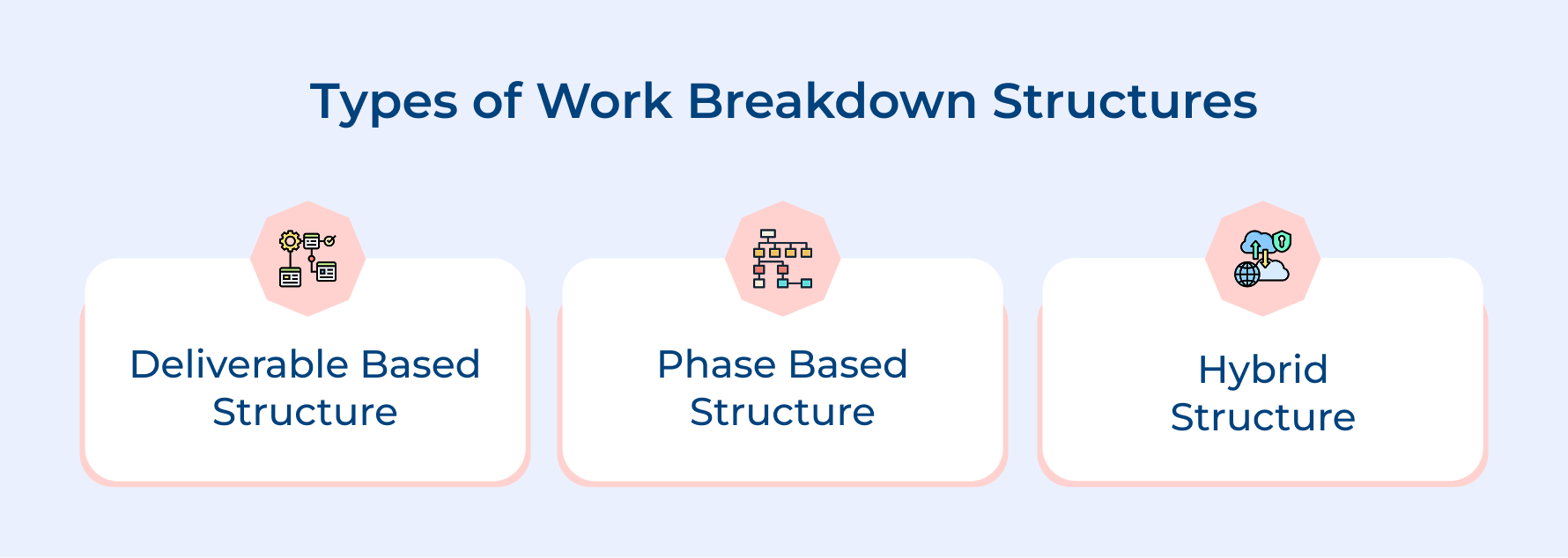
1. Deliverable-Based Work Breakdown Structure
A deliverable-based WBS organizes everything around tangible outcomes. Every branch in the structure represents a completed output – something real that gets handed off. It’s the most preferred approach because stakeholders care about what they receive, not how many meetings happened along the way.
Think about a software launch. The WBS branches into modules like UI, backend and testing – each treated as a standalone deliverable. That clarity makes scope verification during client sign-off straightforward and it keeps risk management simple because you always know exactly what’s been completed as well as what hasn’t.
Here’s what makes a deliverable-based WBS work so well in practice:
- Outcomes stay front and center. The focus never drifts toward activities for their own sake, which means teams stay aligned on what actually moves the project forward.
- Scope control becomes manageable. It acts as the single source of truth for change management, so when something shifts, the impact on project costs is immediately visible rather than discovered weeks later.
2. Phase-Based Work Breakdown Structure
A phase-based WBS structures the project around sequential stages where each phase wraps up before the next one kicks off. If you’re working in a regulated or compliance-heavy environment, this structure brings the process discipline those settings demand.
Each phase in this model is essentially mutually exclusive – work in one stage doesn’t bleed into the next, which keeps approvals clean and accountability clear.
Here’s where a phase-based WBS genuinely earns its place:
- Stage-gate processes fit naturally. Large enterprises that require formal approvals between phases will find this structure aligns with how decisions already get made.
- Financial discipline improves. Budget and resource management can be controlled phase by phase, so spending doesn’t get front-loaded or misallocated across the timeline.
3. Hybrid Work Breakdown Structure
Some projects are simply too complex for one structure to handle cleanly. That’s where a hybrid WBS blends the deliverable-based and phase-based approaches to manage projects where phase dependencies as well as deliverable expectations run at the same time.
Take an ERP implementation. The project naturally follows phases like discovery and configuration, but each phase still produces specific deliverables that stakeholders need to review and approve. Mapping the critical path through a hybrid structure also becomes more precise because you can see both the sequential phase dependencies and the deliverable milestones sitting inside them.
Knowing when to blend both structures is honestly what separates experienced practitioners from those who treat WBS as a box-checking exercise. Real projects are messy and a hybrid WBS is built for exactly that.
Levels of Work Breakdown Structure in Project Management
Getting this right is what separates a WBS that actually guides execution from one that just looks good in a planning document.
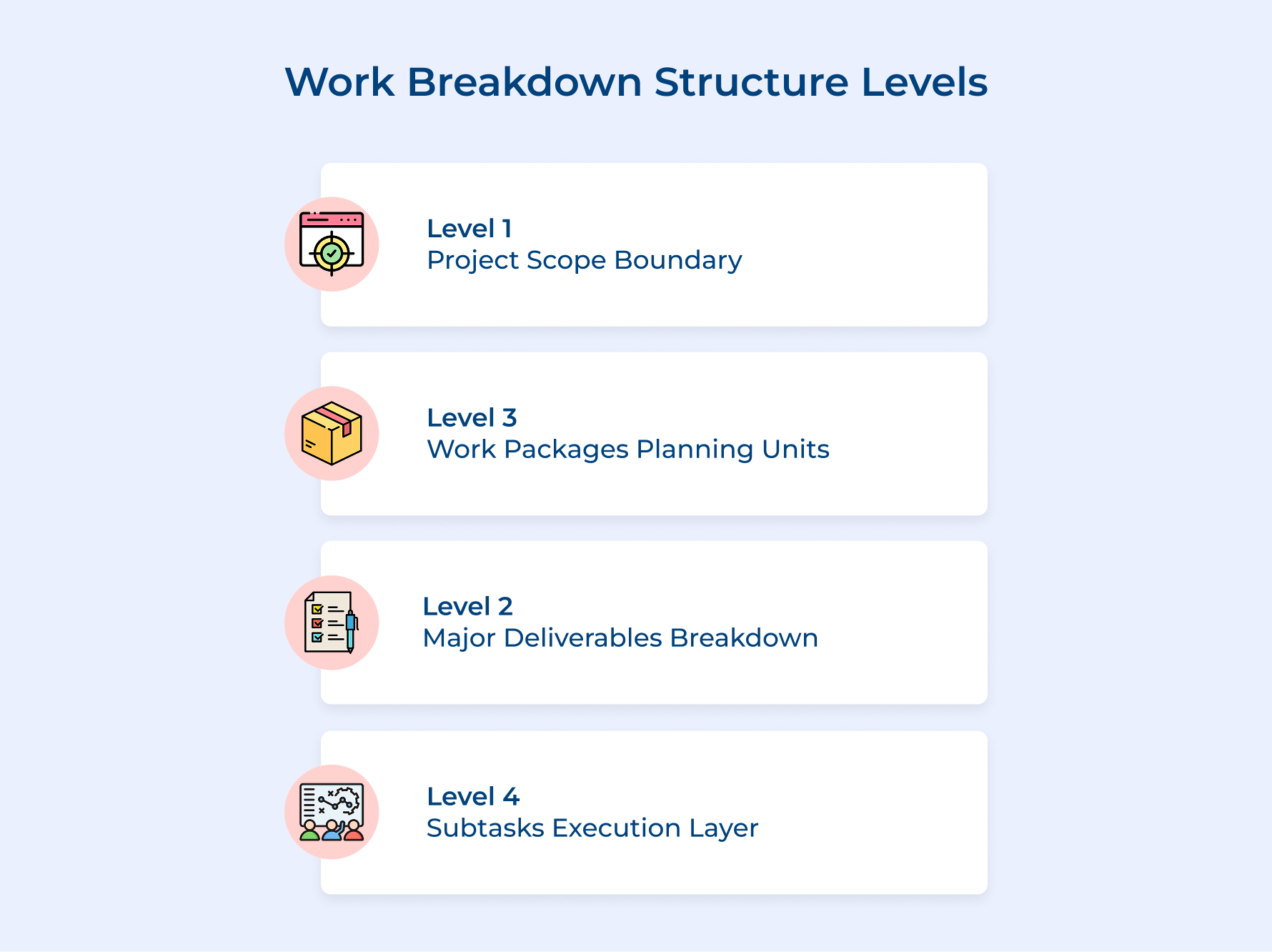
Level 1: The Project (Root Node)
Level 1 is the entire project sitting as a single node at the top of your WBS and it defines the total scope boundary. Think of it as the high-level structure that everything else hangs off. Nothing below it should fall outside this boundary, no exceptions.
Clarity here is non-negotiable. Any ambiguity at Level 1 cascades straight down into every level below it. The project title should reflect the full delivery intent – not a department name, not a vague initiative label.
Level 2: Major Deliverables (The Parent Task)
Level 2 breaks the project into its major deliverables, the primary accountability buckets for your team. Each node here represents a significant chunk of scope that can be owned and tracked independently, similar to how a Product Breakdown Structure separates outputs by category before any execution planning begins.
Here’s how Level 2 looks in a real brand relaunch project:
- Conduct stakeholder discovery workshops
- Define target audience and positioning
- Develop new brand identity system
Level 3: Work Packages (Dependencies and Tasks)
Level 3 is where each major deliverable gets broken into assignable work packages — each carrying its own scope, timeline and resource requirements. This is the true unit of planning / estimation at the execution level and it’s where a business analyst typically gets most involved in validating scope boundaries.
Poorly defined work packages are the number one driver of scope creep, especially in agency and professional services environments. Each package should be small enough to estimate accurately but significant enough to represent a meaningful piece of delivery.
A clean work breakdown structure list at this level makes the difference between a plan your team trusts and one they quietly ignore.
Level 4: Subtasks (Granular Activities)
Level 4 breaks work packages into individual subtasks, specific enough to assign to one person with a clear deadline. This is the execution layer where daily as well as weekly planning actually happens and where task status tracking becomes a reliable signal of project health.
Here’s how Level 4 subtasks look inside a logo design work package:
- Sketch initial concept directions
- Present moodboard for client review
- Deliver final logo files with usage notes
Not every project needs Level 4, but large teams on complex projects absolutely do. Without it, work packages stall because no single person feels directly responsible for moving them forward.
Key Components of a Work Breakdown Structure in Project Management
A WBS is only as strong as the components that hold it together and understanding each one transforms a visual diagram into an executable plan. Weakening any single component creates gaps that surface as delays during execution.
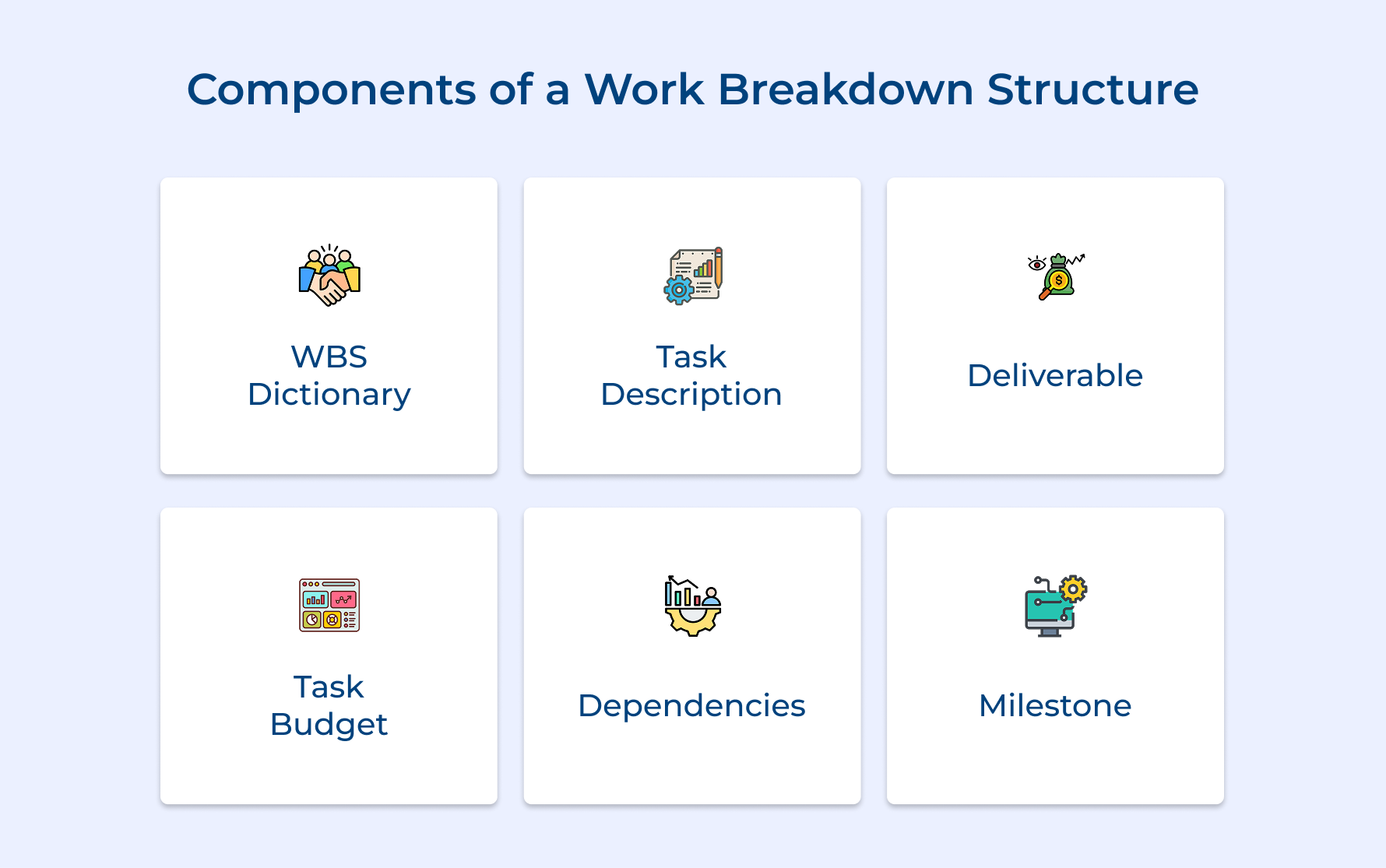
1. WBS Dictionary
The WBS dictionary gives context and definition to every work package making the entire structure actionable rather than just visually organized. It becomes the first reference point whenever a scope question arises during project execution.
Here are the 5 fields every WBS dictionary entry must include:
- Work Package ID: Unique identifier to track and reference each component.
- Scope Description: Clear explanation of what is included and excluded.
- Assigned Owner: The person or team accountable for delivery.
- Estimated Effort: Time and resources required to complete the package.
- Acceptance Criteria: The standard that defines when the work is considered done.
A well-maintained WBS dictionary eliminates back-and-forth conversations that slow teams down during execution. It draws a clear boundary between what is in scope and what is not.
2. Task Description
A task description defines exactly what needs to happen within each work package so any team member can pick it up and execute without confusion. Vague descriptions are one of the most underestimated causes of rework across project environments.
3. Deliverable
A deliverable is the verifiable output that confirms a work package is complete and gives stakeholders something concrete to review. Confusing activities with deliverables makes progress tracking unreliable and complicates client sign-off unnecessarily.
4. Task Budget
The task budget assigns a cost estimate to each work package enabling financial tracking at a granular level. This is what separates teams that catch budget drift early from those who discover overspend only at closure.
Here is what a well-defined task budget should account for:
- Labour costs are tied to estimated effort hours per resource.
- Tool or software costs directly linked to that specific task.
- Buffer allocation for known risks within that work package.
Without budget visibility at work, package level financial control becomes reactive rather than proactive. Teams end up managing total spend without knowing exactly where the overrun is originating.
5. Dependencies
Dependencies define which work packages must be completed before others can begin protecting the entire project schedule from conflict. Mapping these incorrectly during WBS creation creates sequencing problems that are costly to fix mid-execution.
6. Milestone
A milestone marks a critical checkpoint in the project confirming that a significant phase or deliverable has been successfully completed. Unlike tasks, milestones carry no duration — their value lies entirely in validating forward progress.
Work Breakdown Structure Examples in Project Management
These two examples cover different formats so the application is clear across different project environments.
1. Tree Diagram Work Breakdown Structure — Website Redesign Project
A tree diagram WBS maps the entire website redesign scope visually showing how each deliverable branches into work packages and activities.
- Level 1 – Project: Website Redesign and Launch
- Level 2 – Deliverables: Discovery, Design, Development, Content, Testing
- Level 3 – Work Packages: Wireframes, Brand Guidelines, Frontend Build, Page Copywriting, UAT
- Level 4 – Activities: Create homepage wireframe, Develop navigation structure, Write product page copy
- Dependencies: Content must be finalised before development begins and UAT cannot start before build completion
2. List Work Breakdown Structure — Marketing Campaign Launch Project
A list WBS uses a numbered outline format to represent the same hierarchical structure making it easier to manage large scope with deep decomposition.
- Campaign strategy: 1.1 Define target audience, 1.2 Set campaign objectives, 1.3 Finalise messaging framework.
- Creative production: 2.1 Develop visual assets, 2.2 Write ad copy, 2.3 Record video content.
- Media planning: 3.1 Select channels, 3.2 Allocate budget per channel, 3.3 Build campaign calendar.
- Campaign execution: 4.1 Launch paid ads, 4.2 Publish organic content, 4.3 Activate influencer partnerships.
- Performance tracking: 5.1 Set up tracking dashboards, 5.2 Monitor weekly KPIs, 5.3 Compile post-campaign report.
Key Benefits of Using a Work Breakdown Structure
Every tool has its strengths and its friction points as well as a WBS is no different. Understanding both sides helps teams use it more intelligently rather than applying it as a rigid template.
1. Eliminates Scope Ambiguity
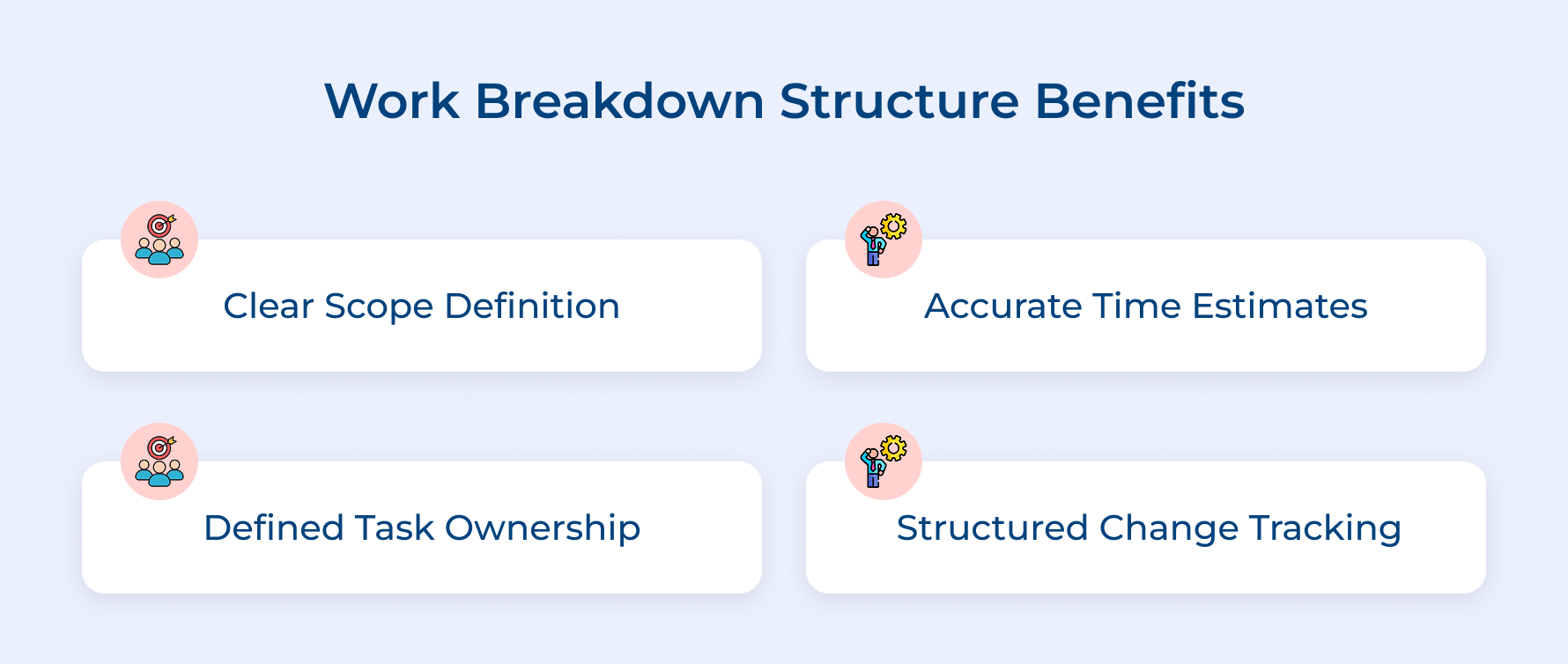
A WBS forces every deliverable to be explicitly defined leaving no room for assumptions that silently grow into unplanned work. Teams with a thorough WBS spend significantly less time debating scope boundaries during execution.
2. Improves Estimation Accuracy
Breaking scope into work packages makes cost and time estimation far more precise than estimating at a total project level. Granular estimation at work package level is what prevents budget surprises that damage client relationships.
3. Strengthens Accountability Across Teams
Assigning ownership at the work package level means every piece of work has a named responsible party with no gaps. This structure removes the ambiguity that allows critical tasks to fall through the cracks unnoticed.
4. Provides a Baseline for Change Control
A baselined WBS gives the project a formal reference point that makes scope changes visible and measurable. Without this baseline teams have no reliable way to assess the true impact of any change request.
Simplify Your Projects with a Work Breakdown Structure, Tools and Templates
A work breakdown structure does a lot more than just organize work. It gives your entire project team a shared language for scope, ownership and delivery accountability. And the teams that struggle most with project delivery? They are almost always the ones who skipped this foundational step.
Starting with the right work breakdown structure tool or template removes the friction of building everything from scratch on every new project. The goal was never a perfect document. It is a clear and agreed structure that keeps everyone aligned from kickoff all the way through to closure.
Limit time — not creativity
Everything you need for customer support, marketing & sales.

Neeti Singh is a passionate content writer at Kooper, where he transforms complex concepts into clear, engaging and actionable content. With a keen eye for detail and a love for technology, Tushar Joshi crafts blog posts, guides and articles that help readers navigate the fast-evolving world of software solutions.