How to Create a Risk Matrix in Project Management
- What is a Risk Matrix in Project Management?
- Benefits of Using a Risk Matrix in Project Management
- 3 Major Types of Risk Matrix in Project Management
- How to Create a Risk Matrix in Project Management in 8 Simple Steps
- Examples of a Risk Matrix Across Different Projects
- Risk Matrix Best Practices in Project Management
- Challenges of a Risk Matrix in Project Management
- Manage Uncertainties with Confidence Using Risk Matrix
- FAQs about Risk Matrix in Project Management

Key Highlights:
- A risk matrix in project management helps teams separate genuine threats from minor hiccups before they derail timelines.
- Plotting risks on a probability-impact grid turns abstract worries into a clear, visual action plan everyone can follow.
- A well-built risk matrix template improves stakeholder communication by making complex risk data instantly understandable without technical expertise.
Most projects don’t fail because of one catastrophic event – they fail because teams couldn’t tell a minor hiccup from a genuine threat until it was too late.
There are always dozens of potential problems on your plate and everything starts feeling equally urgent. You end up chasing low-impact issues while real threats quietly build in the background and eventually blow up your timeline.
A risk matrix in project management cuts through that noise. It ranks threats based on how likely they are and how badly they’d hurt your project, so you always know exactly where to focus first.
What is a Risk Matrix in Project Management?
A risk matrix is a visual tool that helps project managers assess and prioritize potential risks. It plots risks on a grid based on their likelihood of occurrence and potential impact. This simple framework transforms abstract threats into concrete action items that teams can actually address.
How Does The Risk Matrix Work?
The matrix uses two axes to evaluate risks. The vertical axis measures impact severity while the horizontal axis tracks probability. Each risk gets plotted where these factors intersect to reveal its true priority level.
Teams assign numerical or categorical values to both dimensions. A risk with high probability and severe impact lands in the danger zone. Lower-scoring risks might need monitoring but won’t demand immediate resources or attention from your team.
Core objectives:
- Identify risks that deserve immediate attention and which ones can wait for later review.
- Create a shared language for discussing threats so everyone understands what “high risk” actually means.
- Allocate resources efficiently by focusing effort where it matters most to project success.
- Document risk assessments to maintain consistency across different projects and team decisions.
- Enable quick communication with stakeholders through clear visual representation of project vulnerabilities.
Benefits of Using a Risk Matrix in Project Management
Risk matrices turn chaos into clarity. They give teams a practical way to handle uncertainty without getting overwhelmed by endless what-ifs.
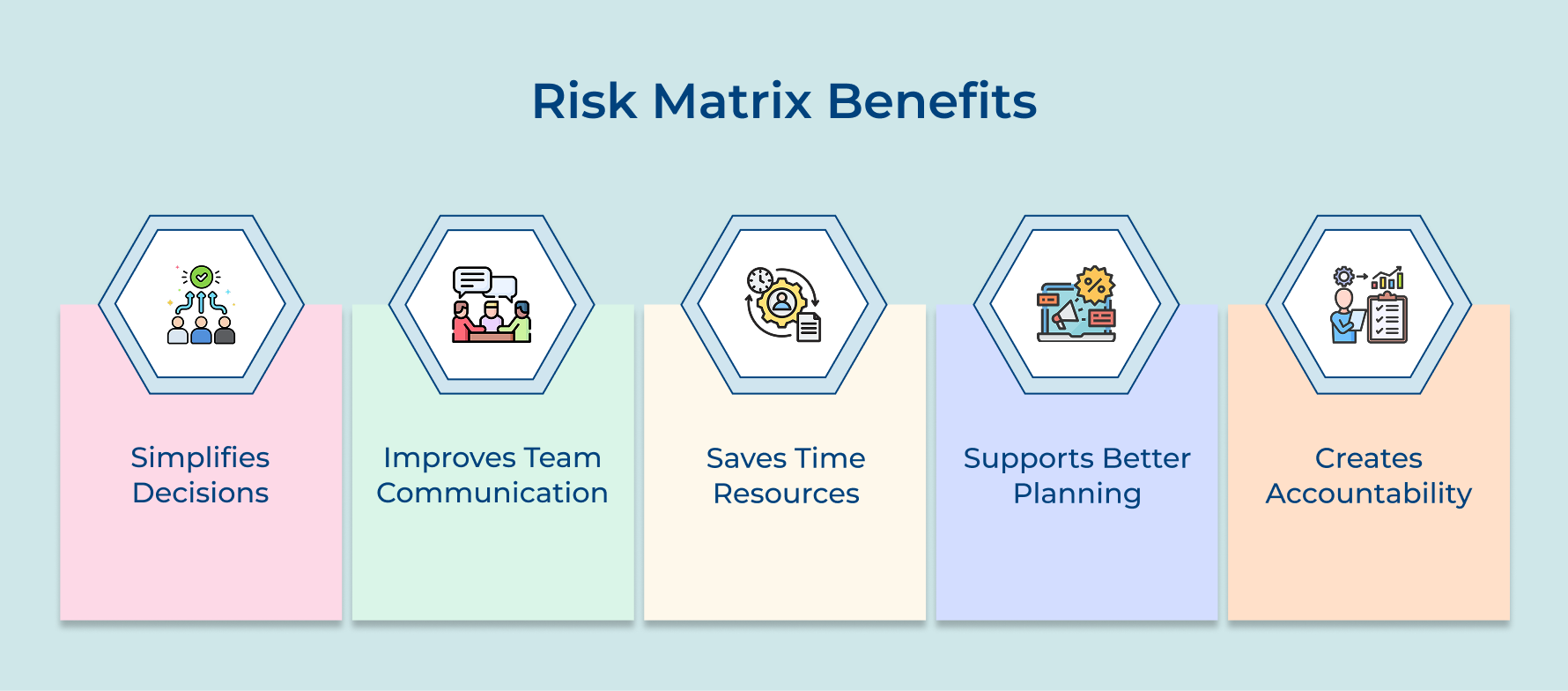
1. Simplifies Complex Decision-Making
The matrix cuts through analysis paralysis by providing a straightforward framework. You can quickly evaluate dozens of risks without needing advanced statistical knowledge or complex modeling tools that slow down your decision process.
2. Improves Team Communication
Everyone sees the same visual representation of project risks. This shared perspective eliminates confusion about priorities and ensures your team members are aligned on what needs attention first.
3. Saves Time and Resources
Instead of treating every risk equally you focus energy where it counts. Low-priority risks don’t drain resources that should go toward preventing or mitigating your most serious threats.
4. Supports Better Planning
Knowing which risks pose the biggest threats helps you build realistic timelines and budgets. You can allocate contingency reserves appropriately rather than making wild guesses about what might go wrong.
5. Creates Accountability
The matrix assigns ownership by making risks visible and categorized. Team members know which threats they’re responsible for monitoring and when they need to escalate concerns to project leadership.
3 Major Types of Risk Matrix in Project Management
Different projects need different approaches to risk assessment. These five matrix types offer flexibility to match your specific project complexity and industry requirements.
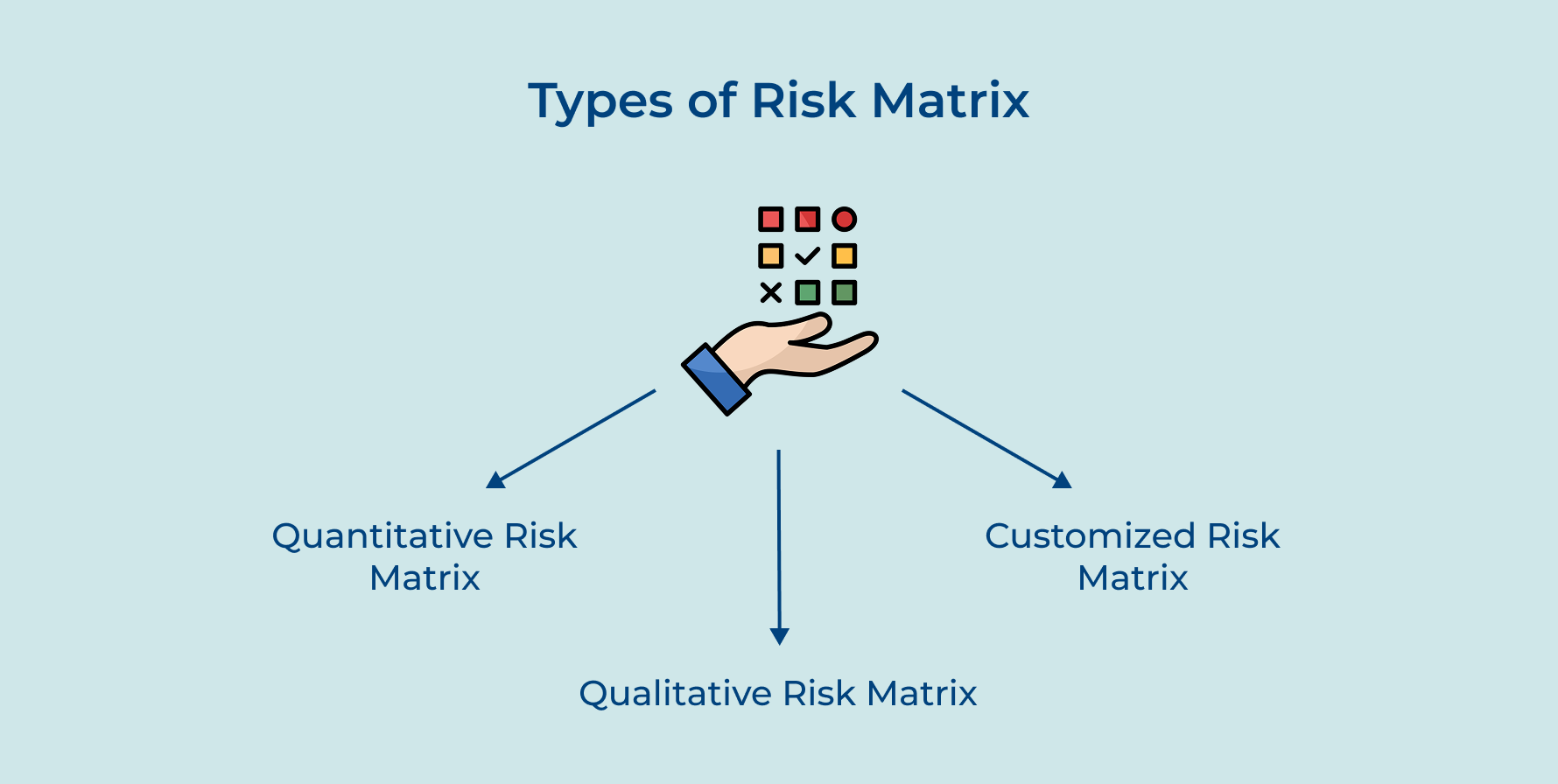
1. Quantitative Risk Matrix
This matrix puts real numbers behind every threat – actual probability percentages and financial impact amounts rather than gut feelings. It calculates the expected monetary value of each risk, making it especially useful during project planning when budgets and timelines are on the line.
Financial risks are where this approach truly shines. Currency fluctuations, investment losses, equipment failure, everything gets converted into dollar amounts so you can compare risks across the board. This makes risk prioritization far sharper and removes the second-guessing.
2. Qualitative Risk Matrix
Not every risk comes with a price tag and that’s where this type earns its place. Rather than hard numbers, teams use descriptive risk categories like “rare” or “catastrophic” based on expert judgment and experience with similar situations.
It handles diverse threats surprisingly well. Reputational damage from bad publicity and compliance risks from regulatory violations can sit side by side in the same assessment, even when assigning precise numerical values to either simply isn’t realistic.
3. Customized Risk Matrix
Some projects need more than a standard template and this version is built for exactly that. The dimensions, scales and impact categories get adjusted to fit specific industries or organizational needs. Sometimes adding urgency as a third dimension and other times reshaping categories around unique stakeholder concerns.
A healthcare project might restructure the matrix to put patient safety front and center. A manufacturing operation could weave in supply chain disruption as a separate layer, going beyond the basics to support smarter risk mitigation across every phase of delivery.
How to Create a Risk Matrix in Project Management in 8 Simple Steps
To build a risk matrix in project management, follow these 8 proven steps that take you from a blank grid to a fully prioritized, action-ready risk register your team can act on immediately.
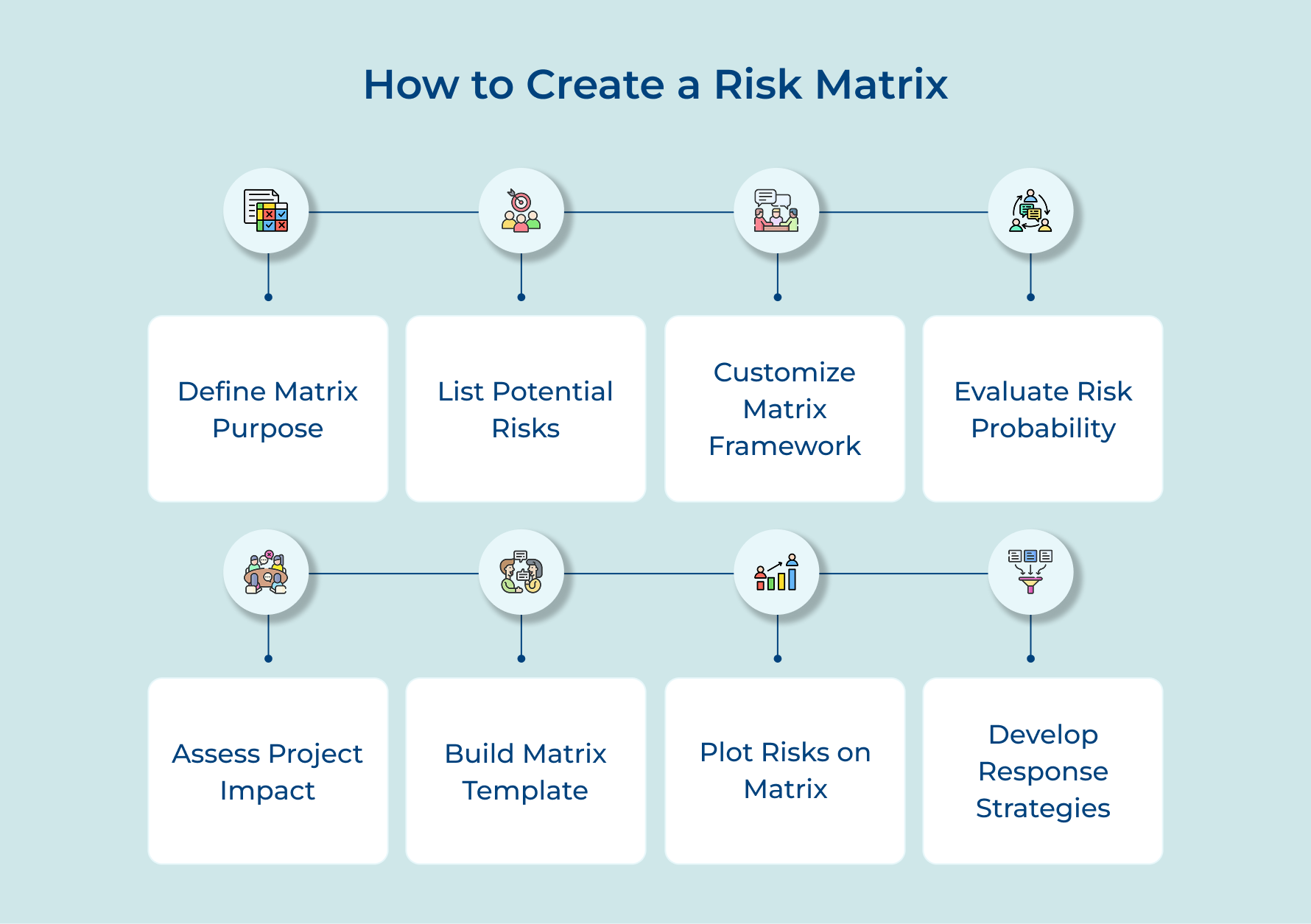
1. Define Your Matrix’s Core Purpose
Before building your matrix you need a clear target to aim for. This foundational step prevents wasted effort and ensures your risk assessment actually serves your project’s specific needs rather than becoming a meaningless checkbox exercise.
Your matrix purpose should be crystal clear and actionable. Here’s what a well-defined purpose includes for maximum effectiveness:
- Scope clarity: Identify if you’re assessing technical risks, financial threats, or comprehensive project vulnerabilities across all domains.
- Decision framework: Establish how risk ratings will trigger specific actions like escalation to sponsors or immediate mitigation resource allocation.
- Success metrics: Define what successful risk management looks like such as preventing budget overruns or maintaining project timeline integrity.
Start by asking yourself one critical question first. What decisions will this matrix help me make and who needs to understand these risk assessments?
Gather your key stakeholders for a 30-minute discussion. Document their concerns and translate them into specific objectives that your matrix will address throughout the project lifecycle.
2. Gather and List All Potential Risks
This step involves collecting every conceivable threat to your project success. Comprehensive risk identification now prevents costly surprises later when you have fewer options and less time to respond effectively.
Here are the most effective approaches for building your risk inventory:
- Team brainstorming workshops: Facilitate structured sessions where team members share concerns based on their expertise and past project experiences.
- Historical project reviews: Examine similar completed projects to identify recurring issues and patterns that typically emerge in your type of work.
- Expert consultations: Interview specialists in relevant domains who can spot technical or industry-specific risks your team might overlook.
- Documentation analysis: Study project plans, contracts and requirement documents to uncover hidden dependencies or potential conflict areas.
Include both obvious threats and unlikely scenarios in your initial list. You can always filter later but missing a risk entirely during this phase means it won’t get managed at all.
3. Customize Matrix Framework for Your Project
Your matrix needs to match your project’s unique characteristics and challenges. A one-size-fits-all approach fails because a small website redesign requires different risk granularity than a multi-year infrastructure program with hundreds of stakeholders.
Customization ensures your matrix delivers actionable insights rather than generic ratings. A poorly fitted framework either oversimplifies critical distinctions or drowns your team in unnecessary complexity that slows down every risk conversation.
Select Appropriate Scale Size and Dimension
Start with project complexity when choosing your grid size. Simple projects work fine with a 3×3 matrix while complex initiatives need 5×5 grids to capture meaningful differences between moderate and serious threats.
Choose Qualitative or Quantitative Assessment Approach
Decide if descriptive terms or numerical values serve your stakeholders better. Qualitative terms like “unlikely” work when your team shares context while quantitative percentages eliminate ambiguity for distributed or formal governance structures.
Align Matrix Categories with Project Complexity
Match your rating definitions to realistic project scenarios and actual consequences. Your “high impact” category should reflect what high impact truly means for your specific project rather than using someone else’s generic template definitions.
4. Evaluate Probability of Risk Occurrence
Realistic likelihood ratings separate genuine threats from theoretical possibilities and getting them right determines where your resources actually go.
Start by defining what each probability level means for your specific project. “Likely” might mean 50–75% in one context and 60–90% in another depending on industry standards as well as stakeholder expectations.
Past projects are your most reliable starting point. Historical evidence combined with expert judgment helps account for anything that makes your current situation unique.
Four ways to build accurate probability ratings:
- Pattern recognition: Review how often similar risks materialized in past projects to set baseline expectations.
- Context adjustment: Modify historical rates based on new technology or changed team capabilities.
- Industry benchmarks: Validate your estimates against sector-wide statistics.
- Stakeholder validation: Cross-check with sponsors and technical leads who might spot overlooked factors.
Economic shifts, regulatory changes and project duration all influence likelihood as conditions evolve throughout the lifecycle.
5. Assess Potential Impact on Project
Evaluating how severely each risk could damage your project is just as important as knowing how likely it is. Impact magnitude helps you distinguish between minor inconveniences and threats capable of derailing everything you’ve worked to build.
Risks typically hit projects in four critical areas:
- Budget overruns: Unexpected costs that exhaust contingency reserves and force scope reductions or additional funding requests.
- Schedule delays: Timeline extensions that miss crucial deadlines and create cascading problems across dependent project phases.
- Quality degradation: Compromised deliverables that fail to meet requirements or stakeholder expectations.
- Scope creep: Uncontrolled changes that expand project boundaries and consume resources meant for planned deliverables.
Quantifying impact turns vague concerns into concrete consequences. Three approaches make this possible:
- Financial modeling: Calculate potential dollar losses including direct costs, opportunity costs and downstream expenses from delays or rework.
- Timeline analysis: Estimate days or weeks each risk could add and identify critical path activities most vulnerable.
- Stakeholder interviews: Gather perspectives on reputational damage or strategic setbacks that numbers alone can’t fully capture.
Accurate impact ratings transform your risk list from abstract worries into a prioritized action plan everyone can rally behind.
6. Build Your Risk Matrix Template
Creating the actual visual framework brings your entire risk assessment together in one place. A poorly designed template leaves your team without a shared reference point, turning risk discussions into confusing debates driven by subjective opinions rather than facts.
Good design communicates risk status instantly. Colors, labels and grid structure should make sense to everyone (from technical staff to executive sponsor) without needing a lengthy explanation to decode.
A complete template needs four foundational elements:
- Probability and impact axes: Clearly labeled scales showing likelihood on one dimension and severity on the other for plotting risks.
- Color-coded risk zones: Visual indicators like red for critical, yellow for moderate and green for low priority threats.
- Rating scale definitions: Explicit criteria explaining what “high probability” or “severe impact” actually means in your specific project context.
- Reference legend: A quick guide showing how to interpret the matrix and what actions each color zone typically triggers.
A software development team, for example, might build a matrix where probability runs from rare to almost certain and impact spans from negligible to catastrophic. The red zones demand immediate attention while green zones need only routine monitoring.
7. Plot Each Risk on the Matrix
You get to position every identified risk at its appropriate grid intersection. Plotting transforms your risk list into a visual priority map that shows at a glance which threats demand immediate attention versus simple monitoring.
Here’s how to position risks correctly on your matrix:
- Cross-reference ratings: Match each risk’s probability score with its impact score to find the exact cell where it belongs.
- Document supporting evidence: Record the reasoning behind each placement including data sources and assumptions that justify the position.
- Assign clear ownership: Designate specific team members responsible for monitoring each risk and executing response plans when needed.
What if team members disagree on placement?
How do you handle conflicts when people see the same risk differently? Facilitate a brief discussion where each perspective gets heard then let the risk owner make the final call based on their domain expertise and accountability.
If disagreement persists, document both viewpoints in your risk register. You can always adjust placement later as new information emerges or circumstances change throughout the project.
8. Develop Response Strategies and Prioritize
The final step converts your risk matrix into an action plan with specific responses. Creating strategies now ensures you’re ready to act decisively when threats materialize instead of scrambling to improvise solutions during a crisis.
Your matrix identifies the problems but response strategies solve them through deliberate resource allocation. This step determines if your risk management delivers actual protection or just creates impressive documentation nobody uses.
High-priority red zone risks get detailed mitigation plans with dedicated budgets. Yellow zone risks receive contingency plans activated if circumstances worsen while green zone risks simply get periodic monitoring.
Pro tips:
- Schedule quarterly matrix reviews to replot risks as project conditions evolve and external factors change threat profiles.
- Link each high-priority risk to specific success metrics so you can measure in case your response strategies actually reduce exposure.
Examples of a Risk Matrix Across Different Projects
Risk matrices work differently depending on what you’re building or delivering. Let’s see how real teams use this tool to navigate their specific project challenges.
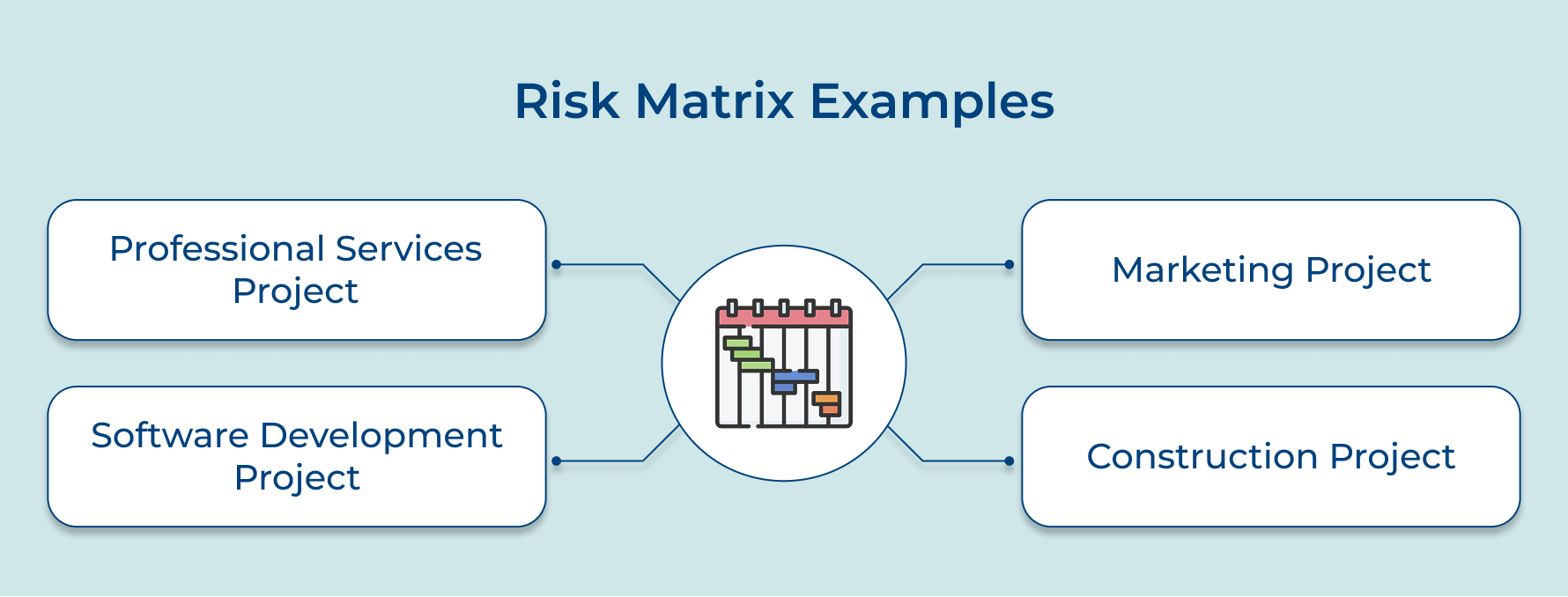
Professional Services Project
A consulting firm uses their risk matrix to manage client engagement risks and deliverable quality. They track threats like scope creep from vague requirements, key consultant unavailability and client expectation misalignment to maintain profitability along with relationship health.
Software Development Project
A financial services company building custom banking software plots technical and vendor risks on their matrix. Integration failures with legacy systems, third-party API changes and security vulnerability discoveries get prioritized to protect both launch timelines as well as regulatory compliance requirements.
Marketing Project
A retail brand planning a holiday campaign uses their matrix to assess creative and execution risks. Influencer controversies, ad platform policy changes and competitor timing conflicts are evaluated to safeguard brand reputation along with return on advertising spend targets.
Construction Project
A commercial developer building an office complex relies on their matrix for safety and logistics management. Material delivery delays, subcontractor licensing issues and severe weather windows get plotted to prevent costly work stoppages while maintaining occupancy deadline commitments.
Risk Matrix Best Practices in Project Management
Following proven practices transforms your risk matrix from a static document into a dynamic management tool. These approaches help you get maximum value from your risk assessment efforts.
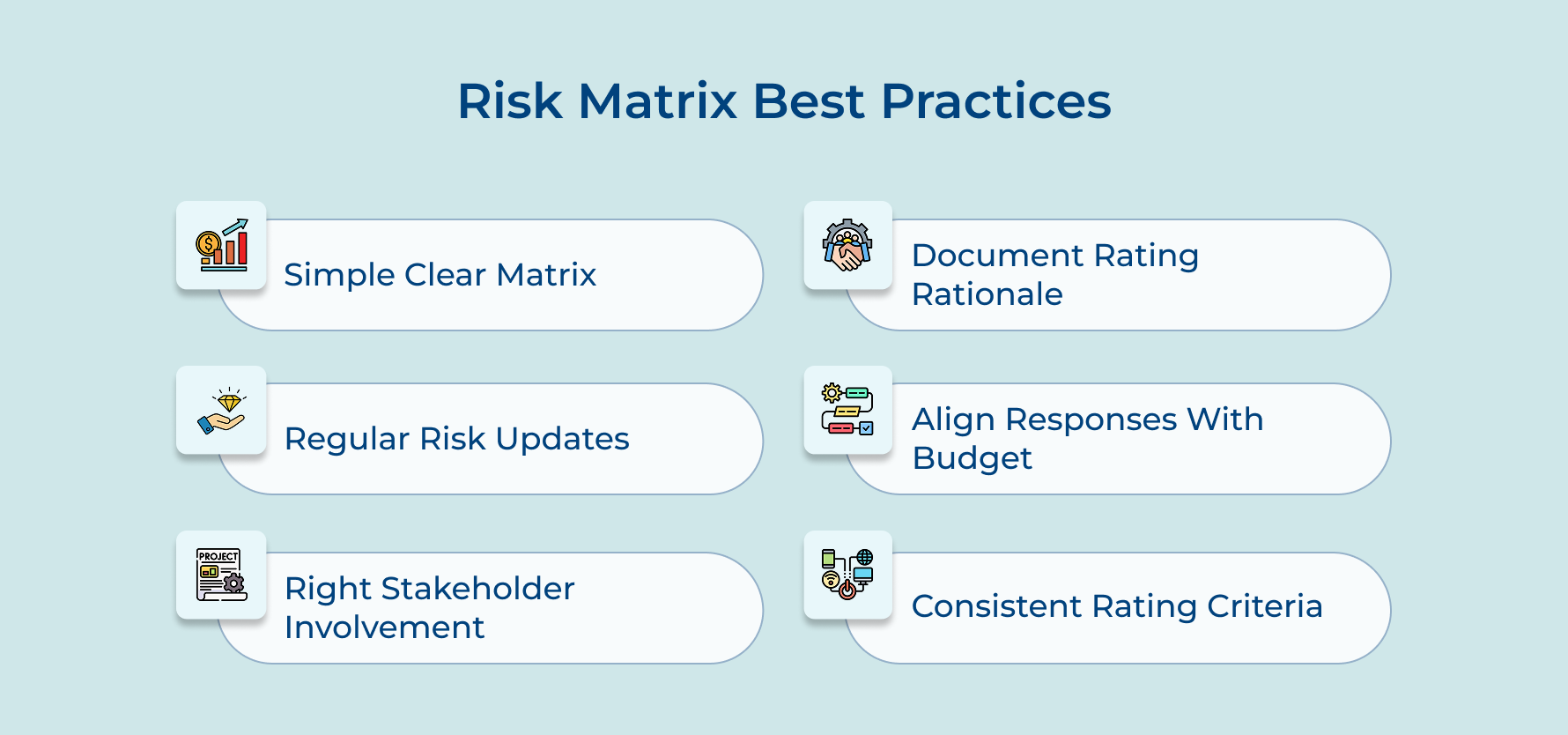
1. Keep Your Matrix Simple and Accessible
Avoid overcomplicating your matrix with excessive categories or confusing terminology. Everyone on your team should understand it instantly without needing lengthy training sessions.
2. Update Risk Ratings Regularly Throughout the Project
Review and adjust your matrix at consistent intervals as conditions change. Yesterday’s low-priority risk can become today’s critical threat requiring immediate action.
3. Involve the Right Stakeholders in Risk Assessment
Include team members who actually work with each risk area daily. Their frontline perspective catches threats that management sitting in meetings might completely miss.
4. Document the Reasoning Behind Each Risk Rating
Record why you assigned specific probability and impact scores to risks. This context prevents confusion when new team members join or memories fade over time.
5. Link Risk Responses to Actual Budget and Resources
Don’t just identify mitigation strategies without backing them with real allocations. Unfunded response plans are worthless when a critical risk actually hits your project hard.
6. Use Consistent Rating Criteria Across All Risks
Apply the same definition of “high impact” to every risk you evaluate. Inconsistent standards make your matrix misleading and undermine confidence in your entire assessment process.
Challenges of a Risk Matrix in Project Management
Risk matrices aren’t perfect tools and come with legitimate limitations. Understanding these challenges helps you use matrices more effectively and avoid common pitfalls.
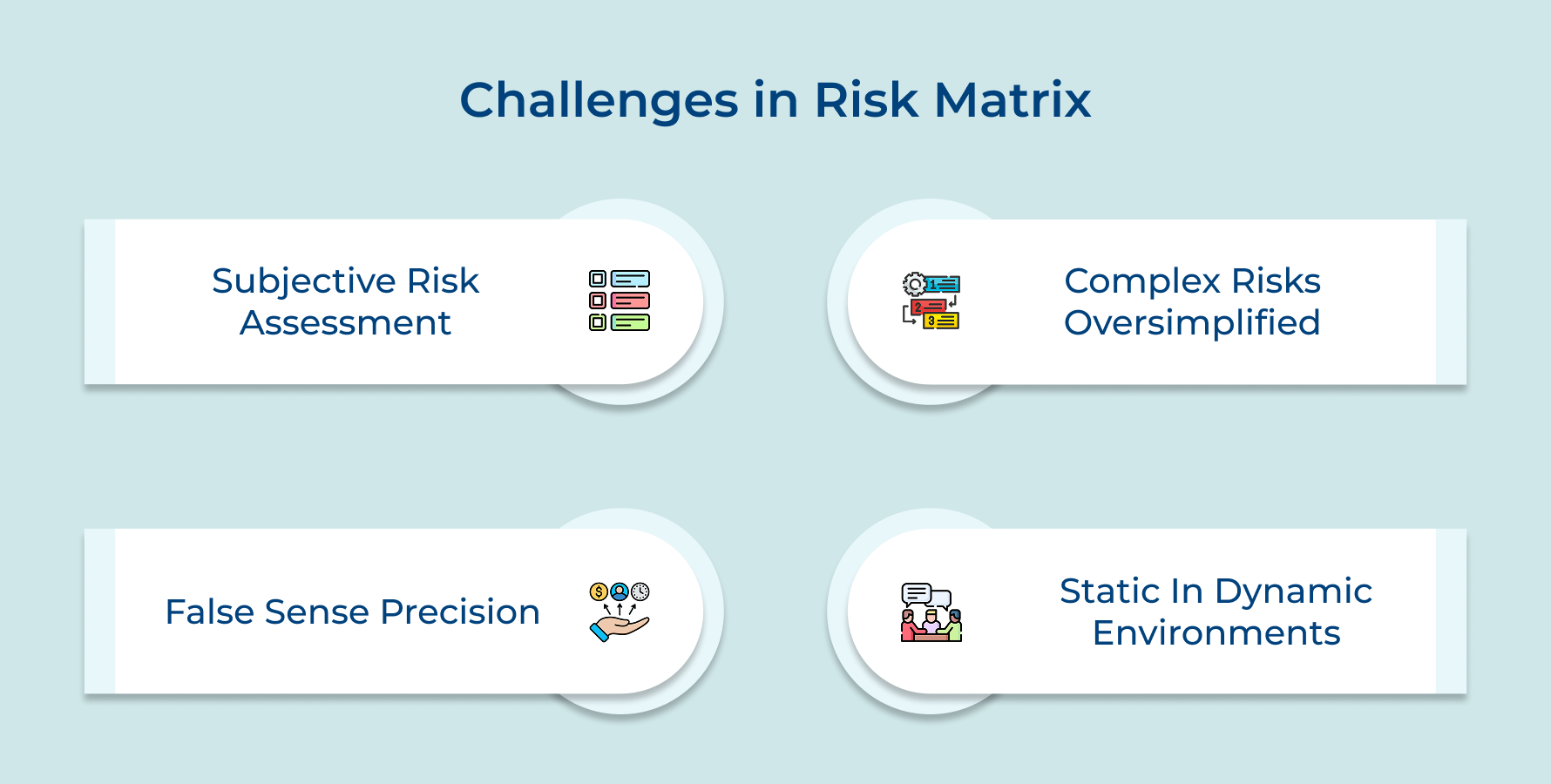
1. Subjective Risk Assessment
Different team members often assign wildly different probability and impact ratings to identical risks. Personal biases, varying experience levels and individual risk tolerance create inconsistency that undermines the matrix’s reliability as well as decision-making value.
2. Oversimplification of Complex Risks
Reducing multifaceted threats to single probability-impact coordinates loses important nuance and context. A risk might have low financial impact but catastrophic reputational consequences that a basic two-dimensional matrix fails to capture adequately.
3. False Sense of Precision
The matrix’s numerical appearance suggests accuracy that doesn’t actually exist in reality. Teams may treat estimated ratings as definitive facts rather than informed guesses based on incomplete information and inherent uncertainty about future events.
4. Static Nature in Dynamic Environments
Matrices quickly become outdated as project conditions shift and new information emerges. A matrix that isn’t updated regularly reflects yesterday’s reality, not the current threat landscape and that’s when poor decisions happen.
These challenges are manageable with the right strategies and disciplined execution. Here’s how to address each limitation effectively:
- Establish clear rating criteria with specific examples to reduce subjective interpretation and create consistent assessment standards across all evaluators.
- Add supplementary documentation fields that capture qualitative details and contextual factors beyond simple probability-impact scores for complex risks.
- Communicate uncertainty explicitly by using ranges or confidence levels rather than presenting risk ratings as absolute certainties to stakeholders.
- Schedule mandatory review cycles with assigned ownership to ensure your matrix stays current and reflects evolving project realities throughout execution.
Manage Uncertainties with Confidence Using Risk Matrix
A risk matrix in project management turns chaos into manageable decisions by giving your team a clear visual framework. It helps you spot genuine threats early (whether they’re external risks like market shifts or internal ones that quietly erode your risk profile) and respond before small problems become project-ending disasters.
The key is treating your matrix as a living tool rather than a one-time exercise. Regular updates, team involvement and a sharp eye on strategic risk keep your assessment accurate so you can protect what matters most to project success.
Limit time — not creativity
Everything you need for customer support, marketing & sales.

Neeti Singh is a passionate content writer at Kooper, where he transforms complex concepts into clear, engaging and actionable content. With a keen eye for detail and a love for technology, Tushar Joshi crafts blog posts, guides and articles that help readers navigate the fast-evolving world of software solutions.