Best of Resource Management Models for Project Success
Key Highlights:
- Resource management models bring clarity, balance workloads and improve project success across complex organizational environments.
- Organizations should reassess allocation strategies regularly to maintain alignment, flexibility and sustainable project delivery outcomes.
- Choosing between centralized, decentralized and hybrid resourcing models depends on structure, collaboration needs as well as business priorities.
Projects start slipping when the right people aren’t available at the right time. Teams compete for the same talent, some departments hold on to resources and others rush to fill urgent gaps just to keep work moving.
Confusion becomes normal especially when there’s no clear direction. High-value initiatives slow down, low-priority tasks take over your best people and visibility into who’s doing what disappears until deadlines are already missed.
That’s where resource management models make a real difference. The right structure brings clarity, balance as well as smarter decision-making. Whether a centralized approach or more team autonomy works best depends on how your organization operates and what your projects truly need.
What are Resource Management Models?
Resource management models are structured frameworks that help organizations allocate and optimize their people, budget, equipment as well as time. These models provide a systematic way to plan, track and distribute resources efficiently across projects as well as operations. They help minimize waste while maximizing overall output and productivity.
Organizations start by mapping out all available resources and upcoming demands. They then apply specific models like capacity planning or resource leveling to match supply with need. The chosen framework guides decisions about who works on what and when priorities shift.
Most models use data from past projects to forecast future requirements. Managers can spot bottlenecks before they happen and redistribute workload when someone’s overloaded. Regular monitoring ensures resources move to where they create the most value rather than sitting idle.
Performance goals:
- Maximize utilization: Keep people and assets productively engaged without burning them out or letting them sit unused.
- Reduce costs: Eliminate redundancies and avoid emergency hiring or rush orders that drain the budget.
- Meet deadlines: Ensure the right resources are available exactly when projects need them to stay on schedule.
- Balance workload: Distribute tasks fairly so no team drowns while another has spare capacity.
- Enable flexibility: Build systems that adapt quickly when priorities change or unexpected opportunities arise.
Types of Resource Management Models You Should Know
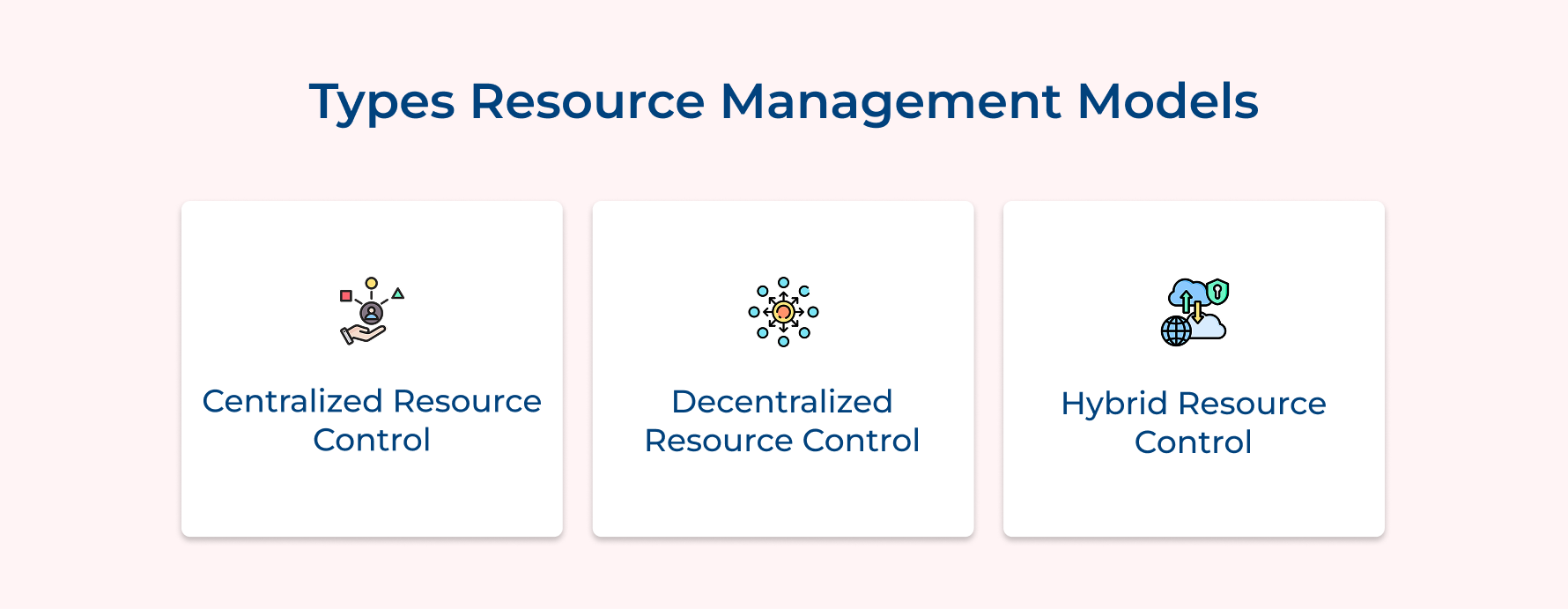
Let us delve into three prominent types of resource management models and explore how they can transform your approach to managing valuable resources.
1. Centralized Resource Management Model
One leader or team makes all the resource allocation decisions in a centralized setup across the organization. Project managers submit requests to this central hub, which reviews priorities and assigns people based on overall business goals. This approach is common in project-driven companies because it reduces conflicts, improves resource utilization and keeps every initiative aligned with strategy.
So what does this look like day to day?
A resource management office tracks everyone’s skills, workload and availability. Instead of managers choosing people based on preference, talent is matched to projects based on impact, urgency and potential project risks.
Why Organizations Choose a Centralized Model
Companies that adopt central control often see measurable improvements in execution:
- Full visibility across projects: Leadership understands who is working on what, preventing double-booking and uncovering hidden capacity before resource shortages occur.
- Stronger prioritization: High-value initiatives receive the best talent first, improving the overall project success rate.
- Fewer internal conflicts: Managers no longer compete for the same people, which creates a more stable environment and supports long-term employee retention.
Challenges to Watch for
Centralization isn’t perfect and some friction is inevitable:
- Slower response times: Every request goes through approval workflows, which can delay urgent needs.
- Limited local context: Central teams may miss subtle team dynamics or culture fit when assigning resources.
- Decision bottlenecks: If the resource office is overwhelmed, projects stall because managers lack autonomy.
Making Centralized Resource Management Work
To implement this model successfully, organizations should:
- Create a dedicated team with authority over allocation decisions.
- Use resource planning software for real-time visibility and standardized workflows.
- Define transparent prioritization rules so everyone understands how decisions are made.
2. Decentralized Resource Management Model
At the other end of the spectrum, departments or project managers control their own people and make allocation decisions independently. This structure works best when teams operate on distinct initiatives with minimal overlap. It’s less common in large enterprises but effective in autonomous business units with a flexible organizational structure.
Benefits of Decentralization
When teams manage their own resources, they gain speed and cohesion:
- Faster decisions: Managers assign people immediately without waiting for approvals.
- Stronger collaboration: Teams repeatedly work together, building trust and improving morale—both key drivers of employee retention.
- Local expertise: Managers understand the nuances of their projects and can respond quickly to emerging project risks.
Common Drawbacks
Independence can also create hidden inefficiencies:
- Resource hoarding: Departments keep top performers even when other teams face resource shortages.
- Inconsistent tracking: Different methods make it hard to measure resource utilization across the company.
- Duplicate investments: Multiple teams hire similar specialists or buy overlapping tools, increasing costs.
How to implement decentralization effectively
Organizations can reduce these issues by:
- Defining clear ownership boundaries for each department.
- Encouraging voluntary resource sharing between teams.
- Running regular cross-team reviews to spot collaboration opportunities.
3. Hybrid Resource Management Model
Many organizations adopt a hybrid approach because neither extreme works for everyone. Shared specialists are managed centrally, while departments retain control over their core teams. This balance improves resource utilization without slowing everyday work.
Finance may manage its own analysts, while a central team assigns limited SAP experts to different projects. Critical talent is optimized, routine work stays fast and the overall project success rate improves.
Foundations of a Successful Hybrid Model
To make this structure work, organizations should:
- Define resource categories: Centralize scarce or high-impact roles while leaving function-specific roles with departments.
- Build strong communication loops: Regular planning discussions prevent surprises and reduce project risks.
- Clarify decision authority: Clear guidelines ensure managers know when to request centrally versus locally.
Is the Hybrid Model Worth the Effort?
Yes—especially when expensive specialists are needed across multiple teams. The added coordination is often offset by better utilization of high-value talent, fewer resource shortages and stronger long-term employee retention.
Which Resource Management Model is Right for Your Business?
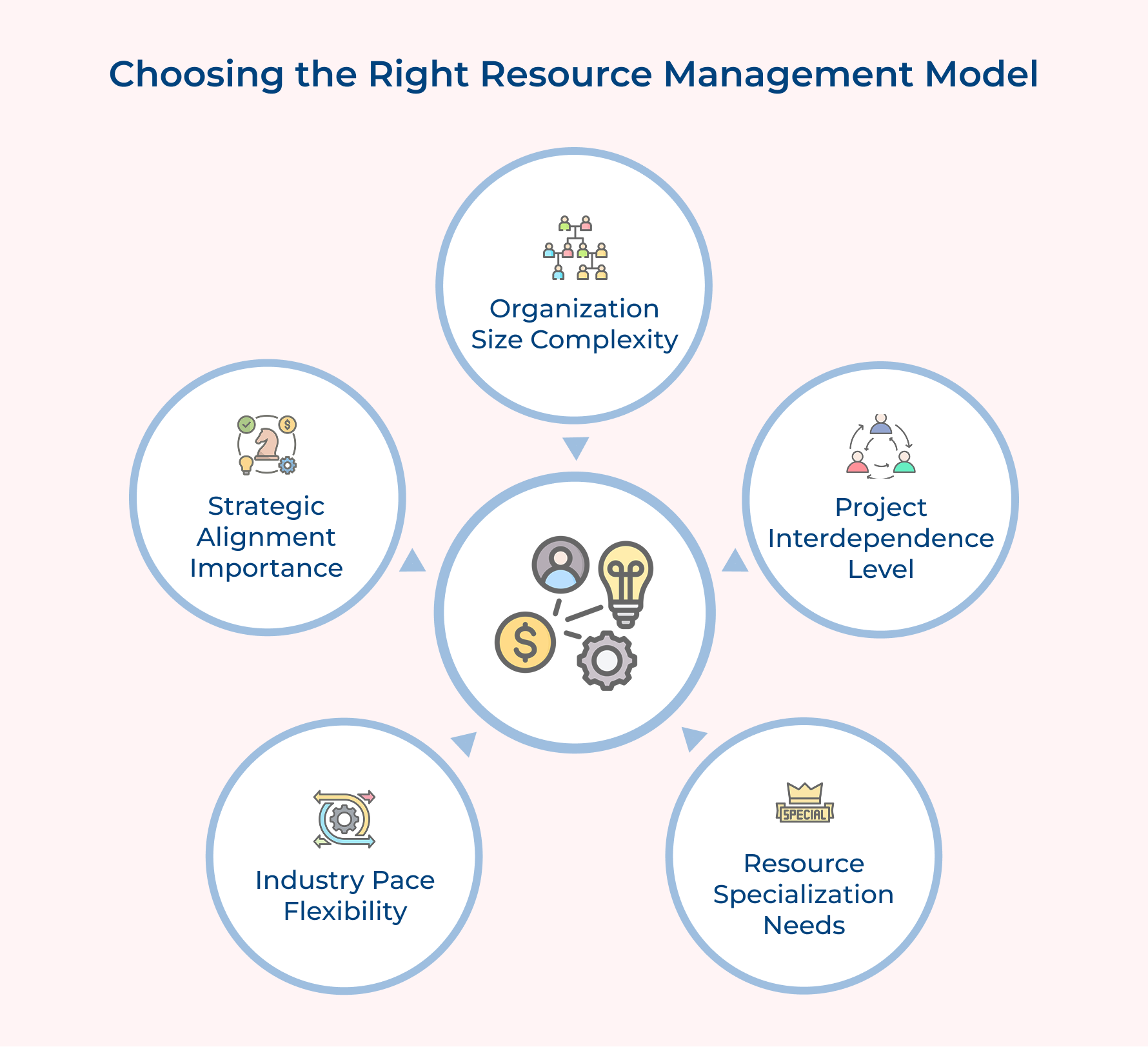
Choosing the right model depends on your organization’s structure and how your teams operate. Consider these six factors to find the approach that matches your needs.
1. Organization Size and Complexity
In smaller organizations with fewer than 50 people, decentralized models often work best. Everyone understands each other’s strengths and project teams can coordinate informally without needing strict oversight or a formal resource management platform to track availability.
But as the company grows beyond 100 employees, things change quickly. Multiple departments begin competing for the same project resources, visibility drops and informal coordination stops working. At this stage, centralized or hybrid models become essential to maintain clarity, improve planning and protect overall employee productivity.
2. Project Interdependence
When projects run independently inside separate business units, decentralized management gives teams the speed they need. For example, marketing initiatives rarely rely on the same project resources as product development, so each team can manage its own people without delays.
When projects frequently share talent or depend on each other’s outputs, centralized coordination becomes critical. A shared resource management platform helps prevent scheduling conflicts, keeps project teams aligned and reduces delays that could hurt employee productivity across the organization.
3. Resource Specialization Level
Organizations staffed mostly with generalists can decentralize more easily. Skills are transferable and managers can usually find capable support within their own project teams without competing for scarce project resources.
But companies that rely on niche expertise – like data science, cybersecurity, or compliance – need tighter control. Centralized visibility through a resource management platform ensures specialists focus on the highest-impact work, which directly improves employee productivity and reduces wasted effort.
4. Industry Pace and Flexibility Needs
Fast-moving industries such as advertising or software startups benefit from decentralized models because speed matters. Teams must react quickly to opportunities and waiting for approvals can slow momentum while reducing employee productivity.
Regulated sectors like healthcare or finance often require centralized oversight. Structured coordination of project resources, supported by a reliable resource management platform, helps maintain compliance, consistency and stability across all project teams.
5. Strategic Alignment Importance
If business units operate like independent profit centers with separate goals, decentralized management naturally fits the structure. Each division controls its own project resources and focuses on maximizing results within its own project teams.
However, when company-wide initiatives define success, centralized or hybrid models work better. A shared resource management platform ensures talent flows toward the most important priorities, strengthening alignment and ultimately boosting overall employee productivity.
Maximize Potential & Minimize Waste with Right Resource Management Models
The right resource management models transform how your organization delivers projects and utilizes talent. Centralized models bring control while decentralized approaches offer speed and hybrid systems balance both strengths based on your needs.
Start by evaluating your organization’s size and project complexity to choose the best fit. The model you select should adapt as you grow and your resource challenges evolve over time.
Limit time — not creativity
Everything you need for customer support, marketing & sales.

Neeti Singh is a passionate content writer at Kooper, where he transforms complex concepts into clear, engaging and actionable content. With a keen eye for detail and a love for technology, Tushar Joshi crafts blog posts, guides and articles that help readers navigate the fast-evolving world of software solutions.