Resource Leveling vs Resource Smoothing: Key Differences
- What is Resource Leveling?
- What Are The Pros and Cons of Resource Leveling?
- What is Resource Smoothing?
- Pros and Cons of Resource Smoothing
- Key Differences Between Resource Leveling and Resource Smoothing
- Key Strategies for Implementing Resource Leveling and Resource Smoothing
- Resource Leveling vs. Resource Smoothing: Choosing the Best Technique for Project Success
- FAQs about Resource Leveling vs Resource Smoothing

Key Highlights:
- Resource leveling vs resource smoothing balance workloads and project timelines effectively.
- Resource leveling as well as resource smoothing prevent burnout and reduce team overallocation risks.
- Leveling extends timelines to match real capacity, smoothing keeps deadlines fixed.
You’ve built what looks like a solid project schedule until you realize your star developer is assigned to three critical tasks in the same week. Your team calendar shows impossible workloads in some periods and idle time in others. Resource conflicts are sabotaging your timeline before the project even starts.
Without fixing these resource problems, you’re heading straight into team burnout and missed deadlines. Your developers will either work unsustainable hours or tasks will slip through the cracks.
Resource leveling vs resource smoothing are two powerful techniques that solve these scheduling nightmares in different ways. Understanding when to extend your timeline for team health versus protecting a fixed deadline while optimizing around it transforms chaotic schedules into executable plans. Let’s break down both approaches so you can choose the right tool for your situation.
What is Resource Leveling?
Resource leveling is a project management technique where you redistribute work and adjust timelines to balance the demand for resources with their actual availability. Think of it like smoothing out peaks and valleys in your resource usage so nobody is overwhelmed one week while sitting idle the next. It helps you avoid the chaos of having three critical tasks competing for the same team member at once.
Impact of Resource Leveling
When you level resources effectively, your project schedule becomes more realistic and your team experiences less burnout from constant overallocation. The trade-off is that your project timeline often extends because you’re resolving conflicts by spreading work across available capacity.
Key objectives:
- Eliminate overallocation: Resource leveling identifies when team members are assigned more work than they can handle and redistributes tasks to prevent burnout.
- Optimize resource utilization: The technique ensures your valuable resources are working steadily throughout the project rather than alternating between frantic periods and downtime.
- Maintain project feasibility: By adjusting schedules to match real availability, resource leveling creates a plan your team can actually execute.
- Reduce resource conflicts: The process resolves scheduling clashes where multiple tasks compete for the same people or equipment at the same time.
- Improve predictability: Leveled schedules give you more reliable completion dates because they’re built on realistic assumptions about what your team can accomplish.
What Are The Pros and Cons of Resource Leveling?
Resource leveling solves critical scheduling problems but comes with real trade-offs that every project manager needs to understand before applying this technique.
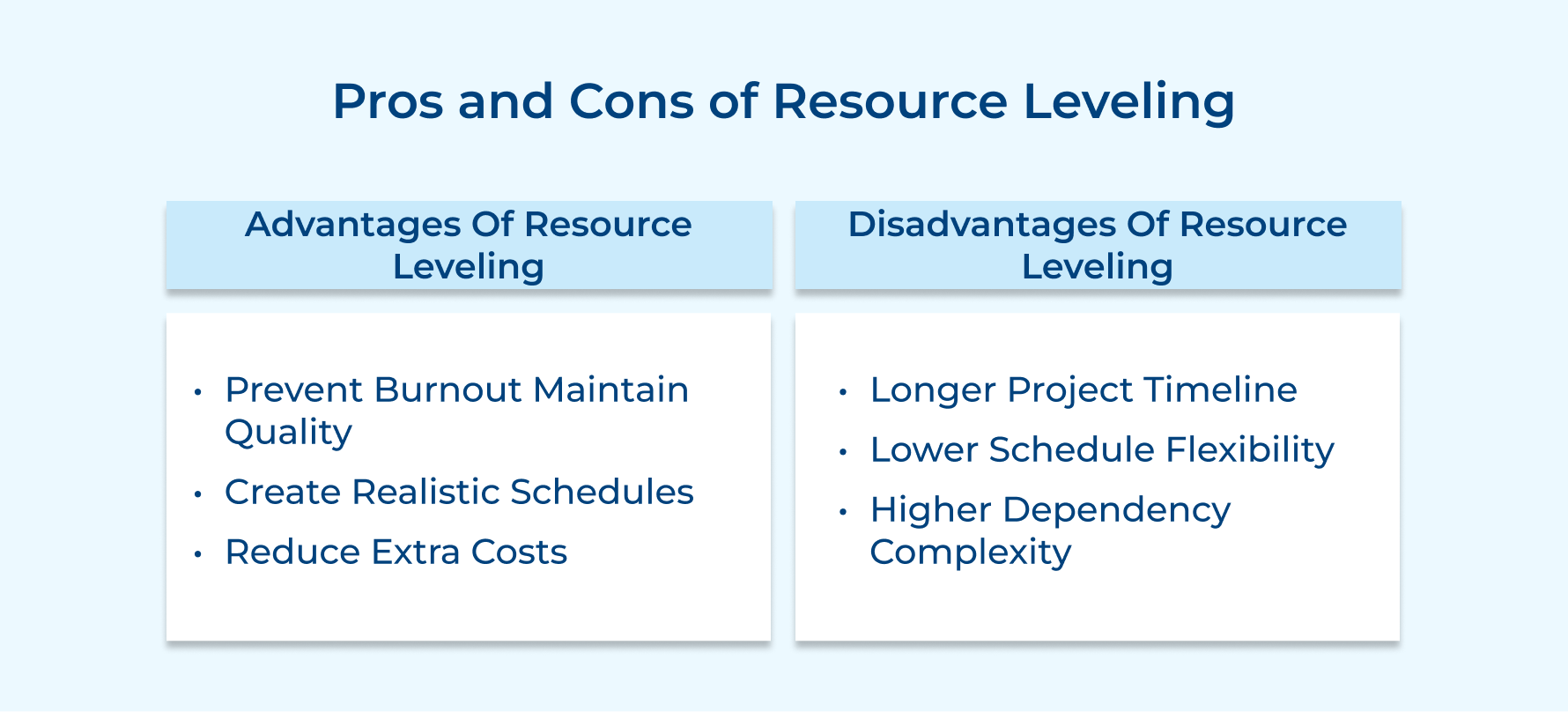
Advantages of Resource Leveling
- Prevents team burnout and maintains quality: Resource leveling helps you protect your team from chaotic workloads. Instead of overloading someone early in the week and leaving gaps later, you create a steady, manageable pace that supports focus, accuracy and better output.
- Creates realistic schedules you can actually trust: It forces you to move away from “ideal” timelines and face what’s truly possible with the people you have. The result? A realistic schedule stakeholders may not love, but one your team can actually deliver without cutting corners.
- Reduces costs from overtime and emergency hiring: When workloads are balanced, you avoid expensive rush solutions like overtime pay or emergency contractors. A steady workload means fewer surprises and more time to plan resource needs properly.
Disadvantages of Resource Leveling
- Extends your project timeline significantly: The biggest drawback is the delay. If you solve resource conflicts by pushing tasks later, the entire schedule can shift – sometimes by weeks.
- Reduces schedule flexibility for responding to changes: A leveled schedule runs close to full capacity, leaving little room for unexpected issues or priority changes. Any disruption can easily create new conflicts or cause even more delays.
- Increases complexity in managing dependencies: Resource leveling means you’re not just tracking task order, you’re also managing who’s available and when. That extra layer of constraints can make rescheduling and communication more challenging for everyone involved.
What is Resource Smoothing?
Resource smoothing is a scheduling technique where you adjust the timing of activities within their available float to create a more balanced distribution of resource usage across your project. Unlike resource leveling, smoothing treats your project deadline as sacred and non-negotiable. You’re essentially moving tasks around within their flexibility windows to avoid resource spikes while keeping your end date locked in place.
Imagine you have two software developers and three coding tasks scheduled for the same week, but one of those tasks has five days of float before it becomes critical. Resource smoothing would shift that flexible task to the following week when your developers have lighter workloads. The project still finishes on time because you only moved tasks that had scheduling flexibility to spare.
Key factors:
- Float availability determines what you can adjust: Resource smoothing only works with tasks that have slack time, so activities on the critical path remain untouched and maintain the project deadline.
- Project deadline stays fixed throughout: The fundamental rule of smoothing is that your end date is sacred, which means you can only redistribute work within the existing schedule boundaries.
- Resource demand gets redistributed across time: The technique spreads resource requirements more evenly by moving flexible tasks away from peak demand periods into valleys where capacity exists.
- Task dependencies limit your smoothing options: You can only move tasks within the constraints of their predecessor and successor relationships, which narrows the window for adjustment.
- Schedule complexity increases with each adjustment: Every task you shift to smooth resources creates a new configuration of the schedule that you need to monitor and communicate to your team.
Pros and Cons of Resource Smoothing
Resource smoothing offers a different balance of benefits and limitations compared to leveling. Understanding these trade-offs helps you choose the right technique for your project’s priorities.
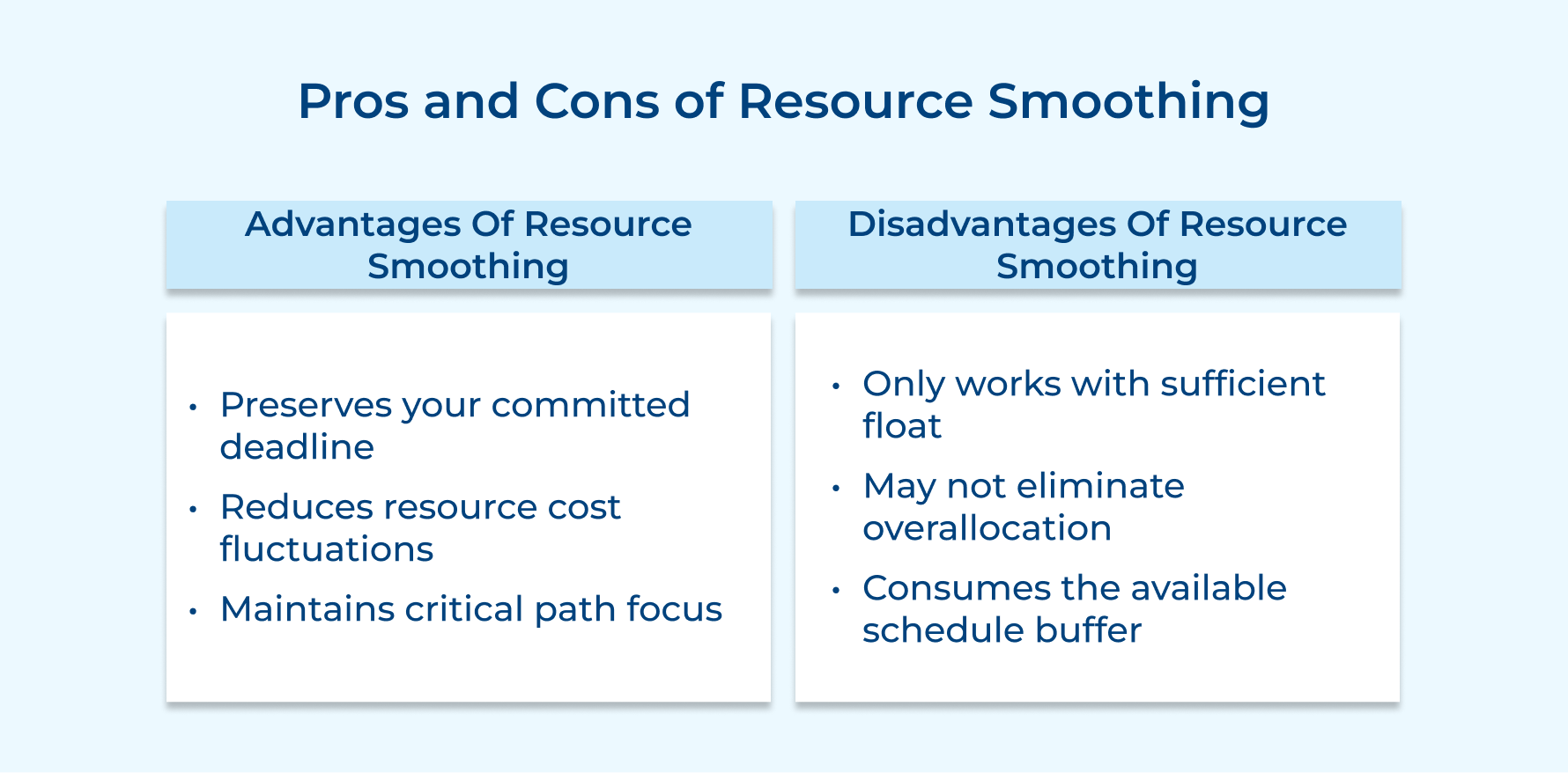
Advantages of Resource Smoothing
- Preserves your committed deadline: Resource smoothing is perfect when you absolutely cannot move your delivery date. Since it only adjusts tasks with float, your project plans stay intact and your stakeholders don’t get unpleasant surprises. Tools like Gantt charts or a network diagram make it easy to spot where you have flexibility, so you can redistribute work without touching the critical path.
- Reduces resource cost fluctuations: Because smoothing evens out workloads, you avoid the costly cycle of rapidly scaling your team up and down. With the help of project management software, you can maintain a steady rhythm of resource consumption instead of reacting to sudden spikes.
- Maintains critical path focus: Smoothing never interferes with deadline-driven tasks, which means your team can stay locked in on what truly matters. Non-critical tasks get reshuffled through smart resource scheduling, ensuring your timeline stays protected while still keeping workloads efficient.
Disadvantages of Resource Smoothing
- Only works with sufficient float: If your schedule is already tight, smoothing becomes tough. Without slack in your network diagram or Gantt charts, there’s simply no room to shift tasks while keeping your end date intact.
- May not eliminate overallocation: Smoothing can reduce resource peaks, but it doesn’t always fix every overallocation, especially if your deadline is fixed. Even with the best project management software, you might still end up with days where certain team members feel stretched.
- Consumes available schedule buffer: When you use float to smooth workloads, you’re essentially spending your built-in safety net. That schedule buffer could have helped you absorb delays later, so once it’s gone, your project plans lose some flexibility to handle surprises.
Key Differences Between Resource Leveling and Resource Smoothing
In the following article, we will explore these differences and how each method can be applied effectively to your projects.
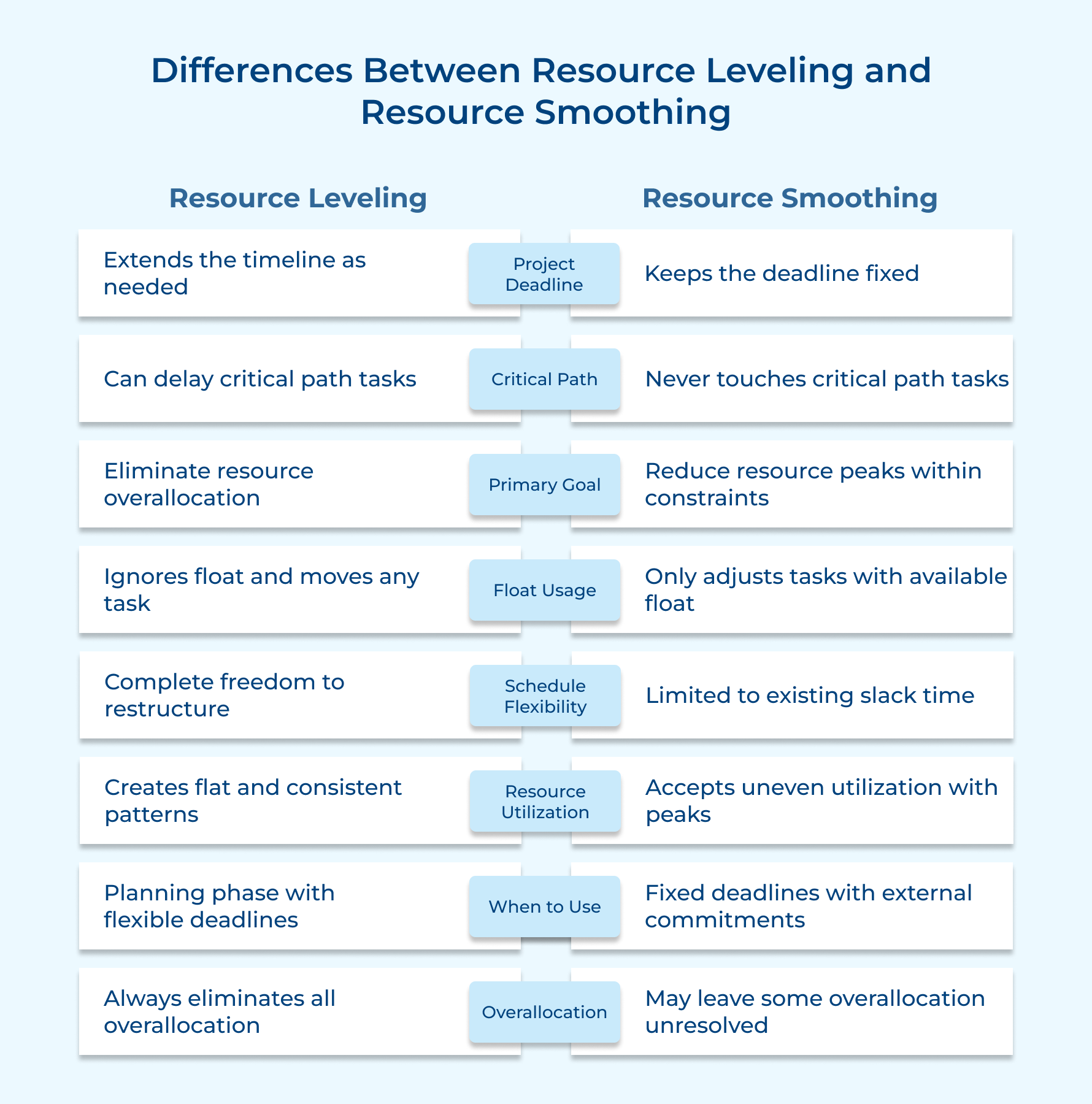
1. Impact on Project Timeline
Resource leveling treats your project deadline as flexible and will extend it whenever necessary to resolve resource conflicts. The technique prioritizes having a realistic workload over meeting the original end date. When you’re overallocated, leveling simply pushes tasks out until resources become available.
Resource smoothing works within your fixed deadline and refuses to extend the project timeline no matter what. It only adjusts tasks that have scheduling flexibility built in. If smoothing can’t resolve a resource conflict without changing the end date, it simply won’t make that adjustment.
Example: Your developer is assigned 80 hours of work in a 40-hour week. Leveling would delay some tasks to next week and push your project deadline back by five days. Smoothing would only shift tasks if they have floats available and would leave the over-allocation if moving tasks would affect the deadline.
Key Takeaways:
- Choose leveling when resource health matters more than hitting your original deadline and stakeholders can accept schedule changes.
- Choose smoothing when your deadline is non-negotiable and you’re willing to accept some resource overallocation to protect it.
2. Treatment of Task Float and Slack Time
Resource leveling doesn’t really care if a task has float or sits right on the critical path, it’s ready to shift anything if that’s what it takes to fix resource allocation issues. In this approach, every task is treated as fair game for rescheduling. So even critical path activities can get pushed back if that helps balance the workload and remove conflicts.
Resource smoothing plays by a much gentler set of rules. It relies on float as its main tool, so tasks with no slack stay exactly where they are. Only the flexible tasks get shuffled around. This works because smoothing improves resource allocation without changing your overall timeline or messing with the critical path.
Here’s how each approach uses float differently:
- Leveling consumes float as a byproduct of moving tasks but doesn’t rely on it existing beforehand.
- Smoothing requires float to exist and deliberately uses it to redistribute resource demand.
- Leveling can create new critical paths by eliminating all floats from previously flexible tasks.
3. Priority Between Resources and Deadlines
Resource leveling puts resource allocation and team wellbeing first. It builds a schedule around real capacity, not wishful deadlines. The focus is simple: protect your team from overload and make sure the work happens at a sustainable pace.
Resource smoothing flips the priority. The deadline becomes non-negotiable, even if it creates pressure on your resources. It keeps the delivery date fixed and works within available float, accepting short periods of overallocation when needed.
Example: If you promised a month-end delivery but your designer is overloaded in week three, leveling would push tasks into week five and adjust the client timeline. Smoothing would rearrange non-critical tasks within the month and let the designer absorb the heavier workload. It’s a classic resource management trade-off between protecting people while protecting deadlines.
Key Takeaways:
- Leveling is your choice when protecting team capacity and creating achievable workloads outweighs the importance of the original timeline.
- Smoothing becomes necessary when external commitments or business consequences make the deadline immovable regardless of resource strain.
4. Flexibility in Adjusting the Schedule
Resource leveling gives you complete freedom to restructure your schedule because it doesn’t treat the deadline as fixed. Resource smoothing works only within the narrow boundaries of existing task floats and refuses to touch the project end date.
Key aspects of how each technique approaches flexibility:
- Leveling can delay any task regardless of its original position or relationship to other activities.
- Smoothing works only within the narrow windows where tasks have built-in flexibility without deadline impact.
- Leveling might reschedule an entire phase of work if that’s what resource availability demands.
This fundamental difference in flexibility means leveling can solve almost any resource conflict while smoothing sometimes has to accept that certain conflicts simply can’t be resolved. When smoothing runs out of float to work with, the resource problem remains unsolved and you’re stuck with overallocation.
5. Common Scenarios for Application
Resource leveling works best when you’re still shaping the project and haven’t made promises you can’t afford to break. If deadlines are flexible and no one outside your team is counting on a fixed date, leveling lets you prioritize realistic workloads without pressure.
Resource smoothing is what you rely on once contracts are signed, delivery dates are public, or missing a deadline could hurt your reputation or your revenue. At that point, protecting the timeline becomes just as important as managing the work.
Here’s how to think about which one to use:
- Would pushing the deadline by two weeks create a major business issue or just mild annoyance?
- Are there penalty clauses or client expectations that make delays expensive?
- Are you managing ongoing operational work where steady resource usage matters more than hitting one specific date?
In the end, the choice depends on who owns the timeline and what missing it would cost. Flexible internal projects favor leveling, while high-stakes external commitments usually call for smoothing.
6. Effect on Resource Utilization Patterns
Resource leveling actively flattens your resource usage into consistent patterns by spreading work across more time to eliminate peaks and valleys. Resource smoothing accepts uneven utilization including overallocation periods because its primary job is protecting the deadline rather than optimizing resource comfort.
Here’s how utilization patterns differ between the techniques:
- Leveling spreads resource demand evenly which can mean longer periods of moderate utilization
- Smoothing accepts peaks and valleys as long as they don’t violate the deadline constraint
- Leveling might show a resource at 80% utilization for eight weeks while smoothing shows them at 120% for two weeks and 40% for six
The practical result is that leveled schedules feel more sustainable for teams who experience steady workloads throughout the project duration. Smoothed schedules create those familiar crunch periods where everyone works overtime followed by slower weeks where the pace relaxes and people catch their breath.
7. Handling of Critical Path Tasks
Resource leveling treats every task the same when resource conflicts show up. If a critical-path task needs someone who’s already overloaded, leveling simply delays that task. It doesn’t prioritize the critical path because it assumes the project timeline can shift as part of realistic resource allocation. In other words, leveling bends the schedule to match actual capacity.
Resource smoothing takes the opposite approach. Critical tasks are untouchable because moving them would instantly extend the deadline. These activities stay locked in place and smoothing works around them by adjusting only non-critical tasks. It’s a classic resource management move: protect the deadline first, then redistribute everything else as efficiently as possible.
Example: If your testing phase sits on the critical path and your lead QA is overloaded, leveling would spread testing across later weeks – pushing the end date out. Smoothing would leave the critical testing tasks exactly where they are and rearrange lower-priority work or accept short-term overallocation to maintain the deadline.
Key Takeaways:
- Leveling changes your critical path by creating new dependencies based on resource availability rather than just task sequence relationships.
- Smoothing preserves the original critical path intact and only optimizes the non-critical tasks that have scheduling flexibility around it.
8. Decision-Making Authority and Stakeholder Involvement
Resource leveling only works when you have enough authority to shift deadlines. You’re essentially telling stakeholders that a realistic, capacity-based schedule is better than forcing the team to meet an arbitrary date. That requires trust, support and the freedom to make timeline changes when resource allocation or team wellbeing demands it.
To know if leveling fits your situation, ask yourself:
- Can you adjust the deadline without seeking approval?
- Can you justify delays based on sustainable resource management?
- Does your organization support capacity-driven scheduling—or do they expect deadlines to be met no matter what?
Resource smoothing is built for situations where the deadline is non-negotiable. You’re not changing the date; you’re working within fixed constraints and optimizing whatever flexibility you actually control. It’s the technique for project managers who must deliver on time, even when they didn’t set the deadline themselves.
Key Strategies for Implementing Resource Leveling and Resource Smoothing
Successfully applying these techniques requires more than just understanding the theory. You need practical strategies that help you execute resource optimization efficiently. Let’s explore them all:
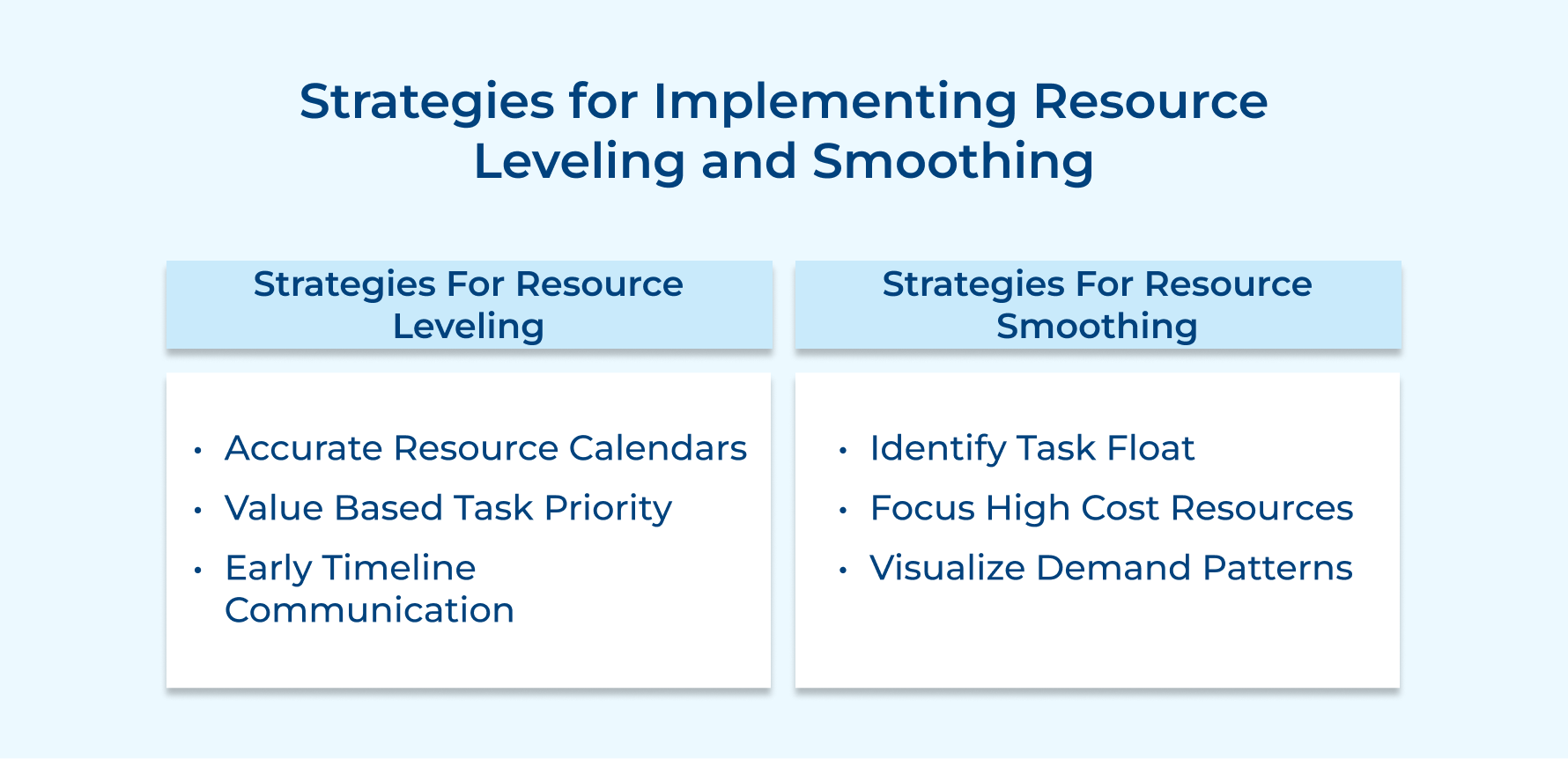
Strategies for Implementing Resource Leveling
- Start with accurate resource calendars and availability data: Before you attempt any leveling, verify when each team member is actually available and account for vacations or other commitments. Leveling decisions based on wrong availability information will create a schedule that fails immediately when reality hits.
- Prioritize tasks by business value rather than just dependencies: When you’re deciding which tasks to delay during leveling, don’t just follow the schedule logic blindly. Move lower-value work first so that critical business deliverables stay as early as possible even within your extended timeline.
- Communicate timeline impacts early and often to stakeholders: The moment leveling reveals a deadline extension, bringing stakeholders into the conversation with clear explanations of why the change protects project success. Surprises damage trust while transparent reasoning about resource constraints builds understanding and support.
Strategies for Implementing Resource Smoothing
- Identify all task floats before making any smoothing decisions: Run a critical path analysis to understand exactly which tasks have flexibility and how much scheduling room exists. Smoothing without this knowledge is like rearranging furniture blindfolded because you don’t know what you can actually move.
- Focus smoothing efforts on resources with the highest cost or scarcity: Don’t waste time smoothing every minor resource when your expensive specialists or limited equipment drive most conflicts. Target your smoothing where the resource constraints hurt most and accept some unevenness in less critical areas.
- Use resource histograms to visualize demand patterns: Graph your resource usage over time to spot the peaks as well as valleys that smoothing can address. Visual patterns reveal smoothing opportunities that spreadsheets and task lists hide in their complexity.
Resource Leveling vs. Resource Smoothing: Choosing the Best Technique for Project Success
The choice between resource leveling vs resource smoothing ultimately depends on whether your project deadline is negotiable or set in stone. Leveling prioritizes team health and realistic workloads by extending timelines when needed, while smoothing protects your end date at all costs even if resources face temporary overallocation.
Master resource leveling vs resource smoothing techniques because different projects demand different approaches based on your stakeholder commitments as well as organizational constraints. Use leveling during initial planning when you control the timeline and switch to smoothing when external pressures make your deadline immovable. The most effective project managers know when each tool fits the situation they’re facing.
Limit time — not creativity
Everything you need for customer support, marketing & sales.

Neeti Singh is a passionate content writer at Kooper, where he transforms complex concepts into clear, engaging and actionable content. With a keen eye for detail and a love for technology, Tushar Joshi crafts blog posts, guides and articles that help readers navigate the fast-evolving world of software solutions.