Resource Conflicts in Project Management: Types, Causes & Fixes
- What are Resource Conflicts in Project Management?
- Why is Resource Conflict Resolution Important in Project Management?
- Types of Project Resource Conflicts
- Common Causes of Project Resource Conflicts
- How to Identify and Resolve Project Resource Conflicts: 6 Steps
- How To Avoid Resource Conflicts In Project Management
- 4 Real-Life Examples of Common Project Resource Conflicts
- Project Management Excellence Starts With Conquering Resource Conflicts
- FAQs about Resource Conflicts in Project Management

Key Highlights:
- Resource conflicts happen when multiple projects compete for limited people, equipment or budgets.
- The main triggers of conflicts are poor planning, unclear priorities and scope creep.
- Prevent conflicts through clear roles and utilization tracking along with the right resource management tools.
Ever wondered why the same team member always ends up booked on two projects at the same time?
It is because resource conflicts stay quiet, usually identified when a deadline is about to slip.
Resource conflict in project management happens when two or more teams compete for the same person, equipment, or budget. Organizations with an established resource management system gain 35% higher utilization
This walkthrough guide breaks down why these conflicts happen, how to spot them and strategies to stop them.
What are Resource Conflicts in Project Management?
Resource conflicts occur when two or more tasks or projects are competing for the limited resource at the same time. It could be a person, a piece of equipment, or a budget line. This clash is the main reason why most projects fall behind schedule, even with proper planning.
So why do well-planned projects face these conflicts? No plan survives contact with reality. A resource conflict rarely announces itself early instead creeps in quietly until someone’s calendar can’t take the overload.
Key factors:
- Timeline overlaps across multiple projects that are competing for the same resource
- Skill scarcity for handling specialized tasks only by one or two people.
- Clear visibility into proper resource allocation across the organization
- Budget constraints that give a limit to the number of resources can be hired or retained
Why is Resource Conflict Resolution Important in Project Management?
Resource conflicts resolution in projects directly protects your timeline, budget and trust your stakeholders have. Let’s explore the benefits in detail:
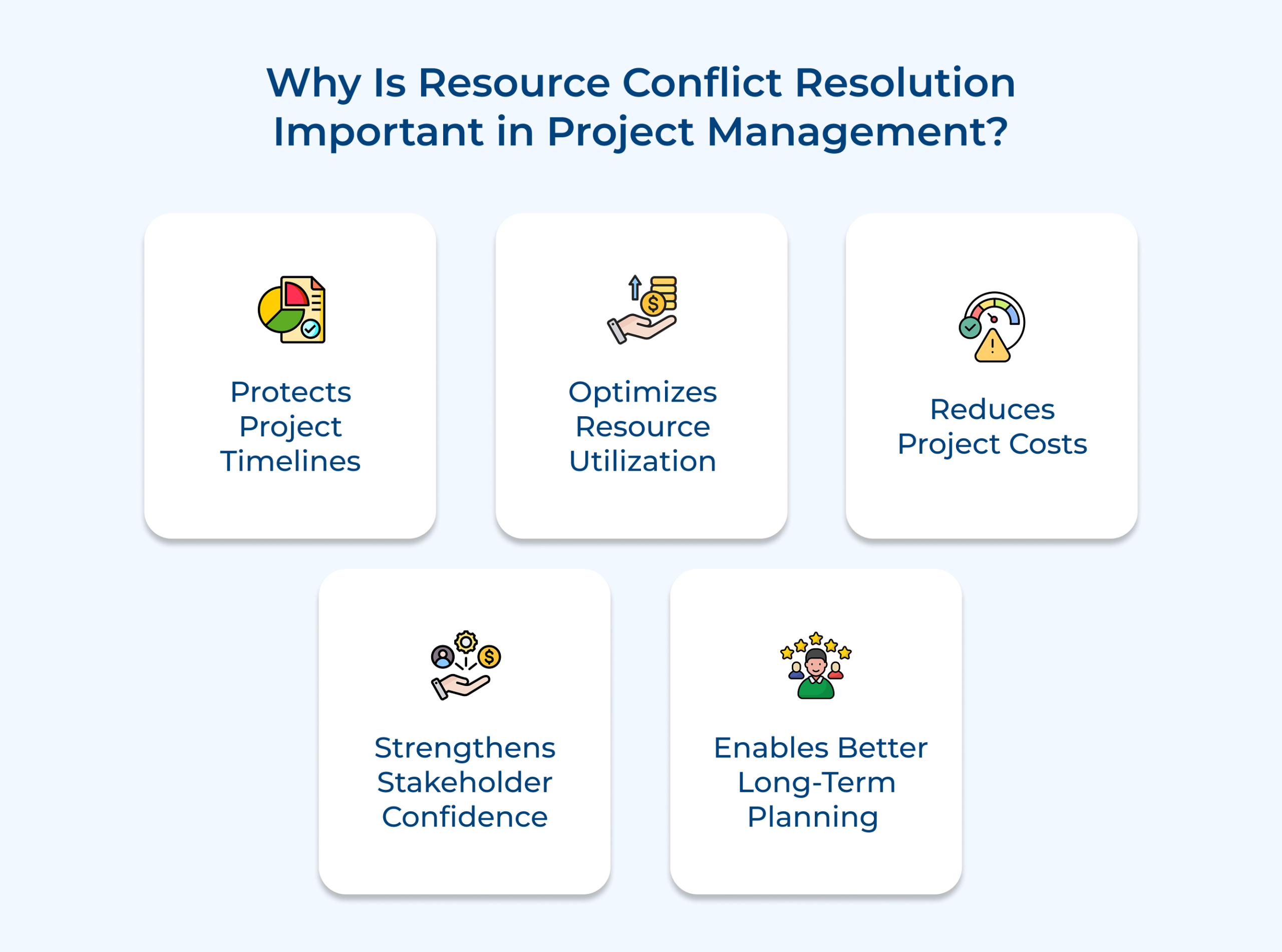
Protects Project Timelines
Tasks stay on the defined timeline when conflicts get resolved early without stalling among teams. Managers who do not follow a proper resolution process can miss entire milestones by weeks and lose client trust.
Optimizes resource utilization
Good conflict resolution in project management helps managers to actually identify individual workload and reveals hidden inefficiencies. You can use your existing talent better instead of hiring new people.
Strengthens stakeholder confidence
Stakeholders when the project manager is handling resource demands smoothly, it builds real confidence in your leadership. The trust built in the future becomes valuable currency for flexibility on deadlines.
Enables better long-term planning
Each resolved conflict gives proper analysis where your resource model is weak. A smart manager can use this for planning, turning firefighting into genuine foresight for better business success as well as client satisfaction.
Types of Project Resource Conflicts
Below are the different types of resource conflict that show up most often in project management.
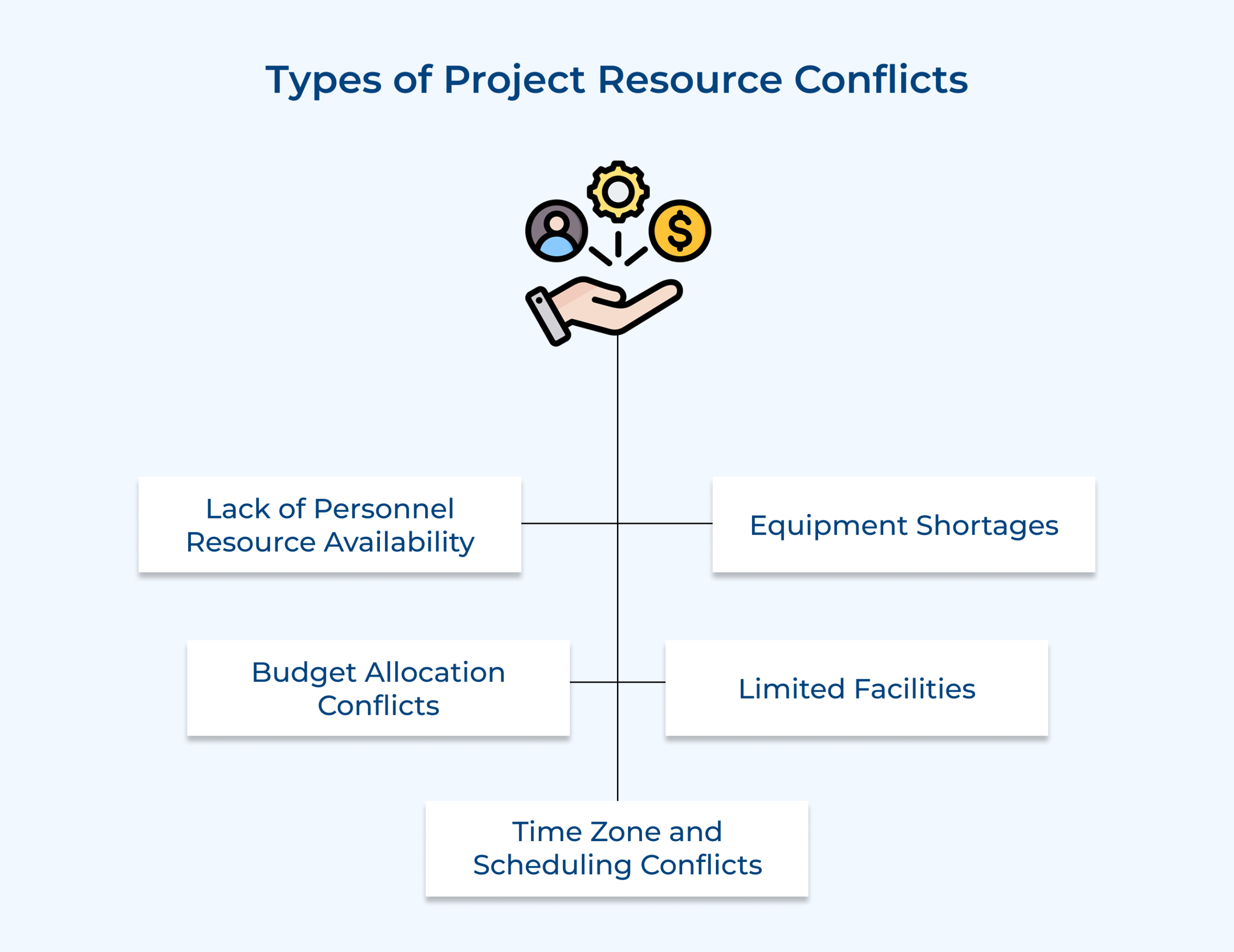
1. Lack Of Personnel Resource Availability
The resource conflict happens when the right person for the task is booked on another project, which leaves no bandwidth to take on new work. Specialized role project teams face this conflict more often.
Some of the common scenarios when this shows up:
- Same developer required in two different sprints
- A single Subject matter expert double-booked for reviews
- During a critical phase key approver is unavailable
2. Equipment Shortages
Multiple projects that depend on shared machinery, software licenses or testing often hit the wall. What can this type of resource conflict in project management do? It can make your entire QA cycle hold for days just to free up a test environment.
Common examples of this project resource conflict are:
- Limited licenses for specialized software
- Shared testing hardware in high demand
- One unit available for multiple sites
3. Limited Facilities
Manufacturing or construction projects are the most common types of projects with this type of conflict and a fixed site capacity. Physical space constraints such as meeting rooms or production floors create friction when teams need the same location at overlapping times.
4. Budget Allocation Conflicts
Two projects, when drawn from the same funding pool, make it difficult for finance teams to choose which initiative requires priority spending. This conflict is especially tense during quarter-end, when budgets are tightest.
5. Time Zone and Scheduling Conflicts
In most service firms, distributed teams across regions struggle to align working hours due to time zone differences, which delays decision-making. These gaps often create issues such as:
- Limited overlap hours for live collaboration
- Delayed approvals due to time zone gaps
- Handoff delays between distributed teams
Common Causes of Project Resource Conflicts
Most resource conflicts in project management trace back to recurring root causes and spotting these early makes resolution easy.
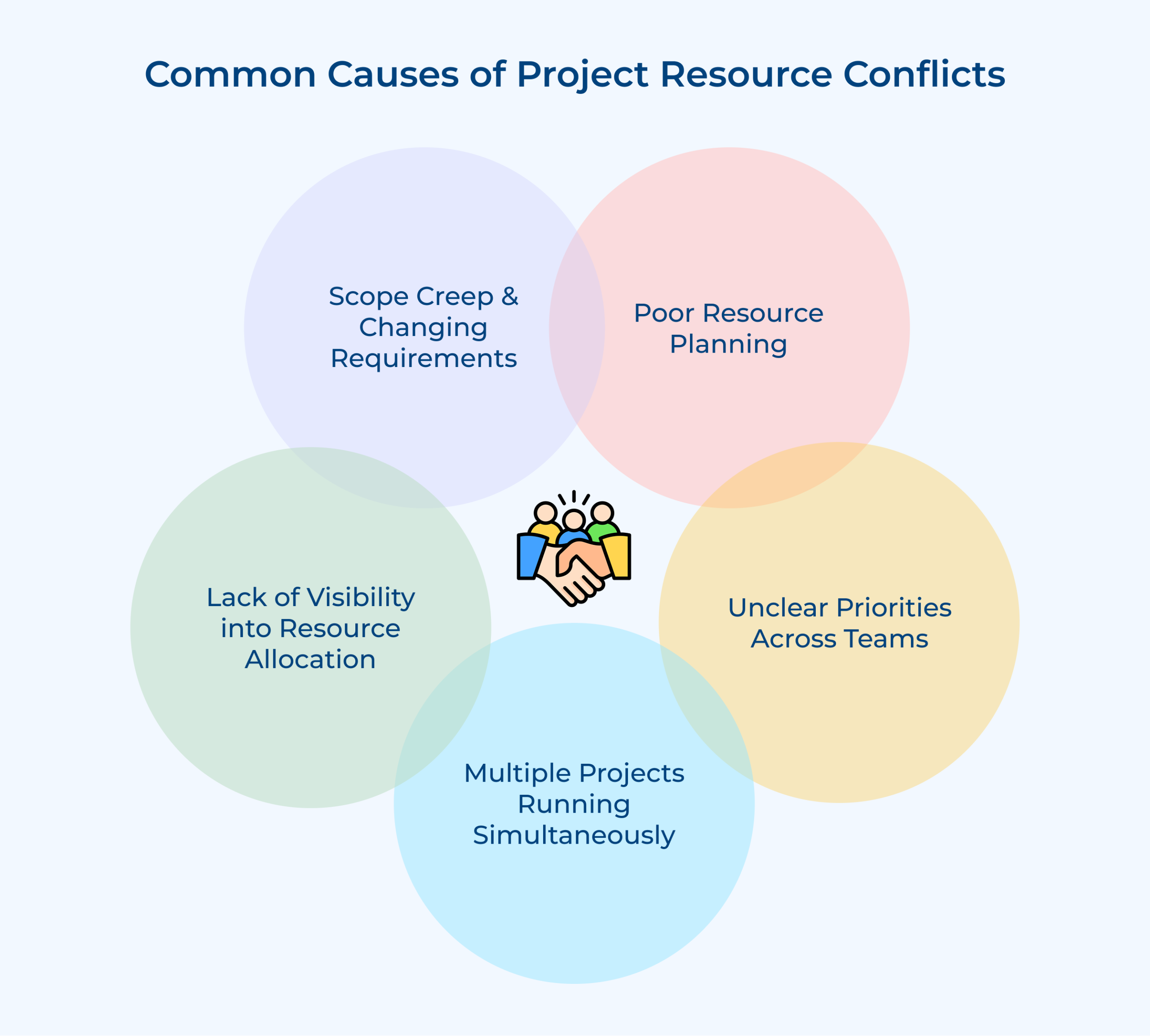
Poor Resource Planning
During initial project planning, when resource needs aren’t mapped out properly, the gaps surface once work is underway. Teams have to go into reactive scrambling instead of proactive allocation, which always costs more time.
Multiple Projects Running Simultaneously
Organizations that are managing multiple projects simultaneously pull resources from the same talent pool without realizing the overlap. Managers without this centralized view lead to claiming the same person for the same week.
Unclear Priorities Across Teams
Knowing someone is “available” isn’t enough; you need to clearly rank which projects matter most. Every team assumes its own work deserves first access to shared resources. The ambiguity in project prioritization creates a constant race for equipping the right resource.
Scope Creep and Changing Requirements
A change in project scope mid-execution quietly demands more resources than planned. It makes the team feel that a manageable workload suddenly stretches far beyond the initial commitment.
Lack Of Visibility Into Resource Allocation
Project managers without having a shared resource tracking system face conflict over who’s working on what. It is identified once there is a delay in task delivery. The blind spot is the biggest reason due to which it goes unresolved until it becomes urgent.
How to Identify and Resolve Project Resource Conflicts: 6 Steps
Resource conflict identification is just halfway, but resolving it properly is the main. Below is the six-step framework that experienced project leaders require.
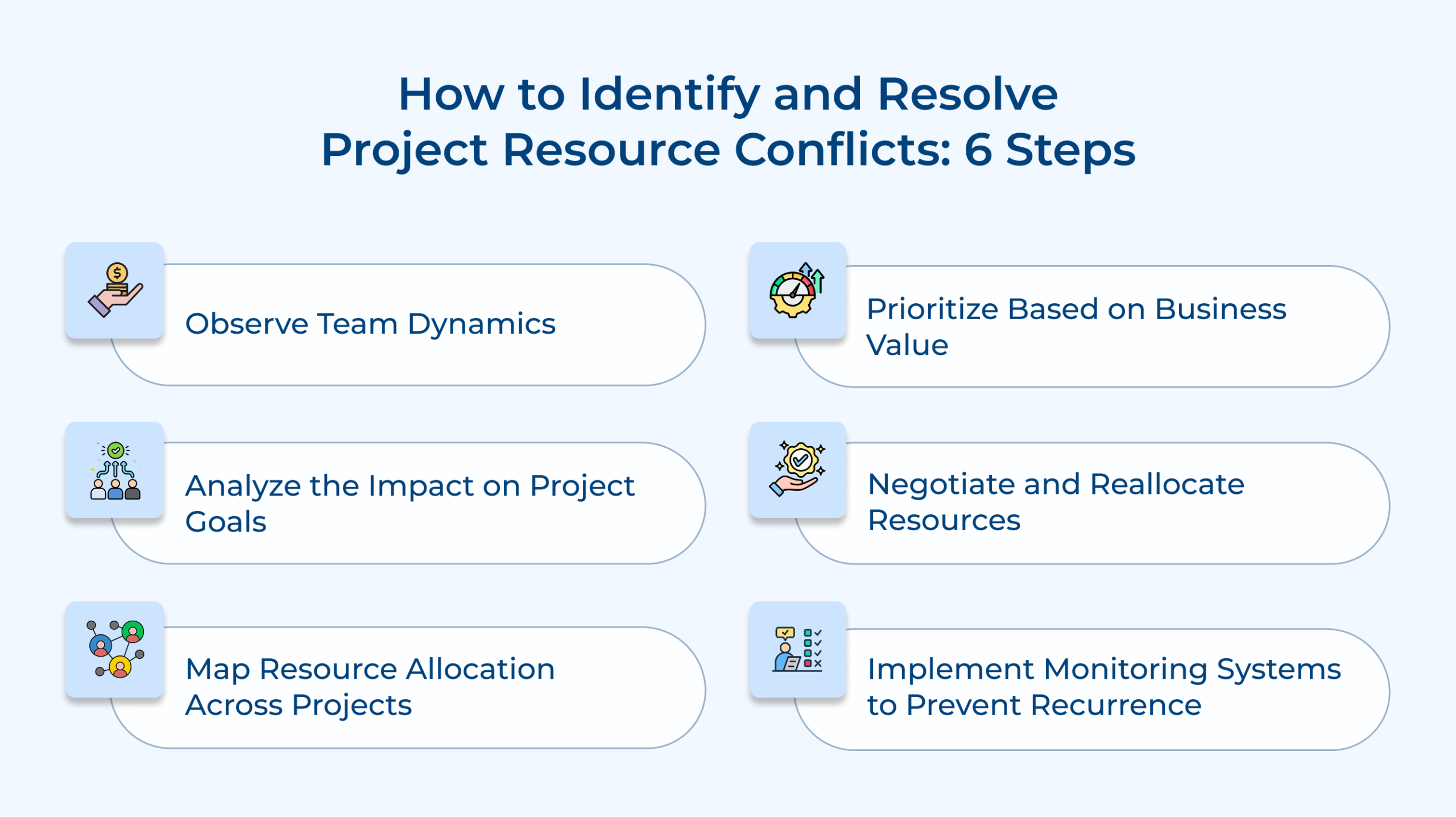
1. Observe Team Dynamics
Resource conflicts in most of the projects show up as people problems and then as scheduling issues. For example, a normally responsive team member suddenly going quiet or missing standups are early signs of being overloaded with too many commitments.
What are some common early warning signs?
- Responsiveness drop: A sudden miss in replies or deadlines without explanation
- Context-switching: Frequent switches between unrelated tasks leave less room for deep focus work
- Visible frustration: Increased tension or short responses show up during cross-team collaboration
Focus on team dynamics to identify workload chatter, tone in status updates and who keeps getting pulled into last-minute fires. Then why doesn’t a resource tracking tool catch this on its own? Software can only track planned allocation, not actual strain.
2. Analyze the Impact on Project Goals
Once you have identified the resource conflicts in the project, figure out what it’s actually causing. A delay on a low-priority task is tolerable, but on a critical-path item it can derail the entire milestone.
Consider these questions to gauge the real impact:
- Does this delay affect tasks directly on the critical path?
- How many tasks are depending on one resource?
- What’s the actual cause of delaying vs reallocating?
This analysis connects the resource gap directly to specific deliverables, deadlines and dependencies. So what’s the goal here? Clarity, not panic. Before deciding how urgently it needs fixing, quantify the impact.
A simple way to assess this is through:
- Dependency review: Check which tasks get affected by resource conflicts from the project’s dependency map
- Buffer check: Review the amount of schedule remaining before deadlines start slipping
3. Map Resource Allocation Across Projects
Conflicts are only visible when managers build a full picture of your resource usage across the entire organization, not just one project.
What happens when you don’t have this wider view? It’s easy to assume that a conflict is isolated, but instead a common pattern repeating across different teams.
A proper mapping pulls data from every active project into a single format that exposes overlaps that managers cannot. So is this really worth the effort it takes? Yes, it reveals uncomfortable truths such as a person being booked at 140%, having a full picture before any fair decisions are made.
Key tools that help in building a proper map:
- Resourcing platforms: Tools such as Kooper or Resource Guru help in tracking capacity in resource capacity in real time
- Capacity dashboards: Weekly updated so that every project manager analyzes the same numbers
- Cross-project sheets: Allocation trackers to review jointly by all project managers involved
4. Prioritize Based on Business Value
The full map helps to make the hard call about which project gets the priority resource. The decision needs to be aligned with the business value. Some criteria for project prioritization:
- Financial weight: The direct revenue impact each competing project
- Hard deadlines: Contractual obligations that carry real penalties if missed
Business value for most firms is not always revenue. It includes everything from strategic importance to regulatory deadlines and client relationships. A smaller project with major client renewal outranks a larger internal initiative having flexible timing.
Pro tips:
- Perform a short prioritization meeting with all relevant stakeholders
- A documented, side-by-side comparison for ranking the competing projects
5. Negotiate and Reallocate Resources
Your actual work of moving resources around starts from here. So what matters most here? Diplomacy as well as logistics. Reallocating a key person from one project goes smoothly without an honest conversation with the manager, losing them.
Try good negotiation by presenting the data gathered earlier and not just announcing a decision. Team members accept reallocation easily when they understand the genuine reasoning instead of feeling blindsided.
Best practices to negotiate effectively:
- Transparent sharing: Allow project managers to review the full impact analysis before reallocation
- Phased handoff: Follow a gradual transition instead of forcing an abrupt switch
- Clear documentation: Record approval from the resource upon change so future planning can refer.
6. Implement Monitoring Systems to Prevent Recurrence
You feel good when one resource conflict is resolved, but without monitoring, the same pattern tends to repeat in the next project within a few months. Avoid this by building a system that catches overlaps before they transform into full-blown conflicts.
A good monitoring system should include:
- Routine reviews: Frequent capacity checks across all active projects
- Threshold alerts: Automatic notification when allocation exceeds a predefined limit
- Shared visibility: A calendar that is accessible to all project managers
Proper monitoring also creates a feedback loop where past conflicts inform future planning decisions. Each resolved conflict leaves a lesson that improves resource allocation next time.
How To Avoid Resource Conflicts In Project Management
Resource conflict resolution after they occur is necessary, but preventing them in the first place makes a project manager strategic. Explore these proven strategies in detail:
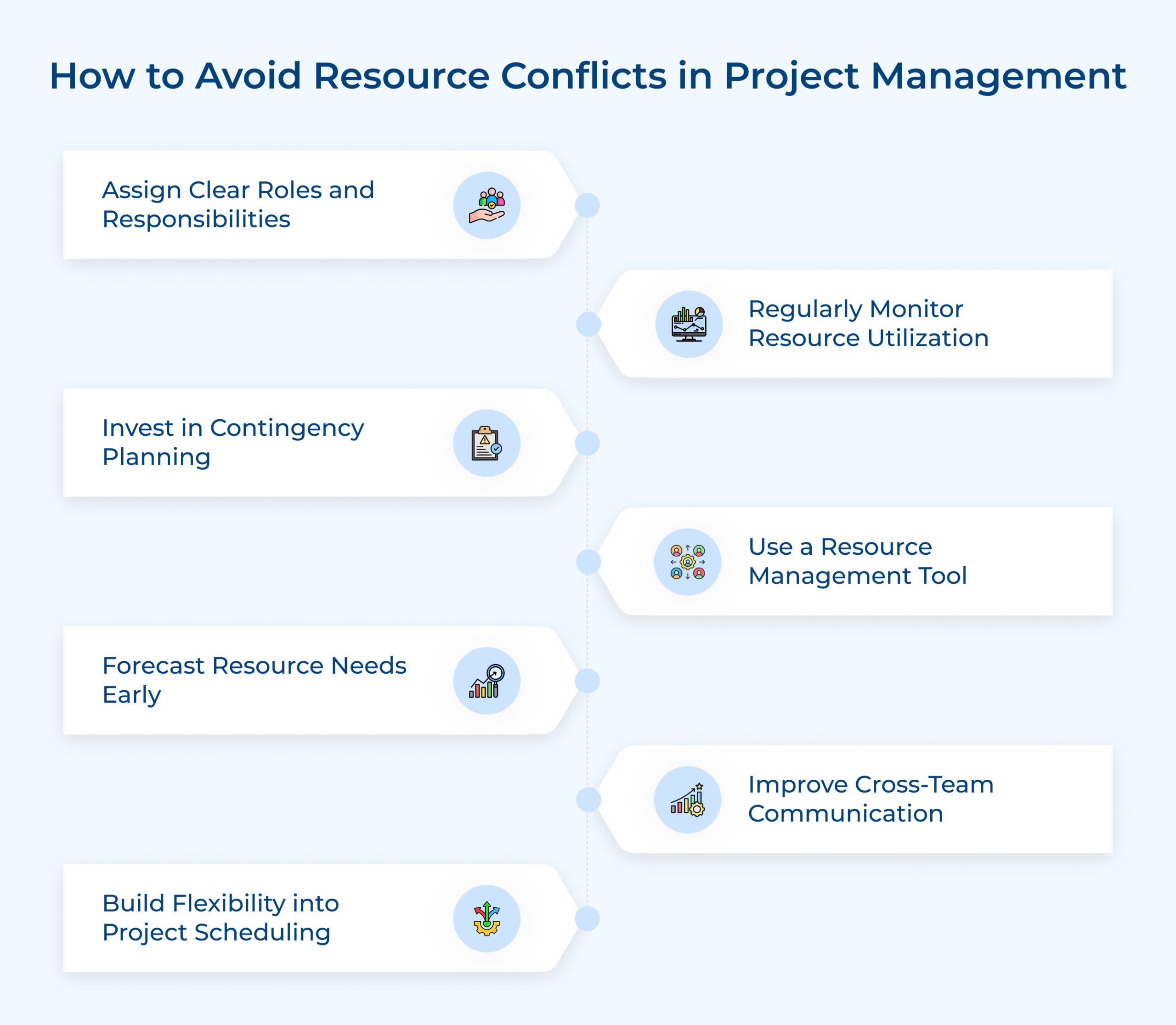
1. Assign Clear Roles and Responsibilities
One of the quickest causes of resource conflict is role ambiguity, since two people might work on the same task, which wastes effort and creates friction. “Clarity” here is the key to preventing confusion reaching a project manager’s desk.
Implement this checklist before proper implementation:
- Does every task of the project have one owner?
- Is proper documentation for approval rights at each decision point?
- Are overlapping responsibilities identified and removed?
- Does each team member know the proper escalation path?
This checklist forces explicit decisions instead of assumed. Once ownership is documented, handling resource conflicts simply disappears from daily project execution.
How to prevent:
- Speeds up decisions: Assign experienced approvers to make sure work doesn’t stall waiting on clarity
- Reduces escalations: Document accountability to resolve disputes faster.
- Improves resource forecasting: Provide clear ownership to make capacity planning more accurate
2. Regularly Monitor Resource Utilization
Track utilization rate to analyze how much each person’s time is actually committed on an ongoing basis instead of a one-time check. Managers can use it to catch overallocation and fix it.
So, how to apply this strategy in practice?
- Weekly capacity snapshots: Review allocation every week to catch drift before it scales to conflict later
- Utilization thresholds: Define a capacity of 85%, leaving a buffer room for unplanned work
Consider an example of a services firm billing clients based on hours worked. After weekly utilization tracking, the manager spots a consultant 120% allocated before the client deadline. It gives them enough time to bring in support to prevent delay.
3. Invest in Contingency Planning
Contingency planning is all about building “slack,” which helps in scheduling and identifying backup resources. Build your plan based on these factors:
- Critical-path exposure: Identify which tasks have zero schedule flexibility
- Key-person dependency: Flag tasks that depend on one irreplaceable specialist
- Budget reserve: Allocate contingency funds for emergency reallocation
So, how much buffer is good enough without padding the schedule unnecessarily? A 10 to 15% extra time on critical-path tasks is best to absorb minor shocks without affecting timeline.
Pro tip: Pre-identify backups early and line up contractor relationships before you need across the deliverables.
4. Use a Resource Management Tool
A question that might come to mind is “Why do most spreadsheets eventually fail at preventing resource project conflicts?” Spreadsheets are just “static snapshots” that need humans to update any changes.
A dedicated resource management tool can update any allocation in real time and gives every project manager the same live view.
Centralize Allocation Visibility Across Projects
A centralized resource allocation tool that consolidates every project’s data into one dashboard, removing the blind spots. This single view makes cross-project conflicts visible before they actually occur.
Automate Overallocation Alerts and Tracking
Automated alerts notify you the moment someone’s allocation crosses a threshold limit, removing the need for manual checking. It catches conflicts days or weeks earlier than someone noticing manually.
5. Forecast Resource Needs Early
Estimate the skills and equipment required for a project well before work starts, based on the scope. Proper forecasting prevents the scramble that happens when demand becomes mandatory mid-project.
Building an early forecast includes these factors:
- Project scope depth: Estimate effort based on detailed requirements instead of assumptions
- Pipeline overlap: Check upcoming projects competing for same talent pool
- Seasonal demand patterns: Use historical spikes by syncing to specific times of year
So, how can forecasts so often miss the mark despite best intentions? Most inaccuracy starts from estimating at too high a level. This unclear scope leads to wrong resource estimation that falls apart once real work starts.
6. Improve Cross-Team Communication
Cross-team communication makes your resourcing decisions visible to every team that might be affected. Most conflicts in project management come when one team simply doesn’t know another team is already claiming the same resource.
A few habits to follow to make this work best:
- Shared resourcing calendars: Give team leaders a real-time view of complete resource allocation for efficiently assigning work. Updated calendars can identify conflicts days before it arrives.
- Brief cross-project syncs: Help in flagging upcoming resource needs before transforming to urgent requests.
- Open escalation channels matter: Conflicts that are unidentified for too long tend to surface as resentment instead of clean resolution. A direct, low-friction approach keeps disagreements about scheduling instead of personalities.
But why do most teams skip this strategy? Simply, communication feels overhead when deadlines are tight, even though skipping it creates more delay and cost than the meetings.
4 Real-Life Examples of Common Project Resource Conflicts
Understanding how resource conflicts actually play out across industries makes it much easier for managers to recognize the pattern.
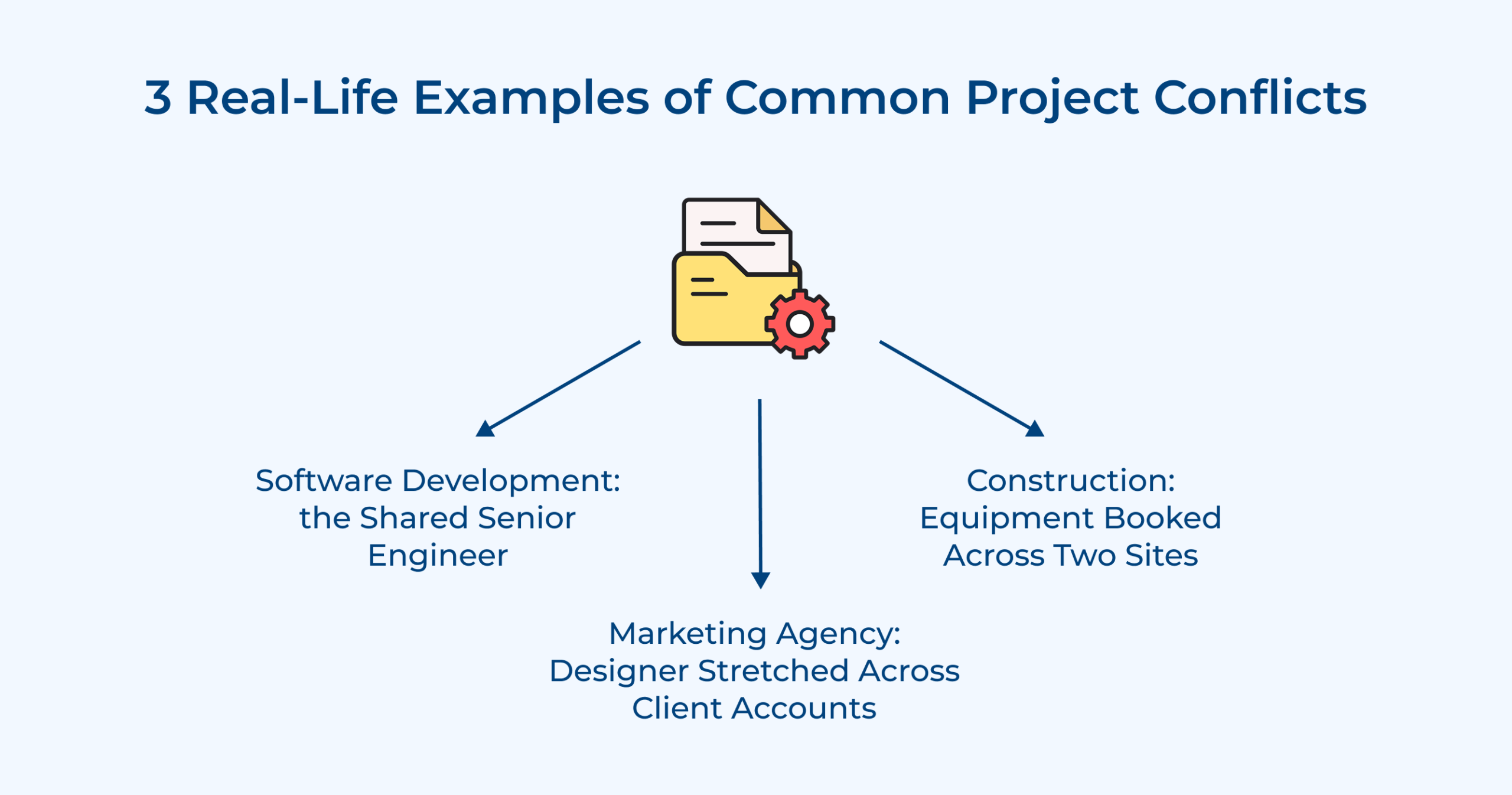
1. The Shared Senior Engineer in Software Development
A mid-sized SaaS company has only one senior backend engineer managing two product launches scheduled. Both project teams provided full access to him, but neither discovered the overlap until standups started colliding mid-week, leading to resource conflict
2. Equipment Booked Across Two Construction Sites
A contractor was running two different builds at the same time with a single crane scheduled for foundation work at both sites. This type of resource conflict is identified only when any one project management crew finds the equipment already in use.
3. Designer Stretched Across Client Accounts in Marketing Agency
A growing agency assigned its lead designer to four client campaigns launching in the same week. Account managers kept escalating individually while unaware that three other teams were already making the same requests at once,, creating a genuine conflict in resources
Project Management Excellence Starts With Conquering Resource Conflicts
Resource conflicts are the inevitable part of running multiple priorities with limited people and budgets. Identifying and resolving them early separates strong project leaders from the ones struggling.
- Prevents most conflicts from occurring with clear visibility into resource allocation
- Prioritization and negotiation resolve clashes faster than decision-making
Teams that still depend on spreadsheets need to explore a dedicated tool for mastering resource conflicts in project management. It’s not just about avoiding every clash but also resolving them faster before the timeline derails.
Limit time — not creativity
Everything you need for customer support, marketing & sales.

Neeti Singh is a passionate content writer at Kooper, where he transforms complex concepts into clear, engaging and actionable content. With a keen eye for detail and a love for technology, Tushar Joshi crafts blog posts, guides and articles that help readers navigate the fast-evolving world of software solutions.