Complete Guide to Professional Services Revenue Forecasting
- What is Professional Services Revenue Forecasting?
- Key Benefits of Revenue Forecasting in Professional Services
- Understanding the 4 Professional Services Forecasting Models
- How to Forecast Revenue for Your Service Business in 7 Steps
- Challenges in Revenue Forecasting for Professional Services and Consultancies
- Best Practices for Improving Revenue Forecasting for Professional Services
- Transform Uncertainty Into Strategic Advantage with Professional Services Revenue Forecasting
- FAQs about Professional Services Revenue Forecasting
Key Highlights:
- Professional services revenue forecasting ensures predictable income, supporting smarter growth and planning.
- Accurate forecasts improve cash flow, optimize resource allocation, enhance client relationships, and support informed strategic planning for sustainable growth.
- Combining multiple forecasting models with scenario planning helps consultancies manage risks, navigate market volatility, and achieve reliable revenue projections.
Most professional service firms struggle with unpredictable revenue streams that make strategic planning feel like gambling. Without reliable forecasting, you cannot confidently hire staff or maintain consistent cash flow.
This uncertainty creates cascading problems that threaten your firm’s viability. You either overcommit when lacking capacity or miss growth opportunities because you cannot predict available resources accurately enough for confident commitments.
Systematic professional services revenue forecasting transforms chaos into clarity through structured approaches to predicting your financial future. Proven methodologies provide reliable predictions that support smarter business decisions and sustainable growth strategies for lasting success.
What is Professional Services Revenue Forecasting?
Professional services revenue forecasting is the process of predicting future income streams for service-based businesses like consulting firms or agencies. Think of it as creating a financial roadmap that helps you anticipate how much money your expertise will generate over specific time periods. This practice combines historical performance data with current pipeline information to estimate future earnings from billable work.
The process starts by analyzing your existing client contracts and ongoing projects to establish a baseline. You then layer in probable new business from your sales pipeline while factoring in seasonal patterns and market conditions. The result is a rolling forecast that gets updated regularly as new information becomes available and helps guide business decisions.
Key components of revenue forecasting:
- Existing contract value: The guaranteed revenue from signed agreements and recurring client relationships already in place.
- Pipeline probability: Potential revenue from prospects weighted by their likelihood of converting into actual paying clients.
- Resource utilization rates: How effectively your billable staff time converts into revenue based on capacity and efficiency.
- Seasonal adjustment factors: Historical patterns that show how your business typically performs during different times of the year.
Key Benefits of Revenue Forecasting in Professional Services
Revenue forecasting transforms how professional services firms operate by providing clarity and direction for critical business decisions. Let’s explore why this practice has become essential for modern consultancies.
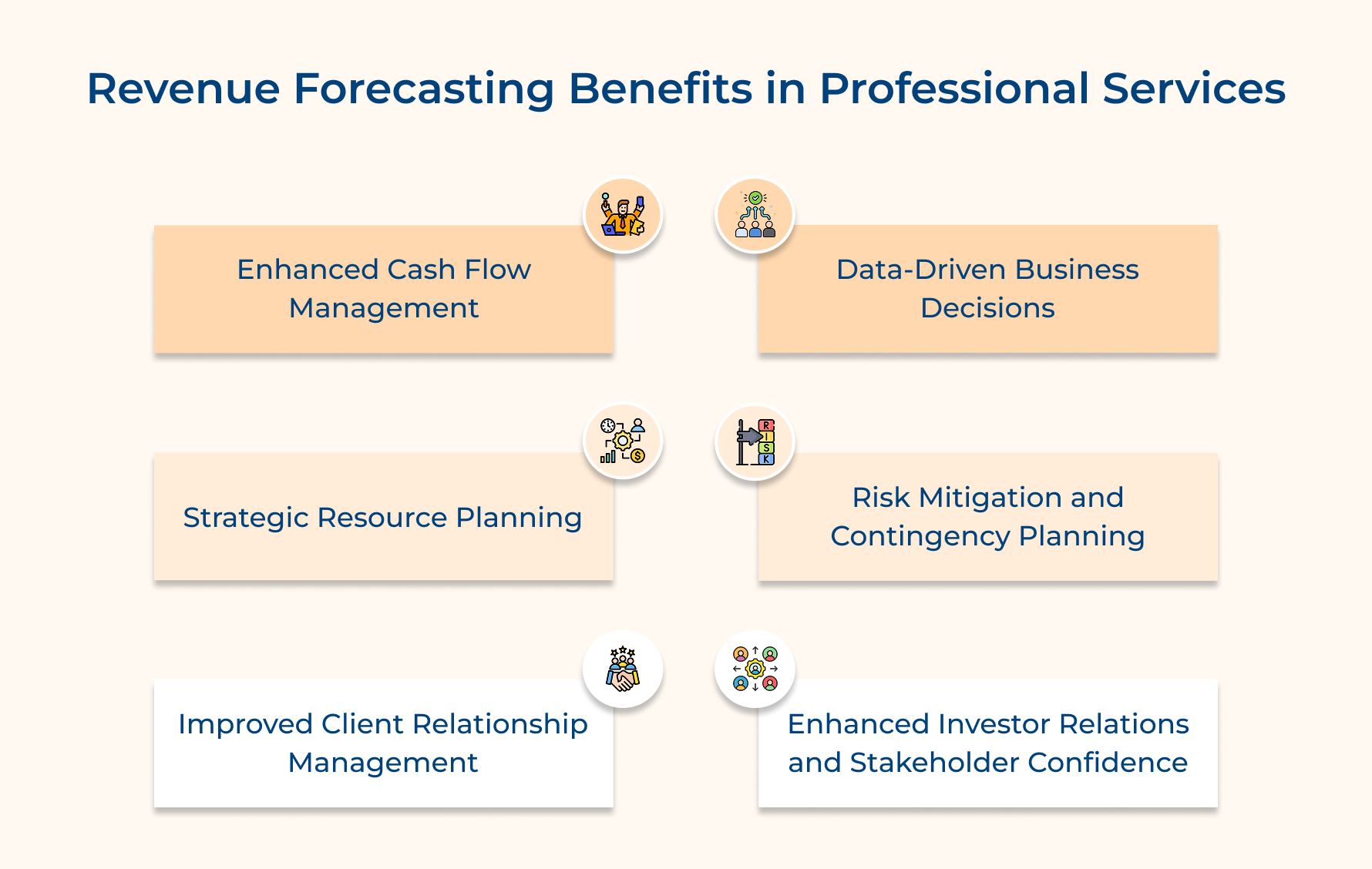
Enhanced Cash Flow Management
Accurate revenue forecasts aren’t just about numbers, they give you clarity on when money will actually hit your bank account, not just when invoices are sent. This helps with better financial planning, so you’re never caught off guard during big expenses or cash dips.
Strategic Resource Planning
Using real-time data, forecasting helps you spot when you’ll need more people or specific skills for upcoming projects. That way, you can hire in advance and avoid the stress (and cost) of last-minute staffing during busy periods.
Improved Client Relationship Management
Understanding your revenue pipeline helps you strike the right balance, serving current clients while confidently pursuing new ones. It stops you from overpromising when your team’s already stretched thin, keeping relationships strong and expectations realistic.
Data-Driven Business Decisions
Want to invest in new tools or open a new office? Accurate forecasts give you a solid foundation for informed decisions. You’ll compare future income with planned expenses and choose what aligns best with your growth goals.
Risk Mitigation and Contingency Planning
Forecasting acts like a financial radar. It highlights potential revenue gaps before they become serious problems. This gives you time to shift strategies or create backup plans instead of reacting under pressure.
Enhanced Investor Relations and Stakeholder Confidence
Reliable forecasting shows investors and board members that you’re in control. When they see consistent, data-driven planning, they’ll trust your vision and are more likely to support funding requests as well as expansion plans.
Understanding the 4 Professional Services Forecasting Models
Let’s explore the four primary types of professional services revenue forecasting models that are empowering organizations to operate with heightened foresight and efficiency.
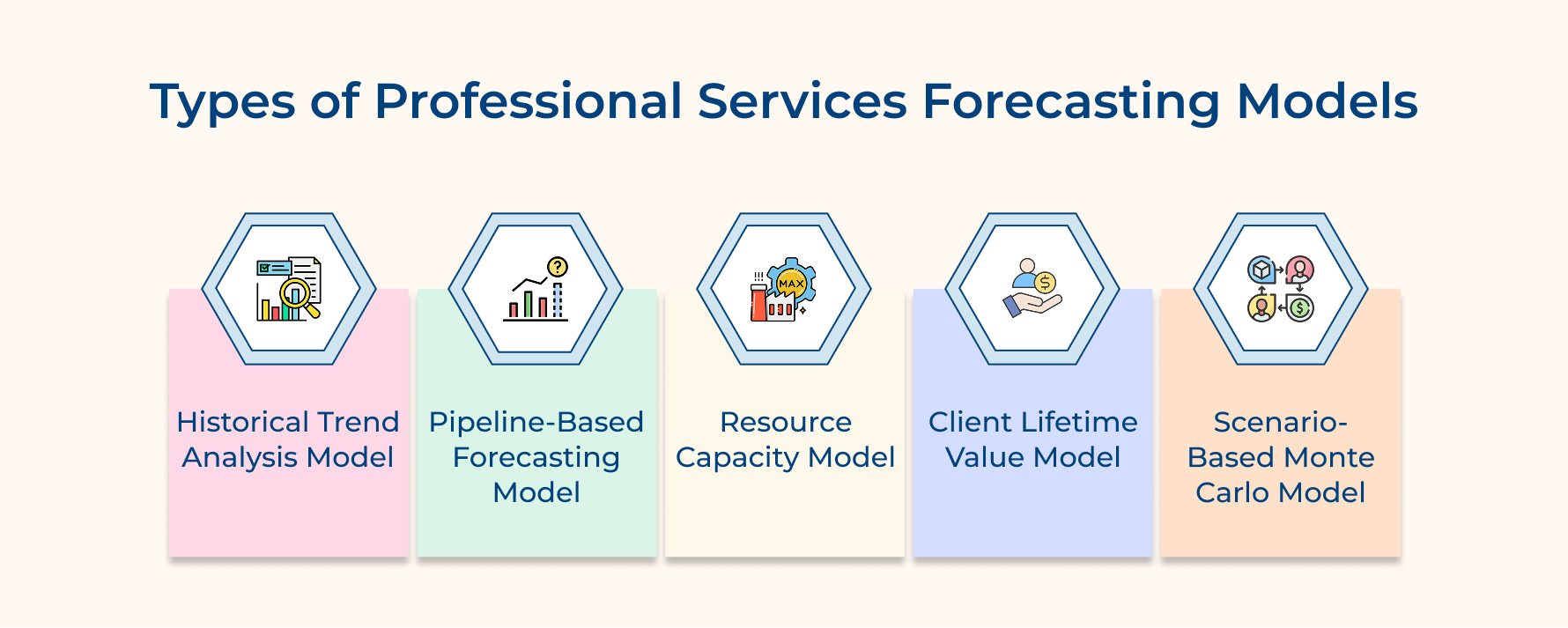
1. Historical Trend Analysis Model
This model uses your firm’s past revenue data to identify patterns and project future earnings based on historical performance trends. Think of it as looking in the rearview mirror to predict what lies ahead on your business journey.
Strengths:
- Simple to implement with basic spreadsheet skills
- Requires minimal data collection beyond existing financial records
Weaknesses:
- Assumes past performance will continue unchanged
- Ignores market shifts and competitive pressures
This calculation provides a baseline expectation for revenue growth and helps identify your firm’s natural business cycles for better planning. It works best for established firms with stable client bases and predictable service delivery patterns.
2. Pipeline-Based Forecasting Model
This approach calculates future revenue by analyzing your current sales pipeline and applying probability weights to potential deals. It transforms your business development efforts into concrete revenue predictions by examining each prospect’s likelihood of converting.
Pros:
- Reflects real business opportunities in your pipeline
- Updates dynamically as deals progress or stall
Cons:
- Relies heavily on sales team accuracy in probability assessments
- Can be overly optimistic about deal closure rates
You need detailed information about each prospect including deal size and estimated probability of winning the business. Calculate by multiplying each opportunity’s value by its probability percentage then summing all weighted values for your total forecasted revenue.
This method helps you understand which business development activities generate the most reliable revenue and where to focus your sales efforts. It provides early warning signals when your pipeline becomes too thin to support growth targets.
3. Resource Capacity Model
It forecasts revenue based on your available billable resources and their utilization rates across different service offerings. It answers the fundamental question of how much money your current team can realistically generate given their time and expertise constraints.
Pros
- Directly links revenue to actual delivery capacity
- Helps identify staffing needs before revenue gaps appear
Cons
- Assumes consistent utilization rates across all team members
- Doesn’t account for varying billing rates between projects
The model creates clear connections between hiring decisions and revenue growth potential which supports budget planning for staff expansion. It also helps optimize team assignments by matching the highest-value work with your most skilled and expensive resources.
4. Client Lifetime Value Model
The approach predicts revenue by analyzing the total value each client relationship will generate over its entire duration. It considers both recurring work patterns and the natural evolution of client relationships to forecast long-term revenue streams.
The model uncovers hidden revenue patterns like seasonal client behavior and relationship maturity cycles that affect spending patterns. It also helps price initial projects strategically to maximize lifetime relationship value rather than just immediate project profitability.
Strengths:
- Accounts for relationship-based revenue that typical models miss
- Helps prioritize client retention and expansion efforts
Weaknesses:
- Requires extensive historical data on client relationships
- Complex calculations that need specialized software or expertise
A consulting firm discovers their average client generates $15,000 monthly for 18 months with relationships growing 10% annually after year one. Their lifetime value model shows each new client represents approximately $297,000 in total revenue over the relationship duration.
How to Forecast Revenue for Your Service Business in 7 Steps
Revenue forecasting serves as the financial compass for your service business, guiding strategic decisions and ensuring sustainable growth. Before diving into the forecasting process, establishing a solid foundation through key preliminary questions will sharpen your approach and improve accuracy.
- What is your average customer lifetime value and how has it trended over the past 12 months?
- What percentage of your revenue comes from recurring clients versus new customer acquisitions?
- How long is your typical sales cycle from initial contact to signed contract?
- What seasonal patterns or cyclical trends have you observed in your service demand?
- What is your current customer churn rate and primary reasons for client departures?
Now let’s explore the seven fundamental steps that will transform these insights into a robust revenue forecast for your service business.
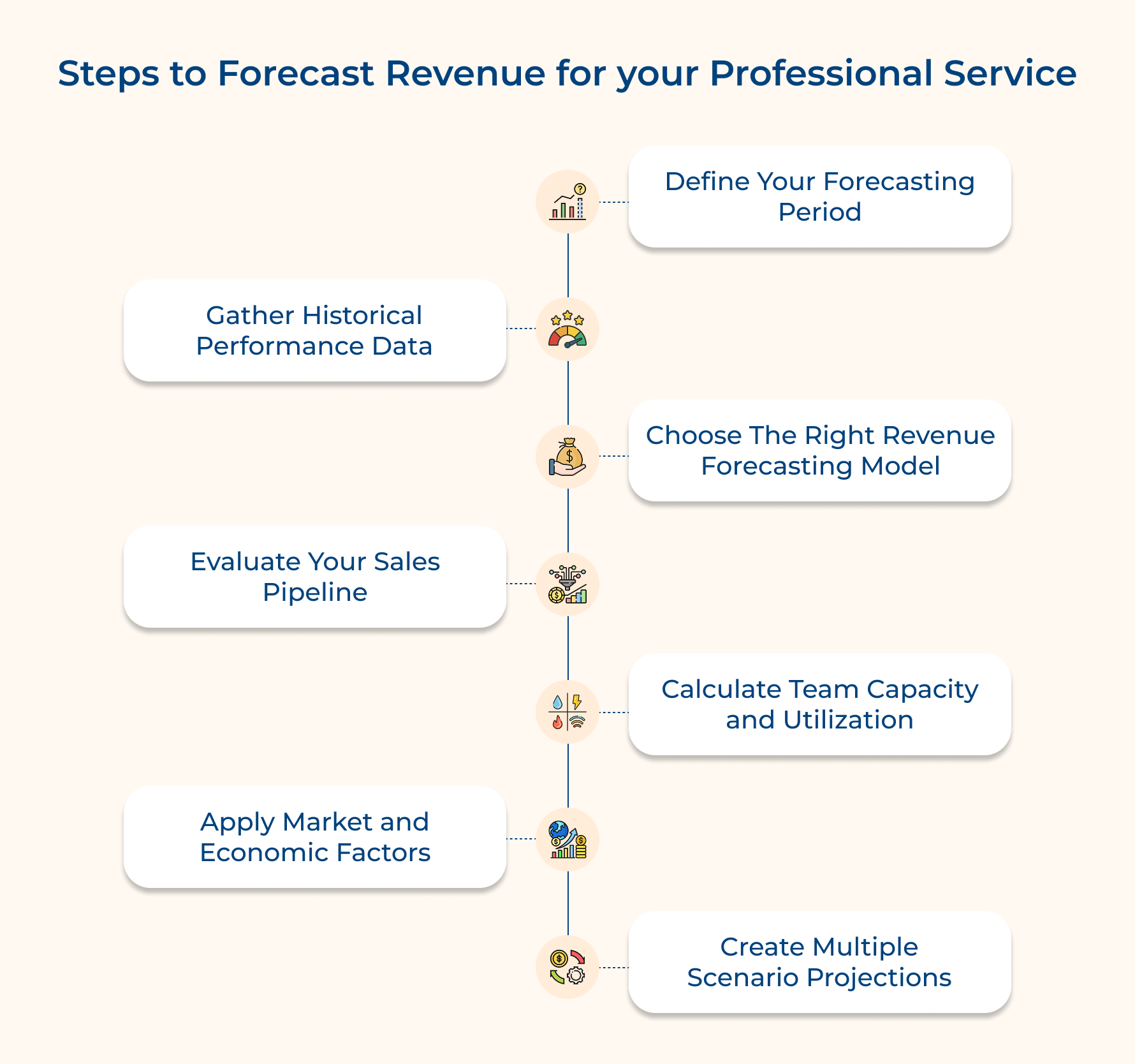
1. Define Your Forecasting Period
Choosing the right forecasting period sets clear boundaries for your revenue predictions and helps your team stay aligned. Most service firms face a trade-off: short-term accuracy vs. long-term planning.
- Quarterly forecasts offer precision and flexibility. They’re great for tracking cash flow and adapting quickly to market changes, but they do require more frequent updates.
- Annual forecasts support big-picture planning and reduce admin work, but they might miss short-term shifts that need fast action.
Whichever you choose, don’t forget to factor in seasonal trends. Client demand often dips or spikes around holidays or fiscal year-ends, and that can really impact your numbers. Aligning your forecasting period with these patterns leads to more accurate revenue forecasts and better planning.
2. Gather Historical Performance Data
Gathering historical performance data is your first step toward smarter, data-driven sales forecasts. By reviewing past revenue, you can spot patterns that help predict future results with more confidence.
Start by asking a few key questions:
- What were your monthly revenues for each service line over the past 3 years?
- How fast do clients usually pay after billing?
- Which months perform above or below your annual average?
- What percentage of revenue comes from repeat vs. new clients?
For example, a marketing consultancy found 60% of their revenue came from three long-term clients who paid fast—within 15 days. That insight helped them plan cash flow more accurately and align with industry trends.
3. Choose the Right Revenue Forecasting Model
Choosing the right model for forecasting revenue is key to maintaining your firm’s financial health. The right fit gives you reliable insights; the wrong one leads to guesswork.
Start by asking:
- How much quality historical data do we have?
- How accurate do our forecasts need to be?
- Does our team have the skills for complex models?
- How often will we need to update forecasts?
For example, a small design agency with limited data might stick to a simple pipeline model instead of advanced analytics and that’s okay.
When selecting a model, consider:
- Data depth vs. model complexity
- Your team’s technical comfort
- How often you’ll need updates
- Accuracy needs vs. simplicity
- How easily the model integrates into your current systems
4. Evaluate Your Sales Pipeline
Evaluating your sales pipeline is all about understanding how likely each one is to convert into revenue. By assigning realistic probability scores, you can turn business development activity into solid financial projections.
- Start by tracking engagement, things like meeting frequency or involvement from decision-makers. More engagement usually means a higher chance of closing.
- Apply your historical win rates to similar opportunities. This removes guesswork and keeps your predictions grounded in real data.
- Consider where each deal is in your sales process. Early-stage leads should carry lower probability scores, while late-stage ones (like deals in negotiation) deserve higher weight.
The firms that hit their revenue targets consistently? They rely on honest, data-driven pipeline evaluations.
5. Calculate Team Capacity and Utilization
Understanding your team’s capacity and utilization helps you see how much billable work they can handle as well as how that translates into future sales potential. It’s about knowing when to scale without overloading your team or hurting service quality.
Ask yourself:
- How many billable hours can each person work after admin and client calls?
- How much time goes into non-billable work like meetings or business development?
- When will new hires be fully productive after onboarding?
By doing the math, you can spot bottlenecks early and avoid overpromising to clients. It also gives you solid ground to plan hires or expand services.
Pro tip: Add a 10–15% buffer for surprise client needs, and review monthly to fine-tune team productivity.
6. Apply Market and Economic Factors
When forecasting revenue, it’s important to look beyond your internal data and factor in the bigger picture because market trends as well as economic conditions can seriously impact all types of revenue.
Keep an eye on your industry’s growth, if it’s expanding, demand for your services likely rises too. Watch out for signs of a recession, like rising unemployment or slowing GDP, which usually lead to tighter client budgets.
Also, higher interest rates can delay big projects, while regulatory changes might either boost demand for your expertise or restrict client spending.
Don’t overreact to every dip. Learn to tell the difference between short-term noise and real shifts that may need a change in your business model. That’s smart, future-ready forecasting.
7. Create Multiple Scenario Projections
Relying on a single forecast can be risky, real life rarely goes exactly as planned. To get accurate revenue projections, smart firms build multiple scenarios to prepare for whatever comes their way.
Here are three practical ways to do it:
- Best-Case, Worst-Case, and Expected (Baseline) Forecasts
Create three versions using optimistic, pessimistic, and realistic assumptions. This shows your possible revenue range and key risk factors. - Monte Carlo Simulation
Run hundreds of forecast variations using different probability weightings. This gives you a range of possible actual revenue outcomes instead of one fixed number. - Sensitivity Analysis
Test how changes in variables (like win rates or project size) affect revenue. It helps you focus on what really moves the needle.
Challenges in Revenue Forecasting for Professional Services and Consultancies
Let’s delve into the key challenges these industries encounter in revenue forecasting and offer insights on how to overcome them.
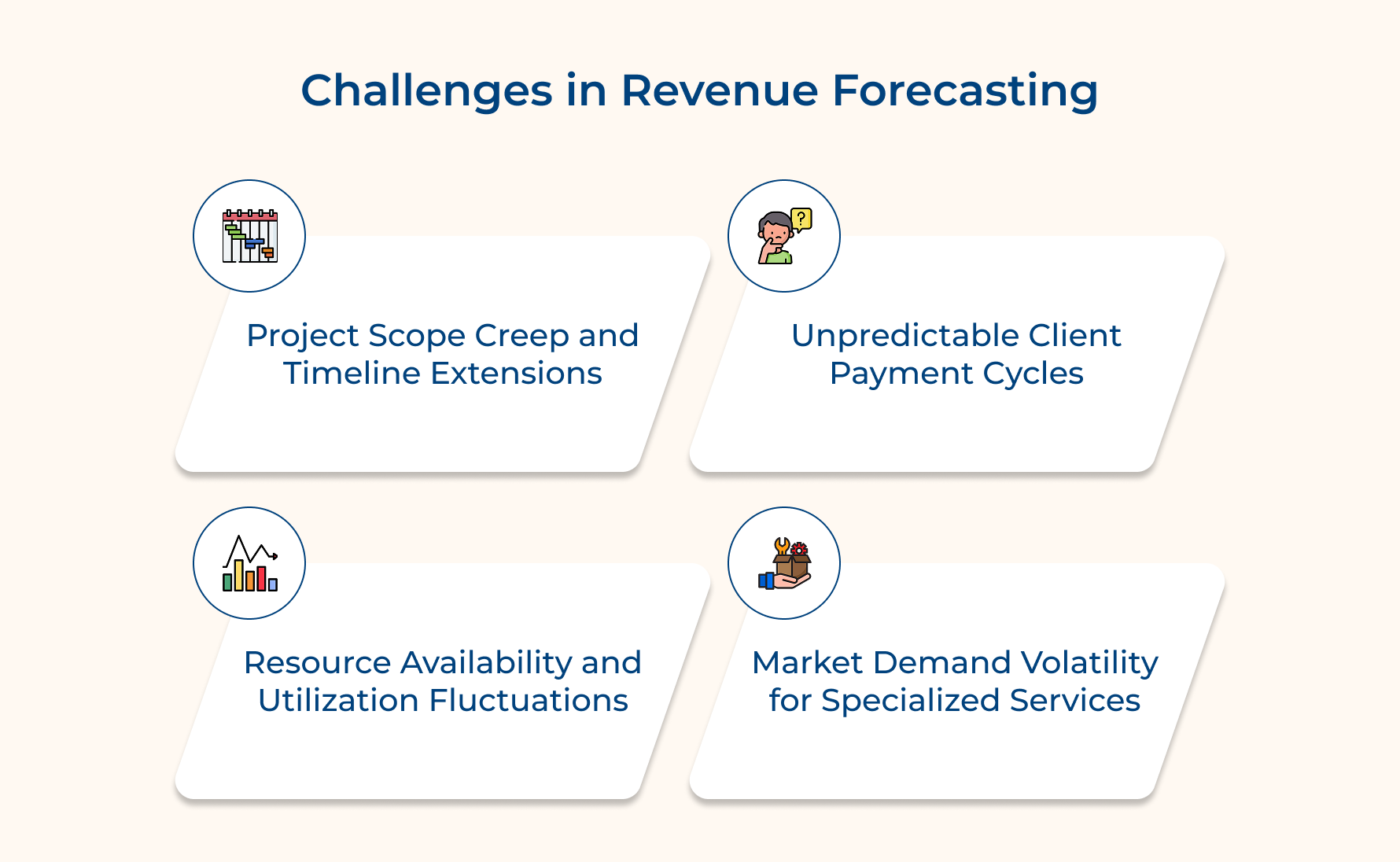
Project Scope Creep and Timeline Extensions
Clients often request additional work mid-project, which leads to scope expansion and impacts original revenue estimates.
Solution: Build a 20–30% buffer into project forecasts to account for typical change requests.
Unpredictable Client Payment Cycles
Professional service firms rarely enjoy consistent payment schedules. Client payment timelines vary significantly, from 15 to 90 days.
Solution: Track payment histories and create segmented forecasts for fast- as well as slow-paying clients.
Resource Availability and Utilization Fluctuations
Team availability can shift due to vacations, project delays, or overlapping commitments, directly affecting billable capacity.
Solution: Maintain a rolling 12-week resource availability calendar to align project delivery with forecasting.
Market Demand Volatility for Specialized Services
Demand for specialized services can fluctuate due to economic shifts or regulatory changes, making long-term projections unreliable.
Solution: Develop multiple forecast scenarios based on different market conditions, supported by contingency plans.
Over Optimistic Pipeline Assumptions
Assuming all opportunities will close skews your revenue outlook.
Solution: Use historical win rates by service line and client size to refine pipeline-based forecasts.
Best Practices for Improving Revenue Forecasting for Professional Services
These proven approaches help transform unreliable guesswork into systematic processes that support better business decisions.
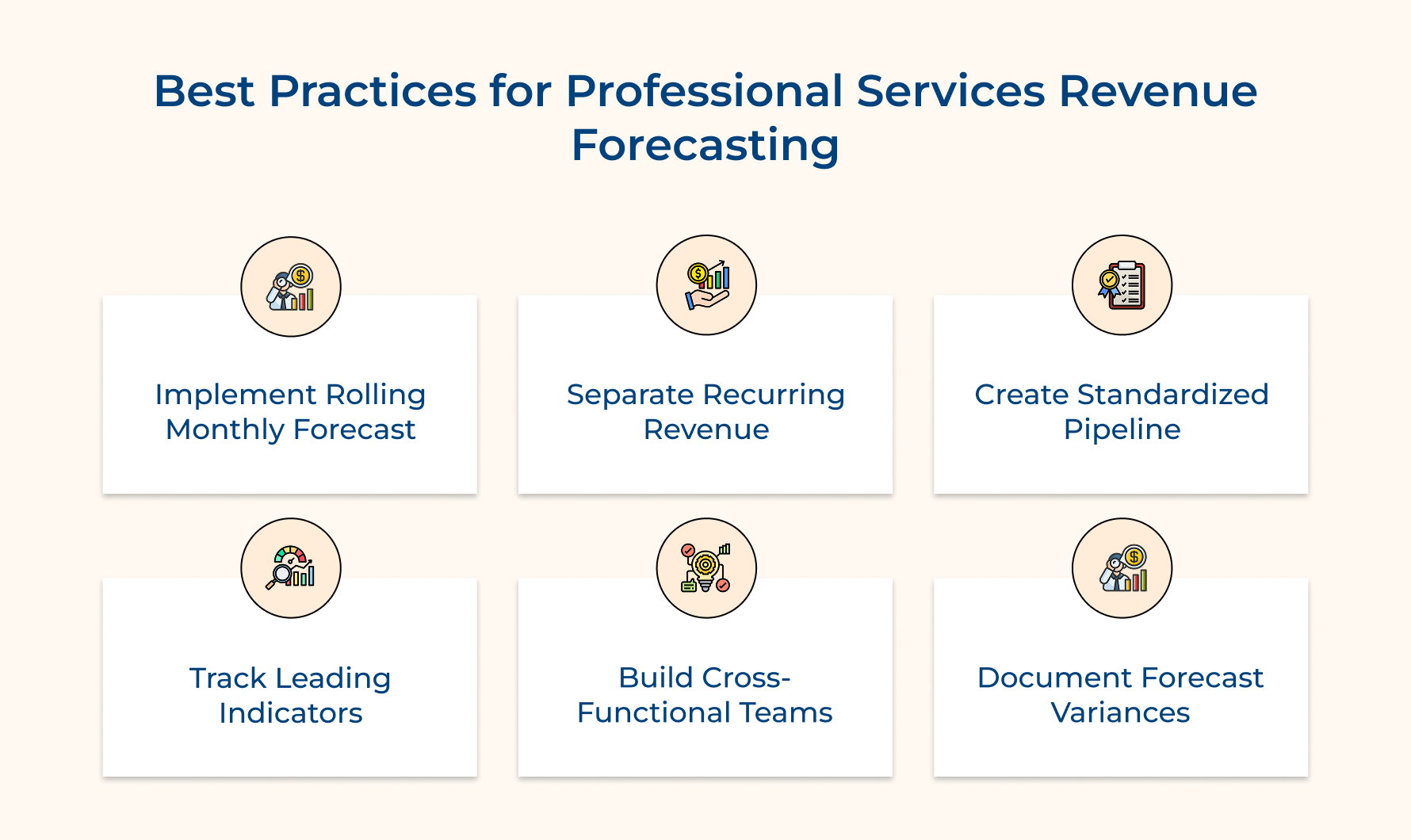
Implement Rolling Monthly Forecast Updates
Update your revenue predictions monthly like a GPS recalculating your route as traffic conditions change. This practice keeps forecasts current with new client information and prevents outdated assumptions from misleading your business planning efforts.
Separate Recurring Revenue from Project-Based Income
Track predictable client relationships separately from one-time project opportunities like distinguishing regular customers from walk-in traffic. This separation allows different forecasting approaches for stable income versus variable growth opportunities requiring distinct probability assessments.
Create Standardized Pipeline Scoring Systems
Develop consistent criteria for evaluating prospect quality using objective factors like budget confirmation and decision-maker engagement. This removes individual bias from pipeline assessments and creates reliable probability weights based on measurable criteria rather than optimistic feelings.
Track Leading Indicators Beyond Revenue Numbers
Monitor early warning signals like proposal activity and client meeting frequency to predict future revenue trends before they appear in financial statements. These indicators provide advance notice allowing proactive strategy adjustments rather than reactive responses to problems.
Build Cross-Functional Forecasting Teams
Combine insights from sales delivery and finance teams to create comprehensive revenue predictions that no single department could provide alone. Each team contributes unique perspectives about client relationships and operational capacity for more accurate forecasting outcomes.
Document Forecast Assumptions and Variances
Maintain detailed records of forecasting logic as well as track prediction accuracy to identify error patterns and refine methodology over time. This documentation provides valuable context for stakeholders while creating a foundation for continuous forecasting improvement efforts.
Transform Uncertainty Into Strategic Advantage with Professional Services Revenue Forecasting
Professional services firms operate in unpredictable environments where client needs shift rapidly and project scopes expand unexpectedly. Without systematic revenue forecasting, these businesses essentially navigate blindfolded through complex market conditions, making critical decisions based on hope rather than data-driven insights.
When consultancies implement robust professional services revenue forecasting systems, they unlock three powerful benefits that compound over time. Profitability improves through better resource allocation and pricing strategies. Operational efficiency increases by matching staff capacity with client demand. Client engagement strengthens through reliable project delivery and proactive communication about potential challenges.
Limit time — not creativity
Everything you need for customer support, marketing & sales.

Shivank Kasera is part of the marketing team at Kooper, where he focuses on building content that helps agencies and service providers grow. With a keen interest in SaaS, operations, and scalability, he translates practical insights into actionable resources for business leaders.