A Complete Guide to PMO Resource Management for Project Success
- What is a PMO?
- What is PMO Resource Management?
- 5 Reasons Why Resource Management is Important for the PMO
- Phases of the PMO Resource Management Process
- Key Differences Between PMO vs Project Resource Management
- 5 Effective PMO Resource Management Techniques
- Best Practices of PMO Resource Management
- Challenges in PMO Resource Management and How to Solve Them
- Unleash the Full Potential of Project Team with PMO Resource Management
- FAQs about PMO Resource Management

Key Highlights:
- Effective PMO resource management runs through five critical phases, from strategic planning to continuous improvement, each building on the last.
- PMOs that target 80–85% utilization rates instead of 100% absorb unexpected changes without derailing existing project commitments.
- The difference between PMO and project resource management comes down to scope, authority, timeline, etc – while confusing the two costs organizations dearly.
Your projects miss deadlines because the right people aren’t available when needed. Teams burn out while other workers sit underutilized because nobody knows their true capacity.
Poor resource management costs millions in missed opportunities and failed deliverables yearly. Project managers fight over specialists while leadership makes commitments without understanding if resources exist.
Mastering PMO resource management means implementing frameworks that give you visibility and control. This guide shows how to allocate resources strategically and keep projects on track.
What is a PMO?
A Project Management Office (PMO) is a centralized department that standardizes project management practices across an organization. It provides governance and oversight while supporting project managers with tools as well as methodologies to deliver successful outcomes.
How Does PMO Work?
The PMO establishes frameworks and templates that project teams follow throughout their work. It tracks progress across multiple projects and identifies risks before they become serious problems.
It also develops best practices by learning from past projects. The office trains team members and ensures everyone uses consistent approaches to planning along with execution.
Primary objectives:
- Standardize project management processes and methodologies across the entire organization.
- Provide strategic oversight to align projects with business goals and priorities.
- Optimize resource allocation by tracking availability and preventing team burnout.
- Monitor project performance through metrics and reporting to catch issues early.
What is PMO Resource Management?
PMO resource management is the practice of allocating and tracking people across multiple projects to maximize productivity. It ensures the right skilled individuals work on the right tasks at the right time while preventing overload and bottlenecks that derail timelines.
Effective resource management directly improves project delivery rates and team satisfaction. Organizations see fewer delays because they can spot capacity issues before they create problems.
It also reduces costs by eliminating unnecessary hiring and overtime expenses. Teams experience less burnout when workloads are balanced and leaders gain visibility into who’s available for incoming work.
5 levels that help PMOs identify and what it will take to move forward:
- Reactive resource assignment: Managers scramble to fill roles as projects start with little advance planning or visibility.
- Basic resource tracking: The PMO maintains spreadsheets showing who works on what but struggles with real-time updates.
- Centralized resource planning: A dedicated system tracks capacity and skills across the organization with structured allocation processes.
- Predictive planning: Historical data informs future resource needs and the PMO forecasts bottlenecks weeks in advance.
- AI-powered optimization: Intelligent systems automatically suggest the best resource matches based on skills and workload patterns.
5 Reasons Why Resource Management is Important for the PMO
Resource management separates high-performing PMOs from those constantly firefighting. Here’s why it matters so much for project success.
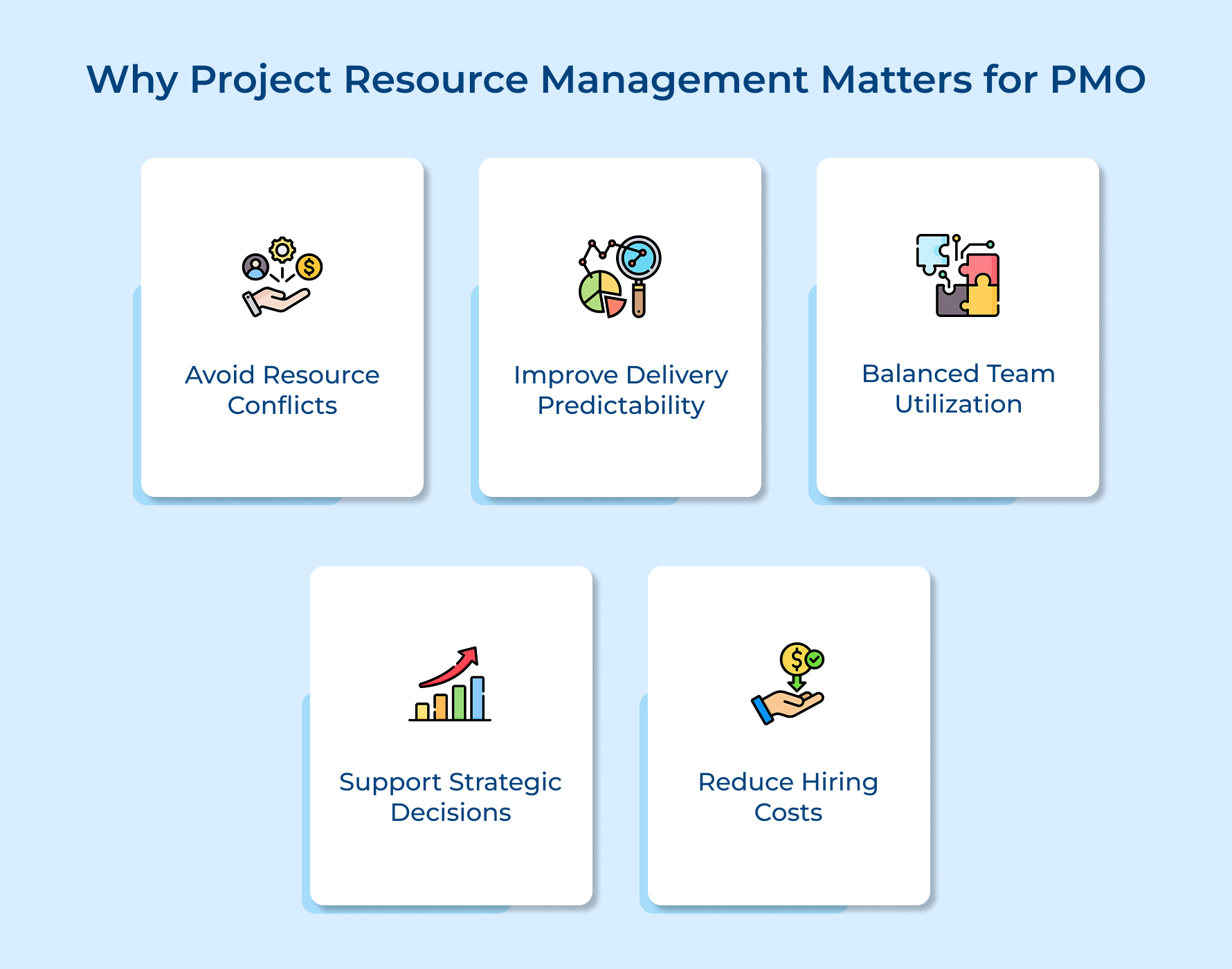
1. Prevents Resource Conflicts and Bottlenecks
Multiple projects often compete for the same people and that’s where priorities start clashing. Strong oversight highlights rising resource demand early, giving the PMO time to step in. Teams can redistribute work, reset expectations, or adjust timelines before delays spiral out of control.
2. Improves Project Delivery Predictability
Clear visibility into availability transforms how projects are planned. A well-managed resource pool allows the PMO to commit to deadlines confidently instead of guessing capacity. Promises become realistic, stakeholders stay aligned and delivery timelines hold up under pressure.
3. Maximizes Team Utilization Without Burnout
Balanced workloads drive sustainable performance. Techniques like resource leveling distribute assignments evenly so some team members aren’t overwhelmed while others remain underused. The PMO keeps productivity high and morale steady by maintaining a pace that feels challenging but manageable.
4. Enables Data-Driven Strategic Decisions
Accurate allocation data reveals which initiatives consume the most capacity and where constraints appear. Practices such as resource smoothing help adjust schedules while protecting key milestones. PMO leaders rely on these insights to prioritize high-impact initiatives that align closely with broader business goals and long-term growth plans.
5. Reduces Unnecessary Hiring And Contracting Costs
Clear capacity insights prevent reactive hiring decisions. The PMO can first reassign internal talent and assess genuine skill gaps before bringing in external support. Smarter allocation protects budgets, avoids overstaffing and ensures every hiring decision directly supports strategic needs rather than short-term pressure.
Phases of the PMO Resource Management Process
Join us as we explore these essential phases and discover how mastering them can transform your organization’s project outcome
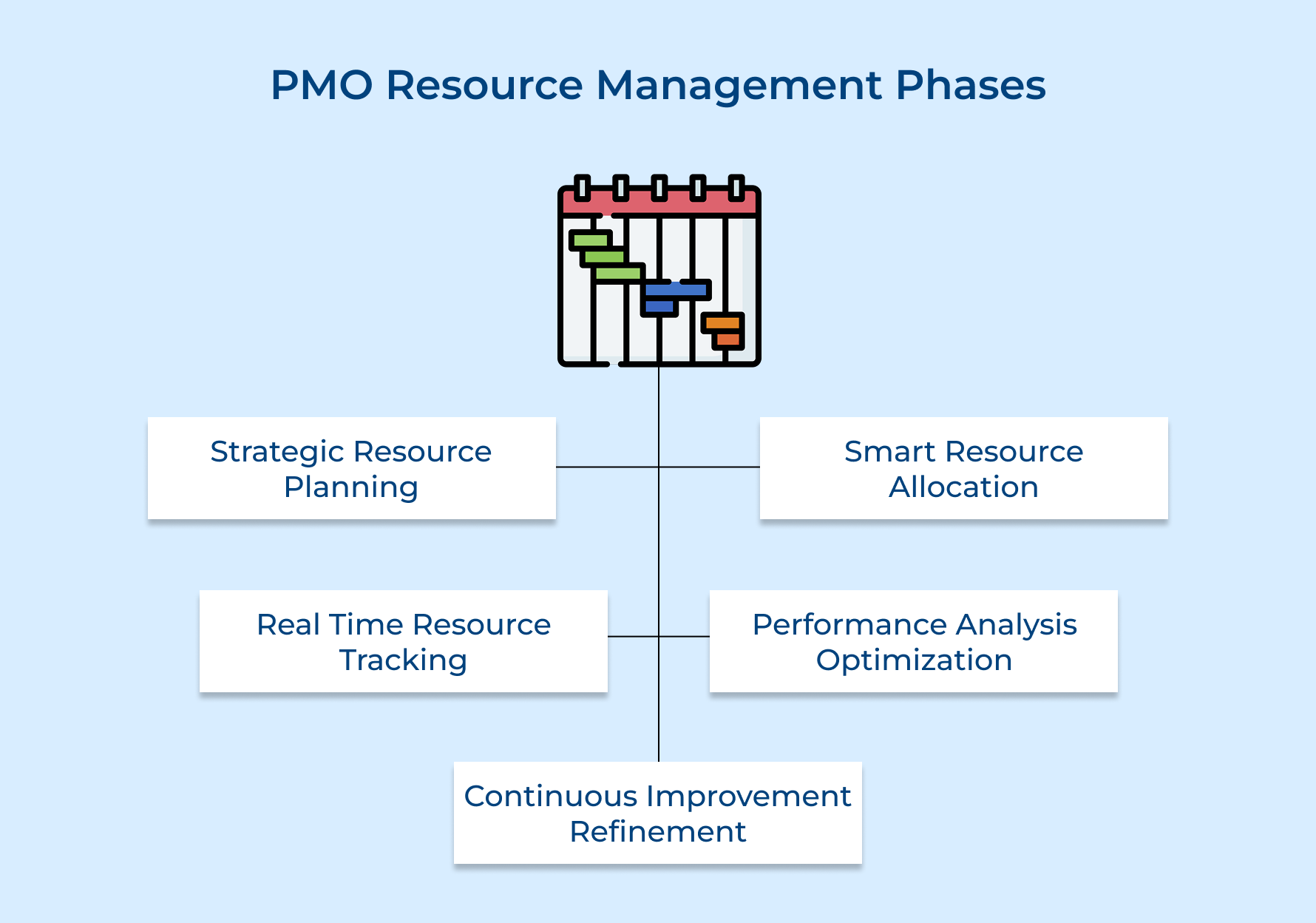
1. Strategic Resource Planning
Strategic resource planning sets the foundation for successful project delivery across the organization. It involves analyzing future project needs against current capacity to ensure the PMO can commit to initiatives without overextending teams or missing critical deadlines.
Effective strategic planning in resource management relies on several activities:
- Demand forecasting: Analyze upcoming projects and estimate the resources needed based on scope as well as complexity.
- Capacity assessment: Evaluate current team availability and identify how many hours each person can realistically contribute.
- Skills inventory: Document the capabilities and expertise of every team member to understand what talent exists.
- Gap analysis: Compare required skills against available skills to pinpoint where hiring or training is necessary.
Consider a software company planning Q2 initiatives. The PMO reviews five proposed projects requiring 80 developers total. Current capacity shows only 60 available developers. Leadership decides to delay two lower-priority projects and hire contractors for critical work.
2. Smart Resource Allocation
Smart allocation is about putting the right people on the right work based on skills and availability. Poor decisions create mismatches, where capable team members spend time on tasks that don’t use their strengths.
A simple structure keeps things smooth:
- Match skills to requirements: Review project needs and assign people whose expertise as well as past results align with the deliverables.
- Balance workloads: Spread work evenly so no one is overloaded while others sit idle. Track committed hours and adjust before capacity becomes a risk.
- Confirm availability early: Align with department heads on timelines and agree on how much time each person can realistically dedicate.
Conflicting priorities between functional teams and projects are inevitable. Clear escalation paths along with leadership involvement prevent delays.
Smart allocation also depends on resource forecasting to anticipate gaps before they disrupt delivery. Most importantly, this isn’t a one-time task. Regular check-ins with project and resource managers keep commitments realistic while ensuring alignment as priorities shift.
3. Real-Time Resource Tracking
Real-time tracking monitors how resources are actually being used compared to the plan. Without this phase, the PMO operates blind and discovers problems only when projects fail or people burn out from hidden overwork.
Key metrics for real-time resource tracking include:
- Resource utilization rate
- Planned hours versus actual hours
- Project schedule variance
- Resource availability percentage
- Task completion velocity
These metrics provide early warning signals when projects consume more resources than anticipated or when team members struggle. The PMO can intervene quickly to reallocate support or adjust timelines before small issues become major failures.
Beyond metrics, effective tracking requires several practical implementations:
- Daily timesheet updates: Require team members to log hours worked on projects to maintain accurate visibility into effort.
- Weekly capacity reviews: Hold brief check-ins with project managers to discuss resource needs for the coming week.
- Automated alerts: Set up notifications when utilization exceeds thresholds or when scheduled availability changes unexpectedly.
- Dashboard visibility: Create real-time views that show resource allocation across all active projects for quick decision-making.
4. Performance Analysis and Optimization
Performance analysis looks at how effectively resources turn effort into results and where improvements are possible. This phase converts tracking data into practical insights that help the PMO make sharper decisions and continuously refine resource management.
Measuring Utilization Rates and Overall Productivity
Utilization shows how much available time goes into project work. While high numbers seem positive, anything consistently above 85% usually signals overwork, increasing the risk of burnout and quality issues.
Analyzing Resource Efficiency Across Different Projects
Some projects consistently succeed, while others struggle with similar teams. Efficiency analysis highlights what drives better outcomes (if it’s project type, leadership style, or team structure) and uncovers areas that need adjustment.
Adjusting Allocations Based on Performance Data
Patterns such as recurring bottlenecks or overstretched skill sets call for proactive changes. The PMO reallocates resources, shifts team structures, or redistributes work to improve outcomes. Strong resource management depends on using these insights to make continuous, data-driven improvements.
5. Continuous Improvement and Refinement
Continuous improvement turns lessons from completed projects into better resource management practices for future work. This phase ensures the PMO evolves rather than repeating the same mistakes and inefficiencies across every project cycle.
The PMO implements improvement through focused activities throughout this phase:
- Post-project reviews: Conduct retrospectives with project teams to identify what worked well and what created resource challenges.
- Process documentation updates: Revise allocation procedures and planning templates based on insights gathered from recent project experiences.
- Tool evaluation: Assess if current resource management software meets organizational needs or if upgrades would improve efficiency.
- Training program development: Create learning opportunities that address skill gaps identified during strategic planning and project execution.
Why does continuous improvement matter when you’re already tracking and optimizing resources? Because organizational needs change and what worked last year might not work next quarter as the business grows.
Organizations mature their resource management capabilities through deliberate practice:
- Benchmark against industry standards: Compare your PMO’s resource management maturity to best practices and identify improvement areas.
- Implement incremental changes: Introduce small process improvements regularly rather than attempting massive overhauls that disrupt ongoing work.
- Measure improvement impact: Track whether changes actually improve outcomes like on-time delivery rates or team satisfaction scores.
A manufacturing PMO noticed projects consistently ran over budget due to estimation errors. They implemented a calibration process where estimates from the past six projects informed future planning. Within three months their budget accuracy improved by 30%.
Key Differences Between PMO vs Project Resource Management
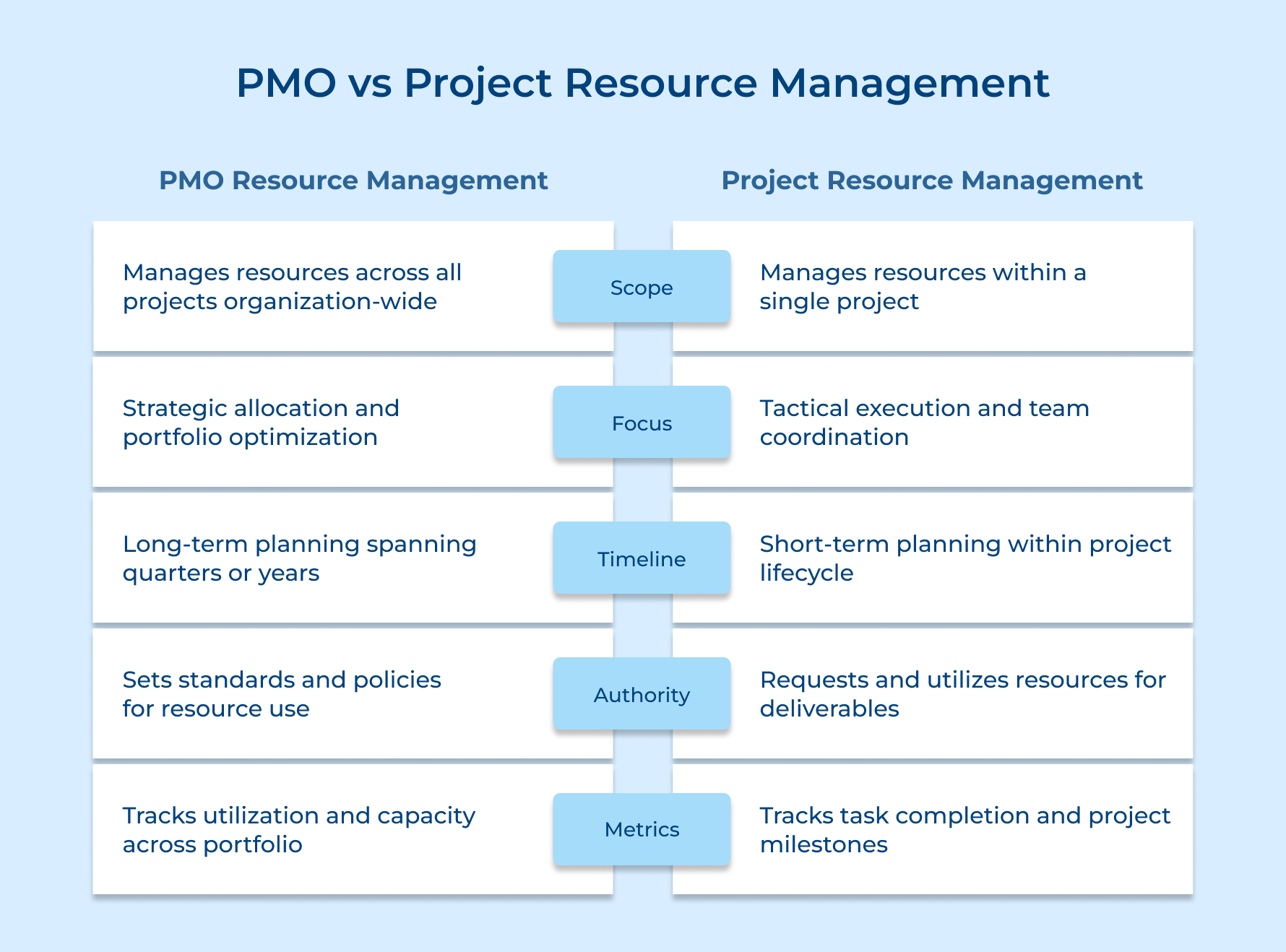
While they work together, PMO and project resource management serve distinct purposes with different scopes as well as responsibilities. Understanding these differences helps organizations structure their teams effectively.
Scope
When you zoom out and look at how organizations actually manage their people as well as projects, Project Management Offices are essentially playing chess with the entire project portfolio. They’re watching how talent moves between initiatives, making sure one high-profile project doesn’t quietly drain the skilled people that three other teams desperately need.
A project manager has one job: get their project done. They’re not losing sleep over what’s happening in the next department – their world begins and ends with their team’s availability as well as their delivery date.
Focus
This difference in scope naturally shapes how each level makes decisions. The PMO is always asking strategic questions – which projects deserve the best people right now and which ones can afford to wait?
Project managers are asking tactical ones – who’s available Thursday and can we hit this milestone by Friday? They’re coordinating their assigned team members day-to-day without necessarily factoring in what’s happening across the broader organization unless they’re pushed to.
Timeline
The time horizons are just as different. PMO planning stretches across quarters and fiscal years, giving leadership the foresight to make smart hiring calls as well as meaningful project commitments well in advance.
Project managers rarely look beyond the current phase, because priorities shift the moment a project wraps up and the team disperses.
Authority
Authority flows clearly from the top down. The PMO sets the governance frameworks and project managers play within them.
A project manager can make a strong case for the people they need, but when competing priorities surface, the final call belongs to whoever is looking at the bigger picture.
Metrics
Even the numbers tell different stories. PMO-level resource management tools generate reports on organizational health – utilization rates, capacity gaps and inefficient allocation patterns that point to systemic issues.
Project managers pull up burn-down charts and milestone trackers instead. Both sets of numbers matter enormously, but they’re answering fundamentally different questions about performance and success.
5 Effective PMO Resource Management Techniques
These approaches help balance workloads while ensuring the right skills land on the right work.
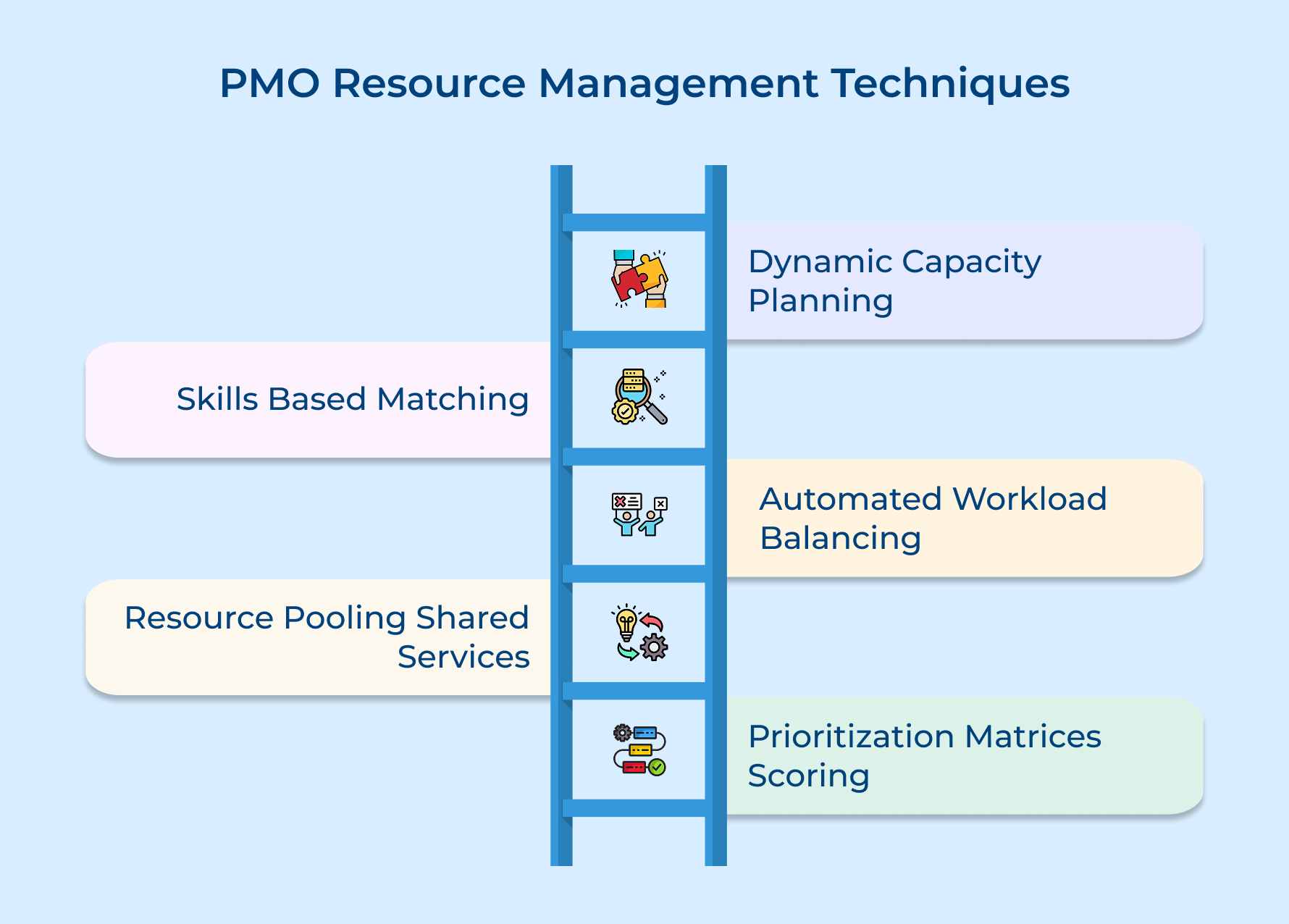
1. Dynamic Capacity Planning
This technique continuously updates resource availability based on real-time project demands rather than static quarterly forecasts. The PMO adjusts capacity models as projects accelerate or slow down to maintain accurate visibility into who’s truly available for new work.
2. Skills-Based Matching
Instead of assigning whoever seems available, this approach matches people to projects based on their documented expertise and experience. The PMO maintains detailed skill inventories and uses them to ensure assignments leverage each person’s strengths for better outcomes.
3. Automated Workload Balancing
Software tools automatically flag when team members exceed healthy capacity thresholds or sit underutilized. The PMO receives alerts to redistribute work before burnout occurs or before talent sits idle while other projects desperately need help.
4. Resource Pooling and Shared Services
The PMO creates centralized pools of specialists who rotate between projects rather than dedicating people permanently to single initiatives. This technique maximizes utilization of scarce skills like data scientists or UX designers across the entire portfolio.
5. Prioritization Matrices and Scoring
The PMO uses weighted criteria to evaluate each initiative based on its strategic value and resource requirements. This tells decision-makers which projects deserve the best people and which ones can either move forward with available capacity or wait until the right resources are in place.
Best Practices of PMO Resource Management
Successful PMOs build systematic approaches that prevent chaos and deliver consistent results. These best practices separate high-performing organizations from those constantly scrambling to meet deadlines.
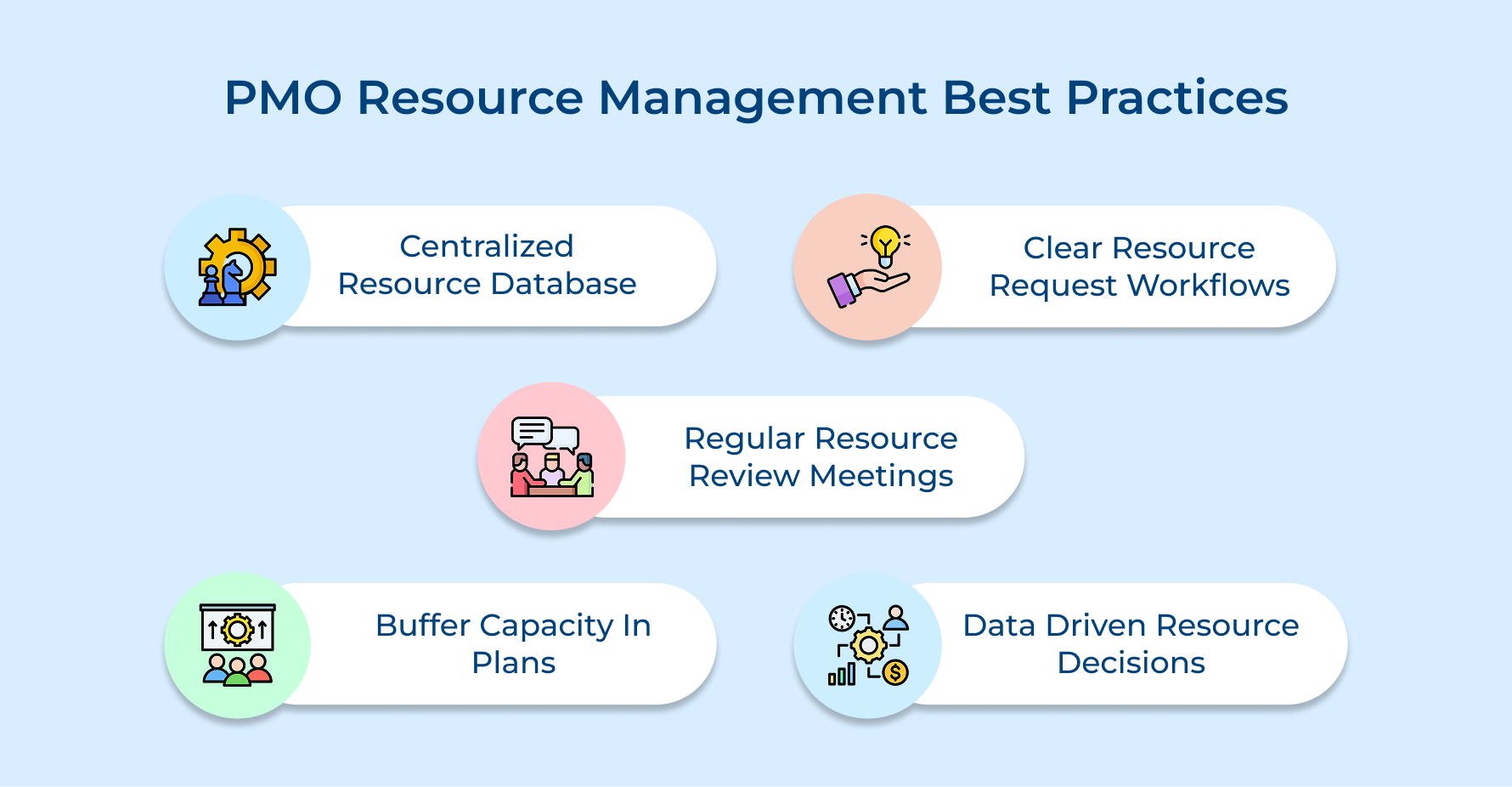
1. Maintain a centralized resource database
A single source of truth eliminates confusion about who’s available and what skills exist within the organization. The PMO updates this database regularly to reflect current capacity and ensures every stakeholder accesses the same accurate information.
Centralization saves project managers from spending hours hunting for the right people or accidentally double-booking the same specialist. Departments operate in silos and leadership makes hiring decisions based on incomplete data about existing talent.
Key elements that make a resource database effective include:
- Skill profiles: Document technical capabilities and certifications beyond just job titles
- Availability calendars: Track vacations and commitments with real-time accuracy
- Project history: Record past assignments to understand experience levels
The database becomes more valuable over time as historical data reveals patterns about resource efficiency. PMOs can identify which team compositions deliver the best results and replicate those successes across future projects.
2. Establish clear resource request and approval workflows
Standardized processes prevent project managers from bypassing the PMO and grabbing resources through informal back-channel conversations. Clear workflows ensure every request gets evaluated against organizational priorities before resources get committed to new work.
The approval process should be fast enough to avoid bottlenecks but thorough enough to catch conflicts. PMOs balance speed with due diligence by setting different approval thresholds based on resource seniority or project duration.
3. Implement regular resource review meetings
Weekly or biweekly review sessions give the PMO opportunities to spot emerging problems before they derail projects. These meetings bring together project managers and resource leads to discuss upcoming needs and resolve allocation conflicts collaboratively.
Review meetings work best when they’re short and action-oriented rather than lengthy status updates. The PMO comes prepared with data showing current utilization and capacity forecasts for the next few weeks.
Elements that make resource reviews productive include:
- Exception-based reporting: Focus discussions on overallocated people or at-risk projects
- Forward-looking planning: Review pipeline projects that will need resources in coming weeks
- Conflict resolution: Address competing demands with transparent prioritization discussions
4. Build buffer capacity into resource plans
Planning for 100% utilization leaves no room for unexpected issues that inevitably arise during project execution. Smart PMOs target 80-85% utilization rates to absorb scope changes and urgent requests without destroying existing commitments.
Buffer capacity also accounts for non-project work like training and administrative tasks that consume time. Organizations that ignore these realities end up with chronically overworked teams and projects that consistently miss deadlines.
Consider what activities consume time beyond direct project work:
- Professional development: Training sessions and skill-building activities that improve long-term capability
- Organizational responsibilities: Meetings and administrative duties that can’t be eliminated entirely
- Unplanned urgencies: Customer escalations or technical issues requiring immediate attention
Teams with built-in buffers respond to change without crisis mode because they have breathing room. The PMO can accept urgent requests or scope additions knowing the plan won’t immediately collapse under pressure.
5. Use data to drive resource decisions
Gut feelings about resource allocation often lead to poor outcomes compared to decisions grounded in historical performance data. The PMO analyzes past projects to understand how long tasks really take and which team configurations deliver the best results.
Data-driven decisions reduce arguments about resource allocation because the evidence speaks for itself. When project managers disagree about priorities, the PMO can point to objective metrics rather than playing politics.
Critical data points that inform better resource management include:
- Actual versus estimated effort: Compare how long tasks were planned to take against reality
- Productivity by team composition: Identify which skill combinations work most effectively together
- Project success rates: Link resource allocation patterns to on-time delivery and quality outcomes
Challenges in PMO Resource Management and How to Solve Them
Even well-structured PMOs face recurring obstacles that disrupt resource allocation and project delivery.
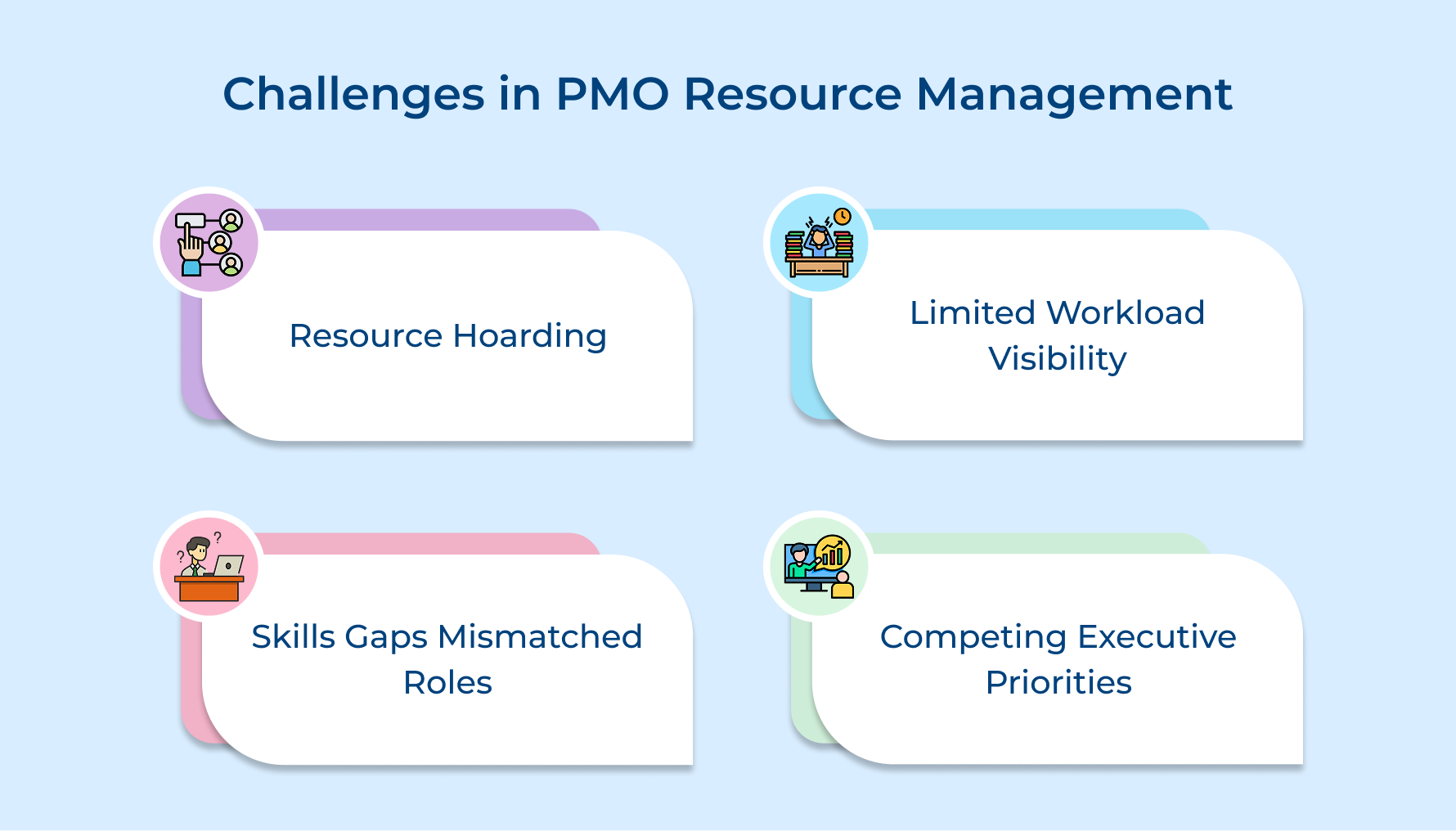
1. Resource Hoarding By Project Managers
Project managers often request more resources than actually needed or refuse to release people when their contribution ends. This hoarding creates artificial scarcity and prevents resources from moving to higher-priority work where they’re desperately needed.
2. Lack Of Visibility Into Actual Workload
The PMO sees what people are assigned to but not what they’re actually working on each day. Team members juggle invisible tasks like meetings and operational support that consume hours but don’t appear in project plans.
3. Skills Gaps And Mismatched Assignments
The PMO assigns people to projects without fully understanding their actual capabilities beyond job titles. Projects suffer when team members lack the specific expertise needed or when overqualified experts waste time on basic tasks.
4. Competing Priorities From Executive Stakeholders
Different executives pressure the PMO to prioritize their pet projects regardless of strategic value or resource availability. These competing demands create constant churn as resources get pulled between initiatives based on who yells loudest.
Addressing these challenges requires both structural changes and cultural shifts that reinforce good resource management practices:
- Implement time-bound resource assignments with automatic release dates built into the allocation system
- Require daily or weekly timesheets that capture all work including non-project activities
- Maintain detailed skills matrices that go beyond job titles to document specific technical competencies
- Establish a steering committee that ranks all projects using objective scoring criteria
Unleash the Full Potential of Project Team with PMO Resource Management
Effective PMO resource management transforms chaos into coordinated execution where the right people work on the right projects. Your teams deliver more with less stress when allocation decisions are based on data rather than guesswork.
Start implementing these practices today and watch productivity climb while burnout drops. The investment in proper resource management pays dividends through faster project delivery and happier teams who actually finish what they start.
Limit time — not creativity
Everything you need for customer support, marketing & sales.

Neeti Singh is a passionate content writer at Kooper, where he transforms complex concepts into clear, engaging and actionable content. With a keen eye for detail and a love for technology, Tushar Joshi crafts blog posts, guides and articles that help readers navigate the fast-evolving world of software solutions.